Hubbry Logo
Merchant raiderMerchant raiderMain
Open search
Merchant raider
Community hub
Merchant raider
logo
8 pages, 0 posts
0 subscribers
Be the first to start a discussion here.
Merchant raider
Merchant raider
from Wikipedia
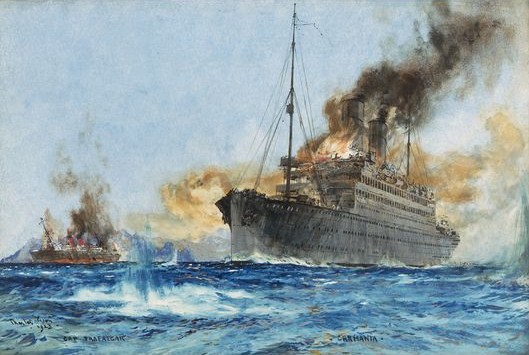
RMS Carmania sinking SMS Cap Trafalgar near the Brazilian islands of Trindade, 14 September 1914

Merchant raiders are armed commerce raiding ships that disguise themselves as non-combatant merchant vessels.

History

[edit]

Germany used several merchant raiders early in World War I (1914–1918), and again early in World War II (1939–1945). The captain of a German merchant raider, Felix von Luckner, used the sailing ship SMS Seeadler for his voyage (1916–1917). The Germans used a sailing ship at this stage of the war because coal-fired ships had limited access to fuel outside of territories held by the Central Powers due to international regulations concerning refueling of combat ships in neutral countries.[1]

Germany sent out two waves of six surface raiders each during World War II. Most of these vessels were in the 8,000–10,000 long tons (8,100–10,200 t) range. Many of these vessels had originally been refrigerator ships, used to transport fresh food from the tropics. These vessels were faster than regular merchant vessels, which was important for a warship. They were armed with six to seven 15 cm (5.9 inch) naval guns, some smaller guns, torpedoes, reconnaissance seaplanes and some were equipped for minelaying. Several captains demonstrated great creativity in disguising their vessels to masquerade as allied or as neutral merchants.

The Kormoran fought the Australian light cruiser Sydney in a mutually destructive battle in November 1941.

Italy intended to outfit four refrigerated banana boats as merchant raiders during World War II (Ramb I, Ramb II, Ramb III and Ramb IV). Only Ramb I and Ramb II served as merchant raiders and neither ship sank enemy vessels due to naval presence in the Red Sea. The New Zealand cruiser Leander sank Ramb I off the Maldives (February 1941) while it tried to make for Japan; Ramb II did reach the Far East, where the Japanese prevented her from raiding, ultimately took her over and converted her to an auxiliary transport ship. (Ramb III served as a convoy escort until torpedoed and ended up as a German minelayer, and Ramb IV was converted for the Italian Royal Navy to a hospital ship.)

These commerce raiders carried no armour because their purpose was to attack merchantmen, not to engage warships—it would also be difficult to fit armour to a civilian vessel. Eventually most were sunk or transferred to other duties.

The British deployed Armed Merchant Cruisers (AMC) in World War I and in World War II. Generally adapted from passenger liners, they were larger than the German merchant raiders, were used as convoy escorts and did not disguise themselves. The British AMC Carmania sank the German SMS Cap Trafalgar which had been altered to look more like the Carmania.

During World War I, the British Royal Navy deployed Q-ships to combat German U-boats. Q-ships were warships posing as merchant ships so as to lure U-boats to attack them; their mission of destroying enemy warships differed significantly from the raider objective of disrupting enemy trade.

See also

[edit]

References

[edit]
[edit]
Revisions and contributorsEdit on WikipediaRead on Wikipedia
from Grokipedia
A merchant raider, also known as a disguised auxiliary or raider, is a converted commercial vessel armed with naval weaponry and disguised to appear as a neutral or enemy , enabling it to conduct surprise attacks on enemy shipping during wartime. These ships typically feature hidden guns, torpedoes, and sometimes or mines, allowing them to blend into global trade routes and evade detection by superior enemy navies. Employed primarily by lesser naval powers lacking a strong battle fleet, merchant raiders serve as a cost-effective tool for warfare, disrupting supply lines, sinking or capturing vessels, and forcing adversaries to divert resources to protection. The concept gained prominence during the early 20th century, particularly in the world wars, where utilized merchant raiders as part of its Handelskrieg (trade war) strategy against Allied shipping. In , raiders such as SMS Wolf, SMS Möwe, and SMS Seeadler conducted extended patrols, collectively sinking or capturing 78 merchant ships totaling 323,644 gross tons over voyages lasting up to 451 days. The Wolf, for instance, operated as a mine-layer and gun-armed freighter, sinking 14 vessels with artillery and 13 more via deployed mines while capturing 467 prisoners, all without being detected by Allied forces. These operations not only inflicted material losses but also sowed fear among merchant mariners, compelling the Allies to reorganize global trade routes. During , Nazi Germany's expanded the tactic with greater sophistication, deploying nine principal raiders—including Schiff 16 (Atlantis), Kormoran, and Pinguin—that undertook 11 cruises lasting from five to 21 months, sinking or capturing 129 ships amounting to 800,661 gross tons. Supported by disguised supply ships and access to neutral ports, these vessels operated across vast oceans, from the Atlantic to the and Pacific, often altering their appearance with false funnels, masts, and paint schemes to impersonate ships from countries like or the . The Atlantis, for example, completed a record 622-day cruise in 1940–1941, accounting for 22 ships (145,364 tons) through and resupplying other raiders, though it was ultimately scuttled after detection by a British . Notable engagements included the Kormoran's mutual destruction with the Australian cruiser HMAS Sydney in 1941, highlighting the raiders' potential to challenge even warships. Merchant raiders proved highly effective in asymmetric warfare, outperforming conventional surface raiders by exploiting the element of surprise and the sheer volume of global merchant traffic, though their success waned as Allied intelligence, radar, and convoy systems improved. Encounters with armed Allied merchant ships, such as the U.S. Liberty ship Stephen Hopkins in 1942—which sank one raider after a fierce gun battle—demonstrated the risks involved, with six U.S. vessels lost to raiders carrying Naval Armed Guards. While the tactic has historical roots in earlier conflicts like the American Civil War, its peak application in the world wars underscores its role in extending naval reach without direct fleet engagements. In contemporary contexts, advancements in missiles, drones, and containerized armaments have prompted discussions of revived merchant raider strategies among modern powers with large commercial fleets.

Definition and Characteristics

Definition

A merchant raider is an armed commerce-raiding ship disguised as a neutral or merchant vessel to evade detection and surprise enemy shipping. These vessels, often converted from fast freighters or passenger liners, rely on deception rather than overt military appearance to approach targets undetected. The primary purpose of a merchant raider is to disrupt enemy trade routes by sinking or capturing , thereby strangling without directly engaging warships. This approach targets the economic lifeline of an adversary, forcing the allocation of naval resources to protection and patrols rather than fleet actions. As part of the broader strategy of , merchant raiders prioritize surprise attacks on isolated vessels to maximize impact on global supply chains. Merchant raiders emerged as a cost-effective alternative to traditional cruisers in asymmetric , particularly for nations lacking a dominant . They emphasize speed, extended range, and subterfuge over heavy firepower or defensive armor, enabling prolonged independent operations in distant oceans. This concept proved viable in major conflicts of the , where limited naval resources necessitated innovative, low-profile tactics to challenge superior maritime powers. Key attributes of merchant raiders include a typical displacement of 9,000 to 19,000 tons, allowing for substantial fuel and supply capacity without compromising merchant-like profiles. They are lightly armed, usually with six 150 mm (5.9-inch) guns concealed behind false bulkheads or pivoting panels, supplemented by anti-aircraft weapons, torpedo tubes, and sometimes mines, but lacking any significant armor plating to maintain speed of 13 to 18 knots. Auxiliary features such as one or two seaplanes for reconnaissance extend their operational reach, enabling the detection of targets over vast areas while the ship remains hidden among commercial traffic.

Design Features

Merchant raiders were typically converted from existing merchant vessels, featuring reinforced hulls to support heavy armament while maintaining a civilian appearance. These ships often had dimensions around 150-165 in length and 18-20 in beam, with displacements ranging from 8,000 to 20,000 tons. systems, usually diesel or diesel-electric, provided speeds of 15-18 knots for evasion and pursuit, with fuel capacities enabling ranges up to 50,000 nautical miles or nearly a year of operation at economic speeds of 10 knots. Armament was concealed to preserve the disguise, with primary batteries consisting of 5-8 quick-firing 15 cm (5.9-inch) guns mounted on pivoting platforms that could be deployed rapidly from hidden positions behind folding panels or screens. Secondary weapons included anti-aircraft guns such as 37 mm and 20 mm pieces, along with 2-6 tubes—both deck-mounted and submerged—for engaging larger targets. Many raiders also carried up to 300-360 contact mines for laying in shipping lanes, emphasizing surprise over sustained combat. Auxiliary equipment enhanced reconnaissance and operational flexibility, including catapults for launching 1-2 floatplanes like the , which scouted for targets up to 200 nautical miles away. Crew sizes were kept minimal at 200-350 to mimic merchant staffing, with provisions for prize crews to operate captured vessels. Additional features included small motor launches for mine-laying or delivery, and modified holds for storing , , and provisions. Disguise mechanisms were integral to the design, incorporating false superstructures, adjustable funnels, and changeable schemes in neutral colors like gray or brown to imitate harmless traders from countries such as the or . Hinged steel ports hid guns, while flags and deck clutter could be altered quickly to match various identities, avoiding the addition of obvious military features like masts. This lack of armor plating preserved speed and silhouette but left the ships vulnerable. Vulnerabilities stemmed from their merchant origins, including thin hull plating that offered no protection against cruiser gunfire or torpedoes, making them unsuitable for fleet engagements. Reliance on surprise and supply ships for extended operations exposed them to detection, while the absence of advanced radar—depending instead on visual and aerial scouting—limited effectiveness in poor visibility. Engine maintenance issues, such as bearing wear, further constrained endurance.

Historical Development

Origins in Earlier Conflicts

The concept of merchant raiders traces its roots to the privateering practices of the 18th and 19th centuries, where armed merchant vessels were commissioned to disrupt enemy commerce under letters of marque. During the (1775–1783), approximately 800 American privateers, often converted merchant ships ranging from schooners to larger brigs, captured or destroyed around 600 British vessels, inflicting an estimated $18 million in damages (equivalent to over $300 million today). These operations relied on the dual role of merchant ships as both traders and raiders, allowing them to approach unsuspecting targets under neutral or false flags before revealing their armament. Similarly, in the (1799–1815), French and allied privateers conducted widespread commerce raiding against British shipping, using fast-sailing merchantmen disguised as neutral traders to evade patrols and seize cargoes in the and beyond. A pivotal 19th-century example emerged during the (1861–1865), with Confederate commerce raiders like the exemplifying the disguised merchant raider model. Built in British shipyards as the Enrica to circumvent neutrality laws, the Alabama was a steam-powered screw disguised as a merchant vessel during construction and initial voyage; once at sea, it operated as a raider under Captain , capturing or sinking 65 Union merchant ships and one warship over 22 months across the Atlantic, Indian, and Pacific Oceans. This success highlighted the effectiveness of blending civilian appearance with military capability, forcing the Union to divert resources to protect its merchant fleet and leading to international arbitration claims against Britain. The late 19th-century transition from sail to steam propulsion fundamentally enabled more effective disguised raiding operations by providing reliable power independent of wind, allowing ships to maintain higher speeds, extend operational ranges, and execute rapid engagements or escapes. Early steam warships, such as those introduced in the 1860s and 1870s, retained auxiliary sails for economy but used engines for combat bursts, as seen in Confederate raiders like the Alabama, which combined sail for long cruises with steam for pursuits. By the 1890s, this hybrid technology supported global operations without frequent coaling stops initially limiting range, setting the stage for modern raiders in imperial navies. Doctrinal foundations for merchant raiding were shaped by U.S. naval theorist , whose 1890 work The Influence of Sea Power upon History emphasized the strategic importance of controlling maritime commerce to national power, arguing that destroying an enemy's trade could cripple its economy and force capitulation without decisive fleet battles. advocated concentrated naval forces to protect one's own shipping while enabling raiding to disrupt rivals, influencing imperial doctrines in Britain, , and by promoting battleship fleets supplemented by cruisers for commerce warfare. His ideas underscored that derived from merchant marine strength, merchant shipping volume, and naval capacity to safeguard or attack trade routes. In the early , amid the (1898–1912), the German Imperial Navy developed plans for merchant raiders as a asymmetric counter to Britain's superior battle fleet and potential blockade. Recognizing their inability to match the Royal Navy's , German strategists under Admiral envisioned fast armored cruisers and disguised merchantmen for worldwide to draw British forces from home waters and disrupt global trade. This planning, detailed in pre-war fleet exercises and cruiser deployments, aimed to exploit coal stations abroad for sustained operations, viewing raiders as a force multiplier against Britain's commerce-dependent empire.

World War I Era

During , initiated the Hilfskreuzer program, converting several civilian liners and cargo vessels into auxiliary cruisers to conduct against Allied shipping. Between 1914 and 1918, approximately 10 such liners were adapted, with five becoming active raiders, including notable examples like SMS Möwe and SMS Wolf. These ships were equipped with concealed armament to masquerade as neutral merchant vessels, allowing them to approach unsuspecting targets in distant waters. The program aimed to disrupt Allied supply lines across global oceans, compensating for 's limited surface fleet capabilities following the Royal Navy's . Key operations highlighted the raiders' effectiveness in the early war years. SMS Wolf, under Commander Fritz Krüder, departed in November 1916 and conducted an extended 451-day patrol across the Atlantic, Indian, and Pacific Oceans without resupply from home bases, laying mines that sank additional ships and capturing prizes for coal and provisions; she sank or captured 37 vessels totaling around 120,000 gross tons, including the use of a for , all while evading Allied forces until her return in February 1918. Similarly, SMS Möwe, commanded by Nikolaus Dohna-Schlodien, undertook two daring Atlantic crossings, departing in December 1915 and November 1916 despite the ; she captured 40 prizes totaling over 182,000 gross tons during these sorties, often resupplying with coal from captured vessels. These actions exemplified the raiders' ability to evade patrols and strike far from home bases. The strategic impact of the Hilfskreuzer was significant but ultimately constrained, as they sank or captured approximately 103 vessels totaling 358,000 gross tons of Allied shipping, forcing the Allies to divert resources for protection. However, intensified Allied hunting patrols, combined with the raiders' operational vulnerabilities, limited their longevity; most were scuttled, interned, or sunk by , with only a few like SMS Wolf operating into 1918. Challenges included chronic fuel shortages, which necessitated capturing from prizes or risking low bunkers during long voyages, as well as through Allied minefields and reliance on neutral ports—such as those in the United States or —for prisoner exchanges and limited resupply without violating neutrality laws. Allied intelligence further hampered operations by alerting convoys to raider sightings. In response, Britain deployed pre-war cruisers for patrols and escorts, exemplified by HMS Cumberland of the Monmouth class, which operated off and captured 10 German merchant ships near Duala in September 1914, before shifting to North Atlantic patrols from 1916 to 1918, including trans-Atlantic convoy duties to counter raider threats and protect vital trade routes. Britain also converted merchant vessels into armed merchant cruisers (AMCs) for similar roles, marking the beginning of broader Allied countermeasures emphasizing widespread ocean surveillance to neutralize the dispersed German threat.

Operations in World War II

German Merchant Raiders

The German merchant raider program during was organized into two primary waves of operations. The first wave, launched between 1940 and 1941, consisted of six raiders, including and Pinguin, which were converted merchant vessels equipped with concealed armaments and designed for long-range commerce disruption. These ships departed German ports under disguise, often posing as neutral or Allied merchantmen, to evade detection while targeting enemy shipping lanes. The second wave, conducted from 1942 to 1943, involved four raiders, such as Michel, which attempted to continue the campaign amid increasing Allied countermeasures, though on a reduced scale due to heightened risks. Overall, the raiders achieved significant results, sinking 136 Allied merchant and auxiliary vessels totaling approximately 850,000 gross tons and capturing 16 prizes for further use or . , under the command of Kapitän zur See —a seasoned surface repurposed for independent operations—exemplified the program's success, accounting for 145,000 tons of shipping over 622 days at sea. Operations focused on remote routes in the Indian, Pacific, and Southern , where raiders like Pinguin exploited vast distances to isolated convoys and independents, often refueling from supply ships to extend their reach. The program's demise came swiftly as Allied forces improved detection capabilities. Most raiders were hunted down and sunk; for instance, Pinguin was destroyed by the British heavy cruiser HMS Cornwall on 8 May 1941 in the , resulting in over 500 German and prisoner casualties. By 1943, the initiative was effectively halted, undermined by Allied air superiority, advanced systems, and coordinated patrols that made long-range sorties untenable. This effort nonetheless imposed substantial economic pressure, compelling the Allies to divert naval resources to anti-raider patrols and escorts, thereby straining global supply lines.

Italian and Other Axis Efforts

Italy's merchant raider program during was modest compared to Germany's, focusing on the conversion of four Ramb-class refrigerated cargo ships—originally built for banana transport from —into auxiliary cruisers between 1937 and 1941. These vessels, including Ramb I, Ramb II, Ramb III, and Ramb IV, were equipped with light armament such as 120 mm guns, anti-aircraft batteries, and torpedoes to enable while maintaining a neutral merchant appearance. However, only Ramb I and Ramb II became operational as raiders, with the others primarily serving in escort or hospital roles due to operational constraints. Ramb I, converted in 1940, departed in the in February 1941 as part of an Italian breakout attempt amid the East Africa Campaign, aiming to conduct raids on Allied shipping in the . Disguised as a neutral merchant, she attempted an ambush but was intercepted by the light cruiser HMNZS Leander on 27 February 1941 west of the . After a brief engagement in which Ramb I revealed her armament and fired ineffectively, Leander sank her with gunfire, resulting in approximately 27 Italian casualties and the rescue of 113 survivors (one of whom died later from wounds); Ramb I had not sunk any Allied vessels during her short sortie. Similarly, Ramb II escaped in early 1941, transited through Japanese-controlled waters after internment in Batavia, and reached , , where she conducted limited raiding attempts in the Pacific before her crew scuttled her following Italy's in September 1943. Refloated by the Japanese, she served briefly as an auxiliary transport but achieved no notable successes. Other pursued limited merchant raider efforts, constrained by resource shortages and strategic priorities. employed auxiliary cruisers such as Aikoku Maru and Hōkoku Maru—disguised merchant vessels of the 24th Special Squadron—for in the Indian and Pacific Oceans starting in 1942, sinking several Allied ships before both were lost to enemy action. However, Japanese disguised , like the aircraft-carrying I-400 class, focused on rather than true merchant raiding, lacking the surface disguise and endurance for sustained commerce disruption. French attempts were even more restricted, with auxiliary cruisers such as Quercy and Vénus mobilized for convoy protection in colonial waters but conducting no significant raiding due to fuel limitations and neutrality pressures under the 1940 armistice. Other Italian auxiliary cruisers, such as Attilio Deffenu, achieved isolated successes like sinking a single merchant vessel, but overall contributions were minimal. Strategically, these Italian and other Axis raider initiatives aimed to divert Allied naval resources and support wolfpacks in the Mediterranean and Atlantic by threatening distant trade routes. Yet, severe fuel shortages, Allied air and surface superiority, and logistical isolation—particularly after the fall of in 1941—severely hampered operations. The programs yielded minimal impact, far short of expectations, leading to their abandonment by in favor of defensive duties.

Tactics and Strategies

Disguise and Engagement Methods

Merchant raiders employed elaborate deception tactics to approach unsuspecting targets, primarily by disguising themselves as neutral or allied merchant vessels from countries such as , the , or . These disguises involved frequent changes to the ship's appearance, including alterable smokestacks, telescoping masts, and removable panels that concealed armaments and other military features, allowing rapid identity shifts while at sea. Crews would hoist false flags—such as those of neutral nations—under the legal principle of , only striking them at the moment of attack to maintain the illusion of harmless commerce. The engagement sequence typically began with reconnaissance using catapult-launched seaplanes to locate isolated , followed by a deceptive approach where the raider shadowed the target for hours or days, posing as a friendly or neutral vessel to close within . Armaments, including hidden 5.9-inch guns and torpedoes, were revealed only at close quarters—often under 3,000 yards—to prevent escape and ensure surprise, with grapnels sometimes deployed to sever the target's radio aerials and block distress calls. Preference was given to capturing intact for gathering and interrogation rather than immediate sinking, deploying boarding parties via small boats to inspect cargoes, seize documents, and transfer prisoners or prize crews to operate captured vessels. Combat doctrine emphasized hit-and-run operations, leveraging the raider's superior speed—up to 18 knots—and favorable weather conditions to evade pursuit, while strictly avoiding confrontations with warships in favor of unarmed targets traveling alone or outside convoys. features like pivoting gun turrets hidden behind false bulkheads enabled this sudden revelation of firepower without prior detection. Smoke generators provided additional cover during retreats, obscuring the raider's movements after an attack. Psychological elements were integral, with crews undergoing specialized training to impersonate civilian sailors, including scripted radio communications and behaviors that exploited wartime confusion, particularly in neutral waters where identification was challenging. This acting fostered a sense of security in targets, amplifying the shock of the sudden assault and contributing to the raiders' aura of unpredictability. These methods proved highly effective in surprise engagements, with German merchant raiders sinking or capturing 129 Allied ships totaling 800,661 gross tons during , though failures occurred when disguises were penetrated, such as through radio direction-finding that enabled Allied warships to intercept and destroy vessels like the .

Logistics and Support

Merchant raiders were designed for prolonged independent operations, typically carrying pre-loaded supplies sufficient for 12 to 18 months at sea, including fuel, provisions, ammunition, and spare parts to enable extended patrols across vast ocean areas without reliance on home ports. These vessels supplemented their onboard stocks by capturing coal, oil, and other resources from prizes, such as the German auxiliary cruiser Atlantis obtaining 4,000 tons of diesel oil from the tanker Ketty Brøvig on 12 February 1941 and 110,000 barrels of aviation gasoline from the Ole Jacob in 1940, which extended its endurance to over 622 days and 144,000 nautical miles. Logistical sustainment relied on a network of secret bases and auxiliary supply ships to facilitate refueling and repairs in remote locations. German raiders utilized hidden anchorages like Gazelle Bay in the for overhauls, where Atlantis conducted maintenance from December 1940 to January 1941, and supply ships such as the Altmark, which provided diesel oil, food, and ammunition to the Graf Spee during its 1939 South Atlantic cruise before being intercepted in Norwegian waters in February 1940. Japanese efforts similarly employed atolls in their Mandated Islands, including Jaluit and Kwajalein, as forward bases for resupplying commerce raiders like those of the 24th , enabling operations in the from 1942 onward. Intelligence support was critical for targeting shipping, with raiders employing radio intercept services to monitor enemy transmissions and codebooks derived from captured vessels to decode routing information. Strict radio protocols minimized detection, limiting transmissions to emergency signals like the German RRRR distress code or pre-arranged coded rendezvous points, such as "Point Mangrove" used by to coordinate with supply ships. Crew management emphasized self-sufficiency during long deployments, with rotations occasionally arranged via captured prizes or submarines to relieve fatigue among the typical 300–350 personnel. Onboard medical and repair facilities allowed for independent handling of injuries, illnesses, and maintenance, as demonstrated by Atlantis's capacity to manage health issues and equipment repairs over its 21-month voyage without external aid. A key vulnerability stemmed from dependence on auxiliary vessels for resupply, which exposed raiders to interception when communication lines were compromised; for instance, Atlantis was sunk by HMS Devonshire on 22 November 1941 after being spotted by the cruiser's aircraft while refueling submarine U-126.

Countermeasures and Responses

Allied Detection and Interception

The decryption of German Enigma codes by Allied codebreakers at Bletchley Park provided valuable intelligence on German naval operations starting in 1941, including some support against surface raiders through cross-referenced radio intercepts, though primary detection of merchant raiders relied on other methods. This breakthrough, known as Ultra intelligence, allowed British and American naval authorities to monitor surface fleet movements, including those of disguised raiders, by cross-referencing decrypted messages with radio intercepts. Complementing this were merchant ship reporting networks, where Allied vessels were instructed to transmit position reports and distress signals—such as the "QQQ" code—upon sighting suspicious ships, helping to alert naval commands to potential raider activity in remote ocean sectors. Technological advancements played a pivotal role in detection efforts. The introduction of radar in the early 1940s equipped Allied warships and with the ability to identify surface contacts beyond visual range, particularly in poor weather conditions common to the Atlantic and Indian Oceans. (HF/DF), or "Huff-Duff," systems enabled precise of raider radio transmissions, allowing Allied listening stations and ships to locate disguised vessels when they broke to communicate with supply ships or home base. Aerial patrols from aircraft carriers and shore bases further enhanced surveillance, with reconnaissance planes scanning vast ocean areas for anomalies in shipping patterns or visual sightings of raiders attempting to masquerade as neutral merchantmen. Allied naval forces organized dedicated hunting groups to intercept suspected raiders. In the Atlantic, British , operating from , conducted sweeps with cruisers and destroyers to cover key shipping lanes, while auxiliary merchant cruisers (AMCs) and destroyers were deployed in the Indian and Pacific Oceans for similar patrols. These operations relied on coordinated to position forces effectively, often diverting assets from escorts to pursue leads from Ultra or radio fixes. Notable successes underscored the effectiveness of these methods. On 8 May 1941, the German raider Pinguin was sighted by a Supermarine Walrus seaplane from HMS Cornwall in the ; the ensuing engagement led to Pinguin's sinking with heavy loss of life, marking a major blow to the raider fleet. Similarly, the recapture of the supply tanker Ketty Brovig on 22 November 1941 by HMS Dorsetshire provided interrogable German prize crew members, whose disclosures pinpointed the position of the raider , forcing its crew to scuttle the vessel later that day upon sighting HMS Devonshire. The scale of these countermeasures was immense, with over 100 Allied warships—including cruisers, destroyers, and AMCs—diverted from other theaters to hunt the handful of German raiders active between 1940 and 1942, straining resources but ultimately neutralizing the threat by mid-1942 as the last raiders were eliminated or recalled. This resource commitment, while costly in terms of operational tempo elsewhere, prevented further disruptions to global Allied supply lines.

Evolution of Defensive Tactics

During , Allied defenses against commerce raiders primarily relied on armed guards aboard vessels and naval patrols to protect shipping lanes, though these measures proved insufficient against elusive surface predators like the German raiders Möwe and , which together sank or captured shipping totaling approximately 240,000 gross tons. As losses mounted, the Royal Navy introduced Q-ships—merchant vessels disguised as unarmed traders but armed with concealed guns—to lure and destroy attackers by feigning , a tactic that accounted for approximately 11 or 12 sinkings, according to British and German records respectively, and was conceptually adaptable to surface raiders by encouraging close approaches for ambush. This shift marked an early evolution from passive protection to deceptive countermeasures, influencing interwar naval thinking on at sea. In , the Allies rapidly expanded the system starting in , grouping merchant ships into protected formations to minimize isolated targets vulnerable to German auxiliary cruisers like and Pinguin, which initially exploited scattered traffic to sink dozens of vessels in the war's opening months. This doctrine, refined through operational experience, reduced opportunities for raiders by concentrating defenses and forcing attackers to risk detection against grouped escorts, with over 90% of transatlantic shipping eventually convoyed by 1941. International cooperation bolstered these efforts via Allied naval conferences, such as the 1941-1942 Arcadia meetings in Washington, where British and American leaders established the to coordinate routing, resource allocation, and intelligence sharing across oceans, ensuring unified protection for global trade routes. Escort innovations further strengthened defenses, with the mass production of corvettes—compact, maneuverable vessels like the Flower-class—and sloops, such as the Black Swan-class, providing layered ocean protection beyond coastal waters; these ships, initially designed for anti-submarine duties, integrated into raider-hunting groups to screen s with depth charges, guns, and , deterring surface attacks through persistent presence. By combining these with larger escorts like cruisers for open-ocean patrols, the Allies created a multi-tiered screen that compelled raiders to evade rather than engage, as seen in the interception of Thor in 1940 after it encountered reinforced convoy guards. Following the U.S. entry into the war in , emphasis shifted to air cover over key trade routes, with long-range aircraft from bases in , Newfoundland, and later extending patrol radii to spot and harass raiders before they could close on convoys, effectively closing the mid-Atlantic "air gap" that had previously shielded surface predators. These lessons in integrated air-naval defense influenced doctrines, emphasizing joint operations and technological fusion to counter asymmetric threats to maritime commerce. The effectiveness of these evolving tactics was evident in the sharp decline of raider successes: German auxiliary cruisers sank or captured 129 ships totaling 800,661 gross tons of Allied shipping from 1940 to 1944, peaking in 1940–1941 with operations by vessels like Orion and Kormoran, but layered defenses reduced sinkings to near zero by late 1943 following the loss of the last raider, Michel, sunk by the U.S. USS in October 1943. This progression from reactive patrols to proactive, multinational systems not only neutralized the surface raider threat but preserved vital supply lines essential to Allied victory.

Notable Examples and Outcomes

Key Engagements

One of the earliest significant engagements involving a merchant raider occurred on 9 November 1914, when the German light cruiser SMS Emden, operating as a commerce raider in the Indian Ocean, attempted to destroy the cable and wireless station on Direction Island in the Cocos (Keeling) Islands. The Emden had already sunk or captured several Allied merchant vessels earlier in its cruise, contributing to initial German successes in disrupting Allied shipping lanes. However, a distress signal from the islands alerted the nearby Australian light cruiser HMAS Sydney, which was escorting a troop convoy and detached to investigate. At approximately 9:40 a.m., the Emden opened fire from 9,500 yards, but the Sydney's superior gunnery range quickly disabled the raider's funnels and masts, forcing it to ground on North Keeling Island by 11:20 a.m. After further bombardment, the Emden surrendered at 4:30 p.m., with 134 Germans killed and 196 survivors captured, while the Sydney suffered only 3 killed and 13 wounded. This battle marked the end of the Emden's raiding operations and represented a turning point that curtailed early German commerce raiding efforts in the region. In , the German auxiliary cruiser (HSK 2) exemplified the peak effectiveness of merchant raiders through its extended operations from March 1940 to November 1941, during which it sank 16 merchant ships and captured 6 others across the Atlantic, Indian, and Pacific Oceans, totaling 22 vessels and 145,697 gross tons. Commanded by Kapitän zur See , the employed disguises as neutral merchantmen to approach unsuspecting targets, conducting its raids over 622 days without direct combat with Allied warships until its final encounter. Notable actions included the sinking of the British steamer Trafalgar off in April 1940 and the capture of the Dutch tanker Ole Jacob in the in , which supplied fuel for further operations. The raider's success disrupted Allied supply lines and demonstrated the viability of long-range, independent commerce warfare, forcing the Allies to divert resources for ocean-wide patrols. However, on 22 November 1941, the British heavy cruiser HMS Devonshire intercepted and sank the in the South Atlantic, ending its campaign and highlighting the risks of eventual detection. A dramatic clash unfolded on 19 November 1941 off the coast of , where the German auxiliary cruiser Kormoran (HSK 8) engaged the Australian HMAS Sydney in a mutually destructive battle. The Kormoran, disguised as a Dutch merchant vessel, surprised the Sydney at close range, inflicting severe damage with its concealed 15 cm guns and torpedoes, leading to the Australian cruiser's sinking with all 645 crew lost. In response, the Sydney's gunfire critically damaged the Kormoran, which was scuttled by its crew; of the 399 Germans aboard, 318 survived and were later captured. This encounter represented the last major success for German merchant raiders, as the Kormoran had previously sunk 10 Allied totaling 86,699 gross tons during its cruise. The high cost, including the total loss of the Sydney, underscored the perils of raider engagements against modern warships and prompted intensified Allied searches in the region. On 27 February 1941, in the near the , the light cruiser HMNZS Leander intercepted the Italian auxiliary cruiser Ramb I, which was operating as a merchant raider disguised as a neutral freighter. When challenged, the Ramb I raised Italian colors and opened fire with its two 120 mm guns, but the Leander's superior armament of eight 152 mm guns overwhelmed the raider in a brief exchange lasting about 50 minutes. The Italian vessel caught fire and sank, resulting in approximately 150 crew killed and 100 rescued by the Leander, with no damage or casualties on the Allied side. Prior to this, the Ramb I had captured a small British vessel, but the engagement exposed the limitations of Italian raider disguises against vigilant patrols. These key engagements collectively revealed the inherent vulnerabilities of merchant raiders, such as their dependence on surprise and the rapid escalation of risks when facing Allied cruisers, which accelerated the development of countermeasures like enhanced radio intelligence, convoy systems, and wide-area aerial reconnaissance. While raiders like Atlantis and Kormoran achieved notable disruptions—sinking or capturing over 50 merchant vessels across oceans in 1940–1941—the high attrition rate, including the loss of four raiders in direct combat, diminished their strategic viability by mid-1941 and shifted Allied focus toward securing vital sea lanes.

Famous Vessels

One of the most iconic merchant raiders of was the SMS Seeadler, a three-masted commanded by Count from December 1916 to August 1917. Disguised initially as the Norwegian sailing ship , Seeadler conducted in the Atlantic and Pacific Oceans, capturing or sinking 15 Allied merchant vessels totaling over 30,000 gross tons without significant loss of life among prisoners, except for one during the capture of the British barque Horngarth. Luckner's chivalrous treatment of captives, including providing them with supplies before releasing them on prize ships, earned him the nickname "Sea Devil" among Allies. The raider's career ended dramatically when it wrecked on the coral reef of Mopelia Atoll in the in August 1917; Luckner and part of the crew escaped to , where they surrendered and were interned in for the war's duration. In , the , under Kapitän zur See , exemplified the pinnacle of surface raiding with its record-breaking 622-day cruise from March 1940 to November 1941, covering approximately 102,000 nautical miles across the Atlantic, Indian, and Pacific Oceans. sank or captured 22 enemy ships totaling 145,697 gross tons, using advanced to impersonate vessels from neutral or Allied nations such as , the , and the . Rogge's evasion tactics, including frequent changes to the ship's appearance via removable superstructures and masts, reconnaissance by , and strict , allowed to avoid detection for over 20 months and rendezvous with supply ships for refueling. The raider's end came on November 22, 1941, when it was surprised and sunk by the British cruiser HMS Devonshire in the South Atlantic, with Rogge ordering scuttling charges to prevent capture; 338 survivors, including prisoners, were later rescued by Axis . The Italian auxiliary cruiser Ramb II represented a brief and improvised Axis effort in the Red Sea during 1941, departing Massawa on February 22 as part of a desperate breakout flotilla amid the collapsing East African Campaign. Armed with two 120 mm guns and anti-aircraft batteries, Ramb II was intended to operate as a commerce raider en route to but conducted limited patrols in the without notable engagements due to fuel shortages and lack of clear orders. Unlike its Ramb I, which was sunk by the New Zealand cruiser on February 27, Ramb II successfully evaded Allied forces and reached Kobe, , on , where it was disarmed and repurposed as a . Its career ended on September 8, 1943, when the crew scuttled the vessel in Kobe Harbor to prevent seizure by advancing Japanese forces following Italy's ; the Japanese later refloated it as the Ikutagawa Maru, which was sunk by a U.S. in 1944. Another prominent World War II German raider was the auxiliary cruiser Kormoran (Schiff 41), commanded by , which operated from December 1940 until its destruction in November 1941. Disguised as the Dutch merchantman Straat Malakka with fabricated superstructures and neutral markings, Kormoran sank or captured ten Allied ships totaling 86,699 gross tons in the Indian and Pacific Oceans before its fateful encounter. On November 19, 1941, approximately 120 nautical miles off , Kormoran was challenged by the Australian cruiser ; Detmers delayed revealing the ship's true identity until close range, then hoisted the German ensign and opened fire, sinking Sydney with heavy gunfire and torpedoes in a mutually destructive battle. Severely damaged, Kormoran was scuttled by its crew that evening, with mines detonating to ensure its sinking; of the 399 aboard, 81 died, while 318 survivors were later rescued and interned. Commanders like and became figures of naval lore due to their innovative leadership in merchant raiding. Von Luckner's audacious use of a in the age of steam demonstrated the value of surprise and , inspiring tales of the "Sea Devil" in Allied accounts. Rogge's meticulous evasion on , blending disguise, intelligence, and crew discipline, set a benchmark for commerce warfare, earning him the Knight's Cross with Oak Leaves and posthumous recognition as one of the Kriegsmarine's most effective surface commanders. These profiles highlight how individual ingenuity extended the viability of disguised raiders against superior naval forces.

Legacy and Modern Context

Post-War Influence

Following , the concept of merchant raiders echoed in naval operations, particularly through the Soviet Union's extensive use of disguised trawlers for espionage and intelligence gathering from the 1950s to the 1980s. These vessels, known as Auxiliary General Intelligence (AGI) ships, were modified fishing trawlers equipped with advanced electronic surveillance antennas, allowing them to monitor U.S. and naval activities while masquerading as civilian craft. Classes such as the Primor'ye (3,700 tons) and Bal'zam (5,400 tons) enabled onboard processing of intercepted signals, with deployments shadowing U.S. strategic submarine bases like in and observing exercises in chokepoints such as the . By the late 1980s, the Soviet fleet included around 60 such AGIs, which also provided tactical support during conflicts, including relaying U.S. air strike warnings to North Vietnamese forces from positions off and in the during the . While not engaged in direct commerce raiding, these operations represented a limited adaptation of disguise tactics for coastal and maritime intelligence. The viability of merchant raider tactics waned significantly in the post-war era due to rapid technological shifts that undermined the element of surprise central to disguise strategies. The proliferation of air power enabled long-range and strikes, allowing Allied and forces to detect and neutralize suspicious vessels far beyond visual range, as seen in the late-war challenges faced by German raiders by 1943. Precision-guided missiles and improved naval weaponry further diminished raider effectiveness, as modern escorts could engage targets with standoff capabilities that outmatched the speed and armament of converted merchant hulls. surveillance, emerging in the and maturing through systems like those operational by the , provided persistent global monitoring, rendering oceanic disguises obsolete by integrating with radio networks and naval control-of-shipping protocols that verified vessel identities in real time. The doctrinal legacy of merchant raiders persisted in post-war naval studies and exercises, influencing analyses of irregular maritime warfare. Declassified logs and operational reports from German auxiliary cruisers informed U.S. examinations of as a coercive tool for weaker powers, emphasizing its psychological impact on supply lines while highlighting vulnerabilities to modern detection. incorporated these lessons into maritime doctrine, with exercises like Silver Tower in 1968 simulating threats to merchant convoys through coordinated naval maneuvers in the Mediterranean, testing defensive procedures against simulated raider interceptions. This archival influence extended to broader training, where raider tactics were studied for asymmetric applications in littoral environments. A rare post-war instance of raider-like auxiliary roles occurred during the 1982 , where Britain requisitioned civilian merchant vessels under the Ships Taken Up From Trade (STUFT) program to support operations, though without true disguises. (RFA) ships, such as the replenishment vessels RFA Regent and RFA Resource (each 22,800 tons), provided at-sea logistics including fuel and stores to the , while landing ship logistics like RFA Sir Galahad (5,500 tons) facilitated troop movements despite losses to air attacks. These 22 RFA and additional STUFT vessels operated in contested waters, echoing raider versatility in blending commercial and military functions, but prioritized sustainment over offensive raiding amid advanced Argentine air threats.

Contemporary Relevance

In contemporary , principles of merchant raiders—particularly the use of disguised civilian vessels for covert operations—have found application in scenarios. has employed civilian in the Black Sea to gather and support activities, echoing historical tactics while evading detection in gray-zone conflicts. This approach, observed since the mid-2010s, integrates commercial traffic with objectives to blur lines between peacetime and wartime actions, complicating adversary responses. Non-state actors have similarly adapted merchant raider mimicry for asymmetric threats. Somali pirates, active from 2005 through the , utilized hijacked dhows and fishing vessels as motherships to extend operational range, launching attacks on commercial shipping for demands that totaled hundreds of millions of dollars. These tactics exploited the anonymity of civilian appearances to target global trade routes, much like historical raiders, though focused on economic rather than state warfare. Technological advancements have updated these concepts for potential modern raider revivals. Unmanned surface vessels (USVs) and drones enable low-signature operations, while cyber tools allow for digital disguises such as spoofed Automatic Identification System (AIS) signals to mimic legitimate merchant traffic. In the South China Sea during the 2020s, China's maritime militia—comprising fishing fleets operating under civilian covers—has conducted surveillance, blockades, and harassment of foreign vessels, integrating advanced sensors and occasional armed support to assert territorial claims without overt military escalation. Strategic debates highlight the role of such disguised operations in disrupting global trade amid escalating tensions. Houthi attacks in the from late 2023 through much of 2025, involving over 190 strikes on merchant vessels until a suspension announced on November 11, 2025, forced rerouting around , increasing shipping costs by up to 50% and reducing traffic by half in early 2024. These actions, often using drone and platforms from Yemen's coast, underscored raider-like interdiction's potential to leverage asymmetric assets against vital chokepoints, prompting international naval coalitions and UN Security Council discussions on protecting disguised combatants and hybrid threats, though the recent suspension introduces uncertainties for trade recovery. Gaps in further amplify these tactics' relevance in gray-zone operations. The Hague Conventions permit naval vessels to use false flags or disguises but require revealing true identity before engagement, creating ambiguities when civilian-masked forces like maritime militias avoid direct combat. This legal gray area, unaddressed in modern treaties, enables state and non-state actors to conduct coercive actions below the threshold of armed conflict, as seen in ongoing incidents and disruptions, where attribution and proportionality remain contentious.

References

Add your contribution
Related Hubs
User Avatar
No comments yet.