Hubbry Logo
CSS AlabamaCSS AlabamaMain
Open search
CSS Alabama
Community hub
CSS Alabama
logo
8 pages, 0 posts
0 subscribers
Be the first to start a discussion here.
CSS Alabama
CSS Alabama
from Wikipedia

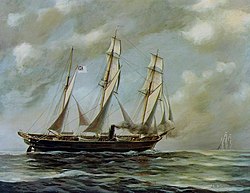
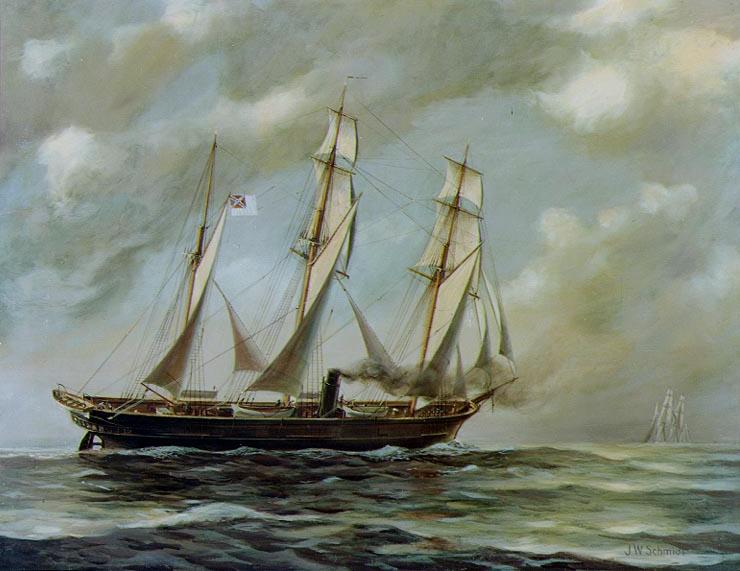
A 1961 painting of CSS Alabama
History
Confederate States of America
NameAlabama
NamesakeAlabama
BuilderJohn Laird Sons & Company
Laid down1862
LaunchedJuly 29, 1862
CommissionedAugust 24, 1862
Motto"Aide Toi, Et Dieu T'Aidera," (God helps those who help themselves)[1]
FateSunk June 19, 1864; 161 years ago (1864-06-19)
General characteristics
Displacement1050 tons
Length220 ft (67 m)[2]
Beam31 ft 8 in (9.65 m)
Draft17 ft 8 in (5.38 m)
Installed power2 × 150 HP horizontal steam engines (300 HP collectively), auxiliary sails
PropulsionSingle screw propeller[3]
Speed13 knots (24 km/h; 15 mph)[2]
Complement145 officers and men
Armament6 × 32 lb (15 kg) cannons, 1 × 110 lb (50 kg) cannon, 1 × 68 lb (31 kg) cannon

CSS Alabama was a screw sloop-of-war built in 1862 for the Confederate States Navy. She was built in Birkenhead on the River Mersey opposite Liverpool, England, by John Laird Sons and Company.[4] Launched as Enrica, she was fitted out as a cruiser and commissioned as CSS Alabama on August 24, 1862. Under Captain Raphael Semmes, Alabama served as a successful commerce raider, attacking, capturing, and burning Union merchant and naval ships in the North Atlantic, as well as intercepting American grain ships bound for Europe. The Alabama continued through the West Indies and further into the East Indies, destroying over seven ships before returning to Europe. On June 11, 1864, the Alabama arrived at Cherbourg, France, where she was overhauled. Shortly after, a Union sloop-of-war, USS Kearsarge, arrived; and on June 19, the Battle of Cherbourg commenced outside the port of Cherbourg, France, whereby the Kearsarge sank the Alabama in approximately one hour after the Alabama's opening shot.

History

[edit]

Construction

[edit]

Alabama was built in secrecy in 1862 by British shipbuilders John Laird Sons and Company, in north-west England at their shipyards at Birkenhead, Wirral, opposite of the city of Liverpool. The construction was arranged by the Confederate agent Commander James Bulloch, who led the procurement of sorely needed ships for the fledgling Confederate States Navy.[5] The contract was arranged through the Fraser Trenholm Company, a cotton broker in Liverpool with ties to the Confederacy. Under prevailing British neutrality law, it was possible to build a ship designed as an armed vessel, provided that it was not actually armed until after it was in international waters. In light of this loophole, Alabama was built with reinforced decks for cannon emplacements, ammunition magazines below water level, etc., but was not fitted with armaments or any "warlike equipment" originally.

Initially known only by her shipyard number "ship number 0290", she was launched as Enrica on 15 May 1862 and secretly slipped out of Birkenhead on 29 July 1862.[6] U.S. Navy Commander Tunis A. M. Craven, commander of USS Tuscarora, was in Southampton and was tasked with intercepting the new ship, but was unsuccessful.[7] Agent Bulloch arranged for a civilian crew and captain to sail Enrica to Terceira Island in the Azores. With Bulloch accompanying him, the new ship's captain, Raphael Semmes, left Liverpool on 13 August 1862 aboard the steamer Bahama to take command of the new cruiser. Semmes arrived at Terceira Island on 20 August 1862 and began overseeing the refitting of the new vessel with various provisions, including armaments, and 350 tons of coal, brought there by Agrippina, his new ship's supply vessel. After three days of work by the three ships' crews, Enrica was equipped as a naval cruiser, designated a commerce raider, for the Confederate States of America. Following her commissioning as CSS Alabama, Bulloch then returned to Liverpool to continue his secret work for the Confederate Navy.[8]

Alabama's British-made ordnance consisted of six muzzle-loading, broadside, 32-pounder naval smoothbores (three firing to port and three firing to starboard) and two larger and more powerful pivot cannons. The pivot cannons were placed fore and aft of the main mast and positioned roughly amidships along the deck's center line. From those positions, they could be rotated to fire across the port or starboard sides of the cruiser. The fore pivot cannon was a heavy, long-range 100-pounder, 7-inch-bore (178 mm) Blakely rifled muzzleloader; the aft pivot cannon a large, 8-inch (203 mm) smoothbore.

The new Confederate cruiser was powered by both sail and by a two-cylinder John Laird Sons and Company 300 horsepower (220 kW) horizontal steam engine,[9][10] driving a single, Griffiths-type, twin-bladed brass screw. (Note: At the time a cylinder was also called an engine. Therefore, the machinery involved, which had two cylinders, could also be referred to as a pair of engines, which description is often found in sources.)

The telescopic funnel could be raised or lowered by chains to disguise the fact that the vessel was a steamer.[11]

With the screw retracted using the stern's brass lifting gear mechanism, Alabama could make up to ten knots under sail alone and 13.25 knots (24.54 km/h) when her sail and steam power were used together.

Commissioning and voyage

[edit]
The Route of the CSS Alabama, The “+” underneath the date is how many prizes were burned.
Alabama in a cyclone in the Gulf Stream on 16 October 1862
CSS Alabama This sketch was made from a photograph (of a drawing) which Captain Semmes gave to a friend, with the remark that it was a correct picture of his ship. (Battles and Leaders of the Civil War Vol 4 p.601)

The ship was purposely commissioned about a mile off Terceira Island in international waters on 24 August 1862. All the men from Agrippina and Bahama had been transferred to the quarterdeck of Enrica, where her 24 officers, some of them Southerners, stood in full dress uniform. Captain Raphael Semmes mounted a gun-carriage and read his commission from President Jefferson Davis, authorizing him to take command of the new cruiser. Upon completion of the reading, musicians assembled from among the three ships' crews began to play the tune "Dixie" as the quartermaster finished hauling down Enrica's British colors. A signal cannon was fired and the ship's new battle ensign and commissioning pennant were broken out at the peaks of the mizzen gaff and mainmast. With that the cruiser became the Confederate States Steamer Alabama. The ship's motto: Aide-toi et Dieu t'aidera (French which approximately translates as "God helps those who help themselves") was engraved in the bronze of the great double ship's wheel.[12]

Captain Semmes then made a speech about the Southern cause to the assembled seamen (few of whom were American), asking them to sign on for a voyage of unknown length and destiny. Semmes had only his 24 officers and no crew to man his new command. When this did not succeed, he offered signing money and double wages, paid in gold, and additional prize money to be paid by the Confederate congress for all destroyed Union ships. The men began to shout "Hear! Hear!" in response. 83 seamen, many of them British, signed on for service in the Confederate Navy. Bulloch and the remaining seamen then boarded their respective ships for the return to England. Semmes still needed another 20 or so men for a full complement, but there were enough to at least handle the new commerce raider. The rest would be recruited from the captured crews of raided ships or from friendly ports-of-call. Many of the 83 crewmen who signed on completed the full voyage.

Deck scene cruiser Alabama in August 1863 - Lts Armstrong and Sinclair at Sinclair's 32-pounder station[13]
Deck scene cruiser Alabama showing First Lieutenant John M. Kell, by the ships stern during her visit to Cape Town in August 1863.
Captain Raphael Semmes, Alabama's commanding officer, standing aft of the mainsail by his ship's aft 8-inch smoothbore gun during her visit to Cape Town in August 1863. His executive officer, First Lieutenant John M. Kell, is in the background, standing by the ship's wheel.[14]

Under Captain Semmes, Alabama spent her first two months in the Eastern Atlantic, ranging southwest of the Azores and then redoubed east, targeting northern merchant ships. After an Atlantic crossing, she continued her cruise in the greater New England region. She then sailed south, arriving in the West Indies, where she continued disrupting merchant vessels before finally cruising west into the Gulf of Mexico. There, in January 1863, Alabama had her first military engagement. She came upon and quickly sank the Union side-wheeler USS Hatteras just off the Texas coast, near Galveston, capturing that warship's crew.[citation needed] She then continued further south, eventually crossing the Equator, where she attained most of the successes of her raiding career while cruising off the coast of Brazil.[citation needed]

After a second, easterly Atlantic crossing, Alabama sailed down the southwestern African coast where she continued the campaign against northern commerce. After stopping in Saldanha Bay on 29 July 1863 in order to verify that no enemy ships were in Table Bay,[15] she made a refitting and reprovisioning visit to Cape Town, South Africa. Alabama is the subject of an Afrikaans folk song, "Daar kom die Alibama" .[16][17][18] She then sailed for the East Indies where she spent six months, destroying seven more ships before finally returning via the Cape of Good Hope en route to France. Alabama was often hunted for by Union warships; however, she was able to successfully evade engagement.[citation needed]

All together, she burned 65 Union vessels of various types, most of them merchant ships.

Expeditionary raids

[edit]
Alabama sinks the whaler Virginia

Alabama conducted a total of seven expeditionary raids, spanning the globe, before heading to France for refit and repairs:

Upon the completion of her seven expeditionary raids, Alabama had been at sea for 534 days out of 657, never visiting a Confederate port. She boarded nearly 450 vessels, captured or burned 65 Union merchant ships, and took more than 2,000 prisoners without any loss of life among either prisoners or her own crew.[citation needed]

Final cruise

[edit]
Chart of battle Between the CSS Alabama and the USS Kearsarge 1864
Battle of the USS Kearsarge and the CSS Alabama (1887 lithograph)
The sternpost of USS Kearsarge, with a 100-pound round embedded within it.
The Battle of the Kearsarge and the Alabama by Édouard Manet, 1864
Sinking of the CSS Alabama off Cherbourg France 1864

On 11 June 1864, Alabama arrived in port at Cherbourg, France. Captain Semmes soon requested permission to dry dock and overhaul his ship, necessary after naval action and so long at sea. Pursuing the raider, the American sloop-of-war, USS Kearsarge, under the command of Captain John Ancrum Winslow, arrived three days later and took up station just outside the harbor. While at his previous port-of-call, Winslow had telegraphed Gibraltar to send the old sloop-of-war USS St. Louis with provisions and to provide blockading assistance. Kearsarge had now boxed in Alabama.

Up to this point, Semmes had faced another warship only once—the much less well armed blockade ship Hatteras. He believed that the Kearsarge was not superior to Alabama, and did not wish for his ship to be interned by the French.[21] Therefore, after preparing his ship and drilling the crew for the coming battle during the next several days, Semmes issued, through diplomatic channels, a challenge to the Kearsarge's commander,[22] "my intention is to fight the Kearsarge as soon as I can make the necessary arrangements. I hope these will not detain me more than until to-morrow or the morrow morning at farthest. I beg she will not depart until I am ready to go out. I have the honor to be Your obedient servant, R. Semmes, Captain."

On 19 June, Alabama sailed out to meet the Union cruiser. Jurist Tom Bingham later wrote, "The ensuing battle was witnessed by Édouard Manet, who went out to paint it, and the owner of an English yacht who had offered his children a choice between watching the battle and going to church."[23]

As Kearsarge turned to meet her opponent, Alabama opened fire. Kearsarge waited until the range had closed to less than 1,000 yards (900 m). According to combatants, the two ships steamed on opposite courses in seven spiraling circles, moving southwesterly with the 3-knot current, each commander trying to cross the bow of his opponent to deliver a heavy raking fire (to "cross the T"). The battle quickly turned against Alabama due to the superior gunnery displayed by Kearsarge and the deteriorated state of Alabama's contaminated powder and fuses. Her most telling shot, fired from the forward 7-inch (178 mm) Blakely pivot rifle, hit very near Kearsarge's vulnerable stern post, the impact binding the ship's rudder badly. That rifled shell, however, failed to explode. If it had done so, it would have seriously disabled Kearsarge's steering, possibly sinking the warship, and ending the contest. In addition, Alabama's too rapid rate-of-fire resulted in poor gunnery, with many of her shots going too high, and as a result Kearsarge's outboard chain armor received little damage. Semmes later said that he did not know about Kearsarge's armor at the time of his decision to issue the challenge to fight, and in the following years firmly maintained he would have never fought Kearsarge if he had known.

Kearsarge's hull armor had been installed in just three days, more than a year before, while she was in port at the Azores. It was made using 120 fathoms (720 ft; 220 m) of 1.7-inch (43 mm) single link iron chain and covered hull spaces 49 feet 6 inches (15.09 m) long by 6 feet 2 inches (1.88 m) deep. It was stopped up and down to eye-bolts with marlines and secured by iron dogs. Her chain armor was concealed behind 1-inch deal-boards painted black to match the upper hull's color. This "chaincladding" was placed along Kearsarge's port and starboard midsection down to the waterline, for additional protection of her engine and boilers when the upper portion of her coal bunkers were empty (coal bunkers played an important part in the protection of early steam vessels, such as protected cruisers).

A hit to her engine or boilers could easily have left Kearsarge dead in the water, or even caused a boiler explosion or fire that could destroy the cruiser. Her armor belt was struck twice during the fight. The first hit, by one of Alabama's 32-pounder shells, was in the starboard gangway, cutting the chain armor and damaging the hull planking underneath. A second 32-pounder shell exploded and broke a link of the chain armor, tearing away a portion of the deal-board covering. Had those rounds come from Alabama's more powerful 100-pounder Blakely pivot rifle, they would have easily penetrated, but the likely result would not have been very serious, as both shots struck the hull a little more than five feet above the waterline. Even if both shots had penetrated Kearsarge's side, they would have missed her vital machinery. However, a 100-pound shell could have done a great deal of damage to her interior; hot fragments could have easily set fire to the cruiser, one of the greatest risks aboard a wooden vessel.

A little more than an hour after the first shot was fired, Alabama was reduced to a sinking wreck by Kearsarge's powerful 11-inch (280 mm) Dahlgrens, forcing Captain Semmes to strike his colors and to send one of his two surviving boats to Kearsarge to ask for assistance.

The ironclad frigate French battleship La Gloire was in the English Channel, near Cherbourg, during the battle between Alabama and Kearsarge

According to witnesses, Alabama fired about 370 rounds at her adversary, averaging one round per minute per gun, a fast rate of fire compared to Kearsarge's gun crews, who fired less than half that number, taking more careful aim. In the confusion of battle, five more rounds were fired at Alabama after her colors were struck. (Her gun ports had been left open and the broadside cannon were still run out, appearing to threaten Kearsarge.) A hand-held white flag at Alabama's stern spanker boom finally halted the engagement.

Prior to this, she had her steering gear damaged by shell hits, but the fatal shot came later when one of Kearsarge's 11-inch (280 mm) shells tore open a mid-section of Alabama's starboard waterline. Water quickly rushed through the hull, eventually flooding the boilers and taking her down by the stern to the bottom. As Alabama sank, the injured Semmes threw his sword into the sea, depriving Kearsarge's commander, Winslow, of the traditional surrender of the sword (an act which was seen as dishonorable by many at the time).

Of her 170 crew, the Alabama had 19 fatalities (9 killed and 10 drowned) and 21 wounded[24] Kearsarge rescued most of the survivors, but 41 of Alabama's officers and crew, including Semmes, were rescued by John Lancaster's private British steam yacht Deerhound, while Kearsarge stood off to recover her rescue boats as Alabama sank.[25] Captain Winslow had to stand by and watch Deerhound spirit his adversary away to England. Semmes and the 41 crew members successfully reached England. Semmes eventually returned to the Confederacy and became a Confederate admiral in the last weeks of the war.[26]

The sinking of Alabama by Kearsarge is honored by the United States Navy with a battle star on the Civil War campaign streamer.

Officers

[edit]
A montage of the officers of the CSS Alabama: top row left to right:Kell; Dr. Llewellyn [drowned]; Semmes; Wilson; Schroeder; Bullock; Sinclair; Freeman; Armstrong; Smith; Dr Galt; Brooke; Maffitt; Anderson; Fullman; Lt. Howell; Robinson [Ships Carpenter-killed]; Yonge; Lowe; Cummings
Officers
Officer Post
List of Officers Of The Confederate States Steamer Alabama

As They Signed Themselves.[27]

Raphael Semmes Commander
John McIntosh Kell First Lieutenant And Executive Officer
Richard F. Armstrong Second Lieutenant
Joseph D. Wilson Third Lieutenant
John Low Fourth Lieutenant
Arthur Sinclair Fifth Lieutenant
Francis L. Galt Surgeon And Acting Paymaster
Miles J. Freeman Chief-Engineer
Wm. P. Brooks Assistant- Engineer
Mathew O Brien Assistant-Engineer
Simeon W. Cummings[A] Assistant-Engineer
John M. Pundt Assistant-Engineer
Wm. Robertson[B] Assistant-Engineer
Becket K. Howell[C] Lieutenant Marines
Irvine S. Bulloch Sailing-Master
D. Herbert Llewellyn[D] Assistant-Surgeon
Wm. H. Sinclair Midshipman
E. Anderson Maffitt Midshipman
E. Maffitt Anderson Midshipman
Benjamin P. Mecaskey Boatswain
Henry Alcott Sailmaker
Thomas C. Cuddy Gunner
Wm. Robinson[E] Carpenter
Jas. Evans Master's Mate
Geo. T. Fullam Master's Mate
Julius Schroeder Master's Mate
Baron Max. Von Meulnier Master's Mate
W. Breedlove Smith Captain S Secretary
A Died in Saldanha Bay from accidental gunshot on 3 August 1863.[15]
B Drowned in the sinking of the Alabama 19 June 1864.[28]
C Lt of CS Marines. Brother-in-law of CS President Jefferson Davis
D Drowned in the sinking of the Alabama 19 June 1864.[29]
E Killed in action in the sinking of the Alabama 19 June 1864[28]

Dr. David Herbert Llewellyn, a Briton and the ship's assistant surgeon, tended the wounded during the battle. At one point the operating table was shot away.[30] He worked in the wardroom until the order to abandon ship was finally given. As he helped wounded men into Alabama's only two functional lifeboats, an able-bodied sailor attempted to enter one, which was already full. Llewellyn, understanding that the man risked capsizing the craft, grabbed and pulled him back, saying "See, I want to save my life as much as you do; but let the wounded men be saved first."

An officer in the boat, seeing that Llewellyn was about to be left aboard the stricken Alabama, shouted "Doctor, we can make room for you." Llewellyn shook his head and replied, "I will not peril the wounded." Unknown to the crew, Llewellyn had never learned to swim, and he drowned when the ship went down.

His sacrifice did not go unrecognized in England. In his native village, a memorial window and tablet were placed at Easton Royal Church.[31] Another tablet was placed in Charing Cross Hospital, London, where he attended medical school.

Repercussions

[edit]
"The gun that sunk the Alabama" (from The Photographic History of The Civil War)

During her two-year career as a commerce raider, Alabama damaged Union merchant shipping around the world. The Confederate cruiser claimed 65 prizes valued at nearly $6,000,000 (about $121,000,000 in today's dollars[32]); in 1862 alone 28 were claimed.[33] In an important development in international law, the U.S. government pursued the "Alabama Claims" against the United Kingdom for the losses caused by Alabama and other raiders fitted out there. A joint arbitration commission awarded the U.S. $15.5 million in damages.

Ironically, in 1851, a decade before the Civil War, Captain Semmes had observed:

(Commerce raiders) are little better than licensed pirates; and it behooves all civilized nations [...] to suppress the practice altogether.[34]

However, she and other raiders failed in their primary purpose, which was to draw Union vessels away from the blockade of the southern coastline that was slowly strangling the Confederacy. The Confederate government had hoped that panicking shipping companies would force the Union to dispatch ships to protect merchant shipping and hunt down the raiders, a task which always requires a proportionately greater force when compared with the numbers of ships attacking (see Battle of the Atlantic). Union officials proved immovable on the blockade, however, and although insurance prices soared, shipping costs went up, and many vessels transferred to a neutral flag, very few naval vessels were taken off the southern blockade. In fact, with clever use of resources and a mammoth shipbuilding program, the Union managed to steadily increase the blockade throughout the war. It also sent vessels to protect merchant shipping and to hunt and destroy the few Confederate raiders and privateers still operating.[citation needed]

The wreck

[edit]

In November 1984 the French Navy mine hunter Circé discovered a wreck under nearly 200 ft (60 m) of water off Cherbourg[35] at 49°45′9″N 1°41′42″W / 49.75250°N 1.69500°W / 49.75250; -1.69500.[36] Captain Max Guerout later confirmed the wreck to be Alabama's remains.

In 1988 a non-profit organization, the CSS Alabama Association, was founded to conduct scientific exploration of the shipwreck. Although the wreck is in French territorial waters, the United States Government, as the successor to the former Confederate States of America, is the owner. On 3 October 1989 the US and France signed an agreement recognizing this wreck as an important heritage resource of both nations and establishing a Joint French-American Scientific Committee for archaeological exploration. This agreement established a precedent for international cooperation in archaeological research and in the protection of a unique historic shipwreck.

The Association CSS Alabama and the Naval History and Heritage Command signed on 23 March 1995 an official agreement accrediting Association CSS Alabama as operator of the archaeological investigation of the remains of the ship. The association, which is funded solely from private donations, is continuing to make this an international project through its fundraising in France and in the US, thanks to its sister organization, the CSS Alabama Association, incorporated in the State of Delaware.

Alabama was fitted with eight pieces of ordnance after she arrived at the Azores; six of those were 32-pounder smooth bores. Seven cannon were identified at the wreck site: Two were cast from a Royal Navy pattern and three were of a later pattern produced by Fawcett, Preston, and Company in Liverpool.

One of the Blakely pattern 32-pounders was found lying across the starboard side of the hull, forward of the boilers. A second Blakely 32-pounder was identified outside the hull structure, immediately forward of the propeller and its lifting frame; the forward 32-pounder was recovered in 2000. Both of the Royal Navy pattern 32-pounders were identified: One lies inside the starboard hull, forward of the boilers, adjacent to the forward Downton pump. The second was identified as lying on the iron deck structure, immediately aft of the smoke pipe; it was recovered in 2001. The sole remaining 32-pounder has not been positively identified, but it could be underneath hull debris forward of the starboard Trotman anchor.

Alabama's heavy ordnance were one Blakely Patent 7-inch 100-pounder shell rifle mounted on a pivot carriage forward and one 68-pounder smoothbore similarly mounted aft. The Blakely 7-inch 100-pounder was found beside its pivot carriage, atop the forward starboard boiler; this was the first cannon recovered from Alabama. The 68-pounder smoothbore was located aft, at the stern, immediately outside the starboard hull structure; it is possible that the remains of its truck and pivot carriage lie underneath the gun barrel. Both heavy cannon were recovered in 1994.

In addition to the seven cannon, the wreck site contained shot, gun truck wheels, and brass tracks for the gun carriages; many of the brass tracks were recovered. Two shot were recovered, and one conical projectile was inside the barrel of the 7-inch Blakely rifle. A shell for a 32-pounder was recovered from the stern, forward of the propeller; that shot was attached to a wood sabot having been packed in a wood box for storage. Additional round shot were observed scattered forward of the boilers and in the vicinity of the aft pivot gun, one possibly having been fired from Kearsarge.

In 2002, a diving expedition raised the ship's bell along with more than 300 other artifacts, including more cannons, structural samples, tableware, ornate commodes, and numerous other items that reveal much about life aboard the Confederate warship.[37] Many of the artifacts are now housed in the Underwater Archaeology Branch, Naval History & Heritage Command conservation lab.

Folklore and heritage

[edit]
CSS Alabama plaque in Simon's Town

Alabama is the subject of a sea shanty, "Roll, Alabama, Roll"[38][39] which was also the basis of a 2014 record of the same name by British contemporary folk band Bellowhead.

Alabama's visit to Cape Town in 1863 has passed (with a slight spelling change) into South African folklore in the Afrikaans song, Daar Kom die Alibama.[40][41][42]

The Alabama Hills in Inyo County, California, are named after the vessel.[43]

[edit]

In 1998, the Jules Verne scholar William Butcher was the first to identify a possible link between the Birkenhead-built Alabama and Captain Nemo’s Nautilus from the Jules Verne 1869 novel Twenty Thousand Leagues Under the Seas. Butcher stated The Alabama, which claimed to have sunk 75 merchantmen, was destroyed by the Unionist Kearsarge off Cherbourg on 11th June 1864…. This battle has clear connections with Nemo’s final attack, also in the English Channel.[44]

Verne had himself made a previous comparison between the Birkenhead-built CSS Alabama and the Nautilus in a letter to his publisher Jules Hetzel in March 1869.[45] Other arguments in favor of a connection were made by Birkenhead born geography teacher John Lamb.[46] Writing in the April 2025 edition of Foundation – The International Review of Science Fiction, John Lamb stated there were many links between the fictional Captain Nemo, the Nautilus and Raphael Semmes the Confederate Captain of the commerce raider CSS Alabama in the American Civil War. Lamb wrote

Both the Alabama and the Nautilus were mainly built in Birkenhead. Both Semmes and Nemo were gifted natural historians. Nemo’s motto was ‘Mobilis in Mobile’ while Semmes was from Mobile Alabama. Semmes was branded a pirate by Abraham Lincoln, who put a bounty on Semmes's head, and Semmes was chased around the seas by Admiral Farragut of the US Navy. Nemo, conversely, was branded a pirate by Captain Farragut of the US Navy, who put a bounty on Nemo's head, and Nemo was chased around the seas by the ship Abraham Lincoln. Both Semmes and Nemo encounter an imaginary island, sail through a patch of white water, encounter fake Havana cigars, mention coral mausoleums, shelter in an extinct volcanic island, and have their final battle off Cherbourg. Semmes had a portrait of the Confederate President, Jefferson Davis, in his cabin while Nemo had a portrait of the Union President, Abraham Lincoln, in his. The Alabama was bankrolled from the Confederate headquarters at Nautilus House Liverpool.[47]

Battle ensigns and other naval flags

[edit]

Both the United States Navy and the Confederate States Navy flew an ensign and a jack (primary and secondary naval flags) following British naval tradition that originated in the 17th century.[48][49] The fledgling Confederate Navy therefore adopted and used jacks, commissioning pennants, battle ensigns, small boat ensigns, designating flags, and signal flags aboard its warships during the Civil War.[50]

Surviving flags

[edit]
First National Flag "Stars and Bars" 7-star battle ensign, 4 May 1861 – 21 May 1861, 1:2 aspect ratio

At the beginning of Alabama's raiding ventures, the newly commissioned cruiser may have been forced, out of necessity, to fly the only battle ensign available to Captain Semmes: an early 1861, 7-star First National Flag, possibly the same battle ensign flown aboard his previous command, the smaller commerce raider CSS Sumter. Between 21 May and 28 November 1861, six more Southern states seceded and joined the Confederacy. Well before Alabama was launched as Enrica at Birkenhead, Merseyside in North West England, six more white, 5-pointed stars had been added to the "Stars and Bars" far away across the Atlantic on the Confederate mainland.[citation needed]

One such early "Stars and Bars" battle ensign was salvaged from Alabama's floating debris, following her sinking by Kearsarge. It still survives and is held by the Alabama Department of Archives and History. It is listed there as "Auxiliary Flag of the C.S.S. Alabama, Catalogue No. 86.3766.1." According to their provenance reconstruction, DeCost Smith, an American from New England, discovered this "Stars and Bars" ensign in a Paris upholstery shop in 1884, where he purchased it for 15 francs. Smith's nephew, Clement Sawtell of Lincoln Square, Massachusetts, later inherited the ensign from his uncle. At the suggestion of retired Rear Admiral Beverly M. Coleman, Sawtell donated it to the State of Alabama on 3 June 1975.[citation needed]

This battle ensign's overall dimensions are different from the Confederate flag regulations' required 2:3 ratio. It is 64-inches high (hoist) by 112-inches long (fly), a proportion of 5:9, and its dark blue canton contains eight white stars, 8-inches (203 mm) high, in an unusual arrangement: The stars are not organized in a circle but configured in three, centered, horizontal rows of two, then three, and finally two. The additional 8th star is tucked into the lower left corner (and in the lower right corner on the opposite side), giving the canton's layout a unique, asymmetrical appearance. It seems plausible this was Alabama's original 7-star battle ensign, possibly flown aboard CSS Sumter as noted earlier, and later altered at some point when the long-delayed news of an 8th state joining the Confederacy finally reached the far distant cruiser.[citation needed]

Two "Star and Bars" battle ensigns, labeled as having belonged to Alabama, also still exist. The first is a mounted and framed, 14-star ensign located at the Mariner's Museum in Virginia. (A small number of these unusual 14-star national flags have survived to the modern era and are held in several Civil War archives.) From the several color photo available on the Internet, this ensign appears to have an approximate hoist-to-fly aspect ratio of 1:2.5 (i.e., very rectangular). A second "Stars and Bars" battle ensign is on display at the Pensacola Historical Museum. Its canton contains a circle of 12 stars surrounding a centered, larger 13th star.[citation needed]

Surviving stainless banners

[edit]

Four of Alabama's later-style ensigns have survived to the modern era. The first measures 67 in × 114 in (170 cm × 290 cm) and is located in South Africa at Cape Town's Bo-Kaap Museum. Its Southern Cross canton is oversize and made after the British navy fashion: Instead of being square, it has a very rectangular 1:2 aspect ratio. It was also made without any white stripes outlining its diagonal blue bars. A central 5-pointed white star, located where the two blue saltires' cross, is larger than the other twelve. This ensign appears to have been made by her British crew sometime between Alabama's two visits to Cape Town. This flown ensign was finally given in thanks to William Anderson, whose ship's chandler company helped make repairs and provide supplies to Alabama in Cape Town, shortly before the raider returned to Cherbourg, France (and her fateful battle with the sloop-of-war, USS Kearsarge).

Second National Flag ("Stainless Banner") 13-star naval battle ensign after 26 May 1863, 1.5:1 aspect ratio

A second Stainless Banner ensign of South African origin was made and then presented to Alabama on one of her two port visits to Cape Town; it resides in the Tennessee State Museum, according to their website.

The third surviving Stainless Banner is one of Alabama's original small boat ensigns. This official-looking 25.5 in × 41 in (65 cm × 104 cm) ensign is marked in brown pigment on its hoist: "Alabama. 290. C.S.N. 1st Cutter." In 2007 it was offered and sold through Philip Weiss Auctions. It was being sold by the grandson of its second owner, who had originally purchased it from the granddaughter of a USS Kearsarge sailor. Its buyer has since resold this small boat ensign through a later auction.

A fourth surviving ensign appears, from various clues observed in on-line photos, to be roughly 36 in × 54 in (91 cm × 137 cm). Because Alabama was forced to replace several of her original small boats lost at different times during her lengthy cruise, this is likely a larger replacement boat ensign. While it could have been made aboard, its somewhat more accurate details suggest it might have been commissioned ashore during a port-of-call visit. This ensign was rescued from the sinking Alabama by W. P. Brooks, the cruiser's assistant-engineer. It was last flown, along with other historic flags, during a ceremony held on the parade ground at Fort Pulaski, GA, sometime during 1937. This ensign has since been mounted and framed and continues to reside with the Brooks family; four modern photos of it can be found at the website for the "Alabama Crew," a British-based naval reenactor group.

The Alabama Department of Archives and History has in its collection one more important Stainless Banner ensign listed as "Admiral Semmes' Flag, Catalogue No. 86.1893.1 (PN10149-10150)". Their provenance reconstruction shows that it was presented to Semmes after the sinking of Alabama by "Lady Dehogton and other English ladies". Such presentations of ceremonial colors were uncommon to ships' captains of the Confederate Navy, but a few were known to have received such honors. This Second National Flag is huge and made of pure silk, giving it an elegant appearance. While this ensign is in a remarkable state of preservation, its large size and delicate condition have made its up-close details and measurements unavailable. When Semmes returned to the Confederacy from England, he brought this ceremonial Stainless Banner with him. It was inherited by his grandchildren, Raphael Semmes III and Mrs. Eunice Semmes Thorington. Following his sister's death, Raphael Semmes III donated the ensign to the state of Alabama on 19 September 1929.

See also

[edit]

References

[edit]
[edit]
Revisions and contributorsEdit on WikipediaRead on Wikipedia
from Grokipedia
CSS Alabama was a screw commissioned into the in 1862, constructed clandestinely at the John Laird and Sons shipyard in , , for against shipping during the . Commanded by Captain , a veteran Confederate naval officer, Alabama embarked on a global cruise spanning 75,000 nautical miles across the Atlantic, Indian, and Pacific Oceans. Over nearly two years of operations from to , Alabama captured or bonded Union vessels and whalers, burning most to deny their use to the Northern and , making her the most successful Confederate raider in terms of prizes taken. Her tactics emphasized speed, surprise, and the use of disguise, avoiding prolonged engagements with Union warships until her final battle. Alabama's career ended on June 19, 1864, when Semmes challenged the USS Kearsarge to combat off , , resulting in Alabama's rapid sinking after a fierce hour-long exchange of broadsides, with Semmes' crew suffering heavy casualties and many survivors rescued by nearby vessels. The ship's construction in British yards despite official neutrality sparked the , a major diplomatic dispute resolved by in 1872, in which Britain paid the $15.5 million in compensation for Alabama's depredations and similar raiders. This outcome reinforced principles of neutrality and in maritime law, influencing future .

Design and Construction

Technical Specifications

The CSS Alabama was a wooden-hulled, screw sloop-of-war with barkentine rigging, designed for speed and long-range cruising as a commerce raider. Her hull was constructed of and , copper-sheathed for protection against marine growth, enabling extended operations without frequent docking. Key dimensions included a of 213 feet 8 inches, an extreme beam of 32 feet, a depth of hold of 18 feet, and a fully loaded draft of 15 feet. Displacement reached 1,438 tons when fully loaded. Alternative measurements cite a deck length of 220 feet with the same beam and loaded draft. Propulsion combined sail and steam power. She featured two direct-acting, horizontal condensing engines with twin cylinders, rated at 300 horsepower total, driving a single lifting screw propeller that could be hoisted clear of the water for sailing efficiency. Four boilers supported steam operations, with a coal capacity of 285 tons allowing for extended voyages. Under steam alone, she achieved about 10 knots; combined sail and steam yielded up to 13 knots, with a designed maximum of 12 knots and ordinary service speed of 10 knots.
CategoryDetails
Armament1 × 7-inch (100-pounder) Blakely rifled pivot gun (forecastle); 1 × 8-inch (68-pounder) pivot gun (quarterdeck); 6 × 32-pounder broadside guns on wheeled carriages
Crew ComplementApproximately 110 to 144 personnel, including 24 to 25 officers and 85 to 120 enlisted seamen

Building Process and Secrecy

The construction of hull number 290, later the CSS Alabama, was commissioned by Confederate States naval agent from John Laird Sons and Company at their Birkenhead Iron Works shipyard, across the Mersey River from , . On 1 August 1861, Bulloch signed a for £47,500 to build a fast steamer ostensibly for mercantile service in the and Pacific trade, concealing its intended role as a commerce raider to circumvent Britain's neutrality of 13 May 1861 and the Foreign Enlistment Act of 1819, which prohibited equipping belligerent warships in neutral ports. The Lairds, whose firm had pioneered iron-hulled steamships since the 1820s, employed approximately 200 workers in a process emphasizing speed and dual-use design: an iron frame with reinforced upper decks for potential gun mounts, a powerful 300-horsepower driving a screw propeller, and auxiliary sail rigging, all completed without installing armaments or overt military fittings. Secrecy was enforced through minimal documentation, verbal instructions to trusted personnel, and the vessel's anonymous designation as "number 290" until its launch as the Enrica on 15 May 1862, after which it underwent engine trials in the . Bulloch closely supervised quality, rejecting substandard materials and insisting on enhancements like a retractable smokestack to mimic a profile at , while armaments—six 32-pounder smoothbores and one 7-inch rifled pivot —were procured separately through Confederate banking firm Fraser, Trenholm and Company and stored off-site for later shipment. U.S. Minister Charles Francis Adams lodged protests with British Foreign Secretary Lord Russell, suspecting Confederate intent based on the ship's speed (up to 13 knots) and hull strength exceeding typical merchants, but lacked conclusive evidence of armament, allowing the Enrica to slip from on 28 July 1862 under cover of a feigned voyage, evading detention orders issued too late. This evasion succeeded partly due to sympathetic local officials and the Lairds' pro-Southern leanings, as John Laird himself held parliamentary seats and defended the project publicly.

Commissioning and Departure

Outfitting and Armament

![Captain Raphael Semmes near the 110-pounder gun aboard CSS Alabama][float-right] The CSS Alabama, constructed at the Laird shipyard in Birkenhead as the ostensibly merchant vessel Enrica to circumvent British Foreign Enlistment Act restrictions, departed Liverpool on July 29, 1862, without her armament or Confederate officers aboard. Provisions, gun carriages, ammunition, small arms, clothing, and coal were procured separately by Confederate agent James Dunwoody Bulloch and transported via tenders to avoid detection. Upon reaching Terceira in the Azores around mid-August, the ship rendezvoused with supply vessels, including a tender from which the crew hoisted the guns aboard over several days. Commander Raphael Semmes and his officers joined at this location, where the vessel was formally commissioned as CSS Alabama on August 24, 1862. This outfitting transformed the 220-foot screw sloop into a fully equipped commerce raider, with her battery emphasizing range and mobility for extended operations. The primary armament comprised eight muzzle-loading cannons: a single 7-inch Blakely rifled 100-pounder pivot gun mounted forward for long-range fire, a 68-pounder (8-inch) pivot gun aft, and six 32-pounder broadside guns arranged three per side. This configuration, lighter than Union equivalents, prioritized speed over heavy broadsides, aligning with her role in disrupting enemy merchant shipping. The guns were supplemented by small arms such as rifles and pistols for boarding parties, though the proved decisive in her 64 prizes over 22 months.

Initial Voyage from Britain

The screw sloop Enrica, built at the Laird shipyard near Liverpool, departed the River Mersey on July 29, 1862, under the command of Captain James D. Bullock, a Confederate agent, though officially captained by a British master to maintain the fiction of a commercial vessel. Unarmed and flying British colors, she carried a predominantly British crew of about 90 men, supplemented by a small cadre of Confederate officers in civilian guise, and embarked under the pretext of engine trials in the Irish Sea to evade scrutiny from British customs and neutralist enforcers alerted to suspicions of her purpose. To further disguise intentions, local dignitaries and ladies were invited aboard for a brief excursion before she cleared the harbor, after which she steered southward across the Atlantic, covering approximately 1,200 nautical miles to the rendezvous at Praia da Vitória on Terceira Island in the Portuguese Azores archipelago. The Enrica arrived at Terceira around August 10, 1862, anchoring in neutral Portuguese waters where British authorities could not intervene, allowing the transfer of armament from the accompanying steamer Agrippina, which had departed earlier with six long 32-pounder guns, one 110-pounder rifled pivot gun, one 68-pounder pivot gun, and munitions smuggled out of ports. , appointed captain, had sailed separately from on August 13 aboard the chartered steamer Bahama with , reaching Terceira on August 20 to oversee fitting-out; the Bahama also delivered additional crew and supplies, enabling the vessel's transformation. Over the next few days, the guns were hoisted aboard and secured, the British crew was mustered and offered the choice to enlist under the —with most accepting after addresses emphasizing the privateer's legal status under international maritime law—or to depart on neutral transports. On August 24, 1862, Semmes formally commissioned the vessel as CSS Alabama in the sheltered harbor, hoisting the Confederate ensign and reading the commission to the assembled officers and crew of 149 men, marking the completion of her covert departure from Britain and the start of operations as the Confederacy's most effective commerce raider. The initial voyage succeeded due to the speed of the 1,040-ton steamer—capable of 13 knots under sail and steam—and precise coordination among Confederate agents, despite Union diplomatic protests to that failed to prompt timely detention. From Terceira, Alabama departed eastward, burning her first prize, the whaler Ocmulgee, on September 20 near the Azores to initiate depredations on Union shipping.

Operational Raids

Atlantic and East Indies Campaigns

Following its commissioning on , 1862, off Terceira in the , CSS Alabama commenced operations in the eastern Atlantic, targeting Union merchant shipping to disrupt commerce. Under Captain , the raider captured and burned nine whaling vessels near the between September 5 and 18, 1862, including the Ocmulgee, Starlight, and Elisha Dunbar, releasing crews on parole after removing supplies. These early successes yielded valuable and provisions while avoiding prolonged engagements. By early October 1862, Alabama shifted northward to the waters off Newfoundland, capturing the grain-laden Brilliant on October 3 and eight additional vessels over the month, such as the Manchester and Lafayette, most of which were burned after offloading cargo. Continuing southward, the ship intercepted the T.B. Wales on November 8, 1862, and burned it, before arriving at Martinique on November 18 amid Union naval presence. In December, Alabama seized the steamer Ariel on December 7 off Cuba, releasing it on bond due to its passenger load and the cruiser's own mechanical issues, then underwent brief repairs at Jamaica. Entering the in January 1863, Alabama engaged and sank the USS Hatteras on January 11 off , in a brief night action that resulted in two Confederate casualties and captured 130 Union sailors. Subsequent Caribbean operations through February and March yielded further prizes, including the burned on January 26 off , Palmetto on February 3, and on March 23 off after shifting southward. Off the Brazilian coast, Alabama captured eleven vessels between March and June 1863, notably converting the Conrad into the prize tender CSS Tuscaloosa on June 20; these actions netted coal, provisions, and bonds totaling significant value in disrupting Union trade routes. After coaling at in April and reaching on August 15, 1863, Alabama departed on September 24 for the , crossing the —a voyage of nearly 4,500 miles—while evading Union pursuers. In November 1863, the raider entered the Strait of Sunda, burning the Amanda on November 6 and Winged Racer, then captured and destroyed the Contest in the on November 11. Continuing into the in December, Alabama burned the Sonora and Highlander on December 26, focusing on whalers and merchantmen to maximize economic impact with minimal risk. By January 1864, operations extended to the , where the Emma Jane was burned on January 14 off India's west coast, concluding the East Indies phase before heading to France for repairs. These campaigns accounted for over 20 prizes, compelling Union shipowners to insure vessels at premiums rising up to 10 percent and reroute trade, though Alabama's light armament limited direct confrontations with warships beyond the Hatteras engagement.

Indian Ocean and Pacific Operations

Following its stop at , , the CSS Alabama departed on September 24, 1863, for an extended cruise across the toward the , covering nearly 4,500 miles. The vessel passed St. Paul's Island on October 12, 1863, en route to the . In early November, Alabama captured and destroyed the bark Amanda on November 6 near the Sunda Strait, carrying hemp and sugar; the clipper Winged Racer on November 10 in the Straits of Sumatra, loaded with sugar, hides, and jute; and the clipper Contest on November 11 off the Gaspar Strait in the Java Sea, with Japanese goods. These actions marked the ship's entry into Southeast Asian waters bordering the Pacific, though it did not fully cross into the open Pacific Ocean. Alabama arrived at on December 21, 1863, where it coaled and encountered British reluctance amid shifting Confederate fortunes. Continuing operations in the Straits of , it burned the ship on December 24 with rice cargo, and the ships and Highlander on December 26, both in . On January 14, 1864, near Anjenga, , the ship Emma Jane was captured and burned. Over six months in the and adjacent seas, Alabama took only six Union vessels, reflecting a decline in Northern merchant shipping due to prior raids and Union countermeasures. Crews from captured ships were generally paroled and landed at neutral ports without loss of life. Facing hull fouling, armament wear, and sparse prizes, Captain opted to return westward across the toward Europe rather than pressing further into the Pacific.

Final Engagement

Arrival in Cherbourg and Preparations

After nearly twenty-two months of continuous operations, during which CSS Alabama had captured or destroyed sixty-five Union merchant vessels, the cruiser arrived in , , at 12:30 p.m. on , 1864. Captain Raphael Semmes, whose health had deteriorated from prolonged exposure and strain, immediately sought docking privileges from French maritime authorities to address the ship's critical condition: extensive fouling of the hull from marine growth, loss of copper sheathing exposing the fastenings to corrosion, and worn rigging and boilers requiring overhaul. French neutrality protocols, enforced by Roze, the Préfet Maritime, permitted limited repairs but prohibited extensive refitting that could enhance the vessel's war-making capacity or allow indefinite stay; Alabama was authorized to coal or repair, but not both extensively, and ordered to depart promptly thereafter. Semmes reported to Confederate Samuel Barron in , noting the vessel's vulnerability while docked and the strategic embarrassment posed by the Union sloop-of-war USS Kearsarge, which arrived off on to blockade the harbor entrance. Over the ensuing days, preparations focused on essential maintenance and : coaling to replenish fuel stocks depleted by the transatlantic approach, gunnery drills to sharpen crew proficiency after months without shore facilities, and minor adjustments to armament and powder amid restricted dockyard access. Semmes, recognizing the blockade's constraint on evasion and buoyed by high crew morale despite the ship's frailties, resolved to and engage Kearsarge rather than submit to or futile flight, with final drills concluding by June 18.

Battle with USS Kearsarge

On the morning of June 19, 1864, CSS Alabama, under Captain , departed harbor after repairs and coaling, escorted partway by the French ironclad Couronne, to challenge the blockading commanded by Captain John A. Winslow. The Alabama mounted one 7-inch , one 8-inch smoothbore, and four 32-pounder smoothbores, while the Kearsarge carried two 11-inch Dahlgren smoothbores, four 32-pounders, and one 30-pounder , with the latter featuring improvised chain armor disguised under wooden planking. Semmes, aware of his ship's worn condition after nearly two years at sea, sought a decisive engagement to break the rather than risk . The duel commenced around 10:57 a.m. in visible from the French , with Alabama firing the first broadside as the ships closed to about 1,000 yards. Both vessels maneuvered in elliptical courses, Alabama circling to port while Kearsarge steamed to starboard, enabling the Union to maintain a tighter radius and rake the Confederate raider's stern. Over the approximately 70-minute , Alabama discharged around 370 rounds at a rapid rate, scoring perhaps 28 hits on Kearsarge, but most proved ineffective against the hidden armor, with one unexploded shell lodging in the sternpost. In contrast, Kearsarge fired 173 deliberate shots, inflicting critical damage including a hit below the from an 11-inch shell that exploded in Alabama's coal bunker, causing rapid flooding. An by Alabama to ram failed due to her slowing speed. By 12:40 p.m., Alabama listed heavily and struck her colors, but Semmes ordered abandonment as the ship settled rapidly. Of Alabama's 149 crew, nine were killed and 21 wounded in the action, with an additional 19 drowning during the sinking, for total losses of 68; Kearsarge suffered three wounded. The British yacht Deerhound, present as an observer, rescued Semmes and 40 others, conveying them to England and preventing their capture, a point of later diplomatic contention. Kearsarge rescued about 40 survivors, including First Lieutenant John Kell. Semmes attributed the defeat to Kearsarge's unforeseen armor and his own ship's deteriorated state, not tactical error. The wreck lies off Cherbourg, explored in subsequent archaeological efforts.

Command and Crew

Key Officers and Leadership

The CSS Alabama was commanded by Raphael Semmes, who received his commission as commander in the Confederate States Navy and took charge of the vessel upon its outfitting in Liverpool, England, on August 24, 1862. Semmes, born in 1809 in Charles County, Maryland, had served as a lieutenant in the United States Navy from 1826 until his resignation in 1860 following Southern secession, bringing extensive experience from the Mexican-American War and prior naval commands. Prior to the Alabama, he had successfully led the CSS Sumter on commerce-raiding cruises in 1861–1862, capturing eighteen Union merchant vessels before the ship was blockaded in Gibraltar. Serving as Semmes' and was John McIntosh Kell, who handled daily ship operations, crew discipline, and tactical execution during engagements. Kell, a Georgia native and former U.S. , had previously acted as on the Sumter, fostering a close professional rapport with Semmes that contributed to the Alabama's operational cohesion over its 22-month cruise. Under their , the —comprising approximately 24 Confederate personnel—emphasized rigorous training and adaptability, enabling the capture or destruction of 65 Union vessels despite the multinational crew's occasional disciplinary challenges. Key supporting officers included Surgeon Francis L. Galt, who managed medical care for the crew amid prolonged voyages and combat injuries, including during the final engagement with USS Kearsarge on June 19, 1864; First Assistant Engineer William P. Brooks, overseeing the ship's steam propulsion and machinery critical to its speed and endurance; and F. Armstrong, who assisted in gunnery and boarding operations. These leaders operated under Semmes' strategic direction, which prioritized evasion of Union warships while maximizing economic disruption through targeted raids, reflecting a of asymmetric . Semmes' command style, informed by his legal training and naval expertise, maintained high morale and effectiveness until the ship's sinking, after which he and surviving officers were rescued and paroled.

Crew Composition and Conditions

The CSS Alabama's officer corps consisted primarily of Confederate States Navy personnel, numbering approximately 24, including Captain Raphael Semmes and his executive officer, First Lieutenant John McIntosh Kell. These officers were drawn from Southern naval experience, providing leadership for the commerce raider's operations from her commissioning on August 24, 1862, until her sinking on June 19, 1864. The enlisted crew totaled around 120-125 seamen at typical strength, achieving a full complement of 145-150 by incorporating recruits from neutral ports and select personnel from captured Union vessels. Initial manning in the included 83 British seamen transferred from support vessels, with the overall crew reflecting a multinational makeup dominated by British subjects from the , supplemented by sailors from various seafaring nations, including a notable contingent of captured American () tars. This composition arose from necessity, as Confederate agents in recruited locally to evade British neutrality laws, yielding a force skilled in but diverse in . Crew conditions emphasized incentives like double wages paid in gold coin and shares of prize money from burned or bonded vessels, which sustained enlistments despite the raider's prolonged 22-month cruise without dry-dock access. Living quarters were cramped on the 1,050-ton , with duties involving constant sail adjustments, gunnery maintenance, and the labor-intensive burning of prizes under threat of Union pursuit, yet the suffered no deaths from and only one from accidental causes over the voyage. Resource constraints, including limited (285 tons for roughly 10 days of steaming) and deteriorating quality, compounded fatigue, leading to declining morale and near-mutinous behavior by mid-1864 as the hull fouled and drills lapsed.

Strategic Impact

Damage to Union Commerce

The CSS Alabama, under Captain Raphael Semmes, operated as a commerce raider from August 1862 to June 1864, capturing or destroying more than 60 Union merchant vessels with a combined value of approximately $6 million in ships and cargoes. These actions included burning 55 ships outright to prevent recapture and bonding or releasing others after extracting valuables and prisoners. The raider's targets spanned sailing merchantmen, whalers, and traders, encountered across the Atlantic, Indian, and Pacific Oceans, with notable concentrations in whaling grounds off the Azores and in the East Indies. Direct depredations peaked in 1862–1863, with 28 prizes taken in 1862 alone, many in the eastern Atlantic and South Atlantic en route to distant stations. In the , Alabama destroyed vessels carrying goods like spices, , and , while in the Pacific, it targeted American whalers, sinking ships such as the Virginia on November 4, 1862, after removing crew and supplies. These losses represented a fraction of total Union tonnage but inflicted targeted blows on export-oriented commerce, including grain shipments from New York and California gold transports. Beyond immediate destruction, Alabama's operations elevated Union marine insurance premiums from 1–2% to as high as 10% by mid-1863, as underwriters accounted for the raider's unpredictable strikes. This cost escalation, combined with fear of capture, prompted American shipowners to transfer over 700,000 tons of shipping to foreign flags, primarily British, eroding U.S. maritime capacity and increasing reliance on neutral carriers for wartime trade. The need to deploy Union warships for convoy protection and hunter-killer patrols further strained naval resources, indirectly amplifying the blockade's enforcement costs despite Alabama's limited fleet impact.

Role in Confederate Asymmetric Warfare

The , outnumbered and outbuilt by the Union fleet, adopted as its primary strategy to inflict economic attrition without seeking decisive battles. This doctrine, articulated by Secretary of the Navy Stephen R. Mallory, prioritized fast, heavily armed cruisers like the CSS Alabama to prey on Union merchant shipping worldwide, aiming to raise premiums, drive vessels under foreign flags, and divert Northern warships from enforcing the Anaconda Plan's blockade. Commissioned on August 24, 1862, under Captain , the Alabama executed this strategy with exceptional effectiveness during its 22-month cruise, capturing or destroying 65 Union merchant ships and whalers across the Atlantic, Indian, and Pacific Oceans. These prizes, valued at roughly $6 million in 1860s dollars, included high-value targets like oil-laden whalers from ports, which Semmes systematically burned after removing crews to maximize psychological and material impact. By employing —such as hoisting neutral flags until close range—and leveraging superior speed and armament, the raider avoided Union naval patrols, striking isolated traders and then vanishing into . The Alabama's operations compelled the Union to reflag approximately 800,000 tons of its under neutral registries, crippling domestic shipping participation and escalating freight costs. This forced the deployment of over a dozen Union cruisers to hunt Confederate raiders, diluting enforcement along the Confederate coast and indirectly supporting Southern export efforts through less vigilant patrols. While the overall Confederate raiding campaign sank fewer than 300 vessels—insufficient to shatter Northern commerce—the Alabama alone accounted for nearly a quarter of these losses, underscoring how a single vessel could amplify asymmetric leverage against a materially superior adversary.

Violations of Neutrality and

The construction of the CSS Alabama at the of Laird, Sons and Company, beginning in 1861 under Confederate agent , was conducted under the guise of a merchant vessel to evade Britain's Foreign Enlistment Act of 1819, which prohibited the outfitting of warships for belligerents in neutral ports. The vessel, initially named Enrica, was launched on May 15, 1862, amid growing suspicions from U.S. Minister to Britain Charles Francis Adams, who warned British Foreign Secretary Lord John Russell as early as October 1861 that the ship was intended as a Confederate commerce raider rather than a legitimate commercial steamer. British authorities, despite receiving detailed intelligence including affidavits from shipyard workers attesting to the vessel's fittings like reinforced decks for guns, declined to detain it, citing insufficient evidence of armament at the time. On July 28, 1862, the Enrica cleared Liverpool customs for sea trials, departing without onboard guns or Confederate crew, which technically complied with the letter of neutrality proclamations issued by Britain on May 13, 1861, recognizing both Union and Confederate sides as belligerents. It proceeded to the Azores, where on August 24, 1862, it received artillery, ammunition, and officers including Commander Raphael Semmes, commissioning as the CSS Alabama and commencing raids on Union merchant shipping. The United States maintained that this sequence constituted a substantive violation of neutrality, as British officials had "due diligence" obligations under customary international law to prevent the ship's conversion into a cruiser of war when facts indicated probable hostile use, a standard derived from precedents like the 1854 Caroline affair emphasizing effective prevention of threats from neutral territory. Following the Civil War, the formalized these grievances as the in diplomatic correspondence starting in 1865, seeking compensation not only for the Alabama's destruction of 65 Union vessels valued at over $6 million in direct losses but also for related raiders like the and Shenandoah facilitated by British laxity. Negotiations culminated in the Treaty of Washington on May 8, 1871, submitting the disputes to by a five-member in , , with rules including the "three rules of Washington" stipulating that neutrals must use to prevent their territory from being used as a base for belligerent operations. The U.S. argued indirect damages such as prolonged war costs and insurance spikes, but the confined awards to verifiable direct losses from ship and cargo sinkings. On September 14, 1872, the ruled that Britain had breached neutrality regarding the by failing to seize it upon clear evidence of its destined belligerent character, though it exonerated Britain on some other vessels due to timely interventions; the award mandated payment of $15,500,000 in gold to cover claims from the , , and Shenandoah. Britain paid the sum in June 1873, averting potential rupture in Anglo-American relations and establishing precedents in , such as the requirement for neutrals to proactively investigate suspicious vessel armaments rather than awaiting overt violations. This outcome underscored causal links between neutral territorial facilitation and wartime damages, influencing subsequent codifications like the 1907 Conventions on neutrality.

Influence on International Maritime Law

The Alabama Claims, arising from the construction of CSS Alabama in British yards at Birkenhead and its departure from Liverpool on July 28, 1862, without interception despite known belligerent intent, led the United States to assert that Great Britain violated international neutrality duties by failing to prevent the outfitting of a Confederate commerce raider. The claims encompassed direct losses from Alabama's captures of 65 Union merchant vessels between 1862 and 1864, totaling over $6 million in vessel and cargo values, plus indirect damages estimated at $1 billion for enhanced Union insurance rates and trade disruptions. This dispute highlighted ambiguities in maritime neutrality, particularly neutrals' obligations to monitor shipbuilding and armament that could augment belligerent naval power at sea. Under the Treaty of Washington, signed May 8, 1871, the parties agreed to arbitrate before a five-member tribunal in , comprising representatives from the , Britain, , , and . Article VI of the treaty articulated three rules of neutrality, deemed declarative of existing by the tribunal: first, neutrals must deploy to prevent their ports from serving as bases for naval hostilities; second, equivalent to bar the departure of vessels equipped or armed for ; and third, immediate and prevention of re-use for any vessel that had already breached neutrality. The arbitrators, issuing their award on September 14, 1872, upheld these rules, finding Britain's lax enforcement—such as ignoring warnings from U.S. diplomats and allowing Alabama's armament at sea—constituted negligence, though rejecting indirect damages claims. Britain was ordered to pay $15.5 million in , disbursed by 1874. This ruling established key precedents in international maritime law by codifying neutral states' proactive duties toward warships, shifting from passive non-interference to active prevention of maritime threats like raiders. It affirmed that neutrals bear responsibility for foreseeable harm from vessels departing their , influencing prohibitions on assisting destroyers, which undermined traditional warfare by raising risks for shipbuilders in neutral ports. The arbitration's success promoted institutionalized , directly inspiring the Convention for the Pacific Settlement of International Disputes and the , while the neutrality rules informed Convention XIII of 1907 on naval neutrality, which expanded bans on use of neutral waters for warship repairs or augmentation. These developments curtailed asymmetric naval strategies reliant on neutral complicity, as seen in later conflicts where states enforced stricter port controls to avoid liability for raider-induced damages.

Wreck and Legacy

Discovery and Archaeological Efforts

The wreck of CSS Alabama was discovered on November 7, 1984, by the minesweeper La Circe during training exercises approximately seven miles off , , in the at a depth of approximately 58 meters (190 feet). Max Guérout, then on active duty with the , confirmed the site's identity through subsequent dives and historical correlation. In response, the Association CSS Alabama was established in 1988 to organize systematic exploration, leading to a 1989 bilateral agreement between the United States and France forming a joint scientific committee; the wreck, as Confederate property, is legally owned by the U.S. but lies in French territorial waters, necessitating cooperative protocols. Initial French-led efforts from 1988 to 1995 utilized submersibles, suction dredges, deflectors, and diver teams to map the site and conduct test excavations, recovering around 200 objects despite persistent issues like 4-knot currents, low visibility, and sediment accumulation up to 3 meters thick. A 1995 accord granted the U.S. Naval Historical Center (now part of the Naval History and Heritage Command) supervisory authority over U.S. interests. The U.S. Department of Defense Legacy Resource Management Program sponsored a major joint investigation from June 19 to July 16, 2000, involving American and French archaeologists, volunteer divers, and Navy support; methods included high-resolution side-scan sonar for mosaicking, induction dredges, airlifts, lift bags, and underwater videography, though weather canceled six of 18 planned dive days and equipment malfunctions (e.g., pump failures) limited progress. This effort documented hull degradation and recovered 19 artifacts, including a Fawcett, Preston & Co. 32-pounder cannon. Further expeditions followed, with 2002 operations employing remotely operated vehicles (ROVs) to retrieve the , and 2005 work prioritizing hull , crew quarters excavation, and additional mapping to assess structural integrity amid ongoing natural deterioration. Persistent challenges, including unpredictable , depth constraints on diver operations, and the site's burial under shifting sands, have shaped a cautious approach emphasizing non-invasive over aggressive recovery to preserve the remains.

Artifacts, Preservation, and Historical Significance

Numerous artifacts have been recovered from the wreck of CSS Alabama since its discovery in 1984 by the French Navy minehunter La Circe off Cherbourg, France. These include ordnance such as 7-inch cast-iron Britten rifled shells stored in wooden boxes, 32-pounder cannonballs with accompanying wooden crates, and artillery pieces like a 32-pounder smoothbore gun raised in 2003 and a 7-inch Blakely rifled pivot gun recovered in 1994. Domestic items, such as crew mess dishes, and structural remnants further document shipboard life and operations. Major recovery efforts occurred during joint French-U.S. expeditions in 2000–2001, yielding over 300 items under U.S. Navy oversight, with additional artifacts transferred to the Naval History and Heritage Command (NHHC) in subsequent years. Preservation of these artifacts employs specialized techniques to combat marine corrosion, including electrolytic reduction and desalination at facilities such as Texas A&M University's Conservation Research Laboratory, France's Archeolyse International Underwater Conservation Lab, Clemson's Warren Lasch Conservation Center (handling items since 2001 for the U.S. Navy), and the Maryland Archaeological Conservation Laboratory (treating ceramics in 2007). The NHHC curates the primary collection, ensuring long-term stability through controlled environments and ongoing analysis, while select pieces like the 32-pounder gun are displayed at the Museum of Mobile on loan from the U.S. Navy. International agreements facilitated these efforts, recognizing the wreck as U.S. property under 1907 Hague Convention principles, though French collaboration was essential for access. These artifacts hold historical significance as primary evidence of Confederate tactics, revealing details of Alabama's armament, storage, and adaptations for extended voyages, which disrupted over 65 Union merchant vessels between 1862 and 1864. They provide insights into crew conditions, supply chains, and battle damage from the June 19, 1864, engagement with USS Kearsarge, including shell impacts and structural failures that led to the sinking. Beyond naval history, the collection underscores advancements in and cultural heritage preservation for sunken warships, influencing protocols for sites like USS Monitor and emphasizing empirical documentation over speculative narratives. Public exhibits and digital archives enhance accessibility, fostering understanding of 19th-century maritime technology and without reliance on biased institutional interpretations.

Flags and Symbolism

The CSS Alabama employed the national flags of the Confederate States as its primary naval ensigns during its service from 1862 to 1864. Upon formal commissioning on August 24, 1862, in the Azores, the vessel flew the First National Flag, known as the "Stars and Bars," which consisted of three horizontal stripes—red, white, red—with a blue canton bearing a circle of white stars (initially seven, expanded to thirteen as states seceded). This flag was raised amid cheers from the crew and accompanying vessel CSS Bahama, marking the ship's entry into Confederate naval operations. In response to battlefield confusions between the Stars and Bars and the U.S. flag, the Confederate Congress adopted the Second National Flag, or "Stainless Banner," on May 1, 1863. The Alabama, operating as a commerce raider on extended voyages, transitioned to this design, which featured a white field symbolizing purity with a red canton containing a blue saltire (St. Andrew's cross) outlined in white and adorned with thirteen white stars. This ensign was hoisted at the stern, while a similar canton served as the naval jack at the bow to signify the ship's nationality during engagements. The Stainless Banner remained the Alabama's ensign through its final cruise, including stops at Cape Town and Singapore. During the Battle of Cherbourg against USS Kearsarge on June 19, 1864, a wool-bunting Second National ensign—measuring 40 by 65 inches—was flown from the spanker gaff until severed by enemy fire; Captain Raphael Semmes ordered the battle flag struck after sustaining critical damage. Surviving relics, including this battle ensign and associated boat flags, attest to the flag's use and have appeared in auctions and collections, underscoring its role in Confederate maritime symbolism. The ship also displayed a commissioning pennant from the main mast, an elongated variant echoing the national flag to denote active commission. These banners facilitated identification, signaling, and morale among the multinational crew, though their white field occasionally prompted temporary disguises as neutral merchantmen to approach prizes undetected.

Surviving Relics

Several artifacts from the CSS Alabama have been recovered from its wreck site off , , where the vessel sank on June 19, 1864, following its engagement with USS Kearsarge. The Naval and Heritage Command's Branch holds over 500 such items, encompassing ordnance like three cannons, structural components such as hull fragments, and personal effects including ceramics, bottles, dishes, and components of flushing toilets, reflecting daily life during the ship's 22-month cruise. These were primarily retrieved during expeditions in the 1980s through 2000s, with conservation ongoing at Clemson University's Warren Lasch Conservation Center since 2001 to stabilize iron, wood, and organic materials exposed to 140 years of seawater . Notable ordnance relics include a 7-inch Blakely rifled pivot , salvaged from the wreck and preserved at La Cité de la Mer museum and aquarium in , which armed the ship's forward battery and exemplifies the vessel's commerce-raiding capabilities. A 32-pounder cannon, recovered by French and American divers in 2003, was transferred to the Museum of Mobile in in 2010, joining other loaned artifacts like cannonballs and wooden ammunition storage boxes excavated around 2001. The , among hundreds of items raised in 2002 by the Naval Historical , provides direct evidence of the vessel's identity and operational history. Additional preserved examples include a 7-inch cast-iron Britten explosive shell stored in its original wooden box, recovered intact from the site and held by the Naval History and Heritage Command, illustrating Confederate munitions logistics. In 2014, over 30 further artifacts were accessioned by the Command, including hull planking and rigging elements, underscoring ongoing efforts to document the raider's material culture without disturbing the in-situ wreck, which remains a protected archaeological resource under French and U.S. agreements. These relics, analyzed through non-destructive techniques like X-radiography, contribute to understanding 19th-century naval engineering and Confederate shipbuilding adaptations from British merchant hulls.

References

Add your contribution
Related Hubs
User Avatar
No comments yet.