Hubbry Logo
MesohippusMesohippusMain
Open search
Mesohippus
Community hub
Mesohippus
logo
8 pages, 0 posts
0 subscribers
Be the first to start a discussion here.
Mesohippus
Mesohippus
from Wikipedia

Mesohippus
Temporal range: Middle EoceneEarly Oligocene, 37–32 Ma
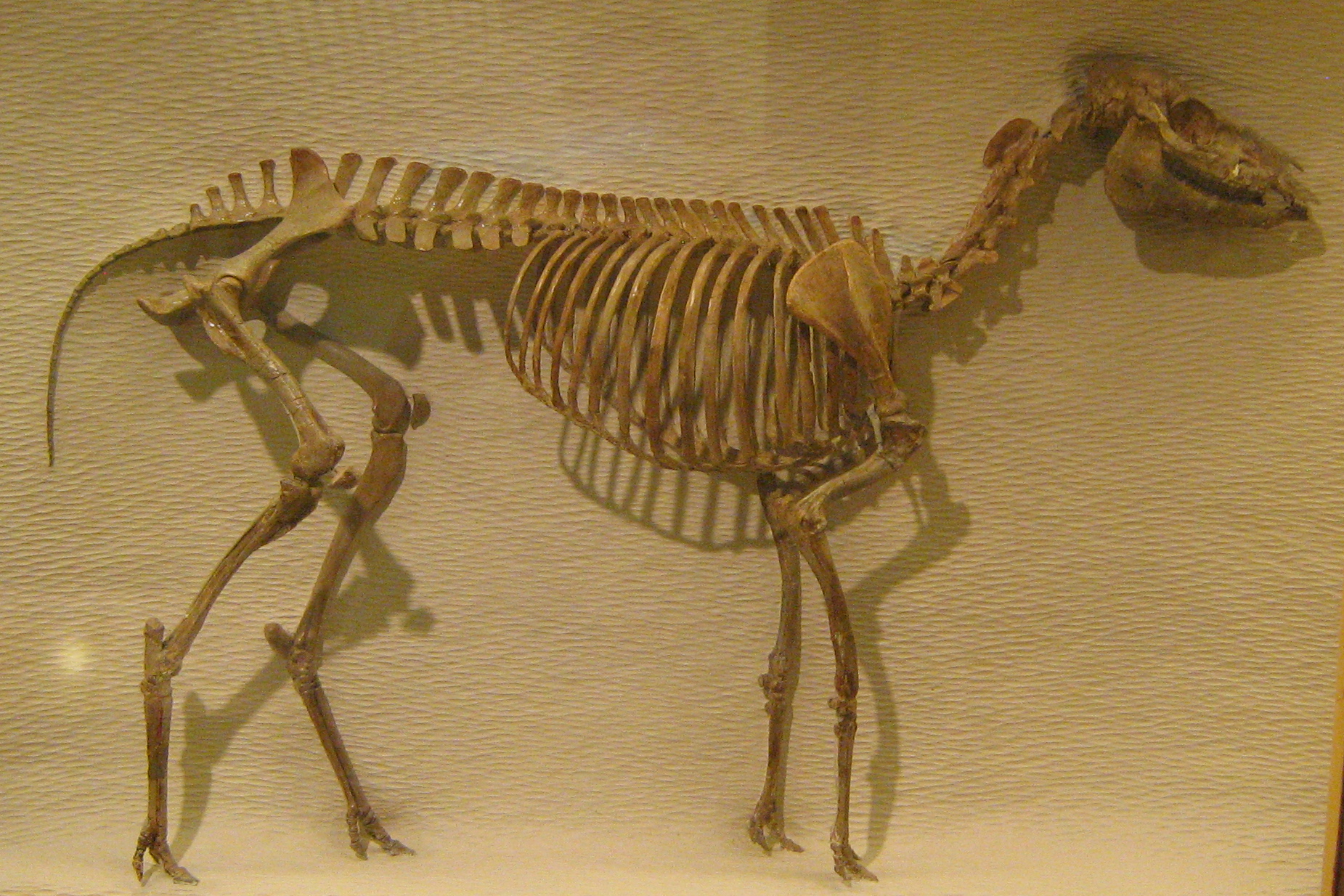
Mesohippus barbouri skeleton at the Harvard Museum of Natural History
Scientific classification Edit this classification
Kingdom: Animalia
Phylum: Chordata
Class: Mammalia
Order: Perissodactyla
Family: Equidae
Subfamily: Anchitheriinae
Genus: Mesohippus
Marsh, 1875
Species

See text

Mesohippus (Greek: μεσο/meso meaning "middle" and ιππος/hippos meaning "horse") is an extinct genus of early horse. It lived 37 to 32 million years ago in the Early Oligocene.[1][2] Like many fossil horses, Mesohippus was common in North America. Its shoulder height is estimated at 60 cm.[3]

Description

[edit]
Restoration by Charles R. Knight

Mesohippus had longer legs than its predecessor Eohippus and stood about 60 cm (6 hands) tall. This equid is the first fully tridactyl horse in the evolutionary record, with the third digit being longer and larger than its first and second digits; Mesohippus had not developed a hoof at this point, rather it still had pads as seen in Hyracotherium and Orohippus.[4] The face of Mesohippus was longer and larger than earlier equids. It had a slight facial fossa, or depression, in the skull. The eyes were rounder, and were set wider apart and further back than in Hyracotherium.

Skeleton

Unlike earlier horses, its teeth were low crowned and contained a single gap behind the front teeth, where the bit now rests in the modern horse. In addition, it had another grinding tooth, making a total of six. Mesohippus was a browser that fed on tender twigs and fruit.[5] The cerebral hemisphere, or cranial cavity, was notably larger than that of its predecessors and its brain was similar to modern horses.

Species

[edit]
  • M. bairdi
  • M. barbouri
  • M. braquistylus
  • M. equiceps
  • M. hypostylus
  • M. intermedius
  • M. latidens
  • M. longiceps
  • M. metulophus
  • M. montanensis
  • M. obliquidens
  • M. proteulophus
  • M. westoni

See also

[edit]

References

[edit]
Revisions and contributorsEdit on WikipediaRead on Wikipedia
from Grokipedia
Mesohippus (from Greek: meso meaning "middle" and hippos meaning "horse") is an extinct genus of small, three-toed horses that lived during the late Eocene to early Oligocene epochs, approximately 37 to 30 million years ago, in North America. Fossils of Mesohippus have been discovered primarily in the Great Plains region, including sites in Colorado, Nebraska, the Dakotas, and western North Dakota, as well as in Canada. Measuring about 2 feet (0.6 meters) tall at the shoulder and up to 4 feet (1.2 meters) long, it was roughly the size of a modern sheep or small deer, with longer legs than its ancestors for improved mobility. Unlike earlier equids such as Hyracotherium (formerly Eohippus), which had four toes on the front feet and three on the hind, Mesohippus retained only three toes on each foot, marking a key step toward the single-toed structure of modern horses. Its teeth featured low-crowned molars and molariform premolars adapted for grinding tougher vegetation, reflecting a browsing diet of leaves and possibly emerging grasses in forested habitats. As an intermediate form in equid , Mesohippus bridged the gap between primitive Eocene horses and more advanced and genera, such as and later grazing specialists like Merychippus. It exhibited enhanced dental for processing a broader range of plant material compared to its predecessors, whose teeth were suited mainly for softer fruits and foliage. The genus is known from numerous well-preserved skeletons, including casts and partial remains that reveal its lightweight build and (running) limb structure, suited to open woodlands rather than dense forests. Mesohippus species, such as M. bairdi and M. westoni, show slight variations in size and tooth morphology across sites, indicating to regional environments during the Eocene- transition, a period of climatic cooling and diversification in the .

Taxonomy

Classification

Mesohippus is classified in the domain Eukaryota, kingdom Animalia, phylum Chordata, class Mammalia, order Perissodactyla, family Equidae, subfamily Anchitheriinae, and genus Mesohippus. The genus was first described by Othniel Charles Marsh in 1875, based on dental and skeletal fossils from the late Eocene White River Group in North America, establishing it as a member of the family Equidae. In 1895, and Jacob Lawson Wortman formally placed Mesohippus within the subfamily Anchitheriinae, recognizing its intermediate position among early equids with three functional toes and browsing-adapted dentition. This placement distinguishes Anchitheriinae, which includes Mesohippus as an early representative from the late Eocene to early , from the more primitive Hyracotheriinae subfamily (exemplified by from the early Eocene) and the more derived subfamily that emerged later in the with increased hypsodonty and adaptations. Subsequent revisions, such as the 1989 analysis by Donald R. Prothero and Neil Shubin, refined the boundaries between Mesohippus and the closely related genus based on cranial and postcranial morphology, confirming Anchitheriinae as the appropriate subfamily while noting overlaps in temporal and geographic ranges.

Discovery and naming

The genus Mesohippus was named by American paleontologist in 1875, as part of his extensive work on early horse fossils during the "Bone Wars," an intense rivalry with that accelerated vertebrate paleontology in from the 1870s to 1890s. The name derives from the Greek words mesos (middle) and hippos (horse), highlighting its position as an intermediate form in horse evolution between earlier and later equids. Marsh established Mesohippus based on dental and skeletal material, designating the type species as M. bairdi, which he synonymized with Joseph Leidy's earlier Palaeotherium bairdii from 1850. Initial fossil discoveries of Mesohippus occurred in the mid-, with Leidy's description of P. bairdi drawn from specimens collected in 1850 by T. A. Culbertson from the White River Group in what is now . The (USNM V3812) consists of lower jaw fragments with teeth, representing an early equid (approximately 33.5–32 million years ago) from these strata. By the late , additional Mesohippus remains were unearthed from the White River Group formations in , , and , often by field teams funded by Marsh and Cope amid their competitive excavations. Subsequent 20th-century finds expanded the known geographic range of Mesohippus beyond the initial White River localities to include sites in , such as the and other deposits, as well as Montana's White River equivalents and the Cypress Hills Formation in , .

Physical description

Size and build

Mesohippus exhibited a body size intermediate between its Eocene predecessors, such as , and later equids, averaging a height of approximately 60 cm (24 inches or about 6 hands high) across various . This made it roughly twice the height of , which stood around 25–50 cm at the , while remaining significantly smaller than forms like Merychippus, which reached up to 1 m. The overall build was slender and agile, with a body length estimated at about 1.2 m, facilitating enhanced mobility in its woodland habitats. The limbs of Mesohippus were tridactyl, featuring three functional toes on both fore- and hindfeet, with the central third digit elongated and primary for , while the lateral second and fourth digits provided substantial support. This structure, combined with a subunguligrade posture, allowed for efficient load distribution, reducing stress on the central metacarpal during locomotion (e.g., posterior stress of approximately -77 MPa during performance ). Unlike modern horses, Mesohippus retained soft digital pads rather than hardened hooves, aiding in force absorption and shock mitigation on varied terrains. The legs were notably elongated relative to the body, indicative of early adaptations for greater speed and stability compared to its four-toed ancestors. Mesohippus also displayed a larger braincase than its predecessors, with expanded cerebral hemispheres that marked a shift toward a more equine neural organization. These changes, including broader and higher cerebral regions, reflected increased encephalization while still retaining primitive features relative to later equids. This cranial expansion contributed to the animal's overall agile morphology, supporting sensory and motor enhancements suited to its lifestyle.

Cranial and dental features

The skull of Mesohippus exhibited an elongated, horse-like structure, characterized by a longer and larger face compared to earlier equids such as Hyracotherium, with a deep, short, and tapering facial region. This configuration included a slight facial fossa, or depression, on the maxilla just in front of the orbit, representing an early development of a feature that became more pronounced in later equids. The cranium was long, narrow, and low, with a straight craniofacial axis and orbits positioned far forward on the skull, their anterior rims aligning approximately over the first molar. The eyes of Mesohippus were rounder than those of Eocene ancestors and set wider apart, with their forward placement contributing to enhanced capabilities relative to predecessors. The nasal bones were long and narrow, broadening posteriorly before tapering to blunt tips, while the zygomatic arches were slender and extended, supporting the overall lightweight cranial build. Internally, the brain of Mesohippus showed notable advancements, with enlarged cerebral hemispheres that were well-convoluted and indicated improved sensory integration and cognitive compared to Eocene forms like Eohippus. The was approximately one-third the weight of that in modern horses, featuring narrower anteriorly tapering hemispheres, larger olfactory lobes, and a configuration where the and did not contact each other, alongside deep transverse frontal sulci and longitudinal parietal-occipital sulci. Dentally, Mesohippus possessed low-crowned (brachyodont) molars that were selenodont, with finely wrinkled and tuberculated enamel, adapted for grinding foliage. It had six grinding cheek teeth per quadrant, including premolars that were largely molariform—P2 through P4 resembling molars with crests and valleys, while P1 was smaller and simpler—marking a shift from the more triangular premolars of earlier equids. The incisors were small with narrow, sharp crowns and truncated edges, flanked by small, erect canines; a short separated the canine from P1 in both jaws, facilitating efficient processing of browse.

Paleobiology

Diet and locomotion

Mesohippus was primarily a browser, feeding on soft leaves, tender twigs, fruits, and low , as inferred from its brachydont teeth adapted for grinding non-abrasive matter. These low-crowned, lophodont-like molars facilitated the processing of leafy browse typical of closed environments, with stable of enamel indicating a diet dominated by shade-grown C3 plants such as and forbs and trees. The exhibited facultative quadrupedal locomotion supported by three functional toes per foot (digits II, III, and IV), enabling agile navigation through forested terrains. Robust, divergent lateral digits on both manus and pes formed a tridactyl foot structure suited to this , with elongated phalanges suggesting enhanced mobility compared to earlier equids. Limb bone proportions in Mesohippus reflect a transitional posture, combining a lowered head position for with a that supported efficient forward movement, thus bridging adaptations from more arboreal ancestors to open-terrain capabilities. This subunguligrade stance, with digit III dominant and all three toes contacting the ground, allowed for versatile locomotion in varied conditions.

Habitat and distribution

_Mesohippus lived during the late Eocene to early epochs, approximately 37 to 32 million years ago, with its peak abundance occurring in the Chadronian and Orellan North American Land Mammal Ages. This temporal range corresponds to the Eocene-Oligocene transition, a period of significant and drying that influenced faunal distributions across . The genus was primarily distributed across western , with fossils documented from the , including the of and sites in , to the Rocky Mountain regions of , , and , and extending northward into , . These localities, often within formations like the White River Group, reflect a broad continental presence tied to fluvial and depositional environments. Mesohippus inhabited subtropical to temperate woodlands and forested floodplains characterized by dense vegetation during the late Eocene, transitioning to cooler, drier savannas with open-canopied woodland-savanna biomes by the early . These environments featured mixed C3 vegetation, including browse and emerging grasses, supporting browsing adaptations evident in its dental morphology. The shift toward aridity is evidenced by stable isotope data showing consistent dietary signals amid increasing openness in habitats.

Evolutionary role

Relation to ancestors and descendants

Mesohippus represents a successor to Eocene genera such as (also known as ), Orohippus, and intermediates like Epihippus, marking a significant transitional phase in equid . Emerging in the late Eocene around 38 million years ago, Mesohippus exhibited clear advancements over its ancestors, including a substantial increase in body size—from the dog-sized to approximately 60 cm at the shoulder—along with a reduction in digits to a functional tridactyl (three-toed) configuration on both fore- and hind feet. These changes facilitated greater mobility and stability, while the development of sharper crests and molariform premolars on low-crowned teeth allowed for more efficient processing of tougher vegetation compared to the dentition of and Orohippus. This genus served as a critical precursor to in the and later anchitheres, including Parahippus, as well as contributing to the early foundations of more advanced forms like Merychippus and Equus lineages. Mesohippus's tridactyl stance, with load-bearing side digits, evolved into more specialized forms in descendants, where side toes became reduced and non-weight-bearing, ultimately leading to the monodactyl (single-toed) condition in modern . Key innovations in Mesohippus, such as a moderately enlarged relative to Eocene ancestors—evidenced by expanded cerebral hemispheres—supported enhanced and behavioral complexity, bridging the cognitive gap between primitive equids and the more intelligent, socially adept Merychippus and Equus. Within the overarching "dawn horse" to modern progression, Mesohippus embodies a diversification phase during the Eocene-Oligocene boundary, approximately 34 million years ago, when global climate cooling led to widespread and the contraction of forested habitats in . This environmental shift favored the proliferation of open woodlands and nascent grasslands, prompting evolutionary responses in equids like Mesohippus, which adapted through improved locomotion and dietary flexibility, thereby setting the stage for the explosive radiation of grazing specialists in the .

Species diversity

The genus Mesohippus includes 13 recognized , all known from North American fossils dating primarily to the early (approximately 37–30 million years ago). The , M. bairdi, was described from early deposits in and represents a relatively small-bodied form ( around 60 cm) with primitive, low-crowned (brachydont) cheek teeth adapted for . Additional recognized comprise M. barbouri, M. braquistylus, M. equiceps, M. hypostylus, M. intermedius, M. latidens, M. longiceps, M. metulophus, M. montanensis, M. obliquidens, M. proteulophus, and M. westoni. These exhibit chronological and morphological variations across their temporal range, with earlier forms like M. bairdi and M. barbouri (from Orellan and Whitneyan stages) being smaller (metacarpal lengths 80–100 mm) and retaining simpler dental loph patterns, such as weaker hypostyles on upper molars. Later , including M. westoni and M. obliquidens (extending into late ), trend toward larger sizes ( up to 70 cm, metatarsal lengths 110–120 mm) and greater dental complexity, with more developed metalophs and ectoloph connections for enhanced grinding efficiency. Taxonomic debates persist regarding species synonymy, often driven by overlapping morphological variation in limited fossil samples. For instance, recent analyses of dental features from and suggest that M. hypostylus (originally described from the early Brule Formation) may be synonymous with M. intermedius, as both share molariform second premolars and similar protoconid-paraconid proportions, potentially representing geographic variants of a single rather than distinct .

References

Add your contribution
Related Hubs
User Avatar
No comments yet.