Hubbry Logo
search
logo
2124876

Messier 92

logo
Community Hub0 Subscribers
Read side by side
from Wikipedia
Messier 92
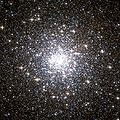
Center of M92 by HST; 1.44 view
Observation data (J2000 epoch)
ClassIV[1]
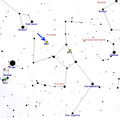
ConstellationHercules
Right ascension17h 17m 07.39s[2]
Declination+43° 08′ 09.4″[2]
Distance26.7×10^3 ly (8.2 kpc)[3]
Apparent magnitude (V)6.4[4]
Apparent dimensions (V)14' arc minutes
Physical characteristics
Mass2.0×105[5] M
Radius54 ly[6]
Metallicity[Fe/H] = –2.32[7] dex
Other designationsM92, NGC 6341, GCl 59[8]
See also: Globular cluster, List of globular clusters

Messier 92 (also known as M92, M 92, or NGC 6341) is a globular cluster of stars in the northern constellation of Hercules.

Discovery

[edit]

It was discovered by Johann Elert Bode on December 27, 1777, then published in the Berliner Astronomisches Jahrbuch during 1779.[9][10] It was inadvertently rediscovered by Charles Messier on March 18, 1781,[a] and added as the 92nd entry in his catalogue.[11] William Herschel first resolved individual stars in 1783.

Visibility

[edit]

It is one of the brighter of its sort in apparent magnitude in the northern hemisphere and in its absolute magnitude in the galaxy, but it is often overlooked by amateur astronomers due to angular proximity to bright cluster Messier 13, about 20% closer. Though when compared to M13, M92 is only slightly less bright, but about 1/3 less extended. It is visible to the naked eye under very good viewing conditions.[12] With a small telescope, M92 can be seen as a nebulous smudge even in a severely light-polluted sky, and can be further resolved in darker conditions.

Characteristics

[edit]

It is also one of the galaxy's oldest clusters. It is around 16×10^3 ly (4.9 kpc) above/below the galactic plane and 33×10^3 ly (10 kpc) from the Galactic Center.[13] It is about 26,700 light-years away from the Solar System.The half-light radius, or radius containing the upper half of its light emission, is 1.09 arcminutes (), while the tidal radius, the broadest standard measure, is 15.17. It appears only slightly flattened: its minor axis is about 89% ± 3% of the major.[3]

Characteristic of other globulars, it has little of the elements other than hydrogen and helium; astronomers term this low metallicity. Specifically, relative to the Sun, its iron abundance is [Fe/H] = –2.32 dex,[13] which is 0.5% of 1.0, on this logarithmic scale, the solar abundance.[14] This puts the estimated age range for the cluster at 11 ± 1.5 billion years.[15]

Its true diameter is 108 ly, and may have a mass corresponding to 330,000 suns.[16]

The cluster is not yet in, nor guaranteed to undergo, core collapse and the core radius figures as about 2 arcseconds (″).[13] It is an Oosterhoff type II (OoII) globular cluster, which means it belongs to the group of metal-poor clusters with longer period RR Lyrae variable stars. The 1997 Catalogue of Variable Stars in Globular Clusters listed 28 candidate variable stars in the cluster, although only 20 have been confirmed. As of 2001, there are 17 known RR Lyrae variables in Messier 92.[17] 10 X-ray sources have been detected within the 1.02 arcminute half-mass radius of the cluster, of which half are candidate cataclysmic variable stars.[18][19]

M92 is approaching us at 112 km/sec. Its coordinates indicate that the Earth's North Celestial Pole periodically passes less than one degree of this cluster during the precession of Earth's axis. Thus, M92 was a "Polarissima Borealis", or "North Cluster", about 12,000 years ago (10,000 BC), and it will again in about 14,000 years (16,000 AD).[16]

The multiple stellar populations in this cluster, revealing that it hosts at least two stellar generations of stars named 1G and 2G, as well as two distinct groups of 2G stars (2GA and 2GB).[20] The helium abundances of 2GA and 2GB stars have higher mass fractions than that of the 1G stars by 0.01 and 0.04, respectively.

[edit]

See also

[edit]

References and footnotes

[edit]
[edit]
Revisions and contributorsEdit on WikipediaRead on Wikipedia
from Grokipedia
Messier 92 (M92), also known as NGC 6341, is a globular star cluster situated in the constellation Hercules, approximately 27,000 light-years from Earth.[1] It contains around 330,000 stars packed into a spherical volume spanning about 110 light-years in diameter, making it one of the brightest and densest globular clusters in the Milky Way with an apparent visual magnitude of 6.3, visible to the naked eye under dark skies.[1][2] Discovered independently by German astronomer Johann Elert Bode on December 27, 1777, and French astronomer Charles Messier on March 18, 1781, M92 was the 92nd entry in Messier's famous catalog of deep-sky objects.[1][3] As one of the Milky Way's oldest known stellar aggregates, M92 has an absolute age of 13.80 ± 0.75 billion years, nearly matching the estimated age of the universe itself at 13.8 billion years. This metal-poor cluster, primarily composed of hydrogen and helium with only trace heavier elements, belongs to the Oosterhoff type II category, characterized by its low metallicity ([Fe/H] ≈ -2.3) and predominance of blue horizontal-branch stars.[2][3] M92's scientific significance stems from its use in calibrating the ages of other globular clusters and probing the early chemical evolution of the galaxy, with studies revealing multiple stellar populations and evidence of heavy metal formation within the cluster itself.[2][4] Observations from the Hubble Space Telescope have resolved individual stars across visible and infrared wavelengths, highlighting its tightly bound structure and faint halo of surrounding stars, while recent James Webb Space Telescope images have detected even fainter, older stars, enhancing our understanding of its formation around 13 billion years ago.[1][5] Despite its proximity to the more prominent Messier 13, M92 remains a key target for studying galactic dynamics, as it approaches Earth at a radial velocity of about 120 km/s.[6]

History

Discovery and Early Observations

Messier 92 was first discovered by the German astronomer Johann Elert Bode on December 27, 1777, during his systematic sweeps of the northern sky.[1] Bode described it as a "nebula, more or less round, pretty bright, in Hercules, between two small stars, 2° 30' north of the star Eta Herculis," noting its position relative to nearby stars without resolving individual members.[7] This observation was published in the Berliner Astronomisches Jahrbuch for 1779, marking it as one of Bode's contributions to early deep-sky catalogs.[7] The cluster was independently rediscovered by French astronomer Charles Messier on March 18, 1781, as part of his ongoing comet hunts.[8] Messier cataloged it as a "nebula, fine, distinct, and very bright, between the knee and the left leg of Hercules," emphasizing its round appearance, clear center, and surrounding nebulosity that resembled a comet's nucleus, with no resolvable stars even in his one-foot telescope.[8] He compared its brightness and size to the nearby globular cluster M13, estimating its diameter at about 5 arcminutes, and positioned it by direct comparison with the star Sigma Herculis.[8] This entry added M92 to Messier's famous catalog of nebulous objects, intended to aid comet observers in distinguishing fixed deep-sky features from transient comets.[8] Early telescopic examinations advanced in 1783 when British astronomer William Herschel observed the object using his 7-foot reflector telescope.[9] Herschel was the first to resolve M92 into a cluster of very small stars, noting their concentration and estimating the object's profundity in his classification system.[9] Subsequent observations with larger instruments, including his 20-foot telescope, confirmed its brilliant, irregular structure spanning 6 to 7 arcminutes, solidifying its identification as a globular star cluster rather than a true nebula.[9] These 18th-century sightings established M92's historical context as a challenging but prominent northern object, later incorporated into broader catalogs like the New General Catalogue as NGC 6341.

Cataloging and Naming

Messier 92 was cataloged as the 92nd entry in Charles Messier's famous list of nebulae and star clusters, published in the 1784 edition of the Connaissance des Temps based on observations from 1781.[10] This designation, M92, reflects its position as one of the later additions to the catalog, observed by Messier on March 18, 1781, who described it as a "nebula, fine, distinct, and very bright, between the knee and the left leg of Hercules, with a clear, brilliant center surrounded by nebulosity, and no stars visible even in a one-foot telescope."[11] Although Messier's entry marked its formal inclusion, the cluster had been previously discovered by Johann Elert Bode in 1777, making Messier's observation a rediscovery.[6] In the late 19th century, the cluster received the designation NGC 6341 in the New General Catalogue of Nebulae and Clusters of Stars, compiled by John Louis Emil Dreyer and published in 1888 as a comprehensive revision of earlier lists like those of William Herschel.[12] Dreyer's catalog standardized positions and descriptions for thousands of deep-sky objects, drawing from observations by multiple astronomers, and NGC 6341 specifically notes the cluster's location in Hercules with a description emphasizing its globular nature and resolved stellar content.[13] Additional identifiers include Melotte 168 from Philibert Jacques Melotte's 1915 catalog of star clusters visible on Franklin-Adams Chart Plates, which lists it among globular clusters based on photographic plates.[14] The cluster's structural properties were further characterized in the 1920s through the Shapley-Sawyer concentration classification system, where Harlow Shapley and Helen Sawyer assigned Messier 92 to class IV in their 1927 Harvard College Observatory Bulletin, indicating a medium level of central star concentration compared to more tightly packed (class I) or loosely distributed (class XII) globulars.[15] This assessment was based on photographic plates showing the degree of stellar density toward the core. Messier 92 also belongs to the Oosterhoff type II group of globular clusters, a classification introduced by Pieter Oosterhoff in 1939 and refined in subsequent studies, defined by its metal-poor stellar population ([Fe/H] ≈ -2.3) and the longer mean periods (around 0.6 days) of its RR Lyrae variables, distinguishing it from metal-richer type I clusters.[2][16]

Location and Observability

Coordinates and Position

Messier 92 is located in the constellation Hercules with equatorial coordinates in the J2000 epoch of right ascension 17h 17m 07.39s and declination +43° 08′ 09.4″. These positions place the cluster near the zenith for observers in the northern hemisphere during summer evenings. In galactic coordinates, Messier 92 has a longitude of 68.34° and latitude of +34.86°, situating it well above the plane of the Milky Way. The cluster lies at a heliocentric distance of 8.3 kiloparsecs (approximately 27,000 light-years) from the Solar System. Relative to the Milky Way's structure, Messier 92 is positioned 4.7 kiloparsecs (about 15,300 light-years) above the galactic plane and 9.6 kiloparsecs (roughly 31,300 light-years) from the Galactic Center, making it a halo object orbiting the galaxy's core. Its radial velocity is -120 km/s, indicating that the cluster is approaching the Solar System.

Visibility from Earth

Messier 92 possesses an apparent visual magnitude of 6.4, which makes it just barely visible to the naked eye under exceptionally dark sky conditions away from light pollution.[17] Its angular size spans approximately 14 arcminutes in diameter, appearing as a faint, fuzzy patch rather than a resolved object without optical aid.[17] Positioned in the constellation Hercules near the distinctive Keystone asterism formed by four bright stars, Messier 92 is optimally visible during summer evenings in the Northern Hemisphere, particularly in July when Hercules is high overhead.[1] With a declination of +43°, the cluster remains circumpolar—never setting below the horizon—from latitudes greater than approximately 47° N, such as those in the United Kingdom and northward.[18] In binoculars, Messier 92 presents as a diffuse, star-like glow, while small telescopes reveal a compact, bright core surrounded by a hazy halo.[19] Telescopes with apertures of 4 inches or larger allow observers to resolve individual stars in the outer regions, unveiling the cluster's intricate structure under favorable conditions.[20] For the best views, observations should occur in dark skies rated Bortle scale 1-4 and when the cluster's altitude exceeds 30° to minimize atmospheric distortion.[1]

Physical Properties

Overall Structure and Classification

Messier 92 is a globular cluster situated in the outer halo of the Milky Way, recognized for its high central stellar density that places it among the more compact systems of its kind. As a classic example of a globular cluster, it consists of hundreds of thousands of stars bound by gravity in a roughly spherical configuration, with the majority formed in the early epochs of galactic evolution. This dense packing is evident in its morphological features, where the core hosts a significant fraction of the cluster's mass within a confined volume.[21] The cluster's structure is quantified by the Shapley-Sawyer concentration class IV, which describes a pronounced central density gradient transitioning to a sparser outer halo. This classification highlights the cluster's intermediate-to-high concentration, with stars more tightly clustered near the center compared to less concentrated globulars. The core radius measures 0.26 arcminutes, delineating the innermost region of peak density, while the half-light radius extends to 1.02 arcminutes, encompassing the area where half of the total emitted light originates. These parameters underscore the cluster's compact morphology, facilitating efficient dynamical interactions among its members.[22][23] In terms of luminosity, Messier 92 exhibits an absolute V-band magnitude of -8.21, reflecting its substantial integrated brightness and status as one of the intrinsically luminous globular clusters in the Milky Way halo. Complementing this, the cluster's metallicity is notably low at [Fe/H] = -2.31 dex, indicating a paucity of elements heavier than helium and hydrogen, a hallmark of ancient, metal-poor populations. This composition aligns with the cluster's inferred age of over 12 billion years, linking its structural stability to early cosmic conditions.[22]

Distance, Size, and Dynamics

Messier 92 lies at a distance of approximately 27,000 light-years from the Sun, placing it within the galactic halo of the Milky Way.[24] This positioning contributes to its physical scale, with the cluster spanning a diameter of 108 light-years, as determined from its angular extent and heliocentric distance.[22] The total mass of Messier 92 is estimated at 330,000 solar masses, or $ 3.3 \times 10^{5} , M_{\odot} $, reflecting the dense concentration of stars and other material bound by gravity.[25] The cluster's age is $ 13.8 \pm 0.8 $ billion years (as of 2023), positioning it among the oldest known globular clusters and providing insights into early Milky Way formation.[26] Dynamically, Messier 92 exhibits a central velocity dispersion of 6.0 km/s, indicative of the internal motions maintaining its structure against gravitational collapse.[22] Its tidal radius measures approximately 119 light-years (corresponding to an angular extent of 15.17 arcminutes), marking the boundary where the cluster's gravity balances the Milky Way's tidal forces.[27] The cluster orbits within the galactic halo on a highly eccentric path with an eccentricity of approximately 0.7, subjecting it to significant influences from galactic tides that shape its long-term evolution.[28]

Stellar Content

Variable Stars and Populations

Messier 92 is estimated to contain around 330,000 stars and displays a blue horizontal branch morphology consistent with its low overall metallicity of [Fe/H] = -2.3.[1][27][29] The cluster harbors approximately 18 known RR Lyrae variables, the majority of which are fundamental-mode RRab types, placing it in the Oosterhoff type II category with a mean RRab pulsation period of 0.63 days.[30] These variables provide key calibrations for distance estimates to the cluster and metal-poor stellar systems in the Galactic halo. In addition to RR Lyrae stars, Messier 92 includes 5 suspected cataclysmic variables detected as faint X-ray sources within its half-mass radius via Chandra observations, likely arising from dynamical interactions in the dense core.[31] The cluster also features one short-period Type II Cepheid, classified as an anomalous Cepheid (V7).[30] JWST/NIRCam imaging has identified multiple stellar populations in Messier 92, distinguished by the Na-O anticorrelation common in globular clusters. The first-generation (1G) population consists of Na-poor and O-rich stars. The second-generation (2G) stars split into two subgroups: 2GA (Na-rich with moderate O depletion) and 2GB (Na-rich with strong O depletion), with helium mass fractions enhanced by ΔY ≈ 0.01 and 0.04 relative to 1G, respectively.[32]

Notable Objects and Composition

Messier 92 features several prominent variable stars among its stellar population. The brightest RR Lyrae variable in the cluster is V3, an RRab-type pulsator. V11 stands out as a long-period RR Lyrae variable with a pulsation period of 0.80 days, contributing to the cluster's classification as an Oosterhoff type II system characterized by longer-period variables. Additionally, the cluster harbors cataclysmic variables, close binary systems where a white dwarf accretes material from a low-mass companion, leading to irregular outbursts detectable in X-ray and optical wavelengths. The chemical composition of Messier 92 reflects its status as one of the most metal-poor globular clusters in the Milky Way, with an iron abundance of [Fe/H] = -2.32, indicating a scarcity of elements heavier than helium formed primarily through supernova enrichment in the early universe.[32] The helium mass fraction is Y = 0.24, consistent with primordial values and supporting models of the cluster's horizontal branch morphology without requiring significant enhancements in second-generation stars.[33] Alpha-elements such as magnesium, silicon, calcium, and titanium exhibit enhancements relative to iron, a hallmark of core-collapse supernova contributions in metal-poor environments. Gaia astrometry provides precise systemic proper motions for the cluster, with mean values of μ_α cos δ = -3.5 ± 0.1 mas yr⁻¹ and μ_δ = -14.0 ± 0.1 mas yr⁻¹, enabling accurate membership determination and orbital modeling within the Milky Way halo.[34]

Scientific Significance

Historical Research

A pivotal advancement came in 1918 when Harlow Shapley analyzed the distances and spatial distribution of 69 globular clusters, including Messier 92, using the period-luminosity relation of RR Lyrae variables within them. Shapley's estimates placed Messier 92 at approximately 36,000 parsecs from the Sun, situating it in the galactic halo far from the plane, which supported his revolutionary model of the Milky Way's structure with the Sun offset from the center. In the 1950s, photoelectric photometry enabled more precise measurements of stellar properties in Messier 92, particularly for its RR Lyrae variables. William A. Baum's 1952 study provided the first photoelectric color-magnitude sequence for the cluster, deriving light curves and colors for key stars, including RR Lyrae types, which confirmed low metallicity and helped calibrate absolute magnitudes for distance determinations.[35] By the 1970s, dynamical modeling advanced understanding of Messier 92's internal structure and mass. Ivan King's self-consistent models from 1966 were applied to radial velocity data, with Christine Cudworth's 1976 analysis using proper motions and velocity dispersions of member stars to estimate the cluster's total mass at around 1.5×10⁵M1.5 \times 10^5 M_\odot, revealing isotropic velocity distributions consistent with relaxation processes in the core.

Modern Studies and Discoveries

In the early 2000s, Hubble Space Telescope (HST) observations of Messier 92 provided the first high-resolution color-magnitude diagrams (CMDs) that resolved distinct multiple stellar populations, revealing splits in the main sequence and broadening in the subgiant branch indicative of chemical abundance variations among stars. These findings, based on deep photometry reaching faint magnitudes, established the presence of first-generation (1G) and second-generation (2G) stars with differing light element compositions, challenging the notion of chemical homogeneity in globular clusters. The 2022 release of Gaia Data Release 3 (DR3) delivered precise proper motions for stars in Messier 92, enabling robust membership confirmation and detailed analysis of internal dynamics, confirming its halo membership. A 2023 analysis using Hubble Space Telescope data determined the absolute age of M92 to be 13.80 ± 0.75 billion years, with uncertainties dominated by distance estimates.[26] James Webb Space Telescope (JWST) NIRCam observations from 2023 onward have offered unprecedented near-infrared resolution of Messier 92's stellar populations, identifying three distinct groups—1G, 2G_A, and 2G_B—through CMDs that separate them based on helium and oxygen abundance differences (ΔY ≈ 0.01–0.04 and Δ[O/Fe] ≈ 0.2 dex).[32] Combined with HST data, these studies trace Na-O anticorrelations linking the populations, providing evidence of self-enrichment processes during the cluster's formation in the early universe, where polluter stars enriched subsequent generations with processed material.[32] The isotropic kinematics across populations suggest no dynamical segregation, implying formation within a shared progenitor environment approximately 12–13 billion years ago.[32]

References

User Avatar
No comments yet.