


Community hub
Recent from talks
Contribute something
Nothing was collected or created yet.
Chobham
View on Wikipedia
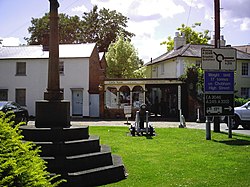
Chobham is a village and civil parish in the Borough of Surrey Heath in Surrey, England.
Key Information


The village has a small high street area, specialising in traditional trades and motor trades. The River Bourne and its northern tributary, the Hale, Mill Bourne or Windle Brook run through the village.
Chobham lost a large minority of its land to West End, in 1968, which has a larger population and was long associated with another parish. Chobham has a wide range of outlying businesses, particularly plant growing and selling businesses, science/technology and restaurants.
Chobham has no railway line; it is approximately midway between London-terminating services at Woking and Sunningdale, just under 5 miles (8.0 km) away. The village sits to the south of Chobham Common, a Site of Special Scientific Interest.
History
[edit]Neolithic flints have been found and there are several round barrows on the heaths; such as the Bee Garden in rolling Albury Bottom, a scheduled monument[2] and the "Herestraet or Via Militaris" of the Chertsey Charters ran through Chobham parish. In 1772 Roman silver coins of Gratian and of the time of a Valentinian, and copper coins of a Theodosius, Honorius, and another Valentinian, a spear-head and a gold ring, were found near Chobham Park in the parish.[3]
The village lay within the Godley hundred, a Saxon administrative area.
Chobham appears in the Domesday Book of 1086 as Cebeham held by Chertsey Abbey, as it was at the time of the conquest, with interests also acquired by the time of its survey, 1086, by two minor Norman figures, possibly bishops, Corbelin and Odin. Its Domesday assets were: 10 hides; 1 church, 1 chapel, 16 ploughs, 10 acres (4 ha) of meadow, woodland worth 130 hogs. It rendered £15 10s 0d per year.[4][5] Chabbeham is the version written in Chertsey Charter, and Chabham was the version recorded in the 13th century Patent Rolls.[3]
St Lawrence Church is on the High Street. Its earliest parts date from about 1080 although there may have been an earlier church on the site. It is dedicated to St Lawrence, who was martyred in Rome in 258.
Until the 19th century almost entirely surrounded by Chobham Common, which was heathland of little agricultural value compared to its central fertile belt, the village was isolated. During mediaeval times, Chobham remained part of the Chertsey Abbey estates. As across the whole hundred which he dominated, the power of the Abbot of Chertsey was considerable.[3]
When the railways were built in the 19th century, lines running east–west went north and south of the village, passing through the neighbouring and at the time smaller villages of Sunningdale and Woking. Thus Chobham remained largely undeveloped during the Industrial Revolution and 20th century, while Woking has grown into a large town on the South West Main Line. In the 19th century peat was cut from the soil all around the village, which provided a cheap and reliable fuel source for heat, smelting and cooking.
Landmarks
[edit]- Chobham Place or Manor
No property in the parish possessed as much land as a medieval manor would have had, since the dues of the whole parish before the English Reformation belonged to ecclesiastical landowners. However, some expansion in building and a modest amount of farming resulted from the presence of two lines of baronets: the Abdy baronets and Le Marchant baronets.[3] The buildings and estate no longer survive.
John Cordrey, the last Abbot of Chertsey, surrendered the possessions of the Abbey to the crown in the reign of Henry VIII, and in July 1558, under Queen Mary I of England, the crown sold a parcel of land for £3,000 to Nicholas Heath, Archbishop of York and Lord Chancellor. The land was inclosed by a pale, whence it was called a park, and is marked as such in Norden and Speed's map of 1610. This grant was confirmed by Queen Elizabeth, but as Heath was later deprived for refusing the statutory oaths, the nominal ownership was conveyed to his brother William in 1564. The former archbishop continued, however, to reside when his nephew Thomas forfeited his new lands in 1588. Later they were restored, and in 1606 sold to Francis Leigh. The Cope, Hale and Henn families held the lands until 1681. The Martin and Crawley families held them until the time when Mr Revel, M.P. 1734–52, is said to have been the owner. In 1758, his daughter and heiress married Sir George Warren, and in 1777 their daughter married Thomas Bulkeley, 7th Viscount Bulkeley. The latter died in 1822, leaving the land to Sir Richard Williams-Bulkeley, 10th Baronet, after which now reduced in area, it was acquired by the Le Marchant baronets.[3]
- Chobham House, Aden, or Ardern Manor
By 1911, Chobham House, which built in the 16th century as the home of minor local gentry, was only represented by a small farm-house.[3] John Ardern held land in Chobham in 1331 and in 1540 this was held by John Danaster 'seized of the manor', baron of the Exchequer, his heiress daughter married a son of the wealthy Sir Edward Bray of Shere, a name later significant in local events and architecture.[3]
- Vicarage
The vicarage was built in 1811 by the Rev. Charles Jerram, vicar 1810–34. Jerram was a noted tutor whose pupils included Lord Teignmouth and Horace Mann.[3]
- Penny Pot or Pentecost
A court roll of the time of Charles II mentions 'Stanners' and 'Pentecost' as tythings (presenting tythingmen).[3] Pennypot Cottage, dating to the 17th century, situated on the long Pennypot Lane, is a Grade II listed building.[6]
- Brook Place
Brook Place, also known as Malt House, is a Grade II*-listed building is dated "W B[ray] 1656". It was built in the Artisan Mannerist style and was mentioned as fine architecture in the History of Surrey in 1809 by Manning and Bray.[7] In 1648 this house's predecessor was the property of Edward Bray, a descendant of the Shiere family, who paid composition for his estate as a Royalist. It belonged to the manor of Aden (locally always pronounced Ardern) linked to Worplesdon but was not the manor house.[3]
- Others
In 1911 Broadford (House) was the residence of Sir Charles George Walpole and Highams, formerly occupied by Lord Bagot was the estate of Mrs Leschallas.[3]
Chobham armour
[edit]Chobham became known for the development represented by its tank factory and testing ground, producing Chobham armour. The terrain was carved out of Chobham Common.
Economy
[edit]1% of the population at the 2011 census (15 people) were employed in agriculture, forestry and fishing sector in 2011. The largest sectors of employment were Wholesale and Retail Trade; Repair of Motor Vehicles and Motor Cycles and Professional, Scientific and Technical Activities at 15% and 11% of the population respectively. Construction, manufacturing, education and health or social work, closely compete for 8% of the labour force.[1]
Amenities
[edit]The array of shops, repair garages, motor outlets and leisure services is diverse, however most international branded clothes shops and larger supermarkets are further afield. The following types of outlets are well-represented:
- Antiques Shops
- Car dealerships
- Motorbicycle dealerships
- Giftshops
- Garden/outdoor living centres and seed stores
- Restaurants[8]
Sports and leisure
[edit]Chobham F.C. were members of the Combined Counties Football League until the end of the 2010–11 season, when they were relegated to the Surrey Elite Intermediate League.
Chobham Rugby Club is a community rugby club with more than 2000 members. Players from the age of five are coached and developed with the active participation of their families in Senior, Junior, Minis, Girls and Touch Rugby sections. Five senior sides play league rugby from London 1 South (Level 6) through to the Surrey Foundation League.
Chobham has a Cricket club that run 3 League teams on a Saturday and a social side on a Sunday. The Cricket club has a colts section and run teams at U9 level through to U17 competing in West surrey youth cricket league.
Chobham & District Rifle Club celebrated its centenary in 2009. Throughout its 100 years of shooting the Club entered teams and individuals in County and National Club league competitions. Members participate in Open Meetings organised by other clubs across the south-east. These Open competitions are held at weekends, throughout the summer months, for .22 prone rifle over 50 yards/meters and 100 yards outdoors. The highpoint of the shooting year is in August when the British Championships are held at Bisley.
Geography
[edit]Soil and elevation
[edit]- Soil
The village and hamlets are chiefly on the gravel and alluvium of the stream beds, but the rest of the pre-1968 drawn parish of 9,057 acres (3,665 ha) is on the Bagshot Sands ('Formation'), with extensive peat beds.[3]
- Elevation
The Chobham Ridges rise to the west of West End to a long ridge which bounds Camberley, at 110–120 metres (360–390 ft), and Staple Hill to the north rises to 87 metres (285 ft).
The River Bourne and its northern tributary, the Hale, Mill Bourne or Windle Brook run through the village. These can flood small but well-developed parts of the village in extreme localised rainfall.[9]
The rolling basin below reaches lowest elevations of between 30 metres (98 ft) in the centre of the west and 20 metres (66 ft) where the rivers join in the centre of the east. The rivers at the western point are less than 100 metres (330 ft) apart; to the east end of the parish where the parish adjoins the landscape of the McLaren Technology Centre the rivers are finally merged along that boundary.[10]
Demography
[edit]It is not accurate to compare pre 1961 and post-1971 sets of statistics due to different borders, excluding principally West End, Surrey but also other minor neighbourhoods, smaller than villages, which left the civil parish during that period.[11]
In 2011 the population lived in 1,616 households compared to 20 fewer in 2001,[1] however the population had declined by one, which contrasts with the increase in the historic, more heavily populated part of the parish which seceded in 1968 from Chobham. This involved 1,454 acres (588 ha), leaving Chobham with, in 2001, for example 2,313 acres (936 ha).[1][12]
|
|
|
|
| Output area | Detached | Semi-detached | Terraced | Flats and apartments | Caravans/temporary/mobile homes | shared between households[1] |
|---|---|---|---|---|---|---|
| (Civil Parish) | 891 | 425 | 158 | 134 | 8 | 0 |
The average level of accommodation in the region composed of detached houses was 28%, the average that was apartments was 22.6%.
| Output area | Population | Households | % Owned outright | % Owned with a loan | hectares[1] |
|---|---|---|---|---|---|
| (Civil Parish) | 3,799 | 1,616 | 43.4% | 36.2% | 2,313 |
The proportion of households in the civil parish who owned their home outright compares to the regional average of 35.1%. The proportion who owned their home with a loan compares to the regional average of 32.5%. The remaining percent is made up of rented dwellings (plus a negligible percentage of households living rent-free).
Localities
[edit]Burrowhill
[edit]
Burrowhill the neighbourhood of the north of the village broken up from the village centre by Wishmore Cross School but is linked to it by two residential roads, one of which is a local through road from Chobham to Sunningdale.[10] There is a Farrier at Chobham Forge, two pubs and two restaurants.[13][14][15][16][17]
Coxhill Green or Mimbridge
[edit]This south-eastern semi-rural village has a network of single carriageway roads with many farms, and fewer homes than Burrowhill many of which amount to smallholdings. It is separated by a wider green buffer than the other localities and adjoins Horsell Common, which is a wooded and open space separating it from the well-developed and former village and suburb of Woking, Horsell which has a longer and wider parade of shops than Chobham. The southern boundary is the Bourne which rises in Bisley a few kilometres to the west well before it has merged with the larger Mill Bourne flowing from the north of the village and rising in Berkshire.[10]
Penny Pot, Broadford and Castle Green
[edit]These south-western and southern lightly populated linear settlements are narrowly separated from the village centre by a farmed field. Castle Green has overflowed along Guildford Road, which splits off from the old road to the Fellow Green part of West End, in the Borough of Woking.
Valley End
[edit]Most of the land of this northernmost hamlet lies north of the M3 motorway which bisects it and its church and main cluster of buildings is on the opposite side. Its church is currently described by the Church of England as 'the church off the beaten track'.[18] This is Grade II listed, built in 1867 from designs by G.F. Bodley and built in red and brown brick with stone dressed windows.[19]
Notable residents
[edit]- James Pickering Kendall born here[20]
- Peter Gabriel of the band Genesis was born here.[21]
- Simon Posford aka Hallucinogen was born here.
- Nicholas Heath, Archbishop of York and Lord Chancellor of England (buried here)[22]
- John William Navin Sullivan, the popular science writer and literary journalist, lived and worked for some years at Paradise Farm, He died there in August 1937[23] and is buried at Brookwood Cemetery.
- Graham Mitchell, former Deputy Director General of the Security Services MI5 during the period 1956–1963 lived in a large house on the edge of Chobham Common, Chobham, Surrey. He took early retirement in 1963 under a cloud of suspicion that he was a Soviet agent.[24]
- King Constantine II resided in Chobham during the first 2 years of his exile from Greece.[25]
- Thomas of Chobham, theologian and subdean of Salisbury, was born here.
- Emma Kennedy, writer and comedian joined the Parish Council in 2021.
- Charlotte Jordan, actress who portrays Daisy Midgeley on Coronation Street was born here.[26]
References
[edit]- ^ a b c d e f Key Statistics; Quick Statistics: Population Density Archived 11 February 2003 at the Wayback Machine United Kingdom Census 2011 Office for National Statistics Retrieved 21 November 2013
- ^ the Bee Garden, Ancient Earthwork by Staple Hill in Albury Bottom, Chobham Historic England. "Details from listed building database (1005950)". National Heritage List for England. Retrieved 9 October 2013.
- ^ a b c d e f g h i j k l H.E. Malden, ed. (1911). "Parishes: Chobham". A History of the County of Surrey: Volume 3. Institute of Historical Research. Archived from the original on 27 October 2014. Retrieved 9 October 2013.
- ^ Surrey Domesday Book Archived 15 July 2007 at the Wayback Machine
- ^ Domesday Map Archived 29 May 2012 at the Wayback Machine Retrieved 9 October 2013
- ^ Pennypot Cottage Grade II listing Historic England. "Details from listed building database (1030020)". National Heritage List for England. Retrieved 9 October 2013.
- ^ Historic England. "Details from listed building database (1189769)". National Heritage List for England. Retrieved 9 October 2013.
- ^ Heritage listing of a restaurant at Grade II architecturally – The Cloche Hat – Historic England. "Details from listed building database (1030028)". National Heritage List for England. Retrieved 9 October 2013.
- ^ "BBC NEWS - UK - England - Southern Counties - Flood warning after heavy showers". news.bbc.co.uk. 14 August 2006. Archived from the original on 24 August 2006. Retrieved 21 December 2006.
- ^ a b c Grid square map Archived 22 January 2021 at the Wayback Machine Ordnance survey website
- ^ "Chobham through time : Population Statistics : Total Population". A Vision of Britain through Time. Archived from the original on 10 June 2015. Retrieved 6 December 2007.
- ^ Vision of Britain – West End CP Archived 10 June 2015 at the Wayback Machine University of Portsmouth and others. Retrieved 9 October 2013
- ^ "Farriers Equipment LTD. About Us". Archived from the original on 16 December 2017. Retrieved 13 July 2017.
- ^ "The Four Horseshoes | Chobham | Surrey". Archived from the original on 3 July 2017. Retrieved 13 July 2017.
- ^ "Stovells's Chobham". Archived from the original on 24 July 2017. Retrieved 13 July 2017.
- ^ "Eastern & Oriental Restaurant - Contact Us". Archived from the original on 14 June 2017. Retrieved 13 July 2017.
- ^ "Luxit Interiors: Luxury Interior Design | Surrey | London". Archived from the original on 10 July 2017. Retrieved 13 July 2017.
- ^ You, A Church Near. "Chobham: St Lawrence, Chobham". A Church Near You. Archived from the original on 30 December 2014. Retrieved 9 October 2013.
- ^ St Saviour's Church, Valley End, Grade II listing Historic England. "Details from listed building database (1377514)". National Heritage List for England. Retrieved 9 October 2013.
- ^ Biographical Index of Former Fellows of the Royal Society of Edinburgh 1783–2002 (PDF). The Royal Society of Edinburgh. July 2006. ISBN 0-902-198-84-X. Archived (PDF) from the original on 24 January 2013. Retrieved 8 February 2017.
- ^ "Peter Gabriel Profile - Lyrics On Demand". Lyrics On Demand. Archived from the original on 2 April 2015. Retrieved 18 August 2007.
- ^ Loades, David (3 January 2008). "Heath, Nicholas (1501?–1578)". Oxford Dictionary of National Biography (online ed.). Oxford University Press. doi:10.1093/ref:odnb/12840. (Subscription, Wikipedia Library access or UK public library membership required.)
- ^ Brandt, Joseph A. (1938). "Literary landmarks of 1937". Books Abroad. 12 (1): 28–35. doi:10.2307/40079116. JSTOR 40079116.
- ^ "I was a Soviet MI5 mole suspect". Manchester Evening News. No. 34802. 26 March 1981. p. 41.
- ^ Mikhailova, Anna (25 August 2013). "Greek retreat Home to exiled king". Sunday Times. Retrieved 14 October 2023.
- ^ Blackbury, Tom (29 March 2023). "Coronation Street star Charlotte Jordan's hidden pop past in girl group formed by Geri Halliwell". Birmingham Live. Retrieved 14 October 2023.
External links
[edit]
| Towns, villages and neighbourhoods |
|  | ||||||||||||||
|---|---|---|---|---|---|---|---|---|---|---|---|---|---|---|---|---|
| Parks | ||||||||||||||||
| Listed Churches | ||||||||||||||||
| Education | ||||||||||||||||
| Transport |
| |||||||||||||||
| Buildings and structures | ||||||||||||||||
| Sport | ||||||||||||||||
Places listed are articles or sections notable as settlements, arranged by post town Camberley is the administrative centre and largest single settlement | ||||||||||||||||
| International | |
|---|---|
| National | |
| Other | |

Chobham
View on GrokipediaGeography
Location and Boundaries
Chobham is a civil parish situated in the Borough of Surrey Heath in northwest Surrey, England. It lies approximately 27 miles (43 km) southwest of central London and 9 miles (14 km) northeast of Guildford, positioning it within easy commuting distance of the capital while retaining a rural character.[6][7] The parish boundaries are defined by neighboring civil parishes: to the north by Bisley and West End, to the east by Windlesham, to the south by Bisley, and to the west by Bagshot. This configuration encompasses a total area of 23.13 km², much of which is characterized by open heathland and woodland.[8][9] Chobham lacks a railway station, with the nearest rail access at Woking station, roughly 4 miles (6 km) to the north, providing frequent services to London Waterloo. Road connectivity is strong via the A30, which runs through the area, and the M3 motorway at Junction 3, about 2 miles (3 km) south, facilitating links to London and beyond. The parish's landscape blends seamlessly with Chobham Common, a 656-hectare (1,620-acre) Site of Special Scientific Interest (SSSI) comprising lowland heath, acid grassland, wetlands, and scattered woodland, including a 574-hectare National Nature Reserve.[10][11][12][13][3]Topography and Natural Features
Chobham's topography features a gently undulating landscape typical of the Thames Basin, with elevations ranging from approximately 20 meters above sea level in the low-lying eastern areas to 120 meters in the higher western ridges near Chobham Common.[14] The terrain rises progressively westward, forming a natural escarpment that transitions from alluvial floodplains to elevated heathland plateaus, influencing local drainage patterns and vegetation distribution.[14] A prominent natural feature is Chobham Common, a 656-hectare (1,620-acre) Site of Special Scientific Interest (SSSI) comprising lowland heath, acid grassland, wetlands, and scattered woodland, including a 574-hectare National Nature Reserve.[13][3] This mosaic of habitats supports diverse biodiversity, including rare species such as sand lizards (Lacerta agilis) and nightjars (Caprimulgus europaeus), which thrive in the open heath and boggy pools dominated by heather and cross-leaved heath.[3][15] The hydrology of the area is shaped by the River Bourne, which originates from springs on Chobham Common and flows eastward through the parish, contributing to periodic flooding in low-lying zones.[16] Notable flood events, such as those in August 2006, have affected Chobham due to the river bursting its banks after heavy rainfall, highlighting vulnerabilities in the alluvial meadows along its course. Chobham Common's conservation is overseen by the Surrey Wildlife Trust in partnership with Surrey County Council, ensuring habitat management through controlled grazing and scrub removal to preserve its ecological integrity.[3] The site forms part of the broader Thames Basin Heaths Special Protection Area, safeguarding it against development pressures while promoting the recovery of threatened heathland species.[17]Geology and Soil
The geology of Chobham is dominated by the Bagshot Formation, consisting primarily of sands and gravels deposited during the Eocene epoch approximately 56 to 34 million years ago, forming the underlying structure across much of the area.[18] These pale yellow-brown to white, fine- to coarse-grained sands, often cross-bedded and locally pebbly, overlie older Tertiary strata and contribute to the region's heathland landscape.[18] Along the river valleys, such as those of the River Bourne, superficial deposits of alluvium—comprising silts, clays, and sands—have accumulated, creating thinner, more fertile layers in low-lying zones.[19] Soil profiles in Chobham are characterized by freely draining, slightly acidic sandy and loamy soils developed over the Bagshot Formation bedrock, with gravelly textures predominant in elevated areas.[20] These soils exhibit low nutrient retention and poor agricultural fertility due to their coarse texture and acidity, rendering them unsuitable for intensive farming but ideal for supporting heathland vegetation adapted to nutrient-poor conditions.[21] In higher elevations reaching up to 120 meters above Ordnance Datum along the Chobham Ridges, the Bagshot Sands form thicker, more uniform gravelly deposits, while lower areas around 20 meters feature alluvial soils with higher clay content and impeded drainage.[22] The geological composition significantly influences local development, as the sandy and gravelly soils provide stable but permeable foundations for construction, though they necessitate careful site preparation to mitigate settlement risks.[19] Alluvial deposits in valley bottoms elevate flood risk during heavy rainfall, prompting regulatory measures for new builds.[23] Historically, the abundance of gravel has led to extraction activities on Chobham Common since at least the 19th century, with documented disputes over quarrying rights in the 1870s shaping land management practices.[24]History
Prehistoric and Roman Periods
Archaeological evidence indicates that the heathlands around Chobham, including Chobham Common, were utilized by Mesolithic hunter-gatherers from approximately 10,000 to 4,000 BCE, who exploited the area's resources such as berries, nuts, fish, and game in the surrounding woodlands and wetlands.[25] While specific artifacts from Chobham are scarce, the regional pattern of Mesolithic activity on Surrey's acidic heath soils suggests transient campsites focused on foraging and small-scale hunting, with pollen evidence from nearby bogs pointing to early forest clearance by these groups.[26] During the Neolithic period (c. 4000–2500 BCE), human activity intensified with the discovery of polished flint axes and arrowheads, signaling the adoption of farming and woodworking tools suited to clearing the dense forests for agriculture and timber extraction. Key finds include a polished flint axe (c. 67mm wide) unearthed 400m north of a tumulus in Longcross Woods, near Chobham's boundary, and additional axes and arrowheads located close to the Sunningdale border, often in proximity to later Bronze Age features.[27] Excavations and surface collections on Chobham Common and adjacent areas, such as the Upper Windle Brook valley, have yielded numerous flint flakes indicative of on-site tool production, though no permanent settlements have been identified, pointing to seasonal exploitation of the heathland's game and vegetative resources.[27] These artifacts, recorded in the Surrey County Council's Sites and Monuments Record (e.g., SMR Nos. 3811 and 1865), underscore early patterns of land use tied to the region's natural bounty, including oak and hazel for tools and fuel.[27] The Bronze Age (c. 2500–800 BCE) is marked by the construction of burial barrows on higher ground around Chobham, reflecting a shift toward more structured communities and ritual practices amid continued reliance on the heath for grazing and hunting. A notable cluster includes four barrows on Brentmoor Heath at West End, adjacent to Chobham Common, with additional tumuli documented near Sunningdale, Longcross, and along ridge lines marking territorial boundaries.[28] These monuments, often aligned with prehistoric trackways, suggest the area's sandy soils supported transient pastoralism, with barrows overlying earlier Mesolithic clearings and indicating long-term cultural continuity in resource management.[29] In the Roman period (43–410 CE), evidence of occupation remains sparse and indicative of transient use rather than major settlements, with no villas identified in the Chobham area. Pottery shards and structural remains, including a stone wall, cobbled floor, kiln, and potter's wheel fragments, have been found at Bagshot, immediately adjacent to Chobham, suggesting small-scale industrial activity possibly linked to local clay sources.[30] Near the River Bourne, scatters of Roman pottery at sites like Queenwood Farm and Mizen's Farm point to episodic habitation or discard, potentially along trade routes.[31] A significant discovery is a hoard of 19 silver denarii, dating from the late Republican period to the reign of Septimius Severus (c. 193–211 CE), unearthed in January 2022 on ploughed land in Chobham; these coins, corroded by acidic soils, were dispersed over a 10m area and recorded under the Portable Antiquities Scheme, highlighting proximity to the Devil's Highway Roman road that traversed nearby Surrey heathlands en route from Londinium to Calleva Atrebatum.[31] An additional Roman coin from the eastern part of Chobham Common and an urn containing coins from a local field further attest to occasional Roman presence, likely for travel, trade, or resource gathering like timber, without evidence of permanent infrastructure.[32] This pattern aligns with the area's role as a peripheral zone to major Roman routes, fostering intermittent activity rather than sustained colonization.[31]Medieval and Early Modern Eras
Following the Norman Conquest, Chobham emerged as a significant feudal manor within the hundred of Godley in Surrey, as documented in the Domesday Book of 1086. The settlement was held by Chertsey Abbey and assessed at 10 hides of land, supporting 12 ploughlands, with a recorded population of 49 households comprising 36 villagers, 10 smallholders, and 3 slaves. Its assets included 10 acres of meadow, woodland rendering 130 swine, and 2 mills, contributing to a valuation of £15 10s in 1086, slightly down from £16 in 1066.[33][34] The medieval period saw the establishment of key institutions tied to Chertsey Abbey's oversight, including the Church of St Lawrence, founded around 1080 as one of two churches noted in Domesday. The structure retains 12th-century Romanesque features, such as the south arcade added circa 1170, reflecting early Norman architectural influences in the region. As part of the abbey's extensive estates, Chobham functioned as an outlying grange, supporting monastic agriculture and tithes that sustained the abbey's operations until its dissolution in 1537.[35][36][37] During the Tudor and Stuart eras, Chobham's landscape accommodated royal interests, particularly through Chobham Place manor, constructed in the 16th century on the former abbey lands. Acquired by Henry VIII in 1535 shortly before the abbey's dissolution, the site served as a royal hunting lodge; the king visited in 1538 and ordered alterations to enhance its use amid the surrounding Windsor Great Park. The area experienced minimal direct conflict during the English Civil War (1642–1651), though nearby Surrey gentry largely supported Parliament, with occasional skirmishes in the broader Home Counties influencing local loyalties and levies.[38][39][40] The early modern economy centered on subsistence farming, with villagers relying on arable cultivation, pastoral grazing, and common rights over the expansive heathland of Chobham Common, which provided foraging and turf-cutting opportunities. This open-field system persisted amid gradual enclosure pressures, supporting a modest growth in population to 1,329 by 1811, reflecting broader rural expansion in Surrey before industrialization.[41]19th and 20th Centuries
In the early 19th century, Chobham underwent significant agricultural changes through the enclosure of common lands, which reshaped local farming practices. The enclosure of Chobham Common Field occurred in 1842 under the General Enclosure Act of 1836, privatizing previously shared open fields and commons that had supported small-scale farming and grazing for centuries.[42] This process, part of broader parliamentary enclosures in Surrey during the period, consolidated land holdings into larger, more efficient farms but displaced many smallholders reliant on common rights, leading to increased reliance on wage labor and migration to urban areas.[43] Chobham's population grew steadily during the 19th century, reflecting gradual modernization and its strategic location near London, though railway development bypassed the village, limiting explosive growth seen elsewhere in Surrey. The parish recorded 1,176 residents in the 1801 census, rising to around 2,000 by mid-century and exceeding 2,500 by 1901, driven by agricultural stability and emerging service roles.[44] Victorian-era developments further supported community infrastructure, including the establishment of an endowed school in 1805 by Rev. Charles Jerram behind the old vicarage to educate local children, and a parish workhouse that provided relief for the poor until its conversion into Jubilee Cottages in the late 19th century commemorating Queen Victoria's jubilee.[45][46] The nearby establishment of Aldershot military camp in the 1850s, following large-scale army maneuvers on Chobham Common—including Queen Victoria's review of 8,000 troops in 1853—boosted the local economy through increased trade in provisions, lodging, and services for soldiers.[45][47] This military presence, just a few miles away, provided seasonal employment and stimulated small businesses in the village high street. The 20th century brought profound disruptions from the World Wars, with Chobham Common requisitioned by the War Office in 1942 for training, vehicle testing at the Fighting Vehicles Proving Establishment, and temporary camps housing Allied soldiers and later German and Italian prisoners of war.[48] The common's heathland sustained heavy tank maneuvers, causing environmental damage that required post-war reseeding, while the village endured air raid impacts and contributed to the war effort through local mobilization. After 1945, a severe housing shortage prompted residents to occupy disused military huts on the common as squats, easing immediate needs but highlighting reconstruction challenges.[49] Post-war suburban expansion transformed Chobham, with new housing estates emerging in areas like Castle Grove Road (eight houses by 1914, expanding later) and Alpha and Beta Roads, shifting the village from agricultural roots toward a commuter hub.[45] The construction of the M3 motorway in the late 1960s, crossing Chobham Common and severing parts of the landscape, improved access to London and facilitated this transition, though it required compensatory land exchanges and planting to mitigate boundary alterations and ecological effects.[50] By the late 20th century, employment had diversified from farming to commuting-based sectors, with the population reaching 4,143 by the 1991 census.[45]Historical Landmarks
Chobham Place, located on Chestnut Lane north of the village center, represents a significant historical manor site dating back to the medieval period. Originally part of the holdings of Chertsey Abbey, the property was acquired by Henry VIII in 1535 as part of the dissolution of the monasteries, serving briefly as a royal hunting lodge before being sold by Queen Mary I. The current structure is a fine Georgian mansion house with a small associated park, constructed in the early 19th century on the site of earlier buildings, including a moated manor that survived into the 18th century. Archaeological evaluations have revealed evidence of the medieval double moat surrounding the original house, highlighting the site's layered historical development.[51][52] The Church of St Lawrence stands as Chobham's most prominent historical landmark, with its core dating to the 12th century and serving as the parish church since at least 1080. The Grade I listed building features a 4-bay nave arcade from the 12th century on the south side, complemented by a 19th-century northern arcade added during restorations by Benjamin Ferrey in 1866; the chancel and south transept were extended in 1898. Architectural highlights include a heathstone tower rebuilt in the 17th century, crown-post roofs, and a unique south aisle roof with carved corbels depicting figures such as a green man and animals. The church contains several notable monuments, including chest tombs and wall tablets from the 18th and 19th centuries commemorating local figures like Anthony Thomas (1723) and Sir William Abdy (1803), reflecting the patronage of prominent families in the parish.[36][35] Among Chobham's other enduring historical sites, Brook Place on Bagshot Road exemplifies 17th-century artisan Mannerist architecture. This Grade II* listed building, dated 1656 on its plaque, is constructed of brown and red brick with shaped Dutch gables, a brick plinth, and string course; it includes large quadruple chimney stacks, leaded casement windows, and a single-storey porch with an arched entrance. Originally known as Malt House, it was built during the Commonwealth period, showcasing confident brickwork typical of post-Civil War prosperity among local yeoman farmers. The Old Vicarage, a Grade II listed structure from 1868 designed by G.F. Bodley, features red and brown brickwork, plain tiled roofs, and sash windows in a gabled porch, originally serving as the residence for the parish clergy. Pennypot Cottage, also Grade II listed and dating to the early 17th century, is a timber-framed building with painted brick infill and a plaintiled roof, possibly originating as a squatter's cottage on common land; it has undergone extensions in the late 17th and 18th centuries, retaining original framing and brick fireplaces. Chobham House, an 18th-century farmhouse now represented by later structures on its site, traces its origins to medieval occupation, with archaeological finds including pottery sherds indicating activity beyond the immediate building footprint.[53][54][55][56] Preservation efforts for these landmarks are overseen by local heritage organizations, including the St Lawrence Friends Heritage Trust, established in 1995 to fund restorations of the church and its hall, and the Chobham Commons Preservation Committee, which monitors sites like moated manor remains amid broader environmental protection. The village center, designated a conservation area in 1972, ensures architectural controls to maintain the historical integrity of listed buildings, while archaeological potential around former manor sites, such as Chobham Place and Chobham Park, continues to be assessed through evaluations by groups like the Surrey Archaeological Society. These initiatives emphasize the cultural significance of Chobham's built heritage, protecting structures that embody the village's evolution from medieval settlement to Georgian-era prosperity.[57][58]Governance and Development
Local Administration
Chobham is a civil parish within the Borough of Surrey Heath, administered by Surrey Heath Borough Council, and falls under the jurisdiction of Surrey County Council for higher-level services such as education and transport.[59][60] The Chobham Parish Council serves as the elected local authority, consisting of nine members elected in May 2023 for a four-year term ending in May 2027, responsible for managing community facilities including the maintenance of the village cemetery, recreation ground, and churchyards, as well as providing seasonal decorations like hanging baskets and Christmas lights.[59][61] The council also oversees allotments in response to local demand, maintains public footpaths and rights of way, and supports community events through sponsorship and grants to voluntary organizations.[62] Full council meetings occur on the last Thursday of each month at 7:30 PM in the Chobham Parish Pavilion, while planning committee meetings are held twice monthly to consult on development proposals, with final decisions made by Surrey Heath Borough Council.[63] For borough-level representation, Chobham forms part of the Windlesham & Chobham ward, which elects three independent councillors to Surrey Heath Borough Council following boundary changes implemented after the May 2023 elections.[64] At the parliamentary level, the village is included in the Surrey Heath constituency, represented by Liberal Democrat MP Dr Al Pinkerton, who was elected in the July 2024 general election.[65] Historically, Chobham's local governance evolved from the traditional vestry system, where parish affairs were managed by church vestries handling both ecclesiastical and civil duties like poor relief and highway maintenance, to the modern parish council structure established by the Local Government Act 1894, which separated civil functions and created elected parish councils to democratize local administration across rural England and Wales.[66] This act marked the formal establishment of Chobham Parish Council, empowering it to address secular community needs independently of church oversight.[67]Recent Planning and Infrastructure
In June 2025, Chobham Parish Council submitted its Neighbourhood Plan to Surrey Heath Borough Council for independent examination and adoption, covering the period from 2024 to 2038. Following submission, a Regulation 16 consultation was held from 15 July to 5 September 2025, with a summary of representations published in September 2025; as of November 2025, the plan is proceeding to independent examination, with potential adoption expected in late 2025.[68][69] The plan addresses local housing requirements based on a 2023 housing needs assessment, which identified the need for over 100 new homes, including 106 units allocated under the emerging Surrey Heath Local Plan—91 at Chobham Rugby Club and 15 at Castle Grove Road—to accommodate an aging population and demand for smaller dwellings.[69] The Neighbourhood Plan emphasizes green belt protection through Policy CH1, which directs new development to within existing settlement boundaries to preserve the openness and rural character of surrounding areas, while aligning with the National Planning Policy Framework (NPPF) 2024's provisions for reviewing and potentially redesignating 'grey belt' land—previously developed sites within the green belt that offer opportunities for sustainable growth without compromising essential green belt functions.[69][70] It also incorporates policies for biodiversity net gain and integration with green infrastructure to mitigate development impacts.[69] As of July 2024, the redevelopment of Chobham Fire Station, originally slated for 2024, was delayed until spring 2025 due to flood risk concerns raised by the Environment Agency regarding the site's location in a flood plain; the current status as of November 2025 remains unclear, though the station appears operational based on recent recruitment activities.[71] In response to national changes in permitted development rights outlined in the 2024 government consultation, Chobham Parish Council submitted feedback in April 2024, advocating for flexibilities that balance housing delivery with protections for rural amenities and agricultural land. Planning efforts in Chobham face ongoing challenges in balancing modest growth with the conservation of Chobham Common, a Site of Special Scientific Interest valued for its heathland biodiversity, where development proposals must demonstrate no adverse impacts on protected habitats.[69] Additionally, increased traffic on the M3 motorway, which borders the parish and experiences high congestion levels from over 130,000 daily vehicles, exacerbates local infrastructure strain and influences transport policies in the Neighbourhood Plan.[72]Demographics
Population Trends
Chobham's population has shown steady growth over the past two centuries, reflecting its evolution from a rural parish to a suburban village in the commuter belt of Surrey. In 1801, the population stood at 1,176 residents, primarily engaged in agriculture and local trades.[44] By the 2011 Census, this had increased to 3,799, marking a more than threefold rise driven by suburban expansion and improved transport links to London.[73] The 2021 Census recorded a population of 4,120, representing an annual growth rate of about 0.82% since 2011, consistent with broader trends in Surrey Heath borough where suburban appeal and commuting opportunities to London have sustained modest increases.[8][74] This growth underscores Chobham's role as a desirable residential area for families seeking proximity to urban centers while maintaining a village character.[75] Looking ahead, local planning policies aim at sustainable suburban development without overwhelming existing infrastructure. Demographically, Chobham remains predominantly White, with 92.5% of residents identifying as White in the 2021 Census (89.1% White British in 2011), higher than the national average and indicative of limited ethnic diversity in the parish.[76][77] The median age was 43 in 2011 (44 in 2021), exceeding the England and Wales average of 39 in 2011 (40 in 2021), reflecting an aging population profile with a notable proportion of middle-aged and older residents attracted to the area's tranquility.[78]Housing and Socioeconomics
Chobham's housing stock reflects its rural village character, dominated by single-family homes in a predominantly affluent area. According to the 2011 Census, the parish had 1,616 households, with a significant emphasis on detached properties that contribute to the area's spacious layout. The breakdown of accommodation types in 2011 highlights this preference for larger homes, as shown in the following table:| Accommodation Type | Number | Percentage |
|---|---|---|
| Detached | 891 | 55% |
| Semi-detached | 425 | 26% |
| Terraced | 158 | 10% |
| Flats | 134 | 8% |
| Total | 1,616 | 100% |