Hubbry Logo
MintonsMintonsMain
Open search
Mintons
Community hub
Mintons
logo
8 pages, 0 posts
0 subscribers
Be the first to start a discussion here.
Mintons
Mintons
from Wikipedia

Vase in coloured lead-glazed Victorian majolica, designed by Carrier-Belleuse, 1868.

Mintons was a major company in Staffordshire pottery, "Europe's leading ceramic factory during the Victorian era",[1] an independent business from 1793 to 1968. It was a leader in ceramic design, working in a number of different ceramic bodies, decorative techniques, and "a glorious pot-pourri of styles - Rococo shapes with Oriental motifs, Classical shapes with Medieval designs and Art Nouveau borders were among the many wonderful concoctions".[2] As well as pottery vessels and sculptures, the firm was a leading manufacturer of tiles and other architectural ceramics, producing work for both the Houses of Parliament and United States Capitol.

Key Information

The family continued to control the business until the mid-20th century. Mintons had the usual Staffordshire variety of company and trading names over the years, and the products of all periods are generally referred to as either "Minton", as in "Minton china", or "Mintons", the mark used on many. Mintons Ltd was the company name from 1879 onwards.[3]

History

[edit]

1793 to 1850

[edit]

The firm began in 1793 when Thomas Minton (1765–1836) founded his pottery factory in Stoke-upon-Trent, Staffordshire, England as "Thomas Minton and Sons", producing earthenware. He formed a partnership, Minton & Poulson, c.1796, with Joseph Poulson who made bone china from c.1798 in his new near-by china pottery. When Poulson died in 1808, Minton carried on alone, using Poulson's pottery for china until 1816. He built a new china pottery in 1824. No very early earthenware is marked, and perhaps a good deal of it was made for other potters. On the other hand, some very early factory records survive in the Minton Archive, which is much more complete than those of most Staffordshire firms, and the early porcelain is marked with pattern numbers, which can be tied to the surviving pattern-books.[4]

Early Mintons products were mostly standard domestic tableware in blue transfer-printed or painted earthenware, including the ever-popular Willow pattern. Minton had trained as an engraver for transfer printing with Thomas Turner. From c. 1798 production included bone china from his partner Joseph Poulson's near-by china pottery. China production ceased c. 1816 following Joseph Poulson's death in 1808, recommencing in a new pottery in 1824.

Minton was a prime mover, and the main shareholder in the Hendra Company, formed in 1800 to exploit china clay and other minerals from Cornwall. Named after Hendra Common, St Dennis, Cornwall, the partners included Minton, Poulson, Wedgwood, William Adams, and the owners of New Hall porcelain. The company was profitable for many years, reducing the cost of materials to the owning potters, and selling to other firms.[5]

Early Mintons porcelain was "decorated in the restrained Regency style",[6] much of it just with edging patterns rather than fully painted scenes, thus keeping prices within the reach of a relatively large section of the middle class.

Early porcelain
Mintons encaustic tile floor at the United States Capitol, 1856

Minton's two sons, Thomas and Herbert, were taken into partnership in 1817, but Thomas went in to the church and was ordained in 1825. Herbert had been working in the business since 1808, when he was 16, initially as a travelling salesman. On his death in 1836, Minton was succeeded by his son Herbert Minton (1793–1858), who took John Boyle as a partner to help him the same year, given the size of the business; by 1842 they had parted company.[7] Herbert developed new production techniques and took the business into new fields, notably including decorative encaustic tile making, through his association with leading architects and designers including Augustus Pugin and, it is said, Prince Albert.

Group of 5 Pugin tiles for the new St George's Cathedral, Southwark, 1847–48, with German bomb damage.

Minton entered into partnership with Michael Hollins in 1845 and formed the tile making firm of Minton, Hollins & Company, which was at the forefront of a large newly developing market as suppliers of durable decorative finishes for walls and floors in churches, public buildings, grand palaces and simple domestic houses. The firm exhibited widely at trade exhibitions throughout the world and examples of its exhibition displays are held at the Smithsonian Institution in Washington, D.C. where the company gained many prestigious contracts including tiled flooring for the United States Capitol. The "encaustic" technique allowed clays of different colours to be used in the same tile, allowing far greater decorative possibilities. Great numbers of new churches and public buildings were given floors in the tiles, and despite the protests of William Morris, many medieval church floors were "updated" with them.

Hard white unglazed "statuary porcelain", later called Parian ware due to its resemblance to Parian marble, was first introduced by Spode in the 1840s. It was further developed by Minton who employed John Bell, Hiram Powers and other famous sculptors to produce figures for reproduction. Mintons had already been making some figures in the more demanding medium of biscuit porcelain, and reused some of these moulds in Parian.[8]

In the year ended 1842, the sales of the main company Minton & Co totalled (all round £'000s) £45K, divided as follows:[9]

  • Porcelain: gilt £13K and ungilt £8K
  • Earthenware: enamelled £6K, printed £10K, "cream-colour" £4K, coloured bodies £2K
  • Ironstone: 2K

Much of the transfer printing was done by outside specialists, and "engraving done off the Works" cost £641, while "engraving done on the Works" cost £183.[10]

1820 to 1850

Mid-Victorian period

[edit]

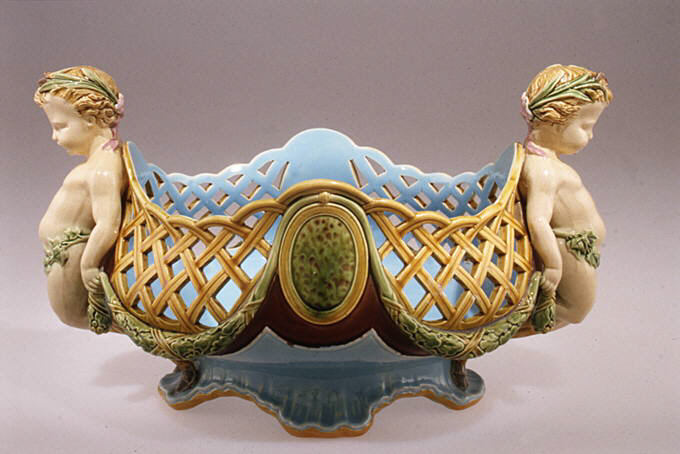
In 1849 Minton engaged a young French ceramicist Léon Arnoux as art director who remained with the Minton Company until 1892. This and other enterprising appointments enabled the company greatly to widen its product ranges. It was Arnoux who formulated[11] the tin-glaze used for Minton's rare tin-glazed Majolica together with the in-glaze metallic oxide enamels with which it was painted. He also developed the colored lead glazes and kiln technology for Minton's highly successful lead-glazed Palissy[12] ware, later also called 'majolica'. This product transformed Minton's profitability for the next thirty years. Minton tin-glazed Majolica imitated the process and style of Italian Renaissance tin-glazed maiolica resulting in fine in-glaze brush-painted decoration on an opaque whitish ground. Minton coloured glaze decorated Palissy ware/ majolica employed an existing process much improved and with an extended range of coloured lead glazes applied to the biscuit body and fired. Both products were launched at the Great Exhibition of 1851. Along with the majolica of multiple other English factories all are now grouped as Victorian majolica. The coloured glazes of Palissy ware became a Mintons staple, as well as being copied by many other firms in England and abroad.

Mintons made special pieces for the major exhibitions that were a feature of the period, beginning with the Great Exhibition of 1851 in London, where they had considerable success, winning the bronze medal for "beauty and originality of design". They followed this with a gold medal at the Exposition Universelle of 1855 in Paris. In London Queen Victoria bought Parian pieces and, for 1,000 guineas, a dessert service in a mix of bone china and Parian, which she gave to Emperor Franz Joseph of Austria; it remains in the Hofburg in Vienna.[13]

Lead-glazed "majolica", and grand Victorian showpieces
Copy in Parian ware of Hiram Powers' hit sculpture The Greek Slave, 1849. 14 1/2 inches high, where the original was life-size.

The next twenty-five years saw Mintons develop several new specialities in design and technique, while production of established styles continued unabated. As at Sèvres itself, and many other factories, wares evoking Sèvres porcelain of the 18th century had become popular from about the 1830s, and Arnoux perfected Mintons' blue and pink ground colours, essential for the Sèvres style, but much used for other wares. The Sèvres pink was called rose Pompadour, leading Mintons to call theirs rose du Barry after another royal mistress.[14] Alexandre Brongniart (1770–1847), artistic director of Sèvres had given Mintons plaster casts of some original moulds, which enabled them to make very close copies.[15] At the end of the century, when the husband of Georgina Ward, Countess of Dudley, sold his original Sèvres pot-pourri vase in the shape of a ship, a famous, spectacular and rare Sèvres shape of the 1760s (now Getty Museum) in the 1880s, Mintons were commissioned to make a copy.[16]

Parian ware, introduced in the 1840s, had become a strong area for Mintons, whose catalogue of 1852 already offered 226 figures in it, priced from an extremely modest two shillings for a dog, to six guineas for a classical figure. In that decade partly tinted Parian figures were introduced, and part-gilded ones.[17] Copies of contemporary sculptures that had been hits at the Royal Academy Summer Exhibition or elsewhere were produced at a much-reduced scale in Parian. The American sculptor Hiram Powers' hit sculpture The Greek Slave was first made in 1843 in Florence, and by the end of the decade some of the five life-size versions he made had toured several countries. Mintons first made a copy in 1848; by the version illustrated here, from 1849, the figure had lost the heavy chains between her hands, which were perhaps too expensive to make for a popular product.

Arnoux had an interest in reviving Saint-Porchaire ware, then generally known as "Henri II ware". This was very high-quality lead-glazed earthenware made from the 1520s to the 1540s in France; in 1898 the pottery was located to the village of Saint-Porchaire (nowadays a part of Bressuire, Poitou). Perhaps sixty original pieces survive, and at the time the ware had a legendary reputation. This was a very complicated ware to make, with much use of inlays of clay with different colours. Arnoux mastered the technique and then taught Charles Toft, perhaps Mintons' top modeller, who produced a small number of pieces. In addition to his influence on the production of encaustic tiles and mosaics, Arnoux also developed and produced azulejos in the Portuguese style.[18]

At some point before 1867 Mintons began to work with Christopher Dresser, often regarded as the most important British designer of the later 19th century. At that time he was beginning what became a strong interest in ceramic design, leading him to work with several other companies. His work with Mintons continued for several decades, and although the Minton Archive has many designs certainly in his hand, other pieces in his style can only be attributed to him. Dresser had travelled to Japan, and in the 1870s produced a number of designs reflecting Japanese ceramics, catching the rising fashion for Japonism in all areas of design. He was also interested in what might be called the "Anglo-Oriental" style, evoking both Islamic and East Asian design, but without precisely following anything.[19]

On his death in 1858 Herbert Minton was succeeded by his equally dynamic nephew Colin Minton Campbell who had joined the partnership in 1849, with a 1/3 share. Herbert had decreased his involvement in day-to-day management in the years before his death.[20] He took the company into a highly successful exploration of Chinese cloisonné enamels, Japanese lacquer and Turkish pottery.

Eclectic revival styles

The Franco-Prussian War of 1870 gave Arnoux the opportunity to recruit the modeller Marc-Louis Solon who had developed the technique of pâte-sur-pâte at Sèvres and brought it with him to Minton. In this process the design is built up in relief with layers of liquid slip, with each layer being allowed to dry before the next is applied. There was great demand for Solon's plaques and vases, featuring maidens and cherubs, and Minton assigned him apprentices to help the firm become the unrivaled leader in this field.

Others introduced to Minton by Arnoux included the sculptor Albert-Ernest Carrier-Belleuse and the painter Antoine Boullemier.

In 1870 Mintons opened an art pottery studio in Kensington, London directed by William Stephen Coleman and encouraged both amateur and professional artists to become involved in pottery decoration and design. This might be in hand-painted plaques, or in producing designs to be replicated in larger quantities in the Stoke factory. When the studio was destroyed by fire in 1875, it was not rebuilt.[24]

Mid-Victorian painting, 1865–1880

Late Victorian and 20th century

[edit]
Top of Secessionist Ware box, 1906

From the mid-1890s onwards, Mintons made major contributions to Art Nouveau ceramics with a fine range of slip-trailed majolica ware, many designed by Marc-Louis Solon's son Leon Solon and his colleague John Wadsworth. Leon Solon was hired by Mintons after his work was published in the hugely influential design magazine The Studio and he worked for the company from 1895 to 1905, including a brief stint as Art Director. Solon introduced designs influenced by the Vienna Secession art movement, founded by Gustav Klimt and others, and a range in earthenware made from about 1901 to 1916 was branded as "Secessionist Ware". It was made mostly using industrial techniques that kept it relatively cheap, and was aimed at a broad market. The range concentrated on items bought singly or in pairs, such as jugs or vases, rather than full table services.[25]

The Secessionist range covered both practical and ornamental wares including cheese dishes, plates, teapots, jugs and comports, vases and large jardinières. The shapes of ornamental vases included inverted trumpets, elongated cylinders and exaggerated bottle forms, although tableware shapes were conventional. Early Secessionist patterns featured realistic renderings of natural motifs—flowers, birds and human figures—but under the combined influence of Solon and Wadsworth, these became increasingly exaggerated and stylised, with the characteristic convoluted plant forms and floral motifs reaching extravagant heights.[26]

Plaque, perhaps 1909, porcelain with pâte-sur-pâte, a late work by Marc-Louis Solon.

"Secessionist Ware" was arguably the last boldly innovative move made by Mintons in terms of design. After World War I wares became rather more conventional. The Minton factory in the centre of Stoke was rebuilt and modernised after World War II by the then managing director, J. E. Hartill, a great-great-great-grandson of Thomas Minton. But the firm shared in the overall decline of the Staffordshire pottery industry in the post-war period. The tableware division was always the mainstay of Minton's fortunes and the post-1950 rationalisation of the British pottery industry took Mintons into a merger with Royal Doulton Tableware Ltd. By the 1980s Mintons was only producing a few different shapes but still employed highly skilled decorators.

Legacy

[edit]

Minton Archive

[edit]

The Minton Archive comprises papers and drawings of the designs, manufacture and production of Mintons. It was acquired by Waterford Wedgwood in 2005 along with other assets of the Royal Doulton group.[27] At one time it seemed the archive would become part of the Wedgwood Museum collection. In the event, the archive was presented by the Art Fund to the City of Stoke-on-Trent, but it was envisaged that some material would be displayed at Barlaston as well as the Potteries Museum and Art Gallery.[28]

Buildings

[edit]

The main factory on London Road, Stoke-on-Trent was demolished in the 1990s, and the other factory, including office accommodation and a Minton Museum, was demolished in 2002 as part of rationalisation within the Royal Doulton group.[29] Royal Doulton was taken over in turn by the Waterford Wedgwood group in January 2005.[30] As a result of these changes, the ceramics collection formerly in the Minton Museum was partly dispersed.[31] On the other hand, the Minton Archive has been kept together with help from the Art Fund, being transferred to the City of Stoke-on-Trent in 2015.[32]

The Victorian building on Shelton Old Road, Stoke, which used to be the Minton Hollins tileworks is on a separate site from the former Minton pottery. It was threatened with demolition in the 1980s but was listed in 1986 and has been preserved.[33][34]

Notes

[edit]

References

[edit]

Further reading

[edit]
[edit]
Revisions and contributorsEdit on WikipediaRead on Wikipedia
from Grokipedia
Mintons Ltd., commonly known as Mintons, is a historic British ceramics manufacturer founded in 1793 by Thomas Minton in , , , renowned for its high-quality , , wares, and encaustic tiles that influenced global throughout the 19th and early 20th centuries. The company originated when engraver Thomas Minton (1765–1836) partnered with skilled potter Joseph Poulson to establish a small pottery exploiting local clay and resources during the , initially producing utilitarian earthenware and pioneering production after the 1796 patent expiration. After Poulson's death in 1808, Minton rented his works and expanded into finer tablewares, pausing china production from 1815 to 1824 before resuming with innovative shapes and patterns like Poonah and Florentine. Under Herbert Minton (1793–1858), Thomas's son, the firm formalized as Minton & Co. in 1849 with partners including nephew Colin Minton Campbell and Michael Daintry Hollins, achieving international acclaim at the 1851 Great Exhibition in London through groundbreaking —vibrantly glazed, Renaissance-inspired earthenware modeled by artists like Léon Arnoux. Mintons distinguished itself with technical innovations, including the Sèvres-derived pâte-sur-pâte decoration for and large-scale encaustic s inlaid with colored clays, which adorned prestigious sites such as the U.S. Capitol extensions from 1856 to 1861 under architect Thomas U. Walter. The company split operations in 1868, with the china division trading as Mintons from around 1873 and the tile continuing separately as Minton, Hollins & Co. until mergers in the 1960s; by 1968, Mintons became a of Doulton Ltd., later integrating into in 2005. Notable products encompassed Parian statuary figures, elaborate dinner services in patterns like Byzantine and & , and monumental pieces that earned medals across international fairs from 1851 to 1894, cementing Mintons' legacy as a leader in Victorian ceramics blending artistry, industry, and export-driven commerce.

History

Founding and Early Years (1793–1836)

Thomas Minton (1765–1836), an accomplished engraver, established the foundations of what would become a prominent ceramics firm in , , in 1793. Having apprenticed at the Caughley Porcelain Works in during the early 1780s under Thomas Turner, Minton honed his skills in copperplate engraving for transfer printing. He later worked for Josiah Spode in , where he is credited with engraving the iconic , a blue transfer-printed design featuring a willow tree, bridge, and pagoda that became a staple in English production. Initially operating as an engraver and gilder of , Minton partnered with merchant Thomas Pownall and local potter Joseph Poulson to supply decorated pottery to the export market, leveraging his expertise to create high-quality transfer prints. By 1796, the partnership had evolved into Minton and Poulson, with Minton opening his own factory on land in Stoke, known later as the Eldon Place Pottery, to produce on a modest scale. Early output focused on undecorated earthenware blanks for gilding, as well as transfer-printed and blue-printed tableware, including simple domestic services like plates, bowls, and teapots in cobalt blue underglaze designs inspired by landscapes and classical motifs such as the "Broseley" and "Roman" patterns. Poulson, operating a nearby facility, contributed bone china production from around 1798, marking an early diversification, though the firm emphasized affordable, functional earthenware for everyday use. The partnership dissolved following Poulson's death in 1808, leaving Minton as sole proprietor and allowing him to streamline operations toward unpretentious yet finely executed table services. Minton's sons, Thomas Webb and Herbert, joined the business in 1817, with Herbert (born 1793) playing an increasing role in management. Upon Thomas Minton's death in 1836, Herbert inherited the firm and oversaw its continuation, shifting focus toward expanded production capabilities. Early pieces from this period bear distinctive marks, including an impressed or scripted "M" for simple , printed "Thomas Minton" in blue enamel on gilded items circa 1805–1806, and pattern-specific printed marks from 1824–1836 on transfer-printed wares, often accompanied by workmen's initials for attribution. These backstamps, typically under the base, reflect the firm's emphasis on engraved designs over elaborate decoration during its formative decades.

Victorian Expansion (1836–1900)

Under the leadership of Herbert Minton, who assumed control of the family firm following his father's death in 1836, Mintons experienced significant growth and modernization during the Victorian period. Herbert focused on expanding production capabilities, rebuilding and enlarging the factory to accommodate advanced manufacturing techniques for and decorative ceramics. This included the introduction of innovative processes that elevated the company's output from utilitarian to high-end ornamental pieces, positioning Mintons as a leader in the British pottery industry. To enhance artistic quality, Mintons recruited talented European designers, including French ceramist Léon Arnoux, appointed as art director in 1849, who oversaw technical and creative developments until 1892. Arnoux's expertise facilitated the revival of historical techniques, such as inlaid decoration inspired by styles. Additionally, French painter Émile Lessore briefly worked at the firm after moving to in the late , contributing painted designs that added painterly flair to the company's . These hires reflected Herbert Minton's strategy to blend industrial scale with artistic excellence, fostering a reputation for sophisticated ceramics. Mintons achieved international acclaim through participation in major exhibitions, beginning with the of 1851 in , where its colorful wares—lead-glazed earthenware in naturalistic and neo-Renaissance forms—earned the prestigious Council Medal, the only such award given to a British ceramics manufacturer. The firm continued to showcase its products at subsequent events, including the Paris Expositions of and 1867, and the of 1876, securing further awards and boosting global visibility. These successes underscored Mintons' shift toward high-end, export-oriented ceramics. Business strategies included strategic partnerships, such as the 1845 formation of Minton, Hollins & Co. with Michael Hollins to specialize in encaustic tiles, which expanded the firm's portfolio and market reach. This tile division drove export growth to , the , and British colonies, with products like decorative tiles appearing in prestigious buildings abroad by the . By mid-century, Mintons held a royal warrant from , granted in 1856, affirming its status as a supplier to the monarchy and sustaining prestige amid rising competition. Following Herbert Minton's death in 1858, his nephew Colin Minton Campbell took over, guiding the firm through a period of while Arnoux remained to ensure artistic continuity. Despite economic pressures from intensified industry competition in the 1870s and 1880s, which strained profitability, the company's focus on premium designs and royal patronage maintained its elite standing until the century's end.

20th Century Operations and Closure (1900–2005)

In the early , Mintons shifted toward mass production of while incorporating influences through its Secessionist Ware line, developed around 1900 by art director Léon Victor Solon and designer John Wadsworth. This range featured bold, stylized floral and geometric motifs in vibrant glazes, marking a departure from Victorian elaboration to more modern, streamlined aesthetics suitable for broader markets. By the and , the firm adapted to trends with patterns featuring geometric designs and simplified forms that aligned with the era's emphasis on functionality and elegance. World War I disrupted operations, leading to reduced output and a pivot to utilitarian to support the , with artistic production curtailed amid material shortages and labor demands. Post-war recovery in the saw a return to decorative , though designs became more conventional as the firm focused on export markets. World War II further strained resources, halting production in 1939 and redirecting efforts to essential items; rebuilding and modernization of the Stoke factory commenced immediately after 1945 under managing director J.E. Hartill, enabling resumption of high-end by the late 1940s. In 1968, Mintons merged with Tableware Ltd, retaining the Minton brand for premium lines while integrating into larger corporate structures; production continued at Stoke facilities, emphasizing traditional craftsmanship alongside mechanized processes. plc, formed in 1987, acquired (including Mintons) in 2005. The 1990s brought rationalization efforts, with the main London Road factory in Stoke closing and being demolished in 2002, shifting some overseas, including to for cost efficiency, which accelerated the decline of traditional hand-finishing techniques. By this time, output was limited to select patterns but still employed around 1,000 skilled decorators. The brand's operations ceased in 2005 amid Waterford Wedgwood's bankruptcy and restructuring, ending over two centuries of independent production; remaining stock and trademarks were absorbed, but no new Minton pieces have been manufactured since. Post-1968 backstamps typically featured the Minton name alongside "Royal Doulton" or "Wedgwood" imprints, often with pattern numbers and "Bone China England" or "Made in Indonesia" notations to reflect evolving sites. This era underscored Mintons' transition from artisanal leadership to corporate subsidiary, preserving its legacy in high-end ceramics despite industrial challenges.

Products

Tableware and Bone China

Mintons began producing in the 1820s, building on earlier experiments with to achieve greater translucency and strength in the material compared to traditional . The company refined its formula over subsequent decades, incorporating high-quality to create a durable yet delicate that rivaled French in finesse. This innovation marked a shift from Mintons' initial precursors, allowing for finer, more elegant domestic items suitable for everyday use. Among Mintons' most enduring bone china patterns for tableware were Haddon Hall, introduced in the mid-20th century with its stylized floral designs, and floral motifs such as Forget-Me-Not, featuring delicate sprays of roses, pansies, and blue forget-me-nots on white grounds trimmed in gold. These patterns adorned dinner services, tea sets, and vases, emphasizing subtle elegance over ornate excess. Production techniques for these items included hand-painting for intricate details, for luxurious edges and accents, and underglaze printing—perfected by Thomas Minton in the late and adapted for —to ensure vibrant, durable colors that resisted wear from frequent use. These methods enabled the creation of complete services, from plates and bowls to teapots and serving platters, often fired multiple times to fuse decorations seamlessly with the body. Positioned as affordable luxury, Mintons' bone china appealed to the Victorian , offering high-quality at prices accessible beyond , while evolving into export-oriented sets that reached international markets by the late . In the 19th and 20th centuries, variations included colored grounds like celadon green for Aesthetic Movement pieces and shaped services with scalloped or molded forms to enhance visual appeal. Identification of genuine Mintons bone china often relies on backstamps, such as the "Minton China" mark accompanied by a emblem introduced in and used through the 1870s, typically impressed or printed on the base.

Architectural Ceramics and Tiles

Mintons pioneered the production of geometric and encaustic tiles in the , driven by Herbert Minton's innovations in multi-colored clay techniques that embedded patterns directly into the tile body for superior and resistance to . These encaustic tiles, characterized by inlaid colored clays rather than surface printing, allowed for intricate designs that retained their vibrancy over time, making them ideal for high-traffic . The process involved pressing semi-dry clay powders into molds under high pressure, a method patented by Richard Prosser in and adopted by Mintons to achieve precise, uniform shapes. Key technical advancements included dust-pressing for enhanced precision and the application of specialized glazes to improve weather resistance, particularly for exterior applications. Dust-pressed tiles significantly reduced production time compared to traditional wet clay methods, while glazes provided a protective layer against and without compromising the inlaid color integrity. This combination ensured longevity, as evidenced by surviving 19th-century installations that withstand heavy use and exposure. Mintons' architectural tiles featured prominently in major projects, including the encaustic flooring for the Houses of Parliament in the 1850s, where approximately 75,000 tiles were laid between 1847 and 1852 to complement Pugin's Gothic Revival designs. Similar tiles adorned the Victoria and Albert Museum's floors, with Pugin-designed patterns in red and white clay installed around 1847–1850 for durable, decorative surfaces. Internationally, Mintons supplied encaustic tiles for the U.S. Capitol extensions starting in 1856, featuring approximately 1,000 different tile patterns in colors like and buff, covering vast areas at a cost of $0.68 to $2.03 per square foot. The firm's tile ranges evolved to include Aesthetic Movement designs in the 1870s, such as transfer-printed motifs inspired by nature and , often in sepia tones for fireplaces and interiors. By the late 19th and early 20th centuries, Mintons produced panels with flowing organic forms, alongside terracotta facades that translated ceramic techniques into sculptural building elements, such as the elaborate Ceramic Staircase at the (1865–1871). Mintons achieved significant export success, supplying encaustic and geometric tiles to Gothic Revival buildings across Britain, , and America from the 1840s onward, with early shipments to continental markets before 1850 capitalizing on the style's popularity. These exports supported restorations of medieval churches and new constructions, leveraging the tiles' durability for both ecclesiastical and civic projects. The Victorian factory expansions in facilitated this large-scale tile production by providing dedicated facilities for dust-pressing and firing. However, by , demand for custom architectural tiles declined amid the , as cheaper alternatives like and rubber flooring emerged, prompting a shift to standardized lines. This transition marked the waning of Mintons' dominance in architectural ceramics, though their legacy endured in preserved installations.

Sculptural and Decorative Ware

Mintons began producing figures in 1845, introducing an unglazed designed to mimic the appearance of from the Greek island of . This statuary , characterized by its fine, vitrified body and detailed modeling, allowed for the creation of classical busts, scenes, and sculptural groups that appealed to middle-class collectors seeking affordable art. The material's smooth, matte finish and ability to capture intricate details made it ideal for standalone decorative pieces, distinct from functional . Between 1846 and 1910, Mintons manufactured over 500 different Parian designs, including replicas of renowned sculptures such as Hiram Powers's , first produced in porcelain by the firm in 1848. These figures often depicted mythological or sentimental themes, with examples like the Sleeping Children group from around 1847 showcasing tender, narrative compositions modeled after monuments by artists such as Sir Francis Chantrey. Such pieces highlighted Mintons' expertise in fine sculpting, emphasizing aesthetic elegance over utility. The firm also produced notable wares, including vibrantly glazed earthenware pieces inspired by designs, from the 1850s onward. In addition to figures, Mintons created decorative vases and ewers featuring raised and enamel work, frequently inspired by styles to evoke opulent historical grandeur. These items, often produced in limited editions for collectors, incorporated bold motifs and intricate surface treatments that enhanced their ornamental appeal. By the , the firm introduced Secessionist pottery, characterized by organic forms and stylized plant motifs influenced by . Following World War I, Mintons' output of sculptural and decorative ware declined due to changing market preferences and broader economic pressures on the Staffordshire pottery industry, leading to a pivot away from elaborate figurative works.

Innovations and Techniques

Majolica Production

Mintons introduced majolica production in 1849, drawing inspiration from Renaissance maiolica ceramics of Italy, but adapting the technique to use vibrant, opaque colored lead glazes applied over a bisque-fired earthenware body. This innovation was spearheaded by French ceramicist Léon Arnoux, who joined the firm that year and served as art director, developing naturalistic designs that emphasized organic forms and intricate relief work, such as the "Fountain" and "Shell" centerpieces. Arnoux's contributions helped establish majolica as a hallmark of Mintons' output, blending artistic revivalism with industrial scalability. The technique gained international acclaim through exhibitions, notably earning a at the Exposition Universelle in for its pieces, which showcased bold colors and sculptural quality. Production reached its peak during the 1850s to 1870s, when Mintons manufactured a range of decorative and utilitarian items including garden seats, umbrella stands, and table ornaments, often featuring motifs of , , and in striking greens, blues, and yellows. These pieces were designed for both indoor display and outdoor use, capitalizing on the durability of the lead glazes against English weather. The manufacturing process involved molding or slip-casting the body to achieve detailed effects, followed by a bisque firing to harden the form without fully vitrifying it. Colored glazes were then painted directly onto the porous bisque surface in multiple layers, allowing for vivid opacity and depth, before a final low-temperature firing to fuse the glazes without distorting the colors. This multi-fire approach enabled the creation of complex, three-dimensional designs that mimicked natural textures like scales, leaves, and shells. Majolica proved immensely popular in Victorian interiors and gardens, serving as affordable yet luxurious accents that reflected the era's fascination with and ; numerous distinct patterns have been documented in Mintons' archives, ranging from whimsical animal figures to elaborate floral arrangements. The success of this line was supported by factory expansions in the mid-19th century, which increased capacity for large-scale production.

Pâte-sur-Pâte and Parian Ware

Mintons adopted the pâte-sur-pâte technique in the 1870s, drawing inspiration from the porcelain manufactory in , where the method had been refined earlier in the century. This intricate process involved applying successive thin layers of liquid porcelain slip—essentially "paste upon paste"—onto unfired, unglazed porcelain bodies to build up relief designs resembling classical cameos. The technique required meticulous control, as each layer had to dry slowly before the next was added, allowing artists to carve and refine details for added depth and dimensionality. Marc-Louis Solon, a skilled ceramicist who had trained at , joined Mintons in 1870 following the and became the master practitioner of pâte-sur-pâte at the firm. He established a dedicated workshop with assistants, producing exceptional pieces that showcased mythological and allegorical scenes in white slip on colored grounds. Notable examples include the "Aurora" plaque, signed by Solon and featuring ethereal figures, as well as vases depicting themes like "Amity and Discord," which highlighted the technique's sculptural potential. In parallel, Mintons pioneered around 1845 under Herbert Minton's leadership, developing this matte bisque specifically for sculptural applications to mimic the appearance of carved from the Greek island of . The body was formulated with a high proportion of , enabling it to withstand high-temperature firing—typically around 1,200–1,300°C—which produced a hard, smooth, semi-opaque finish with subtle shadows akin to 's translucency. Unlike standard , Parian was left unglazed and often cast in molds for efficiency, though finer pieces involved hand-finishing to enhance naturalistic details. Mintons produced over 500 Parian models between 1845 and the early 20th century, encompassing busts of literary figures like —such as the c. 1851 rendition by John Bell—and regal portraits including , alongside classical statues and contemporary commissions. These works catered to a growing market for affordable yet refined home , blending with artistic merit. The artistic output of both techniques remained exclusive, often limited to elite commissions and international exhibitions that underscored Mintons' prestige. Pâte-sur-pâte and Parian pieces were prominently displayed at the 1878 Exposition Universelle, where Solon's intricate vases and plaques earned acclaim for their technical innovation and aesthetic elegance. Solon's tenure at Mintons left a lasting legacy in artist training, notably mentoring apprentices like Alboin Birks, who continued the pâte-sur-pâte tradition into the early 20th century, producing signed works that preserved the firm's high standards in porcelain decoration. Early influences from art director Léon Arnoux further shaped the studio's approach to these refined methods.

Patent Processes and Designs

Mintons actively protected its through patents and design registrations, particularly in the mid-19th century, to safeguard innovations in tile production and decorative ceramics. Under the Copyright of Designs Act 1842, which provided protection for ornamental designs in categories including (Class 4), the firm registered numerous patterns and shapes for tiles and , with records held in the British patent office series BT 43 and BT 44 covering registrations from 1842 to 1883. A key technological advancement was the adoption of Richard Prosser's 1840 patent for dust-pressing, which allowed for the uniform production of ceramic tiles by compressing dry clay powder into molds, enabling mass manufacturing of high-quality , geometrical floor tiles, decorative white glazed wall tiles, and later tiles. Mintons licensed this process from the early , refining it through experimentation with clay mixes, firing temperatures, and shrinkage rates to produce tiles that became staples in by the 1850s. In 1849, Herbert Minton hired French ceramicist Léon Arnoux to develop colored lead glazes for ware, building on earlier efforts and resulting in vividly decorated that mimicked styles; these glazes were showcased at the of 1851, though specific glaze formulas were proprietary rather than formally patented that year. The firm's early intellectual property roots trace to founder Thomas Minton, who as an engraver at Spode's factory around 1780–1790 created the iconic —a design featuring a willow tree, bridge, and —which was later adapted and produced by Mintons after his establishment of the company in 1793. From the , Mintons employed impressed marks such as "Minton" alongside diamond-shaped registry symbols (indicating designs protected under the 1842–1883 system) and pattern numbers to denote registered items, often incorporating intertwined initials or cyphers for authentication. These measures helped combat imitation, as seen in legal disputes over the use of the "Minton" name on tiles in the late , amid growing competition in the majolica market during the 1870s. In the , Mintons continued innovating with patented oven designs adapted for more efficient firing, including transitions to electric post-1920s to replace traditional coal-fired bottle ovens, enhancing production of . These advancements, documented in firm records, focused on strengthening formulations for durability while maintaining translucency, though specific patents emphasized improvements over material compositions.

Notable Figures

Founders and Family Leadership

Thomas Minton (1765–1836), an engraver by trade, apprenticed at the Caughley porcelain works in where he developed skills in copper-plate engraving, notably contributing to the iconic design. In 1793, he relocated to and established a pottery factory on London Road, initially focusing on practical underglaze blue transfer-printed earthenware tablewares to meet growing demand for affordable domestic goods. Around 1796, Minton entered a with local potter Joseph Poulson, who specialized in ornamental ; this collaboration allowed Minton to expand into china production, with Poulson managing the china operations until his death in 1808, after which Minton assumed sole control by renting Poulson's facility. After the began around 1796, Minton and Poulson introduced production shortly thereafter while maintaining a reputation for reliable, high-quality table services that rivaled contemporaries like . In 1817, he brought his sons, Herbert and Thomas Webb Minton, into the business as partners, trading as Thomas Minton & Sons until his death in 1836. Herbert Minton (1793–1858), Thomas's second son, joined the firm as a teenager in 1808 and took full leadership upon his father's passing, transforming the modest operation into a leading ceramics powerhouse through strategic expansions and innovations. He modernized the factories by investing in advanced machinery and processes, such as the introduction of encaustic tile production in the 1840s and , while recruiting skilled artists like Léon Arnoux in 1849 to elevate design standards. Herbert's international travels, including a 1849 tour of with Arnoux and nephew Colin Minton Campbell, provided inspiration for new techniques like , which combined bodies with vibrant lead glazes modeled after prototypes. A key event under his guidance was the firm's prominent role in organizing and exhibiting at the 1851 in London's , where Minton's majolica and Parian displays earned a Council Medal and solidified the company's global prestige. Following Herbert's sudden death in 1858 from a heart condition, the business was placed under a family trust. Hollins, already a partner since 1845, and Campbell carried on until the formal split in 1868, with the operations passing to his nephew Colin Minton Campbell (1827–1885), who had joined as a partner in 1849, trading as Minton's Works from 1868 and later as Mintons around 1873, while the tile works passed fully to another nephew, Michael Daintry Hollins, as Minton, Hollins & Co. Campbell maintained family control through intermarriages and partnerships until the , when financial pressures led to a partial sale to shareholders, marking the shift from exclusive family ownership. Throughout their leadership, the Mintons prioritized by employing expert artisans and implementing rigorous oversight in production stages, from modeling to , to ensure consistency and excellence. They also advanced worker welfare ahead of industry norms, providing apprentices with access to local schools—including a private sponsored by the family in Stoke—and offering loans during hardships, deducted from wages, amid long hours and hazardous conditions like lead exposure in the dipping rooms. These strategies fostered a skilled and contributed to the firm's enduring reputation for craftsmanship.

Key Designers and Artists

Joseph-François-Léon Arnoux, a French ceramicist formerly at Sèvres, joined Mintons as art director in 1849 and served until 1891, where he introduced sophisticated French stylistic influences and oversaw the development of majolica glazes debuted at the 1851 Great Exhibition. Under his leadership, Mintons attracted talented French artists and produced Renaissance-inspired ceramics, Limoges-style painted wares, and vibrant majolica pieces that enhanced the firm's international reputation. Arnoux's direction emphasized artistic innovation, resulting in hundreds of designs across vases, tiles, and tableware that blended technical precision with aesthetic elegance. Marc-Louis Solon, who trained as a designer at porcelain manufactory, arrived at Mintons in 1870 amid the and became the foremost practitioner of the pâte-sur-pâte technique, layering slip to create cameo-like relief decorations on . His intricate works, often featuring classical figures such as maidens and cherubs on vases and plaques, exemplified the method's potential for sculptural depth and translucency, with producing numerous pieces that showcased his mastery until his association with the firm ended around 1904. 's contributions, honed through years of experimentation, distinguished Mintons' decorative in exhibitions and collections worldwide. Other influential non-family designers included , who from the 1870s to 1880s supplied geometric and modernist patterns for tiles and pottery, drawing from botanical and structural inspirations to create bold, simplified forms like cylindrical match pots. , a key figure in the Aesthetic Movement, contributed decorative tile designs in the 1860s and beyond, incorporating stylized motifs that reflected medieval and natural themes. Mintons also employed female artists in the late , particularly through the Art Pottery Studio established in 1871 in , where women decorated pieces with floral and naturalistic motifs under professional guidance. These designers collaborated via in-house studios and external commissions, fostering a creative environment that integrated diverse influences from , , and modernism into Mintons' output. Their collective efforts transformed Mintons from a commercial into a renowned producer of "art ," with pieces earning prizes at international exhibitions and influencing global ceramic trends.

Legacy

Archives and Collections

The Minton Archive, a comprehensive collection of historical records spanning the 18th to 20th centuries, is housed at the Stoke-on-Trent City Archives in , . Originally part of the Royal Doulton plc holdings, which preserved documents from over twenty companies including Minton, the archive measures over 33 cubic metres and encompasses business, design, and operational materials from Minton's establishment in 1793 until the closure of its main factory in 2002. Key components include thousands of watercolours, drawings, and designs by associated artists, alongside ledgers, photographs, and production documents that document the firm's industrial practices. Among the standout holdings are pattern books, with 538 volumes catalogued as "Works" and "" copies, supplemented by around 50 additional volumes in storage; these cover designs primarily from the mid-19th to mid-20th century, illustrating the of ceramic motifs and techniques. Employee records form another vital subset, featuring wage breakdowns, personnel lists, and departmental details from Minton's and operations, offering granular views of dynamics. and documentation is integrated into broader production and business files, such as recipe books and crest registers, which trace the firm's international commerce and material sourcing. Digitization initiatives began in the mid-2010s following the archive's transfer to public ownership in 2015, funded by the Art Fund, National Heritage Memorial Fund, and other donors such as the Pilgrim Trust; an online catalogue was launched that year with initial digital records, expanding to include interactive, browsable volumes by 2018 for enhanced accessibility. While specific partnerships with institutions like the V&A Museum support related ceramic collections, the Minton Archive's digital efforts focus on internal cataloguing to preserve fragile items like leather-bound pattern books. Recent enhancements include post-2015 integrations of Royal Doulton-era corporate records, reflecting the 1968 acquisition and subsequent operations up to the early 2000s. Public access is facilitated through exhibitions at the Wedgwood Museum and the Potteries Museum & Art Gallery, where select items such as design folios and historical volumes have been displayed since the archive's public handover. Loans to other museums enable broader scholarly engagement, with over 5,000 name-indexed entries aiding genealogical and historical research. The archive's research value lies in its illumination of labor conditions via employee data, global trade patterns through export logs, and design innovations across eras, serving as a cornerstone for studies in British industrial ceramics.

Buildings and Industrial Sites

Mintons' primary industrial site was established by founder Thomas Minton on London Road in , beginning operations around 1793 as an earthenware pottery. The facility expanded considerably in the early , with a new factory built in 1824 to support renewed china production under Thomas Minton's direction. By the mid-Victorian era, under Herbert Minton's leadership, the London Road works had grown into a major complex, incorporating advanced manufacturing capabilities that positioned Mintons as Europe's preeminent ceramic factory. The architectural hallmark of the London Road site was its array of traditional bottle , essential for firing and emblematic of Staffordshire's industrial landscape. Archaeological excavations at the factory have uncovered remains of four bottle-shaped dating from the mid-19th to early 20th centuries, providing insights into evolving firing technologies. Steam power was integrated into production across the Potteries region during the , enhancing efficiency at sites like Mintons, while post-1920 conversions to electricity modernized operations amid broader industrial shifts. In the and , Mintons diversified into tile manufacturing with the establishment of specialized facilities, including the Minton Hollins & Co. tile works at Shelton Old Road in , founded in and significantly expanded in the late to meet demand for encaustic and decorative tiles. This site focused on architectural ceramics until its closure around 1990, reflecting the company's pivot toward specialized products. Modern production facilities continued operations at its sites until 2002, with the brand integrating into in 2005 following Mintons' acquisition by . Preservation efforts have safeguarded elements of Mintons' industrial heritage as part of the trail, with surviving bottle kilns and structures at related sites achieving Grade II listed status for their architectural and historical value. Some former works have been repurposed into museums, residences, or interpretive spaces, contributing to initiatives that highlight the Potteries' legacy. As of 2025, Mintons' original sites feature no active production, existing primarily as ruins, memorials, and heritage landmarks amid urban redevelopment; the London Road complex was largely demolished in the early , with the footprint now occupied by commercial buildings like supermarkets. Guided heritage walks and open days continue to educate visitors on the sites' significance.

Cultural and Modern Influence

Mintons' contributions to ceramics, particularly through its Secessionist ware line introduced in the early 1900s, had a lasting impact on design movements, including elements of . Designed by Léon Victor Solon and John Wadsworth, these pieces drew from continental styles, featuring sinuous lines, organic shapes, and stylized floral motifs that influenced subsequent . The ware's innovative tubelining technique and bold glazes helped bridge Victorian opulence with modernist simplicity, inspiring reproductions in contemporary tile and pottery designs. The Minton family's philanthropy extended to , with Herbert Minton serving as a key benefactor to the Stoke-upon-Trent School of Art, established in , which trained generations of ceramic artists and modelers. This support for apprenticeship programs and art in the Potteries district shaped vocational training in the ceramics industry, influencing pottery schools worldwide by emphasizing technical innovation alongside artistic development. In the , Mintons' legacy endures through avid collecting and high auction values for rare pieces. For instance, a 19th-century pâte-sur-pâte monogrammed by Marc Louis fetched $6,710 at Case Antiques, while similar exhibition-quality items by have estimated values exceeding $15,000 in recent sales, reflecting sustained demand among collectors for their technical mastery. Vintage Minton remains globally prized for its translucency and durability, with exports of legacy items continuing to appeal in international markets due to the brand's historical prestige. As of 2025, the Minton brand is owned by the Fiskars Group but no new ceramics are produced, with its legacy maintained through vintage sales and collections.

References

Add your contribution
Related Hubs
User Avatar
No comments yet.