Hubbry Logo
Maijishan GrottoesMaijishan GrottoesMain
Open search
Maijishan Grottoes
Community hub
Maijishan Grottoes
logo
8 pages, 0 posts
0 subscribers
Be the first to start a discussion here.
Maijishan Grottoes
Maijishan Grottoes
from Wikipedia

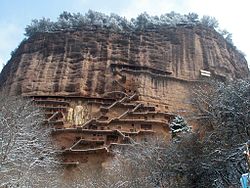
View of Maijishan hill caves, grottoes and stairways
Huge Bodhisattva sculptures at Maijishan
Sculptures in one of the Maijishan grottoes supported by tree trunks
Well preserved painted sculptures can be found in many of the grottoes

The Maijishan Grottoes (simplified Chinese: 麦积山石窟; traditional Chinese: 麥積山石窟; pinyin: Màijīshān Shíkū), formerly romanized as Maichishan, are a series of 194 rock-cut caves cut into the Maijishan hill in Tianshui, Gansu Province, northwest China. They contain over 7,200 Buddhist sculptures and over 1,000 square meters of murals.

The name Maijishan consists of three Chinese words (麦积山): mai () is the generic term for most grains, ji () means "stack" or "mound", and shan () means "mountain". Maijishan is often translated as "wheatstack mountain" or "corn rick mountain".

The mountain is formed of purplish red sandstone. Construction of the grottoes began in the Later Qin era (384–417 CE). A team of Chinese archeologists from Beijing conducted the first modern exploration in 1952–53. They devised the numbering system still in use today. Caves #1–50 are on the western cliff face, while caves #51–191 on the eastern cliff face. The grottoes were later photographed by Michael Sullivan and Dominique Darbois, who subsequently published the primary English-language work on the caves noted in the footnotes below.

The Maijishan Grottoes are just one of the string of Buddhist grottoes that can be found in this area of northwest China, lying more or less on the main routes connecting China and Central Asia. These sites, along with other archeological sites along the eastern Silk Road, were inscribed on the UNESCO World Heritage List in 2014 as part of the "Silk Roads: the Routes Network of Chang'an-Tianshan Corridor" site.[1]

History

[edit]

Maijishan is located close to the east–west route that connects Xi'an with Lanzhou and eventually Dunhuang, as well as the route that veers off to the south that connects Xi'an with Chengdu in Sichuan and regions as far south as India. At this crossroads, several of the sculptures in Maijishan from around the 6th century appear to have Indian—and SE Asian—features that could have come north via these north–south routes. The earliest artistic influence came, however, from the northwest, through Central Asia along the Silk Road. Later, during the Song and Ming Dynasties, as the caves were renovated and repaired, the influences came from central and eastern China and the sculpture is more distinctly Chinese.

Cave shrines in China probably served two purposes: originally, before Buddhism came to China, they may have been used as local shrines to worship one's ancestors or various nature deities.[2] With the coming of Buddhism to China, however, influenced by the long tradition of cave shrines from India (such as Ajanta) and Central Asia (primarily Afghanistan), they became part of China's religious architecture.

Buddhism in this part of China spread through the support of the Later Qin dynasty (384–417), one of the "Sixteen Kingdoms" that existed from 304 to 439 CE—a collection of numerous short-lived sovereign states in China. The Later Qin was ruled by the Qiang people, and their second ruler, Yao Xing, was a fervent believer of Buddhism who heavily promoted the religion to his subjects. The construction of the Maijishan Grottoes most likely began under his reign. The grottoes were later controlled by the Xianbei-led Western Qin dynasty (385–431), who showed interest in Buddhism themselves, as evidenced by their construction of another series of Buddhist grottoes, the Bingling Temple.

Sometime between 420 and 422 CE, a monk by the name of Tanhung arrived at Maijishan and proceeded to build a small monastic community. One of the legends is that he had previously been living in Chang'an but had fled to Maijishan when the city was invaded by the Sung army. Within a few years he was joined by another senior monk, Xuangao, who brought 100 followers to the mountain. Both are recorded in a book entitled Memoirs of Eminent Monks; eventually their community grew to 300 members. Xuangao later moved to the court of the local king where he remained until its conquest by the Northern Wei, when he, together with all the other inhabitants of the court, were forced to migrate and settle in the Wei capital. He died in 444 during a period of Buddhist persecution. Tanhung also left Maijishan during this period and travelled south, to somewhere in Cochin China, when in approximately 455, he burned himself to death.[3]

It is not known how the original community was organized or looked. "Nor is there any evidence to show whether the settlement they founded was destroyed and its members scattered in the suppression of 444 and the ensuring years, or whether it was saved by its remoteness to become a haven of refuge, as was to happen on several later occasions in the history of Maijishan".[4]

The Northern Wei was good to Maijishan and the grottoes existence close to the Wei capital city of Luoyang and the main road west brought the site recognition and, most likely, support. The earliest dated inscription is from 502, and records the excavation of what is now identified as Cave 115. Other inscriptions record the continued expansion of the grottoes, as works were dedicated by those with the financial means to do so.

Design

[edit]

These Wei caves are fairly simple and most follow the pattern of a seated Buddha flanked by bodhisattvas and other attendants, sometimes by monks or lay worshippers. The most common Buddha is Amitābha, the principal Buddha of the Pure Land sect. Amitābha enables all who call upon him to be reborn into his heaven, the "Pure Land". There they undergo instruction by him ultimately to become bodhisattvas and buddhas in their own right. This was a very popular school of Mahayana Buddhism during this period.

The bodhisattvas who accompany him are usually Avalokitesvara on the Buddha's right, and Mahasthamaprapta on his left. Avalokitesvara can be identified by his headdress which holds a small image of the Buddha Amitābha, and the fact that he often carries a small water flask. Sometimes he holds a heart-shaped, or pippala-leaf shaped object (which art historians still can't positively identify). Mahasthamaprapta is slightly more difficult to identify, but this is the usual pairing with Avalokitesvara (who will, in a few hundred more years, change gender and morph into the Goddess or Bodhisattva of Mercy, Guanyin).

The monks are usually the two most famous associated with the historical Buddha: the younger Ananda, and the older Kasyapa, although sometimes the monks are simply generic monks. We also find statuary of nuns and lay worshippers and donors.

Standing near the doorways guarding the Buddha and his entourage are often pairs of dvarapala or the four Heavenly Kings (lokapala).

There are also statues of the historical Buddha, Sakyamuni, and the Buddha of the Future, Maitreya, recognizable by his seated position, legs crossed at the ankle. Some of the statues of the historical Buddha show Gandharan influences from Central Asia. The clue is in the volume and drapery of the robes as well as the shape and proportions of the statue's body and head.

Nearly all of the statuary at Maijishan is made of clay with the addition of some sort of binding agent to help preserve the sculpture. When stone sculptures appear (for example, in caves 117, 127, 133 and 135), they are generally made of sandstone, and many are exquisite. The sandstone is reported not to be indigenous but instead of unknown origin. It is also unknown where the statues were made, or how they were hauled up into the caves. Of special note is Cave 133 with 23 stone stele.

Comparison

[edit]

While there are many examples of Wei statuary, there are fewer examples from the Northern Zhou, which replaced the Wei with more solid, massive, and sculptural forms. The influences mentioned earlier that came from India (and perhaps SE Asia) begin to be apparent in this period and the subsequent Sui, when stiffly posed figures are replaced by more liquid tribhanga stances.

One of the most common types of caves found at both Dunhuang and Yungang—that of a cave with a central shaft—is not found at Maijishan.

We have almost no records of Maijishan during the Tang, a period during which it was probably in part under the control of the Tibetans as a result of the An Lushan rebellion (An saw an opportunity to swoop in and capture Chang'an and its regions). Because both Dunhuang and Maijishan were under Tibetan occupation in 845 CE, the year of the great Buddhist persecutions, both were fortunately saved.

Today, we can find some Tang sculptural influence in the powerful modeling of some of the guardian deities, for example, the very large dvarapala on the narrow open terrace from which lead the Seven Buddha Halls.

Upkeep

[edit]

The Tang was also an era of noteworthy earthquakes, including a very severe one in the region in 734. The Tang poet Du Fu visited the site 25 years later, and wrote a poem entitled "Mountain Temples" that probably is a description of Maijishan. It translates:

There are few monks left in these remote shrines,

And in the wilderness the narrow paths are high.
The musk-deer sleep among the stones and bamboo,
The cockatoos peck at the golden peaches.
Streams trickle down among the paths;
Across the overhanging cliff the cells are ranged,
Their tiered chambers reaching to the very peak;

And for a 100 li one can make out the smallest thing.[5]

The Sung dynasty brought major restoration initiatives to Maijishan so that much of what visitors see today are older grottoes with new or replaced Sung-period sculpture. The most notable change in this period is the shift in emphasis from the Buddha to the bodhisattvas "shown most dramatically in Cave 191 on the extreme western [cliff] face....

"The middle Ming was a period of revival and restoration [remember this is prime earthquake zone]—the last to make any significant mark on Maijishan before the present century."[6] It was also during this period that the two huge triads of statues on the eastern and western faces of the cliff were repaired—on the southeast cliff face, a seated Maitreya with legs pendant, flanked by two standing bodhisattvas; and on the southwest cliff face, an incomplete triad of a tall standing Buddha flanked by two attendants.

In summary, construction and restoration extended over 12 dynasties at Maijishan: over the course of the Later Qin, Northern Wei, Western Wei, Northern Zhou, Sui, Tang, Period of the Five Dynasties, Song, Yuan, Ming and Qing.

Although the region has fallen victim to many earthquakes and other natural and man-made disasters, 194 caves remain, encompassing 7200 pieces of sculpture, and 1000 square meters of frescoes, all excavated on a cliff face 30 to 80 meters above ground.

Caves #1–50 are on the western cliff face; caves #51–191 on the eastern cliff face. These numbers were given the caves by the original 1952–53 Chinese archaeological team.

Forested hills covered with snow, seen from an elevated position on Maijishan
A panoramic view of the landscape around Maijishan, seen from the hill itself, in winter 2009

References

[edit]
[edit]
Revisions and contributorsEdit on WikipediaRead on Wikipedia
from Grokipedia
The Maijishan Grottoes are a complex of 194 rock-cut Buddhist caves excavated into the sheer cliffs of Maijishan (Wheat Stack Mountain), located approximately 45 kilometers southeast of City in Province, northwest . Carved at heights of 30 to 80 meters above the ground and connected by narrow, cantilevered wooden walkways, the grottoes house over 7,200 clay sculptures and more than 1,000 square meters of murals, dating primarily from the Northern Dynasties period (386–581 AD), when about 70% of the caves were created. Construction of the Maijishan Grottoes began during the Later Qin dynasty (384–417 AD), with subsequent expansions and renovations continuing through 12 successive dynasties, from the Western Qin to the Qing (up to the 18th century), reflecting the evolution of and architecture along ancient trade routes. The site's development coincided with the spread of from to via , making it a key testament to cultural and religious exchanges in the region. In 2014, the grottoes were inscribed on the World Heritage List as a component of : the Routes Network of Chang'an-Tianshan Corridor, highlighting their role in this 5,000-kilometer network of historic routes. Renowned for their exquisite clay —characterized by lively expressions, flowing robes, and dynamic poses that peaked in sophistication during the Northern Dynasties—the Maijishan Grottoes represent one of China's four greatest Buddhist cave complexes, alongside those at Yungang, Longmen, and Mogao. The murals, executed in vibrant colors depicting Buddhist narratives, , and donor portraits, cover cliff walls and ceilings, while architectural elements include the largest surviving palace-style structure from the Northern Dynasties era. As a 1,600-year-old repository of art, the site serves as an invaluable resource for studying ancient Chinese , , and techniques, though it faces ongoing preservation challenges from , weathering, and seismic activity.

Location and Setting

Geographical Position

The Maijishan Grottoes are located on the steep cliffs of Maijishan hill in Maiji District, City, Province, in northwest , at precise coordinates of 34°21′03″N 106°00′10″E. This positioning places the site approximately 40 kilometers southeast of central , within a region characterized by rugged mountainous terrain that rises abruptly from the surrounding plains. The grottoes' geographical setting aligns closely with the ancient routes, which historically linked the imperial capital of (present-day ) to , facilitating trade and cultural exchanges across . This strategic proximity underscores the site's role in the broader network of overland paths that extended westward from China's heartland. The Maijishan Scenic Spots, including the grottoes, were added to 's Tentative List in 2001 (Ref. 1631) as a mixed cultural and site and are closely associated with : the Routes Network of Chang'an-Tianshan Corridor, inscribed on the World Heritage List in 2014, recognizing their significance in the 5,000-kilometer heritage route. Administratively, the Maijishan Grottoes form the core of the Maijishan Scenic Area, a designated national 5A-level encompassing 234.22 square kilometers of protected . to the grottoes today involves to South Station followed by bus or services to the scenic area entrance, with internal shuttle paths leading to the cliffside walkways.

Environmental Context

The Maijishan hill, where the grottoes are situated, consists primarily of purple-red formations, a geological composition resulting from complex tectonic movements including the Yanshan and Himalayan orogenies. This soft, loosely cemented rises to a height of 142 meters above the surrounding landscape, forming sheer cliffs that range from 30 to 80 meters in vertical exposure and are highly susceptible to from processes such as wind, water infiltration, and salt crystallization. The hill's isolated position within the Mountains, a major north-south divide in , contributes to its dramatic of steep peaks, ravines, and streams, enhancing the site's seclusion amid a broader plateau region. The local around Maijishan is classified as a cool semi-arid continental type, characterized by cold, dry winters and warm summers with seasonal rainfall concentrated between May and , averaging around 500-600 mm annually. This precipitation pattern, while supporting on the lower slopes, exacerbates preservation challenges by increasing cave humidity and promoting moisture-related deterioration, such as powdering and flaking during rainy periods. In contrast to the arid conditions farther west, the area's semi-arid nature fosters relatively lush , including temperate broad-leaved forests covering 76% of the , with over 2,700 higher plant species encompassing rare gymnosperms like and ginkgo; this greenery thrives on the gentler lower slopes but gives way to barren, exposed cliffs higher up. Topographically, the site's isolation in the seismically active Mountains exposes it to ongoing earthquake risks, with historical records documenting over 20 destructive events in the region, including a magnitude 7.5 quake in 734 CE that severely damaged portions of the cliff face and a series of magnitude-7+ tremors. These seismic hazards, combined with the friable , have periodically altered the hill's structure, underscoring the precarious balance between natural forces and the enduring cultural features carved into it. The soft geology, while vulnerable, originally facilitated the excavation of rock-cut caves by allowing relatively straightforward carving into the cliff.

Historical Development

Early Construction

The construction of the Maijishan Grottoes commenced during the Later Qin dynasty (384–417 CE), a period marked by the promotion of among the ruling Qiang elite. The site's development was spurred by Emperor Yao Xing (r. 394–416 CE), a devout patron of the faith who invited eminent monks like to his court and supported the translation of Buddhist scriptures, fostering an environment conducive to rock-cut cave temples along trade routes. The first caves were likely carved around 400 CE, reflecting the influx of Buddhist practices from and via the . Between 402 and 416 CE, during Yao Xing's reign, the Tanhong arrived at Maijishan and established a monastic community, soon joined by the senior Xuangao. Drawing from historical accounts in the Biographies of Eminent Monks (Liang Gaoseng Zhuan) compiled by Huijiao in 519 CE, the pair meditated and attracted over 300 disciples, transforming the site into a thriving center for Buddhist practice amid its secluded, forested cliffs. This early community laid the groundwork for the grottoes' expansion, emphasizing and scriptural study before Tanhong's departure southward around 420 CE. The dynasty (386–535 CE) marked the beginning of documented expansions at Maijishan, with the earliest surviving inscription dated to 502 CE in the third year of the Jingming era. This record, found in Cave 115, details the excavation of the cave itself and signifies the site's integration into the Wei state's sponsorship of following their conquest of the region. By this period, the monastic community had solidified, supporting ongoing carving activities that built upon the Later Qin foundations.

Subsequent Developments and Restorations

Following the initial excavations during the Later Qin dynasty, construction at the Maijishan Grottoes expanded significantly during the dynasty (386–535 CE), when vigorous activity produced numerous slim and ethereal sculptures emphasizing spiritual expression, such as those in Cave 148 and Niche 98. This phase contributed to the site's early growth as a major Buddhist center in northwest . In the subsequent Western Wei (535–556 CE) and Northern Zhou (557–581 CE) dynasties, sculptural styles evolved toward greater elegance and plumpness, with key examples including the commemorative Cave 44 for Queen Yifu and the 297 base-relief on Cliff 3. The Sui (581–618 CE) and Tang (618–907 CE) periods saw further major expansions, featuring monumental works like the 16-meter seated and accompanying 13-meter Bodhisattvas in Niche 13, alongside vibrant murals depicting the Western Paradise in Cave 5. However, a devastating magnitude-7 in 734 CE during the caused widespread cliff failure, destroying the central section and dividing the complex into eastern (54 caves) and western (140 caves) parts, interrupting ongoing work. Construction resumed and flourished again in the (960–1279 CE), with notable expansions including warrior attendant figures in Cave 9 and murals blending earlier influences in Cave 4, reflecting renewed artistic vitality despite prior damages. Later, during the (1368–1644 CE), extensive repairs addressed accumulated natural deteriorations from earthquakes and erosion, resulting in the addition of simpler murals across many caves, such as the 3.1-meter in Cave 25, which now form the majority of the site's preserved wall art. Overall, these efforts across 12 dynasties—spanning Later Qin, West Qin, , , , Sui, Tang, Five Dynasties, , Yuan, , and Qing—culminated in the creation of over 194 caves through successive phases of building and restoration.

Architecture and Design

Overall Layout

The Maijishan Grottoes feature a distinctive vertical , with 194 rock-cut caves distributed along the nearly sheer face of a cliff that rises approximately 142 meters high. These caves are positioned at elevations ranging from 30 to 80 meters above the ground level, carved into a steep of 70–80 degrees to facilitate excavation and structural stability. This arrangement creates a towering, linear progression of chambers that emphasizes the site's dramatic integration with the natural , distinguishing it from more horizontally oriented complexes. The caves are divided into eastern and western clusters, separated by a central zone largely destroyed by a major earthquake in 734 CE during the , which split the cliff face and eliminated connecting structures. The eastern section contains about 54 caves, while the western holds around 140, forming two distinct but complementary groupings accessed sequentially along the cliff. Unlike sites such as the , which prominently incorporate central pillar caves for , Maijishan's overall layout generally avoids such features, favoring open and asymmetrical designs that enhance visibility and airflow within the chambers. Key structural types among the caves include single-chamber shrines for focused devotional spaces, multi-level niches that stack sculptural elements vertically within a single opening, and evoking tiered towers. Cave 133 serves as a representative example of the latter, featuring a complex, multi-tiered configuration resembling a with layered niches accommodating numerous figures, though adapted to the cliff's constraints. Visitors reach these varied forms via a network of narrow, cantilevered wooden walkways suspended along the facade, which provide safe passage while underscoring the site's precarious yet ingenious engineering.

Construction Techniques

The Maijishan Grottoes were excavated into friable cliffs, a that provided relative stability for large-scale carving despite its softness, which limited fine rock-cut detailing. Construction primarily involved top-down rock-cut excavation to ensure structural integrity, with workers using chisels hammered at oblique angles to remove material layer by layer. Due to the scarcity of wood in the region, scaffolding was minimal, often relying on temporary wooden platforms or natural cliff features for access during the multi-level digging process. Sculptures within the grottoes were created through rather than direct , given the unsuitable texture of the local conglomerate sandstone for intricate work. Artisans built armatures using cane or cores for , which were then layered with fine to form the figures, sometimes reinforced with iron wire for delicate features like fingers. Walls were prepared with applied in three successive layers: a coarse base of silty mixed with (2-3 cm thick), a finer layer incorporating or (2-5 mm), and a thin finishing coat of white lime or (0.11-0.2 mm) to provide a smooth surface for subsequent decoration. Wooden reinforcements, such as lattice frameworks, were occasionally integrated to stabilize applications or support access paths along the cliff face. Over time, construction techniques evolved from simple niches in the early periods, such as those from the Later Qin (384–417 CE) and dynasties, which emphasized basic excavation for functional spaces, to more elaborate designs influenced by aesthetics (618–907 CE). Later phases incorporated complex arched ceilings, pillars, and flattened "pingqi" tops, drawing from Central Plains architectural traditions and allowing for greater integration of plaster-modeled elements and decorative motifs like lotus patterns. This progression reflected advancements in structural imitation of wooden architecture within the rock medium, enhancing both durability and aesthetic sophistication.

Artworks

Sculptures

The Maijishan Grottoes contain over 7,200 sculptures, primarily fashioned from clay and , with some carved from , depicting an array of Buddhist figures such as seated Buddhas, bodhisattvas, disciples like Kāśyapa and , and guardian deities. These works showcase a fusion of Central Asian and indigenous Chinese artistic influences, emphasizing serene expressions and dynamic poses that convey spiritual vitality. The sculptures' materials often include lightweight armatures of wood, reeds, or hemp mixed with mud for durability against the site's humid climate. Stylistic development across dynasties is evident in the progression from elongated, graceful proportions in the period (386–534 CE), where figures appear ethereal and delicately modeled, to the more robust, lifelike forms of the (618–907 CE), featuring fuller bodies and intricate drapery that highlight human-like realism. This evolution reflects broader shifts in Buddhist and artistic techniques, with early works drawing on Indian and Gandharan inspirations before maturing into a distinctly Chinese aesthetic. Sculpture heights vary dramatically, from miniature attendant figures around 20 cm tall to colossal main images surpassing 15 meters, allowing for intimate devotional pieces alongside imposing central icons. A prominent example is the seated Amitābha Buddha in Cave 13, a Sui dynasty (581–618 CE) masterpiece measuring approximately 16 meters in height, accompanied by flanking bodhisattvas each about 13 meters tall, all rendered in clay with majestic poise and flowing robes. In Cave 123, dating to the period (535–556 CE), slender bodhisattvas and a central exhibit the era's elegant, elongated style, emphasizing spiritual detachment through minimal ornamentation. Cave 133, from the era, features ethereal flying apsaras in dynamic flight poses and 23 intricately carved stone , including the notable "Buddha Story Stele" (Stele No. 10) that narrates key episodes from Śākyamuni's life with segmented reliefs of preaching , pensive bodhisattvas like , and offering scenes.

Murals

The Maijishan Grottoes feature approximately 1,000 square meters of murals distributed across more than 130 caves, showcasing a rich array of Buddhist iconography that spans over a millennium of artistic development. These paintings primarily depict recounting the previous lives of the Buddha, paradise scenes such as the Western Paradise, and donor portraits of worshippers and patrons, reflecting the evolution of and societal changes in ancient . The murals serve as a visual of religious narratives, blending spiritual themes with elements of contemporary life, including architectural motifs and attire from various dynasties. Artistic techniques employed in these murals involve the application of mineral pigments, such as , , and lead sulfate, directly onto layers prepared on the cave walls. Early examples from the and periods (5th–6th centuries) exhibit linear styles characterized by simple, fluid curving lines that emphasize outline and form, as seen in Cave 127. By the (7th–9th centuries), the style evolved to incorporate vivid, rich colors and more dynamic compositions, evident in paradise depictions in Cave 5. Later periods, including the and (6th–13th centuries), show a melding of influences with bolder pigmentation and narrative complexity, while Ming-era additions (14th–17th centuries) tend toward simpler, flatter figures often in subdued gray tones. A notable example is the 6th-century murals in Cave 4, dating to the period, which illustrate early Buddhist narratives through integrated scenes of preaching figures and legendary events, highlighting the site's role in the dissemination of Buddhist stories. These paintings often complement the surrounding sculptures, enhancing the three-dimensional storytelling within the cave environments. Preservation challenges have significantly impacted the murals, with degradation primarily due to fading of mineral pigments caused by environmental exposure, moisture infiltration, and natural over centuries. Conservation efforts since the 1970s have focused on stabilizing the plaster substrate and analyzing pigment alterations, though much of the original vibrancy has been lost to time and prior interventions.

Significance and Comparisons

Cultural and Religious Importance

The Maijishan Grottoes serve as a profound embodiment of Buddhism, featuring sculptures and murals that depict core themes such as the life of , bodhisattvas, and enlightened beings, reflecting the religion's emphasis on and the path to enlightenment for all sentient beings. These artworks illustrate the eastward transmission of doctrines along the , where Buddhist ideas from fused with local Chinese elements, creating a unique synthesis evident in the grottoes' and spatial arrangements. Moreover, the structures themselves represent early prototypes of in , with their multi-chambered designs and devotional niches foreshadowing the layout of later freestanding temples during the Northern Dynasties. The grottoes exerted significant influence on the evolution of Chinese , marking a transition from foreign-inspired styles to more indigenous forms. Initial carvings from the Later Qin and periods (384–534 CE) show strong Indian and Central Asian influences, characterized by robust, stylized figures derived from Gandharan traditions. Over subsequent dynasties, artists at Maijishan increasingly incorporated native Chinese aesthetics, such as slender proportions, flowing drapery, and expressive facial features, which became hallmarks of Tang and later , thereby localizing within Chinese cultural contexts. This stylistic shift not only enriched China's artistic heritage but also facilitated the broader integration of into everyday religious practice. As a pilgrimage site, the Maijishan Grottoes have drawn devotees, monks, and scholars for over 1,600 years, underscoring their enduring spiritual role amid the rugged terrain of Province along ancient trade routes. Their continuous veneration across 12 dynasties—from the Later Qin to the Qing (384–1912 CE)—demonstrates remarkable historical continuity, with over 70% of the caves originating in the Northern Dynasties, preserving layers of religious devotion through periods of patronage by imperial courts and local elites. This longevity highlights the site's centrality to Buddhist practice and cultural identity in northwest . In recognition of its contributions to Silk Road heritage, the Maijishan Grottoes were inscribed on the World Heritage List in 2014 as part of the broader network of sites illustrating the routes' cultural exchanges. The inscription emphasizes the grottoes' value as tangible evidence of Buddhism's dissemination and the fusion of diverse influences, affirming their global significance in preserving humanity's shared religious and artistic legacy.

Comparisons to Other Grottoes

The Maijishan Grottoes are recognized as one of China's four major Buddhist cave temple complexes, alongside the in Province, the in Province, and the Mogao Grottoes at in Province. Like these sites, Maijishan shares core similarities in its Buddhist themes, originating from Indian rock-cut traditions transmitted via the , and evolving through dynastic periods such as the , Sui, Tang, and later eras, with artistic influences blending Indian, Central Asian, and indigenous Chinese elements. However, Maijishan distinguishes itself through its emphasis on painted clay and sculptures, totaling over 7,200 pieces, which represent a pinnacle of this medium and earned it the moniker "Oriental Art Museum." In contrast, the Yungang and prioritize massive stone carvings—such as Yungang's over 51,000 statues and Longmen's more than 100,000—while the Mogao Grottoes are renowned primarily for their expansive murals covering over 45,000 square meters, with sculptures playing a secondary role due to the site's harder rock composition. Maijishan's clay focus stems from the softer of its cliff, allowing for more fluid, expressive forms that evolve from the rigid, ethereal style to the fuller, realistic Tang aesthetics, including feminine "Yifu" influences in figures like those in Cave 44. Architecturally, Maijishan often eschews the central pillar caves common in Yungang, where such designs symbolize Mount Sumeru and facilitate multi-sided worship, opting instead for simpler niche-based layouts that highlight individual sculptures against sheer walls. Despite periods of Tibetan control during the Tang Dynasty, Maijishan's art retains strong Tang Chinese stylistic traits, such as rounded forms and dynamic poses, differing from Dunhuang's (Mogao's) pronounced Central Asian and Indo-Iranian motifs, including intricate silk road patterns and foreign donor figures. In terms of scale, Maijishan's 194 caves span a more compact 1 kilometer along a 142-meter-high cliff, accessed via precarious wooden walkways that emphasize verticality, unlike the broader, more horizontal layouts of Mogao's 492 caves or Yungang's expansive face. This steep, isolated positioning on Maiji Mountain contributes to its unique "wheat stack" silhouette and sense of ethereal elevation, setting it apart from the more accessible riverbank settings of Longmen and Yungang.

Preservation and Access

Conservation History

The conservation efforts at the Maijishan Grottoes began in pre-modern times, with significant repairs undertaken during the (960–1279) following damage from earthquakes and natural weathering. In the Northern Song period, restorers reinforced damaged structures, including large statues that had been affected by seismic activity, using techniques that preserved the original Northern Zhou-era forms while applying surface repairs to stabilize the clay sculptures. These interventions were crucial after a major earthquake (around 734 CE) had already compromised the cliff face, leading to collapses that necessitated ongoing maintenance. During the (1368–1644), further renovations focused on repairing monasteries and statues, incorporating influences from central and eastern to enhance durability through plastering and structural supports. Wooden scaffolds were employed to access the high cliff faces, allowing workers to apply protective layers over eroded surfaces and rebuild deteriorated elements of the clay figures. These efforts helped mitigate the site's vulnerability to environmental factors, though the grottoes continued to face challenges from natural , such as efflorescent salts causing material breakdown and rockfalls. In the Republican era (1912–1949), the grottoes suffered neglect amid political instability and wartime conflicts, with only a few monks providing minimal upkeep, exacerbating damage from ongoing erosion and potential impacts from regional turmoil. A key early survey in 1940 by Feng Guorui and a team from the highlighted the site's cultural value and urgent needs, marking a turning point in recognition. Post-1949, Chinese archaeologists conducted comprehensive surveys starting in the 1950s, documenting the 194 surviving caves out of an estimated original total exceeding 200, lost primarily to earthquakes, fires, and decay; these assessments laid the groundwork for systematic preservation by cataloging sculptures, murals, and structural vulnerabilities.

Modern Upkeep and Tourism

In the 2010s, digital scanning initiatives at the Maijishan Grottoes advanced preservation through and inventory projects, enabling detailed of the site's sculptures and murals to support future conservation. A comprehensive digital archive was initiated in 2015 by Chinese researchers to catalog the ancient artworks, addressing gaps in traditional inventories. Following its inclusion in the "Silk Roads: the Routes Network of Chang'an-Tianshan Corridor" in 2014, stabilization efforts received international support, including cliff reinforcement techniques like anchoring and to mitigate structural risks. Anti-erosion barriers and monitoring systems have been implemented to counter climate change impacts, such as increased rainfall and temperature fluctuations exacerbating rock . In May 2025, a seismic monitoring network was established to provide early warnings, enhancing protection against regional seismic activity. Tourism poses significant threats to the site's integrity, with approximately one million annual visitors contributing to physical wear on the narrow walkways and microbial outbreaks on murals due to human activity and ; numbers have surged following Chinese President Xi Jinping's visit in August 2024. In 2018, a severe microbial affected wall paintings, linked partly to visitor-induced changes, prompting enhanced cleaning and control measures. Incomplete remains a challenge, as not all 194 caves have been fully inventoried, hindering comprehensive . Visitor access involves a 200-meter elevated walkway system along the cliff face, requiring guided tours for safety and interpretation, with fees of 80 CNY for entry (as of 2025) and an additional 50 CNY for small-group guides. Seasonal closures occur during winter for maintenance, and virtual reality initiatives, launched in 2020, provide online tours to reduce on-site foot traffic while promoting accessibility. These digital tools, including immersive VR environments, support preservation by diverting crowds and enabling global study without physical strain.

References

Add your contribution
Related Hubs
User Avatar
No comments yet.