


Community hub
Recent from talks
Contribute something
Nothing was collected or created yet.
Musalla complex
View on Wikipedia
The Musalla complex (Pashto: د مصلی ترکيبي, Dari: مجتمع مصلی; lit. 'prayer complex'), also known as the Musallah complex or the Musalla of Gawhar Shah, is a former Islamic religious complex located in Herat, Afghanistan, containing examples of Timurid architecture. Much of the 15th-century complex is in ruins today, and the buildings that still stand are in need of restoration. The complex ruins consist of the five Musallah Minarets of Herat, the Mir Ali Sher Navai mausoleum, the Gawhar Shad Mausoleum, the ruins of the Gawhar Shad mosque, the Gawhar Shad madrasa complex, and the Sultan Husayn Bayqara madrasa and mausoleum complex.
Key Information


Construction on the complex began in 1417 under Queen Gawharshad, the wife of Timurid ruler Shah Rukh, and ended in the late 1400s with the building of a madrassa by Sultan Husayn Bayqara. It was seriously damaged in 1885 during the Panjdeh incident, when the British and ruling Emir of Afghanistan demolished most of the complex buildings. Due to earthquakes and war, four additional minarets fell during the course of the 20th century.
History
[edit]Shah Rukh made Herat the capital of the Timurid Empire in 1405, moving it from Samarkand. The complex was then commissioned by Timurid Queen Gawhar Shad and construction began in 1417, likely under architect Kavamad-Din of Shiraz who also built a similar madrasa in Khar Gerd.[1] The madrasa was built between 1417 and 1426,[2][3] possibly as late as c. 1432. The complex had two minarets by its eastern façade on either side of the main entrance and the mausoleum in its northwest corner.[4] The Gawhar Shad Mosque was completed in 1437.[5][6] A madrasa by Sultan Husayn Bayqara called Madrasa Ni'matiyya was built sometime between 1469 and 1506, probably around 1493 (898 AH).[7]
Destruction
[edit]The Musalla complex was heavily damaged in the late 19th century. The buildings of the complex were destroyed in 1885 by Anglo-Afghan forces, only leaving a few minarets and the Gawhar Shad Mausoleum. During the Panjdeh incident of 1885, Russian soldiers had attacked Afghan soldiers southeast of Merv. Most of the buildings in the complex were leveled by the British and Emir Abdur Rahman Khan in order to prevent the Russians from using the buildings as cover.[6] Only the Gawhar Shad mausoleum and nine of the original twenty minarets were allowed to remain.[7][6] The Heratis had petitioned Abdur Rahman to save the complex, but he responded that saving the living was more important than saving the dead's resting places.[8] Ultimately the crisis was resolved, and fighting never broke out, making the destruction unnecessary.[9][10] Nine minarets and two mausoleums were spared destruction.
An earthquake in 1932 destroyed two of the mosque's four minarets,[5] and another earthquake in 1951 destroyed another, leaving only one standing.[7][1] Only five of the original twenty minarets in the complex remained in 2021.[7]
The complex was visited and photographed in the 1930s by the travel writers Robert Byron and Annemarie Schwarzenbach. Byron's book, The Road to Oxiana, mentions the minarets and discusses Timurid history.[5] The mausoleum of 'Ali Shir Nawa'i was rebuilt in 1950.[6]
Preservation efforts
[edit]By the 20th century, the mausoleum had been extensively damaged, with the cupola in particular being severely deteriorated. Intervention in the 1950s supervised and led by Fikri Saljuqi resulted in drastically changing the appearance of the building, with construction of an entirely new eastern façade and a partly new southern facade, and the hexagonal Mihrab being demolished and replaced with a rectangular one. The interior dome was decorated and mosaics were installed on the outside walls to a height of one metre (3 ft 3 in).[6] Restoration and repairs to the mausoleum often were of poor quality using inappropriate materials.[4]
The United Nations Educational, Scientific and Cultural Organization (UNESCO) along with Italian architect Andrea Bruno began preliminary conservation and restoration efforts in 1974–75. Work started on the minarets of the Nicmatiyya madrassa in April 1977. A year later, structural reinforcement started in cooperation with the Democratic Republic of Afghanistan government. Its aim was to restore the faience decoration and to prevent masonry erosion. The work was slowed due to a lack of steel piping. While close to finishing the mosque restoration, Herat's March 1979 uprising and the resultant suppression caused work to end. UNESCO returned briefly in 1989 to review the situation.[6]
,_with_other_minarets_in_the_background_(Herat,_Afghanistan)._Fr%C3%A9d%C3%A9ric_Gadmer,_1928.jpg)
._Fr%C3%A9d%C3%A9ric_Gadmer,_1928.jpg)
During the Soviet–Afghan War, the mausoleum and minarets suffered additional damage. Herat was the only urban battlefield during the war, and historical buildings were often targeted to lower morale. The mausoleum's roof was struck in 1984–1985 and lost several tiles, especially on the northern and western portions. At the bottom of the dome, writing in Kufic was partially destroyed on the eastern side and completely gone on the north. The 1950 eastern façade was hit by a shell and repaired with regular bricks. Evidence of the former connections to the madrasa to the east and south was destroyed. Its inner square chamber remained in good condition. The last minaret that stood at the corners of the mosque was almost completely destroyed by Soviet heavy artillery during this period, leaving only 12 m (39 ft) of its base remaining. The middle minaret also suffered damage, with tile work in the best condition on the southern side and partly remaining on the eastern side. The balcony supports were destroyed and shells hit the minaret. A two-metre (6 ft 7 in) hole was created 17 m (56 ft) up, exposing the staircase inside. A scar two meters below the hole was also created. The eastern minaret in the southeast corner was the most affected of the four eastern minarets: two holes were created by howitzers 30 m (98 ft) off the ground and 2 metres in diameter. Further repairs were conducted by the Danish Committee for Aid to Afghan Refugees (DACAAR) and the WFP between 1992 and 1994. DACAAR added masonry and covered the dome of the mausoleum along with the base with a thin layer of cement.[6]
Emergency preservation work was carried out at the site in 2001 by the Society for the Preservation of Afghanistan's Cultural Heritage (SPACH). These efforts included erecting walls to protect the mausoleum and Sultan Husain Madrasa, restoring garden landscaping at the mausoleum, and measures to forestall the collapse of the Gawhar Shad Madrasa's remaining minaret.[7][12][13][14] In 2014, UNESCO and the Afghanistan government coordinated to attempt to preserve and replicate the tile work on the exterior dome.[15] In 2004, UNESCO added the City of Herat, including the entire Musalla complex, to the Tentative List of UNESCO World Heritage Sites.[16]
During the occupation of Afghanistan, Soviet troops used the site as a base. Mujahedeen fighters launched attacks against the troops stationed there and the Soviet forces laid anti-personnel mines around the base of the minarets.[17] In 2015 the landmine clearance NGO The HALO Trust began work clearing the site of mines following an accident in which a young man playing football stood on an anti-personnel mine and lost a foot. The site was cleared of mines by May 2016.
In 2020, the Aga Khan Development Network made a pledge to the President of Afghanistan to restore a minaret in danger of collapsing.[18][19][20] This work is being completed through the work of the Aga Khan Trust for Culture.[21][22][23]
Description
[edit]
The Timurids built the complex initially north of the city along the Khiyaban avenue 1.6 km (1 mi) north of Darvaza-yi Malik.[6] The location was convenient because of its close vicinity to the royal residence in the Bagh-i Zaghan.[24] In 2015, Herat's suburbs were surrounding the site.[4] The complex was centered around a musalla 106 m × 64 m (348 ft × 210 ft). The inner court had four iwans, with two arcades going around it.[25] The madrasa with the mausoleum in its corner was built to the northwest Mosque. Husayn Bayqara's madrassa was built to the northwest of Gawhar Shad's madrasa.[6] There was also the mausoleum of Ali-Shir Nava'i between the ruins of the madrasas.[1] Across from the mausoleum of Gawhar Shad there was the tomb of Sheikh Zadeh Abdallah. Abdallah's tomb was octagonal with four iwans, with the north iwan being the largest.[25]
Minarets
[edit]The complex had 20 minarets adorned with tiles in intricate patterns and designs. By 2002, the five remaining Musalla Minarets of Herat had their tiles scattered on the ground around them.[3][6][9][26]
The minarets are each 55 metres (180 ft) tall, braced with steel cables.[27]
Nine towers survived the events of 1885, but the explosions had weakened them structurally, and they remained neglected over the next few years due to an unsettled political situation. No repairs or restorations were undertaken, and over time, four more towers collapsed due to structural weaknesses, earthquake and sheer decrepitude.[3] Only five of the original twenty minarets survived.
Sultan Husayn Bayqara madrasa (1492–3)
[edit].jpg)

_(Khizr_Chela).jpg)
Sultan Husayn Bayqara's madrasa was built circa 1492–3, to the north of the Gawhar Shad Mosque and Gawhar Shad madrasa. Only ruins of the mausoleum and the four minarets, originally set at the angles of the madrasa, remain to this day.[32] There are no known depictions of the monument built by Bayqara, but the remains of fine enamel tileworks on the minarets are a testimony to his past splendour.[32] Babur, the future founder of the Mughal Empire, who visited Herat immediately after Sultan Husayn Bayqara'death in May 1506, confirmed that he was buried there in the mausoleum next to the madrassa.[31][29]
The four eastern minarets stood at the corners of Sultan Husayn Bayqara's Ni'matiyya madrasa before it was demolished, and outlined a courtyard 103 m × 105 m (338 ft × 344 ft).[33] They had one balcony each and were a brighter blue than the four minarets that stood in the west. When built, they were at least 70 m (230 ft) tall. Due to wind and changes in temperature, they all lean westward. The minarets had an ornate turquoise tile covering before it was destroyed. Robert Byron wrote it "was as if one saw the sky through a net of shining hair planted suddenly with flowers". There were also two tall arches over an entrance, depicted in 1887. The tombstone of Bayqara's grandfather, called the Stone of the Seven Pens, is nearby.[5][6]
Minarets of Ni'Matiyya Madrasa[33] Designation Location Height Lean[a] m ft cm in M1: Minar-i Nahbas Southwest 51.83 170.0 70 28 M2 Northwest 54.75 179.6 50 20 M3 Northeast 58.23 191.0 200 79 M4 Southeast 58.72 192.7 170 67
The four minarets in the west stood at the corners of the former mosque and outlined a court 350 m × 210 m (1,150 ft × 690 ft).[8] These were wider, eight-sided, and had one balcony each. They were supported by white marble panels and the color of grape-blue. Three fell due to earthquakes in the 20th century.[7] The remaining minaret, called Minar-i Nahbas, stood in the southwest. It was 37.5 m (123 ft) tall before the Soviet–Afghan War. Fakhr-ul Madaris, a religious school with 350 students, was built at its base around 1940, incorporating the minaret into its northern façade.[1][8] Both minaret and school were destroyed by Soviet artillery in 1985, and only 12 m (39 ft) of the minaret's base remains.[5][6]
The middle minaret with a height of 42.40 m (139 ft 1 in) has two balconies and was decorated with blue lozenges separated by regular bricks with flower mosaics. The top of the minaret (above the second balcony) was hit by artillery and destroyed. It had a lean of 90 cm (35 in) before the Soviet–Afghan War which had extended to 350 cm (140 in) by 1998. The minaret was one of a pair that had stood at the sides of the entrance to the madrasa.[5][6][1]
Gawhar Shad Mosque (1417–1438)
[edit]
The Gawhar Shad Mosque in Herat was built by Gawhar Shad. It is located in the southwestern corner of the Musalla complex.[34]: 94

The mosque was built by the architect Qavam al-Din b. Zayn al-Din Shirazi, after he had finished the Gawhar Shad mosque in Mashhad in 1418. Construction began in 1417–18, and partial completion was achieved in 1437–38.[34]: 102–104 The mosque measured c. 130 by 74 metres (427 by 243 ft), and was built around a four-iwan structure and crowned by four minarets.[34]: 102–104 The decoration consisted in blue glazed tiles, in a style similar to that of the nearby Gawhar Shad Mausoleum.[34]: 102–104
The mosque was demolished by Afghan-British troops in 1885, in the Panjdeh incident.[34]: 102–104 Nothing remains of it, apart from the half-length ruins of the northwestern minaret (minaret No.6).[11]: Fig. 8 The half-minaret was still nicely decorated in lapis lauzuri tiles in the 1970s, but all decoration has now disappeared.[11]: Fig. 9, Fig. 22
A few decorative slabs from the base of the minaret have been reused in the Shrine of Khwaja Abd Allah of Herat.[11]: Fig. 3
Gawhar Shad Madrasa (1417–1438)
[edit],_from_the_northeast,_with_Gawhar_Shad_Mosque_in_the_background._Durand_1885_(Illustrated_London_News_87,_1885).jpg)
The Gawhar Shad Madrasa was a madrasa in Herat, built by Gawhar Shad,[34]: 104–105 and is part of the Musalla complex.
The madrasa measured approximately 83 by 60.75 metres (272.3 by 199.3 ft) and was built between 1417 and 1438. According to Siraj al-Din Saljuqi the madrasa was decorated "with seven-colour glazed tiles (kashiha-i haft rang) … suls inscriptions …. On the inside … with plaster muqarnas and designs in blue and gold colour, and lapis colour. …. Water was brought from the Jui-i Injil by means of a pipe. On the interior of the external portal vault of the Madrasa a large piece of marble was erected, which bore the following in tall suls script, … written by Jalal Ja’far."[34]: 104–105 A variety of decorative tile techniques are used, from banna’i monochrome turquoise-glazed bricks, to colored-glaze “cloisonné” tile (haft-rang with black lines), to mo'araq cut-tile mosaics.[35]
At the northwest corner of the madrasa was established the Gawhar Shad Mausoleum, completed in 827 AH (1423/1424 CE). The mausoleum now stands alone, since the madrasa has completely disappeared. From the madrasa, only the southeastern minaret (minaret No. 5) remains.[34]: 104–105
-
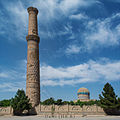 The remains of the madrase today: minaret No. 5, and the Gawhar Shad Mausoleum
 -
 The southeastern minaret of the madrasa (minaret No. 5)
 -
![Colored-glaze “cloisonné” tile (haft-rang technique with black line) found in the area of minaret No. 5.[35]](//upload.wikimedia.org/wikipedia/commons/thumb/f/fa/Colored-glaze_%E2%80%9Ccloisonn%C3%A9%E2%80%9D_tile_found_in_the_area_of_M5_%28south-eastern_minaret_of_the_Gawhar_Shad_madrasa%29%2C_Musalla_complex._Herat_National_Museum.jpg/120px-Colored-glaze_%E2%80%9Ccloisonn%C3%A9%E2%80%9D_tile_found_in_the_area_of_M5_%28south-eastern_minaret_of_the_Gawhar_Shad_madrasa%29%2C_Musalla_complex._Herat_National_Museum.jpg)
-
![Babur entertained to a meal at the "South madrasa", 1506.[29][30][31]](//upload.wikimedia.org/wikipedia/commons/thumb/7/71/Vol.2_f.257r_Babur_entertained_to_a_meal_at_the_South_College%2C_1506._By_Jamshid_Chela._Asset_ID_32362.jpg/120px-Vol.2_f.257r_Babur_entertained_to_a_meal_at_the_South_College%2C_1506._By_Jamshid_Chela._Asset_ID_32362.jpg)


![Colored-glaze “cloisonné” tile (haft-rang technique with black line) found in the area of minaret No. 5.[35]](https://en.wikipedia.org/wiki/File:Colored-glaze_%E2%80%9Ccloisonn%C3%A9%E2%80%9D_tile_found_in_the_area_of_M5_(south-eastern_minaret_of_the_Gawhar_Shad_madrasa),_Musalla_complex._Herat_National_Museum.jpg)
![Babur entertained to a meal at the "South madrasa", 1506.[29][30][31]](https://en.wikipedia.org/wiki/File:Vol.2_f.257r_Babur_entertained_to_a_meal_at_the_South_College,_1506._By_Jamshid_Chela._Asset_ID_32362.jpg)
Gawhar Shad Mausoleum
[edit]
The mausoleum was originally constructed to house the remains of Prince Baysunghur, a son of the Timurid ruler Shah Rukh and Gawhar Shad.[36][37] Some members of Baysunghur's family were interred alongside him. They included Gawhar Shad herself and her brother Amir Sufi Tarkhan,[38] her other son Muhammad Juki,[39] Baysunghur's sons Sultan Muhammad[40] and Ala al-Dawla, as well as the latter's son Ibrahim. More distantly related Timurids, Ahmad and Shah Rukh (sons of Abu Sa'id Mirza, who was responsible for Gawhar Shad's execution), were also buried in the mausoleum.[36] Baysunghur's father Shah Rukh was briefly interred as well, before later being transferred to the Gur-e-Amir in Samarqand.[41]

Gawhar Shad's mausoleum is 27 m (89 ft) tall. It lies is between the two western minarets and was built in the madrasa's northwest corner.[5][6] The building forms a cruciform shape, with a dome covering the center.[25] This dome is the most impressive feature of the structure, in that it is actually three domes superimposed over one another: a low inner dome, a bulbous outer cupola and a structural dome between them.[4] The outer cupola is decorated with flowery light-blue-green mosaics. The inner dome is adorned with gold leaf, lapis lazuli and other colours which form intricate patterns. The interior of the tomb itself is a square chamber with axial niches.[42][6]
Due to the widespread habit of tombstones being taken and re-used, it is unknown how many burials there are in the mausoleum. Though some sources claim there were as many as twenty grave markers at one time, at present there are only six.[36] Lying in the center of the room, they are oblong shaped and made of matt black stone, with floral patterns carved on them. There are two larger stones, three smaller cenotaphs, and a child-sized tomb.[43][6]
In 1998, some objects were located inside the mausoleum to preserve them and prevent robbery. They include twelve 100 cm × 60 cm (39 in × 24 in) marble slabs, a piece of the base of a minaret rising from the mosque, a large slab with seven lines of writing, and other marble panels.[6]
Gallery
[edit]-
 Photo by Annemarie Schwarzenbach, 1939
 -
 Photo by Annemarie Schwarzenbach, 1939
 -
 Dome interior, 2009
 -
 Ruined Gawhar Shad Mausoleum
 -
 Remaining minarets in 1939–40
 -
 Mausoleum in 2009
 -
 Vegetable Stands near the ruins, 2009
 -
 A minaret in 2009
 -
 New replanted trees in complex garden, 2009
 -
 Minaret in 1962
 -
Minaret in 1969
-
 The site in 1975
 -
 Herat skyline with Musallah minarets, 1969
 -
 Herat skyline with Musallah minarets, 2009
 -
 A panorama of the ruins
 -
 Traffic passing on road near the Herat minarets, 2005.
 -
Herat skyline with Musallah minarets,2009
-
Musalla complex — 15th-century Timurid style complex of Islamic structures, 1962
-
 Minarets in 1939–1940.
 -
Kids rest near a minaret by Annemarie Schwarzenbach, 1939.
.jpg)


.jpg)

.jpg)


.jpg)


See also
[edit]


Notes
[edit]- ^ A measurement of how off-balance the minaret is
References
[edit]- ^ a b c d e Dupree, Nancy Hatch (1977). Historical guide to Afghanistan. University of Arizona Libraries. doi:10.2458/azu_acku_ds351_d87_1977. Archived (PDF) from the original on 25 September 2021. Retrieved 25 September 2021.
- ^ "Musalla Complex & Minarets | Herat, Afghanistan Attractions". Lonely Planet. 15 January 2006. Archived from the original on 19 August 2021. Retrieved 25 September 2021.
- ^ a b c Podelco, Grant (11 May 2010). "Monuments Of Herat, Afghanistan's Ancient Cultural Capital, In Danger Of Destruction". Radio Free Europe/Radio Liberty. Archived from the original on 20 September 2018. Retrieved 19 September 2018.
- ^ a b c d Cassar, Brendan; Noshadi, Sara (2015). Keeping history alive: safeguarding cultural heritage in post-conflict Afghanistan. UNESCO Publishing. pp. 184–186. ISBN 978-92-3-100064-5. Archived from the original on 25 September 2021. Retrieved 25 September 2021.
- ^ a b c d e f g "Masjid-i Jami'-i Gawhar Shad | General view of the complex from west, with Gawhar Shad's Mausoleum seen at center and a canal in the foreground. The three minarets on the left marked the corners of Sultan Husain Baiqara's Madrasa, while the minaret at center once flanked the portal to Gawhar Shad's Madrasa. The two minarets seen on the right are the only remnants of Gawhar Shad's Mosque". Archnet. Retrieved 8 February 2021.
- ^ a b c d e f g h i j k l m n o p q Tirard-Collet, Olivier (1998). "After the War. The Condition of Historical Buildings and Monuments in Herat, Afghanistan". Iran. 36: 123–138. doi:10.2307/4299980. ISSN 0578-6967. JSTOR 4299980. Archived from the original on 23 August 2021. Retrieved 6 September 2021.
- ^ a b c d e f "Masjid-i Jami'-i Gawhar Shad-". Archnet.org. Archived from the original on 29 July 2018. Retrieved 5 September 2021.
- ^ a b c Herat : a pictorial guide / text Nancy Hatch ; photography Inger Hansen ; Drawings Brigitte McCulloch (PDF). University of Arizona Libraries. 1966. doi:10.2458/azu_acku_pamphlet_ds375_h47_w65_1966. Archived (PDF) from the original on 17 September 2021. Retrieved 25 September 2021.
- ^ a b "7 must-see minarets in Central Asia". caravanistan.com. Archived from the original on 19 September 2018. Retrieved 19 September 2018.
- ^ "The sad story of the Musalla Complex: art crime and destruction". squarekufic.com. 16 November 2017. Archived from the original on 20 September 2018. Retrieved 19 September 2018.
- ^ a b c d e f Aube, Sandra; Lorain, Thomas; Bendezu-Sarmiento, Julio (2019). "The Complex of Gawhar Shad in Herat: New Findings about its Architecture and Ceramic Tile Decorations (View supplementary material)". Iran Journal of the British Institute of Persian Studies. 58 (1). Iran. doi:10.1080/05786967.2019.1571769.
- ^ "Mousallah Complex in Herat – Afghanistan – Tourist Spots Around the World". Touristspots.org. Archived from the original on 21 January 2019. Retrieved 21 January 2019.
- ^ Podelco, Grant. "Afghanistan: Race To Preserve Historic Minarets Of Herat, Jam". Radio Free Europe/Radio Liberty. Archived from the original on 30 July 2018. Retrieved 21 January 2019.
- ^ "Tư vấn sản phẩm". Adventuretravelphotos.com. Archived from the original on 25 January 2019. Retrieved 21 January 2019.
- ^ "Italian-Funded Conservation of Gawhar Shad Mausoleum in Herat Underway by Afghan Government and UNESCO". unesco.org. UNESCO. 6 November 2014. Archived from the original on 15 November 2019. Retrieved 15 November 2019.
- ^ "Tentative List: City of Herat". unesco.org. UNESCO. 17 August 2004. Retrieved 15 November 2019.
- ^ "HALO partners with UNESCO in Afghanistan".
- ^ "AKDN Vows to Restore Ancient Minaret in Herat". TOLOnews. Archived from the original on 25 November 2020. Retrieved 8 February 2021.
- ^ "AKDN Vows to Restore Ancient Minaret in Herat". AvaPress | Breaking Updated news and Latest headlines from Afghanistan. Archived from the original on 21 January 2021. Retrieved 8 February 2021.
- ^ "Ambassador Hirji discuss Afghan peace process with Minister Naderi". Afghanistan Times. Archived from the original on 3 March 2021. Retrieved 8 February 2021.
- ^ "President Ghani stresses immediate action to restore Minaret Five of Herat Musallah". English. 4 November 2020. Retrieved 8 February 2021.
- ^ "بازسازی منار پنجم مصلی گوهرشاد در هرات آغاز شد". BBC News فارسی (in Persian). 25 November 2020. Retrieved 8 February 2021.
- ^ "A Sufi Lodge, a Leaning Minaret and a Polymath's Shrine: A look at recent efforts to preserve – and appreciate – historical Herat". Afghanistan Analysts Network - English (in Pashto). 29 January 2021. Retrieved 8 February 2021.
- ^ Golombek, Lisa (1969). "The Timurid Shrine at Gazur Gah". Occasional Paper - Royal Ontario Museum, Art and Archaeology (15). Royal Ontario Museum: 90. Archived from the original on 25 September 2021. Retrieved 25 September 2021.
- ^ a b c Petersen, Andrew (2002). Dictionary of Islamic Architecture. Routledge. p. 111. ISBN 978-1-134-61365-6. Archived from the original on 11 August 2020. Retrieved 25 September 2021.
- ^ "Historical Minarets of Herat". alalam.ir. Alalam News Network. Archived from the original on 20 September 2018. Retrieved 20 September 2018.
- ^ "Musalla Complex & Minarets". Herat, Afghanistan Attractions. Lonely Planet. 15 January 2006.
- ^ Subtelny, Maria (2007). Timurids in Transition: Turko-Persian Politics and Acculturation in Medieval Iran. BRILL. p. 361. ISBN 978-90-04-16031-6.
Fig. 7. Zahir al-Din Muhammad Babur paying his respects to the widows of Sultan-Husain Bayqara at the latter's tomb in the Royal madrasa in Herat, in 912/1506. India, ca. 1590. Babur-nāma, MS, British Library, Or. 3714, fol. 256b. British Library Board. All rights reserved.
- ^ a b c Babur, Emperor of Hindustan; Beveridge, Annette Susannah (1922). The Babur-nama in English (Memoirs of Babur). London, Luzac. p. 301.
May 24th 1506- May 13th 1507 (J. Babur visits the Begims in Herat) All the Begums, i.e., my paternal aunt Payanda-sultan Begum, Khadīja Begum, Apāq Begum, and my other paternal aunt Begums, daughters of Sl. Abū-sa'id Mirzā, were gathered together at the time I went to see them in Sl. Husain Mirza's College at his mausoleum. (...) After sitting there for some time during the recitation of the Quran, we went to the South College where Khadīja Begim's tents had been set up and where food was placed before us.
- ^ a b Dupaigne, Bernard (2007). Afghanistan: monuments millénaires. Paris: Imprimerie nationale éd. pp. 150–155. ISBN 9782742769926.
- ^ a b c Green, Nile (2017). Afghanistan's Islam: From Conversion to the Taliban. Univ of California Press. p. 66. ISBN 978-0-520-29413-4.
- ^ a b Allchin, Raymond (2019). The Archaeology of Afghanistan: From Earliest Times to the Timurid Period (Revised and updated ed.). Edinburgh: Edinburgh University Press. p. 565. ISBN 978-0748699179.
Later, in 1492–3, Sultan Husain Baiqara built a madrasa to the east on the other side of the canal. Here there were lofty gateways, arcades, domes and, again, majestic minarets. Only the minarets and mausoleum remain, with corbels encircling the drum (Figs 8.29, 8.30). Unlike the Gawhar Shad monuments, there are few surviving descriptions on which to base a reconstruction, although a standard madrasa design can be assumed. The tile work on the minarets is particularly fine, with each panel framed by marble, although most has been lost due to wind erosion.
- ^ a b Restoration of monuments in Herat: strengthening government's capability for the preservation of historical monuments. United Nations Development Programme. 1981. Archived from the original on 8 September 2021. Retrieved 25 September 2021.
- ^ a b c d e f g h Khairzade, Khair Mohammad; Franke, Ute (1 January 2020). Ahrens, Alexander; Rokitta-Krumnow, Dörte; Bloch, Franziska Bloch; Bührig, Claudia (eds.). The 'Musalla'-Complex in Herat Revisited: Recent Archaeological Investigations at the Gawhar Shad Madrasa: Drawing the Threads Together Studies on Archaeology in Honour of Karin Bartl.
- ^ a b Aube, Sandra; Lorain, Thomas; Bendezu-Sarmiento, Julio (2 January 2020). "The Complex of Gawhar Shad in Herat: New Findings about its Architecture and Ceramic Tile Decorations" (PDF). Iran. 58 (1): Figure 31. doi:10.1080/05786967.2019.1571769.
The dome of the mausoleum is covered by an assemblage of varied techniques. The shell of the dome is covered with monochrome turquoise-glazed bricks, highlighted with gadroons with a pattern of friezes of cobalt, white and yellow diamonds on a turquoise background (see the upper section of the photo Figure 16). In addition to these banna'i bricks, the dome is decorated with colored-glaze "cloisonné" tiles (better known as "cuerda seca"),62 as well as with cut-tile mosaics (note 62: The technique is better known as "black line", "cuerda seca" or even "haft rang" type.
- ^ a b c Knobloch, Edgar (2002). The Archaeology & Architecture of Afghanistan. Tempus. p. 137. ISBN 978-0-7524-2519-1. Archived from the original on 25 September 2021. Retrieved 25 September 2021.
- ^ Roemer, H. R. (1989). "BĀYSONḠOR, ḠĪĀṮ-AL-DĪN". Encyclopaedia Iranica. Encyclopaedia Iranica Foundation. Archived from the original on 14 November 2019. Retrieved 14 November 2019.
- ^ Green, Nile (2017). Afghanistan's Islam: From Conversion to the Taliban. Univ of California Press. p. 66. ISBN 978-0-520-29413-4. Archived from the original on 25 September 2021. Retrieved 25 September 2021.
- ^ Barthold, Vasilii Vladimirovitch (1963). Four Studies on the History of Central Asia. Vol. 2. Brill Archive. p. 147. Archived from the original on 25 September 2021. Retrieved 25 September 2021.
- ^ Golombek (1969, p. 86)
- ^ Manz, Beatrice Forbes (2007). Power, Politics and Religion in Timurid Iran. Cambridge University Press. pp. 258, 263. ISBN 978-1-139-46284-6. Archived from the original on 25 September 2021. Retrieved 25 September 2021.
- ^ Dupree, Louis (2014). Afghanistan. Princeton University Press. p. 318. ISBN 978-1-4008-5891-0. Archived from the original on 20 August 2020. Retrieved 25 September 2021.
- ^ Byron, Robert (1937). The Road to Oxiana. Macmillan and Co. Ltd. pp. 97–103.
External links
[edit]
| Districts |  | |
|---|---|---|
| Populated places | ||
| Landmarks | ||
| Active |
| ||||||||||
|---|---|---|---|---|---|---|---|---|---|---|---|
| Former |
| ||||||||||
