Hubbry Logo
National Highway 44 (India)National Highway 44 (India)Main
Open search
National Highway 44 (India)
Community hub
National Highway 44 (India)
logo
8 pages, 0 posts
0 subscribers
Be the first to start a discussion here.
National Highway 44 (India)
from Wikipedia

National Highway 44 shield}}
National Highway 44
Map
Map of National Highway 44 in red
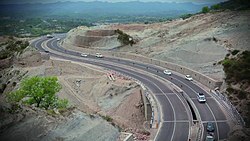
Jammu Srinagar Highway.jpg
Entrance of National Highway 44 in Jammu and Kashmir.
Route information
Part of AH1 AH2 AH43
Length4,113 km (2,556 mi)
GQ: 94 km (58 mi) (Bengaluru – Krishnagiri)
NS: 1,828 km (Lakhnadon – Kanyakumari)
Major junctions
North endSrinagar, Jammu and Kashmir
Major intersections
South endKanyakumari, Tamil Nadu
Location
CountryIndia
StatesJammu and Kashmir: 304 km (189 mi)
Himachal Pradesh: 11 km (6.8 mi)
Punjab: 279 km (173 mi)
Haryana: 257 km (160 mi)
Uttar Pradesh: 287 km (178 mi)
Madhya Pradesh: 547 km (340 mi)
Maharashtra: 260 km (160 mi)
Telangana: 533 km (331 mi)
Andhra Pradesh: 260 km (160 mi)
Karnataka: 135 km (84 mi)
Tamil Nadu: 630 km (390 mi)
Highway system
NH 43 NH 45

National Highway 44 (NH 44) is a major north–south National Highway in India and is the longest in the country.

It passes through the Union Territory of Jammu and Kashmir, in addition to the states of Punjab, Haryana, Delhi, Uttar Pradesh, Rajasthan, Madhya Pradesh, Maharashtra, Telangana, Andhra Pradesh, Karnataka, and Tamil Nadu.[1]

It came into being by merging seven national highways, in full or part, starting with the Jammu–Srinagar National Highway (former NH 1A) from Srinagar in Jammu and Kashmir, former NH 1 in Punjab and Haryana ending at Delhi, part of former NH 2 starting from Delhi and ending at Agra, former NH 3 (popularly known as Agra-Bombay National Highway) from Agra to Gwalior, former NH 75 and former NH 26 to Jhansi, and former NH 7 via Lakhnadon, Seoni, Nagpur, Adilabad, Nirmal, Hyderabad, Kurnool, Anantapur,[2]Chikkaballapur, Devanahalli, Bangalore, Hosur, Krishnagiri, Dharmapuri, Salem, Namakkal, Karur, Dindigul, Madurai, Virudhunagar, Kovilpatti and Tirunelveli terminating at Kanyakumari.[3]

The 70 km Delhi-to-Panipat section, also known as Delhi-Panipat Expressway, is being upgraded,[4] at a cost of ₹2,178.82 crores, to an elevated tolled expressway with 8 (4+4) main lanes and 4 (2+2) service lanes, which was completed in July 2023.[5][6][7] The NH-44 road between Salem and Thoppur in Tamil Nadu is prone to fatal accidents due to the hilly slopes.[8] Agra-Gwalior section of this highway is part of the legendary AB Road(Agra-Bombay Road).

Route

[edit]

The highway starts from Srinagar. NH 44 covers the North-South Corridor of NHDP and it is officially listed as running over 4,112 km (2,555 mi) from Srinagar to Kanyakumari. It is the longest national highway in India.

Route length in states and UTs[9]
States/UTs Total length in State/UT Junctions Destinations Other Cities Covered
Jammu and Kashmir 541 km (336 mi) 4 NH 501 in Anantnag Srinagar (The Starting point)
NH 244 in Anantnag
NH 144 in Domel
NH 144A in Jammu
Himachal Pradesh 11.08 km (6.88 mi) 0 The route runs parallel to Chakki River.
Punjab 279.42 km (173.62 mi) 4 NH 54 in Pathankot Mukerian
NH 3 in Jalandhar
NH 5 in Ludhiana
NH 7 in Rajpura
Haryana 257.80 km (160.19 mi) 6 NH 344 in Ambala Kurukshetra, Faridabad
NH 152 in Ambala
NH 709A in Karnal
NH 709 in Panipat
NH 334B in Sonipat
NH 919 in Palwal
Delhi 15 km (9.3 mi) 3 NH 9 in New Delhi
NH 19 in New Delhi
NH 48 in New Delhi
Uttar Pradesh 269.10 km (167.21 mi) 3 NH 21 in Agra Vrindavan, Mathura, Lalitpur, Kosi Kalan
NH 27 in Jhansi
NH 39 in Jhansi
Rajasthan 28.29 km (17.58 mi) 1 NH 23 in Dholpur
Madhya Pradesh 571.9 km (355.4 mi) 1 NH 347 in Seoni Gwalior, Sagar, Narsinghpur, Lakhnadon, Seoni
Maharashtra 268.36 km (166.75 mi) 11 NH 753 in Mansar Nagpur, Hinganghat, Pandharkawda
NH 753 in Amdi
NH 247 in Kamptee
NH 53 in Nagpur
NH 353D in Nagpur
NH 353I in Jamtha
NH 361 in Butibori
NH 347A in Jamb
NH 347A in Hinganghat
NH 361B in Wadki
NH 930 in Karanji
Telangana 492.85 km (306.24 mi) 5 NH 61 in Nirmal Adilabad, Kamareddy, Jadcherla, Mahbubnagar
NH 63 in Nizamabad
NH 65 in Hyderabad
NH 163 in Hyderabad
NH 765 in Hyderabad
Andhra Pradesh 260.99 km (162.17 mi)[2] 4 NH 40 in Kurnool Kurnool,Anantpur
NH 340C in Dhone
NH 67 in Gooty
NH 42 in Anantpur
Karnataka 95.67 km (59.45 mi) 5 NH 69 in Chikkaballapur Chikkaballapur
NH 48 in Bangalore
NH 209 in Bangalore
NH 75 in Bangalore
NH 275 in Bangalore
Tamil Nadu 627.18 km (389.71 mi) 14 NH 648 in Hosur Virudhunagar, Namakkal
NH 77 in Krishnagiri
NH 844 in Dharmapuri
NH 79 in Salem
NH 544 in Salem
NH 81 in Karur
NH 83 in Dindigul
NH 183 in Dindigul
NH 85 in Madurai
NH 744 in Thirumangalam
NH 138 in Tirunelveli
NH 944 near Nagercoil
NH 66 in Kanyakumari

Bengaluru–Hosur Road

[edit]
National Highway 44 near Bengaluru
16km long elevated stretch of NH 44 through Pench Tiger Reserve in Madhya Pradesh

Bengaluru–Hosur Road of this highway connects Bengaluru, the capital of the state of Karnataka, and the city of Hosur, in the Krishnagiri district on the border of Karnataka and Tamil Nadu. It is a four- to six-lane highway which also has service lanes on either sides at the busier parts. Apart from being a part of the National Highway, the road is also significant because it consist of many industrial and IT business houses. The IT industrial park Electronic City is also located alongside Hosur Road.

The National Highways Authority of India has constructed a 10-kilometre-long (6.2 mi) elevated highway between Bommanahalli and Electronic City. This toll road has made travel to Electronic City a lot faster. The Bruhat Bengaluru Mahanagara Palike and the Bengaluru Development Authority have planned a series of flyovers and underpasses to make this arterial road signal-free.[10]

Expansion

[edit]
  • On 11 March 2024, Prime Minister Narendra Modi laid the foundation stone for five projects in the state, including the work to improve the Thoppur Pass on the Dharmapuri - Salem section of National Highway-44.The work is to be undertaken at a cost of Rs 905 crore, and a 4 km long elevated highway is being constructed on the existing road, which will facilitate safe travel in the accident-prone Thoppur Ghat section.[11][12][13]

Major intersections

[edit]

Tunnels

[edit]
  • T5 Tunnel: On 16 March 2023, the National Highways Authority of India Thursday opened for traffic T5 tunnel, a 870-metre tunnel that bypasses landslide-prone stretch of the mountainous road between Panthial and Magerkote, on the Jammu-Srinagar National Highway in Ramban district.[14]

Primary destinations

[edit]

Notes

[edit]

See also

[edit]

References

[edit]
[edit]
Revisions and contributorsEdit on WikipediaRead on Wikipedia
from Grokipedia
National Highway 44 (NH 44) is the longest national highway in India, spanning approximately 3,745 kilometers from in the union territory of Jammu and Kashmir to in . It serves as a critical north-south arterial route, connecting diverse regions across the country and forming a key component of the National Highway Development Project (NHDP). The highway traverses ten states and the two union territories of Jammu and Kashmir and , passing through Jammu and Kashmir, , , , , , , , , , , and . Its route starts in , passing through major cities such as , , , , , , , , , Hyderabad, Bengaluru, and Salem before terminating at . The path incorporates segments of the former NH-1, NH-2, and NH-7, reflecting renumbering efforts under the NHDP to standardize India's highway network. NH 44 plays a pivotal role in India's economic landscape by facilitating the seamless transport of goods, passengers, and raw materials across north and south India, thereby enhancing , industrial growth, and regional connectivity. It supports vital sectors such as , , and by reducing travel times and logistics costs, while ongoing upgrades under initiatives like Pariyojana aim to widen and modernize the highway for improved safety and efficiency.

Overview

General Description

National Highway 44 (NH 44) is India's longest national highway and a primary north-south , stretching from in Jammu and Kashmir to in . It serves as a vital spine of the country's road network, facilitating connectivity across diverse geographical regions from the Himalayan foothills to the southern tip of the Indian peninsula. The highway spans a total length of 3,718 km (as of 31 March 2019) and passes through 13 states and union territories, including a brief 11 km segment in . NH 44 forms the backbone of the North-South Corridor under the (NHDP), a flagship initiative aimed at enhancing inter-regional trade and mobility by upgrading key highways to four- or six-lane standards. Approximately 94 km of this highway, specifically the Bengaluru-Krishnagiri stretch, is integrated into the network, which links India's four major metropolitan cities—, , , and —to boost . This alignment underscores NH 44's role in supporting national logistics and passenger transport efficiency. Furthermore, NH 44 is designated as part of the , incorporating segments of (the longest Asian Highway running from to via ) and (linking in to Khosravi in ). These international designations highlight its strategic importance in fostering trans-continental and connectivity. Key cities along the route, such as , , Hyderabad, Bengaluru, and others, serve as major hubs for commerce and travel.

Length and Coverage

National Highway 44 (NH 44) is India's longest national highway, spanning a total distance of 3,718 km (as of 31 March 2019) from in Jammu and Kashmir to in . It traverses 13 states and union territories, connecting the northernmost regions to the southern tip of the country and facilitating vital north-south connectivity. The highway's length varies across states and union territories, reflecting its extensive geographical reach. The following table provides a state/UT-wise breakdown of the lengths (as of 31 March 2019): These measurements are based on official records from the Ministry of Road Transport and Highways as of 31 March 2019. Note that subsequent expansions under projects like Bharatmala Pariyojana have increased the total length to approximately 4,112 km as of 2024. NH 44 encompasses a wide range of terrains, from the rugged Himalayan foothills in its northern sections through the fertile Indo-Gangetic plains in the north-central parts, across the elevated Deccan Plateau in the central and southern stretches, and finally reaching the coastal plains near Kanyakumari. This diverse coverage underscores its role in linking varied ecological and economic zones across India.

History and Development

Origins and Renumbering

The development of India's national highway network began shortly after independence, with the enactment of the National Highways Act in 1956, which empowered the central government to declare and maintain key highways connecting major cities, ports, and strategic locations. During the 1950s, under the First Five-Year Plan (1951–1956), initial efforts focused on constructing and upgrading these routes as part of broader infrastructure initiatives to support and connectivity, forming the foundational segments that would later contribute to longer corridors. Prior to 2010, the routes comprising what is now National Highway 44 existed as fragmented segments under the old numbering system, which had been formalized in the 1990s but originated from earlier designations. These included NH 1A from to , NH 1 from to , NH 2 from to , NH 3 from to , NH 75 from to , NH 26 from to Lakhnadon, and NH 7 from Lakhnadon to , each managed separately and lacking a unified identity. In 2010, the Ministry of Road Transport and Highways (MoRTH) initiated a comprehensive renumbering of through Gazette notifications, such as SO 689(E) dated 4 April 2010, to rationalize the system and enhance efficiency. The rationale was to create longer, continuous corridors by merging existing highways, assigning even numbers to north-south routes starting from the east (with NH 44 as the primary axis) and odd numbers to east-west routes, thereby simplifying identification, improving planning, and facilitating development of a more logical network. This reform culminated in the formation of NH 44 by integrating the aforementioned seven segments into a single, extensive north-south highway spanning from to .

Key Expansions and Projects

The Delhi-Panipat section of NH44 has been upgraded to an 8-lane access-controlled expressway spanning approximately 70 km, with the project completed and opened to traffic in July 2023 at a cost of ₹2,179 . This enhancement includes the construction of 11 flyovers totaling 24 km in length within , aimed at improving connectivity and reducing travel time between the national capital and northern . In the southern stretch, the Thoppur Pass project involves the construction of a 4 km along with improvements to the existing alignment on the Salem-Dharmapuri section in , with foundation stone laid in March 2024 at a budget of ₹905 . This initiative seeks to alleviate severe congestion at the section, enhancing safety and efficiency for vehicular movement on NH44. As of November 2025, the is approximately 65% complete, with completion targeted for mid-2026. Under the Bharatmala Pariyojana, multiple stretches of NH44 are undergoing widening from 4 to 6 lanes, encompassing over 2,000 km in total across various phases, with key segments including the Srinagar-Jammu corridor (approximately 250 km of 4-laning) and the Hyderabad-Bengaluru route (upgrades on about 500 km). These projects, awarded as part of the 26,425 km initiative, feature phased completions targeted by 2025 to boost national connectivity and freight movement. Other notable developments include the integration of the Chenani-Nashri Tunnel (now ), a 9.28 km bidirectional tunnel completed in 2017 as part of NH44's alignment between and , reducing the distance by 41 km and travel time by up to two hours. Additionally, ongoing 4-laning efforts in the region, such as the / border to section spanning approximately 117 km, are progressing, with completion targeted for 2025 or later to support industrial corridors.

Route Description

Northern Stretch: Srinagar to Delhi

The northern stretch of National Highway 44 begins in , the of Jammu and Kashmir, and proceeds southward along the alignment of the former NH1A, traversing challenging Himalayan terrain before transitioning to the Indo-Gangetic plains. This segment covers approximately 1,100 kilometers, connecting through key locations in Jammu and Kashmir, , , and ending at the border. In Jammu and Kashmir, the highway spans 541 kilometers, starting from and passing through , Ramban, , (approximately 250 kilometers from ), and before exiting the state. The route navigates the , a geologically fragile area prone to landslides, shooting stones, and disruptions from heavy rainfall, which frequently close sections like the Ramban-Banihal stretch due to slope instability and weak rock formations. These natural hazards pose significant engineering and safety challenges, exacerbated by the steep gradients and narrow valleys that limit widening efforts. Upon entering at , the highway covers 279 kilometers through relatively flatter terrain, passing , (about 93 kilometers from Pathankot), , and . This Punjab segment serves as a vital link for agricultural transport but remains vulnerable to seasonal flooding, particularly in low-lying areas near rivers like the and , where heavy monsoons have historically inundated stretches and disrupted connectivity. The Haryana portion extends 258 kilometers, featuring the Ambala-Kurukshetra corridor, , , , and , before reaching the Delhi border after an additional 15 kilometers within the national capital territory. Here, the landscape shifts to broad alluvial plains, facilitating higher traffic volumes, though flood-prone zones around the and seasonal rivers continue to cause waterlogging and structural vulnerabilities during intense rains. The entire northern stretch thus embodies a transition from rugged mountains to fertile plains, underscoring NH44's role as a critical north-south despite persistent environmental obstacles.

Central Stretch: Delhi to Nagpur

The central stretch of National Highway 44 from to Nagpur covers approximately 1,066 kilometers, connecting the urban expanse of the national capital with the industrial hub of through the fertile Gangetic plains of , a brief segment in , and the undulating highlands of . This segment, integral to the highway's role in north-south freight movement, facilitates access to agricultural heartlands and emerging zones while navigating diverse topographies from flat alluvial soils to rocky plateaus. The route commences in , proceeding southward for about 200 kilometers to via , where it crosses the River multiple times, including via the and local bridges that support heavy commuter traffic. From , the highway continues approximately 108 kilometers to , briefly passing through in before traversing the near Morena in northern , marking the transition into more arid landscapes. From in , the path continues approximately 103 kilometers partly through (via Dabra) and into Uttar Pradesh's region to , characterized by its granite outcrops and historical forts, crossing the en route to provide connectivity to this drought-prone area's agrarian economy. The route then proceeds south from through Lalitpur in Uttar Pradesh before entering south of Lalitpur, extending approximately 203 kilometers to Sagar, passing through scattered tribal settlements and mining operations in the core of . The final portion in , with the state's total share in this stretch approximately 572 kilometers (including the northern segment from Morena to the UP border near and the southern segment from the re-entry to ), proceeds from Sagar via and Lakhnadon to , covering roughly 388 kilometers through forested hills and the Satpura ranges' foothills, where the highway supports timber and mineral transport. Industrial corridors along this route, particularly around with its footwear and tourism sectors proximate to the , and 's handloom and ceramic industries, underscore the stretch's contribution to regional trade.

Southern Stretch: Nagpur to Kanyakumari

The southern stretch of National Highway 44 begins at in and extends southward through the , traversing diverse landscapes including arid plains, forested regions, and urban centers before reaching the coastal tip at in . This approximately 1,745 km segment connects key economic hubs and serves as a vital artery for southern India's and , passing through five states with varying terrain that includes undulating plateaus and occasional sections near the . In Maharashtra, the highway covers about 268 km from to the Telangana border near Pandharkawada, passing through and traversing cotton-rich farmlands and industrial areas around , which facilitate connectivity to local manufacturing clusters. Entering , the route spans roughly 493 km from the Maharashtra border through , Nizamabad, , Hyderabad, and south to the border near Alampur, amid agricultural belts and forested hills, with the path supporting the state's IT and pharmaceutical sectors by linking Hyderabad's outer ring road. This segment features relatively flat terrain with occasional elevation changes near the basin. The highway then enters Andhra Pradesh for about 261 km from the border near Alampur through , , and to , passing through a semi-arid landscape dotted with granite hills and irrigation-dependent , providing essential access to Kurnool's and industries. In , the 96 km stretch from the Andhra Pradesh border via to Bengaluru includes the Bengaluru-Hosur road, navigating rocky outcrops and peri-urban zones that integrate with the state's technology corridor, though urban congestion marks the approach to Bengaluru. The route here transitions from plateau to more varied topography near the city. Finally, in , the longest portion at 627 km runs from through Salem, , and to , crossing the with ghat sections around Salem and that offer scenic views of hillocks and tea estates, before flattening into coastal plains near the endpoint. This part links industrial Salem with temple-rich and culminates at , where the highway approaches the and confluence, emphasizing its role in and southern maritime trade. The overall path highlights the corridor's adaptation to southern India's and biodiversity hotspots.

Infrastructure Features

Tunnels and Bridges

National Highway 44 features several significant tunnels and bridges that address challenging terrain, particularly in the northern Himalayan regions, enhancing safety and reducing travel times along this vital corridor. The northern stretch in Jammu and Kashmir includes at least four major tunnels, with ongoing expansions such as the Digdole–Panthyal (T4) twin-tube tunnel (2.6 km and 3 km) expected to be completed by early 2026 to mitigate landslide risks and improve all-weather connectivity. In June 2025, the central government approved 19 road and tunnel projects worth ₹10,637 crore for Jammu and Kashmir, further strengthening the network. These structures exemplify advanced engineering adapted to seismic and geological conditions. The Chenani-Nashri Tunnel, officially known as the , is India's longest road tunnel at 9.28 kilometers, located between Chenani and Nashri in Jammu and Kashmir. Completed in 2017 and inaugurated by on April 2, it bypasses the treacherous , reducing the Jammu-Srinagar travel distance by 41 kilometers and cutting journey time by over two hours while avoiding 354 curves on the old route. This bi-directional, four-lane tunnel incorporates modern safety features such as ventilation systems, fire detection, and emergency exits. Further south in the same region, the T5 Tunnel, a 870-meter-long twin-tube structure in , was opened to traffic on March 16, 2023, by the . Situated between Panthial and Magerkote, it forms part of an 8.5-kilometer chain of tunnels in the broader Jammu and Kashmir upgrades, bypassing the highly vulnerable, landslide-prone Qazigund-Banihal stretch and improving reliability during monsoons. Additional tunnels like T4 near Magerkote-Panthyal are under construction, expected by early 2026, contributing to the growing network of major tunnels in the northern section. Among the key bridges, the at Wazirabad over the River near stands out as a modern four-lane cable-stayed structure, with a total length of 675 meters and a main span of 251 meters. Inaugurated in 2018, it facilitates smoother north-south traffic flow on NH44 by connecting Wazirabad to East Delhi, alleviating congestion on older crossings and serving as an iconic landmark with its 154-meter-high pylon. In the southern stretches, major bridges focus on river crossings such as those over the Tungabhadra.

Major Intersections

National Highway 44 (NH44), India's longest national highway, features several major intersections that serve as critical connectivity points with other , enabling seamless east-west and regional linkages across its approximately 3,745 km span. These junctions are strategically located in key urban and semi-urban areas, facilitating traffic distribution, , and access to major economic centers. In total, NH44 has over 20 such major junctions, which integrate it into the broader national highway network and support the and other corridors. In , , NH44 intersects with NH52, providing direct access to , and NH152, which links to , enhancing connectivity to northern hill stations and the tricity region. This junction is vital for diverting traffic from the busy Delhi-Chandigarh corridor and supports regional trade in the Ambala industrial belt. At in , NH44 forms a significant junction with NH21, connecting to in , and NH19, which extends eastward to and beyond to . This intersection, located near the area, handles high volumes of tourist and commercial traffic, integrating NH44 into the east-west trade routes while boosting Agra's role as a hub. Nagpur, straddling and , stands out as a major hub on NH44, where it converges with NH53—the east-west corridor linking to —and NH47, which runs from Bamanbore in to Nagpur. This multi-highway interchange, often supported by flyovers and ring roads, positions Nagpur as a central node for , handling freight from ports and industrial zones. In Hyderabad, , the NH44 bypass features key intersections with NH65, providing connectivity to and the western coast, alongside radial arms that link to routes. These bypass junctions, integrated with the , alleviate urban congestion and support Hyderabad's IT and pharmaceutical sectors by enabling efficient movement to coastal ports. Bengaluru in Karnataka hosts important connections on NH44 with NH48, leading to , and NH75, which extends to Mangalore on the western coast. These junctions, near Hebbal and , are crucial for southern India's tech and manufacturing ecosystems, facilitating quick access to ports and airports while integrating with the Bengaluru .

Significance

Economic Impact

National Highway 44 (NH44) plays a pivotal role in connecting India's diverse economic regions, linking northern manufacturing powerhouses like the Delhi-National Capital Region (NCR) with southern technology epicenters such as Bengaluru. This corridor facilitates the efficient transport of raw materials, finished goods, and services, reducing logistics costs and enhancing supply chain resilience for industries spanning automobiles, electronics, and textiles in Delhi-NCR. Further south, it integrates Hyderabad's burgeoning sector, enabling the rapid movement of skilled labor and digital infrastructure components to national markets. In , NH44 bolsters logistics operations in , a strategic warehousing and distribution hub that serves as a gateway for goods redistribution across the country, while passing through to support its tourism-driven economy, where attractions like the generate substantial revenue from domestic and international visitors. By bridging these hubs, the highway fosters inter-regional commerce, with —dominated by major corridors like NH44—handling approximately 70% of India's total freight volume, thereby amplifying trade flows between agricultural north and industrial south to drive national . As of October 2025, road freight traffic on major corridors like NH 44 reached a record high in the first half of FY26, reflecting robust industrial activity. Expansions along NH44 have spurred direct and indirect job creation, with projects employing thousands in , labor, and ancillary services, while ongoing operations sustain in and . The highway supports key sectors such as in and , where it expedites the transport of , , and other produce to markets, and mining in , linking mineral extraction sites to industrial consumers and export points. Toll revenues generated from NH44's multiple plazas contribute to the National Highways Authority of India's (NHAI) overall collections, exceeding ₹55,000 annually across the network, which are reinvested in upkeep and upgrades to sustain long-term viability.

Strategic Importance

National Highway 44 (NH44) serves as a vital conduit for national integration by connecting the northernmost regions of Jammu and Kashmir with the southern tip of , spanning diverse cultural, linguistic, and geographical landscapes across 11 states and the of . This extensive north-south alignment facilitates the movement of people and ideas, fostering cultural exchange and social cohesion among India's varied communities. By linking Himalayan foothills to coastal plains, NH44 symbolizes the country's , enabling seamless interactions that strengthen inter-regional bonds. In terms of defense utility, NH44 plays a critical role in , particularly for troop movements and supply chains in the sensitive Jammu and Kashmir region. The highway's tunnels, such as the strategic Jammu-Srinagar tunnel project, provide all-weather access, ensuring uninterrupted connectivity between the and mainland even during harsh winters or adverse conditions. This infrastructure enhances operational readiness for the armed forces, allowing rapid deployment and reinforcement along the northern borders. Upgrades to the highway have significantly bolstered the Indian Army's logistic capabilities in Kashmir, supporting security operations and counter-terrorism efforts. On the international front, NH44 forms an integral segment of the , specifically contributing to , a major north-south corridor. Its northern extensions support connectivity to trade routes, including pathways that facilitate India-China commerce through border regions. This positioning enhances India's role in regional connectivity initiatives, promoting cross-border economic and strategic linkages. NH44 significantly boosts tourism by providing direct access to key pilgrimage and heritage sites, such as the southern confluence at , the iconic in , and the ancient in . These connections enable millions of devotees and travelers to undertake spiritual journeys and explore historical landmarks, contributing to the growth of across the country. The highway's route through culturally rich areas underscores its importance in preserving and promoting India's .

References

Add your contribution
Related Hubs
User Avatar
No comments yet.