Hubbry Logo
NaginataNaginataMain
Open search
Naginata
Community hub
Naginata
logo
8 pages, 0 posts
0 subscribers
Be the first to start a discussion here.
Naginata
Naginata
from Wikipedia

The naginata (なぎなた, 薙刀, lit.'mowing sword') is a polearm and one of several varieties of traditionally made Japanese blades (nihontō).[1][2] Naginata were originally used by the samurai class of feudal Japan, as well as by ashigaru (foot soldiers) and sōhei (warrior monks).[3]: 158  The naginata is the iconic weapon of the onna-musha, a type of female warrior belonging to the Japanese nobility.

Key Information

Description

[edit]

A naginata consists of a wooden or metal pole with a curved single-edged blade on the end; it is similar to the Chinese guan dao[4] or the European glaive.[5] Similar to the katana, naginata often have a round handguard (tsuba) between the blade and shaft, when mounted in a koshirae (furniture). The 30 to 60 cm (12 to 23.5 in) naginata blade is forged in the same manner as traditional Japanese swords. The blade has a long tang (nakago) which is inserted in the shaft.

The blade is removable and is secured by means of a wooden peg called mekugi (目釘) that passes through a hole (mekugi-ana) in both the tang and the shaft. The shaft ranges from 120 to 240 cm (47 to 94.5 in) in length and is oval shaped. The area of the shaft where the tang sits is the tachiuchi or tachiuke. The tachiuchi/tachiuke would be reinforced with metal rings (naginata dogane or semegane), and/or metal sleeves (sakawa) and wrapped with cord (san-dan maki). The end of the shaft has a heavy metal end cap (ishizuki or hirumaki). When not in use the blade would be covered with a wooden sheath.[3]

History

[edit]
Mounting for naginata, Edo period
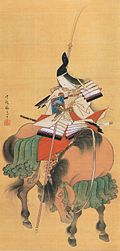
Tomoe Gozen, an "onna-musha", wields a naginata on horseback.
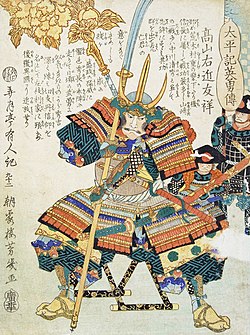
A Meiji-era depiction of a sōhei (warrior monk) with a naginata

It is assumed that the naginata was developed from an earlier weapon type of the later 1st millennium AD, the hoko yari.[6][7] Another assumption is that the naginata was developed by lengthening the hilt of the tachi at the end of the Heian period, and it is not certain which theory is correct.[8]

It is generally believed that naginata first appeared in the Heian period (794–1185).[9] The term naginata first appeared in historical documents in the Heian period. The earliest clear references to naginata date from 1146.[10] In Honchō Seiki compiled from 1150 to 1159 in the late Heian period, it is recorded that Minamoto no Tsunemitsu mentioned that his weapon was a naginata.[9]

In the early Heian period, battles were mainly fought using yumi (longbow) on horseback, but in the late Heian period, battles on foot began to increase and naginata also came to be used on the battlefield. The naginata was appreciated because it was a weapon that could maintain an optimum distance from the enemy in close combat.[8] During the Genpei War (1180–1185), in which the Taira clan was pitted against the Minamoto clan, the naginata rose to a position of particularly high esteem, being regarded as an extremely effective weapon by warriors.[11] The Tale of the Heike, which records the Genpei War, there are descriptions such as ō naginata (lit. big naginata) and ko naginata (lit. little naginata), which show that naginata of various lengths were used.[9] The naginata proved excellent at dismounting cavalry and disabling riders. The widespread adoption of the naginata as a battlefield weapon forced the introduction of greaves as a part of Japanese armor. Ōyamazumi Shrine houses two naginata that are said to have been dedicated by Tomoe Gozen and Benkei at the end of the Heian period and they are designated as Important Cultural Property.[12]

However, according to Karl Friday, there were various notations for naginata in the Heian period and the earliest physical evidence for naginata was in the middle of the Kamakura period, so there is a theory that says when they first appeared is unclear.[10] Earlier 10th through 12th century sources refer to "long swords" that while a common medieval term or orthography for naginata, could also simply be referring to conventional swords; one source describes a naginata being drawn with the verb nuku (抜く), commonly associated with swords, rather than hazusu (外す), the verb otherwise used in medieval texts for unsheathing naginata.[10] Some 11th and 12th century mentions of hoko may actually have been referring to naginata.[13] The commonly assumed association of the naginata and the sōhei is also unclear. Artwork from the late-13th and 14th centuries depict the sōhei with naginata but do not appear to place any special significance to it: the weapons appear as just one of a number of others carried by the monks, and are used by samurai and commoners as well.[14] Depictions of naginata-armed sōhei in earlier periods were created centuries after the fact, and are likely using the naginata as a symbol to distinguish the sōhei from other warriors, rather than giving an accurate portrayal of the events.[15]

After the Ōnin War (1467–1477) in the Muromachi period, large-scale group battles started in which mobilized ashigaru (foot soldiers) fought on foot and in close quarters, and yari (spear), yumi (longbow), and tanegashima (Japanese matchlock) became the main weapons. This made naginata and tachi obsolete on the battlefield, and they were often replaced with the nagamaki and short, lightweight katana.[8][16][17][18]

In the Edo period (1603–1867), the hilts of naginata were often cut off and made into katana or wakizashi (short sword). This practice of cutting off the hilt of an ōdachi, tachi, naginata, or nagamaki and remaking it into a shorter katana or wakizashi due to changes in tactics is called suriage (磨上げ) and was common in Japan at the time.[8][19] In Japan there is a saying about swords: "No sword made by modifying a naginata or a nagamaki is dull in cutting" (薙刀(長巻)直しに鈍刀なし). The meaning of this saying is that naginata and nagamaki are equipment for actual combat, not works of art or offerings to the kami, and that the sharpness and durability of swords made from their modifications have been proven on the battlefield.[19][20]

In the peaceful Edo period, weapons' value as battlefield weapons became diminished and their value for martial arts and self-defense rose. The naginata was accepted as a status symbol and self-defense weapon for women of nobility, resulting in the image that "the Naginata is the main weapon used by women".[8]

In the Meiji era, it gained popularity along sword martial arts. From the Taisho era to the post-War era, the naginata became popular as a martial art for women, mainly due to the influence of government policies.[8]

Although associated with considerably smaller numbers of practitioners, a number of "koryu bujutsu" systems (traditional martial arts) which include older and more combative forms of naginatajutsu remain existent, including Suio Ryu, Araki Ryu, Tendo Ryu, Jikishinkage ryu, Higo Koryu, Tenshin Shoden Katori Shinto Ryu, Toda-ha Buko Ryu, and Yoshin ryu, some of which have authorized representatives outside Japan.

Contemporary construction

[edit]

In contemporary naginatajutsu, two types of practice naginata are in common use.

The naginata used in atarashii naginata (新しいなぎなた), the shiai-yo (試合場), has an oak shaft and a bamboo "blade" (habu). It is used for practice, forms competitions, and sparring. It is between 210 and 225 cm (83 and 89 in) in length and must weigh over 650 g (23 oz).name="books.google.com"/>: 161  The "blade" is replaceable. They are often broken or damaged during sparring and can be quickly replaced, being attached to the shaft with tape.

The naginata used by koryū practitioners has an oak shaft and blade, carved from a single piece of wood, and may incorporate a disc-shaped guard (tsuba). It is called a kihon-yo.

Contemporary usage

[edit]
A naginatajutsu tournament in Brazil, organised by the Confederação Brasileira de Kobudo

Naginata can be used to batter, stab, or hook an opponent,[21] but due to their relatively balanced center of mass, are often spun and turned to proscribe a large radius of reach. The curved blade provides a long cutting surface without increasing the overall length of the weapon.

Historically, the naginata was often used by foot soldiers to create space on the battlefield. They have several situational advantages over a sword. Their reach is longer, allowing the wielder to keep out of the reach of opponents. The weight of the weapon gave power to strikes and cuts, even though the weight of the weapon is usually thought of as a disadvantage. The weight at the end of the shaft (ishizuki), and the shaft itself (ebu) can be used offensively and defensively.

The martial art of wielding the naginata is known as naginatajutsu. Most naginata practice today is in a modernised form, a gendai budō called atarashii Naginata ("new Naginata"[3]), which is organized into regional, national, and international federations, who hold competitions and award ranks. Use of the naginata is also taught within the Bujinkan and in some koryū schools such as Suio Ryu and Tendō-ryū.

Naginata practitioners wear an uwagi, obi, and hakama, similar to that worn by kendo practitioners, although the uwagi is generally white. For sparring, armor known as bōgu is worn. Bōgu for naginatajutsu adds shin guards (脛当, sune-ate) and the gloves (小手, kote) have a singulated index finger, unlike the mitten-style gloves used for kendo.

[edit]

See also

[edit]

References

[edit]

Sources

[edit]
[edit]
Revisions and contributorsEdit on WikipediaRead on Wikipedia
from Grokipedia
The naginata is a traditional Japanese polearm weapon characterized by a long wooden shaft, typically around two meters in length, affixed to a single-edged, curved resembling a , which allows for versatile slashing and thrusting attacks from a distance. This design combines elements of a and a , making it effective against both mounted and foot soldiers in battle. The naginata originated over 800 years ago during the Heian period (794–1185), with the term first appearing in historical records around 1146. Its first recorded use in combat dates to 1086 in the Ōshū Gosanen no Eki, where it proved advantageous due to its reach and weight for dismounting cavalry. Early use is documented among warrior monks (sōhei) during the Heian period. By the late 11th century, it appeared in combat records, and during the Kamakura and Muromachi periods (1185–1573), it became a staple among samurai and ashigaru foot soldiers, evolving into specialized forms like the naginata-naoshi for carrying as a sword. By the 1500s, it had transitioned into a more niche battlefield role, often wielded by elite warriors. In the (1603–1868), the naginata shifted from primary warfare to a symbol of feminine and , particularly for women who trained in its use to embody principles of harmony, order, chastity, and moderation. This association with women persisted into the , where the weapon's practice emphasized mental and physical discipline over combat. Today, has been revitalized as "Atarashii Naginata," a modern sportive martial art governed by the All Naginata Federation, founded in 1955, promoting balance, technique, and spiritual growth for practitioners of all ages and genders. The International Naginata Federation, established in , oversees global competitions across more than a dozen member countries (as of 2025), including , the , and , ensuring the weapon's cultural legacy endures beyond its historical roots.

Overview and Description

Physical Characteristics

The naginata is a traditional Japanese polearm weapon characterized by its elongated design, which provides exceptional reach and versatility in . It features a curved, single-edged mounted perpendicularly at one end of a wooden shaft, closely resembling a in form and function. This configuration allows for effective slashing and thrusting maneuvers from a safe distance, leveraging the weapon's length to maintain superiority over shorter blades like swords. Historical naginata typically measured 150–250 cm in total length, with a of 30–60 cm and a shaft of about 120–200 cm, though proportions varied. Modern sportive versions are standardized to 210–225 cm total length. While historical naginata featured blades, modern versions use for safety. Modern competition naginata must weigh at least 650 g for balance and safety. Historical examples, such as those preserved in collections, often exhibit slight variations in these proportions to suit battlefield conditions or user preferences, with the blade's gentle curve enhancing its cutting efficiency. In historical contexts, naginata dimensions varied based on the intended user; for instance, versions wielded by women warriors, known as onna-bugeisha, were typically shorter overall to accommodate differences in stature and strength while preserving the weapon's defensive advantages. This adaptation maintained the naginata's core emphasis on reach without compromising the user's control, making it a favored tool for household defense during feudal Japan.

Key Components

The naginata is assembled from several key modular components that ensure its structural integrity, balance, and functionality as a . The primary elements include the (secured to the shaft), the hand guard, securing mechanisms, the shaft itself, the butt cap, and protective fittings for storage. The tsuba, or hand guard, is a typically round metal disc positioned between the and the shaft, serving to protect the wielder's hands from sliding onto the during swings and to block incoming strikes by preventing an opponent's weapon from traveling down the toward the hands. This guard contributes to the weapon's overall balance, which is optimized for sweeping motions with a total length often exceeding two meters. The mekugi, a small or metal peg, plays a critical role in assembly by passing through aligned holes (mekugi-ana) in the blade's tang (nakago) and the shaft, firmly securing the to the shaft while allowing for easy disassembly and . This peg absorbs shock during use and can be replaced if damaged, ensuring the weapon's reliability without permanent fixation. The shaft, known as the ebu, forms the weapon's elongated backbone and is traditionally crafted from sturdy wood such as for durability and flexibility; the grip area may be fitted with simple tape or left plain for direct handling. At the shaft's distal end, the ishizuki, or butt cap, is a weighted metal fitting that provides stability on the ground, counterbalances the 's weight for better control, and serves as a secondary striking or thrusting point in combat. For storage and transport, the saya—a lacquered wooden —encases the , along with additional fittings like the kojiri (tip cap) and sageo (cord) that secure the assembly and facilitate carrying, protecting the edge from damage while detached from the shaft. These components interlock modularly, enabling the naginata to be broken down for portability or repair.

Historical Development

Origins in Ancient Japan

The naginata first appears in historical records during the late (794–1185 CE), with the earliest documented reference dating to 1146 in the chronicle Honchō Seiki. In this account, a warrior named Minamoto no Tsunemitsu, startled by thunder while residing at his cousin's home, instinctively reached for his naginata among his weapons, suggesting the polearm was already a recognized armament by that time. This emergence aligns with the broader militarization of Japanese society in the Heian era, as provincial warriors and religious institutions increasingly asserted influence against central court authority. Scholars posit that the naginata likely derived from earlier continental Asian polearms introduced to through trade and cultural exchange, evolving from weapons like the Chinese hoko (a halberd-like tool) or similar glaives that emphasized reach and cutting power. While direct precursors such as the Chinese —a heavy, crescent-bladed —share structural similarities, including a long shaft and curved blade for sweeping strikes, the naginata adapted these designs to 's terrain and combat needs, favoring lighter construction for mobility. Korean polearms, such as variants of the (moon blade), may have also contributed indirectly via regional interactions, though evidence points primarily to Chinese influences during the Nara and early Heian periods. In its initial adoption, the naginata served practical roles among non-elite fighters, particularly (warrior monks) affiliated with powerful temples like and , who employed it for defending monastic lands amid Heian-era conflicts. These monks, often numbering in the thousands, used the weapon's extended reach for crowd control during riots and processions, as well as anti-cavalry tactics to counter mounted charges by dismounting riders or disrupting horse formations from a safe distance. Foot soldiers, precursors to later , similarly adopted it for its versatility in open-field engagements, where its length allowed infantry to hold lines against aristocratic dominance. Prior to its prominence on battlefields, the naginata held an early symbolic role in courtly and ceremonial contexts, functioning as a status marker for guards and attendants in the imperial palace and aristocratic processions during the . Illustrations and records from the era depict it as part of ritual armaments, embodying disciplined protection rather than overt aggression, which aligned with the court's emphasis on refined martial display over brute force. This ceremonial adaptation underscored its transition from imported concept to distinctly Japanese icon, bridging religious, military, and noble spheres.

Evolution Through Feudal Periods

The naginata gained significant prominence during the (1180–1185), a pivotal conflict between the Taira and Minamoto clans that marked the transition to dominance in . As a versatile , it was employed by in both mounted and foot combat, particularly effective for dismounting cavalry by targeting horses' legs and riders with sweeping cuts. This utility led to tactical adaptations, such as the introduction of shin guards (sune-ate) in armor to counter leg strikes inflicted by naginata wielders. Throughout the (1467–1603), the naginata saw widespread adoption among , female warriors from families trained to defend households and castles during prolonged sieges and civil unrest. These women, often fighting alongside male relatives, used the weapon's reach to repel intruders from elevated positions, as exemplified by the Ikko-ikki women's defense of Omori Castle in 1599, where they hurled projectiles. Notable figures like Tsuruhime, who led the defense of Omishima Island in 1541, exemplified women protecting family honor and territory amid the era's constant warfare. The naginata's battlefield role began to wane following the (1467–1477), which initiated the Sengoku period's chaos and accelerated the shift toward longer spears like the for foot soldiers to counter cavalry charges more effectively. By the late Sengoku era, the introduction of firearms in the 1540s further diminished the polearm's utility in open battles, favoring ranged weapons over melee engagements. During the (1603–1868), under the peaceful , the naginata largely faded from military use, with many blades being shortened and remounted as or to suit the era's emphasis on personal swords for samurai status and dueling. This repurposing reflected broader changes in warfare, where firearms and had supplanted traditional polearms, relegating naginata to storage or ceremonial roles. In the late , the naginata experienced a revival as a primary weapon for women in households, promoting physical discipline, skills, and cultural refinement by age 18. Often elaborately decorated as part of a bride's , it symbolized feminine resilience and , with schools teaching to instill values of loyalty and poise in an era of relative stability.

Design and Construction

Traditional Forging and Materials

The blade of a traditional naginata is forged from tamahagane, a high-carbon steel produced by smelting iron sand (satetsu) with charcoal in a tatara furnace, typically yielding steel with 0.6% to 1.5% carbon content. This raw material is then refined through repeated heating, folding, and hammering—often up to 30,000 times for the outer layers—to eliminate impurities, distribute carbon evenly, and create a fine-grained structure known as jihada. The forging process mirrors that of katana production, emphasizing precision with charcoal fires and bellows to control temperatures, ensuring the blade's characteristic curvature (sori) emerges during shaping. A key feature of naginata blade construction is its composite, or laminated, design, consisting of a softer inner core (shingane) forged from low-carbon for flexibility and shock absorption, enveloped by a harder outer jacket (kawagane) of high-carbon for superior edge retention and cutting ability. The shingane is folded approximately 10 times and shaped into a , while the kawagane undergoes more extensive folding before being wrapped around the core and welded together through intense heating and hammering, forming a seamless bond without gaps. Final hardening involves differential quenching, where clay is applied unevenly to the blade before heating and rapid cooling, producing a (hamon line) while the spine remains resilient to prevent brittleness during use. The features a long tang (nakago) that is inserted into a cavity in the wooden shaft and secured using wooden wedges (ishizume) and bindings such as silk cord (maki-ito) to ensure stability during use. The shaft, or nagae, is crafted from seasoned hardwoods such as white (shirokashi), selected for its strength, density, and resistance to warping under stress. This wood is dried and treated through natural seasoning or oil application to enhance durability against repeated impacts and environmental exposure, often measuring 1.2 to 2 meters in length with an oval cross-section for balanced handling. Ornamentation on traditional naginata includes wrappings (ito) around the grip area of the shaft for secure hold and aesthetic appeal, typically in black or subdued colors denoting rank, along with metal fittings like the tsuba (handguard) and ishizuki (butt cap). These fittings, fashioned from materials such as iron, , shakudo (a copper-gold alloy), or (copper-silver mix), feature intricate openwork, inlays, or engravings that signify the wielder's status, with more elaborate designs reserved for higher-ranking warriors.

Modern Variations and Adaptations

In the , the naginata has undergone significant adaptations to prioritize , , and standardization for training and competitive use, particularly within the framework of atarashii naginata (new naginata). The shiai-yō model, specifically designed for shiai (competition), features a total length ranging from 210 to 225 cm, with a minimum weight of 650 grams to balance maneuverability and impact absorption. Its , constructed from flexible slats for non-lethal strikes, attaches to a sturdy shaft (ebu), often sourced from Japanese red or white oak, ensuring durability without causing injury during full-contact . These specifications conform to regulations set by the All Japan Naginata Federation (AJNF), which oversees global standardization to promote fair play and practitioner . The AJNF's international standards extend to precise tolerances for blade curvature (sori), requiring the habu (blade) to fit a designated template for uniformity, as well as guidelines for the sendanmaki (blade-shaft binding), which must measure 15–17 cm in length with a 1 cm depth and 15 cm overlap to prevent slippage during use. Minimum weight requirements and material integrity checks, such as ensuring the bamboo is free of cracks or splinters, are enforced at events like the World Naginata Championship to maintain equipment reliability across competitions. These regulations, developed post-World War II, reflect a shift from battlefield weaponry to a regulated martial sport, influencing federations worldwide. For foundational training, especially in traditional (classical schools), the kihon-yō naginata employs a solid wooden blade integrated onto a standard shaft, typically carved from a single piece of Japanese white oak for simplicity and cost-effectiveness in (forms) practice. Measuring approximately 213 cm (7 shaku), this variant lacks the replaceable bamboo element of the shiai-yō, emphasizing basic technique development without the complexities of modular components, and it adheres to AJNF-approved dimensions for consistency in educational settings. To accommodate diverse practitioners, modern adaptations include lighter and shorter variants tailored for women and , where total lengths can be adjusted down from the standard 220 cm based on height and build—such as 210 cm models for those under 160 cm tall—to reduce strain and enhance control without compromising core techniques. These modifications, while maintaining AJNF compliance, support broader participation by lowering the physical demands, particularly in introductory programs where emphasis is placed on acquisition over .

Usage and Techniques

Role in Historical Warfare

The naginata's extended reach, with a shaft of 1.5 to 2.7 meters and a curved of 30 to 60 centimeters, typically totaling around 2 to 2.5 meters but varying up to over 3 meters historically, provided significant tactical advantages in historical Japanese warfare by allowing wielders to maintain distance from opponents. This length was particularly effective for keeping swordsmen at bay, as the polearm's leverage enabled sweeping slashes and thrusts that outranged shorter blades like the . Against , the naginata excelled in disrupting mounted charges, with its design facilitating hooks to unhorse riders or strikes to disable horses from a safe range. , warrior monks (), and foot soldiers () commonly employed it for these purposes during the Heian and periods. In group formations, the naginata's versatility supported slashing arcs and thrusting attacks, making it suitable for coordinated . Ashigaru units integrated it into battle lines to control space and repel advances, as seen in the in 1600, where warriors like Kani Saizō used the weapon for stabbing and slashing maneuvers amid the chaos of clashing armies. Its balance allowed for fluid transitions between offense and defense, enhancing formation cohesion against enemy infantry or disorganized foes. By the , while spears became more prevalent among due to simplicity in massed ranks, the naginata retained utility in versatile roles within these formations. For female warriors known as , the naginata served a critical defensive function, especially during castle sieges where they protected households and fortifications in the absence of male . Trained from samurai families, these women leveraged the weapon's reach and mobility to navigate confined spaces like corridors or gates, using its length for quick sweeps against intruders without needing to close into range. Despite these strengths, the naginata had notable limitations that contributed to its decline in later warfare. In close-quarters combat, such as within narrow interiors or dense , its length hindered maneuverability, making it cumbersome against agile swordsmen who could slip inside the guard. Additionally, the rise of ranged weapons like firearms () after their introduction in 1543 shifted battlefield tactics toward missile volleys and pike walls, rendering long polearms like the naginata less viable against gun-armed formations. By the early , these factors, combined with the preference for simpler in mass infantry, led to the naginata's reduced prominence on the field.

Techniques in Traditional and Modern Martial Arts

In traditional naginatajutsu, core techniques revolve around precise strikes, thrusts, and sweeps executed from eight directional approaches, emphasizing control and reach with the weapon's long shaft. Basic strikes, known as uchi-waza, target key areas such as the head (men-uchi), wrist (kote-uchi), and shin (sune-uchi), often initiated with upward swings (furiage) or overhead motions (furikaeshi) to generate power while maintaining balance. Thrusts (tsuki) utilize the blade tip (kissaki) or rear iron weight (ishizuki) to probe or attack vital points, excluding the throat for practitioners under 18 to ensure safety. Sweeps (harai-waza) employ the blade's curve (sori) or side edge (e-bu) to deflect an opponent's weapon, such as in e-harai or makiotoshi, disrupting their posture without direct contact. These fundamentals are practiced bilaterally to build coordination and fluidity, allowing practitioners to adapt to dynamic engagements. Koryū schools, such as Jikishinkage-ryū, preserve feudal-era that integrate these basics into choreographed sequences simulating combat against swords or multiple foes, focusing on rhythmic, linear movements and exchanges to hone timing and spirit. Founded in the and transmitted through lineages like Kashima Shinden, this style emphasizes explosive power in straight-line advances, with forms performed without armor to develop unyielding technique. Other , including Tendo-ryū, similarly retain pre-modern methods, training naginata against paired weapons like to replicate historical duels. These traditions prioritize (distance control) through repetitive solo and partnered drills, fostering intuitive responses over competitive scoring. In contrast, modern under the All Japan Naginata Federation (AJNF) adapts these elements into "Atarashii Naginata," a post-World War II system blending tradition with sport via shiai (matches) governed by san-bon-shobu rules, where points are awarded for valid strikes to the head, , or limbs using padded weapons. Practitioners don armor—including men (head guard), kote (gauntlets), dō (chest protector), tare (hip apron), and sune-ate (shin guards)—to enable safe, full-contact that tests speed and strategy. The ranking system employs kyu grades for beginners (up to 1-kyu) and dan levels (1st to 8th dan) for advanced ranks, awarded through examinations assessing proficiency, shiai performance, and theoretical knowledge, with dan certifications issued by the AJNF. Training in contemporary dojos stresses fluid, circular footwork (ashi-sabaki) and partner exercises like uchikaeshi (continuous strikes) or shikake-ōji (initiative-response drills) to refine timing, distance, and harmonious movement, promoting physical fitness and mental discipline for all ages and genders.

Cultural and Contemporary Impact

Symbolism and Representation in Culture

The naginata has long been associated with onna-bugeisha, female warriors of the class in feudal , serving as a primary weapon for self-defense and combat due to its extended reach, which allowed women to keep attackers at a distance. This association is exemplified by legendary figures such as , a 12th-century onna-musha chronicled in historical accounts for her prowess in battle during the , where she commanded troops and engaged in fierce duels, embodying ideals of loyalty, bravery, and martial skill. Through such depictions, the naginata emerged as a symbol of female empowerment, challenging traditional gender constraints by representing women's capacity for agency and resistance within a patriarchal warrior society. In classical Japanese literature, the naginata appears as an emblem of female martial resolve, notably in the Heike Monogatari, where it underscores the valor of women like amid the clan's downfall, though direct battlefield usage by women is more implied through cultural context than explicitly narrated. Later artistic representations, such as 19th-century prints by artists like Yoshitoshi, further immortalized onna-bugeisha wielding the naginata, blending historical narrative with mythic elevation to highlight themes of strength and sacrifice. In modern media, the weapon persists as a cultural icon, often wielded by female characters in anime series like , where Shimura Tae employs it to signify resilient femininity, reinforcing its legacy as a tool of elegant defiance in contemporary storytelling. Ceremonially, the naginata holds sacred significance in Shinto practices, featured prominently in the festival at in , where the Naginata Hoko—a towering float adorned with a naginata symbolizing the Susanoo-no-Mikoto, interpreted as a phallic of purification and protection against calamity—parades through the streets, evoking the weapon's ritual role in warding off epidemics and honoring divine intervention, a tradition dating to the 9th century. Metaphorically, in traditional arts like theater, the naginata represents grace and extended reach, embodying fluid motion and poised authority that mirrors the performer's disciplined elegance. During the (1868–1912), the naginata transitioned from a battlefield implement to a pedagogical tool in women's education, integrated into curricula at institutions like Meiji Jogakkō to foster physical vitality, moral discipline, and self-reliance among female students, aligning with emerging ideals of (good wife, wise mother). Public demonstrations of naginata practice, such as those at the 1891 Imperial Hotel event, highlighted its role in building confidence and societal contribution, transforming it into a enduring symbol of feminine virtue and ethical fortitude.

Global Practice and Organizations

The International Naginata Federation (INF) was established in 1990 to promote and standardize the practice of atarashii naginata worldwide, initially uniting seven member federations from , the , , , , , and the Netherlands. By 2025, the INF had expanded to include 16 member countries across , , the , and , fostering international collaboration through , grading systems, and equipment standards. In 2025, the INF hosted a in , , attracting 50 participants from 15 countries, demonstrating continued global interest. This growth reflects the art's increasing accessibility, with regional bodies like the European Naginata Federation (ENF), founded in 2000, now representing 12 European nations and coordinating continental events. Naginata's spread beyond Japan began post-World War II, primarily through Japanese diaspora communities who introduced the art to and during the mid-20th century. In the , the first organized seminars occurred in 1974, leading to the formation of the United States Naginata Federation (USNF) that same year, marking the establishment of the earliest non-Japanese dojos in the . Similar developments unfolded in , where French and Belgian practitioners established groups in the and , often via exchanges with Japanese instructors, evolving into formal national federations by the 1990s. This diaspora-driven expansion laid the foundation for broader adoption, with dojos now operating in diverse urban centers from to . The INF has organized World Naginata Championships since 1995, held quadrennially to showcase competitive skills in individual and team formats, with a strong emphasis on gender inclusivity through dedicated men's, women's, and sometimes mixed divisions. These events, such as the 8th edition in 2024 hosted in Boulder, Colorado, drew participants from over 15 countries, highlighting the art's global reach and promoting fair play under unified rules. Global participation has grown steadily, with estimates exceeding 80,000 practitioners as of the early 2020s, predominantly in Japan but with significant communities in the West; this figure underscores naginata's appeal as an inclusive martial art practiced by all ages and genders. (Note: Wikipedia cited here as secondary, but primary from AJNF context; adjust if needed.) In Western contexts, naginata has adapted to local needs, incorporating mixed-gender classes to attract broader demographics and integrating with other disciplines like and in multi-sport dojos for shared training facilities and cross-pollination of techniques. For instance, USNF-affiliated groups often offer co-ed sessions alongside traditional women-focused programs, while European clubs emphasize inclusive curricula to align with wellness initiatives. These modifications, guided by INF standards, have sustained growth without diluting core principles, enabling naginata to thrive in non-Japanese cultural settings.

References

Add your contribution
Related Hubs
User Avatar
No comments yet.