Hubbry Logo
Japanese armourJapanese armourMain
Open search
Japanese armour
Community hub
Japanese armour
logo
8 pages, 0 posts
0 subscribers
Be the first to start a discussion here.
Japanese armour
Japanese armour
from Wikipedia
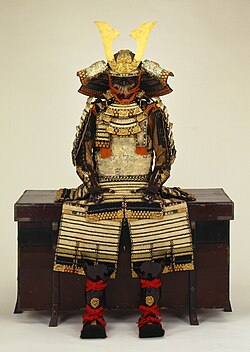
Ō-yoroi, Kamakura period, 13th-14th century, National Treasure, Kasuga Grand Shrine.
A man wearing samurai armor and jinbaori (sleeveless jacket) turns around, 2019

Japanese armour first appeared in the 4th century, as evidenced by the discovery of cuirasses and basic helmets in graves.[1]

During the Heian period (794–1185), the unique Japanese samurai armour ō-yoroi and dō-maru appeared.[2] The Japanese cuirass evolved into the more familiar style of body armour worn by the samurai known as the , with the use of leather straps (nerigawa) and Japanese lacquerware for weatherproofing. Leather and/or iron scales were also used to construct samurai armours, with leather and eventually kumihimo (braided silk) used to connect the individual scales (kozane) of the cuirass.[3]

The Sengoku period had created new armies of ashigaru, lightly-armoured peasant soldiers armed with long spears. Japan also began trading with European powers, principally the Portuguese Empire, which is known as the Nanban trade. Matchlock guns were sold to the Japanese in the 1500s, who rapidly improved them. These new tanegashima guns were mass-produced domestically. The combination of these two things meant samurai needed much lighter and simpler armour with different defensive qualities; this new style was called tosei-gusoku "modern armour".[3]

When a unified Japan entered the peaceful Edo period, samurai continued to wear both plate and lamellar armour as symbols of their status.

Ōyamazumi Shrine is renowned as a repository of armour. It houses 40% of armour that the government of Japan has designated as National Treasures and Important Cultural Properties.[4][5] Kasuga Grand Shrine also has a large collection of valuable armour.[6]

Every year on Children's Day, which is May 5, households in Japan display miniature samurai armour and kabuto (elaborate helmets) as an adaptation of the former Imperial Court ritual of the tango no sekku. In feudal times, real samurai armour, kabuto, and tachi (swords) were displayed.[7][8]

History

[edit]
Dō-maru, Muromachi period, 15th century, Important Cultural Property, Tokyo National Museum
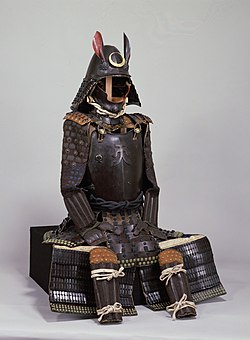
Gusoku Armour from the Kii Tokugawa Family. Edo period, 17th century. Minneapolis Institute of Art. In 2009, it sold for $602,500, the highest bid in Christie's history for a Japanese armour.[9]
Gusoku Armour with a medieval revival style. Cloud dragon is drawn using maki-e technique. Edo period, 19th century, Tokyo Fuji Art Museum

The earliest Japanese armour is thought to have evolved from the armour used in ancient China.[1][10] Cuirasses and helmets were manufactured in Japan as early as the 4th century.[1] Tankō for foot soldiers, and keikō with extra upper torso protection for cavalry, were both pre-samurai types of early cuirass constructed from iron plates connected by leather thongs.[11]

During the Heian (794–1185), the ō-yoroi and dō-maru emerged. High-ranking mounted samurai wore the luxurious and heavily built ō-yoroi, while the lighter dō-maru were typically used by lower-ranking foot soldiers.[2] The Japanese cuirass evolved into the more familiar style known as the dō. Armour makers began using leather, and lacquer was applied to weatherproof the components. Leather and/or iron scales were used to construct samurai armour, with leather and kumihimo connecting the individual scales.[12]

The artistic decoration of ō-yoroi reached its peak around the time of the Genpei War (1180–1185), a civil war at the end of the Heian. Ō-yoroi, which required a high degree of aesthetic refinement, might require up to 300 metres (980 ft) of kumihimo in various colours and weaving styles to complete a single suit of armour. Toward the end of the Kamakura period (1185–1333), even high-ranking samurai often wore the lightweight dō-maru.[2][13]

In the Kamakura period (1185–1333), the simplest style of armour, called hara-ate (腹当), appeared. It protected only the front of the torso and the sides of the abdomen and was worn by lower-ranked soldiers.[14] In the late Kamakura, the haramaki appeared, which extended both ends of the hara-ate to the back. During the Nanboku-chō period (1336–1392), ashigaru and conscripted farmers fought on foot, increasing demand for light, mobile, and inexpensive haramaki. Later, kabuto, men-yoroi (facial armor), and kote (gauntlets) were added to the haramaki, and even high-ranking samurai began to wear them.[15]

In the Muromachi period (1336–1573), the production process of armour became simplified, and mass production became possible at a lower cost and faster rate than before. The scales of traditional armour were connected with cords in a style called kebiki odoshi (毛引縅), which was so dense that the entire surface of the scales was covered with the cords. During this period, another new method, called sugake odoshi (素懸縅), was adopted, in which two cords sparsely connected the scales. The technique of overlapping armour scales was also simplified. Traditional-style scales were the honkozane (本小札), in which half the scales overlapped and were connected. During this period, a new style of scales, iyozane (伊予札), was developed, in which one-fourth of the scales were overlapped and connected.[15]

In the 16th century, the Nanban trade brought matchlocks to Japan in 1543. These were called "Tanegashima" after Tanegashima, the first island the Europeans arrived on.[16] Soon after, when Japanese smiths improved and began to mass-produce the tanegashima, warfare changed completely. The samurai needed armour that was lighter and more protective. In addition, large-scale battles also required the mass production of armour. As a result, the tosei-gusoku was created from the design of the dō-maru.[3]

Additionally, the Japanese adopted a full-plate armour known as nanban dō-gusoku, with an iron helmet and solid cuirass, in imitation of Portuguese armour. The first set was given to Sakakibara Yasumasa by Tokugawa Ieyasu right before the Battle of Sekigahara (1600). It was handed down in the Sakakibara family.[17] Scales were changed to itazane (板札), a relatively large iron or leather plate, providing better defence. Itazane could also replace a row of individual honkozane or iyozane with a single plate. This type of gusoku resembled plate armour; the front and back dō are made from a single iron plate with a raised center and a V-shaped bottom, was called Nanban dō gusoku (Southern barbarian gusoku).[3] Bullet resistant armours were developed called tameshi gusoku ('bullet tested'),[18] allowing samurai to continue wearing armour despite the use of firearms.[19]

Since the armour was no longer flexible, gusoku has changed its method to facilitate donning and doffing by opening and closing the armour at a hinge. The simplified structure of the armour makes it easier to manufacture, allowing armour makers to focus on design and to increase the variety of armour appearances. For example, the iron plate was designed to resemble an old man's chest, and dō-maru-style gusoku was made by attaching coloured threads to its surface.[3][20]

Samurai during this period, especially those with a high rank, such as daimyo, owned a lot of suits of armour. For example, Tokugawa Ieyasu owned dozens of suits, which are now owned by Kunōzan Tōshō-gū, Nikkō Tōshō-gū, Kishū Tōshō-gū, Tokugawa Art Museum, The Tokugawa Museum, Tokyo National Museum, etc.[21][22][23]

The era of warfare called the Sengoku period (1467–1615)[24] ended when a united Japan entered the peaceful Edo period (1603–1868). Although samurai continued to use both plate and lamellar armour as a symbol of their status, traditional armours were no longer necessary for battle. For this reason, in the Edo period, armour in the style of the revival of the medieval period, incorporating gorgeous ō-yoroi and dō-maru designs, became popular.[25]

During the Edo period, lightweight, portable, and secret armours became popular, as personal protection remained necessary. Civil strife, duels, assassinations, and peasant revolts all required the use of armours such as the kusari (chain jacket) and armoured sleeves, as well as other types of armour that could be worn under ordinary clothing.[26] Edo period samurai were in charge of internal security and would wear various types of kusari gusoku (chain armour) and shin and arm protection as well as armored hachimaki to protect the forehead.[27]

Armour continued to be worn and used until the Meiji era in the 1860s, with the last use of samurai armour in 1877 during the Satsuma Rebellion.[28]

Construction

[edit]
Construction of samurai armour, Source Wendelin Boeheim Leipzig 1890:
1. Cuirass - dō (胴(仏胴))
2. Fauld - kusazuri (草摺)
3. Cuisse - haidate (佩楯)
4. Poleyn - tateage (立挙)
5. Greaves - suneate (臑当(篠臑当))
6. Sabaton - kōgake (甲懸)
7. Spaulders - sode (袖(当世袖))
8. Vambrace - kote (籠手(篠籠手))
9. Gauntlets - tekkō (手甲(摘手甲))
10. Helm - kabuto (兜(日根野形頭形兜))
11. Badge (helmet) - kasa-jirushi (笠印)
12. Forehead plate - mabisashi (眉庇)
13. Lame - fukikaeshi (吹返)
14. Neck guard - shikoro (しころ(日根野しころ))
15. Crest (here: water buffalo horns) - wakidate (立物(水牛の脇立))
16. Crest (here: sun disk) - maedate (立物(日輪の前立))
17. Faceplate - menpō or mempō (面頬(目の下頬))
18. Badge (shoulder) - sode-jirushi (垂)
19. Bevor - yodare-kake (襟廻)

Japanese armour was generally constructed from many small iron (tetsu) and/or leather (nerigawa) scales (kozane) and/or plates (ita-mono), connected to each other by rivets and macramé cords (odoshi) made from leather and/or braided silk, and/or chain armour (kusari). Noble families had silk cords made in specific patterns and colors of silk thread. Many of these cords were constructed of well over 100 strands of silk. Making these special silk cords could take many months of steady work, just to complete enough for one suit of armour.[29]

These armour plates were usually attached to a cloth or leather backing. Japanese armour was designed to be as lightweight as possible as the samurai had many tasks including riding a horse and archery in addition to swordsmanship. The armour was usually brightly lacquered to protect against the harsh Japanese climate. Chain armour (kusari) was also used to construct individual armour pieces and full suits of kusari were even used.[30]

Individual armour parts

[edit]
The itazane-structured dou (cuirass), the quirky designs of kabuto (helmet) and mengu (face guard), are typical features of the gusoku armour. Azuchi–Momoyama period, 16th-17th century, Suntory Museum of Art

A full suit of traditional Samurai armour could include the following items:

  • Dou or dō, a chest armour made up of iron and or leather plates of various sizes and shapes with pendents
  • Kusazuri made from iron or leather plates hanging from the front and back of the dou (dō) to protect the lower body and upper leg.
  • Sode, large rectangular shoulder protection made from iron and or leather plates.
  • Kote, armoured glove like sleeves which extended to the shoulder or han kote (kote gauntlets) which covered the forearms. Kote were made from cloth covered with iron plates of various size and shape, connected by chain armour (kusari).
  • Kabuto, a helmet made from iron or leather plates (from 3 to over 100 plates) riveted together. A neck guard shikoro made from several layers of curved iron or leather strips was suspended from the bottom edge of the kabuto.
  • Mengu, various types of lacquered metal and or leather facial armour designed in a way that the top heavy helmet kabuto could be tied and secured to them by various metal posts. Mengu had throat guards yodare-kake made from several rows of iron or leather plates or kusari (chain armour) sewn to a cloth backing, suspended from the bottom edge.
  • Haidate, thigh guards which tied around the waist and covered the thighs. These were made from cloth with small iron and or leather plates of various size and shape, usually connected to each other by chain armour (kusari) and sewn to the cloth.
  • Suneate, shin guards made from iron splints connected together by chain armour (kusari) and sewn to cloth and tied around the calf.

Auxiliary armours

[edit]
  • Guruwa, a type of throat and neck protector.
  • Nodowa, a type of throat and neck guard.
  • Tate-eri, the tate-eri is a small padded pillow like piece with a standing armored collar that sits on the shoulder to protect from the weight of the dou (dō). The standing collar would be lined with kikko armour to protect the neck.
  • Manju no wa, the manju no wa, (also manjunowa or manju nowa) is a combination of shoulder pads, collar and armpit guards in one that protected the upper chest area. Manju no wa were covered with kusari (chain armour), karuta (small armour plates), or kikko (brigandine), these armours or a combination of them were sewn to a cloth backing. The armour could be exposed or hidden between a layer of cloth. When worn the manju no wa looked like a small tight fitting vest. Manju no wa have small wings that would pass under the arm pit area from the back and attach to the front of the manju no wa.
  • Manchira, the manchira is a type of armoured-vest covered with kusari (chain armour), karuta (small armour plates) or kikko (brigandine), these armours or a combination of them were sewn to a cloth backing. The armour could be exposed or hidden between a layer of cloth. Manchira are larger than manju no wa and protected the chest area and sometimes the neck and arm pit. Some manchira could be worn over the dou (dō).
  • Wakibiki, the wakibiki is a simple rectangle of cloth covered with kusari (chain armour), karuta (small iron plates), or kikko (brigandine) these armours or a combination of them were sewn to the cloth backing. Wakibiki could also be made from one solid piece of iron or hardened leather. The wakibiki had cords connected to them which allowed the wakibiki to hang from the shoulder, the wakibiki was then suspended over the exposed arm pit area. Wakibiki were either worn inside or outside the chest armour dou (dō) depending on the type.
  • Yoroi zukin, cloth hoods with various types of armour sewn to the cloth.
  • Kogake, armored tabi, a kind of sabaton that covered the top of the foot.
  • Jingasa (war hat), resembling the civilian coolie hat, issued to Ashigaru retainers, these could be made from metal or leather.
  • Hachi gane/hitai ate, various types of light weight, portable, forehead protectors.
  • Yoroi katabira, jackets covered with various types of armour, the armour could be exposed or hidden between layers of cloth.
  • Yoroi hakama, pants covered with various types of armour, the armour could be exposed or hidden between layers of cloth.
  • Kusari gusoku, chain mail.

Clothing worn with Japanese armour

[edit]
This is a replica of jinbaori with a Mount Fuji design that was worn by Toyotomi Hideyoshi in the 16th century. early–mid-19th century, Metropolitan Museum of Art
  • Uwa-obi or himo, a cloth sash or belt used for attaching various weapons and other items such as the katana, wakizashi and tantō.
  • Fundoshi, a simple loin cloth.
  • Kyahan or kiahan, tight gaiters made of cloth which covered the shins.
  • Hakama, a type of pants worn underneath the armour, hakama could be long or short like the kobakama.
  • Shitagi, a shirt worn underneath the armour.
  • Tabi, a cloth sock with divided toes.
  • Waraji, a woven sandal also known as zōri.
  • Kutsu, short riding boots made from leather.
  • Yugake, gloves that were worn under the kote.
  • Kegutsu, also known as tsuranuki, short leather shoes trimmed with bear fur.
  • Jinbaori, sleeveless jacket worn over Japanese armour.

Auxiliary items worn with Japanese armour

[edit]
  • Sashimono, a small banner that is attached to the back of the dou (dō) by special fittings. Its purpose was to identify the wearer as friend or foe which was essential in the chaotic confusion of a pitched battle melee.
  • Horo, a cloak reserved for prestigious, high-ranking samurai. It provides additional protection from arrows.
  • Agemaki, a decorative tassel worn on the back of some dou and kabuto, the agemaki can also serve as an attachment point.
  • Jirushi, small identification flags or badges worn on the back of the helmet (kasa jirushi) or on the shoulder (sode jurishi).
  • Datemono/tatemono, crests of various shapes and sizes worn on several areas of the helmet (kabuto).
  • Yebira, arrow quiver for ya (arrows).

Types

[edit]

Pre-samurai armour

[edit]
  • Armours that were worn in Japan before the samurai class evolved.
    • Tanko
    • Keiko

Kozane-gusoku

[edit]
A Kozane-gusoku armour in exposition.

Kozane dou (dō) gusoku, are samurai armours with a lamellar cuirass constructed from individual scales (kozane), old fashioned armours used before the introduction of firearms in Japanese warfare (pre-Sengoku styles).[31][32]

  • Ō-yoroi, old style dou (dō) for mounted samurai, constructed with hon kozane (small individual scales).
  • Dō-maru, old style dou (dō) that opened in the back, constructed with hon kozane (small individual scales), later period haramaki dou (dō) were made with armour plates.
  • Hon kozane dou (dō) (small individual scales)
  • Hon-iyozane dou (dō) or Nuinobe dou (dō) (large individual scales).

Tosei-gusoku

[edit]

Tosei dou (dō) gusoku the so-called "modern armours" made from iron plates (ita-mono)[33] instead of individual scales (kozane). Tosei-gusoku became prominent starting in the 1500s due to the advent of fire arms, new fighting tactics and the need for additional protection.[20][34]

  • Okegawa Dou (dō) gusoku - (tub-sided), refers to the tub-like shape of the dou (dō). There are two types of okegawa dou (dō): yokohagi (horizontal lames), and tatehagi (vertical lames).
  • Hishinui dou (dō) or Hishi-toji dou (dō) - chest armours with rows of prominent cross knots, usually an okegawa dou (dō).
  • Munemenui dou (dō) or Unamenui dou (dō) - chest armours with a running stitch that goes horizontally across the surface of the dou (dō). This stitch of lacing runs along the surface of the lame looking like a dotted line paralleling the top.
  • Dangae dou (dō) gusoku - meaning "step-changing", a combination of two or more styles.
  • Hotoke dou (dō) gusoku - chest armour which is smooth and shows no signs of lames.
  • Nio dou (dō) - embossed to resemble the emaciated torso of a starving monk or old man.
  • Katahada-nugi dou (dō) - embossed to resemble a half-naked torso.
  • Yukinoshita or Sendai dou (dō) - five plate, four hinge (go-mai) chest armour in the sendai or yukinoshita style.
  • Hatomune dou (dō) gusoku - (pigeon-breast chest armour or cuirass) were inspired by European peascod breastplate armour. Hatomune dou (dō) have a sharp central ridge running vertically down the front.
  • Uchidashi dou (dō) gusoku - Embossed or hammered out relief on the front.
  • Nanban dou (dō) gusoku — Armour made on the base of late European armour
  • Mōgami dou (dō) - five-plate, four hinge (go mai) chest armours with solid lames which are laced with sugake odoshi instead of being riveted.

Other types

[edit]
  • Tatami-gusoku — Folding portable armour made from karuta armour (small square or rectangular plates) or kikko armour (small hexagon plates).[35][36] Kusari gusoku (chain armour) is another form of tatami armour. Chochin kabuto (collapsible helmets) and hachi gane ( forehead protectors) that folded were also tatami armour.
  • Tameshi-gusoku — bullet tested armour
  • Gyorin kozane-gusoku — Scale armour
  • Nanban-gusoku — western-inspired armour
  • Okasi-gusokulending or borrowing armour or munition armour, usually made for ashigaru (it might be Tatami-do or any plain basic armour) often marked with clan insignia (mon).
  • Uma yoroi, horse armour used in the Edo period for parades.
  • Kusari gusoku Chain armour, armour made entirely of or the majority of the armour being made from kusari (chain mail) sewn to cloth.[35]
  • Kigote, a general term for several varieties of kote extended or completed by the addition of erisuwari (padded collar), kara-ate (shoulder pads) and wakibiki (armpit protectors). Examples of the kigote are the kote haramaki (kote which covers the belly), tominaga kote (kote that connect to each other in the front and back), sashinuki kote (kote made in the form of a short jacket).
  • Yoroi katabira, armored jackets of various styles and sizes. Katabira were armored with kikko, hexagon armor plates, karuta, square or rectangular armor plates, or kusari, chain armor, or a combination of these armors.

Individual samurai armor parts

[edit]

Rating of Japanese armors

[edit]

At present, by the Law for the Protection of Cultural Properties, important armors of high historical value are designated as Important Cultural Properties (Jūyō Bunkazai, 重要文化財), and special armors among them are designated as National Treasures (Kokuhō, 国宝). The armors designated as cultural properties based on the law of 1930, which was already abolished, have the rank next to Important Cultural Properties as Important Art Object (Jūyō Bijutsuhin, 重要美術品).[37]

The Association for the Research and Preservation of Japanese Helmets and Armor (ja:日本甲冑武具研究保存会, Nihon Katchu Bugu Kenkyu Hozon Kai), a general incorporated association, rates high-value armors in five grades. In order of rank, they are, from highest to lowest, Juyo Bunka Shiryo (重要文化資料, Important cultural article), Koshu Tokubetsu Kicho Shiryo (甲種特別貴重資料, Especially precious article first grade), Tokubetsu Kicho Shiryo (特別貴重資料, Especially precious article.), Kicho Shiryo (貴重資料, Precious article), Hozon Shiryo (保存資料, Article worth preserving).[38]

See also

[edit]

References

[edit]
[edit]
Revisions and contributorsEdit on WikipediaRead on Wikipedia
from Grokipedia
Japanese armour, known collectively as yoroi or gusoku, encompasses the protective equipment developed and worn by Japanese warriors, especially the samurai class, from the 4th century CE through the 19th century. Constructed primarily from small scales or plates of iron and leather, these suits were lacquered for weather resistance and durability, then laced together with colorful silk cords (odoshi) to ensure flexibility and ease of movement—essential for mounted archery and horseback combat. A typical complete suit (tōsei-gusoku) included a helmet (kabuto), cuirass (), shoulder protectors (sode), arm guards (kote), thigh guards (haidate), and shin guards (suneate), often embellished with family crests (mon) and intricate decorations symbolizing the wearer's status and heritage. The origins of Japanese armour trace back to the , with archaeological evidence of basic cuirasses and helmets found in ancient graves, likely influenced by continental Asian designs but adapted for local needs such as protection against arrows in horseback warfare. During the (794–1185 CE), the elaborate emerged as the standard for high-ranking , featuring large, square-shaped, hanging shoulder guards (sode) that provided wide defensive coverage but restricted arm mobility, along with box-like construction from laced scales (kozane) to deflect projectiles while allowing archers to draw bows over the armor. By the (1185–1333 CE), warfare shifted toward infantry, prompting lighter variants like the dō-maru (body-encompassing) and haramaki (waist-wrap), which covered the body more fully without impeding foot soldiers. In the Muromachi (1336–1573 CE) and Azuchi-Momoyama (1573–1603 CE) periods, amid the Sengoku (Warring States) era's intense conflicts, armour evolved into the tōsei-gusoku—a "contemporary style" full harness incorporating larger solid iron plates (tosei) riveted together for enhanced protection against emerging firearms like matchlock guns (), while retaining laced elements for articulation, and featuring smaller, curved shoulder guards (sode) that conformed to the body to prioritize mobility. Materials consistently featured iron or rawhide scales backed with leather, coated in black or red to ward off rust and moisture, with silk lacing in patterns that denoted clan affiliation or rank; these suits could be disassembled and folded compactly for storage or travel. During the Edo period (1603–1868 CE), a time of relative peace under the Tokugawa shogunate, practical combat armour gave way to ceremonial and display pieces, often revived in archaic styles with lavish , embroidered , and symbolic motifs to evoke ancestral prestige and social hierarchy. Though production declined with Japan's modernization in the (1868–1912), Japanese armour remains a pinnacle of craftsmanship, blending functionality with artistic refinement in , , and , and continues to influence global perceptions of culture.

History

Origins in Ancient Japan

The earliest evidence of protective gear in Japan dates to the (c. 300 BCE–300 CE), where simple defenses made from , , or wood were used by hunters and early warriors, as indicated by rare surviving examples of lacquered wooden plates from archaeological sites. These rudimentary protections likely served to shield against rudimentary weapons in inter-tribal skirmishes and activities, reflecting a pre-metallic era focused on lightweight, organic materials suited to the archipelago's environment. During the Kofun period (c. 250–538 CE), iron technology was introduced to primarily through exchanges with the Korean Peninsula, enabling the production of more durable metal armors imported from or inspired by Korean and Chinese designs. This era saw the emergence of tankō, a tankard-shaped chest formed from hammered iron plates arranged horizontally and joined by rivets or lacing to encase the torso, providing robust protection for while allowing some mobility. Complementing this was the keikō, a segmented trunk armor suited for horsemen, constructed from vertical rows of iron plates laced together for flexibility during mounted combat; surviving examples, such as those from burial mounds, demonstrate early adaptations of continental lamellar techniques to Japanese needs. Specific artifacts, like the iron tankō in the Metropolitan Museum of Art's collection (dating to the 4th–5th century CE), feature curved plates shaped to the body—higher in the back for rider compatibility—and open at the front, laced with leather cords that have often perished but are evidenced by archaeological traces. In the Asuka and Nara periods (538–794 CE), Japanese armor further adopted continental styles, particularly scale armor (kozane) from and Korea, consisting of small trapezoidal iron or leather scales laced into flexible rows to cover the body. Archaeological sites like the Eta Funayama Tomb in , a 5th–6th century keyhole-shaped , have yielded artifacts such as iron helmets and protective gear reflecting Baekje Korean influences, underscoring the influx of advanced metallurgical and design elements via diplomatic and ties. These developments played a crucial role in early imperial conflicts, including campaigns against northern tribes and expeditions to Korea, where armor equipped conscript forces raised under the system—a centralized legal code modeled on Tang that formalized labor for service and aimed to establish a structured . This system enhanced imperial control by standardizing equipment for provincial levies, transitioning from elite clan warriors to a more organized defense apparatus.

Evolution During the Samurai Era

The evolution of Japanese armour during the Samurai era, spanning the through the , reflected the changing nature of warfare from elite to widespread and firearm-involved conflicts, with designs prioritizing both and mobility. In the (794–1185 CE), armour innovations centered on the needs of the emerging bushi class engaged in horseback . The emerged as a primary type, characterized by large, rectangular shoulder guards (sode) that protected the arms during bow draws and a box-like chest section (dō) constructed from thousands of small, lacquered iron or leather scales (kozane) laced in horizontal rows. This structure provided broad coverage against arrows while accommodating the archer's posture, though its weight—often exceeding 25 kilograms—limited it to high-ranking warriors on horseback. These developments built briefly on earlier continental influences but were distinctly adapted for Japan's terrain and tactics. The (1185–1333 CE) and Muromachi (1336–1573 CE) periods marked a shift toward greater versatility as battles increasingly involved foot soldiers alongside . The dō-maru and haramaki types gained prominence, featuring cuirasses that wrapped fully or partially around the for enhanced mobility in close-quarters combat, constructed with smaller kozane scales for flexibility. The (1180–1185 CE) highlighted the ō-yoroi's role in decisive mounted engagements, yet its rigidity proved less ideal for the prolonged, mixed-combat scenarios that followed, prompting the adoption of these lighter alternatives weighing around 15-20 kilograms. The Ōnin War (1467–1477 CE), a protracted civil conflict, further drove refinements in haramaki designs to support extended marches and hand-to-hand fighting among lower-ranking bushi. By the Sengoku period (1467–1603 CE), the chaos of near-constant warfare necessitated even more practical evolutions, with armour emphasizing speed and resistance to emerging threats like matchlock firearms (tanegashima) introduced in 1543 CE. Designers incorporated thicker solid iron plates (tetsu) over vital areas such as the chest and reinforced lacing to deflect bullets, while overall weight was reduced through minimalist kozane arrangements and the omission of ornate sode on lower armours. These changes enabled massed infantry formations in large-scale battles, balancing protection against projectiles with the agility required for ashigaru foot soldiers. Throughout this era, armour transcended mere functionality to symbolize the rising status of the bushi class, serving as visible markers of rank and loyalty with clan-specific motifs, colors, and heraldic crests (mon) embroidered or painted on laces and plates. High-ranking commissioned customized sets to display wealth and heritage, reinforcing social hierarchies amid feudal fragmentation.

Decline and Preservation

During the (1603–1868 CE), the long era of peace enforced by the transformed Japanese armour from a tool of warfare into a symbol of status and ceremony. With no major conflicts to demand practical functionality, armourers focused on elaborate, decorative designs featuring intricate lacquering, gold inlays, and silk cords, often rendering the pieces unsuitable for combat. These ornate ensembles, known as tōsei-gusoku, were displayed during parades and rituals, emphasizing aesthetic appeal over battlefield utility. The of 1868 accelerated the decline of armour as practical equipment, as the new imperial government dismantled the class and embraced to modernize . Samurai privileges, including the right to bear arms, were abolished, leading to the obsolescence of traditional armour; many pieces were sold, repurposed, or melted down to support industrial efforts, such as forging modern weaponry. This shift marked the end of armour's role in daily military life, confining surviving examples to private collections or emerging public institutions. In the 20th century, preservation efforts gained momentum through institutions like the , which houses extensive collections of armour as national cultural treasures, employing specialized conservation techniques to prevent deterioration from cracking and metal corrosion. Post-World War II, Japan's Law for the Protection of Cultural Properties, enacted in 1950, formalized the safeguarding of such artifacts by designating them as Important Cultural Properties, providing legal frameworks for restoration and public access. This legislation, prompted by wartime losses, ensured systematic protection and study of armour as part of Japan's intangible and tangible heritage. Into the 21st century, artisan revivals have sustained interest in Japanese armour through reproductions crafted for cultural festivals like Kyoto's and historical films, where traditional urushi lacquering techniques—applying multiple layers of tree sap for waterproofing and sheen—are faithfully replicated by skilled craftsmen. Recent archaeological discoveries, such as the 2025 excavation of gilded armour fragments from Emperor Nintoku's 5th-century tomb in , have also revealed intact early variants like keikō-style lamellar plates, offering new insights into pre-Edo construction methods. Historical documentation on women's during the remains limited, with records focusing more on their training in polearms rather than full suits, though recent scholarly analyses have begun addressing this gap by examining clan archives and artistic depictions to highlight female samurai's defensive roles. These studies underscore how peace reduced overt martial involvement for women, yet preserved their cultural significance in symbolism.

Materials and Construction

Materials Used

Japanese armour relied heavily on iron as the primary metal for constructing plates, with the technology for ironworking introduced to Japan from the Korean peninsula during the (c. 300 BCE–300 CE), where early examples from show similarities to Chinese and Korean cast-iron implements. By the (794–1185), raw or tempered iron plates formed the core defensive elements, sourced mainly from iron sand deposits along 's coastlines and riverbeds, which were processed using the tatara smelting method to produce workable metal despite Japan's limited high-quality ore reserves. In later eras, particularly from the (1336–1573) onward, steel alloys—often high-carbon derived from refined iron sand—replaced or supplemented pure iron, offering enhanced hardness and resistance to arrow penetration while maintaining relative lightness. Organic materials played a crucial role in providing flexibility and supplementary protection. Tanned cowhide leather served as a base layer for many armours, valued for its durability and ability to be molded into scales or coverings, with historical examples confirming its use as a substrate beneath metal plates. Raw silk threads, braided into cords known as odoshi or odoshige, were employed for lacing plates together, enabling articulated movement essential for mounted and foot combat; these laces, often color-coded to denote rank or clan affiliation. Protective coatings and auxiliary materials further adapted armour to Japan's humid climate. Urushi lacquer, derived from the sap of the tree, was meticulously applied in multiple layers over iron, , and other surfaces. This process significantly strengthened the armour—particularly by rigidifying leather kozane scales to enhance rigidity and defensive capability—while providing essential weatherproofing for heavier iron plates in later designs. It also offered , resistance, and added durability, hardening effectively at high humidity levels (70–80%) and temperatures around 20–25°C—conditions prevalent in that would otherwise accelerate on untreated metals like European . For lighter or training variants, lacquered (composed of layered, hand-made mulberry fiber sheets) offered inexpensive reinforcement, while strips provided structural support in select reinforcements, both chosen for their availability and resistance to without compromising mobility. These materials were briefly integrated via lacing and layering to balance protection and articulation across armour components.

Manufacturing Techniques

The fabrication of scales, or kozane, for traditional Japanese armour began with hand-forging small plates from iron, typically measuring around 4 cm in width and 2 cm in height, which were shaped through repeated hammering to achieve the desired curvature and uniformity. These scales were punched with pairs of holes along their edges to facilitate assembly, allowing for the creation of flexible lamellar structures that could conform to the body's movements. Over time, particularly from the onward, production techniques evolved toward larger solid plates in tosei-gusoku (contemporary armour), where multiple smaller pieces were riveted together for greater efficiency and strength. Once fabricated, the kozane were assembled using intricate lacing methods known as odoshi, which employed colored cords to bind the scales into rows and boards, ensuring articulation while distributing impact forces across the armour. Common patterns included kebiki odoshi, a dense full lacing that covered the scales without gaps for a seamless appearance, and kechō odoshi, which raised the scales slightly for added protection and visual depth; these techniques allowed the armour to flex during without restricting mobility. The initial lacing , called shita odoshi, secured scales into horizontal boards before vertical connections formed the final structure. The scales and assembled components underwent a lacquering process using urushi, a sap-derived applied in multiple thin layers over iron or bases to provide , prevention (particularly for heavier iron plates in later armors such as tōsei-gusoku), considerable strengthening through hardening and rigidification (especially of leather components), and a glossy finish. Each layer was dried under carefully controlled high-humidity conditions to polymerize the , with up to 30 or more coats common for durability; decorative elements, such as inlays of or silver , were incorporated between layers to enhance aesthetic appeal and signify rank. This technique, refined over centuries, transformed raw materials into resilient, ornate surfaces capable of withstanding harsh conditions. Armour production was dominated by specialized artisan families and schools, such as the Myōchin, which emerged during the (1185–1333) and established guild-like structures emphasizing multi-generational transmission of skills through apprenticeships that could span several years. These armorers, trained in , lacing, and lacquering, produced pieces of varying quality to meet diverse needs. In the Sengoku era (1467–1603), escalating warfare prompted mass-production methods within schools like the Myōchin, shifting from entirely handmade elite armour to standardized variants using simplified riveting and lacing for lower ranks, though high-end pieces retained meticulous craftsmanship. Today, replicas often integrate traditional hand techniques with modern computer numerical control (CNC) machining for precise scale shaping and assembly, preserving historical accuracy while enabling broader accessibility.

Components of Armour

Head Protection

The primary component of head protection in Japanese armour is the , a helmet designed to shield the skull while allowing mobility in battle. Early from the (710–794 CE) featured simple hemispherical bowls known as hachi, constructed from 8 to 12 rectangular iron plates riveted together vertically, providing basic defense against arrows and blades during mounted warfare. Over time, during the Heian (794–1185 CE) and (1185–1333 CE) periods, the design evolved to include more plates for enhanced curvature and strength, with later (1336–1573 CE) examples incorporating up to 32 or 62 ridged plates to form a steeper, more protective hachi that better deflected blows. These helmets were typically forged from iron, lacquered for rust resistance, and often adorned with elaborate crests called maedate, such as feathers or ornate motifs, which served both as status symbols and to intimidate foes on the battlefield. Face protection complemented the kabuto through mengu or menpo , crafted from lacquered iron to cover the face partially or fully, enhancing intimidation with fierce, demonic expressions while safeguarding against slashes. Common variants included the somen, a full-face enclosing the entire visage for maximum coverage, and the hanbo, a half-face type protecting the cheeks and while leaving the eyes and exposed for . These , emerging in the late , were reserved for and high-ranking , with decorative elements like mustaches or gold inlays emphasizing rank and . Neck protection was provided by the shikoro, a series of 3 to 6 scaled lames of lacquered iron or oxhide suspended from the hachi's base, often gilded for added prestige and durability. Integrated with the menpo was the yodare-kake, a plated throat guard that draped forward to shield the neck's front, laced in place to prevent gaps in coverage during dynamic combat. Functionally, incorporated ventilation through narrow slits around the visor and maedate base, ensuring airflow to prevent overheating in prolonged engagements, while the shikoro's lames distributed the helmet's weight—typically 2 to 4 kilograms—across the shoulders rather than straining the neck, crucial for on horseback charging into . This design coordinated seamlessly with torso armour like the do, forming a unified protective ensemble. An iconic example is Toyotomi Hideyoshi's golden from the late , featuring a radiant sun motif maedate symbolizing his rise to power and imperial ambitions.

Torso and Shoulder Armour

The torso and shoulder armour formed the core protective elements for the upper body in Japanese armour, emphasizing mobility, deflection of projectiles, and adaptation to combat styles from mounted warfare to infantry engagements. The dō, or , served as the primary torso protection, encasing the chest and upper back. Early forms, such as the ō-yoroi dō developed during the (794–1185), featured a hinged front design suited for mounted , constructed from over 1,000 small rectangular scales called hon kozane—typically lacquered or iron—overlapping and laced horizontally with or thongs for flexibility and waterproofing. This construction allowed the dō to open at the front for donning while on horseback, though it left the lower abdomen partially exposed, supplemented by additional lames. By the Muromachi (1336–1573) and later periods, the dō evolved into the tosei-gusoku style, reflecting the shift to foot combat during the Sengoku era (1467–1603); these were made from solid, folded iron plates riveted and hinged at the sides, offering greater rigidity and ease of wear without the bulk of scales, often weighing around 10–15 kg alone. Internal padding, known as fukuro, lined the dō with cloth or quilted fabric to absorb impacts and prevent chafing. Shoulder protection was provided by the sode, which varied significantly between early and later armour types. In early sets, the sode were large, roughly square-shaped guards that hung down long from cords over the shoulders and attached to the dō via agemaki (decorative knots), providing a wide defensive area against arrows in charges but restricting arm mobility. They were expansive—up to 30 cm wide and composed of layered iron or leather plates laced similarly to the dō—featuring ebizori (shrimp-tail) curves on the upper edges for deflecting projectiles away from the and head. In contrast, in tosei-gusoku armour, the sode were smaller, curved to closely fit the body's contours, prioritizing mobility and presenting a compact, streamlined appearance suited to infantry combat. Comparison images often depict ō-yoroi sode as protruding prominently from the shoulders, while tosei-gusoku sode appear more fitted and less obtrusive. Later designs integrated sode more closely with defenses (kote), reducing size while retaining laced plate construction. The back of the dō in early designs like the ō-yoroi incorporated large hinged plates such as the sendan-no-ita and kyūbi-no-ita, providing coverage for the upper and lower back, often supplemented by laced scales in transitional styles. Complete torso and shoulder ensembles, when combined with the full armour suit, typically weighed 20–30 kg, distributed to balance the warrior's center of gravity and facilitate extended wear. Decorative aspects enhanced the dō and sode's functionality with symbolism; clan mon (heraldic crests) were often embossed, gilded, or painted in on the front, identifying the wearer in battle and denoting status, as seen in Edo-period (1603–1868) examples where such motifs were integrated into the plate forging.

Arm, Leg, and Foot Protection

The protective gear for arms, legs, and feet in Japanese armour, known collectively as the sangu, was designed to balance defense with the flexibility required for wielding weapons and maintaining mobility on the battlefield. These components typically featured small lacquered iron scales (kozane or small plates) sewn or laced onto a base of , , or fabric using silk cords, allowing articulation while covering vulnerable limbs. Materials evolved from and in early designs to iron by the , with finishes like russet iron for resistance in humid conditions. This construction emphasized lightweight portability, distinguishing Japanese limb armour from the heavier plate designs of European counterparts. Kote, or armored sleeves, extended from the shoulder to the wrist or knuckles, providing comprehensive arm protection while permitting essential movements like drawing a or nocking an . Constructed by attaching rows of small iron plates and sections (kusari) to padded fabric, kote often included a hand guard () shaped as a D or bar for parrying blows. Variations accounted for handedness: the left kote was reinforced with larger plates to shield against bowstring snap, while the right was lighter to facilitate sword grips, as seen in Edo-period examples (1603–1868) measuring approximately 32 inches in length. These sleeves laced directly to the shoulder guards (sode) for seamless integration. Haidate served as thigh guards, functioning as an apron-like structure of overlapping scales on a cloth or backing to protect the upper legs, especially during mounted charges. Laced to the lower edge of the torso's kusazuri ( plates), haidate covered the front and sides of the thighs, with dimensions around 22 inches in length in 17th– artifacts made from iron, , hemp, and horn. Suneate, the shin guards, were splint-style protectors running from to ankle, evolving from simple three-plate or versions in the 12th century to laced iron splints by the (1336–1573). Early suneate lacked dedicated coverage, but later designs incorporated hinged knee caps (hizugatana) for full lower-leg defense, as evidenced in iron examples about 15 inches high from the era. Foot protection remained rudimentary to preserve speed and terrain adaptability, primarily integrating —straw sandals tied over the feet beneath the suneate—for grip on varied surfaces like mud or gravel. Standard foot protection included kogake, armored socks with small plates or over sandals, offering minimal but flexible coverage for the instep and toes. Full enclosing greaves or sabatons were rare, appearing only in specialized late-period () variants for ceremonial or urban combat, where iron-toed boots supplemented the suneate. Adaptations reflected social roles: foot soldiers used lighter versions with fewer plates and more fabric for agility in mass formations, contrasting with the heavier, scale-reinforced sangu of for individual duels.

Types of Japanese Armour

Early and Pre-Samurai Types

The earliest forms of Japanese armour trace their origins to the (c. 300 BCE–300 CE), where protective gear was rudimentary and primarily consisted of simple leather caps and chest bands worn by elites for basic defense during tribal conflicts. These items offered minimal coverage, focusing on the head and upper to guard against rudimentary weapons like wooden spears and arrows, and archaeological evidence remains extremely limited, with only a handful of fragments recovered from burial sites. During the subsequent (c. 250–538 CE), armour evolved into more structured designs suited to the emerging hierarchical society of chieftains and warriors. The tankō (short armour) emerged as a prominent type around the CE, featuring a rigid, box-like constructed from narrow horizontal iron plates riveted or laced together to form a clamshell shape covering the torso while leaving arms and legs exposed. Primarily used by and foot soldiers, the tankō provided solid protection against arrows and close-quarters spears in engagements, often paired with basic leather or iron helmets. Its design reflected indigenous adaptations, though ironworking techniques suggest continental influences from Korea and . By the Asuka (538–710 CE) and Nara (710–794 CE) periods, the keikō (suspended armour) largely replaced the tankō, incorporating horizontal bands of lamellar scales—overlapping iron or plates laced with leather thongs—for enhanced mobility. This construction, worn by court guards and horsemen, drew heavily from Chinese models, including the gyōyō style of rectangular lamellar plates that emphasized layered flexibility over rigidity. Keikō armours were suspended from shoulder straps over padded garments, prioritizing torso defense in ceremonial and limited military roles within the imperial court, where threats were mainly arrows and spears rather than heavy melee weapons. In the early Heian period (794–c. 1000 CE), just prior to the full emergence of the class, transitional designs like the uchikake-shiki keikō served as precursors to later , characterized by their boxy, heavy builds with reinforced iron lames and extensive lacing for noble wearers. These cumbersome pieces, often weighing over 20 kilograms, were reserved for high-ranking in ceremonial contexts at the imperial court, underscoring armour's role as a symbol of status amid evolving warfare. Overall, these pre-samurai armours were crafted from iron, leather, and bronze, with construction emphasizing rivets and lacing for assembly, and they laid foundational techniques for later developments without the elaborate aesthetics of samurai eras. Surviving artifacts are scarce, with fewer than 50 complete or partial sets documented, predominantly fragmented remains excavated from ancient tombs like those in the Kofun clusters. Notable examples include a 5th–6th century tankō cuirass at the Metropolitan Museum of Art, illustrating the solid plate riveting, and 8th–12th century keikō scales from the same collection, showcasing the lamellar lacing.

Heian to Muromachi Period Armour

The armour developed during the Heian (794–1185) to Muromachi (1336–1573) periods represented a pivotal evolution in Japanese protective gear, transitioning from elaborate cavalry-focused designs to more practical forms suited for both mounted and emerging foot soldiers amid intensifying feudal conflicts. These s, primarily constructed from lacquered or iron scales (kozane) laced together with cords (odoshi), emphasized mobility for and swordplay while providing layered defense against arrows and blades. High-ranking warriors favored ornate variants to signify status, but practical adaptations arose as warfare shifted toward larger engagements. The , or "great armour," epitomized Heian-period opulence and was reserved for elite mounted warriors. Its box-shaped dō torso protected the chest and back with rows of large, rectangular kozane, while oversized sode shoulder guards extended dramatically to shield the arms during horseback . Weighing approximately 25–30 kg due to its robust construction, the offered formidable protection but restricted movement, making it ideal for ceremonial and high-status battlefield roles rather than prolonged infantry combat. By the Kamakura period (1185–1333), the dō-maru emerged as a more versatile alternative, particularly for foot soldiers and lower-ranking . This wrap-around style fastened at the right side with cords, allowing easier donning and greater flexibility compared to the cumbersome ō-yoroi; its dō was slimmer and lighter, typically 15–20 kg, with shorter sode and kote arm guards optimized for close-quarters maneuvering. The design prioritized needs during ground assaults, reflecting the growing emphasis on adaptable protection in clan wars. In the , the haramaki addressed the demands of mass mobilization, serving as an economical belted torso armour for foot troops. Tied at the back with a sash-like wrap, it focused protection on the and chest using smaller kozane plates for reduced weight and cost, often under 10 kg, while maintaining compatibility with simple helmets and leg guards. This streamlined form enabled rapid production and deployment for conscripted forces, marking a shift toward scalable defences in prolonged campaigns. Key innovations during this era included color-coded odoshi lacing to denote lineage, such as purple for the or green for the , enhancing visual identification on chaotic battlefields. Following the Mongol invasions of 1274 and 1281, armourers adapted designs for improved joint protection—adding reinforced hinges and flexible skirting to counter the invaders' massed and tactics—while reducing overall bulk to favor dismounted fighting over charges. These armour types dominated major conflicts, including the (1180–1185), where ō-yoroi-clad Minamoto and Taira warriors clashed in decisive engagements, and the Nanboku-chō wars (1336–1392), which saw widespread use of dō-maru and haramaki amid civil strife between northern and southern .

Late Muromachi to Edo Period Armour

During the Late Muromachi and Sengoku periods (roughly 1467–1603), Japanese armour underwent significant evolution to address the demands of intensified warfare, including the introduction of firearms by traders in 1543. This era marked the rise of tōsei-gusoku (当世具足), or "contemporary armour," which represented a shift toward more practical, form-fitting designs emphasizing mobility and bullet resistance over the elaborate, arrow-focused constructions of earlier periods. These armours incorporated riveted and welded iron plates, often lacquered for durability, allowing and foot soldiers to maneuver effectively in large-scale battles. A key innovation within tōsei-gusoku was the okegawa-dō (桶側胴), a tub-shaped cuirass made from horizontally or vertically riveted lames of folded metal sheets, enabling rapid mass production to equip growing armies during the chaotic Sengoku conflicts. This design, typically featuring a single hinge under the left arm for donning and a tapered silhouette for better fit, became the quintessential tōsei-dō (modern cuirass) and was often produced as okashi-dō munition-grade armour for retainers. Building on refinements from mid-Muromachi lamellar styles, the okegawa-dō prioritized functionality, with variants using straight, scale-like, or wavy lames secured by flush or domed rivets. The advent of matchlock firearms profoundly influenced armour construction, prompting thicker plating and hybrid elements like chainmail (kusari) inserts in joints to counter bullet penetration while maintaining flexibility. Post-1543, tōsei-gusoku increasingly featured solid breastplates and reinforced sections, reflecting Western (nanban) influences such as riveted assembly for enhanced strength against projectiles, though full European-style plate was rare and mostly adapted locally. These adaptations proved crucial in battles like Nagashino (1575), where combined arms tactics highlighted the need for armour that balanced protection from gunfire with infantry mobility. Armouries scaled up production dramatically to meet wartime demands, with warlords like overseeing the manufacture of thousands of standardized sets, including Owari-dō variants, to outfit vast forces efficiently. This industrialization of armour-making, centered in regions like after Nobunaga's conquests around 1575, shifted focus from bespoke craftsmanship to utilitarian output, ensuring even lower-ranking troops had viable protection. With the onset of the peaceful Edo period (1603–1868), armour transitioned toward ceremonial and symbolic roles, as exemplified by the jinbaori (陣羽織), a short surcoat worn over lighter tōsei-gusoku sets by daimyo and high-ranking samurai. Originally a practical weatherproof layer of silk, felt, or leather to shield armour from rain and cold, it evolved into an ornate garment adorned with family crests (mon) and metallic threads, signifying status during parades and non-combat duties. Examples from the 17th century, such as those featuring embroidered motifs, underscore this shift from battlefield utility to cultural display.

Specialized Variants

Japanese armour included several specialized variants adapted for particular roles, genders, or regional needs, diverging from standard samurai designs to suit unique circumstances. These adaptations emphasized practicality, mobility, or cultural symbolism while maintaining core protective principles like lacing and lacquering. Women's armour, used by or female warriors, was rare but documented in historical literature and legends, often consisting of lighter variants inspired by early keikō styles or modified dō-maru to accommodate female physiology and combat roles such as defense of the home or battlefield support. Figures like , a renowned during the (1180–1185), are described in the Heike Monogatari as engaging in fierce combat, implying the use of such adapted armour for archery and sword fighting alongside male warriors. Similarly, the legendary Empress Jingū is portrayed as donning armour to lead a military expedition following her husband's death, highlighting early precedents for women in protective gear during the 3rd century. These sets were typically scaled down in weight and bulk compared to ō-yoroi, prioritizing agility for weapons like the , though archaeological evidence remains limited due to their scarcity. Horse armour, or uma-yoroi, provided for mounts, featuring scale-covered chest pieces (uma-dō) and protective masks (bamen) to shield against arrows during prevalent in the (794–1185). Designed to complement the rider's yoroi, these ensembles used lacquered leather or iron scales laced with silk, allowing horses to maneuver in formation while protecting vital areas like the neck and flanks. Surviving examples from later periods, such as Edo-era sets, illustrate continuity in construction, but historical records confirm their widespread use among Heian nobility for enhancing battlefield mobility and prestige in bow-centric warfare. Naval variants emerged during the (1467–1603) for warfare on ships and floating fortresses like , featuring lighter, more flexible constructions to facilitate movement on unstable decks and resist water exposure. These sets often employed waterproofed over tatami-style folding plates, reducing weight for boarding actions and archery from vessels while maintaining core lamellar elements. Such adaptations were essential for clans like the Murakami navy, enabling sustained engagements in coastal battles. Training and children's armour served educational and ceremonial purposes, with nerigawa referring to padded cloth constructions used in practice to mimic battle conditions without the hazards of metal gear. These soft variants allowed young trainees to develop skills in weapon handling and formation drills, common in dojos from the onward. Complementing this, keiki or miniature yoroi were crafted for heirs, symbolizing lineage and warrior heritage; displayed on (May 5), they represented parental aspirations for strength and resilience in boys, often replicating full-scale designs in reduced proportions for inspirational display in noble households. Regional variations included Ainu leather protections in , distinct from mainland due to the indigenous group's lifestyle and harsher climate. Crafted from tanned deer skin (retarpe) or bark fibers (attush), these garments offered natural insulation and abrasion resistance during conflicts or hunts, forming tubular robes without the rigid plates or lacing of yoroi. Worn by Ainu warriors in skirmishes against Japanese settlers up to the 18th century, such attire emphasized mobility in forested terrain over heavy defense, reflecting cultural independence from feudal military norms.

Auxiliary Equipment

Clothing and Undergarments

The primary undergarments worn beneath Japanese armour consisted of the , a simple straight-sleeved made from or , which served to absorb sweat and prevent chafing against the rigid armour plates. This garment, originating from the (794–1185) and continuing into later eras, was typically white or plain for practicality, allowing to maintain mobility while providing a base layer close to the skin. Layered with the kosode was the , a traditional fashioned from a long strip of or linen cloth wrapped around the waist and between the legs, functioning as the most basic form of lower-body undergarment to ensure hygiene and support during extended wear. Over these undergarments and directly beneath the , often donned a hitatare ensemble, comprising a and matching trousers woven from durable fabrics like or , designed for comfort and to facilitate the donning of armour without restricting movement. For protection against weather when armour was worn, a jinbaori was layered on top; this sleeveless, short coat, produced from the 15th to mid-19th century, was typically crafted from , , or —often quilted for insulation—and featured family crests or decorative motifs to signify status. Examples include those lined with or adorned with metallic threads, emphasizing both functionality in rain or cold and ceremonial display. Footwear integrated seamlessly with these layers through , split-toe socks made of white cotton that separated the big toe for compatibility with straw sandals, providing cushioning and grip during long marches on rough terrain. The , tied with ropes around the ankles, were lightweight and disposable, often padded with additional straw for endurance in military campaigns. This combination ensured stability and prevented blisters, integrating with limb protections to preserve full mobility in varied conditions. Clothing choices adapted to Japan's seasonal variations, with lighter and hitatare prevalent in humid summers to promote ventilation, while winter variants incorporated blends or additional quilted linings in jinbaori for warmth against cold winds. These adaptations followed the koromogae tradition of changing attire around June 1 for summer and October 1 for winter, balancing comfort with the demands of armour use. Hygiene was paramount in Japan's humid climate, where sweat and moisture could lead to discomfort or infection under armour; thus, and hitatare featured removable linings or were constructed for easy disassembly, allowing thorough washing via the arai-hari method of unpicking seams, cleaning panels individually, and resewing. This practice extended to , which were frequently replaced, ensuring warriors could maintain cleanliness during prolonged field service.

Additional Protective Items

Shields, known as , were rectangular and primarily employed in early Japanese warfare during the Nara and Heian periods (710–1185) by foot soldiers or archers for formation defense. Constructed from layered wood, rawhide, or riveted iron plates painted in bold colors, they measured approximately 1.5–2 meters in height and were portable or fixed as barriers, but their use declined sharply by the (1467–1603) with the rise of mobile infantry tactics and reliance on personal armor. Rare examples persisted into the as ceremonial items.

Cultural and Symbolic Aspects

Quality Ratings and Craftsmanship

Japanese armour was evaluated through a hierarchical system of recognized armour-making schools under the , which standardized production and quality control across major workshops. The ten principal schools—Myōchin, Saotome, Haruta, Iwai, Yukinoshita, Bamen, Neo, Ichiguchi, Nakasone, and Sakonji—formed the backbone of this framework, with the Myōchin school holding the highest prestige for its innovative techniques and capabilities that influenced nationwide standards. Quality assessments within these schools emphasized the uniformity of scales (kozane), the durability and finish of coatings, and overall structural integrity, where superior pieces demonstrated even lacing, rust-resistant iron plating, and precise assembly to ensure mobility without compromising protection. Craftsmanship excellence was marked by signed components from master artisans, particularly in renowned lineages like the Saotome school, known for their russet-iron helmets () and detailed plate work that balanced aesthetic decoration with functional weight distribution and ergonomic fit. For instance, Saotome Ietada's signed 62-plate suji exemplifies this, featuring riveted iron plates with intricate edging for enhanced durability and visual appeal, often tailored to the wearer's physique for optimal combat performance. These markers extended to decorative elements, such as gold inlays or family crests (mon), which signified not only artistry but also the armour's role in ceremonial displays during the peaceful . Economic disparities in production reflected quality tiers, with mass-produced sets for foot soldiers costing around 4 to 6 ryo (equivalent to approximately 4 to 6 of rice nominally), while elite daimyo-grade ensembles from top schools could cost dozens of ryo or , incorporating rare materials like lacing and custom-forged plates. This variation arose from labor-intensive processes in prestigious workshops versus standardized output in regional foundries, where basic tatami-style armour for lower ranks prioritized affordability over ornamentation. Authentication of historical pieces relies on Tokugawa-era inventories and records, which meticulously documented ownership and modifications for shogunal collections, providing verifiable chains of custody for items like those presented to allies or stored in clan armories. Modern appraisals employ non-invasive techniques such as imaging to detect hidden repairs, revealing concealed rivets, replaced scales, or underlying corrosion in layers that might indicate later alterations. Recent studies since 2000 have highlighted the prevalence of Edo-period pieces in international collections, often involving reassembled components or forged signatures to mimic Saotome or Myōchin styles, with conservation analyses identifying inconsistencies in material and composition through spectroscopic examination. These investigations, including examinations of Sakakibara heirlooms, underscore the need for multi-disciplinary approaches to distinguish originals from fakes, addressing gaps in earlier cataloging that overlooked subtle fabrication discrepancies.

Role in Society and Legacy

Japanese armour served as a profound marker of social hierarchy within the bushi class, embodying the wearer's identity, rank, and allegiance through intricate designs and motifs. Elaborate helmets () and cuirasses often featured clan crests (mon) or symbolic emblems, such as peacock feathers or mythical creatures, which distinguished high-ranking from lower retainers and signaled loyalty to specific or factions during periods of civil strife. These elements transformed functional protective gear into status symbols, where the quality and uniqueness of decorations reflected not only wealth but also martial prowess and social standing in feudal society. Women of the class, known as or onna-bugeisha, had limited but notable roles in warfare, occasionally donning adapted armour to defend castles or lead troops in emergencies, as evidenced by historical accounts of figures like during the . Their involvement underscored the expectation of familial duty, though societal norms increasingly confined such participation to defensive contexts by the . Beyond the battlefield, Japanese armour carried deep symbolism tied to , the warrior code emphasizing valor, loyalty, and honor. Helmets, in particular, represented courage and intimidation, with crests (maedate) like antlers or sun motifs evoking ferocity and divine protection to demoralize enemies while affirming the wearer's unyielding spirit. This iconography extended into cultural practices, where armour elements appeared in theatre costumes to depict warrior archetypes, blending historical realism with stylized elegance to convey themes of duty and transience. In festivals such as the in , replicas of historical armour are paraded to celebrate eras of Japanese history, reinforcing communal ties to heritage and allowing participants to embody the valor of past ages. Similarly, the Armor Festival at features processions in recreated Heian-period o-yoroi, highlighting craftsmanship and ritual significance in contemporary traditions. The global legacy of Japanese armour emerged prominently in the 19th century through Meiji-era exports, which captivated Western audiences and shaped perceptions of exotic Oriental artistry and militarism. Collectors in Europe and America acquired suits as curiosities, influencing designs and fostering , a movement that romanticized aesthetics in fine arts and decorative objects. This fascination persisted into modern pop culture, where armour symbolizes stoic heroism in Akira Kurosawa's 1954 film , which depicted ronin in tattered yet iconic gear to explore themes of sacrifice and community defense. Video games like (2020) further popularized it, drawing on Kurosawa's visual style to portray flexible, layered protection in immersive narratives of resistance against invasion. In contemporary times, the craft of armour-making holds modern relevance as a preserved , recognized in Japan's national inventory since 1998 for techniques like restoration and lacing (odoshi), ensuring the transmission of skills vital to . Compared to European plate armour, Japanese variants prioritized flexibility through lamellar construction, allowing greater mobility for and horseback combat, in contrast to the rigidity of full-plate suits designed for sword and pike engagements. This adaptability not only suited Japan's terrain and tactics but also contributed to its enduring allure as a symbol of resilient .

References

Add your contribution
Related Hubs
User Avatar
No comments yet.