


Community hub
Recent from talks
Contribute something
Nothing was collected or created yet.
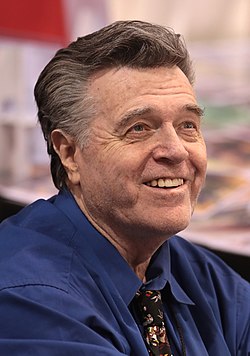
Neal Adams
View on Wikipedia
Neal Adams (June 15, 1941 – April 28, 2022)[1][2][3] was an American comic book artist. He was the co-founder of the graphic design studio Continuity Associates, and was a creators-rights advocate who helped secure a pension and recognition for Superman creators Jerry Siegel and Joe Shuster. During his career, Adams co-created the characters John Stewart, Man-Bat, and Ra's al Ghul for DC Comics.
Key Information


After drawing the comic strip based on the television drama Ben Casey in the early 1960s, Adams was hired as a freelancer by DC Comics in 1967. Later that year, he became the artist for the superhero character Deadman in the science fiction comic book Strange Adventures. Adams and writer Dennis O'Neil collaborated on influential runs on Batman and Green Lantern/Green Arrow in the early 1970s. For Batman, the duo returned the Batman character to his gothic roots as a contrast to the Batman television series of the 1960s.[4] During their Green Lantern/Green Arrow run, O'Neil and Adams introduced a mature, realistic tone through stories such as "Snowbirds Don't Fly", in which Green Arrow's ward Roy Harper is revealed to have become addicted to drugs.[3] The duo created and introduced the Green Lantern character John Stewart in 1971.
Following his runs on Batman and Green Lantern, Adams drew other books for DC such as Superman vs. Muhammad Ali in 1978. In addition to his work with DC, Adams simultaneously freelanced for Marvel Comics on books such as Uncanny X-Men and The Avengers. In 1971, Adams established the art and illustration studio Continuity Associates with Dick Giordano. In 1984, Adams founded his own comic book company Continuity Comics, which was in business until 1994.
Adams was inducted into the Eisner Awards' Will Eisner Comic Book Hall of Fame in 1998, the Harvey Awards' Jack Kirby Hall of Fame in 1999, and the Inkwell Awards Joe Sinnott Hall of Fame in 2019.
Early life
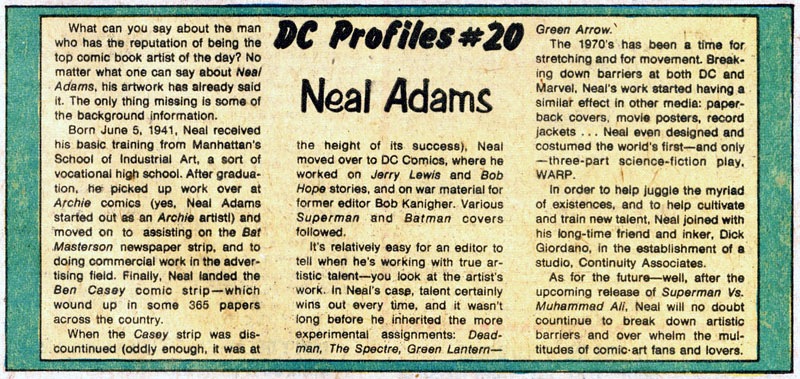
[edit]Neal Adams was born June 15, 1941, on Governors Island, New York City,[2][5][6] to Frank Adams, a writer for the military, and Lilian, who ran a boardinghouse.[7] Raised in a military family, he grew up in a series of army bases, ranging from Brooklyn to Germany.[8] His father was largely absent from his life.[7] Adams attended the School of Industrial Art high school in Manhattan,[9][10] graduating in 1959.[11]
Career
[edit]Early work
[edit]After graduation in 1959, he unsuccessfully attempted to find freelance work at DC Comics,[11] and turned then to Archie Comics, where he wanted to work on the publisher's fledgling superhero line, edited by Joe Simon. At the suggestion of staffers, Adams drew "three or four pages of [the superhero] the Fly", but did not receive encouragement from Simon.[12] Sympathetic staffers nonetheless asked Adams to draw samples for the Archie teen-humor comics themselves. While he did so, Adams said in a 2000s interview, he unknowingly broke into comics:
I started to do samples for Archie and I left my Fly samples there. A couple weeks later when I came in to show my Archie samples, I noticed that the pages were still there, but the bottom panel was cut off of one of my pages. I said, "What happened?" They said, "One of the artists did this transition where Tommy Troy turns into the Fly and it's not very good. You did this real nice piece so we'll use that, if it's OK." I said, "That's great. That's terrific."[12]
That panel ran in Adventures of the Fly #4 (Jan. 1960).[12] Afterward, Adams began writing, penciling, inking, and lettering[9] humorous full-page and half-page gag fillers for Archie's Joke Book Magazine.[12] In a 1976 interview, he recalled earning "[a]bout $16.00 per half-page and $32.00 for a full page. That may not seem like a great deal of money, but at the time it meant a great deal to myself as well as my mothers ... as we were not in a wealthy state. It was manna from heaven, so to speak." A recommendation led him to artist Howard Nostrand, who was beginning the Bat Masterson syndicated newspaper comic strip, and he worked as Nostrand's assistant for three months, primarily drawing backgrounds at what Adams recalled as $9 a week and "a great experience".[9]
Having "not left Archie Comics under the best of circumstances",[9] Adams turned to commercial art for the advertising industry. After a rocky start freelancing, he began landing regular work at the Johnstone and Cushing agency, which specialized in comic-book styled advertising.[13] Helped by artist Elmer Wexler, who critiqued the young Adams' samples, Adams brought his portfolio to the agency, which initially "didn't believe I had done those particular samples since they looked so much like Elmer Wexler's work. But they gave me a chance and ... I stayed there for about a year".[14]
Ben Casey
[edit]
In 1962, Adams began his comics career in earnest at the Newspaper Enterprise Association syndicate. From a recommendation, writer Jerry Caplin, a.k.a. Jerry Capp, brother of Li'l Abner creator Al Capp, invited Adams to draw samples for Capp's proposed Ben Casey comic strip, based on the popular television medical-drama series.[12] On the strength of his samples and of his "Chip Martin, College Reporter" AT&T advertising comic-strip pages in Boys' Life magazine, and of his similar Goodyear Tire ads,[15] Adams landed the assignment.[12] The first daily strip, which carried Adams' signature, appeared November 26, 1962; a color Sunday strip was added September 20, 1964.[16] Adams continued to do Johnston & Cushing assignments during Ben Casey's 3+1⁄2-year run.[17]
Comics historian Maurice Horn said the strip "did not shrink from tackling controversial problems, such as heroin addiction, illegitimate pregnancy, and attempted suicide. These were usually treated in soap opera fashion ... but there was also a touch of toughness to the proceedings, well rendered by Adams in a forceful, direct style that exuded realism and tension and accorded well with the overall tone of the strip".[16]
In addition to Capp, Jerry Brondfield also wrote for the strip, with Adams stepping in occasionally.[18]
The ABC series, which ran five seasons, ended March 21, 1966, with the final comic strip appearing Sunday, July 31, 1966.[16] Despite the end of the series, Adams has said the strip, which he claimed at different points to have appeared in 365 newspapers,[14] 265 newspapers,[19] and 165 newspapers,[20] ended "for no other reason that it was an unhappy situation":
We ended the strip under mutual agreement. I wasn't happy working on the strip nor was I happy giving up a third of the money to [the TV series' producer,] Bing Crosby Productions. The strip I should have been making twelve hundred [dollars] a week from was making me three hundred to three-fifty a week. On top of that, I was not able to express myself artistically when I wanted to. But we left under very fine conditions. I was even offered a deal in which I would be paid so much a month if I would agree not to do any syndicated strip for anyone else, in order that I might save myself for anything they have for me to do.[14]
Adams' goal at this point was to be a commercial illustrator.[12] While drawing Ben Casey, he had continued to do storyboards and other work for ad agencies,[12] and said in 1976 that after leaving the strip he had shopped around a portfolio for agencies and for men's magazines, "but my material was a little too realistic and not exactly right for most. I left my portfolio in an advertising agency promising they were going to hold on to it. In the meantime I needed to make some money ... and I thought, 'Why don't I do some comics?'"[21] In a 2000s interview, he remembered the events slightly differently, saying "I took [my portfolio] to various advertising people. I left it at one place overnight and when I came back to get it the next morning it was gone. So six months worth of work down the drain. ... "[12]
He worked as a ghost artist for a few weeks in 1966 on the comic strip Peter Scratch (1965–1967), a hardboiled detective serial created by writer Elliot Caplin, brother of Al Capp and Jerry Capp, and artist Lou Fine.[22] Comics historians also credit Adams with ghosting two weeks of dailies for Stan Drake's The Heart of Juliet Jones, but are uncertain on dates; some sources give 1966, another 1968, and Adams himself 1963.[18] As well, Adams drew 18 sample dailies (three weeks' continuity) of a proposed dramatic serial, Tangent, about construction engineer Barnaby Peake, his college-student brother Jeff, and their teenaged sibling Chad, in 1965, but it was not syndicated.[23] Adams later said that Elliot Caplin offered Adams the job of drawing a comic strip based on author Robin Moore's The Green Berets, but that Adams, who opposed the Vietnam War, where the series was set, suggested longtime DC Comics war comics artist Joe Kubert, who landed that assignment.[20]
Silver Age splash
[edit]
Turning to comic books, Adams found work at Warren Publishing's black-and-white horror-comics magazines, under editor Archie Goodwin.[24] Adams debuted there as penciler and inker of writer Goodwin's eight-page story "Curse of the Vampire" in Creepy #14 (April 1967). He and Goodwin quickly collaborated on two more stories, "Fair Exchange" in Eerie #9 (May 1967) and "The Terror Beyond Time" in Creepy #15 (June 1967), and Adams reapproached DC Comics.[25]
With DC war comics stalwart Joe Kubert now concentrating on the comic strip The Green Berets, Adams, despite his opposition to then-current U.S. military involvement in Vietnam,[20] saw an opening:
I really didn't like most of the comics [at DC] but I did like war comics, ... so I thought, 'You know, now that Joe is not working there, they've got Russ Heath and they are plugging other people in where Joe used to be. Maybe I could kind of shift into a Joe Kubert kind of thing and do some war comics, and kind of bash them out [quickly]'. ... So I went over to see [DC war-comics editor] Bob Kanigher and I showed him my stuff, and I did have that feeling that they were missing Joe – a guy who could draw and do that rough, action stuff. So he gave me some work".[20]
Adams made his DC debut as penciler-inker of the 8+1⁄2-page story "It's My Turn to Die", written by Howard Liss, in the anthology series Our Army at War #182 (July 1967). He did a smattering of additional horror and war stories, respectively, for the two publishers, and then, after being turned down by DC's Batman editor Julius Schwartz, approached fellow DC editor Murray Boltinoff in the hopes of drawing for Boltinoff's Batman team-up title The Brave and the Bold.[20] Boltinoff instead assigned him to The Adventures of Jerry Lewis #101 (July–August 1967) and its full-length story "Jerry the Asto-Nut", written by Arnold Drake.[26][27] It became the first of a slew of stories and covers Adams would draw for that series and The Adventures of Bob Hope, two licensed titles starring fictional versions of the TV, film and nightclub comedians.[28]
During this period near the end of the industry revival historians call the Silver Age of comic books, Adams was soon assigned his first superhero covers, illustrating that of the Superman flagship Action Comics #356 (Nov. 1967) and the same month's Superman's Girl Friend, Lois Lane #79 (Nov. 1967), featuring Superman and a mysterious new costumed character, Titanman. Also that month, Adams drew his first superhero story, teaming with writer Gardner Fox on the lighthearted backup feature "The Elongated Man" in Detective Comics #369 (November 1967), the flagship Batman title. Shortly afterward, he drew Batman himself, along with the supernatural superhero the Spectre, on the cover of The Brave and the Bold #75 (Jan. 1968) – the first published instance of Adams' work on what would become two of his signature comics characters. The first instance of Adams drawing Batman in an interior story was "The Superman-Batman Revenge Squads" in World's Finest Comics #175 (May 1968).[29]
Another signature character, in what would prove Adams' breakout series, was the supernatural hero Deadman, who had debuted in DC's Strange Adventures #205 (Nov. 1967). Adams succeeded co-creator artist Carmine Infantino with the following issue's 17-page story "An Eye for an Eye",[30] written by Arnold Drake, with George Roussos inking Adams' pencils. Adams went on to draw both the covers and stories for issues 207–216 (Dec. 1967 – Feb. 1969), and taking over the scripting with #212 (June 1968). The series became a fan sensation,[31] winning many awards and being almost immediately inducted into the Alley Award Hall of Fame, with Adams himself receiving a special award "for the new perspective and dynamic vibrance he has brought to the field of comic art".[32]
Adams concurrently drew covers and stories for The Spectre #2–5 (Feb.-Aug. 1968), also writing the latter two issues, and became DC's primary cover artist well into the 1970s. Adams recalled that Infantino "was appointed art director, and decided I was going to be his spark plug. I also thought it was a good idea, and was promised a number of things which were never fulfilled. But I thought it would be an adventure anyway, so I knuckled down to things like 'Deadman', The Spectre and whatever odd things would come my way. I was also doing large amounts of covers".[33]
Adams was called upon to rewrite and redraw a Teen Titans story which had been written by then-newcomers Len Wein and Marv Wolfman. The story, titled "Titans Fit the Battle of Jericho!", would have introduced DC's first African American superhero but was rejected by publisher Carmine Infantino.[34] The revised story appeared in Teen Titans #20 (March–April 1969).[35]
Adams' art style, honed in advertising and in the photorealistic school of dramatic-serial comics strips,[36] marked a signal change from most comics art to that time. Comics writer and columnist Steven Grant wrote in 2009 that,
Jim Steranko at Marvel and Neal Adams were the most prominent new artists of the late '60s to enter a field that had been relatively hostile to new artists ... and breaths of modernism, referencing advertising art and pop art as much as comics. Despite vastly different styles, both favored designs that drew on depth of focus and angularity that put the reader in the center of the action while slightly disorienting them to increase the tension, and placed special emphasis on lighting and body language as emotion cues. Not that these things were unknown in comics by any stretch, but publishers traditionally deemphasized them. As well, both were hugely influential on how a new generation of artists thought about what comics should look like, though Adams was arguably more influential; his approach was more visceral and, more importantly, he ran a studio in Manhattan [Continuity Associates] where many young artists started their professional careers.[37]
First Marvel Comics work
[edit]
While continuing to freelance for DC, Adams in 1969 also began freelancing for Marvel Comics, where he penciled several issues of the mutant-superhero team title X-Men and one story for a horror anthology title. The Marvel "Bullpen Bulletins" column of Fantastic Four #87 (June 1969) described Adams as having "one foot planted in our Marvel doorway. We're guessing your ecstatic comments, when you see the way he illustrated our latest X-Men bombshell, will transform him into a Marvel madman from head to toe." Such freelancing across the two leading companies was rare at the time; most DC creators who did so worked pseudonymously.[38] Adams recalled in 1976:
The first time I got away from DC was when I went to Marvel to do the X-Men. It didn't stop me from working at DC; they were a little annoyed at me, but that was a calculated plan. ... If people saw that I would do such a thing, then other people might do it. Beyond that, it seemed like working for Marvel might be an interesting thing to do. It was, as matter of fact. I enjoyed working on the X-Men. [The company was] more friendly, a lot more real and I found myself delighting in the company of Herb Trimpe, John Romita and Marie Severin. I found them to be people who were not as oppressed as the people at National [i.e., DC Comics] were.[39]
He teamed with writer Roy Thomas on X-Men, then on the verge of cancellation,[40] starting with issue #56 (May 1969).[41] Adams penciled, colored, and collaborated on plotting, including the entire plot for issue #65.[42] In that issue, his final work on the series, Adams and writer Dennis O'Neil, in one of that creative team's earliest collaborations,[43] revived the Professor X character.[44] While working on the series, Adams was paired for the first time with inker Tom Palmer, with whom he would collaborate on several acclaimed Marvel comics; the duo's work here netted them 1969 Alley Awards for Best Pencil Artist and Best Inking Artist, respectively. Thomas won that year for Best Writer. Though the team failed to save the title, which ended its initial run with #66 (March 1970), the collaboration here and on the "Kree-Skrull War" arc of The Avengers #93–97 (Nov. 1971 – May 1972) produced what comics historians regard as some of Marvel's creative highlights of the era.[45][46][47][48] Adams also wrote and penciled the horror story "One Hungers" in Tower of Shadows #2 (Dec. 1969), and co-wrote with Thomas, but did not draw, another in Chamber of Darkness #2 (Dec. 1969). Thomas and Adams collaborated again along with scripter Gerry Conway and penciler Howard Chaykin to introduce the series "The War of the Worlds" and its central character, Killraven, in Amazing Adventures vol. 2 #18 (May 1973).[49]
Batman
[edit]Continuing to work for DC Comics during this sojourn, while also contributing the occasional story to Warren Publishing's black-and-white horror-comics magazines (including the Don Glut-scripted "Goddess from the Sea" in Vampirella #1, Sept. 1969), Adams had his first collaboration on Batman with writer Dennis O'Neil.[50] The duo, under the direction of editor Julius Schwartz,[51] would help revitalize the character with a series of noteworthy stories reestablishing Batman's dark, brooding nature and taking the books away from the campy look and feel of the 1966–68 ABC TV series.[52] Their first two stories were "The Secret of the Waiting Graves" in Detective Comics #395 (Jan. 1970) and "Paint a Picture of Peril" in issue #397 (March 1970), with a short Batman backup story, written by Mike Friedrich, coming in-between, in Batman #219 (Feb. 1970). Adams introduced new characters to the Batman mythos beginning with Man-Bat co-created with writer Frank Robbins in Detective Comics #400 (June 1970).[53] O'Neil and Adams' creation Ra's al Ghul was introduced in the story "Daughter of the Demon" in Batman #232 (June 1971)[54] and the character would later become one of Batman's most common adversaries. The same creative team would revive Two-Face in Batman #234 (Aug. 1971)[55] and revitalize the Joker in "The Joker's Five-Way Revenge!" in Batman #251 (Sept. 1973), a landmark story bringing the character back to his roots as a homicidal maniac who murders people on a whim and delights in his mayhem.[56][57]
Green Lantern/Green Arrow and "relevant comics"
[edit]
Batman's enduring makeover was contemporaneous[43] with Adams and O'Neil's celebrated and, for the time, controversial revamping of the longstanding DC characters Green Lantern and Green Arrow.[58]
Rechristening Green Lantern vol. 2 as Green Lantern/Green Arrow with issue #76 (April 1970), O'Neil and Adams teamed these two very different superheroes in a long story arc in which the characters undertook a social-commentary journey across America.[58] A few months earlier, Adams updated Green Arrow's visual appearance by designing a new costume and giving him a distinctive goatee beard for the character in The Brave and the Bold #85 (Aug.-Sept 1969).[59] A major exemplar of what the industry and the public at the time called "relevant comics",[60] the landmark run began with the 23-page story "No Evil Shall Escape My Sight" and continued to "... And through Him Save a World" in the series' finale, #89 (May 1972). It was during this period that one of the best known O'Neil/Adams stories appeared, in Green Lantern #85–86, when it was revealed that Green Arrow's ward Speedy was addicted to heroin.[61][62] Wrote historian Ron Goulart,
These angry issues deal with racism, overpopulation, pollution, and drug addiction. The drug abuse problem was dramatized in an unusual and unprecedented way by showing Green Arrow's heretofore clean-cut boy companion Speedy turning into a heroin addict. All this endeared DC to the dedicated college readers of the period and won awards for both artist and writer. Sales, however, weren't especially influenced by the praise, and by 1973 the crusading had ceased. I remember dropping in on [editor] Julius Schwartz about this time and asking him how relevance was doing. 'Relevance is dead', he informed me, not too cheerfully.[52]
After Green Lantern was cancelled, the adventures of both super-heroes continued in the pages of The Flash #217–219 and #226 (1972–74).[63]
Other work for DC
[edit]After Green Lantern/Green Arrow, Adams' contributions to DC, apart from his work on Batman, were sporadic, limiting to draw a Clark Kent back-up story in Superman #254 (1972) and sharing credits with Jim Aparo pencilling the Teen Titans in The Brave and the Bold #102 (1972). Adams also drew a few stories for Weird Western Tales and House of Mystery and covers for Action Comics and Justice League of America as well. Adams worked on the first intercompany superhero crossover Superman vs. the Amazing Spider-Man. Several of the Superman figures were redrawn by him.[64]
The last complete story that Adams drew at DC before opening his own company, Continuity Associates, was the oversize Superman vs. Muhammad Ali (1978) which Adams has called a personal favorite.[65][66] After this, Adams' production for DC and Marvel was mainly limited to new covers for reprint editions of some of his work, such as Green Lantern/Green Arrow, The Avengers: The Kree-Skrull War, X-Men: Visionaries, Deadman Collection and The Saga of Ra's al Ghul, which were variously published as reprint miniseries[67] or trade paperback collections. In 1988, he designed a new costume for DC's Robin character Dick Grayson.[68] DC loved the redesign and adopted it to the comics years later when they introduced new Robin Tim Drake. A miniposter was included in the first issue of the Robin limited series.[69]
21st century
[edit]
In 2005 Adams returned to Marvel (his last collaboration for this publisher had been in 1981 drawing a story for the Bizarre Adventures magazine) to draw an eight-page story for the Giant-Size X-Men #3.[70] The following year Adams (among other artists) provided art to Young Avengers Special #1.[70]
In 2010, Adams returned to DC Comics as writer and artist on the miniseries Batman: Odyssey.[71][72] Originally conceived as a 12-issue story, the series ran for six issues,[70][73] being relaunched with vol. 2, #1 in October 2011.[74] A total of seven issues were published for the second series until its end in June 2012.[70]
Apart from those assignments for DC, Adams penciled New Avengers vol. 2, #16.1 (Nov. 2011) for Marvel Comics.[75] In May 2012, Marvel announced that Adams would work on the X-Men again with The First X-Men, a five-issue miniseries drawn and plotted by him and written by Christos Gage.[76][77] Adams produced short stories for Batman Black and White vol. 2 #1 (Nov. 2013)[78] and Detective Comics vol. 2 #27 (March 2014).[79]
In February 2016, Adams revisited some of his most notable covers done for DC Comics in the 1960s and 1970s,[80] replacing the original characters with some of the New 52 ones.[81] Later that same year, Adams wrote and drew the six-part Superman: Coming of the Supermen miniseries.[82] In 2017, Adams wrote and drew a Deadman limited series.[83][84] He drew a new five-page story titled "The Game", which was written by Paul Levitz, for the Action Comics: 80 Years of Superman hardcover collection.[85]
In August 2020, Adams and writer Mark Waid released Fantastic Four: Antithesis, a four issue miniseries starring the Fantastic Four in a battle with a new cosmic threat.[86] This would be his final work as an interior artist.[87][88] Adams' final work as a writer (in addition to providing the artwork) would be Batman vs Ra's al Ghul, a miniseries that was originally published in November 2019 before the final two issues were delayed to March 2021 due to the COVID-19 pandemic.[89]
Film, TV and theater
[edit]Adams' pencil drawings on his later Batman stories were frequently inked by Dick Giordano, with whom Adams formed Continuity Associates,[90] a company that supplied storyboards for motion pictures and interior artwork for comics publishers.
In the early 1970s, Adams was the art director, costume designer, as well as the poster/playbill illustrator for Warp!, a science fiction stage play by director Stuart Gordon and playwright Lenny Kleinfeld under the pseudonym Bury St. Edmund.[91]
In 1980, Neal Adams directed and starred in Nannaz, later released by Troma under the title Death to the Pee Wee Squad. The film co-starred Adams' children Jason and Zeea as well as fellow comics professionals Denys Cowan, Ralph Reese, Larry Hama, and Gray Morrow.[92]
In late 2013 Adams appeared in the PBS TV documentary Superheroes: A Never-Ending Battle.[93]
Creators' rights
[edit]During the 1970s, Adams was politically active in the industry, and attempted to unionize its creative community. His efforts, along with precedents set by Atlas/Seaboard Comics' creator-friendly policies and other factors, helped lead to the modern industry's standard practice of returning original artwork to the artist, who can earn additional income from art sales to collectors. He won his battle in 1987, when Marvel returned original artwork to him and industry legend Jack Kirby, among others.[94][95] Adams helped lead lobbying efforts that resulted in Superman creators Jerry Siegel and Joe Shuster receiving decades-overdue credit and financial remuneration.[96]
Inker Bob McLeod recalled in the 2000s the unique place Adams held in the industry when McLeod entered the comics industry in 1973:
Pat [Broderick] told me I really ought to meet Neal Adams, whom he had met at DC. ... At that time, Neal held a position of respect in the industry that no one in comics since then has achieved. He was the single most respected artist in the business. ... Neal looked at one of my samples and asked me what kind of work I was looking for. I said, "Anything that pays." (By that time, I was down to my last $10. ... ) He just picked up the phone and called the production manager at Marvel and said, "I've got a guy here who has some potential as, well, some potential as an artist, but I think he has a lot of potential as a letterer." I was immediately hired at Marvel in the production department on Neal's recommendation, and they still didn't even want to see my portfolio. If I was good enough for Neal, I was good enough for them.[97]
In 1978, Adams helped form the Comics Creators Guild, which over three dozen comic-book writers and artists joined.[98]
Also during the 1970s, Adams illustrated paperback novels in the Tarzan series for Ballantine Books.[99] With the independent-comic publishing boom of the early 1980s, he began working for Pacific Comics (where he produced the poorly received Skateman)[100] and other publishers, and founded his own Continuity Comics as an offshoot of Continuity Associates. His comic-book company's characters include Megalith, Bucky O'Hare, Skeleton Warriors, CyberRad, and Ms. Mystic. He and fellow artist Michael Netzer entered into a dispute over intellectual property rights to Ms. Mystic, a character they had worked on jointly in 1977, which Adams had published under the Pacific Comics and Continuity Comics imprints, leading to a lawsuit against Adams in United States District Court in 1993.[101] The case was dismissed in 1997, citing the statute of limitations.[102]
Dina Babbitt and work related to the Holocaust
[edit]
In collaboration with Rafael Medoff, director of the David S. Wyman Institute for Holocaust Studies, Adams championed an effort to get the Auschwitz-Birkenau State Museum, which is operated by the government of Poland, to return the original artwork of Dina Babbitt. In exchange for his sparing her mother and herself from the gas chambers, Babbitt worked as an illustrator for Nazi death camp doctor Josef Mengele, who wanted detailed paintings to demonstrate his pseudoscientific theories about Romani racial inferiority.[103] Using text from Medoff, Adams illustrated a six-page graphic documentary about Babbitt that was inked by Joe Kubert and contains an introduction by Stan Lee.[104] However, Adams deemphasized any comparison between the Babbitt case and his struggle for creator rights, saying that her situation was "tragic" and "an atrocity."[103]
In 2010, Adams and Medoff teamed with Disney Educational Productions to produce They Spoke Out: American Voices Against the Holocaust, an online educational motion comics series that tells stories of Americans who protested Nazis or helped rescue Jews during the Holocaust. Each standalone episode, which runs from five to ten minutes, utilizes a combination of archival film footage and animatics drawn by Adams (who also narrates), and focus on a different person. The first episode, "La Guardia's War Against Hitler" was screened in April 2010 at a festival sponsored by the Museum of Comic and Cartoon Art, and tells the story of the forceful stand New York City Mayor Fiorello La Guardia took against Nazi Germany. La Guardia's actions stood in contrast to the relative passivity of President Franklin Roosevelt, who historians such as David S. Wyman believe did not do as much as he could have to save European Jews,[105] a point underlined in the episode "Messenger from Hell". Other episodes include "Voyage of the Doomed", which focuses on the S.S. St. Louis, the ship that carried more than 900 German-Jewish refugees but was turned away by Cuban authorities and later the Roosevelt administration, and "Rescue Over the Mountains", which depicts Varian Fry, the young journalist who led an underground rescue network that smuggled Jewish refugees out of Vichy France.[106][107]
Awards and honors
[edit]
Adams' first Deadman cover won the 1967 Alley Award for Best Cover.[108] A Batman/Deadman team-up in The Brave and the Bold #79 (Sept. 1968), by Adams and writer Bob Haney, tied with another comic for the 1968 Alley Award for Best Full-Length Story; and in 1969, Adams won the Alley Award for Best Pencil Artist, the feature "Deadman" was elected to the Alley Award Hall of Fame, and Adams received a special award "for the new perspective and dynamic vibrance he has brought to the field of comic art".[32]
He also won Shazam Awards in 1970 for Best Individual Story ("No Evil Shall Escape My Sight" in Green Lantern vol. 2, #76, with writer Dennis O'Neil), and Best Pencil Artist (Dramatic Division); and in 1971 for Best Individual Story ("Snowbirds Don't Fly" in Green Lantern vol. 2, #85, with O'Neil).[109][110]
Adams won the 1971 Goethe Award for Favorite Pro Artist,[111] as well as the 1971 Goethe Award for Favorite Comic-Book Story for "No Evil Shall Escape My Sight" (written by Denny O'Neil) in Green Lantern/Green Arrow #76.[112]
He won an Inkpot Award in 1976[113] and was voted the "Favourite Comicbook Artist" at the 1977[114] and the 1978 Eagle Awards.[115]
In 1985, DC Comics named Adams as one of the honorees in the company's 50th anniversary publication Fifty Who Made DC Great.[116]
Adams was inducted into the Eisner Awards' Will Eisner Comic Book Hall of Fame in 1998, and the Harvey Awards' Jack Kirby Hall of Fame in 1999.[117]
In 2019, Adams was inducted into the Inkwell Awards Joe Sinnott Hall of Fame for his lifetime achievement and outstanding accomplishments.[118]
Advocacy of expanding Earth hypothesis
[edit]Adams believed the Earth is growing[119] through a process called pair production.[120] Adams held the work of Australian geologist Samuel Warren Carey in high esteem, but considered the term "Expanding Earth" a misnomer.[121][122] While Carey did advocate an expanding Earth in the mid-20th century, his model was rejected following the development of the theory of plate tectonics.[123][124][125] Adams advocated his ideas in a DVD documentary he wrote and produced, clips of which are available on his YouTube channel.[126][127] Planet growth animations were created by Neal's daughter Zeea Adams.
Adams appeared on the radio show Coast to Coast AM several times to discuss his claims.[128] He was also interviewed by Steven Novella on a Skeptics Guide podcast in 2006, and afterward continued the debate on Novella's blog.[129] Japan Times columnist Jeff Ogrisseg wrote a three-part feature promoting Adams's ideas,[130][131][132] which was roundly criticized by Novella for being an example of "outright promotion of pseudoscience as if it were news."[133] Adams also used the concept as the basis for his Batman: Odyssey series, in which the planet's expansion has produced a Hollow Earth, the inside of which is inhabited by dinosaurs and Neanderthal versions of the main characters.[134]
Personal life and death
[edit]Adams' first wife was comics colorist Cory Adams. Their children are Kristine (Neal's business right hand), Joel (artist and character designer on King of the Hill), Jason (works in toy and fantasy sculpture), and Zeea (colorist, painter, digital artist and animator).
Adams and his second wife Marilyn[93] lived in New York.[135] Together they had one son, Josh.[136] Josh illustrated a pinup of Batman in Batman: Odyssey #1 (Sept. 2010).[137]
Adams died in New York on April 28, 2022, at the age of 80. Marilyn, his wife of 45 years, told The Hollywood Reporter that Adams had died from complications of sepsis.[3]
Bibliography
[edit]See also
[edit]References
[edit]- ^ Miller, John Jackson (June 10, 2005). "Comics Industry Birthdays". Comics Buyer's Guide. Iola, Wisconsin. Archived from the original on February 18, 2011.
- ^ a b Schepens, Beth (2003). "Army Brats Recall Island Paradise – Sidebar: Governors Island Factoids". NYC24.org. Archived from the original on January 31, 2009.
- ^ a b c Kit, Borys (April 29, 2022). "Neal Adams, comic book artist who revitalized Batman and fought for creators' rights, dies at 80". The Hollywood Reporter. Retrieved April 29, 2022.
- ^ Kreps, Daniel (April 29, 2022). "Neal Adams, Legendary Comic Book Artist Who Revitalized 'Batman,' Dead at 80". Rolling Stone. Retrieved April 30, 2022.
- ^ Duncan, Randy; Smith, Matthew J., eds. (2013). !cons of the American Comic Book: From Captain America to Wonder Woman. Santa Barbara, California: Greenwood Publishing Group. p. 1. ISBN 978-0313399237.
- ^ Carlson, Michael (May 6, 2022). "Neal Adams obituary". the Guardian. Retrieved May 6, 2022.
- ^ a b Gustines, George Gene (May 4, 2022). "Neal Adams, Who Gave Batman a Darker Look, Dies at 80". The New York Times. Archived from the original on June 7, 2022. Retrieved September 12, 2022.
- ^ "Front Row Center with Howard Chaykin: Neal Adams". NeoText. Archived from the original on October 30, 2020. Retrieved November 10, 2021.
- ^ a b c d The Neal Adams Treasury. Vol. 1. Detroit, Michigan: Pure Imagination. 1976. p. 3.
- ^ Kimball, Kirk (n.d.). "Gaspar Saladino – The Natural". Dial B for Blog. Archived from the original on April 18, 2016. Retrieved February 11, 2012.
- ^ a b "Neal Adams/Continuity Studios: Biography". NealAdamsEntertainment.com. Archived from the original on October 6, 2011. Retrieved June 17, 2010.
- ^ a b c d e f g h i Neal Adams interview (n.d.). "Neal Adams: Renaissance Man Part I". ComicsBulletin.com. Archived from the original on December 17, 2008.
- ^ Heintjes, Tom (n.d.). "Funny Business: The Rise and Fall of Johnstone and Cushing". Hogan's Alley (online magazine), via MSNBC.com. Archived from the original on August 28, 2009. Additional, November 16, 2009.
- ^ a b c Adams, Neal (1976). The Neal Adams Treasury. Vol. 1. Detroit, MI: Pure Imagination. p. 5. ASIN B0006WZB2E.
- ^ These would later include the one-page "Flash Farrell Gets the Picture at Goodyear Aerospace". See Harvey Comics' Richie Rich #39 (Nov. 1965) at the Grand Comics Database
- ^ a b c Horn, Maurice, ed. (1996). 100 Years of American Newspaper Comics. New York City and Avenel, New Jersey: Gramercy Books. pp. 53–54, Ben Casey (entry). ISBN 978-0-517-12447-5.
- ^ Mendez, Prof. Armando E. "The Rules of Attraction: The Look of Love: The Rise and Fall of the Photo-Realistic Newspaper Strip, 1946–1970: 'The Boy Wonder: Neal Adams and Ben Casey'". Archived from the original on February 24, 2007. Retrieved January 1, 2009. Additional, November 16, 2009.
- ^ a b Mendez, "The Rules of Attraction ... 'The Boy Wonder: Neal Adams and Ben Casey — Ghost Stories'" at the Wayback Machine (archived November 12, 2006). Archived from the original November 13, 2006. Additional, November 16, 2009.
- ^ "Neal Adams interview". The Comics Journal (43). Fantagraphics Books: 52. December 1978.
- ^ a b c d e "Neal Adams: Renaissance Man Part II". ComicsBulletin.com. n.d. Archived from the original on May 26, 2010.
- ^ Adams, Neal (1976). The Neal Adams Treasury. Vol. 1. Detroit, MI: Pure Imagination. pp. 5–7. ASIN B0006WZB2E.
- ^ "Peter Scratch". ThrillingDetective.com. Archived from the original on December 25, 2010. Retrieved June 17, 2010.
- ^ Adams, Neal (1976). The Neal Adams Treasury. Vol. 1. Detroit, MI: Pure Imagination. pp. 22–27 and inside back cover. ASIN B0006WZB2E.
- ^ Arndt, Richard J. "The Warren Magazines" (2005 version with five interviews). Accessed October 11, 2009. Link updated November 16, 2009. WebCite archive.
- ^ Roach, David A.; Cooke, Jon B., eds. (2001). The Warren Companion. Raleigh, North Carolina: TwoMorrows Publishing. p. 218. ISBN 1-893905-08-X.
- ^ McAvennie, Michael; Dolan, Hannah, eds. (2010). "1960s". DC Comics Year By Year A Visual Chronicle. London, United Kingdom: Dorling Kindersley. p. 124. ISBN 978-0-7566-6742-9.
Adams commandeered his first DC work as a penciler/inker with 'It's My Turn to Die' a nine-page back-up tale written by Howard Liss for Our Army at War #182 in July [1967] ... The following month, The Adventures of Jerry Lewis #101 perfectly illustrated how Adams was equally adept at delivering the art of laughter. In his first full-length story for DC, he provided writer Arnold Drake's space odyssey 'Jerry the Astro-Nut' with a photo-realistic flare not seen in comics.
- ^ Shutt, Craig (July 3, 2005). "Neal Adams and Jerry Lewis". Comics Buyer's Guide. Archived from the original on February 8, 2013. Retrieved January 11, 2012.
Adams took over Jerry's art (and covers) with #101.
- ^ Eury, Michael, ed. (2006). The Krypton Companion. Raleigh, North Carolina: TwoMorrows Publishing. p. 99. ISBN 1-893905-61-6.
- ^ McAvennie "1960s" in Dolan, p. 129: "1968 was the year when Neal Adams and Batman's fates became forever intertwined ... Adams tackled his first interior with Batman on Leo Dorfman's script for 'The Superman-Batman Revenge Squads' story in World's Finest Comics #175."
- ^ McAvennie "1960s" in Dolan, p. 125: "In a story by scribe Arnold Drake and artist Carmine Infantino, circus aerialist Boston Brand learned there was much more to life after his death ... In addition, Neal Adams, the artist who succeeded Infantino with the second issue, would soon become an industry legend."
- ^ Goulart, Ron (2004). "Adams, Neal (1941– )". Comic Book Encyclopedia. New York City: Harper Entertainment. p. 5. ISBN 978-0-06-053816-3.
- ^ a b "1969 Alley Awards". Hahn Library Comic Book Awards Almanac. Archived from the original on April 24, 2012.
- ^ Adams, Neal (1976). The Neal Adams Treasury. Vol. 1. Detroit, MI: Pure Imagination. p. 8. ASIN B0006WZB2E.
- ^ Cronin, Brian (2009). Was Superman a Spy?: And Other Comic Book Legends Revealed. Plume. ISBN 9780452295322.
- ^ Evanier, Mark (moderator) (Summer 1999). "Spotlight on Nick Cardy: The 1998 San Diego ComiCon Panel Transcript". Comic Book Artist (5). Raleigh, North Carolina: TwoMorrows Publishing. Archived from the original on May 14, 2011.
- ^ Mendez, "The Rules of Attraction ... Introduction" at the Wayback Machine (archived May 2, 2009). Archived from the original July 9, 2007. Additional, July 16, 2009.
- ^ Grant, Steven (October 14, 2009). "Permanent Damage". Comic Book Resources. Archived from the original on October 18, 2009.
- ^ Evanier, Mark (April 14, 2008). "An Incessantly Asked Question #5". P.O.V. Online (column). Archived from the original on November 26, 2009.
- ^ Adams, Neal (1976). The Neal Adams Treasury. Vol. 1. Detroit, MI: Pure Imagination. p. 12. ASIN B0006WZB2E.
- ^ Stiles, Steve (n.d.). "The Groundbreaking Neal Adams". Archived from the original on October 8, 2008.
- ^ Schumer, Arlen (Winter 1999). "Neal Adams: The Marvel Years". Comic Book Artist (3). Raleigh, North Carolina: TwoMorrows Publishing. Archived from the original on May 14, 2011. Retrieved May 12, 2013.
- ^ O'Neill, Patrick Daniel (August 1993). "'60s Mutant Mania: The Original Team". Wizard: X-Men Turn Thirty. pp. 74–77.
- ^ a b "Dennis O'Neil and Neal Adams collaborations". Grand Comics Database. n.d.
- ^ Sanderson, Peter (2008). "1970s". In Gilbert, Laura (ed.). Marvel Chronicle A Year by Year History. London, United Kingdom: Dorling Kindersley. p. 145. ISBN 978-0756641238.
Writer Dennis O'Neil revealed that it was not Xavier who had perished but a shape-shifter called the Changeling. ... This epic tale provided an appropriately grand finale for the work of legendary artist Neal Adams."
- ^ For example: Hill, Shawn, "Essential Avengers v4" (review) Archived November 23, 2008, at the Wayback Machine, Comics Bulletin, February 15, 2006, re: the "Kree-Skrull War" arc: "This story set the standard for years to come, even if it has since been surpassed"; and Sanderson, Peter. Marvel Universe. New York City: Harry N. Abrams, 1998, ISBN 978-0-8109-8171-3, ISBN 978-0-8109-8171-3, p. 127: "Running nine issues, much of it spectacularly illustrated by Neal Adams, the Kree-Skrull War had no precedent in comics. ... With this story The Avengers unquestionably established its reputation as one of Marvel's leading books"; and Stiles, Steve, "The Groundbreaking Neal Adams", re: X-Men: "Even knowing that the book was slated for the axe, Adams poured out some of the finest, most innovative work of his career".
- ^ Thomas, Roy; Buscema, Sal; Adams, Neal; Buscema, John (2000). Avengers: The Kree-Skrull War. Marvel Comics. p. 208. ISBN 978-0785107453.
- ^ Daniels, Les (1991). Marvel: Five Fabulous Decades of the World's Greatest Comics. New York City: Harry N. Abrams. p. 150. ISBN 9780810938212.
This wild tale ... attempted to tie together more than thirty years of the company's stories ... More than any previous work, 'The Kree-Skrull War' solidified the idea that every comic book Marvel had ever published was part of an endless, ongoing saga.
- ^ Sanderson "1970s" in Gilbert (2008), p. 150: "Unprecedented in Marvel history, this epic spanned nine issues of The Avengers. The saga began in The Avengers #89."
- ^ Sanderson "1970s" in Gilbert (2008), p. 159: "Roy Thomas conceived the initial idea of an alternate-future Earth sequel to H. G. Wells' classic science fiction novel The War of the Worlds ... Neal Adams plotted the first story with a script by Gerry Conway and art by Adams and Howard Chaykin."
- ^ McAvennie "1970s" in Dolan, p. 143: "Artist Neal Adams and writer Denny O'Neil rescued Batman from the cozy, campy cul-de-sac he had been consigned to in the 1960s and returned the Dark Knight to his roots as a haunted crime fighter. The cover of their first collaboration, "The Secret of the Waiting Graves", was typical of Adams' edgy, spooky style."
- ^ Greenberger, Robert; Manning, Matthew K. (2009). The Batman Vault: A Museum-in-a-Book with Rare Collectibles from the Batcave. Philadelphia, Pennsylvania: Running Press. p. 26. ISBN 978-0-7624-3663-7.
Editor Julius Schwartz had decided to darken the character's world to further distance him from the camp environment created by the 1966 ABC show. Bringing in the talented O'Neil as well as the innovative Frank Robbins and showcasing the art of rising star Neal Adams ... Schwartz pointed Batman in a new and darker direction, a path the character still continues on to this day.
- ^ a b Goulart, Ron (1986). Ron Goulart's Great History of Comic Books. Chicago, Illinois: Contemporary Books. p. 297. ISBN 978-0-8092-5045-5.
- ^ Greenberger and Manning, p. 177 "Adams helped darken Gotham City in the 1970s [and] the scene was set for a new host of major villains. One of the first was Man-Bat, who debuted in the pages of 1970's Detective Comics #400.
- ^ McAvennie "1970s" in Dolan, p. 145: "Writer Denny O'Neil once stated that he and artist Neal Adams 'set out to consciously and deliberately to create a villain ... so exotic and mysterious that neither we nor Batman were sure what to expect.' Who they came up with was arguably Batman's most cunning adversary: the global eco-terrorist named Ra's al Ghul."
- ^ Manning, Matthew K. (2014). "1970s". In Dougall, Alastair (ed.). Batman: A Visual History. London, United Kingdom: Dorling Kindersley. p. 111. ISBN 978-1465424563.
Two-Face was reintroduced for the Bronze Age in this collaboration by writer Dennis O'Neil and artist Neal Adams.
- ^ Greenberger and Manning, p. 161 and 163 "In 1973, O'Neil alongside frequent collaborator Neal Adams forged the landmark 'The Joker's Five-Way Revenge' in Batman #251, in which the Clown Prince of Crime returned to his murderous ways, killing his victims with his trademark Joker venom and taking much delight from their sufferings."
- ^ McAvennie "1970s" in Dolan, p. 156: "After decades as an irritating prankster, Batman's greatest enemy re-established himself as a homicidal harlequin in this issue ... this classic tale by writer Denny O'Neil and artist Neal Adams introduced a dynamic that remains to this day: the Joker's dependence on Batman as his only worthy opponent."
- ^ a b McAvennie "1970s" in Dolan, p. 139: "Real-world politics have always gone hand-in-hand with comics and their creators' own personal perspectives. Yet this was never more creatively expressed than when writer Denny O'Neil and artist Neal Adams paired the liberal Green Arrow with the conservative Green Lantern."
- ^ McAvennie "1960s" in Dolan, p. 134: "Artist Neal Adams targeted the Emerald Archer for a radical redesign that ultimately evolved past the surface level ... the most significant aspect of this issue was Adams' depiction of Oliver Queen's alter ego. He had rendered a modern-day Robin Hood, complete with goatee and mustache, plus threads that were more befitting an ace archer."
- ^ Delaney, Samuel R. (1994). Silent Interviews: On Language, Race, Sex, Science Fiction, and Some Comics. Middletown, Connecticut: Wesleyan University Press. p. 89. ISBN 978-0-8195-6280-7.
- ^ Greenberger, Robert (2008). "Green Arrow". In Dougall, Alastair (ed.). The DC Comics Encyclopedia. London, United Kingdom: Dorling Kindersley. pp. 142–143. ISBN 978-0-7566-4119-1.
- ^ McAvennie "1970s" in Dolan, p. 146: "It was taboo to depict drugs in comics, even in ways that openly condemned their use. However, writer Denny O'Neil and artist Neal Adams collaborated on an unforgettable two-part arc that brought the issue directly into Green Arrow's home, and demonstrated the power comics had to affect change and perception."
- ^ "DC Unveils New Collected Editions from the Original Universe". Comic Book Resources. April 5, 2004. Retrieved January 14, 2012.
- ^ McAvennie "1970s" in Dolan, p. 170: "Many talents from both Marvel and DC contributed to this landmark publication – in addition to inker Dick Giordano, Neal Adams provided several re-drawings of Superman while John Romita Sr. worked on numerous Peter Parker/Spider-Man likenesses."
- ^ McAvennie "1970s" in Dolan, p. 178: "Writer/artist Neal Adams proclaimed that Superman vs. Muhammad Ali was "the best comic book" he and co-writer Denny O'Neil had ever produced."
- ^ Schumer, Arlen (1999). "The Greatest: Neal Adams and Superman vs. Muhammad Ali". Comic Book Artist Special Edition (1). Raleigh, North Carolina: TwoMorrows Publishing. Archived from the original on June 2, 2013. Retrieved July 4, 2013.
Arlen Schuer: Do you feel Superman vs. Muhammad Ali is the best comic you ever did?
Neal Adams: I would have to say yes. I've been asked lots of times, but I must admit, even I enjoy reading this book over and over again. - ^ Trumbull, John (July 2015). "DC Comics Deluxe Reprint Series of 1983 to 1988". Back Issue! (81). Raleigh, North Carolina: TwoMorrows Publishing: 89–95.
- ^ Manning, Matthew K. "1990s" in Dolan, p. 247: "When WB made the decision to include Dick Grayson in the Batman Movie DC editorial was required to modify the classic costume of the iconic Boy Wonder to better suit the tone of the movie, they called upon several artists to put their own spin on it. It was legendary artist Neal Adams who delivered the winning concept. Robin is Dick Grayson. An Acrobat that calls himself Robin. I was charmed by the Robin costume as a child so I just made it more sensible. Tights, turned the cape inside out and the boots, well Dick is an acrobat so I gave him footwear that allows him to have better grip"
- ^ Manning "1990s" in Dolan, p. 248: "Complete with a Neal Adams poster stapled to its spine, the first issue [of Robin] featured an apprehensive Robin doubting his place by Batman's side."
- ^ a b c d Neal Adams at the Grand Comics Database
- ^ Segura, Alex (April 2, 2010). "It's Official: Neal Adams on Batman: Odyssey". DCComics.com. Archived from the original on August 21, 2010.
- ^ Manning "2010s" in Dougall (2014), p. 313: "Writer/artist Neal Adams returned to the character of Batman with this series that took place in its own slightly altered continuity"
- ^ Phegley, Kiel (April 2, 2010). "Neal Adams talks about Odyssey". Comic Book Resources. Archived from the original on April 20, 2010.
- ^ Hudson, Laura (July 19, 2011). "Parting Shot: Batman: Odyssey to Return in October with Vol. 2". ComicsAlliance. Archived from the original on December 1, 2011. Retrieved November 30, 2011.
- ^ Phegley, Kiel (April 22, 2011). "Neal Adams returns to Avengers With Bendis". Comic Book Resources. Archived from the original on May 16, 2011.
- ^ Lamar, Cyriaque (May 14, 2012). "Neal Adams to draw The First X-Men, a miniseries starring Wolverine and a Nazi-hunting Magneto". io9. Archived from the original on August 19, 2012. Retrieved August 19, 2012.
- ^ Johnston, Rich (May 14, 2012). "Marvel Announces First X-Men By Neal Adams And Christos Gage". Bleeding Cool. Archived from the original on July 19, 2012. Retrieved August 19, 2012.
- ^ Manning "2010s" in Dougall (2014), p. 339
- ^ Manning "2010s" in Dougall (2014), p. 341
- ^ McGuirk, Brendan (November 15, 2015). "Neal Adams Pays Homage to Distinguished Career of Neal Adams in DC Variant Covers". Comic Book Resources. Archived from the original on March 3, 2016.
- ^ Beedle, Tim (January 29, 2016). "Side-By-Side: Neal Adams Revisits His Legendary Past". DC Comics. Archived from the original on June 26, 2016.
- ^ Yehl, Joshua (November 13, 2015). "Superman Will Be Heroic, Handsome, and Won't Break Necks in Coming of the Supermen: Neal Adams Returns to Superman". IGN. Archived from the original on January 19, 2016.
- ^ Nolan, Liam (July 12, 2017). "Neal Adams Resurrects Deadman For DC Comics". Comic Book Resources. Archived from the original on August 21, 2017.
- ^ Johnston, Rich (August 2, 2017). "Neal Adams Explains That Everything You Knew About Deadman Was Wrong". Bleeding Cool. Archived from the original on August 21, 2017.
- ^ Arrant, Chris (January 23, 2018). "What's Inside Action Comics #1000 Hardcover Companion". Newsarama. Archived from the original on January 23, 2018.
- ^ Spry, Jeff (August 6, 2020). "Superstar Neal Adams on finding the 'family' in new Fantastic Four comic event 'Antithesis '". SYFY.com. Retrieved May 3, 2022.
- ^ Dar, Taimur (April 29, 2022). "RIP Neal Adams: legendary comic artist and champion of creator rights passes away at 80". The Beat. Superlime Media LLC. Retrieved May 3, 2022.
- ^ Younis, Steve (April 29, 2022). "Neal Adams, Legendary Comic Book Artist, Dies Aged 80". SupermanHomepage.com. Retrieved May 3, 2022.
- ^ Harris, Tyler (March 19, 2021). "Review: Batman Vs Ra's Al Ghul #5". Dark Knight News. Retrieved May 3, 2022.
- ^ KUPPERBERG, PAUL (July 20, 2022). "A Comic Moment With… DICK GIORDANO". 13th Dimension.
...he and Neal Adams opened the advertising and comics packaging agency Continuity Associates.
- ^ Miner, Michael (February 26, 2009). "Slow Torture in the Age of Speed". Chicago Reader. Archived from the original on June 9, 2011. Additional.
- ^ Cronin, Brian (September 30, 2018). "That Time Neal Adams Wrote and Directed a Film Starring Comic Artists". Comic Book Resources. Archived from the original on October 2, 2018. Retrieved October 1, 2018.
- ^ a b Spry, Jeff (February 2014). "Neal Adams: Up Close and Personal". Bleeding Cool. #8. Avatar Press. pp. 57–63.
- ^ "Marvel Returns Art to Kirby, Adams". The Comics Journal (116). Seattle, Washington: Fantagraphics Books: 15. July 1987.
- ^ "Neal Adams Receives Art Without Signing Marvel's Short Form". The Comics Journal (116). Seattle, Washington: Fantagraphics Books: 15–16. July 1987.
- ^ Dean, Michael W. (October 14, 2004). "An Extraordinarily Marketable Man: The Ongoing Struggle for Ownership of Superman and Superboy". The Comics Journal. 49 (263): 13–17 [16]. Archived from the original on December 1, 2006. Retrieved January 14, 2012.
- ^ McLeod, Bob (n.d.). "untitled". BobMcLeod.com. Archived from the original on December 31, 2007.
- ^ Groth, Gary (October 1978). "Birth of the Guild: May 7, 1978". The Comics Journal (42). Fantagraphics Books: 21–28.
- ^ "Interview with Neal Adams". Tarzan.cc. May 28, 2005. Retrieved January 14, 2012.
{{cite web}}:|archive-url=is malformed: timestamp (help)CS1 maint: url-status (link) - ^ Markstein, Don (2009). "Skateman". Don Markstein's Toonopedia. Archived from the original on June 2, 2014.
In Skateman, Adams created what is one [of] the least-acclaimed heroes of all time.
- ^ "Adams Sued for $20 Million in Libel/Trademark Suit". The Comics Journal (162). Seattle, Washington: Fantagraphics Books: 7–11. October 1993. Retrieved January 14, 2012.
- ^ Netzer v. Continuity Graphic Associates, Inc., 963 F. Supp. 1308 (Dist. Court, SD New York 1997).
- ^ a b Gustines, George Gene (August 8, 2008). "Comic-Book Idols Rally to Aid a Holocaust Artist". The New York Times. Archived from the original on June 12, 2022. Retrieved August 9, 2008.
- ^ Rafael Medoff; Neal Adams; Joe Kubert; Stan Lee (August 8, 2008). "Story of Dina Gottliebova Babbitt" (PDF). Comics for a Cause. Archived (PDF) from the original on June 6, 2011. Retrieved August 10, 2008.
- ^ Wyman, David S. (1998). The Abandonment of the Jews: America and the Holocaust, 1941–1945. New Press. ISBN 1-56584-415-7.
- ^ Chandler, Doug. "A New Medium for Holocaust Studies", The New York Jewish Week, Vol. 222 No. 46, April 16, 2010
- ^ "They Spoke Out: American Voices Against the Holocaust". The Walt Disney Company. n.d. Archived from the original on March 13, 2016. Retrieved May 26, 2011.
- ^ "1967 Alley Awards". Hahn Library Comic Book Awards Almanac. Archived from the original on March 18, 2012.
- ^ "1970 Academy of Comic Book Arts Awards". Hahn Library Comic Book Awards Almanac. Archived from the original on March 4, 2012.
- ^ "1971 Academy of Comic Book Arts Awards". Hahn Library Comic Book Awards Almanac. Archived from the original on February 20, 2012.
- ^ Bails, Jerry (n.d.). "Adams, Neal". Who's Who in Comic Books: 1928–1999. Archived from the original on April 13, 2016. Retrieved February 3, 2016.
- ^ "Dennis O'Neil on teaching a ten-week course at NYU". The Comics Reporter. September 3, 2009. Archived from the original on July 8, 2016. Retrieved February 3, 2016.
- ^ "Inkpot Award Winners". Hahn Library Comic Book Awards Almanac. Archived from the original on July 9, 2012.
- ^ "Eagle Awards 1977". Eagle Awards. Archived from the original on April 4, 2012.
- ^ "Eagle Awards 1978". Eagle Awards. Archived from the original on February 6, 2011.
- ^ Marx, Barry, Cavalieri, Joey and Hill, Thomas (w), Petruccio, Steven (a), Marx, Barry (ed). "Neal Adams The Advent of Realism" Fifty Who Made DC Great, p. 38 (1985). DC Comics.
- ^ Tapp, Tom (April 29, 2022). "Neal Adams Dies: Comic Book Legend Who Revitalized Batman, Fought For Artists' Rights, Was 80". Deadline. Retrieved May 2, 2022.
- ^ Almmond, Bob (April 13, 2019). "2019 INKWELL AWARDS VOTING RESULTS AND CEREMONY". First Comics News. Retrieved April 15, 2019.
- ^ "Neal Adams Growing Earth". YouTube. Retrieved January 30, 2013. "Neal Adams Growing Earth"
- ^ "Neal Adams – Science: Part 07 – Proton Created Before Your Eyes!""Neal Adams – Science: Part 07 – Proton Created Before Your Eyes!". YouTube. Archived from the original on December 11, 2021. Retrieved January 30, 2013.
- ^ O'Brien, Jeffrey M. (March 2001). "Master of the Universe". Wired. Vol. 9, no. 3. San Francisco, California. Archived from the original on July 28, 2009.
- ^ "The Skeptics Guide podcast: Episode 51, July 12, 2006". Theskepticsguide.org. July 12, 2006. Archived from the original on September 24, 2008. Retrieved June 17, 2010.
- ^ Fowler (1990), pp. 281 & 320–327; Duff (1993), pp. 609–613; Stanley (1999), pp. 223–226.
- ^ Bucher, K. (2005), "Blueschists, eclogites, and decompression assemblages of the Zermatt-Saas ophiolite: High-pressure metamorphism of subducted Tethys lithosphere", American Mineralogist, 90 (5–6): 821, Bibcode:2005AmMin..90..821B, doi:10.2138/am.2005.1718, S2CID 129874595
- ^ Van Der Lee, Suzan; Nolet, Guust (1997), "Seismic image of the subducted trailing fragments of the Farallon plate", Nature, 386 (6622): 266, Bibcode:1997Natur.386..266V, doi:10.1038/386266a0, S2CID 4340130
- ^ "NealAdamsDotCom". YouTube. Retrieved June 17, 2010.
- ^ Adams, Neal. "New Model of the Universe". NealAdams.com. Archived from the original on December 26, 2011. Retrieved January 14, 2012.
- ^ "Coast to Coast with George Noory: Guests – Neal Adams". Coast to Coast AM. n.d. Archived from the original on June 30, 2016. Retrieved January 14, 2012.
- ^ Novella, Steven (December 24, 2007). "Debate With Hollow-Earth Proponent – Neal Adams". NeuroLogicaBlog. Archived from the original on February 2, 2012. Retrieved January 14, 2012.
- ^ Ogrisseg, Jeff (November 22, 2009). "Top artist draws growing global conclusions". Japan Times. Archived from the original on February 2, 2012. Retrieved January 14, 2012.
- ^ Ogrisseg, Jeff (November 22, 2009). "Dogmas May Blinker Mainstream Scientific Thinking". Japan Times. Archived from the original on June 18, 2012. Retrieved January 14, 2012.
- ^ Ogrisseg, Jeff (November 22, 2009). "Our Growing Earth?". Japan Times. Archived from the original on October 18, 2012. Retrieved January 14, 2012.
- ^ Novella, Steven (November 23, 2009). "No Growing Earth, But a Growing Problem with Science Journalism". Skepticblog.org. Archived from the original on November 1, 2011. Retrieved February 10, 2013.
- ^ Hudson, Laura; Wolkin, David (October 13, 2014). "Finally: The Complete and Utter Insanity of Batman: Odyssey, Part 6". ComicsAlliance. Archived from the original on February 10, 2018. Retrieved July 7, 2015.
Batman (or as we dubbed him in his shirtless days, Nude Bruce) is forever telling a mysterious Exposition Hostage a long series of a stories that jump forward and backward in time to other stories that seem to have little or no connection to each other, and often involve Adams' deeply held pseudo-scientific belief that the earth is actually hollow and expanding. For the purposes of the comic, the hollow center of the Earth is where Neanderthal Batman lives.
- ^ "Dark Knight's kind of town: Gotham City". MSNBC/Associated Press. July 20, 2008. Archived from the original on October 6, 2014.
- ^ Chiu-Tabet, Christopher (April 29, 2022). "Neal Adams, Legendary Comic Book Artist and Writer, Dead at 80". Multiversity Comics. Archived from the original on May 14, 2022. Retrieved September 12, 2022.
- ^ Josh Adams at the Grand Comics Database
External links
[edit]
- Official website

- Neal Adams at the Comic Book DB (archived from the original)
- "DC Profiles #20: Neal Adams" at the Grand Comics Database
- Continuity Studios
- Neal Adams at the Lambiek Comiclopedia
- Internet Broadway Database: Warp
- Neal Adams bibliography at Mike's Amazing World of Comics
- Neal Adams at the Unofficial Handbook of Marvel Comics Creators
- Podcast Interview with Neal Adams – The Paracast April 22, 2007
- "Neal Adams". Official transcript, Sci Fi Channel chat. April 26, 2002. Archived from the original on October 31, 2002.
- Neal Adams discography at Discogs
- Neal Adams at IMDb
- Entry at isfdb.org

Neal Adams
View on GrokipediaNeal Adams (June 15, 1941 – April 28, 2022) was an American comic book artist and writer whose dynamic, anatomically precise illustrations revitalized key superheroes including Batman, Green Lantern, and the X-Men, influencing generations of creators in the industry.[1][2] Active from the early 1960s, Adams collaborated with writers like Denny O'Neil on socially conscious stories such as the Green Lantern/Green Arrow series, which addressed issues like racism and drug abuse, while his covers and interiors for DC and Marvel earned multiple awards including Shazam and Alley honors.[3][4] Adams's artistic style emphasized realism, motion, and emotional depth, departing from the stylized norms of earlier eras and setting standards for modern superhero depiction, as seen in his restoration of Batman's darker persona and the introduction of characters like Ra's al Ghul.[5] A staunch advocate for creators' rights, he co-founded the Academy of Comic Book Arts, pushed for unionization amid exploitative work-for-hire practices, and successfully campaigned for royalties and credit restoration for Superman originators Jerry Siegel and Joe Shuster, actions that reshaped industry norms despite resistance from publishers.[6][7] In later years, Adams pursued unconventional scientific interests, producing animations and writings promoting the "growing Earth" theory, which posits planetary expansion through internal matter creation rather than plate tectonics, a hypothesis rejected by geologists but defended by Adams as aligning with empirical observations of continental fit and paleomagnetic data.[8][9] He died in New York City from complications of sepsis.[10][11]
Early Life
Childhood and Family Background
Neal Adams was born on June 15, 1941, on Governors Island in New York City, into a military family.[4][3] His father, Frank Adams, worked as a writer for the U.S. military, necessitating frequent relocations that shaped Adams' early years, including time spent on army bases across the East Coast of the United States and in postwar Germany.[4][1][12] Adams' father was largely absent from daily family life due to his service commitments, leaving his mother, Liliane, to manage the household during these moves.[5][13] Upon settling back in New York, Liliane worked in a shoe factory to support the family.[13] This peripatetic upbringing in the immediate post-World War II era exposed Adams to varied environments, from urban military outposts to European bases still bearing the scars of recent conflict.[1][12] As a child, Adams immersed himself in comic books, which sparked his initial interest in art and drawing.[3] These publications provided early creative outlets and influences, fostering habits of sketching that emerged independently amid the instability of his family's circumstances.[3][4]Initial Artistic Training
Adams received his primary formal artistic training at the School of Industrial Art in Manhattan, a vocational high school established during the Great Depression to equip students with practical skills in commercial and industrial arts, which he attended from his early teenage years and graduated from in 1959.[14][4] The curriculum included cartooning, aligning with his interest in comics and newspaper strips, though instructors actively discouraged such pursuits, predicting the medium's imminent demise due to industry upheavals like the 1954 Comics Code and shifting public perceptions.[15][14] Complementing this structured education, Adams engaged in self-directed study, copying illustrations by established masters to internalize techniques of composition and rendering, and experimenting with life drawing to capture dynamic human poses and movement.[14] He sourced art supplies independently, such as from a displaced artist's abandoned materials, fostering resourcefulness amid his family's financial instability and the broader economic constraints of the late 1950s, when vocational art paths offered limited stability outside advertising or illustration.[14] This blend of institutional instruction and autonomous practice built Adams' early proficiency in realistic depiction and layout principles, essential for commercial viability, positioning him to seek professional opportunities immediately post-graduation despite the era's skepticism toward sequential art careers.[14][4]Entry into Professional Art
Advertising and Commercial Illustration
In the early 1960s, Neal Adams engaged in freelance commercial illustration, primarily through advertising agencies in New York City, where he honed skills in realistic, client-directed artwork under tight deadlines.[4] He worked under mentor Elmer Wexler at the Johnstone & Cushing agency, producing comic-style advertisements that emphasized dynamic visuals for promotional purposes.[4] Adams created illustrations for major clients, including a series of ads featuring "Chip Martin, College Reporter" for the Bell Telephone Company, published in Boys' Life magazine in 1962.[4] [16] Additional work encompassed promotional pieces for Goodyear Tires and General Electric, as well as the "Journey of Discovery with Mark Steel!" campaign for the American Iron & Steel Institute in 1967, demonstrating his versatility in product-focused realism.[4] This period fostered Adams' proficiency in photorealistic techniques tailored to commercial demands, which later distinguished his sequential art, while providing financial stability amid low entry-level pay in other fields.[1] Collaborations with figures like Howard Nostrand in the New York art scene built professional networks that expanded his opportunities beyond pure illustration.[4]Newspaper Strips and Early Comics
Neal Adams entered the field of syndicated newspaper strips in the early 1960s, assisting on features to build his professional experience. He worked briefly as an assistant to artist Howard Nostrand on the Bat Masterson comic strip, gaining initial exposure to the demands of daily production schedules and sequential storytelling.[17] Adams achieved his breakthrough in syndication with the Ben Casey daily comic strip, adapted from the ABC television medical drama. At age 21, he was hired by the Newspaper Enterprise Association (NEA) syndicate, commencing work on November 26, 1962, with scripts provided by Jerry Capp. The strip's focus on hospital scenarios necessitated precise anatomical rendering and dynamic figure work within the constraints of black-and-white dailies, sharpening Adams' ability to convey medical realism and emotional tension in limited panels. A Sunday page was added on September 20, 1964, expanding opportunities for more elaborate compositions while maintaining the format's rigorous pacing requirements.[18][4][19] The black-and-white syndication environment posed distinct challenges compared to color comic books, including tighter deadlines and reliance on ink density for depth and shadow without color support. This period honed Adams' inking techniques, particularly in spotting blacks to enhance dramatic lighting and form, skills that later distinguished his comic book contributions. The daily format emphasized concise narrative progression, training him in efficient panel-to-panel flow essential for serialized storytelling.[4][14]Comics Career
Silver Age Breakthroughs and DC Entry
Neal Adams entered DC Comics as a freelancer in 1967, marking his transition from newspaper strips to superhero titles during the waning years of the Silver Age.[4] His initial contributions included dynamic covers, such as Action Comics #356 (November 1967), which depicted Superman in a pose emphasizing anatomical realism over the era's stylized exaggerations.[20] These early works introduced a photorealistic approach, utilizing observed human proportions derived from life drawing and photographic references to challenge the cartoonish norms dominant in DC's publications.[1] Adams' interior illustrations, particularly splash pages in titles like Strange Adventures, further demonstrated this shift, with intricate depictions of musculature and perspective that prioritized empirical accuracy.[21] For instance, his work on Deadman stories beginning in late 1967 featured expansive opening pages that integrated environmental details and figure dynamics, setting a precedent for more grounded visual storytelling.[4] Collaborating with editors such as Julius Schwartz, Adams produced innovative covers and layouts for science fiction and superhero series, including contributions to The Flash and Hawkman, which accelerated his prominence through unconventional compositions that enhanced narrative tension.[1] This rapid ascent reflected DC's recognition of his ability to infuse Silver Age comics with a level of verisimilitude that appealed to maturing audiences seeking credible depictions of human form and action.[22]Batman Revitalization
Neal Adams collaborated with writer Denny O'Neil on Batman stories beginning with Detective Comics #395 in January 1970, marking the debut of their partnership and initiating a shift from the campy, lighthearted tone of the 1960s Batman toward a darker, more realistic detective noir aesthetic.[23][24] Their work emphasized Batman's intellectual prowess, physical intensity, and shadowy urban vigilantism, with Adams' detailed, photorealistic illustrations portraying the character as a lean, menacing figure in elongated capes and pointed ears, diverging from the bulkier, cartoonish depictions of the prior era.[5] This visual and narrative evolution appeared across 11 issues, including standout covers and interiors that highlighted atmospheric tension and moral complexity.[23] A pivotal contribution was the co-creation of the villain Ra's al Ghul, introduced in Batman #232 in June 1971, alongside editor Julius Schwartz, as an immortal eco-terrorist and intellectual foil to Batman, expanding the lore with themes of global threats and philosophical conflict.[25][26] Adams' intricate artwork in this saga, spanning multiple issues through September 1972, featured dynamic layouts and realistic anatomy that underscored Batman's resourcefulness against sophisticated adversaries, moving away from gadget-heavy resolutions.[27] This O'Neil-Adams era played a causal role in Batman's cultural resurgence during the 1970s, restoring the character's appeal as a serious, gothic hero after the post-television series decline, with their stories influencing subsequent interpretations by emphasizing grit over humor and contributing to renewed fan and critical interest in the franchise.[2][5]Green Lantern/Green Arrow Collaboration
In April 1970, Neal Adams collaborated with writer Denny O'Neil on Green Lantern #76, initiating a run through issue #89 in April 1972 that paired Green Lantern Hal Jordan with Green Arrow Oliver Queen on a "hard-traveling heroes" odyssey across America. The stories confronted real-world social problems, including racism in #76, where Green Lantern witnesses ghetto conditions and questions his priorities; heroin addiction in #85-86, depicting a user's overdose and family devastation; and overpopulation in #78. This shift from cosmic adventures to earthly relevance aimed to revitalize the title amid declining sales, with Adams' pencils inked by artists like Dan Adkins and Dick Giordano.[28][29] Adams' photorealistic style, emphasizing anatomical precision, expressive faces, and dynamic foreshortening, amplified the narratives' emotional realism, portraying societal ills with unflinching detail that contrasted prior cartoonish depictions. His redesign of Green Arrow, featuring a goatee and urban grit, transformed the character into a credible social crusader, influencing future visual interpretations. The artwork's potency lay in grounding abstract issues in tangible human drama, though some panels prioritized message over seamless storytelling integration.[30][29] Issue #87 (December 1971) introduced John Stewart, a Black architect and outspoken activist recruited by the Guardians as Jordan's backup, a character Adams conceived to challenge stereotypes and expand diversity in superhero ranks. Stewart's debut, where he saves Jordan from a rigged frame-up, marked an early prominent African American hero in mainstream comics, persisting in subsequent DC storylines, Justice League iterations, and adaptations like the 2003 Justice League animated series. This innovation contributed to gradual diversification, evidenced by Stewart's enduring role rather than ephemeral novelty.[31][32] While lauded for pioneering relevance—earning acclaim in retrospectives for daring social commentary—the series drew critiques for heavy-handed moralizing that subordinated plot to lectures, as reflected in contemporary fan mail and later analyses decrying uneven pacing. Sales remained stagnant, failing to halt the title's pre-existing decline and leading to cancellation after #89, with no verifiable surge in circulation figures despite the buzz; empirical data underscores comics' niche influence, where cultural shifts owe more to persistent characters than transient issue sales.[29][33][34]Marvel Contributions
Neal Adams' initial significant contributions to Marvel Comics occurred in 1969, when he penciled interiors and covers for Uncanny X-Men issues #56 through #63, despite his primary affiliation with DC Comics.[35] This stint, in collaboration with writer Roy Thomas, featured dynamic panel layouts and photorealistic anatomy that revitalized the struggling title's visual storytelling, including double-page splashes depicting threats like the Living Monolith in #56 and the Sentinels in #58.[35] [3] Adams' approach emphasized heroic proportions and dramatic perspectives, influencing subsequent team-book artists by prioritizing sequential action over static poses.[35] His work extended to Uncanny X-Men #65, where he illustrated the revival of Professor X with intricate, multi-character compositions that heightened the series' tension and character expressiveness.[35] Limited by DC's exclusivity clauses, Adams' Marvel interiors were sporadic, but his covers proliferated in the early 1970s, such as for Avengers #93 (illustrating Vision's reconstruction), #95 (Triton's emergence), and #96 (Rick Jones in the Negative Zone), each showcasing bold, asymmetrical designs that set precedents for Marvel's cover aesthetics.[35] [3] These pieces, often inked by Tom Palmer, integrated photorealistic detailing with explosive energy, aiding the visibility of ensemble titles amid competition from DC.[35] Additional brief engagements included penciling Thor #180-181 (1970) with writer Stan Lee, depicting Loki's body swap and Thor's soul separation through fluid, anatomical sequences, and Amazing Adventures #5 (1970) with Roy Thomas, highlighting Black Bolt's flight in majestic, high-contrast panels.[35] Though constrained to short runs, Adams' Marvel output established benchmarks for realism and layout innovation in superhero narratives, contrasting his longer DC arcs while demonstrating his freelance versatility.[35] [3]Later DC and Independent Works
In the 1980s, Adams shifted focus toward independent publishing through his studio, Continuity Associates, which launched the Continuity Comics imprint to produce creator-owned titles amid the emerging direct market distribution system. One key project was Ms. Mystic, a supernatural adventure series featuring a immortal sorceress, initially published by Pacific Comics with two issues in 1982 before transitioning to Continuity Comics for seven more issues released sporadically through 1993.[36] The title, written and drawn by Adams, emphasized occult themes and dynamic action but suffered chronic delays—Adams himself stated in a 1982 interview that the planned 12-issue run progressed slowly due to his multifaceted commitments—contributing to modest sales and limited commercial success in a market favoring high-output superhero lines from major publishers.[36] Continuity Comics as a whole released a handful of other series, such as Samuree and Knights of the Galaxy, but folded by 1993 amid distribution challenges and insufficient profitability, reflecting the era's hurdles for small presses without mainstream backing.[37] Adams made selective returns to DC Comics in later decades, adapting his photorealistic style to evolving production techniques. In the 2010s, he wrote and illustrated Batman: Odyssey (2010–2011), a two-volume, 12-issue miniseries originally conceived as a 13-chapter epic narrative reimagining Batman's internal conflicts, including hallucinatory threats and ethical dilemmas like a forced choice to kill or be killed.[38] The project incorporated supernatural elements with Deadman and the Joker, alongside critiques of Batman's no-kill rule, but drew mixed reception for its ambitious scope overshadowed by plot inconsistencies and pacing issues, as noted by reviewers who described it as convoluted despite Adams' signature draftsmanship.[39] Parallel to these efforts, Adams contributed covers and select interior art for DC titles into the 2000s and 2010s, experimenting with digital recoloring of his classic Batman stories for reprint collections to align with modern printing and CGI-influenced aesthetics, though these updates sometimes faced criticism for altering original linework.[40] This phase highlighted Adams' persistence in a digital era, prioritizing artistic control over volume output as industry consolidation favored established franchises.Artistic Techniques and Legacy
Photorealistic Style and Innovations
Neal Adams developed a photorealistic style characterized by precise anatomical rendering and dynamic action, drawing from photographic references to achieve realistic muscle tension and proportions in superhero figures.[4] His approach emphasized empirical observation of human form, incorporating life studies and photo references to capture subtle tensions in musculature during movement, as seen in works like X-Men where characters exhibit lifelike strain and extension.[41] This technique departed from stylized abstraction, grounding depictions in verifiable physical principles rather than idealized simplification.[42] In inking, Adams employed bold brush strokes to delineate form through light and shadow, adhering to optical physics by contrasting delicate highlight lines with dense blacks to convey volume and depth.[43] He spotted blacks strategically to enhance three-dimensionality, often requiring collaborative inkers like Dick Giordano to refine the interplay of pen and brush for atmospheric realism, particularly in Batman stories where shadows amplified dramatic tension.[4] This method prioritized causal rendering of light sources over decorative patterns, ensuring forms appeared solid and responsive to environmental illumination.[44] Adams innovated in panel composition by integrating foreshortening and forced perspective to simulate motion, challenging static poses with flowing sequences that implied kinetic energy akin to early motion blur effects in sequential art.[4] In series such as Deadman, he experimented with irregular layouts to guide reader eye flow, using extreme angles to heighten spatial depth and narrative propulsion without relying on conventional grid structures.[43] These techniques stemmed from direct anatomical study, enabling seamless transitions between poses that mirrored real-world dynamics.[45]
Influence on Subsequent Artists
Neal Adams' emphasis on anatomical accuracy, dynamic posing, and photorealistic detailing in superhero comics during the late 1960s and 1970s set a benchmark that reshaped industry standards, prompting widespread stylistic emulation among artists entering the field in subsequent decades. Frank Miller, whose gritty reinterpretations of Batman and Daredevil defined the 1980s wave of mature superhero narratives, explicitly admired Adams for making superheroes "look real," a sentiment echoed in Miller's reflections on Adams' transformative role in visual storytelling.[46] This influence manifested in Miller's adoption of Adams-inspired elements, such as fluid cape dynamics and dramatic chiaroscuro lighting, evident in Batman: The Dark Knight Returns (1986), which built upon the heroic realism Adams pioneered in Detective Comics issues like #395–401 (1970).[47] Todd McFarlane, a key architect of the 1990s Image Comics revolution, similarly drew from Adams' intricate line work and exaggerated musculature, as McFarlane noted in interviews citing Adams alongside figures like Jim Steranko as formative influences on his early style.[48] McFarlane's runs on The Amazing Spider-Man (issues #298–300, 1988) and Spawn (1992 onward) featured hyper-detailed environments and web-slinging action sequences that echoed Adams' high-contrast inking and perspective tricks, contributing to sales peaks—such as Spider-Man #300 selling over 1 million copies—driven partly by visual spectacle akin to Adams' sales-boosting Batman revivals.[49] These emulations extended to broader 1970s–1990s trends, where artists like Mike Grell and Bill Sienkiewicz incorporated Adams' explosive panel layouts and realistic proportions, elevating detail levels in mainstream titles from DC and Marvel. Adams propagated his approach through Continuity Studios, co-founded in 1971, where he hired and mentored dozens of emerging creators, instilling rigorous drafting standards that filtered into professional output.[50] This training legacy correlated with industry shifts toward realism, as publishers increasingly commissioned detailed art that commanded higher page rates—rising from flat fees of $100–$200 per page in the 1970s to $500+ by the 1980s for top talents—reflecting demand for Adams-style visuals that enhanced cover sales and reader retention.[51] Empirical markers include the sustained auction values of Adams-influenced pages, with original art from his era fetching compounded growth rates exceeding 25% annually by the 2010s, underscoring the enduring commercial propagation of his techniques.[52]Critiques of Anatomical and Storytelling Approaches
Critics have noted that Adams' meticulous focus on anatomical precision sometimes overshadowed narrative priorities, leading to artwork that prioritized visual spectacle over seamless storytelling. In a 1974 interview, Adams himself acknowledged this risk, stating that an artist enamored with anatomy might fail to integrate it effectively into story progression, potentially disrupting the flow of events.[42] This perspective aligns with broader evaluations where his "art first" approach reportedly interfered with plot momentum, as observed in forum discussions among comics enthusiasts who described his style as occasionally hindering readability due to excessive detail.[53] A prominent example appears in Batman: Odyssey (2010–2011), where Adams both wrote and illustrated the series, resulting in pacing issues exacerbated by intricate anatomical rendering and repetitive panel layouts. Reviewers highlighted how the dense, hyper-detailed pages slowed narrative advancement, with scenes often recapped through minor visual tweaks rather than forward propulsion, contributing to reader confusion and fatigue over the 14-issue run.[54] [39] The series received widespread criticism for its convoluted plotting, with one analysis deeming it "insane" in structure and another calling the script a stark contrast to the artwork's technical prowess, underscoring how Adams' anatomical emphasis amplified storytelling shortcomings.[55] [56] Despite Adams' innovations, his style did not supplant simpler artistic approaches in mainstream comics, as evidenced by the persistence of more accessible, less anatomically rigorous techniques that better serve rapid pacing and broad readership.[57] This endurance of varied styles counters claims of universal superiority, with critiques emphasizing that over-rendered anatomy can alienate audiences seeking efficient narrative delivery over exhaustive realism.[58]Advocacy Efforts
Campaign for Creators' Rights
In the early 1970s, Neal Adams emerged as a leading advocate for comic book creators' rights, challenging the industry's prevailing work-for-hire model where publishers claimed full ownership of intellectual property despite creators originating characters and stories. Adams contended that creators, as the primary causal agents behind successful properties, deserved ongoing royalties and credit rather than one-time payments, a position he advanced through organized efforts and direct negotiations with DC Comics. His campaigns emphasized empirical evidence of creators' contributions, such as sales data from popular titles, to argue against publishers' normalization of exploitative contracts.[59] Adams co-founded the Academy of Comic-Book Arts (ACBA) in 1970 alongside Stan Lee, initially promoted as a professional organization but quickly leveraged to push for union-like protections, including better pay, benefits, and ownership stakes. The ACBA drafted proposals for industry-wide standards, including royalties on reprints and merchandise, though internal divisions limited its longevity; it dissolved by 1972 amid resistance from publishers wary of collective bargaining. Undeterred, Adams formed the Comics Creators Guild in the mid-1970s, which focused on collective action to negotiate returns of original artwork—a practice DC and others resisted until creators withheld services, leading to policy shifts by the late 1970s where artwork began being returned as standard.[60][2] A pivotal success was Adams' involvement in advocating for Superman co-creators Jerry Siegel and Joe Shuster, whose heirs faced poverty despite the character's profitability. In 1975, following public campaigns amplified by Adams—including fan letters, media attention, and professional endorsements—DC settled by providing each creator an annual pension of $20,000 for life, health insurance, and mandatory byline credits on Superman works starting in 1976 issues. This outcome, secured after Adams rejected an initial $15,000 annual offer as insufficient given the property's value, set a precedent for recognizing creators' enduring claims.[61][62] Adams also pressured DC for personal and industry-wide royalties, boycotting work in 1973-1974 to demand residuals on high-selling covers and stories; his leverage from titles like Batman yielded a royalty system at DC by the mid-1970s, extending payments based on sales thresholds and influencing broader adoption. These efforts extended to negotiations aiding Jack Kirby's partial recovery of original art from publishers in the 1970s, underscoring Adams' cross-company push against unilateral publisher control. Despite publisher pushback portraying such demands as disruptive, Adams' results empirically improved creator earnings and retention policies, fostering a more equitable framework grounded in the causal link between origination and value.[6][7]Support for Dina Babbitt's Holocaust Art
In the 1970s, Holocaust survivor Dina Babbitt discovered that seven portraits she had painted of Roma prisoners while incarcerated at Auschwitz-Birkenau were held by the Auschwitz State Museum in Poland.[63] Babbitt, a Czech Jewish artist coerced by Josef Mengele to create the works in exchange for sparing her life and her mother's, argued they constituted her personal property and vital survivor testimony rather than institutional artifacts.[64] The museum refused repatriation, asserting the paintings' historical value to Holocaust documentation superseded individual claims.[65] Neal Adams became involved in 2006, partnering with historian Rafael Medoff of the David S. Wyman Institute for Holocaust Studies to champion Babbitt's restitution efforts.[66] Drawing parallels to his prior advocacy for comic creators' rights to reclaim original artwork from publishers, Adams framed the issue as a moral imperative to honor the artist's agency and the works' role as direct eyewitness accounts of camp atrocities.[64] He organized a global petition signed by over 450 comic book artists and writers, including Stan Lee and Joe Kubert, demanding the museum return the portraits to Babbitt.[67] Adams amplified the campaign through comic media, contributing to Marvel's 2009 publication of a strip in Uncanny X-Men detailing Babbitt's plight and producing artwork for awareness efforts.[63] He publicly critiqued the museum's stance, emphasizing that retaining coerced artworks undermined survivor dignity and the ethical principle that personal creations retain ownership tied to their human origin, even amid historical significance.[68] Despite exhibitions of the portraits and ongoing pressure, including congressional appeals, the museum maintained possession, prioritizing communal memory over individual restitution.[64] Babbitt died on July 29, 2009, without regaining the works, though Adams and allies continued advocating for their release to her family into the 2010s.[69] The effort highlighted tensions between institutional Holocaust preservation and personal rights, with Adams underscoring the causal link between artwork retention and erasure of survivor narratives.[66] No full repatriation occurred, as the museum deemed the portraits integral to its exhibits on Roma victims.[65]Promotion of Expanding Earth Theory
Neal Adams advocated for the growing Earth hypothesis, positing that the planet has increased in radius and mass over geological time through internal matter creation, obviating the need for subduction in explaining continental positions. Beginning in the mid-2000s, he produced animated reconstructions demonstrating how continents, including a late Paleozoic supercontinent, fit contiguously on an Earth approximately 80% of its current diameter around 250 million years ago, with subsequent expansion cracking the crust to form ocean basins.[8] These visuals, first publicly shared via YouTube videos in 2007 and elaborated in subsequent online series through the 2010s, highlighted apparent puzzle-like jigsaw fits of continental shelves and consistent fossil distributions—such as Glossopteris flora and Mesosaurus reptiles across southern landmasses—as evidence favoring expansion over lateral drift.[70][71] Adams extended his promotion through lectures, interviews, and writings, critiquing plate tectonics for relying on unobservable subduction processes and inconsistent density models for mantle convection, while asserting from first-principles analysis that observed continental outlines and mid-ocean ridge patterns align better with radial growth than with recycled oceanic crust.[72] He incorporated the theory into creative works, such as the 2010–2011 Batman: Odyssey miniseries, and persisted in public discourse until his death in 2022, framing it as a challenge to entrenched geological paradigms.[4] Proponents in fringe circles praised the animations for visually intuitive reconstructions, viewing Adams' outsider perspective as a merit against institutional bias in academia.[73] Empirical data, however, overwhelmingly supports plate tectonics over growing Earth models. Sea-floor magnetic anomalies exhibit symmetric striping indicative of continuous spreading at mid-ocean ridges since at least 180 million years ago, with ages increasing toward continents, consistent with divergence but incompatible with uniform global expansion.[74] Subduction is evidenced by Benioff zones of deep-focus earthquakes (up to 700 km depth) aligned with oceanic trenches, Wadati-Benioff planes, and arc volcanism tracing descending slabs, phenomena absent in expansion predictions.[75] Global geodetic networks, including GPS and satellite laser ranging since the 1980s, measure plate velocities of 1–10 cm/year with convergence at trenches balancing spreading, showing no detectable increase in Earth's radius (less than 0.1 mm/year upper limit), which would otherwise produce measurable strain if expansion occurred at rates implied by Adams' timelines.[75] Adams' hypothesis offers no verified mechanism for sustained mass accretion—such as atomic collapse creating subatomic particles—nor successful predictions, like current crustal stresses or planetary volume changes, rendering it empirically unsubstantiated despite its visual appeal and anti-dogmatic framing.[76] Mainstream dismissal stems from this evidentiary mismatch, though Adams' efforts exemplify persistent scrutiny of consensus models.[74]Additional Ventures
Film, Television, and Theater Involvement
Neal Adams contributed storyboards to animated television productions, including episodes of Super Friends during the 1970s, working through his studio Continuity Associates with collaborator Dick Giordano.[77] These efforts involved detailed sequential artwork to guide animation sequences, such as facial expressions across multiple frames, as Adams described in a 1974 interview where he noted creating up to 50 frames for expressive subtlety in storyboards.[42] His television design work extended to broader commercial animation projects, reflecting adaptability from print comics but remaining secondary to his core comic book output.[4] In theater, Adams took on multifaceted design roles for the 1973 Broadway production of Warp!, a science fiction play co-written and directed by Stuart Gordon at the Ambassador Theatre. He served as art director, stage designer, and creator of the promotional poster, which featured bold, pulp-inspired visuals measuring approximately 29.5 by 44.5 inches.[4][78] This involvement showcased his graphic skills in live performance contexts, though verifiable outputs were limited, with no produced scripts or major theatrical credits emerging amid his prioritization of comics and studio obligations.[4] Overall, Adams' non-print media engagements had minor empirical impact compared to his comic legacy, serving primarily as extensions of his illustrative expertise rather than standalone ventures.[4]Broader Commercial and Educational Contributions
Adams co-founded the graphic design studio Continuity Associates in 1971 with Dick Giordano, which focused on commercial illustration, advertising production art, storyboards, and animatics for corporate clients such as General Electric and the Bell Telephone Company.[1][79] The studio's output included high-profile projects like the promotional poster for the 1973 science fiction film Westworld and collaborations on illustrated merchandise with various companies, enabling Adams to apply his photorealistic style to non-comic markets and achieve economic independence from publisher-dominated work.[80][81] Continuity served as a training hub where Adams mentored dozens of young artists through hands-on studio sessions and informal "Crusty Bunkers" gatherings, teaching techniques in anatomy, posing, and composition that emphasized realism and functionality over stylization.[46][50] These efforts directly influenced the careers of protégés who entered the industry, raising overall standards for illustrative accuracy and narrative clarity in commercial and sequential art by prioritizing observable human mechanics and proportional logic.[46] In his later career, Adams extended educational outreach via online lessons and demonstrations, covering topics such as muscle tension versus relaxation in figure drawing, which built on his studio training to disseminate practical anatomical knowledge to broader audiences.[82] This combination of commercial ventures and mentorship diversified his output while causally advancing professional illustration practices through empirical skill-building rather than rote convention.[50]Recognition and Honors
Industry Awards and Inductions
Neal Adams garnered significant recognition from comic book industry peers for his artistic innovations, particularly his realistic anatomy and dynamic storytelling in titles like Batman and Green Lantern/Green Arrow. These honors, spanning fan-voted and professional awards from the 1960s through the 2010s, emphasized his technical prowess and influence on superhero visuals rather than extraneous efforts.[3][1] Key awards include four Alley Awards for Best Pencil Artist in 1967, 1968, and twice in 1969, reflecting early acclaim for his detailed linework on DC Comics stories.[1] He also received the 1971 Goethe Award for Favorite Professional Artist and for Favorite Comic-Book Story ("No Evil Shall Escape Her Clutch" from Green Lantern/Green Arrow #87).[83] An Inkpot Award from Comic-Con International further acknowledged his lifetime contributions to comics.[84] Adams' hall of fame inductions solidified his legacy:| Year | Induction | Organization | Notes |
|---|---|---|---|
| 1998 | Will Eisner Comic Book Hall of Fame | Eisner Awards | Honored for revitalizing superhero aesthetics with realistic proportions and dramatic perspectives.[3][85] |
| 1999 | Jack Kirby Hall of Fame | Harvey Awards | Recognized via peer nomination for penciling and inking excellence.[3][2] |
| 2019 | Joe Sinnott Hall of Fame | Inkwell Awards | Celebrated for inking mastery and collaborative impact over decades.[86][17] |