Hubbry Logo
Negative-feedback amplifierNegative-feedback amplifierMain
Open search
Negative-feedback amplifier
Community hub
Negative-feedback amplifier
logo
8 pages, 0 posts
0 subscribers
Be the first to start a discussion here.
Negative-feedback amplifier
from Wikipedia
Figure 1: Ideal negative-feedback amplifier

A negative-feedback amplifier (or feedback amplifier) is an electronic amplifier that subtracts a fraction of its output from its input, so that negative feedback opposes the original signal.[1] The applied negative feedback can improve its performance (gain stability, linearity, frequency response, step response) and reduces sensitivity to parameter variations due to manufacturing or environment. Because of these advantages, many amplifiers and control systems use negative feedback.[2]

An idealized negative-feedback amplifier as shown in the diagram is a system of three elements (see Figure 1):

  • an amplifier with gain AOL,
  • a feedback network β, which senses the output signal and possibly transforms it in some way (for example by attenuating or filtering it),
  • a summing circuit that acts as a subtractor (the circle in the figure), which combines the input and the transformed output.

Overview

[edit]

Fundamentally, all electronic devices that provide power gain (e.g., vacuum tubes, bipolar transistors, MOS transistors) are nonlinear. Negative feedback trades gain for higher linearity (reducing distortion) and can provide other benefits. If not designed correctly, amplifiers with negative feedback can under some circumstances become unstable due to the feedback becoming positive, resulting in unwanted behavior such as oscillation. The Nyquist stability criterion developed by Harry Nyquist of Bell Laboratories is used to study the stability of feedback amplifiers.

Feedback amplifiers share these properties:[3]

Pros:

  • Can increase or decrease input impedance (depending on type of feedback).
  • Can increase or decrease output impedance (depending on type of feedback).
  • Reduces total distortion if sufficiently applied (increases linearity).
  • Increases the bandwidth.
  • Desensitizes gain to component variations.
  • Can control step response of amplifier.

Cons:

  • May lead to instability if not designed carefully.
  • Amplifier gain decreases.
  • Input and output impedances of a negative-feedback amplifier (closed-loop amplifier) become sensitive to the gain of an amplifier without feedback (open-loop amplifier)—that exposes these impedances to variations in the open-loop gain, for example, due to parameter variations or nonlinearity of the open-loop gain.
  • Changes the composition of the distortion (increasing audibility) if insufficiently applied.

History

[edit]

Paul Voigt patented a negative feedback amplifier in January 1924, though his theory lacked detail.[4] Harold Stephen Black independently invented the negative-feedback amplifier while he was a passenger on the Lackawanna Ferry (from Hoboken Terminal to Manhattan) on his way to work at Bell Laboratories (located in Manhattan instead of New Jersey in 1927) on August 6th, 1927[5] (US Patent 2,102,671,[6] issued in 1937). Black was working on reducing distortion in repeater amplifiers used for telephone transmission. On a blank space in his copy of The New York Times,[7] he recorded the diagram found in Figure 1 and the equations derived below.[8] On August 8, 1928, Black submitted his invention to the U. S. Patent Office, which took more than 9 years to issue the patent. Black later wrote: "One reason for the delay was that the concept was so contrary to established beliefs that the Patent Office initially did not believe it would work."[9]

Classical feedback

[edit]

Using the model of two unilateral blocks, several consequences of feedback are simply derived.

Gain reduction

[edit]

Below, the voltage gain of the amplifier with feedback, the closed-loop gain AFB, is derived in terms of the gain of the amplifier without feedback, the open-loop gain AOL and the feedback factor β, which governs how much of the output signal is applied to the input (see Figure 1). The open-loop gain AOL in general may be a function of both frequency and voltage; the feedback parameter β is determined by the feedback network that is connected around the amplifier. For an operational amplifier, two resistors forming a voltage divider may be used for the feedback network to set β between 0 and 1. This network may be modified using reactive elements like capacitors or inductors to (a) give frequency-dependent closed-loop gain as in equalization/tone-control circuits or (b) construct oscillators. The gain of the amplifier with feedback is derived below in the case of a voltage amplifier with voltage feedback.

Without feedback, the input voltage V′in is applied directly to the amplifier input. The according output voltage is

Suppose now that an attenuating feedback loop applies a fraction of the output to one of the subtractor inputs so that it subtracts from the circuit input voltage Vin applied to the other subtractor input. The result of subtraction applied to the amplifier input is


Substituting for V′in in the first expression,

Rearranging:

Then the gain of the amplifier with feedback, called the closed-loop gain, AFB is given by
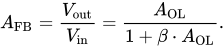
If AOL ≫ 1, then AFB ≈ 1 / β, and the effective amplification (or closed-loop gain) AFB is set by the feedback constant β, and hence set by the feedback network, usually a simple reproducible network, thus making linearizing and stabilizing the amplification characteristics straightforward. If there are conditions where β AOL = −1, the amplifier has infinite amplification – it has become an oscillator, and the system is unstable. The stability characteristics of the gain feedback product β AOL are often displayed and investigated on a Nyquist plot (a polar plot of the gain/phase shift as a parametric function of frequency). A simpler, but less general technique, uses Bode plots.

The combination L = −β AOL appears commonly in feedback analysis and is called the loop gain. The combination (1 + β AOL) also appears commonly and is variously named as the desensitivity factor, return difference, or improvement factor.[10]

Summary of terms

[edit]
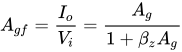
  • Open-loop gain = [11][12][13][14]
  • Closed-loop gain =
  • Feedback factor =
  • Noise gain = [dubiousdiscuss]
  • Loop gain =
  • Desensitivity factor =

Bandwidth extension

[edit]
Figure 2: Gain vs. frequency for a single-pole amplifier with and without feedback; corner frequencies are labeled

Feedback can be used to extend the bandwidth of an amplifier at the cost of lowering the amplifier gain.[15] Figure 2 shows such a comparison. The figure is understood as follows. Without feedback the so-called open-loop gain in this example has a single-time-constant frequency response given by
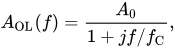
where fC is the cutoff or corner frequency of the amplifier: in this example fC = 104 Hz, and the gain at zero frequency A0 = 105 V/V. The figure shows that the gain is flat out to the corner frequency and then drops. When feedback is present, the so-called closed-loop gain, as shown in the formula of the previous section, becomes
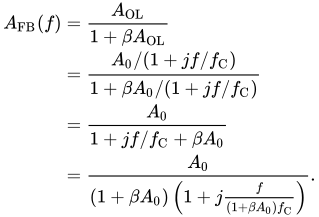
The last expression shows that the feedback amplifier still has a single-time-constant behavior, but the corner frequency is now increased by the improvement factor (1 + β A0), and the gain at zero frequency has dropped by exactly the same factor. This behavior is called the gain–bandwidth tradeoff. In Figure 2, (1 + β A0) = 103, so AFB(0) = 105 / 103 = 100 V/V, and fC increases to 104 × 103 = 107 Hz.

Multiple poles

[edit]

When the close-loop gain has several poles, rather than the single pole of the above example, feedback can result in complex poles (real and imaginary parts). In a two-pole case, the result is peaking in the frequency response of the feedback amplifier near its corner frequency and ringing and overshoot in its step response. In the case of more than two poles, the feedback amplifier can become unstable and oscillate. See the discussion of gain margin and phase margin. For a complete discussion, see Sansen.[16]

Signal-flow analysis

[edit]

A principal idealization behind the formulation of the Introduction is the network's division into two autonomous blocks (that is, with their own individually determined transfer functions), a simple example of what often is called "circuit partitioning",[17] which refers in this instance to the division into a forward amplification block and a feedback block. In practical amplifiers, the information flow is not unidirectional as shown here.[18] Frequently these blocks are taken to be two-port networks to allow inclusion of bilateral information transfer.[19][20] Casting an amplifier into this form is a non-trivial task, however, especially when the feedback involved is not global (that is directly from the output to the input) but local (that is, feedback within the network, involving nodes that do not coincide with input and/or output terminals).[21][22]

A possible signal-flow graph for the negative-feedback amplifier based upon a control variable P relating two internal variables: xj = Pxi. Patterned after D'Amico et al.[23]

In these more general cases, the amplifier is analyzed more directly without the partitioning into blocks like those in the diagram, using instead some analysis based upon signal-flow analysis, such as the return-ratio method or the asymptotic gain model.[24][25][26] Commenting upon the signal-flow approach, Choma says:[27]

"In contrast to block diagram and two-port approaches to the feedback network analysis problem, signal flow methods mandate no a priori assumptions as to the unilateral or bilateral properties of the open loop and feedback subcircuits. Moreover, they are not predicated on mutually independent open loop and feedback subcircuit transfer functions, and they do not require that feedback be implemented only globally. Indeed signal flow techniques do not even require explicit identification of the open loop and feedback subcircuits. Signal flow thus removes the detriments pervasive of conventional feedback network analyses but additionally, it proves to be computationally efficient as well."

Following up on this suggestion, a signal-flow graph for a negative-feedback amplifier is shown in the figure, which is patterned after one by D'Amico et al..[23] Following these authors, the notation is as follows:

"Variables xS, xO represent the input and output signals, moreover, two other generic variables, xi, xj linked together through the control (or critical) parameter P are explicitly shown. Parameters aij are the weight branches. Variables xi, xj and the control parameter, P, model a controlled generator, or the relation between voltage and current across two nodes of the circuit.
The term a11 is the transfer function between the input and the output [after] setting the control parameter, P, to zero; term a12 is the transfer function between the output and the controlled variable xj [after] setting the input source, xS, to zero; term a21 represents the transfer function between the source variable and the inner variable, xi when the controlled variable xj is set to zero (i.e., when the control parameter, P is set to zero); term a22 gives the relation between the independent and the controlled inner variables setting control parameter, P and input variable, xS, to zero."

Using this graph, these authors derive the generalized gain expression in terms of the control parameter P that defines the controlled source relationship xj = Pxi:


Combining these results, the gain is given by
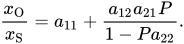
To employ this formula, one has to identify a critical controlled source for the particular amplifier circuit in hand. For example, P could be the control parameter of one of the controlled sources in a two-port network, as shown for a particular case in D'Amico et al.[23] As a different example, if we take a12 = a21 = 1, P = A, a22 = –β (negative feedback) and a11 = 0 (no feedforward), we regain the simple result with two unidirectional blocks.

Two-port analysis of feedback

[edit]
Various topologies for a negative-feedback amplifier using two-ports. Top left: current-amplifier topology; top right: transconductance; bottom left: transresistance; bottom right: voltage-amplifier topology.[28]

Although, as mentioned in the section Signal-flow analysis, some form of signal-flow analysis is the most general way to treat the negative-feedback amplifier, representation as two two-ports is the approach most often presented in textbooks and is presented here. It retains a two-block circuit partition of the amplifier, but allows the blocks to be bilateral. Some drawbacks of this method are described at the end.

Electronic amplifiers use current or voltage as input and output, so four types of amplifier are possible (any of two possible inputs with any of two possible outputs). See classification of amplifiers. The objective for the feedback amplifier may be any one of the four types of amplifier and is not necessarily the same type as the open-loop amplifier, which itself may be any one of these types. So, for example, an op amp (voltage amplifier) can be arranged to make a current amplifier instead.

Negative-feedback amplifiers of any type can be implemented using combinations of two-port networks. There are four types of two-port network, and the type of amplifier desired dictates the choice of two-ports and the selection of one of the four different connection topologies shown in the diagram. These connections are usually referred to as series or shunt (parallel) connections.[29][30] In the diagram, the left column shows shunt inputs; the right column shows series inputs. The top row shows series outputs; the bottom row shows shunt outputs. The various combinations of connections and two-ports are listed in the table below.

Feedback amplifier type Input connection Output connection Ideal feedback Two-port feedback
Current Shunt Series CCCS g-parameter
Transresistance Shunt Shunt CCVS y-parameter
Transconductance Series Series VCCS z-parameter
Voltage Series Shunt VCVS h-parameter

For example, for a current-feedback amplifier, current from the output is sampled for feedback and combined with current at the input. Therefore, the feedback ideally is performed using an (output) current-controlled current source (CCCS), and its imperfect realization using a two-port network also must incorporate a CCCS, that is, the appropriate choice for feedback network is a g-parameter two-port. Here the two-port method used in most textbooks is presented,[31][32][33][34] using the circuit treated in the article on asymptotic gain model.

Figure 3: A shunt-series feedback amplifier

Figure 3 shows a two-transistor amplifier with a feedback resistor Rf. The aim is to analyze this circuit to find three items: the gain, the output impedance looking into the amplifier from the load, and the input impedance looking into the amplifier from the source.

Replacement of the feedback network with a two-port

[edit]

The first step is replacement of the feedback network by a two-port. Just what components go into the two-port?

On the input side of the two-port we have Rf. If the voltage at the right side of Rf changes, it changes the current in Rf that is subtracted from the current entering the base of the input transistor. That is, the input side of the two-port is a dependent current source controlled by the voltage at the top of resistor R2.

One might say the second stage of the amplifier is just a voltage follower, transmitting the voltage at the collector of the input transistor to the top of R2. That is, the monitored output signal is really the voltage at the collector of the input transistor. That view is legitimate, but then the voltage follower stage becomes part of the feedback network. That makes analysis of feedback more complicated.

Figure 4: The g-parameter feedback network

An alternative view is that the voltage at the top of R2 is set by the emitter current of the output transistor. That view leads to an entirely passive feedback network made up of R2 and Rf. The variable controlling the feedback is the emitter current, so the feedback is a current-controlled current source (CCCS). We search through the four available two-port networks and find the only one with a CCCS is the g-parameter two-port, shown in Figure 4. The next task is to select the g-parameters so that the two-port of Figure 4 is electrically equivalent to the L-section made up of R2 and Rf. That selection is an algebraic procedure made most simply by looking at two individual cases: the case with V1 = 0, which makes the VCVS on the right side of the two-port a short-circuit; and the case with I2 = 0. which makes the CCCS on the left side an open circuit. The algebra in these two cases is simple, much easier than solving for all variables at once. The choice of g-parameters that make the two-port and the L-section behave the same way are shown in the table below.

g11 g12 g21 g22
Figure 5: Small-signal circuit with two-port for feedback network; upper shaded box: main amplifier; lower shaded box: feedback two-port replacing the L-section made up of Rf and R2.

Small-signal circuit

[edit]

The next step is to draw the small-signal schematic for the amplifier with the two-port in place using the hybrid-pi model for the transistors. Figure 5 shows the schematic with notation R3 = RC2 || RL and R11 = 1 / g11, R22 = g22.

Loaded open-loop gain

[edit]

Figure 3 indicates the output node, but not the choice of output variable. A useful choice is the short-circuit current output of the amplifier (leading to the short-circuit current gain). Because this variable leads simply to any of the other choices (for example, load voltage or load current), the short-circuit current gain is found below.

First the loaded open-loop gain is found. The feedback is turned off by setting g12 = g21 = 0. The idea is to find how much the amplifier gain is changed because of the resistors in the feedback network by themselves, with the feedback turned off. This calculation is pretty easy because R11, RB, and rπ1 all are in parallel and v1 = vπ. Let R1 = R11 || RB || rπ1. In addition, i2 = −(β+1) iB. The result for the open-loop current gain AOL is:

Gain with feedback

[edit]

In the classical approach to feedback, the feedforward represented by the VCVS (that is, g21 v1) is neglected.[35] That makes the circuit of Figure 5 resemble the block diagram of Figure 1, and the gain with feedback is then:
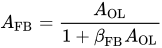
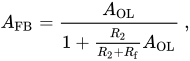
where the feedback factor βFB = −g12. Notation βFB is introduced for the feedback factor to distinguish it from the transistor β.

Input and output resistances

[edit]
Figure 6: Circuit set-up for finding feedback amplifier input resistance

Feedback is used to better match signal sources to their loads. For example, a direct connection of a voltage source to a resistive load may result in signal loss due to voltage division, but interjecting a negative feedback amplifier can increase the apparent load seen by the source, and reduce the apparent driver impedance seen by the load, avoiding signal attenuation by voltage division. This advantage is not restricted to voltage amplifiers, but analogous improvements in matching can be arranged for current amplifiers, transconductance amplifiers and transresistance amplifiers.

To explain these effects of feedback upon impedances, first a digression on how two-port theory approaches resistance determination, and then its application to the amplifier at hand.

Background on resistance determination

[edit]

Figure 6 shows an equivalent circuit for finding the input resistance of a feedback voltage amplifier (left) and for a feedback current amplifier (right). These arrangements are typical Miller theorem applications.

In the case of the voltage amplifier, the output voltage βVout of the feedback network is applied in series and with an opposite polarity to the input voltage Vx travelling over the loop (but in respect to ground, the polarities are the same). As a result, the effective voltage across and the current through the amplifier input resistance Rin decrease so that the circuit input resistance increases (one might say that Rin apparently increases). Its new value can be calculated by applying Miller theorem (for voltages) or the basic circuit laws. Thus Kirchhoff's voltage law provides:

where vout = Av vin = Av Ix Rin. Substituting this result in the above equation and solving for the input resistance of the feedback amplifier, the result is:

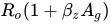
The general conclusion from this example and a similar example for the output resistance case is: A series feedback connection at the input (output) increases the input (output) resistance by a factor ( 1 + β AOL ), where AOL = open loop gain.

On the other hand, for the current amplifier, the output current βIout of the feedback network is applied in parallel and with an opposite direction to the input current Ix. As a result, the total current flowing through the circuit input (not only through the input resistance Rin) increases and the voltage across it decreases so that the circuit input resistance decreases (Rin apparently decreases). Its new value can be calculated by applying the dual Miller theorem (for currents) or the basic Kirchhoff's laws:
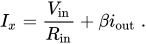
where iout = Ai iin = Ai Vx / Rin. Substituting this result in the above equation and solving for the input resistance of the feedback amplifier, the result is:
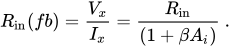
The general conclusion from this example and a similar example for the output resistance case is: A parallel feedback connection at the input (output) decreases the input (output) resistance by a factor ( 1 + β AOL ), where AOL = open loop gain.

These conclusions can be generalized to treat cases with arbitrary Norton or Thévenin drives, arbitrary loads, and general two-port feedback networks. However, the results do depend upon the main amplifier having a representation as a two-port – that is, the results depend on the same current entering and leaving the input terminals, and likewise, the same current that leaves one output terminal must enter the other output terminal.

A broader conclusion, independent of the quantitative details, is that feedback can be used to increase or to decrease the input and output impedance.

Application to the example amplifier

[edit]

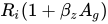
These resistance results now are applied to the amplifier of Figure 3 and Figure 5. The improvement factor that reduces the gain, namely ( 1 + βFB AOL), directly decides the effect of feedback upon the input and output resistances of the amplifier. In the case of a shunt connection, the input impedance is reduced by this factor; and in the case of series connection, the impedance is multiplied by this factor. However, the impedance that is modified by feedback is the impedance of the amplifier in Figure 5 with the feedback turned off, and does include the modifications to impedance caused by the resistors of the feedback network.

Therefore, the input impedance seen by the source with feedback turned off is Rin = R1 = R11 || RB || rπ1, and with the feedback turned on (but no feedforward)
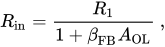
where division is used because the input connection is shunt: the feedback two-port is in parallel with the signal source at the input side of the amplifier. A reminder: AOL is the loaded open loop gain found above, as modified by the resistors of the feedback network.

The impedance seen by the load needs further discussion. The load in Figure 5 is connected to the collector of the output transistor, and therefore is separated from the body of the amplifier by the infinite impedance of the output current source. Therefore, feedback has no effect on the output impedance, which remains simply RC2 as seen by the load resistor RL in Figure 3.[36][37]

If instead we wanted to find the impedance presented at the emitter of the output transistor (instead of its collector), which is series connected to the feedback network, feedback would increase this resistance by the improvement factor ( 1 + βFB AOL).[38]

Load voltage and load current

[edit]

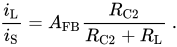
The gain derived above is the current gain at the collector of the output transistor. To relate this gain to the gain when voltage is the output of the amplifier, notice that the output voltage at the load RL is related to the collector current by Ohm's law as vL = iC (RC2 || RL). Consequently, the transresistance gain vL / iS is found by multiplying the current gain by RC2 || RL:
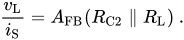
Similarly, if the output of the amplifier is taken to be the current in the load resistor RL, current division determines the load current, and the gain is then:
Is the main amplifier block a two-port?

[edit]
Figure 7: Amplifier with ground connections labeled by G. The feedback network satisfies the port conditions.

Some drawbacks of the two two-port approach follow, intended for the attentive reader.

Figure 7 shows the small-signal schematic with the main amplifier and the feedback two-port in shaded boxes. The feedback two-port satisfies the port conditions: at the input port, Iin enters and leaves the port, and likewise at the output, Iout enters and leaves.

Is the main amplifier block also a two-port? The main amplifier is shown in the upper shaded box. The ground connections are labeled. Figure 7 shows the interesting fact that the main amplifier does not satisfy the port conditions at its input and output unless the ground connections are chosen to make that happen. For example, on the input side, the current entering the main amplifier is IS. This current is divided three ways: to the feedback network, to the bias resistor RB and to the base resistance of the input transistor rπ. To satisfy the port condition for the main amplifier, all three components must be returned to the input side of the main amplifier, which means all the ground leads labeled G1 must be connected, as well as emitter lead GE1. Likewise, on the output side, all ground connections G2 must be connected and also ground connection GE2. Then, at the bottom of the schematic, underneath the feedback two-port and outside the amplifier blocks, G1 is connected to G2. That forces the ground currents to divide between the input and output sides as planned. Notice that this connection arrangement splits the emitter of the input transistor into a base-side and a collector-side – a physically impossible thing to do, but electrically the circuit sees all the ground connections as one node, so this fiction is permitted.

Of course, the way the ground leads are connected makes no difference to the amplifier (they are all one node), but it makes a difference to the port conditions. This artificiality is a weakness of this approach: the port conditions are needed to justify the method, but the circuit really is unaffected by how currents are traded among ground connections.

However, if no possible arrangement of ground conditions leads to the port conditions, the circuit might not behave the same way.[39] The improvement factors (1 + βFB AOL) for determining input and output impedance might not work.[40] This situation is awkward, because a failure to make a two-port may reflect a real problem (it just is not possible), or reflect a lack of imagination (for example, just did not think of splitting the emitter node in two). As a consequence, when the port conditions are in doubt, at least two approaches are possible to establish whether improvement factors are accurate: either simulate an example using Spice and compare results with use of an improvement factor, or calculate the impedance using a test source and compare results.

A more practical choice is to drop the two-port approach altogether, and use various alternatives based on signal flow graph theory, including the Rosenstark method, the Choma method, and use of Blackman's theorem.[41] That choice may be advisable if small-signal device models are complex, or are not available (for example, the devices are known only numerically, perhaps from measurement or from SPICE simulations).

Feedback amplifier formulas

[edit]

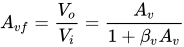
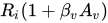
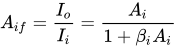
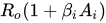
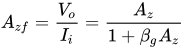
Summarizing the two-port analysis of feedback, one can get this table of formulas.[34]

Feedback Amplifier Source Signal Output Signal Transfer Function Input Resistance Output Resistance
Series-Shunt (voltage amplifier) Voltage Voltage
Shunt-Series (current amplifier) Current Current
Series-Series(transconductance amplifier) Voltage Current
Shunt-Shunt (transresistance amplifier) Current Voltage

The variables and their meanings are

- gain, - current, - voltage,- feedback gain and - resistance.

The subscripts and their meanings are

- feedback amplifier, - voltage,- transconductance, - transresistance, - output and - current for gains and feedback and - input for resistances.

For example means voltage feedback amplifier gain.[34]

Distortion

[edit]

Simple amplifiers like the common emitter configuration have primarily low-order distortion, such as the 2nd and 3rd harmonics. In audio systems, these can be minimally audible because musical signals are typically already a harmonic series, and the low-order distortion products are hidden by the masking effect of the human hearing system.[42][43]

After applying moderate amounts of negative feedback (10–15 dB), the low-order harmonics are reduced, but higher-order harmonics are introduced.[44] Since these are not masked as well, the distortion becomes audibly worse, even though the overall THD may go down.[44] This has led to a persistent myth that negative feedback is detrimental in audio amplifiers,[45] leading audiophile manufacturers to market their amplifiers as "zero feedback" (even when they use local feedback to linearize each stage).[46][47]

However, as the amount of negative feedback is increased further, all harmonics are reduced, returning the distortion to inaudibility, and then improving it beyond the original zero-feedback stage (provided the system is strictly stable).[48][45][49] So the problem is not negative feedback, but insufficient amounts of it.

See also

[edit]

References and notes

[edit]
Revisions and contributorsEdit on WikipediaRead on Wikipedia
from Grokipedia
A negative-feedback amplifier is an electronic circuit that employs negative feedback by sampling a portion of its output signal and feeding it back to the input in a manner that opposes the input signal, thereby stabilizing the amplifier's gain, reducing distortion, and extending bandwidth. This technique, first invented by Harold S. Black at Bell Laboratories in 1927, addressed critical challenges in long-distance telephony by minimizing nonlinear distortion in multi-stage amplifiers used for transcontinental signal transmission. The core principle involves a basic amplifier with open-loop gain AA combined with a feedback network of factor β\beta, yielding a closed-loop gain of Af=A1+AβA_f = \frac{A}{1 + A\beta}, where the loop gain Aβ1A\beta \gg 1 ensures the overall response approximates the ideal 1β\frac{1}{\beta}. Negative feedback distinguishes itself from by subtracting the fed-back signal from the input, which desensitizes the gain to variations in the amplifier's parameters, such as characteristics or changes, through a desensitivity factor of 1+Aβ1 + A\beta. Key advantages include improved , which reduces by up to 50 dB in practical implementations, and enhanced rejection by suppressing both internal and external disturbances. Additionally, it increases the and decreases the , making the amplifier more suitable for driving varied loads while maintaining signal integrity across a broader frequency range. The invention emerged from Black's work on repeater amplifiers for telephone lines, where cascading hundreds of stages without feedback led to instability and signal degradation over 4,000 miles. Patented in after initial skepticism at , the negative-feedback amplifier revolutionized electronics, enabling reliable amplification in applications from audio systems to operational amplifiers in modern integrated circuits. Its impact persists in control systems and communication technologies, where stability and precision are paramount.

Overview

Definition and Principles

A negative-feedback amplifier is an that incorporates a mechanism to subtract a portion of the output signal from the input signal, thereby stabilizing gain, reducing , and improving . This subtraction occurs through a feedback network that returns the output in a phase opposite to the input, ensuring the effective input to the amplifying element is an error signal proportional to the difference between desired and actual output. In contrast, adds the feedback signal to the input, which can amplify signals uncontrollably and lead to if the loop gain exceeds unity. The basic structure comprises a forward path with an open-loop amplifier of gain AOLA_{OL} and a feedback path with a network characterized by the feedback factor β\beta, which samples the output (typically voltage or current) and mixes it subtractively with the source input. The resulting closed-loop gain ACLA_{CL} is given by the equation ACL=AOL1+AOLβ,A_{CL} = \frac{A_{OL}}{1 + A_{OL} \beta}, where the term AOLβA_{OL} \beta is the loop gain, representing the amplification around the entire feedback loop. For sufficiently high open-loop gain (AOL1|A_{OL}| \gg 1), the closed-loop gain approximates 1/β1 / \beta, making the overall amplification independent of variations in AOLA_{OL} and determined primarily by the stable, passive feedback network. This concept was invented by Harold S. Black in 1927 during a ferry crossing of the , where he sketched the initial design to address in long-distance amplifiers at Bell Laboratories. The loop gain AOLβA_{OL} \beta quantifies the strength of the feedback; a larger magnitude (typically 40–50 dB in early implementations) enhances desensitivity to amplifier imperfections but necessitates careful design to maintain stability and prevent .

Key Benefits and Limitations

Negative feedback in amplifiers provides several key advantages that enhance overall performance and reliability. One primary benefit is increased gain stability against variations in component values, , or aging, achieved through the desensitivity factor 1+AOLβ1 + A_{OL} \beta, where AOLA_{OL} is the and β\beta is the feedback factor; this factor reduces the sensitivity of the closed-loop gain to changes in AOLA_{OL} by dividing the fractional variation by 1+AOLβ1 + A_{OL} \beta, making the gain primarily dependent on stable passive components in the feedback network. Additionally, it improves by counteracting nonlinearities in the stages, extended bandwidth by a factor approximately equal to 1+AOLβ1 + A_{OL} \beta at lower frequencies, and reduced and , with historical implementations achieving distortion reductions of up to 50 dB across a 4–45 kHz range. Despite these benefits, negative feedback introduces notable limitations. The closed-loop gain ACLA_{CL} is inherently lower than the open-loop gain AOLA_{OL}, as ACL1/βA_{CL} \approx 1/\beta for large AOLβA_{OL} \beta, trading raw amplification for other improvements. A significant drawback is the potential for instability and oscillation, which occurs if the loop gain AOLβA_{OL} \beta equals 1 with a 180° phase shift, requiring careful design to maintain adequate gain and phase margins (typically 3–5 and 30°–60°, respectively) and avoid self-oscillation. Furthermore, in certain topologies such as voltage-series feedback, the configuration can increase power consumption due to the need for higher drive currents to achieve low output impedance and maintain linearity under load. A key trade-off arises with the depth of feedback, defined by the loop gain AOLβA_{OL} \beta: higher values amplify the benefits of stability, linearity, and bandwidth extension but noise contributions from the feedback network are suppressed by the loop gain, though low-noise components are still needed to minimize their impact relative to the reduced internal noise. This balance underscores the importance of optimizing feedback for specific applications to maximize performance without exacerbating drawbacks.

Historical Development

Early Concepts in Control Systems

The concept of emerged in the through efforts to regulate mechanical systems, particularly steam engine governors designed to maintain constant speed despite varying loads. These devices, pioneered by in the late , used to adjust valves, forming a closed-loop mechanism where output (engine speed) influenced input (fuel supply) to correct deviations. By the mid-, engineers recognized that such feedback could lead to instability, including oscillations known as "," where the system overcorrected and cycled uncontrollably. James Clerk Maxwell provided the first mathematical analysis of feedback stability in his 1868 paper "On Governors," examining the dynamics of centrifugal governors as linear differential equations to determine conditions for stable operation. Maxwell modeled the governor as a feedback loop involving , , and linkage , deriving criteria that distinguished stable from oscillatory behavior based on the roots of the characteristic equation. His work highlighted how excessive gain in the feedback path could cause , a fundamental insight into design that predated electronic applications by decades. This analysis shifted the understanding of feedback from empirical tuning to theoretical prediction, influencing subsequent . In the early , feedback concepts advanced through for servomechanisms, such as those in naval gunnery and industrial machinery, where mechanical linkages provided error correction to track commands accurately. These systems, evolving from Watt's , incorporated to minimize discrepancies between desired and actual positions, often using hydraulic or electrical amplifiers in pre-electronic forms. Similarly, in , feedback mechanisms appeared in automatic relays and regulators from the onward, correcting signal distortions over long lines by adjusting transmission based on received errors, ensuring reliable mechanical reproduction of messages. A pivotal development came in 1932 with Harry Nyquist's "Regeneration Theory," which introduced a graphical stability criterion for feedback systems using complex plots, applicable to both mechanical and emerging electrical controls. Nyquist's method assessed encirclements of the critical point to predict stability without solving differential equations, predating its widespread use in electronics and building directly on earlier analyses of oscillations. The feedback concept, thus rooted in mechanical control, demonstrated inherent challenges like long before electronic amplifiers, establishing a theoretical foundation for later adaptations.

Evolution in Electronic Amplifiers

The invention of the negative-feedback amplifier is credited to Harold S. Black, an engineer at Bell Laboratories, who conceived the concept on August 2, 1927, while commuting by ferry across the . Black's innovation addressed the inherent nonlinearity and in vacuum-tube amplifiers, which were critical for amplifying signals in long-distance telephone lines but suffered from variability due to tube characteristics. He formalized the idea in a 1934 paper published in the Bell System Technical Journal, where he demonstrated how feeding a portion of the output signal back to the input could stabilize gain and reduce , independent of the amplifier's open-loop imperfections. Black filed for a patent in 1932, which was granted as U.S. Patent 2,102,671 in 1937, marking a foundational advancement for electronic amplification. In the , saw rapid adoption in audio and radio applications by major companies such as RCA and , building on ' telephony successes. , closely tied to Bell, integrated feedback into high-fidelity to achieve low and wide , essential for emerging sound reproduction systems. RCA similarly employed the technique in radio receivers and amplifiers, as evidenced by 1937 publications detailing its use in Class B stages to minimize while maintaining . This era's implementations highlighted feedback's role in practical electronics, extending beyond to consumer audio technologies and setting standards for performance. Following , transitioned to transistor-based designs in the , paving the way for operational amplifiers (op-amps) and benefiting from theoretical advancements like Hendrik W. Bode's 1945 book, Network Analysis and Feedback Amplifier Design, which provided rigorous methods for analyzing feedback stability and frequency response in multi-stage amplifiers. , invented at in 1947, replaced vacuum tubes in op-amp modules by the late , with early solid-state examples like the GAP/R P65 in 1961 using matched transistor pairs for improved reliability. A key milestone occurred in the 1960s with the rise of integrated-circuit op-amps, such as Fairchild's μA709 in 1965, which leveraged to enable precise analog computing operations like integration and , driving widespread adoption in scientific and engineering applications. One critical advantage of in early vacuum-tube amplifiers was its ability to counteract aging effects, such as gradual gain drift from filament wear and emission degradation, thereby maintaining consistent performance over time. This desensitivity to tube variations was particularly vital for ' long-distance telephony networks, allowing reliable signal amplification across transcontinental lines without frequent recalibration and enabling the expansion of carrier systems to handle multiple voice channels.

Fundamentals of Feedback

Open-Loop Amplifier Characteristics

An open-loop consists of a direct signal path from input to output without any feedback mechanism, where the amplification is governed solely by the intrinsic properties of the active components, such as transistors or vacuum tubes. The , denoted AOLA_{OL}, represents the ratio of output voltage to input voltage in this configuration and is highly dependent on device parameters like gmg_m and load resistance. In discrete circuits, bipolar junction transistors (BJTs) or field-effect transistors (FETs) serve as the core amplifying elements, while in integrated circuits, multi-stage arrangements of these devices achieve the desired amplification. A primary characteristic of open-loop amplifiers is their high gain, which, however, suffers from significant instability owing to variations in environmental and manufacturing factors. For instance, a single-stage common-emitter BJT amplifier typically exhibits an AOLA_{OL} of approximately 100 to 1000, calculated as AOLgmRCA_{OL} \approx -g_m R_C, where gm=IC/VTg_m = I_C / V_T (with ICI_C as collector current and VTV_T as thermal voltage) and RCR_C as collector resistance; yet, this gain can fluctuate by 20-50% due to temperature-induced changes in ICI_C and β\beta (current gain, often 100-300), as well as process variations in fabrication. Such sensitivity arises because small shifts in biasing conditions or device mismatches directly impact gmg_m and overall transfer function, leading to unpredictable performance across operating conditions. Additionally, open-loop amplifiers generate high distortion at large signal levels, as the nonlinear voltage-current relationships in transistors (e.g., exponential in BJTs) introduce harmonics, with total harmonic distortion (THD) increasing rapidly beyond small-signal limits. The of open-loop amplifiers is inherently limited, featuring a at higher frequencies primarily due to parasitic within the active devices, such as base-collector in BJTs. This results in a dominant pole that defines the bandwidth, often in the low kHz range for single-stage designs, beyond which the gain decreases at -20 dB per following a single-pole response. The gain-bandwidth product remains roughly constant, meaning higher DC gain corresponds to narrower bandwidth; for example, internal like 1-10 pF can limit the -3 dB bandwidth to hundreds of kHz in a typical stage, exacerbated by the where feedback is amplified by (1+AOL)(1 + |A_{OL}|). These limitations, including narrow bandwidth and susceptibility to variations, underscore the need for to extend usable range and enhance stability in practical applications.

Closed-Loop Negative Feedback Mechanism

In a closed-loop amplifier, a portion of the output signal is sampled and fed back to the input stage to oppose the input, thereby forming an signal that drives the amplification process. This mechanism begins with the feedback network extracting a β of the output voltage V_out, where β is the feedback factor (0 < β ≤ 1), typically representing the proportion of the output returned to the input. The voltage V_e is then generated by subtracting this feedback signal from the input voltage V_in: Ve=VinβVoutV_e = V_{in} - \beta V_{out} This subtraction is achieved through a differential input stage in the amplifier, ensuring the negative polarity that defines the feedback as opposing rather than reinforcing. The error signal V_e is subsequently amplified by the open-loop gain A_OL of the amplifier core, producing the overall output V_out = A_OL V_e. The strength of the feedback loop is governed by the loop gain A_OL β, which quantifies the effectiveness of the corrective action; higher values of A_OL β enhance the system's ability to minimize deviations between desired and actual output. The inherent negative sign in the feedback path—arising from the subtraction—ensures that any increase in V_out reduces V_e, stabilizing the loop. In practical terms, the loop gain determines the degree of error correction, with large A_OL β values making the feedback dominant over open-loop variations. Under ideal conditions with sufficiently high loop gain (A_OL β ≫ 1), the error signal approaches zero (V_e ≈ 0), resulting in the output closely tracking the input scaled by the inverse feedback factor: V_out ≈ V_in / β. This desensitivity to open-loop imperfections allows the closed-loop gain to be primarily set by the stable, passive feedback network rather than the amplifier's variable characteristics. In the original conceptualization by Harold S. Black, this ideal behavior was key to reducing in amplifiers. Practical implementation of the feedback sampling often employs resistor networks for voltage feedback, where β is defined by a voltage divider ratio, or current-sensing elements like small sampling resistors for current feedback, which convert output current to a proportional voltage. In early designs, transformers were used to isolate and sample the output without loading the amplifier, particularly in high-power or RF applications, ensuring minimal disturbance to the signal path while providing the necessary subtraction at the input. These methods allow flexible configuration of β while maintaining the core subtraction mechanism.

Feedback Topologies

Negative feedback in amplifiers is classified into four principal topologies based on how the output is sampled (either voltage or current) and how the feedback signal is mixed with the input (either in series or shunt). This classification, originally formalized in standard analog circuit theory, determines the amplifier's ideal input and output characteristics, such as impedance levels and transfer function types. The voltage-series topology samples the output voltage and mixes the feedback signal in series with the input voltage. This configuration is commonly implemented in non-inverting operational amplifier circuits, where the feedback voltage subtracts from the input to stabilize gain. It effectively increases the input impedance and decreases the output impedance by a factor of (1 + Aβ), where A is the open-loop gain and β is the feedback factor, making it suitable for voltage amplification with high input isolation and low output loading. In the voltage-shunt topology, the output voltage is sampled, but the feedback is mixed in shunt (parallel) with the input, typically as a current. This is exemplified by inverting operational amplifier configurations, where the feedback path provides a virtual ground at the input. The topology reduces both input and output impedances by (1 + Aβ), which is advantageous for applications requiring low input impedance to sense signals accurately while maintaining controlled output drive. The current-series topology samples the output current (via series connection at the output) and mixes the feedback in series with the input voltage. This setup, similar to configurations in transimpedance-like amplifiers, boosts both input and output impedances by (1 + Aβ), promoting high-fidelity current-to-voltage conversion with minimal loading effects on the source or load. Finally, the current-shunt topology samples the output current and mixes the feedback in shunt with the input current. Often used in transconductance amplifiers, it decreases the input impedance while increasing the output impedance by (1 + Aβ), enabling efficient voltage-to-current conversion where low input impedance facilitates signal sensing and high output impedance ensures constant current delivery. In summary, each uniquely modifies the amplifier's input and output impedances to match specific application needs: voltage-series enhances input and reduces for voltage buffering; voltage-shunt lowers both for precise sensing; current-series raises both for isolation; and current-shunt lowers input while raising output for current sourcing. These effects stem from the loop's desensitivity to internal variations, as analyzed in classical models.

Classical Feedback Analysis

Gain Reduction and Desensitivity

In negative feedback amplifiers, the overall gain is intentionally reduced compared to the open-loop gain to achieve greater stability and predictability. The closed-loop gain ACLA_{CL} is given by the formula ACL=AOL1+AOLβA_{CL} = \frac{A_{OL}}{1 + A_{OL} \beta}, where AOLA_{OL} is the open-loop gain and β\beta is the feedback factor representing the fraction of the output signal fed back to the input. This reduction occurs because the feedback subtracts from the input, counteracting amplification and stabilizing the system. When the loop gain AOLβA_{OL} \beta is much greater than 1, the closed-loop gain simplifies to ACL1βA_{CL} \approx \frac{1}{\beta}, making the effective gain primarily determined by the stable, passive feedback network rather than the variable open-loop amplifier. This gain reduction leads to desensitivity, where variations in the have minimal impact on the closed-loop performance. To derive this, start with the closed-loop gain ACL=AOL1+AOLβA_{CL} = \frac{A_{OL}}{1 + A_{OL} \beta}. Differentiate ACLA_{CL} with respect to AOLA_{OL}, yielding dACLdAOL=1+AOLβAOLβ(1+AOLβ)2=1(1+AOLβ)2\frac{d A_{CL}}{d A_{OL}} = \frac{1 + A_{OL} \beta - A_{OL} \beta}{(1 + A_{OL} \beta)^2} = \frac{1}{(1 + A_{OL} \beta)^2}. The relative sensitivity is then the fractional change dACL/ACLdAOL/AOL=11+AOLβ\frac{d A_{CL}/A_{CL}}{d A_{OL}/A_{OL}} = \frac{1}{1 + A_{OL} \beta}, showing that the effect of any percentage change in AOLA_{OL} is attenuated by the desensitivity factor 1+AOLβ1 + A_{OL} \beta. For instance, if the loop gain AOLβ=100A_{OL} \beta = 100, a 1% variation in AOLA_{OL} results in only a 0.01% change in ACLA_{CL}, demonstrating how shields the from drifts due to , aging, or tolerances. A practical example illustrates this in operational amplifiers (op-amps), which typically exhibit high open-loop gains around 10510^5 but suffer from variability. Consider an op-amp configured in a non-inverting setup with AOL=105A_{OL} = 10^5 and β=0.01\beta = 0.01 (e.g., via a feedback resistor network setting the desired gain to 100). The closed-loop gain is ACL1051+1050.01=100A_{CL} \approx \frac{10^5}{1 + 10^5 \cdot 0.01} = 100, and even if AOLA_{OL} drifts by 10% to 1.1×1051.1 \times 10^5, the new ACLA_{CL} remains approximately 100, with desensitivity factor 1+103=10011 + 10^3 = 1001, reducing the impact to about 0.01%. This stability enables reliable precision applications, such as instrumentation, where open-loop variations would otherwise dominate.

Bandwidth Extension and Frequency Response

Negative feedback in amplifiers trades a portion of the for an extension in the usable bandwidth, resulting in a more constant gain-bandwidth product across the frequency range. In an open-loop amplifier, the bandwidth BWOLBW_{OL} is typically narrow due to the high DC gain AOLA_{OL}, often limited by internal poles that cause the gain to at higher frequencies. With , the closed-loop bandwidth BWCLBW_{CL} expands approximately by the loop gain factor (1+AOLβ)(1 + A_{OL} \beta), where β\beta is the feedback fraction, such that BWCL(1+AOLβ)BWOLBW_{CL} \approx (1 + A_{OL} \beta) BW_{OL}. This invariance of the gain-bandwidth product ACLBWCLAOLBWOLA_{CL} \cdot BW_{CL} \approx A_{OL} \cdot BW_{OL} was a key insight in the development of practical feedback amplifiers, allowing designers to achieve wider operational ranges at the expense of reduced closed-loop gain ACL1/βA_{CL} \approx 1/\beta. To derive this, consider a single-pole model for the : AOL(jω)=A01+jω/ωpA_{OL}(j\omega) = \frac{A_0}{1 + j\omega / \omega_p} where A0A_0 is the low-frequency gain and ωp\omega_p is the dominant pole , so BWOL=ωp/(2π)BW_{OL} = \omega_p / (2\pi). The closed-loop gain with is ACL(jω)=AOL(jω)1+βAOL(jω).A_{CL}(j\omega) = \frac{A_{OL}(j\omega)}{1 + \beta A_{OL}(j\omega)}. For frequencies where βAOL(jω)1|\beta A_{OL}(j\omega)| \gg 1, ACL(jω)1/βA_{CL}(j\omega) \approx 1/\beta, maintaining a flat response up to a higher ωc\omega_c where βAOL(jωc)=1|\beta A_{OL}(j\omega_c)| = 1. Solving yields ωcβA0ωp\omega_c \approx \beta A_0 \omega_p, extending the bandwidth by the factor βA0\beta A_0, while the product ACLωc|A_{CL}| \cdot \omega_c remains approximately constant at A0ωpA_0 \omega_p. This approximation holds under the single-pole assumption, complementing the DC gain desensitivity discussed previously. The of the closed-loop is thereby flattened over a broader band, with the gain curve exhibiting less peaking and a smoother compared to the open-loop case. Without feedback, the open-loop response may show significant variation or near the pole, but the feedback loop suppresses these effects by desensitizing the gain to internal variations, ensuring a more uniform magnitude response up to the extended bandwidth limit. This flattening is particularly evident in Bode plots, where the closed-loop gain follows the ideal 1/β1/\beta level until intersecting the open-loop . For example, consider a typical with a gain-bandwidth product of 1 MHz and A0=105A_0 = 10^5, yielding BWOL10BW_{OL} \approx 10 Hz. Applying with β=0.1\beta = 0.1 (for a closed-loop gain of 10) extends the bandwidth to BWCL100BW_{CL} \approx 100 kHz, maintaining the product at 1 MHz while providing a flat response over this wider range.

Stability and Multiple-Pole Effects

In negative-feedback amplifiers, multiple poles in the open-loop introduce cumulative phase lags that can destabilize the . Each pole contributes approximately -90° of phase shift as increases, so amplifiers with two poles exhibit a -180° shift, while those with three or more can exceed this, inverting the feedback polarity at the unity-gain crossover and risking if the loop gain magnitude equals or exceeds 1 at that point. This effect arises because real amplifiers, such as multi-stage designs, inherently possess multiple poles due to device capacitances and circuit parasitics, amplifying the challenge in high-gain applications. Stability in such systems is assessed using established criteria to ensure the closed-loop response remains bounded. The states that a feedback system is stable if the Nyquist plot of the open-loop does not encircle the critical point (-1, 0) in the , with the number of encirclements indicating unstable poles in the right-half s-plane; for minimum-phase systems like most amplifiers, zero encirclements confirm stability. Complementarily, Bode plots provide a practical graphical tool, plotting loop gain magnitude and phase versus frequency on logarithmic scales, where stability requires a gain margin of at least 6 dB (loop gain below 0 dB when phase reaches -180°) and a exceeding 45° (phase above -180° when gain crosses 0 dB). These margins quantify the distance from instability, with typical design targets of 10 dB gain margin and 60° for robust performance against variations. To mitigate instability from multiple poles, dominant-pole compensation is commonly employed, introducing a low-frequency pole via a compensation —often in the amplifier's internal circuitry or external feedback network—to dominate the response and enforce a single-pole roll-off of -20 dB/decade through the crossover region. This technique shifts higher-frequency poles further out, ensuring the phase shift remains near -90° at unity loop gain, thereby securing adequate ; for instance, in operational amplifiers, a Miller-compensated across the high-gain stage achieves this by effectively multiplying the at the internal node. While this reduces overall bandwidth compared to uncompensated designs, it guarantees unconditional stability for a wide range of feedback factors. Consider a representative two-pole open-loop amplifier with poles at 1 kHz and 10 kHz, yielding a phase shift approaching -180° near 3-5 kHz where the gain might cross unity without compensation. Applying with a factor β = 0.01 shifts the crossover to lower frequencies (e.g., around 100-500 Hz, depending on ), where the phase lag is dominated by the first pole at about -90°, restoring stability with a of 50-70°; adjusting β finer tunes this crossover to balance gain accuracy and margin. The boundary between stability and oscillation is further illuminated by the Barkhausen criterion, which posits that sustained oscillations occur when the loop gain A_OL β equals 1 in magnitude and the total phase shift is 180° (or an odd multiple thereof), effectively making the feedback positive and regenerative at that frequency. This condition, while necessary for linear analysis, is insufficient alone for predicting startup in nonlinear real systems but serves as a foundational guideline for avoiding marginal designs.

Advanced Analysis Methods

Signal-Flow Graph Approach

The (SFG) approach provides a graphical method to model and analyze linear feedback systems, including negative-feedback amplifiers, by representing signal paths, nodes, and transmittances between variables. In this framework, nodes correspond to system variables such as voltages or currents, while directed branches indicate signal flow with associated gains or transmittances. This visualization facilitates the systematic computation of transfer functions without algebraic reduction of block diagrams, making it particularly suitable for amplifiers with multiple interdependent paths. Central to the SFG method is , which determines the overall TT from input to output as the ratio of the sum of forward path gains weighted by their cofactors to the graph : T=kPkΔkΔT = \frac{\sum_k P_k \Delta_k}{\Delta} Here, PkP_k is the gain of the kk-th forward path from input to output, Δk\Delta_k is the value of the Δ\Delta for the subgraph excluding branches and loops touching the kk-th path (the cofactor), and Δ\Delta is given by: Δ=1Li+LiLjLiLjLm+\Delta = 1 - \sum L_i + \sum L_i L_j - \sum L_i L_j L_m + \cdots where the sums are over all individual loop gains LiL_i, products of gains for pairs of nontouching loops LiLjL_i L_j, triples LiLjLmL_i L_j L_m, and so on, with alternating signs. This formula, derived from topological properties of the graph, accounts for all feedback interactions efficiently. In negative-feedback amplifiers, the SFG approach models the open-loop gain AOLA_{OL} along the forward path and the feedback factor β\beta along the return path, forming a single loop with gain AOLβ-A_{OL} \beta (negative for feedback stability). Applying Mason's formula yields a single forward path with gain AOLA_{OL} and cofactor Δ1=1\Delta_1 = 1, while Δ=1(AOLβ)=1+AOLβ\Delta = 1 - (-A_{OL} \beta) = 1 + A_{OL} \beta, resulting in the closed-loop transfer function: ACL=T=AOL1+AOLβ.A_{CL} = T = \frac{A_{OL}}{1 + A_{OL} \beta}. This matches the classical expression for feedback gain reduction and desensitivity, but the graphical method extends naturally to systems with multiple loops by incorporating all path and loop contributions. The advantages of SFGs over traditional block diagram reduction include their ability to handle multiple feedback loops and nontouching paths without iterative simplification, as well as applicability to non-planar or complex topologies common in integrated amplifiers. They offer a visual intuition for signal propagation and loop interactions, aiding stability analysis and design iteration in systems like operational amplifiers or RF stages. For example, consider a simple shunt-shunt feedback where the feedback network samples output voltage and mixes it with input voltage at the 's inverting input, with loading effects modeled via self-loops. The SFG includes nodes for input voltage v1v_1, summing vsv_s, output v2v_2, and feedback voltage vf=βv2v_f = \beta v_2, with branches: forward gain AOLA_{OL} from vsv_s to v2v_2, feedback transmittance β\beta from v2v_2 to vfv_f, and unity gain from v1v_1 and vf-v_f to vsv_s. Self-loops at the input (e.g., due to input resistance rinr_{in} and source impedance) and output (e.g., load RLR_L) are represented as loops with gains L1=1/(rin+Rs)L_1 = -1/(r_{in} + R_s) and L2=RL/roL_2 = -R_L / r_o, assuming they do not touch the main path. Mason's formula then computes ACL=v2/v1A_{CL} = v_2 / v_1 as the forward path gain AOLA_{OL} times the cofactor (1, since no touching loops) divided by Δ=1+AOLβ+L1+L2\Delta = 1 + A_{OL} \beta + L_1 + L_2 (nontouching self-loops add positively). For typical parameters like AOL=100A_{OL} = -100, β=0.1\beta = 0.1, and small self-loop gains L1,L21|L_1|, |L_2| \ll 1, this yields ACL10A_{CL} \approx -10, with self-loops adjusting for realistic loading by about 5-10% in bandwidth-limited cases.

Two-Port Network Representation

In the analysis of negative feedback amplifiers, the amplifier core and the feedback network are modeled as interconnected to quantify their mutual interactions using standardized parameter sets such as z-parameters (open-circuit impedance parameters), y-parameters (short-circuit admittance parameters), h-parameters (hybrid parameters), or ABCD parameters (transmission parameters). This representation enables a precise assessment of signal flow, impedance transformations, and loading effects between the ports, distinguishing it from graphical methods like signal-flow graphs by emphasizing matrix-based port characterizations. The feedback network is characterized as a passive or active two-port, often using ABCD parameters for chain-like connections or z-parameters for impedance-focused analysis. With z-parameters, the port voltages relate to currents via V1=z11I1+z12I2,V2=z21I1+z22I2,\begin{align} V_1 &= z_{11} I_1 + z_{12} I_2, \\ V_2 &= z_{21} I_1 + z_{22} I_2, \end{align} where z11z_{11} and z22z_{22} represent input and output impedances under open-circuit conditions at the opposite port, while z12z_{12} and z21z_{21} capture reverse and forward transfer impedances, respectively. The amplifier itself is modeled as a dependent two-port, with its input port connected to the feedback network's output port and vice versa, forming the closed loop; this setup isolates the feedback's influence on the amplifier's ports without assuming ideality. Even unilateral amplifiers, which ideally exhibit no reverse transmission, are approximated as two-ports when external feedback is applied, as the feedback network introduces bidirectional through its parameters. Small-signal circuit analysis employs the hybrid-π model for bipolar junction transistors within the , incorporating gm=IC/VTg_m = I_C / V_T, base-emitter resistance rπ=βVT/ICr_\pi = \beta V_T / I_C, and output resistance ror_o, with the feedback two-port imposing loading at the input and output nodes. This loading modifies the effective small-signal parameters, such as reducing the apparent or altering the output voltage swing due to the feedback's z12z_{12} and z21z_{21} terms. The resulting loaded AOLA_{OL}', which accounts for these interactions, is expressed as AOL=AOL/(1+δ)A_{OL}' = A_{OL} / (1 + \delta), where δ\delta encapsulates the loading factors derived from the feedback port's parameters, such as δz12z21/(z11z22)\delta \approx z_{12} z_{21} / (z_{11} z_{22}) in simplified z-parameter approximations; this desensitivity ensures the overall gain stability against variations in the amplifier's intrinsic parameters. A representative example is the series-shunt feedback topology, common in voltage amplifiers, where the feedback samples output voltage (shunt at output) and mixes it in series with the input. Here, z-parameters of the feedback network facilitate computation of input reflection effects, with the input impedance Zin=z11z12z21/(z22+ZL)Z_{in} = z_{11} - z_{12} z_{21} / (z_{22} + Z_L) and reflection coefficient Γin=(ZinZ0)/(Zin+Z0)\Gamma_{in} = (Z_{in} - Z_0) / (Z_{in} + Z_0), where Z0Z_0 is the source impedance and ZLZ_L the load; this analysis reveals how feedback enhances input matching while the hybrid-π model quantifies the transistor-level loading, yielding, for instance, an effective gain reduction factor of approximately 1 + loop gain in practical circuits with RS=300ΩR_S = 300 \, \Omega and RL=3.5kΩR_L = 3.5 \, \mathrm{k}\Omega.

General Feedback Formulas

The general formulas for negative-feedback amplifiers derive from a unified of the as a chain of two-port networks, where the amplifier and feedback elements are interconnected to form the closed loop. This approach allows calculation of the by solving for the overall response, incorporating the open-loop parameters and the loop transmission. The key quantity is the return ratio TT, defined as the negative of the loop gain (i.e., T=AOLβT = -A_\text{OL} \beta, where AOLA_\text{OL} is the and β\beta is the feedback fraction), obtained by breaking the loop at a suitable point and measuring the returned signal relative to the injected test signal. The closed-loop gain ACLA_\text{CL} is given by Blackman's formula in its general form: ACL=AOL1+AOLβ+δ,A_\text{CL} = \frac{A_\text{OL}}{1 + A_\text{OL} \beta + \delta}, where δ\delta captures non-ideal effects such as loading between the amplifier output and the feedback network, or finite impedances in the feedback path that alter the ideal loop transmission. In the ideal case with no loading (δ=0\delta = 0), this simplifies to ACL=AOL1+TA_\text{CL} = \frac{A_\text{OL}}{1 + T}, emphasizing desensitization of the gain to variations in AOLA_\text{OL}. This expression applies across topologies by appropriately defining β\beta (e.g., voltage, current, or transimpedance fraction). The derivation starts from the or two-port chain matrix, where the total transfer is the forward path divided by the characteristic equation 1+T+δ=01 + T + \delta = 0, solved by or matrix inversion for the interconnected ports. Input and output impedances are similarly modified by the loop gain, providing stabilization against source and load variations. For voltage feedback (series input mixing at the amplifier), the closed-loop input impedance is Zin,CL=Zin,OL(1+AOLβi),Z_\text{in,CL} = Z_\text{in,OL} (1 + A_\text{OL} \beta_i), where βi\beta_i is the input-referred feedback factor and Zin,OLZ_\text{in,OL} is the open-loop input impedance; this increase enhances isolation from source loading. For current feedback (shunt output sampling), the closed-loop output impedance is Zout,CL=Zout,OL1+AOLβv,Z_\text{out,CL} = \frac{Z_\text{out,OL}}{1 + A_\text{OL} \beta_v}, where βv\beta_v is the voltage feedback factor and Zout,OLZ_\text{out,OL} is the open-loop output impedance; this reduction improves load driving capability. These arise from the two-port chain by setting appropriate test conditions (e.g., open-circuit for input impedance with feedback closed) and incorporating the return ratio TT in the denominator, analogous to Blackman's impedance formula Z=ZD/(1+T)Z = Z_D / (1 + T), where ZDZ_D is the driving-point impedance with the dependent source nulled. The return ratio TT also governs sensitivities and performance factors. The gain sensitivity to open-loop variations is SAOLACL=11+TS^{A_\text{CL}}_{A_\text{OL}} = \frac{1}{1 + T}, showing reduction by the loop gain magnitude for large T1|T| \gg 1. For introduced within the , the output-referred voltage (or current) is attenuated by 1+T1 + T, effectively dividing internal by the desensitivity factor. Similarly, nonlinear generated in the forward path is reduced at the output by 1/(1+T)1 / (1 + T), linearizing the response; this holds for both and products, with the reduction factor approaching 1/T1/T for high loop gain. These expressions stem from perturbing the two-port model with or sources and solving the closed-loop transfer from those sources to the output, yielding the same denominator 1+T1 + T as in the signal gain.

Performance Enhancements

Distortion Reduction Mechanisms

Negative feedback in amplifiers suppresses nonlinearities by comparing the output signal with the input through a feedback network, where the difference (error) drives the amplifier to minimize deviations from linearity. This process effectively linearizes the overall transfer function, reducing both harmonic and intermodulation distortion components generated by the open-loop amplifier's nonlinear behavior. The closed-loop distortion DCLD_{CL} is approximately DOL/(1+AOLβ)D_{OL} / (1 + A_{OL} \beta) at low frequencies, where DOLD_{OL} is the open-loop distortion, AOLA_{OL} is the open-loop gain, and β\beta is the feedback fraction; this division by the loop gain factor directly attenuates distortion products present in the forward path. At higher frequencies, where loop gain decreases due to the amplifier's limited bandwidth, feedback becomes less effective, potentially introducing higher-order distortion effects. Insufficient gain can allow low-order nonlinearities (such as second-order terms) to interact within the extended closed-loop bandwidth, generating new higher-order harmonics like third-order products that were previously suppressed in the open-loop response. In operational amplifiers, negative feedback commonly provides 40-60 dB of distortion reduction in the audio band, transforming open-loop THD levels on the order of several percent into closed-loop values below 0.01%. Intermodulation distortion experiences similar suppression, as the feedback mechanism equally attenuates products arising from multiple input tones. A representative example is a Class A amplifier with 5% open-loop THD, which can achieve 0.05% closed-loop THD under 40 dB of negative feedback, demonstrating the practical scaling of distortion reduction by the loop gain factor.

Noise Figure Improvement

Negative feedback in amplifiers can improve the overall signal-to-noise ratio (SNR) by reducing the contribution of noise generated in stages after the input stage to the output; these internal noise sources are attenuated by the loop gain factor (1 + A_OL β). However, this does not reduce the input-referred noise or noise figure of the amplifier itself, which is primarily determined by the input stage and remains approximately the same as in the open-loop configuration (e_n,CL ≈ e_n,OL). The misconception that feedback broadly reduces noise figure arises from overlooking that the closed-loop gain reduction offsets the noise attenuation when referred to the input. Feedback network components, such as resistors, can introduce additional thermal directly at the input, which is not attenuated. While provides no benefit for external noise (e.g., from source resistance), it can enhance SNR in multi-stage designs where a low-noise input stage precedes noisier later stages, with the feedback loop encompassing both. In modern low-noise feedback designs, particularly for RF and precision applications, techniques like chopper stabilization further mitigate low-frequency (1/f) noise within the feedback loop. Chopper techniques modulate the signal to higher frequencies, amplify it, and demodulate back, suppressing offset and flicker noise while preserving the benefits of negative feedback for broadband performance. For instance, a 2020 chopper-stabilized amplifier design achieved an input-referred noise floor of approximately 50 nV/√Hz, with integrated noise of 3.46 µV rms over 200 Hz–5 kHz, demonstrating enhanced noise suppression in feedback-based structures for neural recording and similar low-noise applications.

Input and Output Impedance Modifications

Negative feedback in amplifiers allows precise control over input and output impedances by incorporating the feedback factor and open-loop gain, enabling designers to tailor the amplifier for specific interfacing requirements such as buffering or matching. In topologies employing series mixing at the input, such as voltage-series feedback, the closed-loop input impedance Zin,CLZ_{\text{in,CL}} is given by Zin,CL=Zin,OL(1+AOLβseries)Z_{\text{in,CL}} = Z_{\text{in,OL}} (1 + A_{\text{OL}} \beta_{\text{series}}), where Zin,OLZ_{\text{in,OL}} is the open-loop input impedance, AOLA_{\text{OL}} is the open-loop gain, and βseries\beta_{\text{series}} is the series feedback factor. This modification significantly increases the input impedance for voltage amplifiers, minimizing loading effects on the signal source. Conversely, shunt mixing at the input reduces the input impedance by a factor of approximately 1/(1+AOLβshunt)1 / (1 + A_{\text{OL}} \beta_{\text{shunt}}). At the output, shunt feedback topologies, common in voltage amplifiers, decrease the closed-loop output impedance according to Zout,CL=Zout,OL/(1+AOLβshunt)Z_{\text{out,CL}} = Z_{\text{out,OL}} / (1 + A_{\text{OL}} \beta_{\text{shunt}}), where Zout,OLZ_{\text{out,OL}} is the open-loop output impedance and βshunt\beta_{\text{shunt}} is the shunt feedback factor. This reduction enhances the amplifier's ability to drive low-impedance loads without substantial voltage drop. In series output feedback, used in current amplifiers, the output impedance increases, providing a high-impedance source suitable for current sensing or driving high-impedance loads. A representative example is the non-inverting configuration, which employs voltage-series feedback. Here, the typically exceeds 1 MΩ, approaching the open-loop differential input impedance of the op-amp, while the falls below 1 Ω, allowing effective driving of loads down to tens of ohms. In contrast, current-shunt feedback amplifiers exhibit low (often below 100 Ω) and high (greater than 10 kΩ), ideal for transimpedance applications like interfaces. For non-ideal loads, these impedance modifications must account for interactions using equivalent circuits; a voltage amplifier with feedback can be represented by its Thevenin equivalent ( in series with Zout,CLZ_{\text{out,CL}}), while current amplifiers use the Norton equivalent ( in parallel with ), ensuring accurate prediction of voltage or current delivery without excessive .

Applications

Operational Amplifier Circuits

Operational amplifiers (op-amps) leverage to achieve precise control over gain, bandwidth, and impedance characteristics, relying on their inherently high AOLA_{OL} (typically 10510^5 to 10610^6) to approximate ideal behavior in closed-loop configurations. This high AOLA_{OL} ensures that the differential input voltage is minimized, allowing external components to dominate the circuit's . Common topologies include inverting and non-inverting amplifiers, where feedback stabilizes against variations in AOLA_{OL}. In the inverting amplifier configuration, the input signal is applied to the inverting terminal through an input RinR_{in}, with a feedback RfR_f connecting the output to the inverting input; the non-inverting input is grounded. The closed-loop gain is given by Vout=RfRinVinV_{out} = -\frac{R_f}{R_{in}} V_{in}, independent of AOLA_{OL} for high-gain op-amps. The feedback factor β\beta is RinRin+Rf\frac{R_{in}}{R_{in} + R_f}, which determines the loop gain AOLβA_{OL} \beta and ensures stability when greater than unity at low frequencies. This setup inverts the input signal and provides a at the inverting input, yielding low approximately equal to RinR_{in}. The non-inverting amplifier applies the input to the non-inverting terminal, with a formed by RfR_f and RgR_g (from output to ground) providing feedback to the inverting input. The gain is Vout=(1+RfRg)VinV_{out} = \left(1 + \frac{R_f}{R_g}\right) V_{in}, again set by the ratio. Here, β=RgRf+Rg\beta = \frac{R_g}{R_f + R_g}, and the configuration maintains high (ideally infinite). Unity-gain stability is inherent when Rf=0R_f = 0 ( feedback), making it suitable for buffers where Vout=VinV_{out} = V_{in}. Despite these idealizations, real op-amps impose limitations due to finite gain-bandwidth product (GBW, typically 1–100 MHz), which causes the closed-loop bandwidth to roll off as f3dB=GBW1+RfRgf_{-3dB} = \frac{GBW}{1 + \frac{R_f}{R_g}} for non-inverting (or equivalent gain for inverting). This frequency-dependent AOLA_{OL} reduces loop gain at higher frequencies, potentially introducing phase shift and gain errors. Additionally, (SR, often 0.5–100 V/μs) limits the maximum rate of output voltage change, arising from internal current charging capacitances within the feedback loop; excessive input slew demands can cause or clipping. A representative example is the precision integrator, where an input RR feeds the inverting input, and a feedback CC connects output to inverting input, yielding Vout=1RCVindtV_{out} = -\frac{1}{R C} \int V_{in} \, dt. Without a DC path, offsets accumulate, but adding a high-value (e.g., 1–10 MΩ) in parallel with CC provides at DC, correcting input offset voltage and bias currents to minimize drift without substantially altering AC integration for frequencies above f=12πRparallelCf = \frac{1}{2\pi R_{parallel} C}. This hybrid approach enhances long-term accuracy in applications like analog computation or .

Power and RF Amplifiers

In power amplifiers, is commonly employed in Class AB configurations to enhance while managing stability concerns. Global feedback loops are utilized to reduce overall across the amplification stages, ensuring that the output closely tracks the input signal. For instance, in amplifiers, this approach significantly mitigates inherent to Class AB output stages, where transistors transition between conduction regions, by providing corrective action through high loop gain. Local feedback, often applied around individual stages such as the output transistors, complements global feedback by improving stability and reducing local nonlinearities without compromising the broader benefits. In RF amplifiers, negative feedback serves to achieve gain flatness over the operating bandwidth, counteracting variations due to device parasitics and frequency-dependent losses. However, at high frequencies, feedback effectiveness is constrained by phase shifts introduced by transmission lines and component delays, which can lead to if the loop phase exceeds 180 degrees. To address these limitations, predistortion techniques are integrated with feedback, where intentional input signal distortion pre-compensates for amplifier nonlinearities, often using analog circuits for and phase adjustment in integrated transmitters. A key challenge in applying to power and RF amplifiers arises from output stage nonlinearities, such as those in saturation regions, which demand high loop gain for effective suppression but increase design complexity and risk of . Efficiency trade-offs are also prominent, as feedback loops in linear Class AB power amplifiers typically yield efficiencies below 70% due to the need for constant biasing to maintain , contrasting with higher-efficiency nonlinear classes. For example, in base stations, Doherty amplifiers incorporate feedback loops alongside predistortion for , enabling efficient operation at back-off power levels while meeting stringent requirements for wideband signals.

Modern Digital and Signal Processing Uses

In digital signal processing (DSP), negative feedback principles are emulated through infinite impulse response (IIR) filters, which incorporate recursive feedback paths to mimic the behavior of analog filters while processing discrete-time signals. These filters use feedback to achieve sharp frequency selectivity and efficient approximation of analog prototypes, such as Butterworth or Chebyshev responses, enabling compact implementations in resource-constrained DSP systems. Adaptive algorithms further extend this concept; for instance, the least mean squares (LMS) algorithm employs negative feedback in a digital loop to iteratively adjust filter coefficients, minimizing error in applications like acoustic echo cancellation. In echo cancellation, the LMS-based adaptive filter models the echo path and subtracts the estimated echo from the received signal, achieving convergence rates that reduce residual echo by up to 30 dB in real-time telephony systems. In mixed-signal systems, negative feedback enhances linearity in analog-to-digital converters (ADCs) and digital-to-analog converters (DACs), particularly through sigma-delta modulators where high loop gain shapes quantization noise away from the signal band. The feedback loop in these modulators linearizes the overall conversion by correcting errors from the quantizer and DAC, enabling dynamic ranges exceeding 100 dB in audio and instrumentation applications. For example, a 28 nm continuous-time sigma-delta ADC achieves -101 dBc total harmonic distortion across a 120 MHz bandwidth, demonstrating how feedback suppresses nonlinearities to levels unattainable without it. Post-2015 advancements have integrated machine learning (ML) techniques to optimize feedback loops in neural network accelerators, where adaptive feedback mechanisms dynamically tune parameters for energy-efficient inference. In recurrent spiking neural networks, ML-driven feedback training, such as full-FORCE methods, enables low-latency learning with reduced power consumption by adjusting synaptic weights in real-time hardware implementations. Concurrently, quantum amplifiers leverage feedback cooling to approach quantum-limited noise performance; radiatively cooled microwave amplifiers, for instance, use parametric feedback with radiative cooling to operate at elevated temperatures up to 1.5 K while achieving an added noise of 1.3 quanta. Recent designs, including pulse-driven Josephson parametric amplifiers, reduce power dissipation by 90% compared to continuous-operation counterparts, facilitating scalable quantum computing by preserving qubit coherence during readout. Negative feedback plays a critical role in 5G beamforming, where digital adaptive loops align phases across antenna arrays to mitigate errors from channel variations, improving (SNR) by 20-30 dB in millimeter-wave links. In distributed massive MIMO systems, feedback-enabled beam management statistically estimates channel statistics for precise alignment, reducing outage probabilities under blockage scenarios. For (IoT) devices, in low-noise amplifiers (LNAs) and converters enhances noise and power efficiency during low-voltage operation, typically below 1 V, by stabilizing gain and minimizing thermal noise contributions. For example, a 180 nm sigma-delta ADC achieves 498 μW power consumption and 84.8 dB SNR for biomedical IoT applications, enabling extended battery life in nodes. This approach supports reliable operation in energy-harvesting IoT applications by improving the compared to open-loop designs.

References

Add your contribution
Related Hubs
User Avatar
No comments yet.