Hubbry Logo
New PlaceNew PlaceMain
Open search
New Place
Community hub
New Place
logo
8 pages, 0 posts
0 subscribers
Be the first to start a discussion here.
New Place
New Place
from Wikipedia

New Place was William Shakespeare's final place of residence in Stratford-upon-Avon. He died there in 1616. The whole building was demolished in 1702 by Sir John Clopton, who replaced it with a modern-style house, also called New Place. This in turn was demolished by Francis Gastrell, vicar of Frodsham, Cheshire, in 1759. It was never rebuilt after the second demolition and only the foundations remain.[1]

Key Information

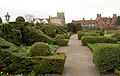
Though the house no longer exists, the site is owned by the Shakespeare Birthplace Trust, which maintains it as a specially designed garden for tourists.

Early history

[edit]

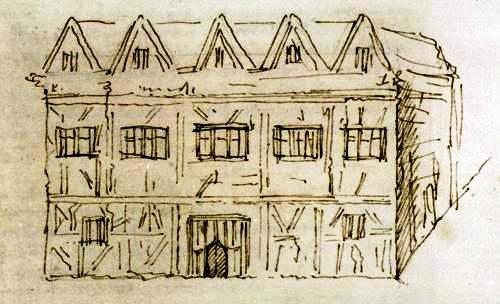
The three-storey house stood on the corner of Chapel Street and Chapel Lane, and was apparently the second largest dwelling in the town. The current site of New Place was initially within the plot of an Iron Age farmstead sometime around 700 BC – 43 AD, as indicated by pottery that also dates to the same time period. New Place was built atop the site of a former 13th-century timber building in 1483 by Sir Hugh Clopton, a wealthy London mercer and Lord Mayor. Built of timber and brick (then an innovation in Stratford) it had ten fireplaces, five handsome gables, and grounds large enough to incorporate two barns and an orchard.[2]

In 1496 Sir Hugh Clopton left New Place in his will to his great-nephew William Clopton I ('my cousin William Clopton') and the male heirs of the lordship of Clopton.[3] In his will William Clopton I (d. 29 May 1521) granted his wife, Rose (d. 17 August 1525)[4] a life interest in the property, with the reversion after her death to his son, William Clopton II. When John Leyland visited in 1540, he described New Place as a "praty house of Bricke and tymbre wherm he (ie Hugh Clopton) lived in his latter dayes and dyed". In November 1543, William Clopton II leased it for forty years to a surgeon, Thomas Bentley (d.1549), who left his wife, Anne, a life interest in the lease during her widowhood. Anne remarried, however, and after she became the wife of Richard Charnock, William Clopton II retook possession of New Place. By his wife Elizabeth Grey, the daughter of Sir Edward Grey of Enville, Staffordshire, William Clopton II had a son, William Clopton III (1537–1592), to whom he left New Place by will in 1560. On 20 December 1563, hard-pressed for money to pay his sisters' marriage portions and continue travelling in Italy, William Clopton III sold New Place to William Bott, who had already resided in it for several years. In 1567 Bott sold New Place to William Underhill I (c. 1523 – 31 March 1570), an Inner Temple lawyer and clerk of assizes at Warwick, and a substantial property holder in Warwickshire.[5][6][7][8][9]

Sale to Shakespeare

[edit]
The final concord (a conveyance in two parts) between William Shakespeare and Hercules Underhill, confirming Shakespeare's title to New Place, Michaelmas 1602

At his death in 1570, Underhill left New Place to his son, William Underhill II (d.1597), who in 1597 sold it to William Shakespeare for £60. He (William Underhill II) died two months later, and it emerged that he had been poisoned by his eldest son and heir, Fulke Underhill. According to some sources, Fulke Underhill died in May 1598 while still a minor and before the fact that he had murdered his father was discovered.[10][11][12] According to other sources, however, Fulke Underhill was hanged in 1599 for his father's murder and attainted for felony, whereby his property, including New Place, was forfeit to the crown.[13][8] In 1602 the Court of Exchequer appointed a commission to "obtain an account of the possessions of Fulke Underhill of Fillongley, county Warwick, felon, who had taken the life of his father, William Underhill, by poison".[10] When Fulke's younger brother, Hercules Underhill, came of age in 1602, his father's former properties were regranted to him, and he and Shakespeare negotiated a confirmation of the sale.[13][8][14]

After Shakespeare's death

[edit]

In 1616 the house passed directly to Shakespeare's eldest daughter Susanna Hall who lived there for some time. Her daughter, Elizabeth Hall, Shakespeare's last surviving descendant, lived in New Place with both her mother and her first husband, Thomas Nash,[15] who had owned the house next door. Thomas Nash wrote a will on 25 August 1642, leaving New Place to his cousin Edward Nash, but had no legal right to do so as the house still belonged to Susanna Hall. This will went missing in the nineteenth century and was only rediscovered in the National Archives in 2025.[15] After Nash predeceased both his wife and mother in law in 1647, the women obtained a deed of settlement to confirm that they were still the legal holders of Shakespeare's estates. Edward Nash took Elizabeth Nash to chancery court the following year, demanding that she honour the terms of her late husband's will. His legal bid was not successful.[16][15]

Elizabeth Nash married for a second time, to John Bernard (MP for Northampton) on 5 June 1649 (1604–74). Just weeks after the marriage, Susanna Hall died and Elizabeth inherited the Shakespeare family property from her. The Bernards moved into New Place.[17] On her death in 1670 Elizabeth left no surviving heirs. Her will stipulated "according to my promise formally made to him" that Edward Nash would have the right to acquire New Place, but there are no records of his having ownership. The house was returned to the Clopton family.

In 1702 Sir John Clopton demolished the original New Place, building in its place a replacement, also called New Place, in a very different contemporary style.[18][19][20] In 1756 then-owner Reverend Francis Gastrell (vicar of Frodsham, Cheshire[21]) having become tired of visitors, attacked and destroyed a mulberry tree in the garden said to have been planted by Shakespeare.[22] In retaliation, the townsfolk destroyed New Place's windows. Gastrell applied for local permission to extend the garden. His application was rejected and his tax was increased, so Gastrell retaliated by demolishing the house in 1759. This greatly outraged the inhabitants and Gastrell was eventually forced to leave town.[22]

The Shakespeare Birthplace Trust acquired New Place and Nash's House in 1876. Today the site of New Place is accessible through a museum that resides in Nash's House, the house next door.[23] The site received 109,452 visitors during 2018.[24]

Archaeological excavations

[edit]

Excavations in the grounds of Nash's House were initially carried out in 1862 and January 1864 by James Halliwell-Phillipps but after the excavations were finished, the ruins were eventually covered up by a garden and further excavations carried out during 2010, 2011 and 2012 by Birmingham Archaeology, removing the garden from the site all together.[25] Archaeologists from Time Team visited the dig during 2011 and a special programme on the subject, "Searching for Shakespeare's House", was transmitted on 11 March 2012.[26] BBC One National Treasures broadcast a live programme from the site in August 2011.[27] Findings from the excavation indicated the presence of a Tudor structure but were inconclusive as to the ground plan of Shakespeare's original house.

Clay pipe fragments at Stratford-upon-Avon

[edit]

Clay pipe fragments unearthed in recent years in Shakespeare's Stratford-upon-Avon garden were found to possibly contain traces of cannabis, along with tobacco and camphor, based on the results of a study published in the South African Journal of Science.[28][29] This has fuelled speculation by some that Shakespeare may have possibly smoked cannabis,[30] which is known to have been used to treat certain medical conditions at the time by Elizabethans, as well as in the manufacture of materials such as sails, rope, and clothing, and may have also been used for purposes of pleasure.[28] The pipe fragments, however, could have belonged to any number of other persons besides the famous playwright, and cannot be definitively dated to the periods of his residency there as they could have been from the 18th century, around 200 years after Shakespeare's death.[28]

[edit]

See also

[edit]

Notes

[edit]

References

[edit]

Further reading

[edit]
[edit]
Revisions and contributorsEdit on WikipediaRead on Wikipedia
from Grokipedia
New Place was William Shakespeare's final residence and family home in , , , which he purchased in 1597 for £120 from William Underhill and occupied until his death there on 23 April 1616. Originally constructed in the 1480s by the wealthy Stratford merchant Hugh Clopton as a grand medieval , it featured a central , approximately 20 to 30 rooms, and ten hearths, making it the largest and most prominent property in the borough at the time. Shakespeare's acquisition of New Place at age 33 exemplified his rising affluence as a successful and , and he undertook significant renovations, including rebuilding the and adding a . Following Shakespeare's death, New Place passed to his daughter and her husband John Hall, with his wife residing there until 1623; it later descended to their daughter Elizabeth, who lived without heirs until 1670, with the recent discovery of Thomas Nash's will in August 2025 shedding light on inheritance disputes; the house then passed to the Clopton family, who demolished and rebuilt it in 1702, but the replacement house was controversially razed to the ground in 1759 by its owner, Reverend Francis Gastrell, reportedly out of frustration with local taxes and tourists seeking to view the Shakespeare-associated site. No further building was erected on the foundations, which survived and were excavated between 2010 and 2015, revealing details of the house's layout and artifacts from Shakespeare's era. Today, the site of New Place is preserved as a public garden and historical attraction by the , which acquired it in 1876; it includes landscaped grounds, mulberry trees descended from those planted in the , and exhibits exploring Shakespeare's life, family, and legacy through sculptures, audio installations, and interactive displays. The location's significance lies not only in its role as the backdrop for Shakespeare's later years but also as a testament to his status as a prominent figure in Elizabethan and Jacobean , connecting visitors to the domestic world of the playwright.

Historical Background

Construction and Early Ownership

New Place was constructed in 1483 by Sir Hugh Clopton, a prosperous mercer and former (1491–1492), who had amassed significant wealth through international trade in textiles and other goods. As a prominent benefactor to his hometown of , Clopton built the house as a grand reflecting his mercantile success and civic pride. The property, located of Chapel Street and Chapel Lane opposite the Guild Chapel, was a substantial timber-framed structure arranged around a central , featuring three main buildings: a two-story street-facing range with shops and chambers, a service wing with workrooms and a cellar, and a set back from the . It included ten fireplaces, five gables, making it the second-largest house in Stratford at the time, surpassed only by the town's former college. Following Clopton's death in 1496, the estate passed to his great-nephew William Clopton (c. 1481–1521), who inherited the property as part of the family legacy. Upon William's death, ownership transferred to his widow, Rose Clopton, but the family's fortunes began to wane amid broader economic pressures on the . By the mid-16th century, the house had fallen into "great ruyne and decay" due to and unrepaired , as noted in records from its lease to tenant Thomas Bentley between 1543 and 1549. Financial difficulties intensified for the later Clopton heir, William Clopton III (1538–1592), who faced mounting debts from family obligations such as his sisters' marriage portions and his own travels to . These pressures culminated in the mortgaging of the property and its eventual sale on December 20, 1563, to the local alderman William Bott, marking the end of Clopton ownership after nearly eight decades. This transaction set the stage for New Place's later acquisition by in 1597.

Acquisition by William Shakespeare

In May 1597, acquired New Place, the largest house in , through a legal transaction with William Underhill II, a gentleman from . The sale was formalized via a fine levied in the Court of Common Pleas on May 4, 1597, for the sum of £60, which represented the recorded court fee rather than the full purchase price—likely closer to £120, aligning with earlier sixteenth-century valuations of the property. This acquisition was facilitated by Shakespeare's burgeoning success as a and in , where his earnings from shares in the and collaborative theatrical ventures provided the financial means for such an investment. The purchase symbolized Shakespeare's aspiration to gentlemanly status, as owning substantial Stratford property like New Place—originally built by Sir Hugh Clopton in the late fifteenth century with its distinctive courtyard and expansive layout—elevated his social standing in his hometown. The transaction faced complications shortly after completion when William Underhill II was poisoned by his eldest son, Fulke Underhill, in July 1597; Fulke was subsequently tried, convicted of murder, and hanged in 1599, leading to the attainder of his inheritance and potential clouding of the property title. To secure clear ownership, Shakespeare pursued a confirmatory deed in Michaelmas term 1602 from Hercules Underhill, the younger brother and rightful heir upon reaching adulthood, who reconveyed the estate for a nominal consideration. This legal resolution ensured Shakespeare's unencumbered title to New Place, including its associated barns, gardens, and orchards. There is no contemporary evidence indicating that Shakespeare immediately occupied the residence following the 1597 purchase; instead, it appears to have served initially as a strategic in local , complementing his later acquisitions such as the Blackfriars in in 1613.

Shakespeare Family Era

Ownership and Use During Shakespeare's Lifetime

acquired New Place in 1597, marking the beginning of his family's long association with the property as their primary residence in . By the early 1610s, following his active career in , Shakespeare retired to Stratford, where he and his wife made New Place their main home during his final years. Their daughter Susanna, though married and residing nearby at Hall's Croft with her husband John Hall, maintained close family ties to the household. New Place served as a gentleman's residence befitting Shakespeare's status, featuring spacious accommodations with between 20 and 30 rooms, a , and surrounding grounds that included two gardens and two orchards. While no extensive renovations are documented during his tenure, Shakespeare is believed to have rebuilt the and added a , enhancing the property's comfort and prestige. of daily life includes the presence of a black mulberry tree in the garden, long associated by legend with Shakespeare himself, though its planting by him remains unverified; the tree later became a symbol of his legacy before being felled in 1759. Shakespeare died at New Place on April 23, 1616, at the age of 52. In his will, drafted shortly before his death, he designated New Place as the , bequeathing the bulk of his estates—including the house and its grounds—to Susanna and John Hall as executors and heirs, underscoring its central role in the family's life.

Inheritance and Later Family Possession

Upon William Shakespeare's death at New Place in 1616, the property passed to his daughter as specified in his will, which designated her as the primary heir to his estates including the house and surrounding lands. Susanna, along with her husband Dr. John Hall, resided there until her own death in 1649, at which point New Place and the associated Shakespeare family properties were inherited by their only child, Elizabeth Hall. Elizabeth, born in 1608, had married Thomas Nash in 1626; the couple lived at New Place with Susanna after John Hall's death in 1635. Following Nash's death on April 4, 1647, without issue, his will sought to bequeath New Place to his cousin Edward Nash, prompting a legal dispute. Elizabeth and Susanna refused to relinquish the property, leading Edward Nash to file a bill in the in early 1648; Elizabeth argued successfully that her husband lacked the authority to dispose of the inheritance, which was tied to the Shakespeare family settlement, thereby retaining possession. In June 1649, Elizabeth remarried of Abington, who was knighted in 1661; the couple had no children and continued to occupy New Place. Elizabeth Barnard died on February 17, 1670, at age 61, leaving no direct heirs. In her will, she directed that New Place be sold after the death of her husband Sir , with first refusal rights given to Edward Nash at a of around £300; other properties, such as the inn, were bequeathed to her cousin Hart, son of Shakespeare's sister Joan Hart. Sir died in 1674, after which New Place was sold to Sir John Clopton, ending direct possession by the Shakespeare family.

Decline and Demolition

18th-Century Ownership Conflicts

Following the death of the last direct Shakespeare descendant, Elizabeth Barnard, in 1670, New Place passed to remote relatives before the Clopton family regained ownership in the late 17th century. Sir John Clopton, a descendant of the original builder, had the existing house entirely demolished and commissioned a new Queen Anne-style brick building on the site around , which retained the name New Place. However, Clopton's ambitious renovations strained his finances. The property passed to his son Sir Hugh Clopton upon Sir John's death in 1719, who occupied it until his own death in 1751 without further significant alterations. In 1753, the Clopton estate sold New Place to Reverend Francis Gastrell, a canon of and a retired from , as an addition to his portfolio of properties. Gastrell, who had a of disputes including prior conflicts over church matters, initially resided there but soon grew resentful of the site's growing fame as a Shakespeare destination. By the mid-18th century, New Place had become a magnet for literary enthusiasts seeking relics associated with the playwright, including a famed mulberry tree in the garden believed to have been planted by Shakespeare himself, which drew persistent visitors demanding access. Gastrell's frustrations escalated into open conflicts with locals and tourists; in 1756, irritated by the intrusions and possibly by the tree's damage to the house foundations, he ordered the mulberry cut down in a nighttime act decried as "Gothick barbarity" by contemporaries like , as recorded in James Boswell's account. The incident only heightened tensions, as the tree had become a symbol of Shakespeare's legacy, attracting notable figures such as Johnson during his visits to Stratford amid the rising tide of Shakespearean . Further disputes arose when Gastrell petitioned the Stratford authorities in 1759 to exempt him from poor rates—local taxes supporting the indigent—arguing the property's non-residential status after his relocation, which alienated the community and underscored the owner's disconnect from the site's cultural significance.

Demolition Events

In 1702, Sir John Clopton, who had acquired the property in the late , oversaw a major rebuild of New Place that involved the full demolition of the original Tudor structure to accommodate contemporary architectural preferences. This process resulted in the loss of many original features associated with Shakespeare's era. The rebuilt residence, still known as New Place, was designed as a more modern edifice, completed for occupation by Clopton's son, Hugh. The second and complete demolition occurred in 1759 under the ownership of Reverend Francis Gastrell, who had purchased the property in 1753. Motivated by ongoing disputes with local authorities over property taxes—stemming from his part-time residency and a rejected application for a reduced rate—and exacerbated by harassment from 18th-century tourists seeking access to the site's Shakespearean relics, Gastrell ordered the total destruction of the house. This act of retaliation left the site as ruins, with only foundations and scattered remnants visible, and the land was subsequently sold off in lots, preventing any immediate reconstruction. The demolitions, particularly Gastrell's, provoked widespread public outrage in , where residents viewed the loss of the original Tudor features as an irreparable cultural tragedy. This backlash led to Gastrell's effective expulsion from the town, as his unpopularity forced him to relocate to , amid rumors of a local ban on the Gastrell name. The events underscored the growing tensions between private ownership and emerging heritage interests in the .

Archaeological Investigations

19th-Century Excavations

In 1861, Shakespearean scholar James Orchard Halliwell-Phillipps established a trust and purchased the site of to prevent further development and preserve its historical significance, following the demolition of structures on the property nearly a century earlier. The excavations, funded through the trust and public subscriptions, began in 1862 under Halliwell-Phillipps's supervision, with on-site direction by architect Thomas Martin Hunt, and continued into early 1864. These efforts focused on uncovering the buried remains of the Tudor-era house, reflecting growing Victorian interest in Shakespeare's legacy. The 1861–1862 digs revealed substantial foundations of the original New Place, including stone walls dating to the late 15th century and earlier timber structures from the 13th or 14th century, as well as evidence of garden layouts consistent with 16th-century deeds describing two gardens and orchards. A prominent central well was also discovered, filled with clean water and containing artifacts such as an 18th-century brass candlestick, which provided insights into the site's post-Shakespearean use. Halliwell-Phillipps prioritized high-value items like architectural fragments and metal objects, often discarding smaller finds such as pottery shards, though some pottery and a knife blade attributable to the Shakespeare period were retained. These artifacts, including pottery shards, are now displayed in collections held by the Shakespeare Birthplace Trust. Further excavations in January 1864 uncovered additional structural elements, including a stone pillar believed to support the , helping to confirm the overall position and scale of the main building as described in contemporary records. The findings authenticated the site's layout against historical documents, demonstrating New Place's evolution from a medieval to Shakespeare's spacious family residence. Public fascination with these revelations, fueled by reports in scholarly journals and newspapers, led to increased visitor interest and prompted Halliwell-Phillipps to erect fencing around the site in the mid-1860s to safeguard the exposed remains from and .

20th- and 21st-Century Discoveries

In the late 2000s and early 2010s, the initiated a major archaeological project known as the "Dig for Shakespeare" at New Place, employing geophysical surveys and targeted excavations from 2009 to 2012 to map the site's subsurface features without extensive disturbance. These efforts revealed extensive Tudor-era foundation walls, confirming the layout of Shakespeare's substantial residence, which included at least 20 rooms and multiple outbuildings. Key discoveries included remnants of domestic infrastructure, such as a stone-built in what was likely a bake-house adjacent to the main , alongside a and cold storage pit that highlighted the household's self-sufficiency in food preparation. Excavators also uncovered evidence of features, including a privy pit, providing insights into daily life and in a prominent 16th-century home. These findings built upon 19th-century mappings of surface foundations to create a more precise reconstruction of New Place's ground plan. Earlier artifacts from 19th-century digs at the site gained renewed attention through scientific analysis in , when fragments of clay pipes unearthed in the 1860s were tested using gas chromatography-mass spectrometry. The tests detected residues of , , and on several pipes from the garden area, suggesting recreational or medicinal use among 17th-century occupants, though no direct link to Shakespeare himself could be established. From 2016 onward, post-excavation analysis and site enhancements integrated these discoveries into public interpretation, with the redesigned gardens and exhibitions at opening in March 2016 to illustrate the home's architecture and inhabitants' routines. Ongoing updates through 2025 included scholarly publications refining the site's chronology and artifact cataloging. A significant archival breakthrough occurred in August 2025, when historian rediscovered the 1642 will of Thomas Nash—at the UK's among uncataloged Chancery documents. The document detailed bequests of New Place properties amid a family dispute over inheritance following Shakespeare's 1616 death, offering new context on the estate's post-Shakespearean management and legal entanglements. This find has been incorporated into the site's educational programs, enhancing understanding of the Shakespeare family's legacy at New Place.

Modern Preservation and Significance

Site Management and Gardens

The Shakespeare Birthplace Trust acquired the site of New Place and adjacent Nash's House in 1876, transforming the area into a public garden space dedicated to preserving the historical footprint of Shakespeare's family home. Since then, the Trust has maintained the property without reconstructing the demolished house, instead emphasizing the integration of visible ruins and lush greenery to evoke the Elizabethan era. The gardens at New Place are designed in an Elizabethan style, featuring formal knot gardens with aromatic herbs and flowers inspired by period landscaping, as well as open green spaces that highlight the site's archaeological remains. A notable element is the recreated mulberry tree in the Great Garden, propagated from a cutting of the original black mulberry that grew on the property during Shakespeare's lifetime and was famously felled in 1759. Visitors access the gardens through Nash's House museum, which serves as the entry point and provides interpretive exhibits before leading to outdoor features such as viewing platforms over excavation sites and pathways tracing the house's foundations. The archaeological foundations are briefly integrated into the garden layout to allow contemplation of the site's history amid the planting. Ongoing conservation efforts by the Trust focus on , including careful preservation of subterranean foundations and periodic monitoring to protect the site's integrity against environmental factors. In 2024, the gardens attracted 64,002 visitors, underscoring their continued role as a key heritage destination managed for educational and recreational purposes.

Cultural and Historical Importance

New Place holds profound symbolism as the final residence and death place of , serving as a tangible link to the playwright's and legacy. This association inspired cultural events such as David Garrick's 1769 Shakespeare Jubilee in , which celebrated Shakespeare through processions, performances, and the unveiling of a Shakespeare that drew international attention to his domestic world at New Place. The Jubilee not only popularized Shakespearean but also underscored New Place's role in romanticizing the Bard's later years, transforming the site into a cornerstone of literary heritage. The site's influence extends to Stratford-upon-Avon's , which relies heavily on Shakespeare-related and generated £860 million in revenue in 2024 from nearly 10 million day trips to the , with the town attracting over two million visitors annually and New Place serving as a key draw. In Shakespeare studies, New Place informs biographical scholarship by illuminating aspects of his retirement and family dynamics, fostering ongoing research into Elizabethan domesticity and social status. Its representation in art, notably George Vertue's 1737 sketch depicting the timber-framed house with its gabled facade, provides one of the earliest visual records, influencing later artistic interpretations and reconstructions of Shakespeare's environment. Within the context of Stratford's historic core, New Place features in UNESCO's Memory of the World Register through the "Shakespeare Documents," a collection of 90 manuscripts including tied to the house, recognizing their global cultural value in preserving Shakespeare's life story. Debates persist over the authenticity and implications of relics like the 17th-century clay pipes unearthed from the site, which contain traces of and residues, prompting scholarly discussions on whether Shakespeare or his contemporaries used such substances, though direct attribution remains unproven. The 2025 rediscovery of Thomas Nash's 1642 will—Shakespeare's granddaughter's husband's document that sparked inheritance disputes over New Place—has revitalized family history , offering fresh insights into post-Shakespearean legal and familial conflicts surrounding the property, and has prompted new exhibits and initiatives at the site. The modern gardens at New Place embody this enduring legacy, serving as a serene space for reflection on Shakespeare's familial and creative life.

References

Add your contribution
Related Hubs
User Avatar
No comments yet.