Hubbry Logo
NoliNoliMain
Open search
Noli
Community hub
Noli
logo
8 pages, 0 posts
0 subscribers
Be the first to start a discussion here.
Noli
Noli
from Wikipedia
A map showing the expansion of the Municipality of Savona and Republic of Noli during the 1100s and 1200s. Sources are listed in the image's description.

Key Information

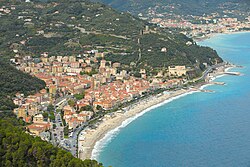
Noli (Italian: [ˈnɔːli]; Ligurian: Nöi [ˈnɔːi]) is a coast comune of Liguria, Italy, in the Province of Savona, it is about 50 kilometres (31 mi) southwest of Genoa by rail, about 4 metres (13 ft) above sea-level. The origin of the name may come from Neapolis, meaning "new city" in Greek.

It is one of I Borghi più belli d'Italia ("The most beautiful villages of Italy").[4] From 1192 to 1797 Noli was one of the maritime republics, the Republic of Noli.

Geography

[edit]

The bounding communes of Noli are Finale Ligure, Spotorno and Vezzi Portio.

History

[edit]

The name Noli, testified in the form Naboli in the oldest documents (between 1004 and 1005), certainly derives from a form of Neapolis which means "new city" in Byzantine Greek (same etymology as for Naples).

It may be mentioned as Neapolis by 7th century geographer George of Cyprus.[5]

The Republic of Noli was an independent republic from 1193 until 1797. In 1239 it became seat of a bishop; later on the diocese was united with that of Savona as the Diocese of Savona-Noli. The Napoleonic invasion in 1797 put an end to Noli's sovereignty.

Main sights

[edit]
  • Romanesque basilica of S. Paragorio (11th century)
  • Household and annexed Tower (14th-15th century)
  • San Paragorio (5th–6th century)
  • Tower and Gate Papone (13th-14th centuries)
  • Tower of Four Sides.
  • Nemo's Garden (Noli)

Twin towns — sister cities

[edit]

Noli is twinned with:

Personalities

[edit]
  • António de Noli, Italian nobleman and explorer, discoverer of some Guinea territories and Cape Verde islands on behalf of the Portuguese crown.[6] Born in Genoa 1419, "family with origins in Noli or the Castle of Noli".[7]

References

[edit]
[edit]
Revisions and contributorsEdit on WikipediaRead on Wikipedia
from Grokipedia
Noli is a coastal in the , in the region of . Located about 50 km (31 mi) southwest of by rail and at an elevation of 2 m (6.6 ft) above , it covers an area of 9.67 km² (3.73 sq mi) along the . In Ligurian, it is known as Nöi. Historically, Noli was an independent maritime republic from 1192 until 1797, when it was annexed during the . The town is recognized as one of the ("The most beautiful villages of Italy"). As of 2025, Noli has an estimated population of 2,434 and a population density of 252/km² (650/sq mi).

Geography and Environment

Location and Administrative Boundaries

Noli is a coastal comune in the region of northwestern , situated in the . It lies approximately 50 km southwest of along the Ligurian Riviera. The town's geographic coordinates are 44°12′22″N 8°24′48″E, with the central area at an elevation of 2 meters above sea level. The covers a total area of 9.623 km², encompassing both coastal and inland terrain. It borders to the west, Spotorno to the east, and Vezzi Portio to the north. These administrative boundaries define Noli's position within the province, integrating its urban center with surrounding rural landscapes. Noli includes two main frazioni, or hamlets: Tosse and Voze. Tosse, located on the southern slope of Bric delle Rive at about 285 meters elevation, serves as a rural extension with agricultural focus, integrated into the comune through shared administrative services and connectivity via local roads. Voze, perched higher in the inland valleys overlooking the Gulf of Noli, features a historic character and functions as an elevated residential and cultural outpost, linked to the main town by trails and paths that highlight its role in the broader municipal territory. Administratively, Noli operates in the zone (UTC+1 or CET), advancing to (UTC+2 or CEST) during summer months. Its postal code is 17026, and the dialing code is 019.

Physical Geography and Coastline

Noli's terrain is characterized by a predominantly hilly inland that gently rises toward the Ligurian Apennines, with elevations increasing from the narrow to the surrounding mountain ranges. This configuration results in steep slopes descending directly to the sea in many areas, limiting the extent of flat land and creating a dramatic interface between the mountainous interior and the shoreline. The coastline features rugged rocky shores punctuated by small pebble beaches, forming part of the scenic Riviera di Ponente along the . A key landmark is the Capo Noli , a prominent that extends into the and shapes the local coastal morphology with its cliffs and coves. The marine environment offshore includes underwater caves and supports innovative projects such as Nemo's Garden, an experimental underwater biosphere for established in 2012 by Ocean Reef Group in the Baia del Sole bay. This modular system of biospheres, anchored at depths of 6 to 10 meters, leverages natural seawater conditions to cultivate terrestrial plants, contributing to research on hydroponic farming in marine settings. Biodiversity in the region is notable for the presence of Mediterranean maquis vegetation, including sclerophyllous shrubs like cork oak and aromatic plants, which thrive in the hilly inland areas. Offshore, the Fondali Noli-Bergeggi safeguards diverse marine habitats, encompassing meadows and habitats for species such as the pen shell () and various populations, enhancing local . Geologically, the area exhibits formations typical of the nearby Finalese karstic zone, where bedrock has been shaped by dissolution processes into caves and sinkholes. These features contribute to historical risks, particularly along the Capo Noli promontory, where cliff instability has been documented due to tectonic influences and .

Climate and Weather Patterns

Noli experiences a , classified as Csa under the Köppen-Geiger system, characterized by mild, wet winters and warm, dry summers influenced by its coastal position in . This classification is typical for the region's Riviera di Ponente, where proximity to the moderates temperatures and contributes to relatively stable weather patterns throughout the year. The annual mean temperature in Noli is approximately 15°C, with summer highs reaching around 28°C in and winter lows averaging about 6°C in . During the warm season from June to September, daytime temperatures often exceed 25°C, fostering ideal conditions for outdoor activities, while the cool season from November to March sees highs rarely surpassing 15°C and occasional frost near the interior hills. These variations reflect the seasonal shift driven by Mediterranean air masses, with the acting as a buffer to prevent extreme cold snaps. Precipitation totals around 800 mm annually, concentrated primarily in the autumn and winter months, with being the wettest at over 150 mm. Summers remain notably dry, with receiving less than 20 mm, aligning with the Mediterranean of low humidity and minimal rainfall during peak warmth. This results in about 150 rainy days per year, mostly as short, intense showers rather than prolonged downpours, though occasional thunderstorms can occur in spring and fall. In recent years, Noli has faced heightened weather risks, including a climber rescue operation on Capo Noli cliffs in April 2024 amid challenging coastal conditions. Weather alerts for storms and flooding have been issued periodically, such as moderate rain warnings in November 2025 and severe flooding events in nearby Savona province during heavy autumn rains in September 2025 and October 2024. These incidents highlight the vulnerability of the area's steep terrain and coastal exposure to intensified precipitation events. Climate change is exacerbating environmental pressures on Noli's low-lying coast, with rising sea levels projected to erode beaches and increase flooding risks. Italy's coastline has seen an average sea level rise of 1.64 mm per year since 1903, potentially leading to the loss of up to 20% of beaches nationwide by 2050 under current trends. In Liguria, this manifests as heightened coastal inundation during storms, threatening the town's historic shoreline and prompting concerns over long-term habitat shifts.

History

Origins and Early Settlement

The name of Noli is believed to derive from the Greek-Latin term "Neapolis," meaning "new city," reflecting its establishment as a planned settlement, with the earliest documented reference appearing as "Naboli" in records from 1004–1005. Archaeological evidence indicates that the area around Noli was inhabited by Ligurian tribes prior to Roman , serving as an ancient coastal center with rudimentary settlements tied to the rugged Ligurian landscape, though specific pre-Roman artifacts remain sparse and primarily inferred from broader regional patterns of Indo-European or pre-Indo-European populations dating to the period. During the Roman era, Noli emerged as a continuous settlement from the early onward, featuring residential structures, production workshops, and a cremation , as revealed by excavations uncovering bronze coins and amphorae fragments that point to its role in coastal trade routes along the . These artifacts, including those from maritime commerce in wine and oil, underscore Noli's integration into the empire's economic network without evidence of a major port but with clear ties to regional exchange. The transition to the early Christian period in the 5th–6th centuries marked a pivotal shift, exemplified by the foundation of the San Paragorio church complex, which included a with an octagonal font and pavement, alongside sarcophagi of local stone, signaling the of the and its evolution from Roman villa foundations into an organized religious settlement. This site, possibly a Byzantine "plebs cum baptisterio," featured early church structures from the late , with associated residential areas showing hearths and metallurgical activity, indicating a growing medieval amid Late transformations. Under Carolingian influence in the 8th–9th centuries, Noli underwent further village reorganization, with distinct zones for residences and crafts emerging along pathways, accompanied by a 9th-century that prompted rebuilding and reinforced the settlement's resilience. Fortifications began to take shape during this era, as evidenced by the early defensive structures at Monte Ursino, which were destroyed around 900 and subsequently rebuilt, evolving into a fortified village by the early to protect against regional threats.

Medieval Republic and Independence

Noli emerged as an independent maritime republic in the late 12th century, declaring its autonomy from the Marquisate of Savona and the Del Carretto family around 1192, with the traditional date of full independence set at August 7, 1193. This status was confirmed by Emperor Henry VI in 1196, allowing Noli to function as a free commune and participate actively in Mediterranean trade networks. To safeguard its sovereignty against regional threats from Savona and the Marquisate of Finale, Noli forged a strategic alliance with the Republic of Genoa in 1202, establishing a partnership of equals that provided naval protection in exchange for shared commercial interests, while also maintaining ties with Pisa during early Crusader expeditions. The governance of the Republic of Noli was structured as a popular regime led by elected consuls drawn from heads of prominent families, supported by a council of elders (Anziani) and a smaller advisory body known as the Consiglietto, which functioned similarly to a in deliberating on policy and ordinances. These early statutes formed the basis of communal law, emphasizing maritime and economic priorities. Noli maintained an autonomous fleet of powerful , with each of the town's 72 defensive towers built by ship-owning families (armatori) and symbolically associated with a galley—to support its role in transporting Crusaders, pilgrims, and during the in 1099 and subsequent ventures. The republic's economy thrived on trade in spices like ginger, cloves, and ; wool fabrics from and ; copper ; French textiles; and weapons, leveraging its strategic port position despite geographic constraints. Key events marked Noli's medieval prominence, including its elevation to an independent bishopric by in 1239, separating it ecclesiastically from the Diocese of and underscoring its growing influence. The republic reached its peak in the late 13th to 14th centuries as a vital hub, expanding territorial control over nearby areas such as Orco, Mallare, Segno, and Vado, and engaging in naval contracts, such as ship rentals in 1268–1269. However, this era was punctuated by conflicts, including wars with Finale and , invasions by Spanish, Milanese, and Piedmontese forces, and raids by Barbary corsairs, which strained resources and led to defensive fortifications like walls and towers built from 1181 onward. The decline of the accelerated in the 15th and 16th centuries due to prolonged warfare, economic isolation, and the shifting dynamics of Mediterranean trade, culminating in the Napoleonic invasion of 1797, when French forces incorporated it into the alongside . This marked the end of over six centuries of independence, with Noli's fleet suffering further losses after the British victory at the Battle of Cape Noli in 1795. Ecclesiastically, the independent bishopric persisted until the 19th century, when it merged with the of in 1820 to form the of Savona-Noli.

Modern Developments and Recent Events

In the 19th century, Noli was integrated into the newly formed on March 17, 1861, as part of the broader Risorgimento unification process that incorporated the Ligurian territories previously under the Republic of Genoa's influence. During this period, the local economy remained dominated by traditional , including and cultivation on terraced hillsides, alongside a robust artisanal fishing sector that utilized small boats and net techniques passed down through generations. The 20th century brought significant disruptions to Noli due to , during which the Italian coastal defenses along the Ligurian Riviera, including areas near Noli, were bolstered with fortifications such as bunkers and observation posts to counter potential Allied invasions from the sea. These structures, part of a broader network aimed at denying access to the coastline, reflected the strategic importance of the region's ports and bays. In the post-war era, Noli experienced a gradual economic shift as emerged as a key driver, drawing visitors to its preserved and pristine beaches, which helped diversify beyond and by the mid-20th century. In 2008, Noli received official recognition as one of "," highlighting its well-preserved historic center and contributing to increased . The has seen Noli evolve further through community and environmental initiatives, including the annual Il Golfo dell'Isola Race, which on May 17, 2025, served as the third stop in the Golden Trail World Series, attracting international runners to its coastal paths and promoting sustainable outdoor activities in the surrounding hills. Ongoing conservation efforts focus on maintaining Noli's medieval walls and towers, with restoration projects addressing structural integrity and integrating surviving elements into modern urban fabric while preserving their . The adjacent Area Marina Protetta Isola di Bergeggi, established in 2007 and encompassing waters near Noli, continues to enforce protections for marine biodiversity, including seagrass meadows and coralligenous habitats, with active monitoring and educational programs as of 2025. No formal World Heritage bids for Noli have advanced to inscription status by 2025. A notable recent incident occurred on November 6, 2025, when the 26.9-meter motor Principessa Matera caught fire approximately five nautical miles off Capo Noli, resulting in the vessel's total destruction but with all three crew members rescued by the Italian Coast Guard and firefighters. The fire, believed to have started in the , was extinguished by responding vessels, with no injuries reported.

Government and Demographics

Local Administration and Politics

Noli operates as a within the in the region of , governed by a standard municipal structure that includes a (sindaco) elected directly by residents and a (consiglio comunale) responsible for legislative functions. The executive branch, known as the giunta comunale, is led by the mayor and comprises appointed assessors who handle day-to-day administration. As of 2025, the mayor is Ambrogio Repetto, who was elected on June 12, 2022, for a five-year term representing the local list Prospettiva Noli. The comune's administrative divisions encompass the main town (capoluogo) and two frazioni, Tosse and Voze, which are inland hamlets integrated into municipal governance without separate autonomous bodies but subject to the same council oversight and service provision. These frazioni participate in local decision-making through resident consultations and are represented in town council deliberations on area-specific matters. The broader provincial level provides oversight through the , coordinating inter-municipal policies on and . Politically, Noli aligns with the regional dynamics of , where local administrations often collaborate on shared priorities under the influence of the regional government's center-right coalition led by President Marco Bucci since 2024. Key local issues include coastal preservation, addressed through inter-institutional protocols like the 2025 agreement for managing the Capo Noli area to mitigate erosion and habitat loss, and regulation to balance with environmental sustainability, as evidenced by Noli's ongoing Blue Flag certification for beach quality and eco-management. Municipal responsibilities cover essential services such as , where the comune manages school-related logistics including transportation and meal programs for local primary and secondary institutions; , outsourced to SAT Servizi Ambientali Territoriali for differentiated collection achieving high rates compliant with EU standards; and public safety, enforced by the local police (polizia municipale) and a communal civil protection plan that addresses risks like and emergencies.

Population and Social Composition

As of 2010, the population of Noli stood at 2,861 residents. By the 2011 census, this figure had slightly decreased to 2,797, reflecting early signs of demographic stagnation typical in small Ligurian municipalities. More recent data from the (ISTAT) indicate a continued gradual decline, with 2,450 residents recorded as of December 31, 2023, and 2,434 residents as of December 31, 2024 (January 1, 2025), driven primarily by an aging population and low rates. The trend suggests ongoing stability with minimal growth potential absent significant immigration. The population density in Noli was 297.3 inhabitants per square kilometer in 2010, calculated over its 9.62 km² municipal area. By , this had fallen to about 253.0 inhabitants per square kilometer due to the reduced resident count. The for residents is Nolesi. Demographically, Noli exhibits a high proportion of elderly individuals, with 32.9% of the population aged 65 and over (805 people), compared to just 7.8% under 15 (192 people) and 59.3% in the working-age group of 15-64 (1,453 people). This structure yields an old-age index of 419.3 elderly per 100 youth, underscoring pronounced aging. Gender distribution shows a slight female majority, with approximately 51.3% women and 48.7% men in recent years, a pattern amplified among seniors where women outnumber men due to higher . Birth rates remain low at 4.5 per 1,000 inhabitants in 2023, aligning with broader rural Italian trends of below-replacement fertility. Ethnically, Noli's residents are predominantly Italian, comprising 94.2% of the total in 2023. The remaining 5.8% consists of minor immigrant communities, totaling 143 foreigners, with notable origins including (28 individuals, 19.6% of foreigners), (18, 12.6%), and (15, 10.5%). An estimated 148 foreigners (6.1% of total) reside as of 2025, with similar composition. Social trends reveal net out-migration over the past decade, contributing to the alongside natural decrease from excess deaths over births; for instance, the 2023 demographic balance showed a +4 net change in foreigners but an overall resident drop of 35 from the prior year. These patterns, sourced from ISTAT, highlight challenges in sustaining the community amid of younger residents to urban centers.

Economy and Infrastructure

Economic Sectors and Tourism

Noli's economy is predominantly driven by , which serves as the primary source of income for the locality. The sector attracts visitors primarily to its pristine beaches and well-preserved medieval historic center, including narrow caruggi alleys and ancient towers. In 2019, the town recorded approximately 59,000 overnight stays, with 47,000 from Italian tourists and 12,000 from foreigners, generating an estimated annual revenue of around €2.3 million from tourism-related activities. Tourism presences in Noli grew by 5% in 2023 compared to 2022, reflecting broader regional recovery trends in . Accommodations range from seaside hotels to agriturismi, such as Agriturismo Costamagna, which integrate rural experiences with proximity to coastal attractions, supporting a total of about 90 lodging facilities concentrated near the shore. Tourism peaks seasonally in summer, particularly , contributing to economic vibrancy but also straining local resources. Complementing tourism are traditional sectors like fishing and agriculture, which maintain cultural and economic significance on a smaller scale. Artisanal fishing in the Gulf of Noli, conducted by a cooperative of 9 fishermen using small gozzi boats and traditional methods such as tramaglio nets and palamiti longlines, focuses on species including local anchovies, mullet, hake, and octopus. This activity, preserved as a Slow Food Presidio since the early 2000s, supplies fresh catch to daily markets and supports enogastronomic tourism, though it faces constraints from EU regulations and the absence of a dedicated port. Agriculture emphasizes olive cultivation for Riviera Ligure extra-virgin olive oil (DOP certified) and vineyards producing Lumassina IGP wine, with efforts underway to revive abandoned terraced landscapes covering about 180 hectares to mitigate landslide risks and bolster production. Small-scale artisan crafts, including local woodworking and ceramics tied to historical traditions, provide supplementary income but remain marginal. Challenges in Noli's economy include risks of due to high seasonal concentrations, leading to , parking shortages, and environmental pressures on coastal ecosystems. To address these, initiatives align with Agenda 2030 goals, such as destagionalizing through off-peak events and outdoor activities like and , funded partly by revenue (with at least 60% reinvested in infrastructure like trail maintenance). As of 2019, agricultural enterprises had declined by 44% since 2000, underscoring 's dominant role in local economic output. An innovative contribution to Noli's economy comes from Nemo's Garden, an underwater project located 80 meters off the shoreline since 2012, pioneering sustainable biospheres for cultivating herbs, , and superfoods in a hydroponic system that reduces freshwater use by leveraging natural seawater conditions. This initiative advances the by creating the agronaut profession and fostering research in pharmaceuticals and , while offering guided underwater visits that enhance research-oriented and promote .

Transportation and Accessibility

Noli benefits from its strategic location along the Ligurian coast, providing multiple transportation options that connect it to regional and national networks. The primary road access is via the A10 Autostrada dei Fiori, a major coastal motorway running from Genoa to the French border, with the nearest exit at Spotorno, approximately 3 kilometers east of Noli. From there, travelers proceed westward along the SS1 Via Aurelia, a historic state road that parallels the coastline and offers scenic views while linking Noli directly to nearby towns like Spotorno and Bergeggi. Rail connectivity is facilitated by the Spotorno-Noli railway station, situated on the , which follows the and provides frequent services to major cities. operates regional trains from this station to 's Brignole station approximately every three hours, with journey times around 1 hour and 4 minutes, and fares typically ranging from €4 to €11. The line also extends westward toward and connections to France, enabling onward travel to destinations like in about 3 to 4 hours with changes. For sea access, Noli features a small harbor primarily used by local fishing boats, supporting limited maritime activities along the crystal-clear waters of the Gulf of Genoa. While not a major ferry hub, the harbor accommodates occasional small vessel operations, complementing the town's coastal position. Air travel is supported by nearby international airports: Genoa Cristoforo Colombo Airport (GOA), about 56 kilometers northeast and reachable in under 1 hour by car or train plus bus, serves as the closest option with flights to major European hubs. The Nice Côte d'Azur Airport (NCE), approximately 147 kilometers west, offers additional international connections and can be accessed via a 1 hour 40 minute drive or combined train services. Alternative mobility includes pedestrian-friendly infrastructure, with the town center largely pedestrianized for easy navigation on foot, and coastal walking paths such as the Noli-Varigotti trail, a offering views and connecting to nearby over moderate terrain. Cycling enthusiasts can utilize coastal bike routes along the corridor, including loops around Noli and that highlight the Riviera's landscapes, with options for road and gravel paths suitable for various skill levels. For visitors with disabilities, provides assistance services at stations like Spotorno-Noli, including wheelchair access on many regional trains and support through the Sala Blu lounges for pre-travel aid, though local buses operated by TPL Linea offer varying levels of accessibility with priority seating. Private accessible transfers are available from airports and stations to accommodate reduced mobility needs.

Culture and Heritage

Architectural Sights and Monuments

Noli's architectural heritage is dominated by its medieval structures, reflecting its status as a former maritime republic. The , dating to the early , exemplifies in with its basilican plan featuring three naves separated by columns and a raised presbytery supported by a . The church, originally constructed over a paleochristian site in 1001, served as Noli's cathedral until 1572 and includes remnants of 14th- to 15th-century frescoes on its arches and walls, along with a that once functioned as an . Archaeological excavations around the basilica have uncovered early Christian elements, including a , underscoring its layered historical significance from . The town's defensive fortifications, built between the 12th and 15th centuries, enclose the historic center and highlight Noli's strategic maritime role. These include extensive medieval walls punctuated by towers, of which only eight survive from an original 72, symbolizing family prestige and communal defense. Notable examples are the Torre Papone, a well-preserved cylindrical tower from the 13th century, and the Torre dei Quattro Canti, the tallest at 38 meters, constructed in the same period to oversee the western approaches. City gates, such as the Porta di San Giovanni, integrated into the walls, feature arched portals and remnants of late medieval frescoes now housed in the nearby Palazzo Communale. Overlooking the town from Monte Ursino, the Castello di Noli consists of 12th- to 14th-century ruins that once formed a fortified complex with circular towers and sloping walls for defense against sea incursions. Built initially around 1200 by the Marquis del Carretto, the castle was expanded in the 14th century, though much was damaged over time, leaving evocative remnants of battlements and cisterns today accessible via volunteer-guided paths. Civic architecture is represented by the Palazzo Communale, a 14th- to 15th-century structure serving as the town's historic , characterized by pointed arches, brick facades, and an adjacent for public assemblies. Inside, the 17th-century council hall preserves fragments of late medieval cycles originally from the city gates, illustrating Noli's republican . Evidence of Noli's Roman-era roots appears in archaeological sites, including settlement remains from the 1st century BCE that transitioned into early medieval communities, with artifacts like pottery and structures unearthed near the modern town and Le Manie district. Preservation efforts, led by local authorities and volunteers, focus on ongoing restoration of these monuments, such as seismic reinforcements for the basilica following 19th-century earthquakes and maintenance of the castle ruins to prevent further erosion.

Traditions, Festivals, and Cuisine

Noli's traditions are deeply rooted in its maritime heritage, reflecting centuries of and seafaring activities that shaped the community's identity as one of Italy's historic . Local often revolves around tales of ancient voyages and the protective role of the sea, preserved through oral stories and communal practices passed down among fishing families. A key tradition is the use of the sciabica, a traditional trawl net for collective , recognized as a presidium since 2014 for its cultural and sustainable significance. The town's patron saint, St. Eugenius of (Sant'Eugenio), is honored annually on the second Sunday in July, typically spanning four days of celebrations from mid-July. Festivities include solemn processions on land and sea, starting with a gathering at the fishermen's beach and a boat procession to Bergeggi Island, followed by a high in the Cathedral of San Pietro and evening events featuring over the harbor at Molo Sant'Antonio. These rituals commemorate the saint's martyrdom and Noli's devotion, drawing locals and visitors to reinforce communal bonds. Noli's festivals emphasize its medieval past and vibrant cultural scene, enhanced by its designation as one of Italy's . Annual medieval reenactments, such as the historical recreation of the founding of the Free Municipality of Noli in August, feature costumed parades, tournaments, and markets that revive the town's 12th-century . The Palio dei , a summer regatta held in late June, includes boat races and neighborhood competitions echoing ancient maritime rivalries. Summer music events like the Noli Musica Festival, running for seven evenings in and , showcase lyric , instrumental performances, and in historic venues, often paired with tastings of local products. Cuisine in Noli highlights fresh seafood and Ligurian staples, influenced by its coastal location and agricultural hinterland. Signature dishes include acciughe ripiene, fresh anchovies stuffed with breadcrumbs, herbs, garlic, and cheese, then baked or fried, a delicacy tied to the town's abundant anchovy catches. Variations of pesto alla genovese, made with basil, pine nuts, and local olive oil, accompany pasta like trofie in many eateries. The region pairs these with Vermentino, a crisp white wine known for its citrus and herbal notes, produced in nearby Ligurian vineyards. Olive oil production remains central, with terraced groves yielding extra-virgin varieties used liberally in local cooking for their mild, fruity profile. Artisan crafts, such as woodworking and ceramics inspired by maritime motifs, complement these traditions, though lace-making is not prominently documented in Noli.

Notable People

Historical Figures

António de Noli (c. 1419–after 1461), a Genoese navigator of noble birth with family origins tracing back to the castle and town of Noli in Liguria, played a pivotal role in early European exploration of Africa. Sponsored by Prince Henry the Navigator, he led the first documented European expedition to reach the West African coast beyond Cape Bojador in 1448, sailing along the Gambia River and establishing contact with local kingdoms. Later, around 1460, de Noli discovered the Cape Verde archipelago, which became Portugal's first overseas colony, where he served as the inaugural governor until approximately 1461. His voyages marked the beginning of sustained European presence in sub-Saharan Africa, bridging medieval trade routes with the Age of Discovery. During Noli's medieval republic era (1192–1797), local consuls governed the city-state, overseeing its maritime trade and defenses amid rivalries with neighboring powers like . In the 13th century, these leaders forged strategic alliances to secure commercial interests; for instance, consuls negotiated a defensive and trade pact with the in 1202, countering threats from the Marquisate of Finale and ensuring safe passage for Ligurian shipping lanes. Such pacts bolstered Noli's economy through salt, wine, and exports, positioning it as a minor but resilient player among Italy's . Ecclesiastical figures were central to Noli's post-1239 history following the establishment of its independent , separated from by to affirm the town's autonomy. Contardi served as the first of Noli from 1239 until his death in 1250, while also holding the position of Bishop of Brugnato since 1230; he oversaw the initial organization of the , including the consecration of the of San Paragorio. Later 13th-century bishops like Corrado di Ancisa (1251–1264) and Ruffino Colombo (1278–1287) navigated the through papal reforms and local governance, fostering religious institutions that supported the republic's cultural identity. Ugolinus (attested 1292) further solidified episcopal ties to Genoa's archdiocese, aiding in the preservation of medieval manuscripts and liturgical practices unique to Noli.

Contemporary Residents

Ambrogio Repetto has served as the mayor of Noli since June 2022, leading the local administration under the Prospettiva Noli coalition after winning the municipal elections with a margin of over 150 votes. Born in 1964, Repetto previously held the position from 2004 to 2014, focusing on infrastructure development, environmental protection, and tourism enhancement in the coastal town. His current term emphasizes cantieri (construction projects) and combating coastal erosion, reflecting his long-term commitment to preserving Noli's medieval heritage and natural landscape. Luca Gamberini, co-founder and head of operations for Nemo's Garden, maintains strong ties to Noli through the underwater aquaculture project established in the town's bay in 2012. As the son of founder Sergio Gamberini, Luca oversees the innovative biospheres that cultivate herbs and at depths of up to 10 meters, promoting sustainable farming amid climate challenges. His work has positioned Nemo's Garden as a global model for subaquatic , with collaborations including for technological advancements and potential expansions to projects like in . Noli's contemporary scene also features figures like Cesare Maestri, an Italian trail runner recognized for his performances in events such as the Il Golfo dell'Isola Trail, part of the Golden Trail World Series hosted in the area. Maestri, a Nike Trail team athlete, has contributed to elevating Noli's profile in international , though his primary base is in .

References

Add your contribution
Related Hubs
User Avatar
No comments yet.