Hubbry Logo
Olga SamaroffOlga SamaroffMain
Open search
Olga Samaroff
Community hub
Olga Samaroff
logo
8 pages, 0 posts
0 subscribers
Be the first to start a discussion here.
Olga Samaroff
Olga Samaroff
from Wikipedia

Key Information

External audio
audio icon You may listen to Olga Samaroff performing Franz Liszt's Liebesträume No. 3 in A Flat Major in 1921 and her arrangement of Johann Sebastian Bach's Fugue in G minor, BWV 578 in 1931 here on archive.org

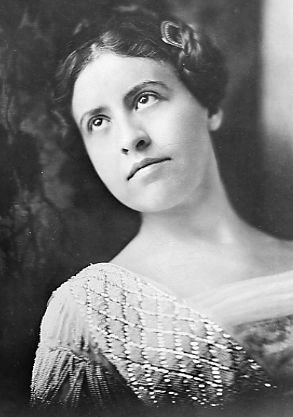
Olga Samaroff (born Lucy Mary Agnes Hickenlooper; August 8, 1880 – May 17, 1948) was an American pianist, music critic, and teacher. Among her teachers was Charles-Valentin Alkan's son, Élie-Miriam Delaborde. Her second husband was the conductor Leopold Stokowski.

Samaroff was also a prominent member of the Philadelphia Art Alliance.[1]

Early life and education

[edit]

Samaroff was born on August 8, 1880 in San Antonio, Texas, the daughter of Jane (Loening) and Carlos Hickenlooper.[2][3] She grew up in Galveston, where her family owned a business later wiped out in the 1900 Galveston hurricane. She began studying with her grandmother, and, after her talent for the piano was discovered, she was sent to Europe to study, since at that time there were no great piano teachers in the United States. She was the first American woman to win entrance to the piano class at Paris' Conservatoire Nationale de Musique. She first studied with Antoine François Marmontel and Charles-Valentin Alkan's son, Élie-Miriam Delaborde, at the Conservatoire de Paris, and later with Ernst Jedliczka in Berlin. It was in Europe that she made the acquaintance of longtime friend and influential opera singer Geraldine Farrar.

Career

[edit]

After her divorce and the 1900 hurricane that claimed her family's business, she returned to the United States and tried to carve out a career as a pianist. She soon discovered she was hampered by both her awkward name and her American origins. Her agent suggested a professional name change, which was claimed to be taken from a remote relative.

As Olga Samaroff, she self-produced her New York debut at Carnegie Hall in 1905 (the first woman ever to do so). She hired the hall, the orchestra, and conductor Walter Damrosch, and made an overwhelming impression with her performance of Tchaikovsky's Piano Concerto No. 1 and the Schumann Piano Concerto. She played extensively in the United States and Europe thereafter.

Samaroff discovered Leopold Stokowski (1882–1977) when he was church organist at St. Bartholomew's in New York and later conductor of the Cincinnati Symphony Orchestra. She played Tchaikovsky's Piano Concerto No. 1 under Stokowski's direction when he made his official conducting debut in Paris with the Colonne Orchestra on May 12, 1909.

She married Stokowski in 1911, and their daughter Sonya was born in 1921. At that time, Samaroff was much more famous than her husband and was able to lobby her contacts to get Stokowski appointed in 1912 to the vacant conductor's post at the Philadelphia Orchestra, thus launching his international career. Samaroff made a number of recordings in the early 1920s for the Victor Talking Machine Company. She was the second pianist in history, after Hans von Bülow, to perform all 32 Beethoven piano sonatas in public, preceding Artur Schnabel (who did the series in 1927) by several years.[4] German pianist Walter Gieseking also performed the complete sonatas in public by age 15 (c. 1910).[citation needed]

In January 1917, when the Philadelphia Art Alliance launched a new series of "sociable luncheons" to familiarize prominent men and women in the Philadelphia region with fine arts and music trends, the organization's leaders chose Samaroff to be the series' first speaker. Well known to the alliance and residents of the Philadelphia region from her work on the alliance's music committee, as well as from her performance career, she presented a lecture on "The Correlation of Music and the Fine Arts."[5]

In 1923, Samaroff and Stokowski divorced; the reasons included Stokowski's infidelity, from which she never recovered. She took refuge in her friends, among whom were George Gershwin, Irving Berlin, Dorothy Parker, and Cary Grant. In 1925, Samaroff fell in her New York apartment and suffered a shoulder injury that forced her to retire from performing. From that point on, she worked primarily as a critic and teacher. She wrote for the New York Evening Post until 1928 - the first woman to serve as music critic for a New York daily newspaper - and gave guest lectures throughout the 1930s.[6]

Olga Samaroff (center) with students Solveig Lunde and William Kapell (courtesy of Solveig Lunde Madsen)

Samaroff developed a course of music study for laymen and was the first music teacher to be broadcast on NBC television. She taught at the Philadelphia Conservatory of Music and in 1924 was invited to join the faculty of the newly formed Juilliard School in New York, becoming the first American-born teacher on the piano faculty.[7] She taught at both schools for the rest of her life. Called "Madam" by her students, she was an advocate for them, supplying many of her Depression-era charges with concert clothes and food, or helping to subsidize their rent or letting them live with her in her New York apartment. She also pressed officials at Juilliard to build a dormitory – a project that was not realized until after her death decades later. Her most famous pupil was concert pianist William Kapell, who was killed in a 1953 plane crash at age 31. She herself said that the best pianist she ever taught was the New Zealander Richard Farrell, who also died at age 31, in a motor vehicle accident in England in 1958.

Death

[edit]

Samaroff published an autobiography, An American Musician's Story, in 1939. She died of a heart attack at her home on 24 West 55th Street in New York on the evening of May 17, 1948, after giving several lessons that day.[8]

Personal life

[edit]

While in Berlin, she was very briefly married to Russian engineer Boris Loutzky.

Samaroff is related to Civil War general Andrew Hickenlooper and to Colorado Governor John Hickenlooper. In John Hickenlooper's 2016 memoir, he states that the name change from Hickenlooper to Samaroff was suggested by Samaroff's cousin and federal judge Smith Hickenlooper.[9]

Notable pupils

[edit]

References

[edit]
[edit]
Revisions and contributorsEdit on WikipediaRead on Wikipedia
from Grokipedia
Olga Samaroff (August 8, 1880 – May 17, 1948) was an American concert pianist, music educator, , and author who broke barriers as one of the first prominent women in , achieving international acclaim as a performer and influential teacher. Born Lucie Hickenlooper in , , she adopted the stage name Olga Samaroff to overcome biases against American and female artists in , where she pursued rigorous training that propelled her to debut fame. Her career spanned performances with major orchestras, pioneering recordings, and advocacy for American musicians, marking her as a trailblazer who navigated gender and national prejudices to shape 20th-century musical life. Raised in a musical family—her mother and maternal grandmother were accomplished pianists—Samaroff began lessons at age three and showed prodigious talent by outpacing local teachers in Galveston, Texas, where she received early tutoring at the Ursuline Convent. At fourteen, she moved to Paris with her grandmother, securing a scholarship as the first American woman admitted to the Paris Conservatoire in 1895, where she studied under Élie Delaborde; she later trained with Ernst Jedliczka in Berlin and Ernest Hutcheson in Baltimore. These formative years honed her technique amid cultural challenges, as she later reflected on the "agonizing uncertainty" of transitioning from student to professional in a field dominated by Europeans. Samaroff's performing career ignited with her 1905 debut at alongside the New York Symphony Orchestra, followed by appearances with the Boston Symphony and as one of the first American pianists to record commercially in 1908, thanks to her friendship with . She married Russian conductor Boris Loutzky around 1900 (divorcing due to cruelty) and later wed in 1911, whom she discovered and promoted; their union produced a daughter, Sonya, but ended in divorce in 1923 amid personal strains. A milestone was her complete cycle of all 32 Beethoven piano sonatas in recital, a feat that solidified her reputation as a leading international artist in the early . In her later years, Samaroff shifted focus to education and advocacy, joining the Juilliard School faculty in 1924 as its only American-born piano teacher and chairing the piano department at the Philadelphia Conservatory from 1928 to 1948, where she mentored generations of performers. She became the first female music critic for a New York daily newspaper, writing for the New York Evening Post from 1926 to 1928, and authored books including The Layman’s Music Course (1935) and her autobiography An American Musician’s Story (1939). Samaroff founded the Schubert Memorial Foundation in 1928 to support young artists and the Laymen’s Music Courses in 1932 to broaden public appreciation; she received honorary doctorates from the University of Pennsylvania (1931) and Cincinnati Conservatory (1943), and served on President Roosevelt's Advisory Committee on Music in 1944. Her legacy endures as a pioneer who championed opportunities for emerging musicians, emphasizing artistic growth over survival struggles.

Early life and education

Childhood and family background

Olga Samaroff was born Lucy Jane Olga Hickenlooper on August 8, 1880, at in , . She was the daughter of Carlos Hickenlooper, a U.S. Army officer who resigned his commission soon after her birth to pursue civilian opportunities, and Jane Loening Hickenlooper, an amateur of German descent whose family had strong ties to musical traditions. Jane's mother, Lucy Palmer Loening Grünewald, had been a professional concert in the United States and , fostering an environment rich in musical appreciation from Olga's earliest years. The family, including Olga's younger brother George, relocated first to and then to , around 1886, where they settled in the affluent Silk Stocking District. In Galveston, Carlos worked at a music store, Thomas Goggan & Bro., and the household provided a stable, cultured upbringing influenced by Jane's amateur performances and the grandmother's legacy, which early on highlighted Olga's innate musical inclinations. The unusual surname Hickenlooper, of Dutch origin, would later prompt professional considerations for a , but it defined her childhood identity within a close-knit family. Tragedy struck in September 1900 with the Great Galveston Hurricane, which devastated the city and destroyed the family's music store business, plunging them into financial hardship at a critical juncture. Despite the loss, the family survived unscathed, though the economic fallout forced relocations and shaped Olga's resilient early environment amid the cultural vibrancy of her mother's German heritage.

Initial musical training

Olga Samaroff, born Lucy Jane Olga Hickenlooper in 1880, received her earliest instruction from her mother, Jane Hickenlooper, an accomplished amateur , in their family home in . Both her mother and maternal grandmother, skilled musicians who offered lessons locally, recognized her talent and provided foundational that emphasized technical precision and from a young age. By the time she was ten years old, Samaroff was performing publicly for visiting musicians, whose acclaim prompted recommendations for advanced European study. In Galveston, Samaroff continued her development under local instructors, notably the Russian pianist and teacher Adele Margulies, with whom she studied intensively and demonstrated rapid advancement in repertoire and technique. Her progress was such that, while tutored at the until her departure for in 1895, she soon outpaced available opportunities in the region, performing complex works that showcased her burgeoning virtuosity. The devastating Galveston hurricane of 1900 disrupted family finances but ultimately allowed greater focus on her musical pursuits amid the relocation to . Upon her return to the in 1904, at age 24, Samaroff had surpassed her Galveston teachers and briefly studied with American mentors in , including Constantin von Sternberg and Ludovic Breitner, to refine her skills ahead of her professional debut. She also worked with Ernest Hutcheson in nearby , gaining insights into interpretive depth and stage presence during this transitional period. These U.S.-based sessions bridged her European foundations with global aspirations, honing her as a professional artist. To enhance her professional image in an era when European-sounding names facilitated acceptance in circles, Samaroff adopted the stage name "Olga Samaroff" around , derived from her maternal great-grandmother, a Russian émigré, which evoked a sense of continental sophistication tied to her distant ancestry. This change marked her emergence as a poised concert artist, distinct from her American roots.

Advanced studies in Europe

In 1894, at the age of fourteen, Olga Samaroff traveled to with her grandmother to pursue advanced studies, securing a as the first admitted to the Paris Conservatoire in 1895, where she studied under Élie Delaborde. Her primary instructor was Élie-Miriam Delaborde, a distinguished and son of composer , who had studied under and emphasized interpretive depth and technical precision. The curriculum was demanding, requiring over seven hours daily on practice and performance, supplemented by four to five hours on academic subjects such as , , and under Émile Durand, as well as with M. Bétout. Samaroff's time at the Conservatoire was marked by significant challenges as an navigating barriers in a traditionally male-dominated European institution; upon her first lesson, Delaborde reportedly questioned her aptitude by asking why she attempted without evident talent, reflecting broader prejudices against female and foreign students. Despite these obstacles, she excelled and graduated in 1897 with a premier prix in , a rare honor that affirmed her technical mastery and artistic potential. Following her graduation, Samaroff relocated to in late 1897 or early 1898, accompanied by her grandmother, to continue private lessons with Ernst Jedliczka, a Russian pianist who had studied at the under and . Under Jedliczka's guidance, she refined her repertoire and technique, focusing on the Romantic school with an emphasis on expressive phrasing and structural insight derived from her teacher's Russian influences. This period immersed her in Berlin's vibrant musical scene, where she gained exposure to European concert traditions through attendance at performances and interactions with international artists, fostering essential networking opportunities for her emerging career. By 1904, after nearly a decade abroad, Samaroff returned to the United States, equipped with the sophisticated training and cultural acclimation that positioned her for a professional debut on the American stage. Her European education not only honed her artistry but also highlighted the perseverance required to overcome institutional biases, paving the way for her contributions as a pioneering female pianist.

Performing career

Debut and rise to prominence

Olga Samaroff made her professional debut in New York on January 18, 1905, at , performing Robert Schumann's Piano Concerto in , Op. 54, with the New York Symphony Orchestra under conductor . This self-financed event marked her as the first woman to rent the hall for such a presentation, showcasing her determination in an era when female orchestral soloists were rare. The performance received immediate critical acclaim, with reviewers praising her technical precision, musical insight, and commanding stage presence, which propelled her into a series of follow-up U.S. tours. These engagements established Samaroff as the first major American-born female , breaking barriers for women in and gaining her recognition among American audiences previously dominated by European artists. Her success highlighted the viability of native talent, inspiring greater acceptance of American performers on major stages. In 1908–1909, Samaroff undertook an early European tour, including appearances in , where she performed Tchaikovsky's No. 1 in B-flat minor, Op. 23, with the London Symphony Orchestra. Despite prevailing prejudices against American musicians, who were often dismissed as inferior to their European counterparts, her virtuosic interpretations and refined artistry earned enthusiastic receptions, solidifying her international . This tour overcame skepticism by demonstrating the high caliber of U.S.-trained pianism, paving the way for her broader continental successes. A key milestone in her rising prominence came in the , when Samaroff became the first American pianist to perform all 32 of Beethoven's piano sonatas in a series of public recitals, completing the cycle between 1920 and 1921. This ambitious endeavor, presented across multiple concerts, underscored her interpretive depth and endurance, further cementing her status as a pioneering figure in American piano performance.

Major tours and recordings

Following her successful debut, Samaroff undertook extensive tours across the and from 1909 to 1925, performing with major orchestras and in solo recitals that solidified her reputation as a leading American pianist. In the , she collaborated frequently with prominent ensembles, including the and the under her husband , where she performed works such as Beethoven's Piano Concerto No. 4 in 1915 and Tchaikovsky's Piano Concerto No. 1 in 1917. Her European engagements, though more concentrated earlier in the period, included appearances with the London Symphony Orchestra in 1908—technically just before but extending into subsequent years—and solo recitals in cities like and , showcasing her command of Romantic repertoire. A highlight was her 1920–1921 cycle of all 32 Beethoven piano sonatas across eight concerts in New York, the first complete presentation by an American pianist, which drew widespread acclaim for its interpretive depth. From 1911 to 1923, Samaroff's tours increasingly featured joint appearances with Stokowski, whose career she had helped advance since their marriage in ; their first collaboration was a December 1911 concert in , followed by shared programs that boosted both their profiles. These partnerships often involved her as soloist with orchestras he conducted, such as the , where they presented Beethoven sonata cycles in 1920, with Stokowski delivering lectures to contextualize the music for audiences. Such collaborations not only expanded her reach in the U.S. but also emphasized educational elements, making more accessible during an era of growing public interest in orchestral performances. Samaroff's recording career gained prominence through her association with the , where she became one of the label's featured artists starting in 1921, producing a series of acoustic discs that captured her virtuosic style. Among her key recordings were Liszt's Liebesträume No. 3 (1921), Chopin's in , Op. 9 No. 2 (1923), and the finale from Chopin's Piano Sonata No. 3 in B minor, Op. 58 (1923), alongside arrangements like Beethoven and Rubinstein's Turkish March (1921). These Victor sessions, conducted in , often featured her preferred for optimal tone, and she recorded over 20 sides by the mid-1920s, including Liszt's Hungarian Rhapsody No. 12 and Debussy's Clair de lune (1924), preserving her interpretations for broader audiences despite the limitations of early recording technology. Throughout her tours, Samaroff actively advocated for new American compositions, integrating works by contemporary composers into her programs to promote national musical development. As secretary of the League of Composers, founded in 1923, she championed the inclusion of George Gershwin's music in the organization's publications, overruling objections about his lack of European study and arguing for recognition of innovative American voices. She also premiered pieces by composers like , emphasizing women in American music and using her platform to bridge classical traditions with emerging styles during her U.S. engagements.

Injury and career shift

In late 1925 (some sources cite 1926), Olga Samaroff suffered a serious injury to her left shoulder/arm after falling in her New York apartment, which marked the beginning of the end for her performing career. The injury severely impaired her ability to play the piano at a professional level, leading her to cancel a planned recital in 1926 and all subsequent concert engagements for at least a year. Despite undergoing medical treatments in an effort to recover, including rest and rehabilitation, Samaroff found that her hand strength and endurance could not be restored sufficiently for demanding performances, with her performing activities significantly reduced thereafter and her last known public concert occurring in 1940 at Town Hall. The physical limitations forced a profound professional pivot, as Samaroff shifted toward writing and broadcasting to sustain her involvement in music. In , she became the first woman appointed as music critic for the New York Evening Post, a role she held until , where she reviewed concerts and advocated for American musicians. This interim career provided and an outlet for her expertise amid the emotional toll of losing her primary artistic medium; as she later reflected, "There was much else I wanted to do... I decided not to resume public playing." Adapting to her circumstances, Samaroff began delivering lectures on technique and musical interpretation, relying on verbal explanations and analytical descriptions rather than live demonstrations to convey her insights. This approach allowed her to continue influencing the field intellectually, drawing on her extensive experience while navigating the frustration of her physical constraints.

Personal life

Marriages and family

Olga Samaroff's first marriage was to Boris Loutzky, a Russian , in 1900 while she was in preparing for her European debut. The union was brief and tumultuous, ending in divorce around 1904 after Loutzky forbade her from pursuing her piano career; the couple had no children. In 1911, Samaroff married conductor , whom she had met several years earlier in New York around 1906, when he was organist at St. Bartholomew's Church, and whose career she actively supported from its outset. Their relationship developed prior to her 1908 European tour, during which she encouraged Stokowski, then an emerging musician in , to apply for the position, leveraging her influential contacts to aid his appointment in 1909. She further assisted in securing his role with the in 1912 by handling contract negotiations and providing strategic support, though direct financial aid details remain tied to her broader promotional efforts. The couple occasionally collaborated on joint tours early in their marriage, blending their professional lives. Samaroff and Stokowski's marriage produced one daughter, Sonya Maria Noel Stokowski, born on December 23, 1921, in . Following their divorce in 1923, Samaroff shared custody of Sonya and prioritized a stable family environment amid her demanding career, eventually shifting toward teaching to balance motherhood with professional commitments. Sonya later married Dutch pilot H. Thorbecke in 1946 and lived a private life until her death on March 19, 2025. No evidence confirms a subsequent marriage for Samaroff after her divorce from Stokowski, and she remained focused on her daughter and career thereafter.

Final years and death

In the 1940s, Olga Samaroff continued her dedicated teaching at the of Music while engaging in public advocacy for , including serving on President Franklin D. Roosevelt's Advisory Committee on Music in 1944 and contributing to radio broadcasts such as a 1943 version of her Layman’s Music Course on WQXR. She also participated in organizational roles, such as becoming vice chairman of the arts and professions committee for the Women’s Auxiliary of the New York Republican Club in 1947. Despite these activities, her health had been declining due to a longstanding cardiac condition for which she was under a physician's care. Samaroff resided in a apartment at 24 West 55th Street, where she maintained a routine centered on her Juilliard teaching duties alongside her personal commitments. Her days often involved private lessons and institutional work, reflecting her commitment to mentoring young musicians even as her physical limitations from earlier injuries and ongoing health challenges grew more pronounced. On May 17, 1948, Samaroff suffered a fatal heart attack—diagnosed as and cardiac hypertrophy—in her New York apartment, shortly after completing several teaching sessions that day; she was 67 years old. A nurse discovered her body that evening. Her body was cremated, and a memorial service took place on May 20, 1948, at the of Music on Claremont Avenue, drawing tributes from the musical community for her enduring influence as an educator.

Teaching career

Professional positions

Following an arm injury in 1926 that curtailed her performing career, Olga Samaroff transitioned to teaching, leveraging her experience as a concert pianist to shape in the United States. In 1924, she joined the faculty of the newly established of Music in New York as a instructor, becoming the first American-born member of its artist faculty; she held this position until her death in 1948, teaching a rigorous curriculum that emphasized musical independence and artistic development. In January 1928, she was appointed chair of the piano department at the Conservatory of Music, a role she maintained concurrently with her Juilliard duties until 1948, making weekly trips from New York to conduct master classes and contribute to curriculum development focused on training future music educators and prioritizing public and holistic student growth. Samaroff also held teaching positions at the Mannes School of Music and Yale University, where she delivered lectures and classes on piano performance and pedagogy. As an administrative contributor, she advocated for greater opportunities for women in music education roles, breaking barriers as a pioneering female faculty leader and supporting initiatives like the Federal Music Project's advisory committee in 1935 to promote inclusive professional training.

Notable students and pedagogy

Olga Samaroff's most prominent students included the American virtuoso , who debuted with the in 1941 at age 18 and became renowned for his interpretations of contemporary works before his tragic death in a 1953 plane crash; Eugene List, a distinguished known for his broad and long career; and Raymond Lewenthal, celebrated for his Romantic interpretations. Other notable pupils were , a leading Bach specialist who debuted as a and later taught at institutions like Juilliard; and , a Bulgarian-born celebrated for his command of the Romantic . Samaroff's pedagogy emphasized musical interpretation and artistic independence over mere technical proficiency, urging students to develop their own unique approaches to compositions rather than imitating her playing. She adopted a holistic method that integrated performance with , encouraging pupils to study scores away from the piano, practice slowly in small sections, and engage broadly with the , , and to foster well-rounded human development. Through her position at Juilliard, she conducted annual master classes and maintained a private studio in New York, where she championed emerging American talent by providing scholarships via the Schubert Foundation and advocating for of works by U.S. composers to challenge European dominance in piano training. This philosophy profoundly influenced 20th-century American pianism, producing interpreters who prioritized expressive depth and innovation.

Writings and influence

Published books

Olga Samaroff Stokowski authored several books aimed at broadening among general and young audiences, drawing from her experiences as a performer and educator. Her publications were primarily issued by and served as companions to her music appreciation courses, emphasizing practical guidance over technical esoterica. These works collectively reflect her commitment to democratizing musical knowledge in mid-20th-century America, where access to education was often limited to elites. Her first major publication, The Layman's Music Book (1935), introduced fundamental concepts of to non-specialists through accessible explanations of musical forms, history, and listening techniques. It included suggestions for correlated reading at the end of each chapter and was later revised and reissued as The Listener's Music Book in 1947, maintaining its focus on building listener engagement with symphonic and chamber works. Following this, The Magic World of Music: A Music Book for the Young of All Ages (1936) targeted younger readers with an engaging narrative on musical discovery, using simple language and examples from orchestral to foster early appreciation. In 1937, Samaroff published A Music Manual: Containing Certain Things that Everybody Wishes to Know and Remember about Music, a concise reference guide that expanded on prior works with chapters detailing musical forms, historical developments, and basic theory, including a chart of orchestral instruments. Designed as a practical handbook for self-study, it complemented her instructional materials by providing quick-reference tools for music enthusiasts. Her total output included these four core texts tied to her educational initiatives, alongside minor contributions such as analytical notes and forewords to piano technique guides and symphonic scores, like those in the Symphonic Score Guide series. Samaroff's autobiography, An American Musician's Story (1939), provided a personal account of her career trajectory, from her origins and European training to challenges in the American concert scene, her marriages, and the evolving landscape of U.S. music institutions. The book candidly addressed obstacles faced by women in and offered insights into the professional rigors of touring and recording during the early . These publications received praise for their clarity and approachability, with reviewers noting their value in enlightening lay audiences and aspiring artists alike. The Layman's Music Book was commended for bridging the gap between professional musicians and everyday listeners, while the was lauded for its inspirational tone toward young performers navigating similar hurdles. Samaroff's books influenced subsequent materials by prioritizing audience accessibility, contributing to the popularization of appreciation courses in schools and community programs during and .

Music criticism and advocacy

Following an arm injury in 1925 from a fall in her apartment, which curtailed her performing career, Olga Samaroff transitioned into , serving as chief music critic for the New York Evening Post from 1926 to 1928. In this role, she became one of the few women to hold a daily position in New York, reviewing concerts and advocating for contemporary and innovative works. Her columns often highlighted emerging talents and critiqued bold orchestral innovations, including those of her former husband, , with whom she had divorced in 1923; she praised his visionary approaches while questioning aspects of their execution in performances. Samaroff's writing stirred controversy for its directness, as she challenged traditional norms and pushed for broader recognition of American artistic contributions. A notable example of her advocacy appeared in a 1928 Evening Post article, written upon her return from , where she declared America "the seat of highest actual achievement in musical performance," citing superior U.S. orchestras and compared to 's declining standards amid economic hardship. She argued against the prevailing European bias that marginalized American composers and performers, noting that before , it was "almost impossible for a native-born and locally educated American artist to secure a hearing" in major venues. To combat this, Samaroff founded the Schubert Memorial Foundation in 1928, the first competition exclusively for American musicians, which provided winners with orchestral performance opportunities to elevate U.S. talent on par with European counterparts. Samaroff extended her advocacy through radio broadcasts and lectures, using these platforms to educate audiences and promote inclusivity in music. Her educational radio and programs aimed to deepen public appreciation of , often featuring discussions of new compositions and orchestral repertoire. In lectures, such as her 1937 address titled "" before the National Federation of Music Clubs, she staunchly defended women's roles in professional orchestras, countering prejudices that limited them to "feminine" instruments and advocating for equal opportunities based on merit. Her efforts influenced broader policy, culminating in her 1944 appointment by President to the Advisory Committee on Music at the Department of State, where she helped shape national strategies for and support for American artists.

Legacy

Impact on American music education

Olga Samaroff played a pioneering role for women in conservatory leadership, becoming the first American-born member of the piano faculty at the in 1924 and serving there until her death, where she helped challenge gender biases in musical institutions. As a trailblazer, she also became the first woman to serve as a music critic for a New York daily newspaper in 1926, using her platform to advocate for female musicians and broader access to professional opportunities. At Juilliard, Samaroff expanded the piano curriculum to emphasize diverse styles and periods, including the integration of American repertoire, which encouraged students to explore contemporary and national works alongside traditional European canons. Through her teaching at Juilliard and the Conservatory, where she chaired the piano department from 1928, Samaroff trained numerous professional pianists who shaped mid-20th-century performance standards, focusing on artistic independence, rigorous score analysis, and musical maturity rather than rote technique. Notable students included , , Eugene List, and , many of whom went on to international acclaim and embodied her of fostering self-reliant interpreters. Her approach influenced institutional training norms by prioritizing human development and broad musical understanding, setting a model for American conservatories during a period when European methods dominated. Samaroff advocated for accessible music education through her writings and lectures, founding the Layman’s Music Courses in 1933 to promote active listening and appreciation among non-professionals, which she detailed in her book The Layman’s Music Book (1935). Her efforts extended to public school programs via involvement in the Federal Music Project in 1935 and the Advisory Committee on Music in 1944, where she pushed for music integration in general education to cultivate wider cultural participation. These initiatives, including her lectures on using recordings for teaching, democratized music learning and influenced curriculum development in American public institutions during the Great Depression and beyond. Her long-term impact included bolstering American participation in international competitions through the establishment of the Schubert Memorial Foundation in 1928, which provided financial support and performance opportunities for young American musicians, enabling them to compete and gain visibility on global stages. This advocacy countered the era's preference for European-trained artists, fostering a generation of confident American performers who elevated the nation's presence in events like the .

Posthumous recognition

In the 2010s and beyond, Samaroff's early recordings for the Victor label underwent significant archival rediscovery, with her complete solo works reissued in 2024 by APR Records, highlighting her acoustic-era interpretations of pieces by composers such as Chopin and Debussy. These efforts have made her performances digitally accessible on platforms like the , where collections of her 78 rpm discs from 1908 to 1930 are available for public listening and study. Posthumous honors include the establishment of the Olga Samaroff Scholarship at , which supports promising students and continues her legacy of . Additionally, her personal papers and memorabilia form the Olga Samaroff Stokowski Collection at the International Piano Archives and at the University of Maryland, preserving correspondence, scores, and artifacts that document her career and influence. Biographical tributes have emerged in recent decades, such as the 2018 Song of the Lark blog series, which detailed her pioneering role as an American female and educator through in-depth posts drawing on historical accounts. Samaroff's contributions are also featured in broader histories of , recognizing her as a trailblazer who advanced gender equity in classical performance and criticism. Her cultural legacy endures through initiatives like the 2016 Texas Historical Commission marker in , placed at her childhood home to commemorate her origins and achievements as a native daughter who rose to international prominence. Scholarly studies of American pianism frequently cite Samaroff's pedagogical innovations and recording artistry as foundational to the development of 20th-century piano technique and interpretation in the United States.

References

Add your contribution
Related Hubs
User Avatar
No comments yet.