Hubbry Logo
Operation Linebacker IIOperation Linebacker IIMain
Open search
Operation Linebacker II
Community hub
Operation Linebacker II
logo
8 pages, 0 posts
0 subscribers
Be the first to start a discussion here.
Operation Linebacker II
from Wikipedia

Operation Linebacker II
Part of the Vietnam War

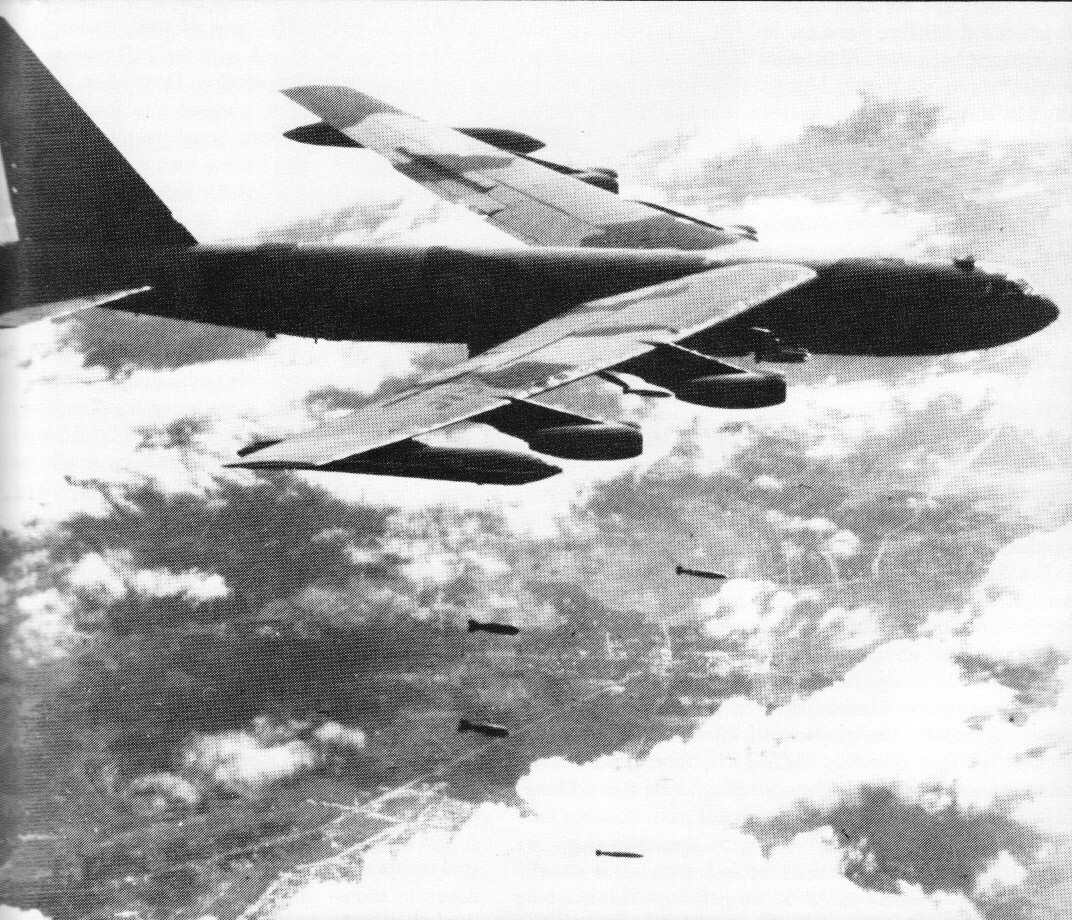
Boeing B-52 Stratofortress on bomb run
Date18–29 December 1972
Location
Result Both sides claim victory[2][3][4][5]
Belligerents

United States

North Vietnam

Commanders and leaders
John W. Vogt Jr.[6]
John C. Meyer[7]
Damon W. Cooper[8]
Lieutenant General Văn Tiến Dũng, Chief of General Staff
Major General Phùng Thế Tài,[citation needed] Deputy Chief of General Staff
Colonel Lê Văn Tri,[citation needed] Commander of the Air Defense – Air Force
Strength
197 to 207 strategic bombers B-52,[citation needed]
14 tactical air groups consisting of 1,077 aircraft of all types from 3 air bases and 6 aircraft carrier[9]
14 SA-2 batteries[10]
(266 SA-2 missiles were launched during the operation[10])
100+ aircraft[7] (including 31 MiG-21s and 16 MiG-17s fighters[11])
AA gun units
Casualties and losses

U.S. claim:[12]
12 tactical aircraft shot down
15 B-52s shot down
4 B-52s suffered heavy damage
5 B-52s suffered medium damage

43 killed in action
49 taken prisoner[13]
PAVN claim:
81 aircraft shot down
(including 34 B-52s and 5 F-111s;[14] this includes two B-52s shot down by MiG-21 fighters[15])
U.S. claim: 6 MiG-21s shot down (including 2 MiG-21s shot down by B-52 tail gunners)[7]
PAVN claim: 3 MiG-21s shot down[16]
1,624 civilians killed[17]

Operation Linebacker II, sometimes referred to as the Christmas bombings and, in Vietnam, Dien Bien Phu in the air,[a] was a strategic bombing campaign conducted by the United States against targets in North Vietnam from 18 December to 29 December 1972, during the Vietnam War. More than 20,000 tons of ordnance was dropped on military and industrial areas in Hanoi and Haiphong and at least 1,624 civilians were killed. The operation was the final major military operation carried out by the U.S. during the conflict, and the largest bombing campaign involving heavy bombers since World War II.

By late 1972, U.S. combat involvement in Vietnam had been dramatically reduced, and negotiations to end the war were underway in Paris. After secret meetings in October between lead negotiators Henry Kissinger and Le Duc Tho, an informal agreement was reached. The terms included a total U.S. withdrawal, North Vietnam's recognition of South Vietnam, new borders based on the present front lines, and new elections in the South, which would include the then-banned Communist Party of Vietnam. South Vietnamese president Nguyen Van Thieu, however, totally rejected these terms when he was informed about them and, following Richard Nixon's reelection in November, the U.S. submitted new terms, which included the Vietnamese Demilitarized Zone (DMZ) as the recognized national border, leading to a breakdown in negotiations on 16 December. Nixon issued an ultimatum for the North to return to negotiations within 72 hours, after which he ordered the bombing campaign on 18 December. Conducted by more than 200 B-52 bombers from Strategic Air Command supported by tactical planes of the Seventh Air Force and Task Force 77, the raids ran from 18 to 24 December and 26 to 29. The U.S. acknowledged the loss of 16 B-52 bombers, while North Vietnam claimed 34 bombers shot down.

The effect of the bombings on the peace negotiations is debated. On 22 December, Nixon asked the North to return to the talks with the terms offered in October and warned Thieu that he would sign the agreement even if Thieu did not. The North agreed, and Nixon ordered a halt to the bombings on 30 December. The North Vietnamese delegation stated that the campaign played no role in the decision to return to negotiations, while an aide to Kissinger remarked that "[w]e bombed the North Vietnamese into accepting our concessions". On 27 January 1973, the Paris Peace Accords were signed along the same terms as the initial October agreement.

Background

[edit]

"Peace is at hand"

[edit]

On 8 October 1972, U.S. National Security Advisor Henry Kissinger and North Vietnamese Politburo member Le Duc Tho met in Paris to discuss new proposals by both nations, hoping to reach mutually agreeable terms for a peace settlement for the nearly decade-old Vietnam War. Tho presented a new North Vietnamese plan which included proposals for a cease-fire, the withdrawal of American forces, and an exchange of prisoners of war. All three Vietnamese combatant governments—North Vietnam, the Republic of Vietnam (South Vietnam), and the Provisional Revolutionary Government of South Vietnam (PRG)—would remain intact, as would their separate armies. Hanoi no longer demanded that South Vietnamese president Nguyen Van Thieu be removed from office, the U.S. did not have to cease its aid to the southern government, and both Washington and Hanoi could continue to resupply their allies or forces on a parity basis. No new North Vietnamese forces were to be infiltrated from the north, and the U.S. agreed to extend post-war reconstruction assistance to North Vietnam.[citation needed]

The new terms on the table also included the establishment of a National Council of National Reconciliation and Concord, a loosely defined administrative structure which was to work toward general and local elections within South Vietnam. Political power would be shared by three groups: the Saigon government, the PRG, and a "third force" group to be mutually agreed upon by the other two parties. Since it was to work by consensus, nothing could be accomplished by the new council without the agreement of President Thieu.[18][19]

When the two sides convened again on 17 October, there were two main areas of disagreement: the periodic replacement of South Vietnam's American weaponry and the release of political prisoners held by the Saigon government.[20] The North Vietnamese had made significant modifications to their past negotiating position and were hurrying to get the agreement signed before November, believing that President Richard Nixon would be more willing to make concessions before, rather than after, the upcoming presidential election.[21] Although there were still some issues to be finalized, Kissinger was generally satisfied with the new terms and so notified Nixon, who gave his approval to the settlement.[22]

Kissinger then flew on to Saigon on the 18th to discuss the terms with Thieu. The South Vietnamese president was not happy with either the new agreement or with Kissinger, who he felt had betrayed him.[23] Although Kissinger knew Thieu's negotiating position, he had not informed him of the changes made in Paris nor had his approval been sought. Kissinger "had negotiated on behalf of the South Vietnamese government provisions that he, Thieu, had already rejected".[23] Thieu completely castigated the agreement and proposed 129 textual changes to the document. He went further, demanding that the Demilitarized Zone separating the two Vietnams be recognized as a true international border and not as a "provisional military demarcation line" (as had been stipulated in the Geneva Accords) and that South Vietnam be recognized as a sovereign state. The supreme irony, in the words of Stanley Karnow, had now arrived: "having fought a war to defend South Vietnam's independence, the United States was now denying its legitimacy."[24]

Thieu then went one step further on 26 October, and publicly released an altered version of the text that made the South Vietnamese provisions look even worse than they actually were.[25] The North Vietnamese leadership, believing that they had been deceived by Kissinger, responded by broadcasting portions of the agreement that gave the impression that the agreement conformed to Washington and Saigon's objectives.[26][27] Kissinger, hoping to both reassure the Communists of America's sincerity, and convince Thieu of the administration's dedication to a compromise, held a televised press conference at the White House during which he announced "[w]e believe that peace is at hand."[28]

On 20 November, the South Vietnamese revisions, and 44 additional changes demanded by Nixon, were presented to the North Vietnamese delegation by Kissinger.[28][29] These new demands included: that the DMZ be accepted as a true international boundary; that a token withdrawal of North Vietnamese troops take place; that the North Vietnamese guarantee an Indochina-wide cease fire; and that a strong international peace-keeping force (the ICCS) be created for supervising and enforcing the cease-fire.[29]

Once the North Vietnamese read the new demands, they began to retract their own concessions and wanted to bargain anew, leading Kissinger to proclaim that they were "stalling".[30] The talks, scheduled to last ten days, ended on 13 December, with both parties agreeing to resume negotiations.[30] Teams of experts from each side met to discuss technicalities and protocols on 14 December, during which time the North Vietnamese representatives submitted a Vietnamese-language text of the protocol on prisoners containing several important changes that Hanoi had failed to gain in the main negotiating sessions. At a subsequent meeting of experts on 16 December, the North Vietnamese side "stone-walled from beginning to end". The talks broke down that day, and the Hanoi negotiators refused to set a date for the resumption of negotiations.[31]

Prelude

[edit]

Decisions

[edit]

Nixon was now working against a January deadline. Kissinger's "peace is at hand" statement had raised expectations of a settlement among the US population. Even weightier on the President's mind was the fact that the new 93rd Congress would go into session on 3 January, and the President feared that the heavily Democratic legislative branch would preempt his pledge of "peace with honor" by legislating an end to the war.[32]

Also prompting the President toward some form of rapid offensive action was the cost of the force mobilization that had accompanied Operation Linebacker. The additional aircraft and personnel assigned to Southeast Asia for the operation was straining the Pentagon's budget. The cost of maintaining this "augmentation force" totaled over $4 billion by mid-autumn and Secretary of Defense Melvin Laird insisted that the President request a supplementary defense appropriation from Congress to pay for it.[32] Nixon and Kissinger were convinced that the legislative branch "would seize the opportunity to simply write the United States out of the war".[33]

After returning from Paris on 14 December, and after consultations with Nixon, Kissinger fired off an ultimatum to Hanoi, threatening "grave consequences" if North Vietnam did not return to the negotiating table within 72 hours.[34][35] On that day, Nixon ordered the reseeding of North Vietnamese ports with air-dropped naval mines and that the Joint Chiefs of Staff direct the Air Force to begin planning for a bombing campaign (a three-day "maximum effort" operation) which was to begin within 72 hours.[36] Two days after the 16 December deadline had passed, the U.S. bombed Hanoi. Senior Air Force officers James R. McCarthy and George B. Allison stated years later that the operation had been mainly politically driven, as a negotiation tool to "bring the point home".[37]

Many historians of the Vietnam War follow the lead of President Nixon, who claimed that Hanoi's representatives had walked out of the talks, refusing to continue the negotiations.[38] Both sides had proclaimed their willingness to continue the talks; however, Hanoi's negotiators refused to set a date, preferring to wait for the incoming Congress.[31] The goal of President Nixon was not to convince Hanoi, but to convince Saigon. President Thieu had to be assured that "whatever the formal wording of the cease-fire agreement, he could count on Nixon to come to the defense of South Vietnam if the North broke the cease-fire."[39]

Planning

[edit]
B-52 bombing crews at Andersen Air Force Base, Guam being briefed on the operation.

In the wake of Operation Linebacker, the U.S. had a force of 207 B-52 bombers available for use in Southeast Asia.[40] A total of 54 bombers (all B-52Ds) were based at U-Tapao RTAFB in Thailand, while 153 were based at Andersen Air Force Base in Guam (55 B-52Ds and 98 B-52Gs). This deployment comprised nearly half of the Air Force's manned bomber fleet, and Strategic Air Command (SAC) commanders were initially reluctant to risk the expensive aircraft and their highly trained crews in such an operation; the production line for B-52s had long since been shut down, and losses could not be replaced.[41][42] The use of large numbers of B-52s was unprecedented in the war and the proposed mass attacks on targets within 10 nautical miles (20 km) of Hanoi "represented a dynamic change in the employment of air resources".[43]

The new operation, given the title Linebacker II, was marked by top-down planning by the SAC headquarters at Offutt AFB. Due to the restrictive time frame imposed by President Nixon (only three days) and the experience of Linebacker (in which North Vietnamese fighter aircraft had posed the highest threat to the bombers), SAC's plan called for all of the bombers to approach Hanoi at night in three waves, each using identical approach paths and flying at the same altitude.[44]

Once the aircraft had dropped their bombs, they were to execute what SAC termed "post-target turns" (PTT) to the west. These turns had two unfortunate consequences for the bombers: the B-52s would be turning into a strong headwind, slowing their ground speed by 100 kn (120 mph; 190 km/h) and prolonging their stay in the target area and the PTT would point the emitter antennas of their Electronic Warfare (EW) systems away from the radars they were attempting to jam, degrading the effectiveness of the cells, as well as showing the largest radar cross-section to the missile guidance radars.[45] The aircraft employed had significantly different EW capabilities; the B-52G carried fewer jammers and put out appreciably less power than the B-52Ds but had more efficient engines and larger fuel tanks, hence they were assigned to longer range mission routes.[46]

Vietnamese air defense

[edit]

At the start of Linebacker II, the air defense missile forces of the Vietnamese People's Army had 36 air defense missile battalions armed with the S-75M Dvina (SA-2 Guideline) missile system; probably half were involved in this operation.[47] The SA-2 system was first fielded in 1957 and was a fairly obsolete and cumbersome system by 1972 standards.[48] The VPAF had only 71 operational aircraft. Of these, only 47 aircraft (31 MiG-21s and 16 MiG-17s) could be used for air combat. The MiG-19s were made in China and were not used in combat. Only 13 MiG-21 pilots and five MiG-17 pilots were trained for individual night flight in normal and flying in difficult meteorological conditions. Of 194 pilots, 75 (about 40 percent) were young.[clarification needed][11]

Bombings

[edit]

Initial phase

[edit]

The first three missions of the operation were flown as planned by SAC on three consecutive nights beginning on 18 December 1972. On the first night 129 bombers took off, 87 of them from Guam.[37][49] 39 support aircraft of the Seventh Air Force, the Navy's Task Force 77 and the Marine Corps supported the bombers by providing F-4 Phantom fighter escorts, Republic F-105 Thunderchief Wild Weasel SAM-suppression missions, Air Force Douglas EB-66 Destroyer and Navy Grumman EA-6 Prowler radar-jamming aircraft, chaff drops, KC-135 refueling aircraft and search and rescue aircraft; the skies were dominated by American airpower to ensure the safety of the aircraft involved in the operation.[50] One B-52 bomber pilot flying out of Guam recalled: "We took off one airplane a minute out of Guam for hours. Just on time takeoff after on time takeoff."[51]

North Vietnamese anti-aircraft weapons

The targets of the first wave of bombers were the North Vietnamese airfields at Kép, Phúc Yên and Hòa Lạc and a warehouse complex at Yên Viên while the second and third waves struck targets around Hanoi. Three B-52's were shot down by the 68 surface-to-air missiles (SAMs) launched by North Vietnamese batteries, two B-52Gs from Andersen and a B-52D from U-Tapao.[52][53] Two of the B-52's were shot down over North Vietnam, while the third aircraft made it back to Thailand before crashing [54] Two D models from Andersen with heavy battle damage managed to limp into U-Tapao for repairs.[55] Of the three downed B-52's, parts of two crews were captured after bailing out over North Vietnam, while the third crew were all rescued in Thailand [56] That same evening, an Air Force F-111 Aardvark was shot down while on a mission to bomb the broadcasting facilities of Radio Hanoi.[7] Unlike Linebacker, which had been launched in response to a North Vietnamese offensive in South Vietnam, President Nixon did not address the nation on television to explain the escalation. Instead, Kissinger held a press conference at which he accused (at Nixon's behest) Le Duc Tho of having "backed off" on some of the October understandings.[57]

On the second night, 93 sorties were flown by the bombers. Their targets included the Kinh No Railroad and storage area, the Thái Nguyên thermal power plant, and the Yên Viên complex. Although 20 SAMs were launched and a number of the bombers were damaged, none were lost on the mission.[52] SAC expected that the third (and supposedly last) night of the operation would proceed just as well as the previous one.[citation needed] The targets of the 99 bombers sent in on 20 December included the Yên Viên railyards, the Ai Mo warehouse complex, the Thái Nguyên power plant, a transshipment point at Bắc Giang, the Kinh No Railroad complex and the Hanoi petroleum products storage area—all in or near Hanoi. The combination of repetitive tactics, degraded EW systems and limited jamming capability led to dire consequences when, as the official Air Force history of the campaign has stated, "all hell broke loose."[58]

The repetitious nature of the previous evening's strike profiles had allowed North Vietnamese air defense forces to anticipate strike patterns and to salvo 34 missiles into the target area.[52] Four B-52Gs and three B-52Ds were lost in the first and third waves of the mission.[52] A fourth D model, returning to Thailand, crashed in Laos. Only two of the eight downed crews were recovered by search and rescue aircraft.[53] The repercussions from the mission were fast and furious. SAC headquarters was under pressure from "many external sources" to "stop the carnage ... it has become a blood bath".[59] Of more concern was the position taken by a number of senior Air Force officers that they "would lose too many bombers and that airpower doctrine would be proven fallacious ... or, if the bombing were stopped, the same thing would occur".[59]

The main problem seemed to lie within the headquarters of SAC, which had based its tactics on a MiG threat that had not materialized during the three missions. The tactics (flight paths, altitudes, formations, timing, etc.) had not varied. The Air Force explanation for this course of events was that the similarity would be helpful to the B-52 crews, who were inexperienced in flying in such high-threat environments.[60] Air Force historian Earl Tilford offered a differing opinion: "Years of dropping bombs on undefended jungle and the routines of planning for nuclear war had fostered a mind-set within the SAC command that nearly led to disaster ... Poor tactics and a good dose of overconfidence combined to make the first few nights of Linebacker nightmarish for the B-52 crews."[61] During the operation the USAF depended almost entirely on the Ryan Model 147 Buffalo Hunter AQM-34L/M unmanned aerial vehicles for bomb damage assessment due to bad weather.[62]

Re-evaluation

[edit]
A B-52G lands at Andersen AFB after a mission on 15 December 1972.

It was at this point that President Nixon ordered that the effort be extended past its original three-day deadline. The first change that could be made by local Air Force commanders was divulged by a comparison of the differences between the radar jamming equipment of the B-52 models. The equipment aboard the G models was designed for use in the more sophisticated air defense environment of the Soviet Union, not against the more antiquated SA-2 and Fan Song radar systems used by the North Vietnamese.[63] SAC headquarters stipulated that only the aircraft stationed at U-Tapao (equipped with more powerful and sophisticated ECM gear) be allowed over the North.[64] On the fourth night (21 December) of the operation, 30 of the U-Tapao bombers struck the Hanoi storage area, the Văn Điển storage depot, and Quang Te Airfield. Two more of the D models were lost to Surface to Air Missiles (SAMs). On the following night, the target area shifted away from Hanoi to the port city of Haiphong and its petroleum storage areas. Once again, 30 aircraft participated in the strikes, but this time there were no losses among the bombers. An F-111 was shot down over the Kinh No Railroad complex.[65]

Bach Mai Airfield bomb damage assessment 21 December 1972

On the 22nd, over 100 bombs from a B-52 hit the Bach Mai Hospital in the southern suburbs of Hanoi, obliterating the building and killing 28 doctors, nurses and pharmacists and wounding 22, despite most taking refuge in the hospital's basement.[66] Almost the entire hospital was destroyed, including the operating rooms and pharmacy stock.[67] The US military claimed that the hospital "frequently housed anti-aircraft positions."[68] According to the director of the hospital, Đỗ Doãn Đại, the US bombing served to break the morale of hospital staff and Hanoians.[66]

The civilian deaths were criticized by the North Vietnamese and U.S. peace activists. The hospital sat 1 kilometer from the runway of Bach Mai Airfield and a major fuel storage facility was only 180 metres (200 yd) away.[69] Two days before Christmas, SAC added SAM sites and airfields to the target list. Air Force F-111s were sent in before the bombers to strike the airfields and reduce the threat of enemy fighters. The F-111s proved so successful in these operations that their mission for the rest of the campaign was shifted to SAM site suppression.[70]

The bomber missions of the sixth night (23 December) again avoided Hanoi and hit SAM sites northeast of the city and the Lang Dang Railroad yards.[71] There were no losses. On the following night, the run of American good luck (and avoidance of Hanoi) continued. Thirty bombers, supported by 69 tactical aircraft, struck the railyards at Thái Nguyên and Kép and no American aircraft were lost during the mission.[72] Although the B-52s got most of the publicity during the campaign, the tactical aircraft were also hard at work. While the B-52s and F-111s attacked by night, an average of 69 tactical aircraft of the Air Force, Navy and Marines attacked by day (averaging nearly 100 sorties per day).[70] Losses for these aircraft were extremely light, with fewer than a dozen lost during the entire campaign.[65] It was not difficult for their crews to deduce why. The North Vietnamese air defense forces "simply waited for nightfall and the arrival of more lucrative targets."[70]

Final phase

[edit]

The strikes of 24 December were followed by a 36-hour Christmas stand-down, during which Air Force planners went to work to revise their plans for the next phase of operations. Due to aircraft losses during the initial phase, they intended to launch an all-out attack on North Vietnam's air defenses when the operation resumed. This course was also necessary since, by Christmas, most of the strategic targets within North Vietnam were in shambles.[73] SAC also belatedly turned over tactical mission planning to its subordinate Eighth Air Force headquarters on Guam, which promptly revised the tactics. Instead of using waves, all of the bombers would be in and out of the target area within 20 minutes and they would approach from different directions and at different altitudes. They would exit by varying routes and the steep PTTs were eliminated.[74] Ten targets, in the Hanoi and Haiphong areas were to be struck by bombers approaching in seven streams, four of which were to come in off the Gulf of Tonkin.[75]

On 26 December 120 bombers lifted off to strike Thái Nguyên, the Kinh No complex, the Duc Noi, Hanoi, and Haiphong Railroads and a vehicle storage area at Văn Điển. 78 of the bombers took off from Andersen AFB in one time block, the largest single combat launch in SAC history, while 42 others came in from Thailand.[76] The bombers were supported by 113 tactical aircraft which provided chaff corridors, escort fighters, Wild Weasel SAM suppression and electronic countermeasures support.[77] The North Vietnamese air defense system was overwhelmed by the number of aircraft it had to track in such a short time and by a dense blanket of chaff laid down by the fighter-bombers.[78] 250 SAMs had been fired from 18 until 24 December and the strain on the remaining North Vietnamese inventory showed, since only 68 were fired during the mission.[52][b] One B-52 was shot down near Hanoi and another damaged aircraft made it back to U-Tapao, where it crashed just short of the runway. Only two members of the crew survived.[80]

On the following night, 60 bombers flew, with some attacking SAM sites while others struck Lang Dang, Duc Noi, the Trung Quang Railroad and Văn Điển. One B-52 was so heavily damaged that its crew ejected over Laos, where it was rescued. A second aircraft was not so lucky. It took a direct hit and went down while attacking the Trung Quang Railroad yards.[81] During the evening's operations two F-4s and an HH-53 search and rescue helicopter were also shot down.[65] Day ten (28 December) called for strikes by 60 B-52s–15 Gs and 15 Ds from Andersen and 30 Ds from U-Tapao, The aircraft formed six waves attacking five targets. Four of the waves struck targets in the Hanoi area (including SAM Support Facility #58), while the fifth hit the Lang Dang Railroad yards southwest of Lạng Sơn, a major choke-point on the supply route from the People's Republic of China. No aircraft were lost on the mission.[80] By the eleventh day (29 December), there were few strategic targets worthy of mention left within North Vietnam. There were two SAM storage areas at Phúc Yên and the Lang Dang yards that could be profitably attacked.[82] A total of 60 aircraft again made the trip North but the mix was altered; U-Tapao again provided 30 D models but the Andersen force was varied, putting 12 G models and 18 Ds over the North. Total bombing was rounded out by sending 30 G models on Arc Light missions in the southern panhandle of North Vietnam and in South Vietnam.[82]

Aftermath

[edit]

Negotiating

[edit]

On 22 December, Washington asked Hanoi to return to the talks with the terms offered in October.[83] On 26 December, Hanoi notified Washington that it was willing to "impress upon Nixon that the bombing was not the reason for this decision, the CPV Politburo told Nixon that halting the bombing was not a precondition for further talks".[84] Nixon replied that he wanted the technical discussions to resume on 2 January and that he would halt the bombing if Hanoi agreed. They did so and Nixon suspended aerial operations north of the 20th parallel on 30 December. He then informed Kissinger to agree to the terms offered in October, if that was what it took to get the agreement signed.[85] Senator Henry Jackson (D, Wash.), tried to persuade Nixon to make a televised address to explain to the American people that "we bombed them in order to get them back to the table."[86] It would have been extremely difficult to get informed observers in the U.S. to believe that he "had bombed Hanoi in order to force North Vietnamese acceptance of terms they had already agreed to".[86]

Now the only stumbling block on the road to an agreement was President Thieu. Nixon tried to placate him by writing on 5 January that "you have my assurance of continued assistance in the post-settlement period and that we will respond with full force should the settlement be violated by North Vietnam."[87][88] By this time, due to congressional opposition, Nixon was in no position to make such a promise, since the possibility of obtaining the requisite congressional appropriations was nil.[89] The South Vietnamese president still refused to agree. On 14 January, Nixon made his most serious threat: "I have therefore irrevocably decided to proceed to initial the agreement on 23 January 1973 ... I will do so, if necessary, alone".[90][91]

On 9 January, Kissinger and Le Duc Tho returned to Paris. The agreement struck between the U.S. and North Vietnam was basically the same one that had been reached in October. The additional demands that had been made by the U.S. in December were generally discarded or went against the U.S. John Negroponte, one of Kissinger's aides during the negotiations, was more caustic: "[w]e bombed the North Vietnamese into accepting our concessions."[92] The DMZ was defined as provided for in the Geneva Accords of 1954, and would in no way be recognized as an international boundary. The demanded withdrawal of North Vietnamese troops from South Vietnam was not mentioned at all in the text of the agreement. Kissinger did obtain a "verbal agreement" from Tho for a token withdrawal of 30,000 North Vietnamese troops.[93]

The demand for an inclusive, Indochina-wide cease-fire was simply discarded in the written agreement. Once again, Kissinger had to be satisfied with a "verbal understanding" that a cease-fire would be instituted in Laos simultaneous with or shortly following that in South Vietnam.[94] An agreement on Cambodia (where the North Vietnamese had no influence over the Khmer Rouge) was out of the question. The size of the ICCS was finally decided by splitting the difference in the number demanded by both parties at 1,160 personnel.[95] The Paris Peace Accords were signed at the Majestic Hotel in Paris on 27 January 1973.[96]

Outcome and assessments

[edit]

Military

[edit]
B-52 wreckage left as a historical attraction in Hanoi as of 2022

During Operation Linebacker II, 741 B-52 sorties were dispatched to bomb North Vietnam; 729 completed their missions.[97] B-52s dropped 15,237 tons of ordnance on 18 industrial and 14 military targets (including eight SAM sites) while fighter-bombers added another 5,000 tons of bombs to the tally.[97] Another 212 B-52 missions were flown within South Vietnam in support of ground operations during the campaign.[98] Ten B-52s were shot down over the North and five others were damaged and crashed in Laos or Thailand. Thirty-three B-52 crew members were killed or missing in action, another 33 became prisoners of war, and 26 more were rescued.[99]

Over 11 days, North Vietnamese air defenses fired 266 SA-2 missiles downing—according to North Vietnam—34 B-52s and four F-111s.[10][14] While warding off the massive strike by U.S strategic, tactical and carrier aviation, the North Vietnamese missile air defense forces conducted over 180 engagements, two-thirds of which were against B-52s. North Vietnamese claims of aircraft destroyed or shot down differ greatly from US official records. In Marshall Michel's 2002 book The 11 Days of Christmas: America's Last Vietnam Battle, the author uses mission records to confirm that "15 B-52s were shot down ... 10 crashed 'on the spot' in North Vietnam and 5 were able to move out of the Hanoi area and into Laos or Thailand before they crashed".[100] North Vietnam claimed 36 aircraft destroyed (31 B-52s and 5 tactical aircraft) with the expenditure of 244 missiles against the B-52s and 22 missiles against tactical aircraft, or 7.9 missiles for every B-52 aircraft shot down, or 4.4 missiles for every tactical aircraft shot down. During the offensive, they initially overcame various types of interference and obstacles employed by the U.S aircraft to interrupt missile engagement.[101] In the latter stages of the bombing campaign, due to a change in tactics, B-52 losses decreased significantly. By the last night of the campaign, no losses were reported. During the 11 days of Operation Linebacker, the B-52s flew 795 sorties with a loss rate of 2.63 percent (15 were shot down and five others were heavily damaged)[100]

The Air Force flew 769 sorties and 505 were flown by the Navy and Marine Corps in support of the bombers.[97] Twelve of these aircraft were lost on the missions (two F-111s, three F-4s, two A-7s, two A-6s, an EB-66, an HH-53 rescue helicopter and an RA-5C reconnaissance aircraft).[65] During these operations, ten American aviators were killed, eight captured and 11 rescued.[102] US Air Force losses included fifteen B-52s, two F-4s, two F-111s, one EB-66 and one HH-53 search-and-rescue helicopter. Navy losses included two A-7s, two A-6s, one RA-5 and one F-4. Seventeen of these losses were attributed to SA-2 missiles, three to daytime MiG attacks, three to antiaircraft artillery and four to unknown causes. U.S. forces claimed eight MiGs were shot down during the operation, including two by B-52 tail gunners.[103][104] The two B-52 tail gunner kills were not confirmed by VPAF, and they admitted to the loss of only three MiGs.[105]

According to Dana Drenkowski and Lester W. Grau, the number of aircraft lost by the USAF is unconfirmed since the USAF figures are also suspect. If a plane was badly damaged but managed to land, the USAF did not count as a loss, even if it was a write-off. During the operation, the USAF told the press that 17 B-52s were lost but later, the USAF told Congress that only 13 B-52s were lost. Nine B-52s that returned to U-Tapao airfield were too badly damaged to fly again. The number of B-52s that managed to return to Guam but were combat losses remains unknown. The overall B-52 loss is probably between 22 and 27.[106]

During this operation, the VPAF launched 31 air sorties of which 27 were flown by MiG-21s and four were flown by MiG-17s. They conducted eight aerial engagements and claimed two B-52s, four F-4s and one RA-5C shot down. Their losses were three MiG-21s.[11] Two B-52s were claimed by North Vietnamese MiG-21 fighter pilots; both incidents were attributed to SAMs by the U.S.[15] The raids inflicted severe damage to North Vietnam's infrastructure. The Air Force estimated the bombs caused 500 rail interdictions, destroyed 372 pieces of rolling stock and 11,000 cubic meters (3 million U.S. gallons) of petroleum products and eliminated 80 percent of North Vietnam's electrical power production capability. Logistical imports into North Vietnam, assessed by U.S. intelligence at 160,000 tons per month when the operation began, had dropped by January 1973, to 30,000 tons per month.[107] Lê Duẩn later admitted that the bombing "completely obliterated our economic foundation."[108] Despite the damage, an enormous effort was made to keep transportation networks open. Some 500,000 workers were mobilized to repair bomb damage as needed, with an additional 100,000 constantly at work.[109] The raids did not break the stalemate in the South, nor halt the flow of supplies down the Ho Chi Minh trail.[110]

Casualties

[edit]
Khâm Thiên Memorial

According to official North Vietnamese sources the bombing campaign killed 1,624 civilians, including 306 in Haiphong and 1,328 in Hanoi.[17] The book "Hanoi – The aerial Dien Bien Phu" from the "People's Army Publishing House" gives a death toll of 2,368 civilians killed and 1,355 others injured. The book states that a number of neighborhoods and villages were destroyed, 5,480 houses and nearly 100 other buildings including factories, schools, hospitals, and stations were destroyed.[111] By 20 December 1972, there were 215 dead and 325 injured in Hanoi. In Hai Phong alone on 18 December, 45 people were killed, 131 people were injured. Kham Thien Street, Hanoi was attacked on the night of 26 December 1972, killing 278 people, including 91 women, 40 old people, and 55 children. 178 children were orphaned in Kham Thien Street and 290 people were injured, 2,000 houses, schools, temples, theaters, and clinics collapsed, of which 534 houses were completely destroyed.[111]

House 51 on Kham Thien Street was completely blown into a crater and the seven people living there were killed. This area has been converted into a memorial with a stele bearing the words "Khâm Thiên deeply holds the hatred of the American enemy" and a bronze statue of a woman holding a child who died from an American bomb was based on the owner of the destroyed house. On the anniversary of the bombing each year, people living on the street and other places come to the memorial to burn incense sticks to commemorate those who died from American airstrikes. In the courtyard of Bạch Mai Hospital, there is a stele bearing the word "Hatred" to remember the bombing of the hospital on 22 December, which killed 1 patient and 30 nurses and doctors. At the time of the bombing, most doctors and patients had already been evacuated. Each department had only a few people on duty and approximately 300 patients had taken cover in the basement.[112]

Diplomatic

[edit]

The North Vietnamese government reported that the U.S. had "carpet-bombed hospitals, schools, and residential areas, committing barbarous crimes against our people", citing the bombing of Bach Mai Hospital on 22 December and Kham Thien street on 26 December which they claimed had killed 278, wounded 290 and destroyed more than 2,000 homes.[113][114]

Both the Soviet Union and China denounced the bombing, while some Western countries also criticized the US operation. In a famous speech, Olof Palme, the Prime Minister of Sweden, compared the bombings to a number of historical crimes including the bombing of Guernica, the massacres of Oradour-sur-glane, Babi Yar, Katyn, Lidice and Sharpeville and the extermination of Jews and other groups at Treblinka. He said that "now another name can be added to this list: Hanoi, Christmas 1972". In response to his protests, the U.S. withdrew their ambassador from Sweden, and told Stockholm not to send a new ambassador to Washington.[115][116]

The new Prime Minister of Australia, Gough Whitlam, whose country had pushed America to expand the war[clarification needed], angered the Nixon administration by criticizing the bombings in a letter to the U.S. President, chilling United States–Australia relations until Whitlam's dismissal in 1975.[117] In the U.S., Nixon was criticized as a "madman", and some of the people who supported Operation Linebacker I[who?] questioned the necessity and unusual intensity of Operation Linebacker II.[118] Newspaper headlines included: "Genocide", "Stone-Age Barbarism" and "Savage and Senseless".[119] The USAF Strategic Air Command (SAC) made some serious mistakes, suffered serious losses and their campaign came close to failure, yet after the war they launched a massive media and public relations blitz (and internal witch hunt) to prove that Linebacker II was an unqualified success that unfolded as planned.[120] US officials claimed that the operation had succeeded in forcing North Vietnam's Politburo to return to negotiating, citing the Paris Peace Accords signed shortly after the operation. Much of the American public had the impression that North Vietnam had been "bombed into submission".[119]

In Paris, the North Vietnamese refused to change the terms they had agreed to in the October 1972 agreement. When South Vietnam's President Nguyen Van Thieu objected to the terms, Nixon threatened to depose him like Ngo Dinh Diem.[121] In January 1973, the U.S. signed the agreement as the Paris Peace Accords. The main effect of the accord was to usher the United States out of the war.[122]

Journalist Bob Woodward later wrote that Richard Nixon thought, prior to Operation Linebacker II, that previous bombing campaigns against North Vietnam had achieved "zilch". Woodward wrote that in early 1972 Nixon wrote a note to National Security Adviser Henry Kissinger, which said there was "something wrong" with the way the strategy was being carried out. Other notes, written at the same time, show that Nixon was frustrated with the resistance of the North Vietnamese and wanted to punish them, in an effort to "go for broke".[123]

Some historians believed that Hanoi was not in need of any settlement, and only agreed to do so to get the United States out of Vietnam. The historian Gareth Porter wrote that Hanoi's objective was an agreement on the October terms, and that "the bombing of Hanoi and Haiphong forced Nixon and Kissinger to accept the terms they had earlier rejected." However, according to Pierre Asselin, had the bombing been a failure, as Hanoi said it was, the North Vietnamese leadership would never have agreed to Nixon's request to talk. Hanoi agreed to resume talks only because the bombing had crippled their country. Additionally, the bombing paved the way for the finalization of an agreement, thus ending American intervention on terms acceptable to the Nixon administration.[124][125] Nevertheless, the terms were also favorable to North Vietnam.[126]

American historian A.J. Langguth wrote the Christmas bombings were "pointless" as the final peace agreement of 23 January 1973 was essentially the same as that of 8 October 1972, as Thọ refused to make any substantial concessions.[127] John Negroponte, in the 2017 documentary The Vietnam War, was disdainful of the attack's value, stating "[w]e bombed them into accepting our concessions."[122]

U.S. aircraft lost

[edit]
Date Type Service Cause
18 Dec. F-111A USAF unk.
B-52G USAF SA-2
B-52G USAF SA-2
B-52D USAF SA-2
A-7C USN SA-2
20 Dec. B-52D USAF SA-2
B-52G USAF SA-2
B-52G USAF SA-2
B-52D USAF SA-2
B-52G USAF SA-2
B-52G USAF SA-2
A-6A USN SA-2
21 Dec. B-52D USAF SA-2
B-52D USAF SA-2
A-6A USN SA-2
22 Dec. F-111A USAF AAA
23 Dec. EB-66E USAF engine out
A-7E USN SA-2
F-4J USN SA-2
26 Dec. B-52D USAF SA-2
B-52D USAF SA-2
27 Dec. F-4E USAF MiG-21
F-4E USAF MiG-21
HH-53 USAF small arms
B-52D USAF SA-2
B-52D USAF SA-2
28 Dec. RA-5C USN MiG-21

U.S. air order of battle

[edit]
United States Air Force – Eighth Air Force (Strategic Air Command)[128]
Wing Station Aircraft
43d Strategic Wing Andersen AFB, Guam B-52D
72d Strategic Wing (Provisional) Andersen AFB, Guam B-52G
307th Strategic Wing U Tapao RTAFB, Thailand B-52D
United States Air Force – Seventh Air Force (Pacific Command)[citation needed]
Wing Station Aircraft
8th Tactical Fighter Wing Ubon RTAFB, Thailand F-4
354th Tactical Fighter Wing Korat RTAFB, Thailand A-7
388th Tactical Fighter Wing Korat RTAFB, Thailand F-4, F-105G
432d Tactical Reconnaissance Wing Udorn RTAFB, Thailand F-4, RF-4
474th Tactical Fighter Wing Takhli RTAFB, Thailand F-111

† additionally, two squadrons from the 4th TFW at Seymour Johnson AFB, North Carolina, and one squadron from 33d TFW at Eglin AFB, Florida
‡ additionally, two squadrons from 366th TFW after its departure from Da Nang AB, RVN

United States Navy – Task Force 77 (Pacific Command)[citation needed]
Air Wing Ship Aircraft
Carrier Air Wing 8 USS America (CVA-66) F-4, A-6, A-7
Carrier Air Wing 14 USS Enterprise (CVAN-65) F-4, A-6, A-7
Carrier Air Wing 5 USS Midway (CVA-41) F-4, A-6, A-7
Carrier Air Wing 19 USS Oriskany (CVA-34) F-8, A-7
Carrier Air Wing 2 USS Ranger (CVA-61) F-4, A-6, A-7
Carrier Air Wing 3 USS Saratoga (CVA-60) F-4, A-6, A-7

See also

[edit]

Notes

[edit]

Bibliography

[edit]
[edit]
Revisions and contributorsEdit on WikipediaRead on Wikipedia
from Grokipedia
Operation Linebacker II was a sustained campaign carried out by air forces against the Democratic Republic of Vietnam () from December 18 to 29, 1972, consisting of intensive B-52 Stratofortress raids supplemented by tactical fighter-bomber strikes on infrastructure, air defenses, and logistics targets concentrated around and . Initiated by President after walked out of peace negotiations and launched offensives against , the operation sought to dismantle ’s war-sustaining capabilities, including sites, anti-aircraft batteries, rail yards, power plants, and bridges, while compelling the North Vietnamese leadership to return to the bargaining table on terms favorable to ending direct U.S. involvement. Involving approximately 12,000 U.S. airmen across 729 B-52 sorties from bases in and , the campaign delivered over 15,000 tons of bombs in 11 days—exceeding the tonnage of prior sustained air efforts against the North—severely degrading ’s air defense network and industrial base despite fierce resistance from Soviet-supplied defenses that downed 15 B-52s and damaged dozens more. authorities claimed around 1,600 civilian fatalities from the strikes, figures echoed in some post-war analyses but contested by U.S. reviews emphasizing precision targeting of dual-use and sites with designed to limit noncombatant harm, though unavoidable proximity of defenses to populated areas contributed to collateral losses. The operation's defining impact lay in its coercive success: facing unsustainable attrition and infrastructure collapse, capitulated, resuming talks and agreeing to the on January 27, 1973, which enabled the phased U.S. troop withdrawal and a temporary , though the accords' long-term fragility highlighted limits of in enforcing political outcomes absent ground commitments.

Background

Political Stalemate in Paris Talks

The secret negotiations in Paris between U.S. National Security Advisor and North Vietnamese Politburo member Le Duc Tho had produced a draft agreement by early October 1972, encompassing ceasefire terms, prisoner exchanges, and political provisions for . However, on October 22, 1972, South Vietnamese President Nguyen Van Thieu rejected the draft, objecting to its failure to mandate withdrawal of an estimated 140,000 to 300,000 North Vietnamese troops from and its allowance for the Provisional Revolutionary Government (PRG)—the political arm of the —to participate in a National Council of Reconciliation and Concordance without prior dissolution or subordination to Saigon's authority. Thieu characterized the terms as enabling a communist takeover through political means, preserving Hanoi's military presence while legitimizing insurgent forces. Hanoi responded to Thieu's opposition by exploiting the division, refusing to accept the October framework and demanding revisions that intensified pressure on Saigon, including the immediate resignation of Thieu, unrestricted release of all political prisoners held by South Vietnam (many affiliated with the PRG), and establishment of a Provisional Government of National Concord with supervisory authority over ceasefire implementation—effectively a coalition tilting toward communist dominance. North Vietnam rejected discussions on troop withdrawals, offering only vague "understandings" for relocation rather than verifiable commitments, and opposed continued U.S. military aid to South Vietnam post-ceasefire. Kissinger, balancing U.S. goals of preserving South Vietnamese sovereignty with Nixon's electoral mandate for "peace with honor," conveyed these concerns in a November 25, 1972, message from President Nixon emphasizing adherence to the original agreement with limited improvements. Kissinger's follow-up meetings with Tho, from November 20 to 23 at , involved presenting 69 specific amendments requested by Thieu to safeguard against these risks, but ended in stalemate as demonstrated "absolutely no substantive give" and reverted to maximalist positions, declining to set a date for further talks. Subsequent sessions in early December similarly gridlocked over political structures—U.S. proposals for elections within Saigon's framework clashed with 's insistence on a and segmented governance—and foreign policy neutrality clauses that would constrain U.S. support for Saigon. A six-hour meeting on December 13, 1972, formalized the impasse, with Tho refusing concessions amid 's broader strategy of leveraging U.S. domestic pressures for war termination without yielding on core objectives of unifying under communist control. This deadlock, rooted in North Vietnam's intransigence following Thieu's veto and Hanoi's calculation that U.S. resolve would falter post-election, prompted Nixon to issue a 72-hour on December 14 for resumption of serious negotiations, culminating in the suspension of talks and authorization of escalated military pressure to break the impasse.

North Vietnamese Intransigence Post-Election

Following President Richard Nixon's re-election on November 7, 1972, U.S. negotiator resumed secret talks with North Vietnamese counterpart Le Duc Tho in on November 20, presenting 69 modifications to the draft agreement from October 1972, primarily to address South Vietnamese President Nguyen Van Thieu's objections regarding political clauses that risked undermining the Republic of Vietnam's government. North Vietnamese leaders, guided by a directive issued on November 22, viewed these proposals as an attempt to renegotiate the entire accord and instructed Tho to "concentrate on arguing hard to defeat the American plan to change the content of the Agreement." This stance reflected Hanoi's strategic calculation to preserve terms favoring the Provisional Revolutionary Government (the political arm), including delineation of controlled areas in , exclusion of any North Vietnamese troop withdrawals from the South, and provisions for "" via a National Council of Reconciliation that would facilitate a dominated by communist elements. Tho's responses during the November sessions were noncommittal on key issues like troop withdrawals and hardened progressively, accepting only minor textual adjustments while rejecting substantive changes to political and prisoner-of-war provisions, which U.S. diplomats described as rigid and uncompromising. By December 4, negotiations neared collapse as Tho explicitly refused all U.S.-proposed alterations, insisting on adherence to the unaltered draft, which demanded complete U.S. military withdrawal within approximately four months alongside mechanisms to isolate and eventually oust Thieu. North Vietnamese intransigence stemmed from a belief that post-election U.S. domestic pressures and Thieu's vulnerability would force concessions, coupled with Hanoi's unwillingness to yield on core demands like retaining southern infiltration routes and political leverage, as evidenced by their dismissal of withdrawal proposals as violations of principle. The deadlock culminated on December 13, 1972, when public plenary sessions in stalled over unresolved disputes on the and troop issues, prompting the North Vietnamese delegation to effectively halt talks by refusing further engagement without U.S. capitulation to their terms. This unyielding position, characterized by diplomats as "absolutely intransigent" and preconditioned on Thieu's overthrow, directly precipitated the U.S. decision to initiate military pressure via Operation Linebacker II, as showed no intent to compromise despite the impending holiday season and potential for renewed U.S. resolve under the re-elected Nixon administration.

US Domestic and Military Pressures

In late 1972, the United States grappled with mounting domestic fatigue from the Vietnam War, characterized by declining public support and intensified congressional scrutiny. Public opinion polls indicated that by November 1972, only about 30% of Americans supported continued US involvement, reflecting years of anti-war demonstrations and media coverage of high casualties, which had peaked at over 58,000 US deaths by that point. This war weariness pressured President Nixon to accelerate withdrawal under Vietnamization, which had already reduced US ground forces to approximately 27,000 troops by December, but the collapse of Paris peace talks on December 13—following North Vietnam's rejection of agreed terms—threatened to prolong the conflict indefinitely. Nixon faced additional leverage from a Democratic-controlled Congress, which was poised to slash military appropriations and South Vietnamese aid in early 1973, potentially undermining US leverage and risking a perceived abandonment of Saigon. These domestic constraints paradoxically incentivized escalation, as Nixon sought to compel North Vietnamese concessions before legislative deadlines eroded bargaining power. Despite vocal anti-war opposition, Nixon's re-election on November 7, 1972, provided to pursue forceful measures without immediate electoral backlash, framing Linebacker II as essential to avert "peace with dishonor" and reassure South Vietnam's President Thieu amid his own domestic pressures against compromise. Internal administration debates highlighted the risk of inaction leading to further , with advisors like warning that prolonged stalemate could embolden critics and fracture allied resolve. On the military front, US air commanders had advocated for unrestrained since the mid-1960s, contending that operations like Rolling Thunder (1965–1968) failed due to restrictive that spared key northern infrastructure and allowed North Vietnamese recovery. By 1972, with B-52 Stratofortress squadrons redeployed to and , military leaders pressed for Linebacker II to demonstrate air power's coercive potential against and , targeting war-sustaining assets like power plants and rail yards to degrade logistics and morale without ground commitments. This aligned with doctrinal emphasis on massive, concentrated strikes to break enemy will, as prior graduated responses had proven ineffective in altering North Vietnamese behavior, fueling frustration among planners who viewed the campaign as a overdue test of unrestricted B-52 efficacy. The operation's authorization on December 14 reflected these imperatives, overriding earlier sanctuaries to signal unambiguous US resolve amid stalled diplomacy.

Strategic Objectives

Breaking North Vietnamese Resolve

The strategic objective of Operation Linebacker II concerning North Vietnamese resolve centered on coercive diplomacy: imposing severe military and psychological costs to compel Hanoi's to abandon intransigence in negotiations and accept terms closer to U.S. demands, including a in place, release of all POWs, and recognition of South Vietnam's government without immediate political restructuring. This approach contrasted with earlier limited campaigns like Rolling Thunder, emphasizing unrestricted B-52 strikes on and to signal that prolonged deadlock would invite total devastation of urban-industrial centers. U.S. planners anticipated that destroying war-sustaining —such as power grids, bridges, and rail yards—would erode leadership confidence in sustaining the war, particularly after North Vietnam's October 1972 walkout over troop withdrawal modalities. From December 18 to 29, 1972, the campaign executed 730 B-52 sorties alongside tactical strikes, delivering 20,237 tons of ordnance—equivalent to three times the total from Linebacker I—devastating 80% of 's electrical capacity, key railyards like Yen Vien, and military depots, while neutralizing much of the SAM threat through secondary targeting. These attacks caused an estimated 1,318 North Vietnamese military deaths and significant civilian hardship, including the destruction of 39,000 tons of supplies and over 1,600 apartment units in , amplifying internal pressures on a already strained by supply shortages from prior interdictions. initially responded with defiant , labeling the raids "barbaric" and claiming unbroken morale, yet declassified assessments indicate debates shifted toward capitulation to avert further B-52 waves, which threatened regime survival amid Soviet and Chinese hesitance to intervene decisively. The operation's coercion manifested in Hanoi's December 29 signal via intermediaries, expressing readiness to resume talks without preconditions, prompting President Nixon to suspend bombing on December 30; negotiations restarted January 8, 1973, yielding the Paris Accords on January 27, which conceded U.S. extraction timelines and POW repatriation on terms Hanoi had rejected pre-campaign. While North Vietnamese accounts later minimized the bombing's role, attributing concessions to U.S. domestic politics, empirical outcomes—such as the accords' omission of NLF veto power in Saigon—demonstrate a tactical break in resolve, as Hanoi's leadership prioritized avoiding escalated destruction over ideological purity, enabling a temporary halt to U.S. involvement. This success hinged on the credible threat of continuation, underscoring airpower's utility in signaling resolve against a regime valuing strategic patience but vulnerable to acute material denial.

Targeting War-Sustaining Infrastructure

The primary targets of Operation Linebacker II included infrastructure essential for North Vietnam's war-sustaining , such as power plants, railroad yards, storage depots, and related transportation networks, which were selected to disrupt military supply flows, energy production, and troop mobility. These targets were concentrated around and , where B-52 Stratofortresses delivered the bulk of ordnance—over 20,000 tons total across the campaign—to sever lines of communication and industrial support for North Vietnamese forces. Target selection prioritized high-value sites validated through intelligence, excluding purely civilian areas but focusing on dual-use facilities that enabled sustained combat operations, as determined by joint U.S. military planning under the . Key strikes against power infrastructure included the Thai Nguyen thermal power plant on December 19, 1972, where 93 B-52s inflicted severe damage, rendering much of the facility inoperable and contributing to widespread blackouts in northern . Similarly, the Haiphong thermal power plant was targeted later in the campaign, alongside rail yards, to compound disruptions to electrical supply for military command and industrial output. Railroad infrastructure faced intensive bombardment, with 19 rail targets attacked overall, including the Yen Vien rail yards and Kinh No railroad complex on December 18 and 19, halting train movements in the Hanoi- corridor and isolating supply lines from . These attacks severed critical arteries for POL (petroleum, oil, lubricants) distribution and troop reinforcements, with post-strike assessments confirming extensive destruction of tracks, , and repair facilities. The campaign's focus on such infrastructure yielded measurable impacts on North Vietnam's war machine: power generation capacity was reduced by up to 80% in affected areas, rail throughput collapsed, and storage sites for war materiel were largely neutralized, compelling to divert resources from frontline operations to reconstruction. While North Vietnamese anti-aircraft defenses and repairs mitigated some long-term effects, the immediate achieved the objective of degrading sustainment capabilities, as evidenced by the regime's return to peace talks on December 30, 1972. This approach aligned with established U.S. air doctrine for , emphasizing systemic disruption over tactical hits, though it drew international scrutiny for proximity to populated zones.

Signaling Resolve to Hanoi and Allies

Operation Linebacker II, launched on December 18, 1972, served as a deliberate demonstration of United States resolve to North Vietnam following Hanoi's abrupt withdrawal from Paris peace talks on December 13, 1972, over disagreements regarding South Vietnamese President Nguyen Van Thieu's role in a proposed National Council of Reconciliation and Concord. President Richard Nixon authorized the campaign to punish North Vietnamese intransigence and convey that prolonged stalling would incur severe military costs, targeting key infrastructure in Hanoi and Haiphong with over 20,000 tons of ordnance across 729 B-52 sorties to underscore the credibility of U.S. threats to escalate if necessary. This psychological and material pressure aimed to compel Hanoi to resume negotiations on terms closer to U.S. preferences, including guarantees for South Vietnam's political viability, rather than accepting Hanoi's demands for Thieu's ouster. The operation also projected U.S. determination to North Vietnam's primary backers, the and , amid Nixon's policy, signaling that continued material support—such as Soviet surface-to-air missiles (SAMs) that downed 15 B-52s—would not deter American and could provoke broader confrontation. By employing unrestricted B-52 arcs despite Soviet resupply efforts through Chinese ports and rail lines, the U.S. aimed to impress upon and the unprofitability of sustaining 's war effort, leveraging diplomatic channels to explain the bombing's limited scope and avert escalation while invoking a "madman" persona to imply unpredictability. Although Soviet and Chinese aid persisted, enabling robust North Vietnamese air defenses, the campaign's intensity pressured these allies to quietly urge toward compromise, contributing to the resumption of talks by December 29, 1972, and the Paris Accords' signing on January 27, 1973. Scholars debate the extent of versus pure signaling, with some arguing the bombings failed to extract major concessions from beyond pre-existing terms, as North Vietnamese morale held amid dispersed and allied support, yet the operation restored U.S. negotiating leverage by visibly rejecting capitulation. Regardless, Linebacker II reinforced perceptions of American military credibility, countering domestic anti-war pressures and post-Vietnamization doubts about U.S. commitment, though its long-term diplomatic impact was constrained by ensuing Watergate scandals that eroded promises.

Planning and Preparation

Force Assembly and Bomber Deployment

The Strategic Air Command assembled a formidable bomber force for Operation Linebacker II, consisting primarily of B-52 Stratofortress heavy bombers staged from on and U-Tapao Base in . This force included 153 B-52s at —comprising 55 B-52D models and 98 B-52G models—and an additional 54 B-52Ds at U-Tapao, totaling over 200 aircraft supported by more than 12,000 personnel. The B-52Ds, modified with "Big Belly" configurations to carry up to 108 conventional bombs each, were optimized for saturation bombing, while B-52Gs provided versatility with for potential low-altitude operations, though missions were flown at high altitudes to evade defenses. Deployment began in early December 1972 following presidential authorization, with B-52s rapidly ferried from bases in the continental , such as those under the Eighth and Fifteenth Air Forces, to the forward operating locations. This surge involved non-stop flights across the Pacific, refueled by KC-135 Stratotankers, enabling the assembly of combat-ready squadrons within days; for instance, units like the 306th and 91st Strategic Wings contributed to Andersen. The operation marked the largest concentration of B-52s since , with positioned to launch multiple daily waves, each involving up to 100 bombers supported by airborne refueling orbits involving dozens of tankers. Force assembly emphasized redundancy and surge capacity, drawing from SAC's global alert posture, which allowed for quick mobilization without prior public indication of intent, preserving operational surprise against North Vietnamese defenses. Maintenance crews and munitions handlers prepared ordnance loads exceeding 20,000 tons, including Mark 82 bombs, while electronic countermeasures pods were fitted to counter surface-to-air missiles. This deployment underscored SAC's logistical prowess, enabling 729 sorties from alone over the 11-day campaign, demonstrating the feasibility of sustained heavy bombardment from dispersed Pacific bases.

Target Selection and Ordnance Planning

Target selection for Operation Linebacker II prioritized military and war-sustaining infrastructure in the Hanoi and Haiphong areas to disrupt North Vietnamese logistics, command-and-control, and industrial capacity without excessive civilian risk, as validated by the Joint Chiefs of Staff and CINCPAC's joint targeting committee. Primary targets included rail complexes such as Yen Vien, Gia Lam, and Kinh No yards in Hanoi; power plants like Hanoi Thermal and Thai Nguyen; airfields including Bac Mai, Gia Lam, and Phuc Yen; radio communications facilities such as Hanoi Radio; petroleum oil lubricant (POL) storage depots; and surface-to-air missile (SAM) sites, with a total of approximately 34 targets across northern North Vietnam. Haiphong-specific strikes focused on port facilities, shipyards, warehouses, and rail yards like Lang Dang to interdict imports and naval operations. Initial lists were generated centrally by Strategic Air Command (SAC) headquarters, with mission routes and axes approved by the Joint Chiefs, though planning authority shifted to Eighth Air Force by December 26 for tactical flexibility amid heavy defenses. Ordnance planning emphasized high-volume saturation bombing to achieve maximum destruction of hardened targets, with B-52s configured for internal loads of up to 108 x 500-pound Mk 82 general-purpose bombs per in early waves, later incorporating 750-pound variants for deeper penetration. When weather permitted visual acquisition—such as on December 21, 27, and 28—laser-guided bombs (LGBs) and electro-optical guided bombs (EOGBs) like Mk-84s were employed by tactical for precision strikes on bridges and rail infrastructure, achieving over 5,100 direct hits from approximately 10,500 LGB releases. Total B-52 ordnance exceeded 15,000 tons across 729 from December 18 to 29, 1972, comprising mostly unguided high-explosive bombs released in strings from high altitude (around 30,000 feet) to saturate defenses. SAC planners coordinated loads with target hardness and expected flak/SAM threats, adjusting for post-mission battle damage assessments to reallocate munitions toward undamaged sites like SAM storage in later phases. This approach tested doctrine by prioritizing volume over initial precision, contributing to the destruction of 80% of northern electrical power and 25% of POL reserves.

Anticipated North Vietnamese Defenses

US intelligence assessments prior to Operation Linebacker II, conducted from to 29, 1972, identified North Vietnam's air defense system as a formidable, integrated network bolstered by Soviet-supplied equipment and extensive operational experience. This system, concentrated around and , combined surface-to-air missiles (SAMs), anti-aircraft artillery (AAA), and fighter interceptors, with overlapping coverage enabling coordinated engagements against high-altitude bombers. Planners expected saturation tactics would be necessary to overwhelm these defenses, given their density and proven effectiveness in prior campaigns like Linebacker I. The primary SAM threat consisted of SA-2 Guideline batteries, with estimates of 26 sites operational nationwide and 21 focused in the Hanoi-Haiphong area, each capable of firing multiple missiles guided by Fan Song radars. analysts anticipated hundreds of launches, as had stockpiled missiles and demonstrated rapid site relocation to counter suppression efforts, posing a high risk to B-52 formations flying at 30,000-40,000 feet. Initial intelligence pinpointed 9-10 occupied sites within a 10-mile radius of alone, with defenses designed for interlocking fire zones. North Vietnamese fighters, numbering around 145 aircraft including MiG-21s for high-speed intercepts and MiG-19s for close support, were expected to employ and low-altitude "pop-up" ambushes to disrupt bomber streams. With approximately 93 MiG-21s available at the campaign's outset, these assets could vector toward B-52s to cue SAM launches or engage escorts, though fuel shortages and base vulnerabilities limited sustained operations. AAA formations added a layered , comprising thousands of 37mm, 57mm, 85mm, and 100mm guns, often radar-directed but capable of sound-based firing, forming dense belts effective against maneuvering below 20,000 feet. While less lethal to high-altitude B-52s, AAA was anticipated to blind radars with barrages, force evasive actions increasing SAM vulnerability, and target supporting tactical during suppression missions. Overall, US commanders foresaw attrition rates potentially exceeding 5% for B-52s due to this triad of threats, prompting countermeasures like saturation, electronic jamming, SAM-hunting, and MIGCAP fighter sweeps to degrade defenses before main strikes. These expectations drew from data and prior losses, emphasizing the need for overwhelming force to achieve mission success without prohibitive costs.

Execution of Bombing Campaign

Opening Strikes December 18-20, 1972

The opening phase of Operation Linebacker II began on the evening of December 18, 1972 ( time), when U.S. Air Force F-111 Aardvark aircraft struck six North Vietnamese airfields to degrade MiG interceptor capabilities and prevent immediate aerial threats to incoming bombers. This was followed by three waves of B-52 Stratofortress bombers from the 306th, 91st, and 17th Bombardment Wings, launching primarily from , , and Utapao Royal Thai Naval Airfield, , to deliver 129 sorties against 10 military targets in the region, including rail classification yards at and Yen Vien, the thermal power plant, military storage depots, and army barracks. The strikes dropped approximately 850 tons of ordnance, focusing on war-sustaining infrastructure while employing electronic countermeasures and chaff dispersal to counter anticipated (SAM) defenses; North Vietnamese forces responded by launching over 1,000 SA-2 missiles, resulting in three B-52 losses—two B-52G models in the first wave and one B-52D in the third—due to missile impacts before and after bomb release. On December 19, B-52 operations continued with roughly 90 sorties targeting similar infrastructure in , supplemented by daytime tactical strikes from F-4 Phantoms and F-105 Thunderchiefs against SAM sites and antiaircraft artillery positions to suppress defenses. Losses were lighter, with two B-52s downed by SAMs, as crews refined ingress routes and jamming tactics amid dense fog and poor weather over the , which limited some visual bombing accuracy but did not halt the campaign's momentum. Concurrently, Navy and Marine Corps from Task Force 77 contributed over 50 sorties, hitting petroleum storage and rail targets in to widen the pressure on North Vietnamese logistics. December 20 marked an escalation in intensity, with B-52 waves executing around 100 sorties primarily against Hanoi-area power plants, depots, and transportation nodes, dropping over 1,000 tons of bombs despite intensified defenses. North Vietnamese SAM crews fired volleys exceeding those of prior nights, downing six B-52s—four B-52Gs and two B-52Ds—primarily through improved tracking and salvo tactics that overwhelmed electronic countermeasures, prompting post-mission assessments of vulnerability in the predictable three-wave formation. These initial three nights inflicted significant damage on electrical generation and rail throughput, reducing Hanoi's power output by an estimated 50% temporarily, though at the cost of 11 B-52s total and highlighting the potency of North 's integrated air defenses supplied by Soviet advisors. ![B-52G Stratofortress landing at Andersen AFB, Guam, during December 1972 operations]float-right

Mid-Campaign Adjustments and Losses

Following the opening strikes of December 18–20, 1972, U.S. forces suffered significant B-52 losses, with three Stratofortresses downed on December 18 and six on December 20, primarily to North Vietnamese SA-2 surface-to-air missiles (SAMs) defending Hanoi. These casualties—totaling nine aircraft and prompting concerns over mission sustainability—led Strategic Air Command (SAC) planners to scale back operations on December 21 to 30 B-52D sorties from U-Tapao Royal Thai Naval Airfield, incorporating upgraded electronic countermeasures (ECM) equipment; two more B-52s were lost that night. No B-52 losses occurred during limited strikes on December 22, which focused on fighter-bombers and allowed initial assessment of defensive adaptations. A 36-hour operational pause ensued from December 23 to 25, officially attributed to observance and a unilateral U.S. offer for a bombing halt north of the 20th parallel if resumed peace talks, but also enabling crew rest, aircraft maintenance, and tactical reevaluation amid adverse weather over northern targets. During this interval, SAC and the shifted planning authority to the latter, implementing key adjustments: diversification of inbound routes and attack altitudes to avoid predictable SAM engagement zones; enhanced chaff corridors for radar deception; elimination of the vulnerable post-target 180-degree turn, with egress redirected eastward to the ; and prioritization of SAM site suppression through preemptive strikes. Force composition was refined by excluding Guam-based B-52Gs and certain B-52Ds, emphasizing Thailand-sourced models with improved jamming capabilities. Resumed B-52 operations on December 26 featured four compressed waves totaling 120 aircraft approaching from multiple axes simultaneously—reducing exposure time to approximately 15 minutes per cycle—and denser ECM/chaff integration, which suppressed SAM effectiveness and destroyed 12 of 32 active sites around by mission's end. Losses diminished thereafter, with two B-52s downed on December 26 and one on December 28, contributing to a campaign total of 15 Stratofortresses lost and 73 airmen killed or . These mid-campaign modifications, informed by real-time intelligence on North Vietnamese and SAM relocation patterns, halved the attrition rate compared to the opening phase while sustaining pressure on infrastructure.
DateB-52 SortiesLosses
Dec 181293
Dec 20~1006
Dec 21302
Dec 22Limited0
Dec 26120 (4 waves)2
Dec 28Variable1
Total B-52 losses: 15. Data reflects U.S. acknowledgments; North Vietnamese claims exceeded 30.

Resumed Operations December 26-29, 1972

Following the Christmas pause from December 23 to 25, bombing operations resumed on December 26 with a return to large-scale B-52 Stratofortress raids targeting remaining military and industrial sites in the Hanoi-Haiphong area, including storage depots and rail infrastructure. Approximately 120 B-52s participated that night, launching from on and U-Tapao in , delivering heavy ordnance loads under cover of enhanced electronic countermeasures and varied approach corridors designed to evade surface-to-air missiles (SAMs). No B-52 losses occurred during these strikes, reflecting the effectiveness of post-pause tactical refinements such as increased saturation and route diversification, which had been implemented after earlier heavy attrition. On December 27, operations continued with around 57 B-52s dispatched in multiple waves, focusing on similar war-sustaining targets amid intensified North Vietnamese air defenses that fired numerous SAMs. Two B-52s were shot down that night—one over and another in the —resulting in the loss of all crew members from the former and partial rescues from the latter, marking the only significant casualties in the resumed phase. Fighter-bombers provided daytime support, suppressing SAM sites and radars with anti-radiation missiles and cluster munitions to facilitate the heavy bombers' ingress. Strikes on December 28 involved roughly 60 B-52s striking and command nodes, with no aircraft losses reported as defenses showed signs of degradation from prior damage and ammunition depletion. The final night, December 29, saw 60 B-52s target Hanoi storage facilities and the Lang Dang rail yards, dropping the campaign's concluding bomb loads before operations halted at 0800 the next morning, prompted by North Vietnamese signals of willingness to resume negotiations. Overall, the resumed operations accounted for a substantial portion of the campaign's total B-52 sorties, contributing to the destruction of key while incurring minimal losses compared to the initial phase's 12 B-52s downed.

North Vietnamese Response

Air Defense Operations

The North Vietnamese air defense system during Operation Linebacker II integrated Soviet-supplied SA-2 Guideline surface-to-air missiles (SAMs), extensive anti-aircraft artillery (AAA), MiG fighter aircraft, and radar-directed early warning networks to counter U.S. B-52 Stratofortress raids over and from December 18 to 29, 1972. This multilayered approach emphasized saturation tactics, with SAM batteries launching missiles in salvos to overwhelm bomber countermeasures and AAA guns providing dense low-altitude barrages. North Vietnamese forces expended approximately 1,285 SAMs across the 11-day campaign, achieving direct hits on all 15 B-52s lost by U.S. forces, alongside downing three additional aircraft. On the opening night of December 18-19, 68 SAMs were fired, resulting in three B-52 losses, while subsequent nights saw intensified launches, peaking with massed volleys that forced B-52s to jink evasively, increasing fuel consumption and collision risks. Soviet advisors, embedded with North Vietnamese units and occasionally manning SAM sites themselves, provided training and operational guidance, enhancing targeting accuracy against high-altitude bombers despite U.S. electronic jamming. AAA defenses comprised over 8,000 guns, concentrated in Hanoi with interlocking fields of fire that created lethal curtains of 37mm, 57mm, and 85mm shells, accounting for several U.S. tactical aircraft losses and contributing to B-52 damage through proximity fuses. MiG-21 fighters from the North Vietnamese Air Force conducted around 100 sorties, employing hit-and-run tactics under ground control, though successes were limited primarily to tactical jets rather than B-52s, with U.S. fighters claiming 16 MiGs destroyed. Overall, these operations inflicted significant attrition on U.S. bombers early in the campaign but depleted North Vietnamese missile stocks and exposed vulnerabilities to chaff, jamming, and Wild Weasel suppression strikes.

Soviet and Chinese Involvement

The provided substantial military assistance to 's air defense network during Operation Linebacker II, including the supply of S-75 (SA-2 Guideline) surface-to-air missiles that accounted for all 15 U.S. B-52 losses. advisors and technicians, numbering in the thousands overall from 1965 to 1974, were embedded with units to train crews, maintain and missile systems, and occasionally man SAM batteries directly, enhancing operational effectiveness against high-altitude bombers. Approximately 10,000 to 15,000 personnel served in by the early 1970s, focusing on air defense upgrades that proved critical during the December 1972 campaign, where over 260 SA-2 missiles were fired. The offered logistical and material support to , though its involvement in air defense was less direct and had diminished by 1972 compared to earlier peaks. Chinese aid included anti-aircraft artillery, engineering units for infrastructure repair, and supply convoys, with troop commitments peaking at around 300,000 personnel from 1965 to 1968 for border defense and logistics, but withdrawals reduced on-ground presence during Linebacker II. Exports of war materiel from to dropped sharply from 160,000 tons per month before the broader Linebacker operations to 30,000 tons amid U.S. naval of harbor, limiting resupply during the bombing. Post-strike, Chinese forces assisted in railroad and facility reconstruction near the border, but their role in active air defense operations was minimal, overshadowed by Soviet missile expertise. Both nations issued strong diplomatic condemnations of the U.S. bombings, with the resupplying SAMs and ammunition via alternative routes despite blockades, while coordinated with on political propaganda portraying the campaign as imperial aggression. This support underscored the proxy dynamics of the , where Soviet technical aid enabled North Vietnam's most effective countermeasures, contributing to 15 B-52 shootdowns, whereas Chinese contributions emphasized sustainment over frontline combat capabilities.

Civilian and Leadership Reactions

North Vietnamese political and military leaders responded to Operation Linebacker II with public declarations of defiance, characterizing the U.S. bombing as a desperate aimed at derailing peace negotiations. Prime Minister issued statements condemning the raids as violations of international norms, while the official press portrayed the campaign as evidence of American imperial weakness rather than strength. Internally, however, the leadership confronted significant disruptions, including the depletion of stocks and damage to command , which strained their ability to project unyielding resolve. The , under General Secretary , prioritized maintaining party control amid the crisis, evacuating key officials from and mobilizing repair efforts to sustain war production. Declassified assessments indicate that the bombing's focus on air defenses and urban targets forced a tactical reevaluation, with exhausting Soviet-supplied missiles by December 26 and facing operational paralysis in parts of its integrated air defense system. This pressure, rather than ideological capitulation, aligned with the leadership's pragmatic shift toward resuming talks, as evidenced by their delegation's return to on December 30, 1972, following the U.S. halt. Hanoi civilians, numbering over one million in the capital area, relied heavily on pre-existing infrastructure during the 11-day campaign, including roughly 400,000 individual foxhole-style shelters and extensive tunnel networks designed for rapid dispersal. Eyewitness accounts describe residents spending nights in these positions, emerging periodically to extinguish fires or clear debris, with the December 24-25 pause allowing brief recovery. North Vietnamese authorities reported 1,624 civilian deaths and thousands injured, primarily from strikes on and , though independent verification remains limited due to restricted access. State media amplified narratives of collective endurance, framing civilian sacrifices as contributions to national victory, which helped mitigate visible signs of demoralization such as flight from urban centers. However, the raids' psychological impact tested public cohesion, with reports of suppressed and accelerated efforts to rally support through and material aid distribution. In , port workers and families endured repeated dockside and residential hits, yet repair crews restored some functionality within days, underscoring the regime's emphasis on rapid adaptation over open acknowledgment of vulnerability.

Immediate Results and Damage

Destruction of Military and Industrial Targets

Operation Linebacker II targeted 34 military and industrial sites concentrated around and , including airfields, rail yards, storage areas, power plants, communication centers, (SAM) sites, warehouses, and petroleum reserves critical to North Vietnamese logistics and command functions. B-52 Stratofortresses conducted 729 sorties delivering 15,237 tons of ordnance, supplemented by tactical aircraft dropping an additional 5,000 tons across 1,216 sorties, for a total exceeding 20,000 tons on these objectives from December 18 to 29, 1972. U.S. bomb damage assessments (BDA) documented significant impacts on military infrastructure, with 1,600 structures damaged or destroyed, including 191 storage facilities and 372 pieces of rendered inoperable. Rail networks suffered 500 line cuts, severely hampering supply movement and reducing overall throughput from 160,000 tons per month to 30,000 tons. Airfields and SAM sites were prioritized to degrade air defense capabilities, while command centers faced repeated strikes to disrupt coordination. Industrial targets supporting military operations experienced heavy attrition: electrical power production capacity fell by 80%, crippling energy-dependent facilities, and approximately 25% of petroleum, oil, and lubricants (POL) reserves were eliminated, limiting fuel for vehicles, , and generators. These reductions stemmed from direct hits on power plants like Thái Nguyên and storage depots, confirmed via post-strike and , though North Vietnamese repairs and dispersal mitigated some long-term effects. The campaign's focus on verifiable utility prioritized these sites over broader urban areas, aligning with operational directives to maximize strategic disruption.

Disruption of Logistics and Command

The bombing campaign targeted key rail infrastructure in the and areas, inflicting 500 cuts to rail lines that severed critical supply routes from and internal distribution networks. Specific strikes hit major yards including Gia Lam, Thai Nguyen, and Yen Vien, disrupting repair and transshipment capabilities essential for moving munitions, fuel, and equipment southward. These interruptions compounded prior efforts, forcing North Vietnamese forces to rely on slower road and manual repairs, thereby degrading the overall flow of war . Storage and petroleum facilities faced heavy attrition, with 191 depots destroyed and multiple POL sites at and rendered inoperable, limiting fuel availability for military transport and operations. Combined with an 80% reduction in electrical power generation from strikes on plants, these losses hampered mechanized and industrial support for the . Overall, the campaign imposed severe constraints on North Vietnam's sustainment capacity, as evidenced by post-operation assessments of damaged war-support . Command structures in , the central hub, were disrupted through direct attacks on communication nodes, including the Hanoi Radio transmitter struck on , which impaired dissemination and military signaling. Radar networks and control centers suffered severe degradation, with 1,600 military structures damaged or destroyed, complicating coordination of air defenses and ground forces. The loss of power further eroded command reliability by affecting electronics and backup systems, contributing to fragmented decision-making amid the intensified bombing.

Quantitative Bomb Tonnage and Strike Accuracy

During Operation Linebacker II, from December 18 to 29, 1972 (excluding Christmas Day), U.S. B-52 Stratofortress bombers conducted 729 sorties, expending 15,237 tons of ordnance on 34 primary targets concentrated in the Hanoi-Haiphong region, including rail yards, power plants, warehouses, and sites. U.S. Navy and tactical fighter-bombers flew over 1,200 additional sorties, adding roughly 5,000 tons of munitions, for a campaign total exceeding 20,000 tons delivered against 59 designated military and industrial sites. This tonnage represented the heaviest aerial bombardment of to that point, surpassing daily averages from prior urban raids in some metrics, though concentrated over fewer days and targets. Strikes relied predominantly on and bombing due to nighttime operations and persistent , employing AN/ASQ-151 electro-optical systems for initial and offset release points to minimize exposure to defenses; visual bombing occurred opportunistically when conditions allowed. Bomb damage assessments (BDA) confirmed substantial impacts, with electrical generating capacity in reduced by approximately 80 percent and key rail infrastructure like the Hanoi-Kep and Thai Nguyen yards rendered inoperable, though exact (CEP) metrics for B-52 radar drops—typically in the range of 1,000-2,000 feet under similar Vietnam-era conditions—were not publicly detailed for this operation. Initial waves experienced lower precision from rigid flight paths, prompting mid-campaign shifts to more evasive cell formations and diversified ingress routes, which enhanced both and on-target delivery in subsequent nights. Overall, the campaign achieved targeted destruction rates of 70-90 percent on many sites per U.S. evaluations, despite North Vietnamese claims of exaggerated inaccuracies and collateral hits on adjacent civilian areas.

Casualties and Losses

American Aircraft and Personnel Losses

During Operation Linebacker II, from December 18 to 29, 1972, the United States lost a total of 25 fixed-wing aircraft, primarily to North Vietnamese surface-to-air missiles (SAMs) and anti-aircraft artillery concentrated around Hanoi. The heaviest losses occurred among B-52 Stratofortress bombers, with 15 destroyed—six on the first night (December 18), three on December 20, and the remainder spread across subsequent missions—as crews flew low-altitude routes exposing them to dense defenses. These B-52 losses represented about 7.5% of the 200 bombers committed from bases in Guam and Thailand, prompting tactical shifts to higher altitudes and chaff dispersal that reduced subsequent attrition. Other aircraft losses included U.S. Air Force F-4 Phantoms (two), F-111 Aardvarks (two), and one HH-53 Jolly Green Giant helicopter during search-and-rescue efforts; U.S. Navy losses comprised two A-7 Corsair IIs, two A-6 Intruders, and one RA-5C Vigilante reconnaissance aircraft. No U.S. fighters were lost to enemy fighters, though B-52 tail gunners claimed two MiG-21 kills. Personnel casualties totaled 43 U.S. airmen killed or across all services, with an additional 49 captured as prisoners of war and dozens wounded or rescued after ejecting over hostile territory. For the B-52 crews alone—typically six per aircraft—the 15 losses affected approximately 90 men, resulting in 33 killed or , 33 taken prisoner, and 26 successfully rescued by helicopters despite heavy ground fire. These figures reflect the operation's intense air defense environment, where SAM crews fired over 1,000 missiles, but U.S. electronic countermeasures and decoys mitigated further damage after initial nights.

North Vietnamese Military and Civilian Casualties

North Vietnamese authorities reported a total of 1,624 deaths during Operation Linebacker II from December 18 to 29, 1972, with 1,318 occurring in Hanoi and 306 in Haiphong, attributing these primarily to civilian victims amid strikes on urban areas housing military infrastructure. These figures, disseminated through official channels, emphasized non-combatant losses to underscore alleged indiscriminate bombing, though they did not differentiate between civilians unaffiliated with military activities and those in proximity to targeted sites such as airfields and SAM batteries integrated into populated zones. United States military evaluations contested the exclusively civilian characterization, estimating total North Vietnamese casualties at approximately 1,318, a figure deemed low relative to the 15,237 tons of bombs dropped by B-52s on verified and industrial targets, implying significant losses among air defense crews, personnel, and forces at struck facilities like the Yen Vien and Thuyung depot. Precision in target selection, including rail lines, power plants, and anti-aircraft positions, supported claims that many fatalities were , with deaths resulting from collateral effects in dual-use urban- complexes rather than deliberate attacks on non- sites. Specific incidents highlighted disputes over casualty nature; for instance, the December 21 bombing near Bach Mai Airfield struck the adjacent Bach Mai Hospital, killing 28 staff members and an undetermined number of patients, which North Vietnam cited as evidence of civilian targeting, while U.S. assessments asserted the facility's military utility due to documented hospital expansion and equipment storage for combat support. Overall, the operation's focus on degrading North Vietnam's war-sustaining capacity—evidenced by destruction of 80% of Hanoi's electrical grid and numerous SAM sites—suggests military casualties outnumbered civilian ones, though exact breakdowns remain unverifiable due to restricted access to North Vietnamese records and reliance on conflicting post-operation reports.

Comparative Analysis of Losses

The incurred 15 B-52 Stratofortress losses and 10 additional aircraft (including F-4s, F-111s, A-6s, A-7s, and one RA-5) during the 11-day campaign, primarily to North Vietnamese surface-to-air missiles (SAMs) and antiaircraft artillery (AAA). These occurred across 729 B-52 sorties, yielding a loss rate under 2 percent after initial tactical adjustments shifted bombing routes and altitudes to evade defenses. Personnel losses totaled 33 U.S. airmen killed or missing, with many crew members captured after ejections, though rescue operations recovered some. North Vietnam, by contrast, sustained approximately 1,600 total deaths, including 1,318 civilians per official counts, alongside undisclosed military casualties from AAA crews, SAM operators, and support personnel. Defenses fired over 1,000 SAMs and millions of AAA rounds, depleting Soviet-supplied stocks and exposing sites to counterattacks that destroyed at least eight SAM batteries and suppressed dozens more. No North Vietnamese aircraft losses were recorded in air-to-air combat during the operation, as MiG intercepts were minimal due to prior attrition from earlier campaigns. This disparity underscores the campaign's asymmetry: U.S. forces delivered 20,237 tons of ordnance—75 percent from B-52s—devastating 34 targets like rail yards, power plants, and depots, while absorbing losses equivalent to a fraction of the sortie rate. North Vietnamese defenses, though tactically resilient in early waves (claiming six B-52s on ), proved unsustainable against sustained high-altitude saturation, forcing resource exhaustion without halting the raids. The ratio of inflicted damage to U.S. casualties—measured in strategic infrastructure crippled versus 15 irreplaceable heavy bombers—favored aerial superiority, validating adaptive bombing doctrine over prolonged attrition.

Diplomatic Aftermath

Resumption of Paris Negotiations

Following the breakdown of negotiations on December 13, 1972, when North Vietnamese delegates rejected the draft agreement reached in October and walked out of talks with U.S. negotiator , President authorized Operation Linebacker II on December 18 to compel to return to the bargaining table on the original terms. The 11-day bombing campaign targeted military infrastructure, air defenses, and command facilities in and around and , inflicting significant damage and demonstrating U.S. resolve amid stalled diplomacy. North Vietnam initially denounced the operation as coercive but, facing sustained aerial pressure and internal assessments of unsustainable losses, signaled through diplomatic channels a willingness to resume discussions by late December. On December 29, 1972, as the bombing paused, conveyed via intermediaries an acceptance of the pre-walkout draft without substantive revisions, prompting Nixon to halt further strikes. This concession reflected the campaign's coercive efficacy, as ese leaders, including Le Duan, prioritized averting further devastation over prolonged deadlock. Talks formally resumed in on , 1973, with Kissinger and Le Duc Tho convening for direct sessions that advanced rapidly toward finalizing the agreement. The U.S. position held firm, refusing to renegotiate core provisions on , POW , and troop withdrawal, which Hanoi now endorsed under duress from the bombings. This resumption marked a pivotal shift, enabling the initialing of the accords on January 23 and their signing on January 27, though South Vietnamese President Nguyen Van Thieu's objections required additional U.S. assurances.

Signing of Paris Peace Accords

The , formally titled the Agreement on Ending the War and Restoring Peace in Vietnam, were signed on January 27, 1973, in by representatives of the , the Democratic Republic of Vietnam (), the Republic of Vietnam (), and the Provisional Revolutionary Government of South Vietnam (representing the ). The agreement had been initialed on January 15, 1973, following the collapse of secret talks in October 1972, when rejected a draft due to South Vietnamese President Nguyen Van Thieu's opposition to provisions allowing National Liberation Front participation in Saigon’s government. Key U.S. negotiator and North Vietnamese counterpart Le Duc Tho finalized terms without altering the core October framework, which called for a , U.S. troop withdrawal within 60 days, release of prisoners of war, and political negotiations among Vietnamese parties for national reconciliation. Operation Linebacker II directly precipitated the resumption and conclusion of these talks, as the 11-day bombing campaign from to 29, 1972, inflicted severe damage on North Vietnamese infrastructure and military capabilities, compelling to return to negotiations on December 30 after initially walking out. North Vietnamese leaders, facing the prospect of sustained U.S. air power without Soviet or Chinese intervention, conceded to signing the unaltered agreement to halt further strikes, as evidenced by 's rapid signaling of willingness to accept terms post-bombing cessation. The accords took effect immediately upon signing, establishing a Military Armistice Commission for oversight, though enforcement mechanisms proved ineffective against ongoing violations by North Vietnamese forces. The signing marked the effective end of direct U.S. military involvement, with all American combat troops withdrawn by March 29, 1973, and 591 prisoners of war repatriated over the subsequent 60 days. Despite the diplomatic breakthrough attributed to coercive air power, the agreement's provisions for in-place North Vietnamese troops south of the 17th parallel—estimated at over 150,000—enabled continued offensive operations, undermining long-term stability and contributing to South Vietnam's collapse in 1975. Le Duc Tho declined the 1973 Nobel Peace Prize, citing the absence of genuine peace, while Kissinger accepted it amid controversy over the accords' fragility.

POW Releases and Ceasefire Implementation

The , signed on January 27, 1973, mandated the release of all prisoners of war held by within 60 days, alongside an immediate across and the withdrawal of remaining U.S. forces from . commenced on February 12, 1973, with the first group of American POWs transferred from to in the before repatriation to the ; a total of 591 prisoners were released in phases through March 29, 1973, including 325 U.S. Air Force personnel, 138 Navy, 77 Army, 26 Marines, and 25 civilians. The releases proceeded in batches via aircraft such as C-141 Starlifters, with medical evaluations and debriefings conducted upon return, marking the fulfillment of a key U.S. objective tied to the Linebacker II campaign's pressure on negotiations. Ceasefire implementation faltered rapidly, as North Vietnamese forces retained positions south of the Demilitarized Zone in violation of accord provisions requiring withdrawal to pre-invasion lines, and initiated probing attacks within days of the agreement. U.S. combat troops completed withdrawal by March 29, 1973, coinciding with the final POW releases, but South Vietnamese forces faced escalating North Vietnamese incursions, including artillery barrages and infiltrations that undermined the truce's intent for mutual de-escalation and political reconciliation. By mid-1973, documented ceasefire breaches by Hanoi exceeded 40,000 incidents, eroding the accords' framework and presaging the 1975 collapse of South Vietnam despite U.S. aid commitments.

Military and Strategic Assessments

Effectiveness in Achieving Objectives

The primary objective of Operation Linebacker II, launched on December 18, 1972, was to exert sufficient military pressure on to compel its leadership to return to stalled Paris peace negotiations and accept terms allowing a U.S. withdrawal from alongside the release of American prisoners of war (POWs). This goal was achieved when agreed to resume talks on January 8, 1973, following an 11-day halt in bombing on December 29, culminating in the signed on January 27, 1973, which facilitated the phased U.S. exit and the return of over 590 POWs by March 1973. Militarily, the operation degraded North Vietnam's air defense infrastructure and logistical capabilities, with U.S. forces delivering 20,237 tons of ordnance across 1,624 B-52 sorties and suppressing (SAM) sites through tactics refined after initial losses, destroying or damaging 70% of SAM storage and launch facilities by the campaign's end. Key targets, including the Uong Bi thermal power plant (70% destroyed) and rail yards, were rendered inoperable, halting electricity production in for several days and disrupting supply lines critical to the (PAVN). Despite North Vietnamese claims of resilience, post-campaign assessments confirmed significant attrition of MiG fighters and antiaircraft artillery, with U.S. losses limited to 15 B-52s (a 2% rate over 729 sorties) after adaptive and jamming countermeasures proved effective against the world's densest integrated air defenses at the time. Critics, including some U.S. military analysts, contend the campaign fell short of breaking Hanoi’s strategic will, as North Vietnam maintained offensive capabilities and later violated the accords by invading the South in 1975, suggesting the bombing's coercive effects were temporary and amplified by concurrent diplomatic signals from U.S. allies and adversaries rather than air power alone. However, contemporaneous evaluations by figures like Henry Kissinger attributed the negotiation breakthrough directly to the demonstrated U.S. resolve and material damage inflicted, arguing that without Linebacker II, Hanoi would have prolonged the deadlock indefinitely. Empirical sequencing—Hanoi's walkout from talks preceding the operation and their concessions following its cessation—supports a causal link, though North Vietnamese records later emphasized Soviet resupply constraints as a co-factor in their compliance.

Lessons on Strategic Bombing Tactics

Operation Linebacker II exposed critical shortcomings in rigid strategic bombing tactics when confronting sophisticated integrated air defenses. B-52 crews initially flew predictable "banana" routes at altitudes of 35,000–36,000 feet in three-aircraft cells, separated by one mile horizontally and 500 feet vertically, which allowed North Vietnamese SA-2 SAM operators—bolstered by Soviet advisors—to anticipate and mass fire effectively. This approach, rooted in outdated World War II-era formations, led to 15 B-52 losses from 729 sorties, with a peak loss rate of 6% on December 20, 1972. Tight post-bomb-release turns further degraded electronic countermeasures (ECM) by disrupting radar jamming patterns, prolonging exposure to SAM guidance radars. Tactical adaptations mid-campaign markedly improved survivability. Route variability was introduced, including multiple approach paths and altered ingress/egress corridors; altitudes were lowered to 34,500–35,000 feet for enhanced dispersion; and time-on-target windows were compressed to 90–120 seconds to overwhelm defenses with saturation bombing. Evasive maneuvers were authorized immediately after bomb release to expedite exit from SAM envelopes, while ECM employment was refined, particularly on upgraded B-52Ds over unmodified B-52Gs, which suffered higher attrition early on. These shifts reduced overall loss rates to approximately 2%, enabling the delivery of 15,000 tons of ordnance across 11 days despite over 1,200 SAMs launched by . The operation affirmed the viability of all-weather, nighttime using radar-directed ordnance, which neutralized visual anti-aircraft while pressuring military-industrial targets like rail yards and power facilities. However, it underscored the imperative for rapid doctrinal evolution in limited conflicts: enemy defenses adapt swiftly, necessitating pre-mission suppression of SAM sites, robust ECM integration, and avoidance of repetitive patterns that enable predictive countermeasures. Linebacker II's lessons reinforced the U.S. Air Force's emphasis on flexible employment in conventional roles, influencing post-war training to prioritize electronic warfare and dynamic tactics over static high-altitude precision. While costly in and —33 fatalities or missing—it validated concentrated air power's coercive potential when defenses are saturated, though at the risk of escalation if initial tactics falter.

Long-Term Impact on Vietnam War Outcome

Operation Linebacker II, conducted from December 18 to 29, 1972, exerted coercive pressure on North Vietnam, prompting Hanoi to resume stalled Paris peace negotiations on December 30, 1972, after previously walking out on December 13. This shift in North Vietnamese posture directly facilitated the signing of the Paris Peace Accords on January 27, 1973, which mandated a ceasefire, the withdrawal of U.S. combat forces by March 29, 1973, and the release of over 590 American prisoners of war by April 1973. The campaign's demonstration of unrestricted U.S. air power—delivering 20,237 tons of ordnance in 730 B-52 sorties—inflicted severe damage on North Vietnamese military infrastructure, air defenses, and logistics, eroding Hanoi's confidence in prolonging the stalemate without concessions. In the broader war outcome, however, Linebacker II's effects proved transient, as violated the accords' ceasefire terms within months, initiating probing attacks in by early 1974 and launching a full conventional offensive in March 1975 that captured Saigon on April 30, 1975. The operation secured an "honorable" U.S. exit and POW repatriation but failed to compel to abandon its unification goals or ensure 's long-term viability, given Congress's subsequent cuts to —from $2.28 billion in 1973 to $700 million by 1975—leaving Saigon unable to counter North Vietnamese forces independently. Analysts note that while the bombing temporarily broke North Vietnamese resolve, exposing vulnerabilities in their integrated air defense system, it did not address underlying asymmetries in political will and sustained ground commitment, allowing to regroup with Soviet and Chinese support. Strategic assessments highlight Linebacker II's role in validating the potential of concentrated to extract diplomatic gains when unhampered by restrictions, as evidenced by Hanoi's rapid return to talks to avert further devastation to urban and industrial centers. Yet, its long-term influence was undermined by U.S. domestic constraints, including the of 1973 and eroding public support, which precluded re-intervention despite Nixon's private threats of reprisals. This contributed to the war's communist victory but also informed later U.S. doctrines emphasizing credible deterrence through demonstrated force, though without complementary ground strategies, such coercion remained insufficient against ideologically driven adversaries.

Controversies and Debates

Allegations of War Crimes and Indiscriminate Bombing

North Vietnamese authorities alleged that Operation Linebacker II involved systematic war crimes through indiscriminate aerial bombardment of areas in and , resulting in excessive casualties and damage to non-military targets. They claimed 1,318 deaths during the 11-day campaign from December 18 to 29, 1972, including fatalities from strikes on residential districts and infrastructure. A focal point of these accusations was the bombing of Bạch Mai Hospital on December 21, 1972, where reported the deaths of dozens of medical staff and destruction of the facility, portraying it as a deliberate attack on a protected civilian object under the . Similarly, the December 26 strike on the Kham Thien residential area was cited as evidence of targeting non-combatants, with Vietnamese sources stating six blocks were leveled, nearly 2,000 houses damaged, and hundreds of civilians killed or injured. Propaganda efforts by extended to claims of intentional dike bombings to cause widespread flooding and , though such assertions largely referenced prior operations but were leveraged to frame Linebacker II as part of a genocidal strategy. These allegations, disseminated through and diplomatic channels, aimed to generate global outrage and pressure the , drawing parallels to prohibited methods of warfare like area bombing without distinction between military and civilian objectives. Critics in Western anti-war circles echoed these charges, citing the use of B-52 Stratofortress bombers for saturation tactics over densely populated zones. However, North Vietnamese reporting, produced by a with a history of wartime , often conflated casualties from their own anti-aircraft defenses with direct bomb impacts and lacked independent verification.

Counterarguments on Proportionality and Necessity

The necessity of Operation Linebacker II stemmed from the collapse of Paris Peace Talks on December 13, 1972, when North Vietnamese negotiators rejected U.S. proposals for mutual withdrawal and ceasefire provisions, demanding unilateral American exit without reciprocal concessions, thereby stalling progress after years of diplomatic efforts. This impasse risked prolonging U.S. military involvement indefinitely, as North Vietnam had rebuilt its logistics networks and resumed offensives in South Vietnam following the earlier bombing halt in October 1972, necessitating a decisive coercive measure to compel return to negotiations on terms preserving South Vietnamese sovereignty. Empirical outcomes validated this approach: after 11 days of intensive bombing from December 18 to 29, 1972, Hanoi signaled willingness to resume talks on December 30, culminating in the Paris Peace Accords signed January 27, 1973, which facilitated U.S. troop withdrawal and POW releases. Proponents argue that absent such pressure, North Vietnam's intransigence—evident in their post-walkout military preparations—would have extended the conflict, incurring higher long-term costs in lives and resources than the operation's immediate toll of 15 B-52 losses and approximately 1,600 claimed civilian deaths. On proportionality, defenders contend the campaign adhered to principles of under , targeting North Vietnam's war-sustaining infrastructure—including rail yards, power plants, and airfields in and —while restricting strikes to areas north of the 20th parallel and issuing pre-attack warnings via leaflets and broadcasts to minimize exposure. The operation's 20,624 tons of ordnance over 12 days represented a focused escalation proportional to Hanoi's defiance, achieving strategic disruption (e.g., destruction of 70% of North Vietnam's above-ground oil storage) without indiscriminate area bombing, as evidenced by a per ton of explosives comparable to or lower than prior U.S. campaigns like Linebacker I. Critics' war crimes allegations overlook contextual reciprocity: North Vietnam's in March 1972 had killed thousands of South Vietnamese civilians through barrages on urban centers, and Hanoi routinely colocated military assets in populated zones, complicating precision amid dense anti-aircraft defenses that downed 15 B-52s. Legal analyses affirm Linebacker II's compliance with just war doctrine's proportionality test, weighing anticipated military advantage against incidental harm, particularly given the operation's brevity and success in averting broader ground escalation.

Historical Reassessments of Success and Morality

Historians have reassessed Operation Linebacker II as a qualified strategic success in coercing to resume s and concede key terms, despite initial tactical challenges and high operational costs. The campaign, conducted from December 18 to 29, 1972, involved 729 B-52 sorties delivering approximately 20,000 tons of ordnance on military targets in and , resulting in the destruction or damage of 80% of 's infrastructure and significant degradation of air defenses. This pressure compelled to return to the talks on January 8, 1973, after rejecting U.S. proposals in mid-December, leading to the January 27 signing of the , which included provisions for a , U.S. withdrawal by March 29, 1973, and the release of over 590 American POWs by April 1973. Analysts like Trong Q. Phan argue it exemplified effective U.S. air by targeting regime survival assets, breaking the without ground , though execution flaws—such as predictable B-52 routes enabling 15 losses and 43 crew deaths—highlighted limitations in operational design. Post-war studies, including declassified assessments, affirm its political efficacy in averting a congressional cutoff and securing short-term concessions on issues like the Demilitarized Zone's neutrality, even as violated the accords post-1973. Longer-term evaluations question its enduring impact on war outcomes, with some scholars like Mark Clodfelter viewing it as evidence of airpower's coercive potential against determined adversaries but limited by the absence of sustained follow-through, as relaunched offensives in 1975 after U.S. aid to waned. Empirical data supports success metrics: North Vietnamese leadership, facing regime-threatening damage, prioritized survival over maximalist demands, as evidenced by internal debates shifting from intransigence to compromise. However, critics contend the campaign's intensity unified domestically rather than fracturing it, per Marshall L. Michel's analysis, though this overlooks concessions extracted, such as recognition of South Vietnam's existence and POW repatriation without linkage to broader political settlements. Reassessments emphasize causal realism: the bombing's threat to industrial and command nodes directly influenced decision-making, contrasting with prior failed escalations lacking urban heartland strikes. On morality, debates center on proportionality and civilian impacts, with U.S. -legal reviews concluding compliance with through targeted strikes on valid objectives amid dense air defenses, minimizing relative to tonnage dropped—estimated North Vietnamese civilian deaths at 1,624, primarily from secondary effects in defended areas. Incidents like the bombing of Bach Mai Hospital, which killed 28 civilians despite prior warnings and indicating use, fueled war crimes allegations, but investigations attributed errors to issues and SAM concentrations, not intent, upholding distinction and necessity principles under the 1949 . North Vietnamese claims of indiscriminate terror bombing, echoed in , ignore their integration of assets into civilian zones and failure to evacuate despite alerts, paralleling tactics in the 1972 . Ethical reassessments by theorists, such as those in Air University studies, defend the operation's restraint—halting after concessions and avoiding chemical or incendiary weapons—as proportionate to North Vietnam's provocations, including POW mistreatment and walkouts, prioritizing empirical utility over deontological absolutes. While academic critiques often amplify civilian suffering to question strategic bombing's , causal analysis reveals the campaign's necessity in averting prolonged and enabling POW returns, with no of deliberate targeting exceeding wartime norms observed in peer conflicts.

References

Add your contribution
Related Hubs
User Avatar
No comments yet.