Recent from talks
Nothing was collected or created yet.
Operation Linebacker
View on Wikipedia
| Operation Linebacker | |||||||
|---|---|---|---|---|---|---|---|
| Part of the Vietnam War | |||||||
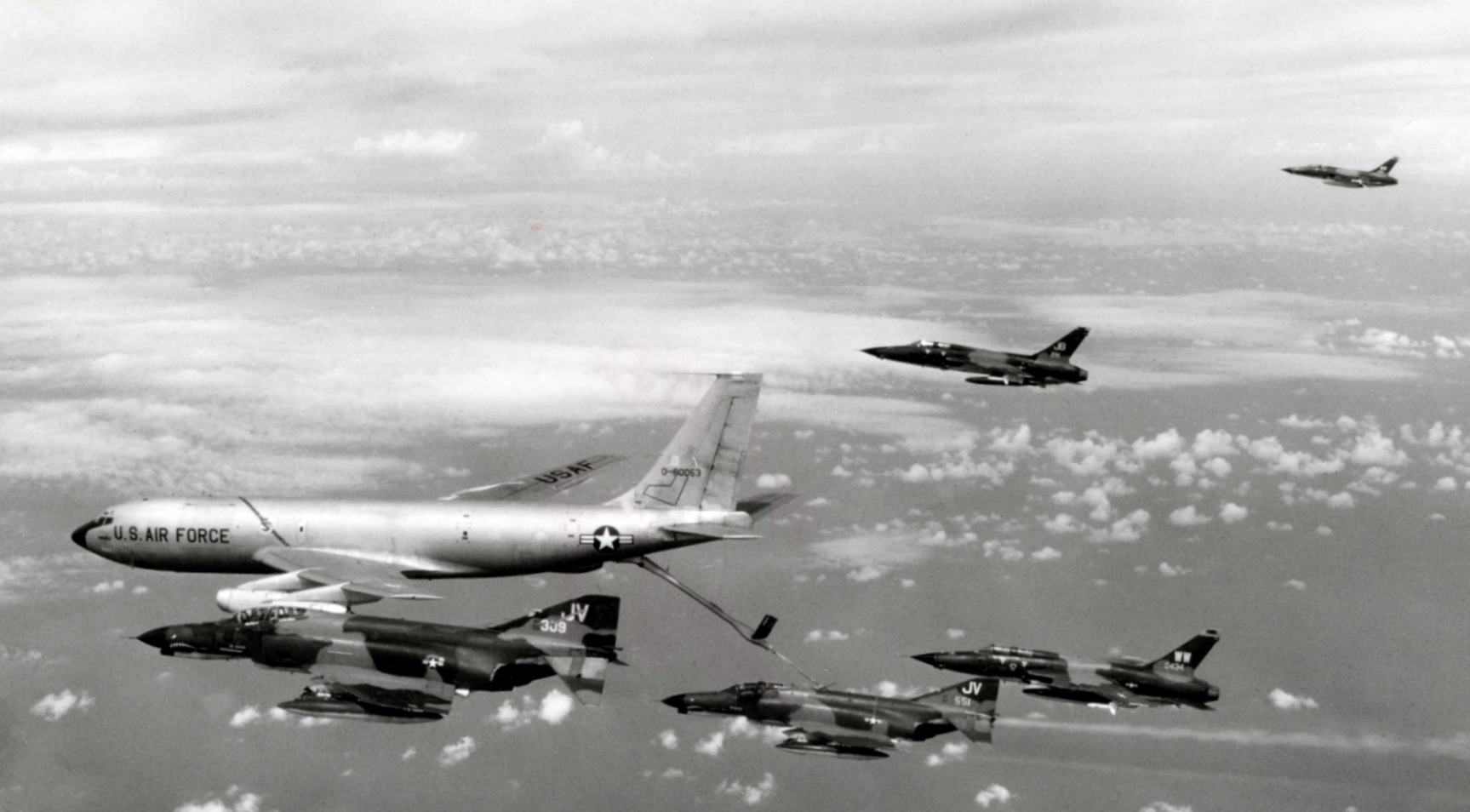
A 388th TFW SAM hunter-killer team refueling on its way to North Vietnam, October 1972 | |||||||
| |||||||
| Belligerents | |||||||
|
|
| ||||||
| Commanders and leaders | |||||||
|
John W. Vogt Jr.[4] Damon W. Cooper[4] | Nguyen Van Tien[citation needed] | ||||||
| Casualties and losses | |||||||
|
in combat or operational accidents[5] (excluding the number of aircraft that were badly damaged beyond repair[6]) North Vietnamese claim: 651 aircraft shot down, 80 warships sunk or damaged[7] |
U.S. claim: 63 aircraft shot down North Vietnamese claim: 47 aircraft shot down (26 MiG-21s, 5 MiG-19s and 16 MiG-17s)[8] | ||||||
Operation Linebacker was the codename of a U.S. Seventh Air Force and U.S. Navy Task Force 77 air interdiction campaign conducted against North Vietnam from 9 May to 23 October 1972, during the Vietnam War.
Its purpose was to halt or slow the transportation of supplies and materials for the Nguyen Hue Offensive (known in the West as the Easter Offensive), an invasion of the South Vietnam by the North Vietnamese People's Army of Vietnam (PAVN) that had been launched on 30 March. Linebacker was the first continuous bombing effort conducted against North Vietnam since the end of Operation Rolling Thunder in November 1968.
Nguyen Hue Offensive
[edit]At midday on 30 March 1972, 30,000 PAVN troops, supported by regiments of tanks and artillery, rolled southward across the Demilitarized Zone (DMZ) that separated the two Vietnams.[9] This three-division force caught the Army of the Republic of Vietnam (ARVN) and their American allies unprepared.[10] The PAVN force struck the defensive positions of the ARVN 3rd Division and threw it into disarray. ARVN forces then fell back, and a race began between both belligerents to the bridges at Đông Hà and Cam Lộ.[11]: 50–63
By 4 April, ARVN officers had patched together a defensive line that held the PAVN at bay, but it was only a temporary respite.[12] Although the conventional attack by the PAVN, which included the extensive use of armor and heavy artillery, riveted the attention of the allies on the northern provinces, it was only the first of three such operations that were launched that spring. On 5 April, a PAVN force of 20,000 crossed the border from their sanctuaries in Cambodia in another three-division, combined arms force to attack Bình Long Province, north of Saigon.[13] They quickly seized the town of Lộc Ninh and then surrounded the town of An Lộc, cutting the road to the capital.[14]
On 12 April, the PAVN struck again, this time moving in from eastern Laos and seizing a series of border outposts around Đắk Tô in Kon Tum Province in the Central Highlands.[15] The PAVN then proceeded east toward the provincial capital of Kon Tum. Hanoi had initiated the offensive to coincide with the winter monsoon, when continuous rain and low cloud cover made air support difficult.[16]
The initial U.S. response to the offensive was lackadaisical and confused.[17] The Pentagon was not unduly alarmed and the U.S. Ambassador to South Vietnam and Commander, U.S. Military Assistance Command, Vietnam, General Creighton W. Abrams, were both out of the country. President Richard Nixon's first response was to consider a three-day attack by Boeing B-52 Stratofortress heavy bombers on Hanoi and the port city of Haiphong. His National Security Advisor, Dr. Henry Kissinger, convinced Nixon to reconsider, since he did not want to jeopardize the formalization of the Strategic Arms Limitation Treaty (SALT I) with the Soviet Union, that was due to be signed in May.[18] Another stumbling block to the plan was Abrams' desire to utilize the available bombers (with their all-weather capability) to support the ARVN defense.[19]
Nixon and Kissinger considered a plan offered by the Joint Chiefs of Staff to be both unimaginative and lacking in aggression.[20] On 4 April, Nixon authorized the bombing of North Vietnam (which had been limited to reprisal raids just above the DMZ) up to the 18th parallel.[21] To prevent a total ARVN collapse and to protect American prestige during the upcoming summit meeting with Soviet general secretary Leonid Brezhnev, Nixon decided to risk a massive escalation of force.[22]
Due to the continuous withdrawal of American forces as part of the policy of Vietnamization, at the time of the invasion fewer than 10,000 U.S. combat troops remained in South Vietnam, and most of them were scheduled to leave within the next six months.[23] The number of combat aircraft stationed in Southeast Asia was less than half that of its peak strength in 1968–1969. At the beginning of 1972, the U.S. Air Force (USAF) had only three squadrons of McDonnell Douglas F-4 Phantom II fighter-bombers and one squadron of Cessna A-37 Dragonfly light attack aircraft, a total of 76 aircraft, stationed in South Vietnam.[24] Another 114 fighter-bombers were located at bases in Thailand. 83 B-52s were stationed at U-Tapao RTAFB, Thailand and at Andersen Air Force Base, Guam.[25] The U.S. Navy (USN)'s Task Force 77 (stationed in the Gulf of Tonkin), had four aircraft carriers assigned to it, but only two were available at any one time to conduct operations. Their air wings had approximately 140 aircraft.[26]
Build-up and air attacks
[edit]American and Republic of Vietnam Air Force (RVNAF) aircraft had been supporting the defense (weather permitting) since the beginning of the offensive. These strikes were conducted in support of ARVN forces, and included those of the air wings of the carriers USS Coral Sea and USS Hancock. The bad weather limited the ability of the U.S. aircraft to assist in stemming the North Vietnamese onslaught. By 6 April, at naval and air bases around the globe, American forces were put on alert and ships and aircraft squadrons began moving toward Southeast Asia.[27]
The U.S. began a rapid build-up of airpower. The USAF deployed 176 F-4s and 12 F-105 Thunderchiefs from bases in the Republic of Korea and the U.S. to Thailand between 1 April and 11 May in Operation Constant Guard.[28] Strategic Air Command (SAC) dispatched 124 B-52s from the U.S. to Guam bringing the total B-52 strength available for operations to 209.[29] The USN cut short its port period for the carriers USS Kitty Hawk and USS Constellation and ordered USS Midway, USS America and USS Saratoga to augment the fleet so that four or more carrier air wings could conduct missions simultaneously. 7th Fleet assets in local waters were thereby increased from 84 to 138 ships.[20]
USAF tactical strikes against North Vietnam north of the 20th parallel were authorized on 5 April under the nickname Freedom Train.[21] The first mass B-52 raid directed against the north was conducted on 10 April when 12 B-52s, supported by 53 attack aircraft, struck petroleum storage facilities around Vinh.[30] By 12 April, Nixon had informed Kissinger that he had decided on a more comprehensive bombing campaign which would include strikes against both Hanoi and Haiphong.[20]

The following day 18 B-52s struck Thanh Hóa's Bai Thuong Air Base. Three more days followed before another strike, this time by another 18 bombers in a pre-dawn attack against an oil tank farm outside Haiphong. They were followed by more than 100 tactical aircraft attacking targets around Hanoi and Haiphong during daylight.[21] Between 6 and 15 April, U.S. aircraft also struck and destroyed the Paul Doumer and Thanh Hóa bridges and the Yên Viên railway marshalling yard. This marked the introduction of laser-guided bombs against strategic targets in North Vietnam. Both bridges had previously been attacked unsuccessfully with conventional bombs and even missiles. The B-52s were then withdrawn from operations in the north and when they returned in June, their missions would be limited to South Vietnam.[31]
By mid-month, nearly all of North Vietnam had been cleared for bombing raids for the first time in over three years. Air Force and Navy commanders and pilots were relieved that Nixon (unlike President Johnson) left the operational planning to local commanders and loosened the targeting restrictions that had hampered Operation Rolling Thunder.[32] Between 1 May and 30 June B-52s, fighter-bombers, and gunships had flown 18,000 sorties against formidable anti-aircraft defenses with the loss of 29 aircraft.[33]
The U.S. also now began what North Vietnamese historians have described as "using devious political and diplomatic schemes...to cut back the amount of aid being supplied to us by socialist nations".[34] On 20 April Kissinger met secretly with Brezhnev in Moscow. Unwilling to jeopardize the normalisation of relations with the West and wary of Washington's growing relationship with Beijing, Brezhnev agreed to apply pressure to Hanoi to end the offensive and negotiate seriously.[35]
Brezhnev then arranged for another secret meeting between Kissinger and Hanoi's lead negotiator Le Duc Tho, to be held on 2 May in Paris. On the day, the two men met for a session that Kissinger later described as "brutal and insulting."[36] The North Vietnamese, sensing victory, were in no mood to make concessions. As a result of this meeting and the fall of Quảng Trị City Nixon was prepared to up the ante, stating that "the bastards have never been bombed like they're going to be bombed this time".[37]
Operation Pocket Money
[edit]On 27 April, ARVN defenses in Quảng Trị Province began to collapse. Due to conflicting orders from their high command, ARVN units joined an exodus of refugees heading southwards, abandoning Quảng Trị city.[38] PAVN forces entered the city on the same day as the meeting between Kissinger and Le Duc Tho. The PAVN offensive had become a massive conventional military operation that was being conducted on three fronts simultaneously, involving the equivalent of 15 divisions and 600 tanks.[39] As the North Vietnamese continued to gain ground in three of South Vietnam's four military regions, the U.S. Joint Chiefs of Staff updated their contingency plans (drawn up before the bombing halt of 1968) for the resumption of bombing in the north and recommended it to the President, who approved it on 8 May.[40]
Shortly after his inauguration, Nixon had ordered the preparation of a contingency plan, one that would hopefully bring the Vietnam War to an end.[41] Operation Duck Hook was to include an invasion of the North and included a proposal to mine its major harbors.[42] The plan had been shelved at the time as too extreme but it had not been forgotten. The USN had also been updating its own contingency plans for just such a mining operation since 1965. On 5 May, Nixon ordered the Joint Chiefs to prepare to execute the aerial mining portion of the Duck Hook plan within three days under the operational title Pocket Money.[41]
At precisely 09:00 (local time) on 9 May, six US Navy A-7 Corsair IIs and three A-6 Intruders from the USS Coral Sea flew into Haiphong harbor and dropped thirty-six 1,000-pound (450 kg) Mark-52 and Mark-55 naval mines into its waters. They were protected from attacks by Vietnam People's Air Force (VPAF) MiG fighter aircraft by the guided-missile cruisers Chicago and Long Beach, with several destroyers including the guided-missile destroyer USS Berkeley launching Operation Custom Tailor and by supporting flights of F-4 Phantoms. The reason for the precise timing of the strike became apparent when Nixon simultaneously delivered a televised speech explaining the escalation to the American people: "The only way to stop the killing is to take the weapons of war out of the hands of the international outlaws of North Vietnam.".[43] The mines were activated five days after their delivery to allow any vessels then in port to escape without damage.[40] Over the next three days other US carrier-based aircraft laid 11,000 more mines into North Vietnam's secondary harbors, blockading all maritime commerce for the country.[44]
Before and during Pocket Money, Nixon and Kissinger had worried about the Soviet and Chinese reaction to the escalation. Hours before Nixon's speech announcing the mining, Kissinger had delivered a letter to Soviet ambassador Anatoly Dobrynin which outlined the U.S. plan, but which also made clear Nixon's willingness to proceed with the summit.[45] The next day, Nixon shook the hand of Soviet Foreign Trade Minister Nikolai Patolichev at the White House. Although Moscow and Beijing publicly denounced the American operation, they were not willing to jeopardize their thawing relationship with the U.S. and Hanoi's requests for support and aid from its socialist allies met with only cool responses.[43]
Going north
[edit]Operation Linebacker, the code name for the new interdiction campaign, would have four objectives: to isolate North Vietnam from its sources of supply by destroying railroad bridges and rolling stock in and around Hanoi and north-eastwards toward the Chinese frontier; the targeting of primary storage areas and marshalling yards; to destroy storage and transshipment points and to eliminate (or at least damage) the North's air defense system.[46] With nearly 85 percent of North Vietnam's imports (which arrived by sea) blocked by Pocket Money, the administration and the Pentagon believed that this would cut its final lines of communication with its socialist allies. China alone shipped an average of 22,000 tons of supplies a month over two rail lines and eight major roads that linked it with North Vietnam.[41]

On 10 May Operation Linebacker began with mass bombing operations against North Vietnam by tactical fighter aircraft of the Seventh Air Force and Task Force 77. Their targets included the railroad switching yards at Yên Viên and the Paul Doumer Bridge, on the northern outskirts of Hanoi.[47] A total of 414 sorties were flown on the first day of the operation, 120 by the Air Force and 294 by the Navy and they encountered the heaviest single day of air-to-air combat during the Vietnam War. The U.S claimed 11 VPAF MiGs (four MiG-21s and seven MiG-17s) and two Air Force F-4s shot down.[48] The VPAF confirmed two MiG-21s, three MiG-17s and one MiG-19 shot down, and they claimed 7 F-4s were shot down (after the war, 5 F-4s shot down were confirmed[49]) Anti-aircraft artillery and surface-to-air missile firings also brought down two USN aircraft (one of which was flown by aces Duke Cunningham and William P. Driscoll).[48]
By the end of the month, American aircraft had destroyed 13 bridges along the rail lines running from Hanoi to the Chinese border. Another four were destroyed between the capital and Haiphong, including the notorious Thanh Hóa Bridge. Several more bridges were brought down along the rail line leading to the south toward the DMZ. Targets were then switched to petroleum and oil storage and transportation networks and North Vietnamese airfields.[50] There was an immediate impact on the battlefield in South Vietnam. Shelling by PAVN artillery dropped off by one-half between 9 May and 1 June. This slowdown was not due to an immediate shortage of artillery shells, but rather to a desire to conserve ammunition. U.S. intelligence analysts believed that PAVN had enough stockpiled supplies to sustain their campaigns throughout the autumn.[51]
The intensity of the bombing campaign was reflected by the sharp increase in the number of strike and support sorties flown in Southeast Asia as a whole: from 4,237 for all services, including the RVNAF, during the month preceding the invasion, to 27,745 flown in support of ARVN forces from the beginning of April to the end of June (20,506 of them flown by the Air Force).[52] B-52s provided an additional 1,000 sorties during the same period.[52] The North was feeling the pressure, admitting in the official PAVN history that "between May and June only 30 percent of supplies called for in our plan actually reached the front-line units."[53] In total, 41,653 Linebacker missions dropped 155,548 tons of bombs.[54]
In addition to interdicting the road and rail system of North Vietnam, Linebacker also systematically attacked its air defense system. The VPAF, with approximately 200 interceptors, strongly contested these attacks throughout the campaign. Navy pilots, employing a mutually supporting "loose deuce" tactical formation and many with TOPGUN training, claimed a kill ratio of 6:1 in their favor in May and June, such that after that the VPAF rarely engaged them thereafter.[55] In contrast, the USAF experienced a 1:1 kill ratio through the first two months of the campaign, as seven of its eventual 24 Linebacker air-to-air losses occurred without any corresponding VPAF loss in a twelve-day period between 24 June and 5 July.[56] USAF pilots were hampered by use of the outdated "fluid four" tactical formations (a four-plane, two element formation in which only the leader did the shooting and in which the outside wingmen were vulnerable) dictated by service doctrine. Also contributing to the parity was a lack of air combat training against dissimilar aircraft, a deficient early warning system, and ECM pod formations that mandated strict adherence to formation flying.[57] During August the introduction of real-time early warning systems, increased aircrew combat experience and degraded VPAF ground control interception capabilities reversed the trend to a more favorable, with 4:1 kill ratio were claimed.[58]
During the operation, each side would ultimately claim favourable kill ratios. A total of 201 air battles took place between American and Vietnamese planes in 1972 sorties. The VPAF lost 47 MiGs (including 26 MiG-21s, 5 MiG-19s and 16 MiG-17s [8]) and they claimed 90 U.S. aircraft were shot down, including 74 F-4 fighters and two RF-4C (MiG-21s shot down 67 enemy aircraft, MiG-17s shot down 11 and MiG-19s shot down 12 enemy aircraft[59]
Linebacker saw several other "firsts". On the opening day of the operation, USN Lieutenant Duke Cunningham and his radar intercept officer, Lieutenant (j.g.) William P. Driscoll became the first U.S. air aces of the Vietnam War when they shot down their fifth MiG.[60] On 28 August, the USAF gained its first ace when Captain Richard S. Ritchie downed his fifth enemy aircraft. Twelve days later, Captain Charles B. DeBellevue (who had been Ritchie's backseater during four of his five victories) downed two more MiGs, bringing his total to six. On 13 October another weapons officer, Captain Jeffrey S. Feinstein, was credited with his fifth MiG, making him the final Air Force ace.[60]
Operation Lion's Den
[edit]Although Linebacker was largely carried out by air, naval forces were also deployed to provide counter-battery fire against enemy targets along the coast and other important logistical areas and in support of ground troops. One such operation was Operation Lion's Den, or "The Battle of Haiphong Harbor". On the night of 27 August 1972, Vice Admiral James L. Holloway III took the heavy cruiser USS Newport News, the guided missile cruiser USS Providence, and the destroyers USS Robison and USS Rowan on a brief night raid against the North Vietnamese forces protecting the port of Haiphong. After the bombardment, the ships were threatened by four Soviet-built torpedo boats. Holloway's ships, and two aircraft from the USS Midway, sank all four torpedo boats. It was one of the few ship-to-ship naval battles of the war.[61][62]
Paris Peace Talks and conclusion
[edit]The stalled offensive in the South and the devastation in North Vietnam had helped to convince Hanoi to return to the bargaining table by early August.[60] The meetings produced new concessions from Hanoi which promised to end the deadlock that had plagued negotiations since their inception in 1968. Gone were Hanoi's demands for the ouster of South Vietnamese President Nguyễn Văn Thiệu and his replacement by a coalition government in which the Viet Cong would participate.[63] The U.S. on its part agreed to a cease fire in place which conceded that PAVN soldiers could remain in South Vietnam after a peace agreement.[64] The diplomatic impasse was broken and Nixon ordered a halt to all bombing above the 20th parallel on 23 October and on 26 October Kissinger announced that "peace is at hand." This once again placed Hanoi and Haiphong off-limits, and halted Linebacker operations.[64]
Air Force historian Earl Tilford has written that Linebacker was "a watershed in aerial warfare...it was the first modern aerial campaign in which precision guided munitions changed the way in which air power was used."[65] It succeeded, where Rolling Thunder had failed, he claimed, for three reasons: Nixon was decisive in his actions and gave the military greater latitude in targeting; American airpower was forcefully and appropriately used; and the immense difference in the technology utilized made Linebacker the first bombing campaign in a "new era" of aerial warfare.[66]
During and immediately following the PAVN offensive, U.S. Air Force, Navy and Marine Corps aviators had flown 18,000 sorties in the four northern provinces of South Vietnam and dropped 40,000 tons of ordnance in the Battle of An Lộc. Between March and May, B-52 sortie rates had climbed from 700 to 2,200 per month and they had dropped 57,000 tons of bombs in Quảng Trị Province alone.[67] During Freedom Train and Linebacker proper, B-52s had dropped 150,237 tons of bombs on the North while Air Force and Navy tactical aircraft had flown 1,216 sorties and dropped another 5,000 tons of ordnance.[68]
From the beginning of Freedom Train in April to the end of June 1972 the United States lost 52 aircraft over North Vietnam: 17 to missiles; 11 to anti-aircraft weapons; three to small arms fire; 14 to MiGs; and seven to unknown causes.[69] During the same time period, the RVNAF lost ten aircraft.[70] 63 VPAF aircraft were destroyed during the same time period.[71] North Vietnam claimed that it had shot down 651 aircraft and sunk or set on fire 80 U.S. warships during the operation.[7]
Linebacker had played a crucial role in blunting the northern offensive by drying up its vital sources of supply. PAVN had evolved into a conventional military force, and such a force depended upon a complex logistical system, which made it vulnerable to aerial attack.[72] By September, imports into North Vietnam were estimated at 35 to 50 percent below what they had been in May, bolstering claims that the campaign had been successful in its interdiction effort.[73] USAF General Robert N. Ginsburgh, of the Office of the Secretary of the Air Force, summed up the attitudes of U.S. commanders by remarking that Linebacker had "a greater impact in its first four months of operation than Rolling Thunder had in three and one-half years."[74] Although Kissinger may have announced that peace was at hand, it was not going to come easily. American bombers would once again return to the skies of North Vietnam in 1972 during Operation Linebacker II before the American commitment to the Vietnam War came to an end.[75]
North Vietnamese aircraft losses
[edit](Air-to-air losses only, claimed by the U.S)[76][77]
| Dates | Service | MiG-21 | MiG-19 | MiG-17 | Total |
|---|---|---|---|---|---|
| 5 April – 9 May | USAF | 4 | 1 | 5 | |
| USN | 2 | 2 | 4 | ||
| 10 May – 23 October | USAF | 30 | 7 | 37 | |
| USN | 3 | 2 | 11 | 16 | |
| USMC | 1 | 1 | |||
| VPAF Total | 40 | 10 | 13 | 63 |
According to the VPAF, they lost 47 MiGs in aircombat (including 26 MiG-21s, 5 MiG-19s and 16 MiG-17s)[78]
U.S. aircraft losses during Linebacker
[edit]Between 10 May and 23 October 1972, the United States lost a total of 134 aircraft either over the north or as a direct result of Linebacker missions. 104 were lost in combat and 30 were destroyed in operational accidents. Losses by service were:[5]
USAF: – 70 total
- 51 combat losses (22 to MiGs, 5 induced losses,[79] 20 to AAA, 4 to SAMs)
- 43 F-4D/E Phantom II (+17 non-combat losses)
- 2 RF-4C Photo Recon (+1 non-combat loss)
- 4 F-105G Wild Weasel (+1 non-combat loss)
- 2 F-111A "Aardvark"
USN: – 54 total
- 43 combat losses (4 to MiGs, 2 induced, 13 SAM, 27 AAA)
- 8 F-4B/J Phantom II (+3 non-combat losses)
- 22 A-7A/C/E Corsair II (+3 non-combat losses)
- 3 A-6A Intruder
- 2 F-8J Crusader (+3 non-combat losses)
- 5 A-4F Skyhawk (+1 non-combat loss)
- 1 RA-5C Vigilante
- 2 RF-8G Photo Crusader (+1 non-combat loss)
USMC: – 10 total
- 10 combat losses (1 MiG, 1 SAM, 8 AAA)
- 4 F-4J Phantom II
- 2 A-4E Skyhawk
- 4 A-6A Intruder
U.S. air order of battle
[edit]Task Force 77
[edit]| USS Constellation; 1 October 1971 – 30 June 1972[80] | ||
| Air Wing | Squadron | Aircraft Type |
| CVW-9 | VF-92 | F-4J Phantom II |
| VF-96 | F-4J Phantom II | |
| VA-146 | A-7E Corsair II | |
| VA-147 | A-7E Corsair II | |
| VA-165 | A-6A & KA-6D Intruder | |
| USS Coral Sea; 12 November 1971 – 17 July 1972[81] | ||
| Air Wing | Squadron | Aircraft Type |
| CVW-15 | VF-51 | F-4B Phantom II |
| VF-111 | F-4B Phantom II | |
| VA-22 | A-7E Corsair II | |
| VA-94 | A-7E Corsair II | |
| VMA(AW)-224 | A-6A & KA-6D Intruder | |
| USS Hancock; 7 January 1972 to 3 October 1972[82] | ||
| Air Wing | Squadron | Aircraft Type |
| CVW-21 | VF-24 | F-8J Crusader |
| VF-211 | F-8J Crusader | |
| VA-55 | A-4F Skyhawk | |
| VA-164 | A-4F Skyhawk | |
| VA-212 | A-4F Skyhawk | |
| USS Kitty Hawk; 17 February 1972 to 28 November 1972[83] | ||
| Air Wing | Squadron | Aircraft Type |
| CVW-11 | VF-114 | F-4J Phantom II |
| VF-213 | F-4J Phantom II | |
| VA-192 | A-7E Corsair II | |
| VA-195 | A-7E Corsair II | |
| VA-52 | A-6A & KA-6D Intruder | |
| USS Midway; 10 April 1972 to 3 March 1973[84] | ||
| Air Wing | Squadron | Aircraft Type |
| CVW-5 | VF-151 | F-4B Phantom II |
| VF-161 | F-4B Phantom II | |
| VA-56 | A-7B Corsair II | |
| VA-93 | A-7B Corsair II | |
| VA-115 | A-6A & KA-6D Intruder | |
| USS Saratoga; 11 April 1972 to 13 February 1973[85] | ||
| Air Wing | Squadron | Aircraft Type |
| CVW-3 | VF-31 | F-4J Phantom II |
| VF-103 | F-4J Phantom II | |
| VA-37 | A-7A Corsair II | |
| VA-105 | A-7A Corsair II | |
| VA-75 | A-6A & KA-6D Intruder | |
| USS America; 5 June 1972 to 24 March 1973[86] | ||
| Air Wing | Squadron | Aircraft Type |
| CVW-8 | VF-74 | F-4J Phantom II |
| VMFA-333 | F-4J Phantom II | |
| VA-82 | A-7C Corsair II | |
| VA-86 | A-7C Corsair II | |
| VA-35 | A-6A & KA-6D Intruder | |
| USS Oriskany; 5 June 1972 to 30 March 1973[87] | ||
| Air Wing | Squadron | Aircraft Type |
| CVW-19 | VF-191 | F-8J Crusader |
| VF-194 | F-8J Crusader | |
| VA-153 | A-7A Corsair II | |
| VA-155 | A-7B Corsair II | |
| VA-215 | A-7B Corsair II | |
USMC
[edit]| 1st Marine Aircraft Wing, Marine Aircraft Group 15 | |||
| Base | Squadron | Aircraft Type | Notes |
| Danang AB, RVN April 1972 to June 1972;[88] Nam Phong RTAB, Thailand June 1972 to August 1973[89] | Marine Fighter Attack Squadron 115 | F-4B Phantom II | Deployed from MCAS Iwakuni; 6 April 1972 – 31 August 1973[90][88] |
| Marine Fighter Attack Squadron 212 | F-4J Phantom II | Deployed from MCAS Kaneohe Bay; 14 April 1972 – 20 June 1972[90][91] | |
| Marine Fighter Attack Squadron 232 | F-4J Phantom II | Deployed from MCAS Iwakuni; 6 April 1972 – 1 September 1973[90][88] | |
| Marine All-Weather Attack Squadron 533 | A-6A Intruder | Deployed from MCAS Iwakuni; 21 June 1972 – August 1973[92] | |
| Marine Aircraft Group 12 | |||
| Base | Squadron | Aircraft Type | Notes |
| Bien Hoa Air Base, RVN[93] | Marine Attack Squadron 211 | A-4E Skyhawk | Deployed from Naha Air Force Base, Okinawa; 17 May 1972 – 30 January 1973[93] |
| Marine Attack Squadron 311 | A-4E Skyhawk | Deployed from MCAS Iwakuni; 17 May 1972 – 30 January 1973[93] | |
Seventh Air Force
[edit]| 8th Tactical Fighter Wing, Ubon RTAFB, Thailand[94] | ||
| Squadron | Aircraft Type | Notes |
| 25th Tactical Fighter Squadron | F-4D Phantom II | [95] |
| 433rd Tactical Fighter Squadron | F-4D Phantom II | [96] |
| 435th Tactical Fighter Squadron | F-4D Phantom II | [97] |
| 497th Tactical Fighter Squadron | F-4D Phantom II | [98] |
| Constant Guard I | ||
| 334th Tactical Fighter Squadron | F-4E Phantom II | Deployed from 4th TFW, Seymour-Johnson AFB, North Carolina; 11 April 1972 – 5 August 1972; 30 September 1972 – 18 March 1973[99][100] |
| 336th Tactical Fighter Squadron | F-4E Phantom II | Deployed from 4th TFW, Seymour-Johnson AFB, North Carolina; 12 April 1972 – 30 September 1972; 9 March 1973 – 7 September 1973[101][100] |
| Temporary Duty (TDY) | ||
| 335th Tactical Fighter Squadron | F-4E Phantom II | Deployed from 4th TFW, Seymour-Johnson AFB, North Carolina; 6 July 1972 – 22 December 1972[102] |
| 49th Tactical Fighter Wing, Takhli RTAFB, Thailand[103][104] | ||
| Constant Guard III | ||
| Squadron | Aircraft Type | Notes |
| 7th Tactical Fighter Squadron | F-4D Phantom II | Deployed from Holloman AFB, New Mexico; 11 May 1972 – 12 August 1972[105][106] |
| 8th Tactical Fighter Squadron | F-4D Phantom II | Deployed from Holloman AFB, New Mexico; 12 May 1972 – 2 October 1972[107][106] |
| 9th Tactical Fighter Squadron | F-4D Phantom II | Deployed from Holloman AFB, New Mexico; 13 May 1972 – 5 October 1972[108][106] |
| 417th Tactical Fighter Squadron | F-4D Phantom II | Deployed from Holloman AFB, New Mexico; 10 May 1972 – 30 September 1972[109][106] |
| 474th Tactical Fighter Wing, Takhli RTAFB, Thailand[110] | ||
| Constant Guard V | ||
| Squadron | Aircraft Type | Notes |
| 429th Tactical Fighter Squadron | F-111A | Deployed from Nellis AFB, Nevada; 26 September 1972 |
| 430th Tactical Fighter Squadron | F-111A | Deployed from Nellis AFB, Nevada; 26 September 1972 |
| 56th Special Operations Wing, Nakhon Phanom RTAFB, Thailand[111] | ||
| Squadron | Aircraft Type | Notes |
| 1st Special Operations Squadron | A-1 Skyraider | [112] |
| 21st Special Operations Squadron | CH-53 Sea Stallion | [113] |
| 366th Tactical Fighter Wing, Danang AB, RVN; transferred to Takhli RTAFB, Thailand 27 June 1972[114][115] | ||
| Squadron | Aircraft Type | Notes |
| 4th Tactical Fighter Squadron | F-4E Phantom II | Transferred to Takhli RTAFB, Thailand; 27 June 1972[116] |
| 390th Tactical Fighter Squadron | F-4D Phantom II | Transferred to the 347th TFW, Mountain Home Air Force Base, Idaho; 30 June 1972[117] |
| 421st Tactical Fighter Squadron | F-4E Phantom II | Transferred to Takhli RTAFB, Thailand; 27 June 1972[118] |
| Commando Fly | ||
| 35th Tactical Fighter Squadron | F-4D Phantom II | Deployed from 3rd TFW, Kunsan AB, Korea; 3 April – 12 Jun 1972; Deployed to Korat RTAFB, Thailand, 13 June – 12 Oct 1972[119][120] |
| 388th Tactical Fighter Wing, Korat RTAFB, Thailand[121] | ||
| Squadron | Aircraft Type | Notes |
| 34th Tactical Fighter Squadron | F-4E Phantom II | [122] |
| 469th Tactical Fighter Squadron | F-4E Phantom II | Inactivated 31 October 1972[123] |
| 17th Wild Weasel Squadron | F-105G Thunderchief | [124] |
| Constant Guard I | ||
| 561st Tactical Fighter Squadron | F-105G Thunderchief | Deployed from 23rd TFW, McConnell AFB, Kansas; 11 April 1972 – 27 January 1973[125][126] |
| 432d Tactical Reconnaissance Wing, Udorn RTAFB, Thailand[127] | ||
| Squadron | Aircraft Type | Notes |
| 13th Tactical Fighter Squadron | F-4D Phantom II | [128] |
| 14th Tactical Reconnaissance Squadron | RF-4C Phantom II | [129] |
| 555th Tactical Fighter Squadron | F-4D Phantom II | [130] |
| Commando Flash | ||
| 523rd Tactical Fighter Squadron | F-4D Phantom II | Deployed from 405th TFW, Clark AB, Philippines; 9 April – 24 October 1972[131][132] |
| Constant Guard II | ||
| 308th Tactical Fighter Squadron | F-4E Phantom II | Deployed from 31st TFW, Homestead AFB, Florida; 28 April – 29 July 1972[133][134] |
| 58th Tactical Fighter Squadron | F-4E Phantom II | Deployed from 33d TFW, Eglin AFB, Florida; 29 April – 14 Oct 1972[135][134] |
| 43d Strategic Wing, Andersen AFB, Guam[136][137] | ||
| Squadron | Aircraft Type | Notes |
| 60th Bombardment Squadron (Provisional) | B-52D Stratofortress | [137] |
| 63rd Bombardment Squadron (Provisional) | B-52D Stratofortress | [137] |
| 72d Strategic Wing (Provisional), Anderson AFB, Guam | ||
| Squadron | Aircraft Type | Notes |
| 64th Bombardment Squadron (Provisional) | B-52G Stratofortress | |
| 65th Bombardment Squadron (Provisional) | B-52G Stratofortress | |
| 329th Bombardment Squadron (Provisional) | B-52G Stratofortress | |
| 486th Bombardment Squadron (Provisional) | B-52G Stratofortress | |
| 307th Strategic Wing, U Tapao RTAFB, Thailand[138][139] | ||
| Squadron | Aircraft Type | Notes |
| 364th Bombardment Squadron | B-52D Stratofortress | [139] |
| 365th Bombardment Squadron | B-52D Stratofortress | [139] |
See also
[edit]Notes
[edit]- ^ "How Nixon's Operation Linebacker Countered North Vietnam's All-Out Bid to Conquer the South". HistoryNet. 5 April 2022. Retrieved 7 November 2023.
- ^ Haun, Phil; Jackson, Colin (2015). "Breaker of Armies: Air Power in the Easter Offensive and the Myth of Linebacker I and II in the Vietnam War". International Security. 40 (3): 139–178. doi:10.1162/ISEC_a_00226. ISSN 0162-2889. JSTOR 43828564. S2CID 57564546.
- ^ Pribbenow, Merle L. (2001). "Rolling Thunder and Linebacker Campaigns: The North Vietnamese View". The Journal of American-East Asian Relations. 10 (3/4): 197–210. doi:10.1163/187656101793645524. ISSN 1058-3947. JSTOR 23613043.
- ^ a b Thompson, p. 257.
- ^ a b Ed Rasimus (2006). "Appendix I – Linebacker Losses". Palace Cobra: A Fighter Pilot in the Vietnam Air War. St. Martin's Press. ISBN 978-0-312-35356-8., pp. 233–248. Losses are enumerated by date, aircraft type and serial number, and crew members.
- ^ Drenkowski & Grau 2007, p. 3.
- ^ a b Van Thai & Van Quang 2002, p. 301.
- ^ a b "Archived copy". old.vko.ru. Archived from the original on 3 February 2014. Retrieved 11 January 2022.
{{cite web}}: CS1 maint: archived copy as title (link) - ^ Maj. A.J.C. Lavalle, ed. Airpower and the 1972 Spring Offensive. Maxwell AFB AL: Air University Press, 1976, p. 4.
- ^ David Fulghum & Terrance Maitland, et al., South Vietnam on Trial. Boston: Boston Publishing Company, 1984, p. 138.
- ^ Melson, Charles (1991). U.S. Marines In Vietnam: The War That Would Not End, 1971–1973. History and Museums Division, Headquarters, U.S. Marine Corps. ISBN 9781482384055.
This article incorporates text from this source, which is in the public domain.
- ^ Fulghum and Maitland, p. 141.
- ^ Lavalle, p. 6.
- ^ Andrade, Dale (1995). Trial by Fire: The 1972 Easter Offensive, America's Last Vietnam Battle. New York: Hippocrene Books. p. 73.
- ^ Fulghum and Maitland, pp. 154–158.
- ^ Earl H. Tilford, Setup: What the Air Force Did in Vietnam and Why. Maxwell AFB AL: Air University Press, 1991, p. 225.
- ^ Fulghum and Maitland, pp. 141–142.
- ^ Tilford, p. 234.
- ^ Fulghum and Maitland, p. 170.
- ^ a b c Fulghum and Maitland, p. 142.
- ^ a b c Tilford, p. 228.
- ^ Tilford, p. 232
- ^ Michael Casey, Clark Dougan, Samuel Lipsman, Jack Sweetman, Stephen Weiss, et al., Flags into Battle. Boston: Boston Publishing Company, 1987, p. 182.
- ^ Lavalle, p. 12.
- ^ Tilford, pp. 223–224.
- ^ John Morocco, Rain of Fire. Boston: Boston Publishing Company, 1985, p. 170.
- ^ Morrocco, John (1985). Rain of Fire: Air War, 1969–1973. Boston: Boston Publishing Company. p. 170. ISBN 0-939526-14-X.
- ^ Lavalle, pp. 19, 23–25. Also see Morocco, pp. 108–109.
- ^ Tilford, p. 224.
- ^ Wayne To Hanoi and Back. Washington, D.C.: Smithsonian Institution Press, 2000, p. 225.
- ^ Thompson, p. 229.
- ^ Stanley Karnow, Vietnam. New York: Viking, 1983, p. 643.
- ^ Casey, Dougan, Lipsman, p. 39.
- ^ Van Thai & Van Quang 2002, p. 299.
- ^ On 21 February 1972 Nixon had landed in Beijing for his dramatic diplomatic breakthrough with the People's Republic of China. The Chinese, who had previously hoped that a long war in Southeast Asia would bleed both the Americans and their Vietnamese neighbors, now feared that a decline in American power would deprive them of a counterweight to the Soviet Union. Karnow, p. 638.
- ^ Fulghum and Maitland, p. 179.
- ^ Fulghum and Maitland, p. 168.
- ^ Dale Andrade, Trial by Fire. New York: Hippocrene Books, 1995 p. 52.
- ^ Dave Richard Palmer, Summons of the Trumpet, New York: Ballentine, 1978, p. 317.
- ^ a b Tilford, p. 233.
- ^ a b c Morocco, p. 130.
- ^ Fulghum and Maitland, p. 144.
- ^ a b Morocco, p. 131.
- ^ Andrade, p. 518.
- ^ Fulghum and Maitland, pp. 170–171.
- ^ William P. Head, War Above the Clouds, Maxwell AFB AL: Air University Press, 2002, p. 65.
- ^ Casey, Dougan and Lipsman, p. 39.
- ^ a b Thompson, p. 236.
- ^ "Vietnamese Air-to-Air Victories, Part 2". ACIG. Archived from the original on 20 July 2012. Retrieved 14 November 2014.
- ^ Tilford, p. 235.
- ^ Andrade, p. 519.
- ^ a b Head, p. 66.
- ^ Van Thai & Van Quang 2002, p. 293.
- ^ Clodfelter, p. 224.
- ^ Morocco, p. 144.
- ^ Marshall L. Michel, Clashes: Air Combat Over North Vietnam 1965–1972. Annapolis MD: Naval Institute Press, 1997, p. 244.
- ^ Michel, p. 288
- ^ Michel. p. 284
- ^ "Vietnam Conflict Aviation Resource Center - A Warbirds Resource Group Site".
- ^ a b c Morocco, p. 145.
- ^ Holloway, James L. (2007). Aircraft Carriers at War: A Personal Retrospective of Korea, Vietnam, and the Soviet Confrontation. US Naval Institute Press. ISBN 1-59114-391-8, pp. 314-323
- ^ Sherwood, John (2009). Nixon's Trident: Naval Power in Southeast Asia, 1968–1972. Naval Historical Center. pp. 68–9. ISBN 9781505469127.
This article incorporates text from this source, which is in the public domain.
- ^ Lipsman and Weiss, p. 9. See also Karnow, p. 647.
- ^ a b "Memoirs v Tapes: President Nixon and the December Bombings". Archived from the original on 12 July 2018. Retrieved 23 June 2015.
- ^ Tilford, p. 238.
- ^ Tilford, pp. 238–240.
- ^ Lavalle, p. 103.
- ^ Head, p. 71.
- ^ Head, p. 66. One of those aircraft was an EB-66 electronic jamming aircraft with the call sign Bat-21. The EB-66 was shot down over northern South Vietnam on 2 April with only one survivor, Lieutenant Colonel Iceal Hambleton. See Lavalle, pp. 35–43.
- ^ Tilford, pp. 231, 251. Linebacker. See also Lavalle, p. 107.
- ^ Tilford, p. 245.
- ^ Palmer, p. 322.
- ^ Tilford, p. 237.
- ^ Morocco, p. 136.
- ^ Boyne, Linebacker II.
- ^ "United States Air Force in Southeast Asia: Aces and Aerial Victories – 1965–1973" (PDF). Air University. Archived from the original (PDF) on 5 November 2006. Retrieved 15 February 2007., on-line book, pp. 95–102.
- ^ Drendel, Lou. (1984). ...And Kill MiGs. Squadron/Signal Publications. ISBN 978-0-89747-056-8.
- ^ "Wayback Machine". old.vko.ru.
- ^ Michel, p. 317 note 2. An "induced loss" occurred when a MiG was credited with indirectly causing a U.S. aircraft loss, including fuel exhaustion, fratricide, and loss of control while maneuvering.
- ^ Francillion, p. 126.
- ^ Francillion, p. 131.
- ^ Francillion, p. 140.
- ^ Francillion, p. 147.
- ^ Francillion, p. 150.
- ^ Francillion, p. 161.
- ^ Francillion, p. 118.
- ^ Francillion, p. 155.
- ^ a b c Nicholson, pp. 53–54
- ^ Nicholson, pp. 62–63
- ^ a b c Davies, p. 92.
- ^ Nicholson, p. 54
- ^ Nicholson, p. 63
- ^ a b c Mersky, p. 105
- ^ "8th Tactical Fighter Wing". Archived from the original on 5 June 2018.
- ^ "25th Tactical Fighter Squadron". Air Force Historical Research Agency.
- ^ "433rd Tactical Fighter Squadron". Air Force Historical Research Agency.
- ^ "435th Tactical Fighter Squadron". Archived from the original on 22 August 2022. Retrieved 18 November 2019.
- ^ "497th Tactical Fighter Squadron". Air Force Historical Research Agency.
- ^ "334th Tactical Fighter Squadron". Air Force Historical Research Agency.
- ^ a b Nicholson, p. 39, p. 44
- ^ "336th Tactical Fighter Squadron". Air Force Historical Research Agency.
- ^ "335th Tactical Fighter Squadron". Air Force Historical Research Agency.
- ^ "49th Tactical Fighter Wing". Air Force Historical Research Agency.
- ^ Nicholson, pp. 49–50
- ^ "7th Tactical Fighter Squadron". Air Force Historical Research Agency.
- ^ a b c d Nicholson, p. 50
- ^ "8th Tactical Fighter Squadron". Air Force Historical Research Agency.
- ^ "9th Tactical Fighter Squadron". Air Force Historical Research Agency.
- ^ "417th Tactical Fighter Squadron". Air Force Historical Research Agency.
- ^ Picinich, A.A., Colonel (21 February 1974). Radzykewycz, D.T., Captain (ed.). "The F-111 In Southeast Asia September 1972 – January 1973". CHECO/CORONA HARVEST Division, DCS/Plans and Operations, HQ PACAF. Project CHECO Report (Special Project). Hq USAF: Department of the Air Force. UNCLASSIFIED.
{{cite journal}}: CS1 maint: multiple names: authors list (link) - ^ "56th Special Operations Wing". Air Force Historical Research Agency.
- ^ "1st Special Operations Squadron". Air Force Historical Research Agency.
- ^ "21st Special Operations Squadron".
- ^ "366 Fighter Wing (ACC)".
- ^ Nicholson, p. 61
- ^ "4th Tactical Fighter Squadron". Air Force Historical Research Agency.
- ^ "390th Tactical Fighter Squadron". Air Force Historical Research Agency.
- ^ "421st Tactical Fighter Squadron". Air Force Historical Research Agency.
- ^ "35th Tactical Fighter Squadron". Air Force Historical Research Agency.
- ^ Nicholson, pp. 36–37
- ^ "388th Tactical Fighter Wing". Air Force Historical Research Agency.
- ^ "34th Tactical Fighter Squadron". Air Force Historical Research Agency.
- ^ "469th Tactical Fighter Squadron". Air Force Historical Research Agency.
- ^ "17th Wild Weasel Squadron". Air Force Historical Research Agency.
- ^ "561st Tactical Fighter Squadron". Air Force Historical Research Agency.
- ^ Nicholson, p. 40
- ^ "432d Tactical Reconnaissance Wing". Air Force Historical Research Agency.
- ^ "13th Tactical Fighter Squadron". Air Force Historical Research Agency.
- ^ "14th Tactical Reconnaissance Squadron". Air Force Historical Research Agency.
- ^ "555th Tactical Fighter Squadron". Air Force Historical Research Agency.
- ^ "523rd Tactical Fighter Squadron". Air Force Historical Research Agency.
- ^ Nicholson, pp. 36–37, p. 46.
- ^ "308th Tactical Fighter Squadron". Air Force Historical Research Agency.
- ^ a b Nicholson, pp. 45–46
- ^ "58th Tactical Fighter Squadron". Air Force Historical Research Agency.
- ^ "43rd Strategic Wing".[dead link]
- ^ a b c "43rd Bomb Wing - SAC - Andersen AFB - B-52".
- ^ "307th Strategic Wing". Air Force Historical Research Agency.
- ^ a b c "307th Bombardment Wing - SAC -".
References
[edit]Published government documents
[edit]- Boyne, Walter J. (May 1997). "Linebacker II". Air Force Magazine. 80 (11). ISSN 0730-6784. Archived from the original on 24 December 2012. Retrieved 3 January 2016.
- Head, William P. (2002). War from Above the Clouds: B-52 Operations During the Second Indochina War and the Effects of the Air War on Theory and Doctrine (PDF). Maxwell AFB, Alabama: Air University Press. OCLC 54838431. Archived from the original (PDF) on 10 November 2016. Retrieved 1 January 2016.
- Lavalle, A.J.C., ed. (1976). Airpower and the 1972 Spring Offensive (PDF). Maxwell AFB, Alabama: Air University Press. OCLC 263557387. Archived from the original (PDF) on 9 June 2011.
- Nalty, Bernard C. (1995). Air War Over South Vietnam: 1969–1975. Washington DC: Center of Air Force History. ISBN 9780160509148.
- Nicholson, Charles A. (1972). Project CHECO Southeast Asia Report. The USAF Response to the Spring 1972 NVN Offensive: Situation and Redeployment (PDF). HQ PACAF, Directorate of Operations Analysis, CHECO/CORONA Harvest Division. Archived (PDF) from the original on 15 November 2019.
- Picinich, A.A., Colonel (21 February 1974). Radzykewycz, D.T., Captain (ed.). "The F-111 In Southeast Asia September 1972 – January 1973". CHECO/CORONA HARVEST Division, DCS/Plans and Operations, HQ PACAF. Project CHECO Report (Special Project). Hq USAF: Department of the Air Force. UNCLASSIFIED.
{{cite journal}}: CS1 maint: multiple names: authors list (link) - Schlight, John (1993). A War Too Long (PDF). Washington DC: Center of Air Force History. OCLC 464220328. Archived from the original (PDF) on 5 July 2007.
- Thompson, Wayne (2002). To Hanoi and Back: The U.S. Air Force and North Vietnam, 1966–1973. Washington DC: Smithsonian Institution Press. ISBN 9781560988779.
- Tilford, Earl H. (1991). Setup: What the Air Force Did in Vietnam and Why. Maxwell Air Force Base, Alabama: Air University Press. ISBN 9781429458276.
- Van Thai, Hoang; Van Quang, Tran, eds. (2002) [1988]. Victory in Vietnam: The Official History of the People's Army of Vietnam, 1954–1975, translated by Merle L. Pribbenow (English ed.). Lawrence, Kansas: University Press of Kansas. ISBN 978-0-7006-1175-1.
Secondary sources
[edit]- Andrade, Dale (1995). Trial by Fire: The 1972 Easter Offensive, America's Last Vietnam Battle. New York: Hippocrene Books. ISBN 9780781802864.
- Casey, Michael; Dougan, Clark; Lipsman, Samuel; Sweetman, Jack; Weiss, Stephen (1987). Flags into Battle. Boston, Massachusetts: Boston Publishing Company. ISBN 9780201116762.
- Clodfelter, Micheal (1995). Vietnam in Military Statistics: A History of the Indochina Wars, 1772–1991. Jefferson, North Carolina: McFarland & Company. ISBN 978-0786400270.
- Davies, Peter E. (2012). US Marine Corps F-4 Phantom II Units of the Vietnam War. Midland House, West Way, Botley, Oxford: Osprey Publishing. ISBN 978-1849087513.
- Drendel, Lou (1984). Air War over Southeast Asia: Volume 3, 1971–1975. Carrollton, Texas: Squadron/Signal Publications. ISBN 9780897471480.
- Drenkowski, Dana; Grau, Lester W. (December 2007). "Patterns and Predictability: The Soviet Evaluation of Operation Linebacker II" (PDF). Journal of Slavic Military Studies. 20 (4): 559–607. doi:10.1080/13518040701703096. S2CID 143833568. Archived from the original (PDF) on 14 March 2016. Retrieved 16 May 2016.
- Francillion, Rene J. (1988). Tonkin Gulf Yacht Club: U.S. Carrier Operations off Vietnam. Annapolis, Maryland: Naval Institute Press. ISBN 978-0870216961.
- Fulghum, David; Maitland, Terrence (1984). South Vietnam on Trial: Mid-1970–1972. Boston, Massachusetts: Boston Publishing Company. ISBN 9780939526109.
- Karnow, Stanley (1983). Vietnam: A History. New York: Viking Books. ISBN 9780670746040.
- Lipsman, Samuel; Weiss, Stephen (1985). The False Peace: 1972–74. Boston, Massachusetts: Boston Publishing Company. ISBN 9780201112726.
- Littauer, Raphael; Uphoff, Norman (1972). The Air War in Indochina. Boston, Massachusetts: Beacon Press. ISBN 9780807002490.
- Mersky, Peter (2007). US Navy and Marine Corps A-4 Skyhawk Units of the Vietnam War 1963–1973 (Combat Aircraft). Midland House, West Way, Botley, Oxford. ISBN 978-1846031816.
{{cite book}}: CS1 maint: location missing publisher (link) - Michel III, Marshall L. (1997). Clashes, Air Combat Over North Vietnam 1965–1972. Annapolis, Maryland: Naval Institute Press. ISBN 9781591145196.
- Morocco, John (1985). Rain of Fire: Air War, 1969–1973. Boston, Massachusetts: Boston Publishing Company. ISBN 9780939526147.
- Palmer, Dave Richard (1978). Summons of the Trumpet: The History of the Vietnam War from a Military Man's Viewpoint. New York: Ballantine. ISBN 9780891410416.
- Randolph, Stephen P. (2007). Powerful and Brutal Weapons: Nixon, Kissinger, and the Easter Offensive. Cambridge: Harvard University Press. ISBN 9780674024915.
- Smith, John T. (March–May 1992). "Day of the Top Guns, May 10, 1972". Air Enthusiast. No. 45. pp. 13–23. ISSN 0143-5450.
External links
[edit]Operation Linebacker
View on GrokipediaStrategic Background
North Vietnamese Easter Offensive
The North Vietnamese Easter Offensive, also known internally as the Nguyen Hue Offensive, commenced on March 30, 1972, with a massive conventional invasion across the Demilitarized Zone (DMZ) into northern South Vietnam, involving over 25,000 troops from the People's Army of Vietnam (PAVN) divisions such as the 304th and 312th, supported by Soviet-supplied T-54 tanks, artillery, and anti-aircraft systems.[4] This three-pronged assault targeted key areas: the northern province of Quang Tri Province to seize territory below the DMZ; the Central Highlands around Kontum to disrupt South Vietnamese Army of the Republic of Vietnam (ARVN) lines of communication; and the eastern approaches to Saigon via An Loc in Binh Long Province, aiming to draw ARVN reserves southward and potentially topple the government.[5] Unlike prior guerrilla tactics, the offensive emphasized armored spearheads and artillery barrages, reflecting North Vietnam's strategy to exploit U.S. troop withdrawals under Vietnamization and test ARVN resolve amid ongoing Paris peace talks, with the inferred goal of securing territorial gains for a favorable ceasefire.[5] Initial PAVN advances overwhelmed ARVN defenses, capturing Quang Tri City by May 1 after defeating the ARVN 3rd Division in a series of engagements.[6] In the central front, PAVN forces assaulted Kontum Province in April, employing the 320th and 10th Divisions with heavy artillery support, but ARVN counterattacks, bolstered by U.S. tactical air strikes, stalled the offensive by May, inflicting significant PAVN equipment losses including tanks and howitzers.[7] The southern prong targeted An Loc, where on April 13, three elite PAVN divisions encircled the city, subjecting it to relentless shelling and ground assaults, yet ARVN defenders held with U.S. B-52 Arc Light bombings and close air support disrupting supply lines and armor concentrations.[8] Overall, the offensive committed an estimated 200,000 PAVN and Viet Cong troops against ARVN forces numbering around 300,000 in the South, but faltered due to logistical overextension, ARVN resilience, and decisive U.S. air intervention, which destroyed over 700 PAVN tanks and inflicted up to 100,000 casualties.[9] ARVN suffered approximately 43,000 casualties, including 10,000 killed, alongside substantial materiel losses such as 37 tanks and numerous artillery pieces.[10] By October 22, 1972, PAVN forces withdrew from most gains, though they retained some border areas, marking the offensive's ultimate failure to achieve a decisive breakthrough or collapse South Vietnam.[5] The campaign's heavy reliance on Soviet aid—evident in advanced weaponry and resupply—highlighted external sustainment but also exposed vulnerabilities to interdiction, prompting U.S. policymakers to reassess bombing restrictions to counter the threat and leverage negotiations.[7] Analyses from U.S. military records emphasize that without American air power, the offensive might have overwhelmed ARVN, underscoring its role in validating Vietnamization while necessitating escalated responses like Operation Linebacker.[10]US Strategic Objectives and Planning
The United States initiated Operation Linebacker on May 9, 1972, primarily to interdict North Vietnamese supply lines and reinforcements flowing south, thereby halting the ongoing Easter Offensive that had begun on March 30, 1972.[11] The campaign's strategic objectives included destroying key infrastructure such as roads, bridges, rail networks, petroleum storage facilities, power plants, and military bases to impose logistical attrition on invading forces, while avoiding the reintroduction of American ground troops.[3] President Richard Nixon also aimed to compel Hanoi to resume serious negotiations in the Paris peace talks by demonstrating U.S. military resolve and inflicting unacceptable operational costs, with the broader goal of preserving South Vietnam's territorial integrity amid ongoing U.S. withdrawal efforts.[11] Planning for the operation evolved from initial limited strikes in southern North Vietnam starting April 6, 1972, which proved insufficient to stem the offensive, leading to Nixon's authorization on May 4 for a sustained air campaign combined with naval mining under Operation Pocket Money.[1] [11] The effort was coordinated through the Joint Chiefs of Staff, Commander in Chief Pacific (CINCPAC), and Seventh Air Force, with naval contributions from Task Force 77 deploying multiple aircraft carriers to the Gulf of Tonkin.[1] Target selection prioritized lines of communication north of the 20th parallel, incorporating B-52 Arc Light strikes for area denial and tactical fighters for precision attacks using newly emphasized laser-guided munitions to minimize losses from enhanced North Vietnamese air defenses.[3] Reinforcements included surging tactical air wings to bases in Thailand and Guam, enabling over 150,000 tons of ordnance delivery by October, while electronic countermeasures and improved intelligence addressed surface-to-air missile and MiG threats.[1] Nixon publicly announced the mining and bombing escalation on May 8, with mining commencing that day and full northern strikes expanding by May 10.[11]Operational Execution
Initial Air Attacks and Interdiction
Operation Linebacker commenced with aerial mining of North Vietnamese harbors on 9 May 1972, followed by initial air strikes on 10 May targeting transportation infrastructure and supply lines south of the 20th parallel.[12] The primary objective was to interdict the flow of war materiel from seaports and railheads to North Vietnamese Army (NVA) forces conducting the Easter Offensive in South Vietnam, thereby disrupting their logistical sustainment without immediately escalating to strikes on Hanoi or Haiphong.[1] U.S. forces employed tactical fighter-bombers from the Seventh Air Force—operating from bases in Thailand and South Vietnam—and carrier-based aircraft from Navy Task Force 77, including squadrons aboard USS Coral Sea, Constellation, and Kitty Hawk.[13] Early strikes focused on lines of communication, including rail yards, bridges, roads, waterways, and petroleum, oil, and lubricants (POL) storage facilities in the northern panhandle and central regions.[12] For instance, Navy aircraft numbering around 90 in the opening missions hit POL depots, railway targets, and bridges near key supply routes.[13] Precision-guided munitions, such as laser-guided bombs, were introduced for the first time in large numbers to destroy fixed targets like the heavily defended Thanh Hoa bridge, which was downed on 13 May after 14 Navy sorties employing these weapons overcame previous failures from unguided bombing.[14] Railroad bridges over the Red River and associated tracks were also prioritized to sever north-south logistics, with guided bombs enabling single-strike successes where multiple sorties had previously failed.[1][15] Daily sortie rates quickly escalated into the hundreds, supported by Wild Weasel electronic warfare aircraft for surface-to-air missile (SAM) suppression and KC-135 tankers for extended range.[1] B-52 Stratofortresses were initially reserved for area interdiction targets like troop concentrations and supply depots, flying limited missions in the southern zones to avoid heavy air defenses further north.[16] These attacks inflicted significant damage on NVA logistics, with preliminary battle damage assessments indicating disruptions to rail traffic and port throughput, though North Vietnamese repairs and alternative routes—such as barge traffic and manual labor—mitigated some effects in the short term.[15] U.S. losses in the opening phase were moderated by improved tactics, including standoff weapons and reconnaissance for target validation, contrasting with higher attrition rates in prior campaigns like Rolling Thunder.[17]Operation Pocket Money: Naval Mining
Operation Pocket Money was initiated on May 9, 1972, as a component of Operation Linebacker, involving aerial delivery of naval mines by U.S. Navy and Marine Corps aircraft against Haiphong Harbor—North Vietnam's principal port handling approximately 85 percent of imports—and secondary ports such as Hon Gai and Cam Pha.[18] [19] President Richard Nixon authorized the mining on May 6 during a National Security Council meeting, with public announcement in a televised address on May 8, framing it as a retaliatory measure against the ongoing North Vietnamese Easter Offensive.[20] The campaign marked the first large-scale U.S. aerial mining effort in the conflict, employing carrier-based aircraft from Task Force 77 to target shipping lanes without direct confrontation, thereby avoiding escalation with Soviet vessels while disrupting resupply of munitions, fuel, and equipment primarily from the Soviet Union and China.[17] The initial mining strike on May 9 involved nine aircraft launching from USS Coral Sea: three A-6 Intruders dropping 1,000-pound Mark 52 magnetic/acoustic mines into Haiphong's inner channel and six A-7 Corsairs seeding the outer approaches with 500-pound Mark 36 Destructor acoustic mines, totaling 36 mines in the primary field.[21] [22] These quick-reaction mines incorporated programmable features, including a 72-hour arming delay on the initial MK 52-2 variants to allow nine ships then in harbor—including four Soviet and one British vessel—to depart safely, alongside self-sterilization or destruct mechanisms after 7 to 19 days to maintain field potency without permanent obstruction.[23] [20] Follow-on sorties from carriers including USS Midway and USS Kitty Hawk conducted periodic reseeding to counter natural neutralization and North Vietnamese sweeps, with A-6s and A-7s delivering approximately 5,200 MK 52 and MK 36 mines specifically under Pocket Money, contributing to a cumulative total exceeding 11,000 mines across North Vietnamese waters by the campaign's extension into Operation Linebacker II.[22] [20] The mining imposed severe constraints on North Vietnamese logistics, trapping 27 vessels in Haiphong and prompting dozens more—including Soviet freighters—to divert or abort approaches, reducing effective port usage from hundreds of annual arrivals to sporadic entries via smaller facilities ill-equipped for bulk cargo.[24] Daily throughput at Haiphong, previously around 4,000 tons of supplies, plummeted, compelling reliance on costlier overland routes from China and straining the offensive's sustainment amid concurrent air interdiction.[20] U.S. assessments documented over 100 merchant ships damaged or sunk across the mined areas by late 1972, with the campaign's low sortie demands—relative to bombing—yielding high interdiction efficiency despite North Vietnamese countermeasures like minesweepers and port dredging.[25] Soviet diplomatic protests ensued, but the operation's precision and deniability minimized broader naval incidents, underscoring aerial mining's coercive utility in blockade without fleet commitment.[24]Escalation to Northern Strikes
On May 8, 1972, President Richard Nixon directed the expansion of air operations under Operation Linebacker to target infrastructure north of the 20th parallel, escalating from prior interdiction efforts confined to southern North Vietnam.[17] This decision followed the breakdown of Paris peace talks and aimed to interdict North Vietnamese logistics supporting the ongoing Easter Offensive.[1] Aerial strikes commenced on May 10, 1972, with U.S. Navy and Air Force aircraft attacking rail yards, bridges, and supply depots in the Hanoi-Haiphong region, marking the first such bombings since the cessation of Operation Rolling Thunder in 1968.[12] Temporary restrictions halted strikes in the Hanoi-Haiphong area during Nixon's summit with Soviet leaders from May 21 to June 5, 1972, to avoid diplomatic complications.[14] Operations resumed thereafter, incorporating B-52 Stratofortress heavy bombers for area saturation attacks on petroleum storage and military targets north of the 20th parallel beginning May 16.[1] Tactical innovations, including laser-guided munitions, enhanced precision against bridges and railyards, with over 150,000 tons of ordnance dropped across North Vietnam by October.[3] Intensification peaked in July-September 1972, as U.S. forces targeted power plants, steel works, and transportation networks in the northern heartland to disrupt war-sustaining industry.[15] These strikes faced dense antiaircraft defenses and Soviet-supplied surface-to-air missiles, necessitating hunter-killer teams and electronic warfare support.[17] The campaign's focus on northern targets pressured Hanoi by severing external supply lines from China and the Soviet Union, contributing to the eventual stalling of ground advances in South Vietnam.[26]Operation Lion's Den: Haiphong Assault
Operation Lion's Den was a U.S. Navy surface action conducted on the night of 27 August 1972, targeting North Vietnamese military installations around Haiphong harbor as part of the broader Operation Linebacker campaign to interdict enemy supply lines.[27][28] The operation aimed to suppress coastal defenses, destroy surface-to-air missile (SAM) sites in the Cat Ba archipelago, and strike barracks, ammunition depots, and other facilities to facilitate ongoing aerial mining and bombing of the port, North Vietnam's primary import hub supporting the Easter Offensive.[29][30] Task Unit 77.1.2, under Vice Admiral James L. Holloway III, comprised four warships: the heavy cruiser USS Newport News (CA-148) armed with eight-inch guns, the guided-missile cruiser USS Providence (CLG-6), and the guided-missile destroyers USS Sterett (CG-31) and USS Robison (DDG-12).[31][32] The force approached under cover of darkness, navigating minefields and karst islands near the harbor entrance, with air support from carrier-based aircraft providing illumination and suppressing inland threats.[27][33] Commencing around midnight, the ships fired on ten pre-designated targets, expending 433 eight-inch, 532 five-inch, and 33 three-inch rounds over 33 minutes, registering hits on coastal batteries, radar sites, and fuel storage areas.[32][30] Two secondary explosions indicated probable strikes on ammunition stockpiles, though post-mission bomb damage assessments were limited by North Vietnamese concealment efforts.[32] As the unit withdrew, three North Vietnamese torpedo boats emerged from the Cat Ba area and closed to attack range; rapid counterfire from Newport News and the destroyers damaged at least two boats, forcing the third to retreat without inflicting harm on U.S. vessels.[30][34] The raid achieved its immediate tactical goals with no U.S. casualties or ship damage, demonstrating the viability of close-in naval gunfire support despite risks from mines, anti-ship missiles, and fast attack craft.[29][35] It temporarily neutralized key defenses, aiding subsequent aerial operations, though North Vietnamese repairs and Soviet resupply efforts mitigated long-term effects on harbor throughput.[17]Cessation and Immediate Outcomes
Impact on Paris Peace Talks
The initiation of Operation Linebacker on May 9, 1972, followed President Richard Nixon's suspension of the Paris Peace Talks on May 8, marking a deliberate escalation to compel North Vietnam to abandon its Easter Offensive and return to negotiations on more favorable terms.[11][14] By targeting rail lines, bridges, petroleum storage, and port facilities—including the mining of Haiphong Harbor—the campaign inflicted substantial logistical damage, dropping over 155,000 tons of ordnance and halting North Vietnam's invasion momentum after initial gains. This degradation of supply routes and air defenses forced the North Vietnamese Politburo to reassess its position, signaling by late June 1972 a readiness to resume talks amid unsustainable attrition.[11][14][17] The pressure yielded tangible diplomatic results in secret bilateral sessions, where U.S. National Security Advisor Henry Kissinger and North Vietnamese negotiator Le Duc Tho finalized a draft agreement on October 11–12, 1972, incorporating provisions for a ceasefire, U.S. troop withdrawal within 60 days, and release of American prisoners of war. Nixon responded by halting bombings north of the 20th parallel on October 23, 1972, to consolidate these gains and advance toward a formal accord.[11][14] Although South Vietnamese President Nguyen Van Thieu's rejection of the draft and subsequent North Vietnamese insistence on revisions precipitated a stalemate by November, eroding the agreement's momentum, Linebacker's coercive effects had nonetheless extracted unprecedented concessions from Hanoi, shifting the talks from impasse to provisional alignment with U.S. objectives.[11][14]Strategic and Diplomatic Leverage
Operation Linebacker provided critical strategic leverage by severely disrupting North Vietnamese supply lines and logistics, which contributed to stalling their Easter Offensive launched on March 30, 1972.[11] The campaign, initiated on May 9, 1972, involved extensive aerial interdiction, including the mining of Haiphong Harbor under Operation Pocket Money, which reduced North Vietnamese imports by over 90% in the initial months and limited deliveries of Soviet-supplied SA-2 missiles.[17] U.S. strikes destroyed 17 key bridges in the first three weeks alone, cutting overall supply flows into South Vietnam by approximately 70% by late July 1972 and halving Soviet and Chinese aid shipments.[26] These disruptions forced North Vietnamese forces to divert resources from ground operations to infrastructure repair and air defense, enabling ARVN counteroffensives to retake Quang Tri City by September 1972 and halt the advance on Kontum, where NVA units suffered over 50% casualties in some divisions.[26] Diplomatically, the operation demonstrated U.S. resolve under President Nixon, who combined military pressure with incentives like promised troop withdrawals to compel Hanoi to the negotiating table.[11] By targeting North Vietnam's war-sustaining infrastructure, Linebacker pressured the Politburo to abandon preconditions for talks and engage seriously for the first time, leading to a breakthrough agreement in principle between Henry Kissinger and Le Duc Tho on October 11–12, 1972.[11] Nixon ordered a bombing halt north of the 20th parallel on October 23, 1972, following Hanoi's concessions on a ceasefire framework, though subsequent disputes with South Vietnam's President Thieu delayed finalization until Linebacker II.[26] This leverage underscored the efficacy of calibrated escalation in extracting diplomatic concessions without full-scale invasion, as North Vietnam's logistical vulnerabilities proved decisive in shifting their strategic calculus.[11]Military Effectiveness and Analysis
Achievements in Halting the Offensive
Operation Linebacker, commencing on May 9, 1972, achieved significant interdiction of North Vietnamese logistics supporting the Easter Offensive, which had begun on March 30, 1972. Aerial mining of Haiphong harbor under Operation Pocket Money, handling 85% of North Vietnam's imports, effectively halted Soviet and Chinese resupply, reducing deliveries by over 50% and cutting sea-based external supplies by approximately 67%. This forced reliance on pre-existing stockpiles and vulnerable overland routes, depleting materiel essential for sustaining the invasion forces in South Vietnam.[17][36] Concurrent bombing campaigns targeted rail lines, bridges, petroleum storage, and other infrastructure, destroying key nodes in the supply network from Hanoi and Haiphong southward. These strikes crippled the flow of reinforcements and ammunition, with over 150,000 tons of ordnance delivered, exacerbating shortages for North Vietnamese divisions engaged in the offensive's three prongs at Quang Tri, Kontum, and An Loc. By mid-1972, the interdiction had stalled momentum, contributing to the relief of An Loc in June and the recapture of Quang Tri City on September 16, 1972, by South Vietnamese forces bolstered by U.S. air support.[36][3][37] The campaign's strategic pressure diverted North Vietnamese anti-aircraft and surface-to-air missile resources northward, weakening defenses in the South and enabling more effective close air support for ground operations. This combination of supply disruption and operational leverage compelled Hanoi to accept a ceasefire in the South by late October, marking the effective halt of the offensive after five months of intense fighting. While tactical air power in South Vietnam played a direct role in ground engagements, Linebacker's focus on northern sources achieved a decisive reduction in the invaders' sustainment capacity.[17][37]North Vietnamese and US Losses
During Operation Linebacker, from May 10 to October 23, 1972, the United States lost 134 aircraft, encompassing fixed-wing fighters, bombers, and support types from the Air Force, Navy, and Marines, due to a combination of enemy action over North Vietnam and operational accidents elsewhere in theater. Approximately 100 of these were attributable to North Vietnamese defenses, including surface-to-air missiles (SAMs), antiaircraft artillery (AAA), and MiG intercepts, with the remainder resulting from mechanical failures, weather, or collisions. Navy carrier-based aircraft bore a significant portion, with Task Force 77 reporting around 50 losses, while Seventh Air Force assets accounted for the majority of the rest. Personnel casualties included over 100 airmen killed or missing in action from downed aircraft, alongside hundreds captured as prisoners of war, many during rescue attempts amid intense SAM barrages that downed dozens of helicopters.[38][17] ![North Vietnamese antiaircraft weapons][float-right] North Vietnamese losses were concentrated in air defenses and logistics infrastructure rather than direct infantry engagements, as People's Army of Vietnam (PAVN) ground forces were primarily committed to the Easter Offensive in South Vietnam. The Vietnamese People's Air Force (VPAF) suffered at least 51 aircraft destroyed, predominantly MiG-17s and MiG-21s, in air-to-air combat with U.S. fighters employing improved tactics and radar warning systems; notable engagements included 11 MiGs downed on the campaign's opening day, May 10. Ground-based defenses incurred heavy attrition, with U.S. strikes destroying over 90 SAM sites and numerous AAA positions, inflicting casualties on crews but exact figures undisclosed by Hanoi due to propaganda considerations. Naval assets lost at least three torpedo boats and a Komar-class missile boat sunk, alongside 200 coastal supply vessels.[17][13] Civilian and military casualties from bombing runs on rail yards, bridges, POL storage, and factories remain disputed, with North Vietnamese state media claiming thousands dead to amplify international condemnation, though U.S. assessments, corroborated by post-war analyses, indicate lower totals—likely 1,000 to 2,000 civilians—owing to targeted precision strikes, prior evacuations of urban areas, and emphasis on military objectives amid 155,000 tons of ordnance dropped. PAVN military deaths from these interdictions were indirect, stemming from severed supply lines that exacerbated ground losses in the south (estimated at 100,000 total during the offensive), but direct bombing casualties among northern defenders were not systematically reported, reflecting Hanoi's opacity on defensive failures. Systemic bias in North Vietnamese reporting, aimed at sustaining morale and diplomatic leverage, inflated collateral claims while understating air defense collapses.[39][14]| Category | U.S. Losses | North Vietnamese Losses |
|---|---|---|
| Aircraft | 134 total (100+ to enemy action) | 51 MiGs |
| Personnel (KIA/MIA) | 100+ airmen | Undisclosed (SAM/AAA crews, pilots); indirect PAVN attrition high |
| Other Assets | N/A | 90+ SAM sites, 3+ naval vessels, 200 coastal craft |
Tactical Innovations and Lessons
Operation Linebacker introduced significant tactical advancements in precision-guided munitions, with the widespread combat deployment of Paveway I laser-guided bombs (LGBs) enabling highly accurate strikes against hardened targets previously resistant to conventional bombing. On May 13, 1972, F-4 Phantom aircraft destroyed the Thanh Hoa Bridge using 15 MK-84 LGBs, nine M-118 LGBs, and 48 MK-82 bombs, achieving success where prior campaigns like Rolling Thunder had failed after expending thousands of unguided munitions.[15] Similarly, the U.S. Navy employed AGM-62 Walleye television-guided bombs from A-7 Corsair aircraft, as in the October 6, 1972, attack on the Thanh Hoa Bridge, contributing to the destruction of over 100 bridges in the campaign's first three months.[17] These PGMs demonstrated a circular error probable of approximately 8 feet, with 80-90% single-shot kill probability against visible targets, representing 100-200 times greater effectiveness than unguided bombs on bridges and rail infrastructure.[15][40] Suppression of enemy air defenses (SEAD) saw refined Wild Weasel tactics, utilizing F-105G Thunderchiefs armed with AGM-45 Shrike anti-radiation missiles in Iron Hand missions to neutralize surface-to-air missile (SAM) sites and anti-aircraft artillery.[15] Electronic countermeasures, including radar jamming and chaff corridors, protected strike packages, while the Teaball airborne command and control system, operational by early August 1972, provided real-time tactical intelligence that reversed the MiG engagement kill ratio to 4:1 in favor of U.S. forces.[1][15] Integrated operations combined U.S. Air Force B-52 Stratofortress arc light strikes with tactical fighters and Navy carrier-based aircraft, as seen in the April 16, 1972, Freedom Porch Bravo raids that destroyed 50% of Hanoi and Haiphong petroleum storage.[15] Relaxed rules of engagement and delegated authority to field commanders facilitated rapid adaptation, enhancing overall mission flexibility.[15] Key lessons underscored the transformative impact of PGMs, which required far fewer sorties and munitions—such as 24 LGBs versus 2,400 conventional bombs to interdict five bridges on the Northwest Rail Line—while minimizing exposure to defenses in high-threat areas like Hanoi.[15][40] Effective SEAD and electronic warfare proved essential for sustaining operations against dense SAM networks, reducing U.S. losses and enabling sustained interdiction that cut North Vietnamese logistics by approximately 80%, halting their Easter Offensive.[1][15] The campaign highlighted the necessity of integrated air-naval coordination and all-weather capabilities, refined through LORAN navigation, but also revealed South Vietnam's reliance on U.S. air superiority, foreshadowing vulnerabilities after the American withdrawal in August 1972.[15][17] These insights influenced subsequent doctrines emphasizing precision strike integration and persistent SEAD in contested airspace.[40]Controversies and Criticisms
Civilian Casualties and Collateral Damage Claims
U.S. forces conducted Operation Linebacker strikes primarily against military and logistical targets, including rail yards, bridges, petroleum storage, and power plants, under rules of engagement that prohibited attacks on hospitals, religious sites, POW camps, and required minimization of civilian harm to the extent feasible.[15] Precision-guided munitions, such as laser-guided bombs (LGBs) and electro-optically guided bombs (EOGBs), were employed extensively for attacks near urban areas, enabling accurate hits that limited off-target effects compared to unguided ordnance used in prior campaigns.[41][15] Bomb damage assessments (BDA) by U.S. photo interpreters and commanders reported negligible collateral damage to civilian infrastructure, with Seventh Air Force commander General John Vogt asserting no significant destruction of populated zones or mass civilian impacts.[15] Isolated incidents, such as minor nicks to dikes from ballistic bombs near military targets, caused no breaches, flooding, or associated civilian fatalities.[15][14] North Vietnamese government sources alleged widespread civilian casualties and intentional bombing of dikes to provoke inundation and deaths, portraying the campaign as indiscriminate terror bombing.[14] U.S. analyses, including photographic reconnaissance and investigations, refuted these claims as disinformation, demonstrating that damages were incidental, confined to military-adjacent sites, and did not result in verifiable large-scale civilian losses.[14] No independent or declassified estimates provide precise civilian death tolls, though military records emphasize the campaign's focus on reducing non-combatant exposure relative to earlier air operations over North Vietnam.[41]Legal and Ethical Debates
The aerial mining of Haiphong harbor during Operation Linebacker I, initiated on May 9, 1972, raised questions under international maritime law, particularly regarding the 1907 Hague Convention VIII on the laying of automatic submarine contact mines, which prohibits unanchored mines that become dangerous after control is lost and requires notification to neutrals.[42] U.S. military planners asserted compliance by using aircraft-dropped mines with timed self-neutralization mechanisms and issuing prior warnings to Soviet and other neutral shipping to evacuate, thereby mitigating indiscriminate effects and aligning with customary rules on blockade enforcement in armed conflict.[14] Critics, including some international legal scholars, contended that the mining effectively blockaded a major port in a non-belligerent zone for neutral trade, potentially violating freedom of navigation principles under the 1958 Geneva Convention on the High Seas, though the U.S. viewed North Vietnam's reliance on the harbor for war supplies as legitimizing the interdiction under the doctrine of military necessity.[43] Legal debates also centered on the adherence to jus in bello principles of distinction and proportionality during bombing runs over Hanoi and other urban-industrial targets, as codified in customary international law and the U.S. Department of Defense Law of War Program.[44] Operation directives explicitly required targeteers to select military objectives like supply depots, bridges, and airfields while avoiding populated areas, with rules of engagement prohibiting strikes within 1,000 meters of dikes or cultural sites; post-operation analyses confirmed that collateral damage was minimized relative to the 155,000 tons of ordnance expended in Linebacker I and II combined.[14] North Vietnamese allegations of systematic violations, including claims of over 1,300 civilian deaths in Linebacker II alone, were dismissed by U.S. reviews as unsubstantiated and inflated for propaganda, given the high volume of surface-to-air missiles fired (over 1,000) which likely caused many reported explosions in civilian zones; independent estimates place verified civilian fatalities far lower, around 100-200 for the December phase.[37][44] Ethically, proponents framed Linebacker as a proportionate response to North Vietnam's Easter Offensive, which involved conventional invasions killing thousands of South Vietnamese civilians and military personnel, arguing that halting aggression through targeted interdiction preserved more lives in the long term by compelling negotiations and averting prolonged ground warfare.[14] Detractors, often from anti-war academic and media circles prone to sympathetic portrayals of communist forces, invoked just war theory to decry the operation as coercive terror bombing akin to World War II area raids, emphasizing psychological impacts on Hanoi residents despite empirical evidence of precision targeting via laser-guided munitions and B-52 radar offsets to reduce overshoot risks.[45] These ethical critiques frequently overlooked North Vietnam's integration of military assets into civilian infrastructure, such as antiaircraft batteries in urban areas, which complicated distinction efforts and shifted moral responsibility for collateral harm under principles of shielding prohibitions in international humanitarian law.[46] Overall, the operation's restraint—evidenced by fewer civilian deaths per ton bombed than in prior Rolling Thunder campaigns—supported arguments for its ethical defensibility as a calibrated escalation rather than indiscriminate destruction.[14]Domestic and International Reactions
In the United States, Operation Linebacker prompted divided responses amid ongoing war fatigue. President Richard Nixon announced the campaign on May 8, 1972, framing it as a direct counter to North Vietnam's Easter Offensive, which had invaded South Vietnam on March 30 with three divisions crossing the DMZ, necessitating interdiction of supplies and infrastructure to stabilize the front.[14] The Nixon administration regarded the operation as militarily effective in disrupting North Vietnamese logistics, with over 150,000 tons of bombs dropped by October 23, though it faced criticism from anti-war activists who organized protests against the resumption of strikes north of the 20th parallel, including a demonstration in Boulder, Colorado, on May 8 explicitly opposing the impending bombings.[3] Congress did not mount significant opposition during the campaign, partly due to its focus on halting an overt aggression, but broader public sentiment reflected exhaustion with the war, tempered by polls showing conditional support for defensive air power against the invasion—Gallup surveys in mid-1972 indicated around 55% approval for intensified bombing to end the conflict swiftly, though trust in government war conduct remained low following prior escalations.[36] Internationally, communist powers issued sharp diplomatic condemnations while increasing material aid to North Vietnam. The Soviet Union protested the U.S. mining of Haiphong harbor on May 8-9, 1972, which sank or damaged several Soviet ships carrying war supplies, delivering formal notes warning of aggravated tensions in Indochina and globally, though Moscow limited its response to rhetoric and accelerated deliveries of SAM missiles and MiG fighters rather than direct intervention.[47] [48] The People's Republic of China denounced the bombings in statements on March 10 and April 11, 1972, accusing the U.S. of committing "new crimes" against Vietnamese sovereignty and intensifying shelling, consistent with Beijing's ongoing "Resist America, Aid Vietnam" campaign despite recent Nixon's February visit signaling détente.[49] [50] South Vietnam's leadership, under President Nguyen Van Thieu, endorsed the operation as vital relief for ARVN troops under severe pressure from the offensive, enabling ground stabilization without immediate U.S. troop commitments.[14] Western allies like the United Kingdom expressed reservations over civilian risks but refrained from outright opposition, prioritizing the containment of communist expansion.Forces and Resources
US Air Order of Battle
Operation Linebacker, conducted from May 9 to October 23, 1972, involved coordinated air operations under the command of the Seventh Air Force (7th AF), which served as the single manager for U.S. fixed-wing air efforts in Southeast Asia, alongside U.S. Navy Task Force 77 (TF 77) operating from the Gulf of Tonkin.[51] The campaign drew upon tactical aircraft from bases in Thailand, the Philippines, Japan, and Korea, with Strategic Air Command (SAC) providing heavy bombers and tanker support.[51] U.S. Air Force assets included approximately 306 F-4D/E Phantom IIs for strike, escort, and suppression roles; 27 F-105G Thunderchiefs as Wild Weasels for surface-to-air missile (SAM) suppression; 48 F-111A Aardvarks for all-weather interdiction from Takhli Royal Thai Air Force Base (RTAFB); 72 A-7D Corsair IIs for close air support and strikes; 20 A-1E Skyraiders for search and rescue (SAR) escort; 18 RF-4C Phantoms for reconnaissance; and 17 EB-66 Destroyers for electronic countermeasures.[51] Key wings encompassed the 432d Tactical Reconnaissance Wing at Udorn RTAFB for MiG combat air patrol (CAP); the 474th Tactical Fighter Wing operating F-111s; the 388th, 8th, and 355th Tactical Fighter Wings for chaff and electronic countermeasures (ECM) missions; and the 405th, 18th, and 3d Tactical Fighter Wings from regional bases.[51] The 555th Tactical Fighter Squadron, part of the 432d Wing at Udorn, specialized in MiG interception.[52] B-52 Stratofortresses from SAC, based at Andersen AFB, Guam, and U-Tapao RTAFB, Thailand, conducted selective Arc Light strikes, supported by KC-135 Stratotankers for aerial refueling.[51]| Aircraft Type | Primary Role | Approximate Number |
|---|---|---|
| F-4D/E | Strike/Escort/SAM Suppression | 306[51] |
| F-105G | Wild Weasel (SAM Suppression) | 27[51] |
| F-111A | All-Weather Interdiction | 48[51] |
| A-7D | Attack/Strike | 72[51] |
| RF-4C | Reconnaissance | 18[51] |
| EB-66 | ECM | 17[51] |
