


Community hub
Recent from talks
Contribute something
Nothing was collected or created yet.
 | This article needs additional citations for verification. (March 2013) |
| Ops | |
|---|---|
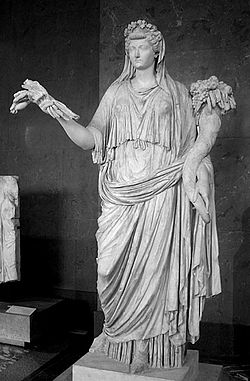
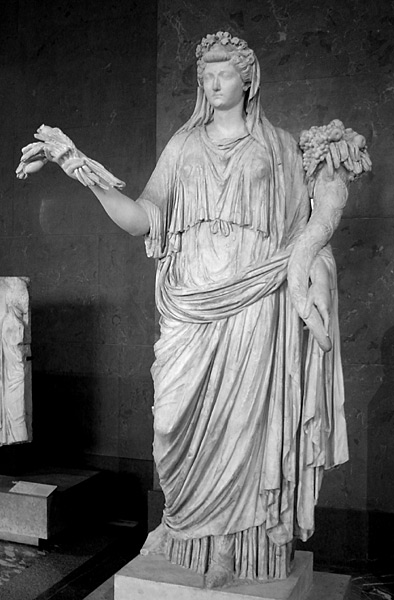
 Livia attired as the goddess Ops | |
| Other names | Opis ("Plenty") |
| Abode | Chthonic |
| Symbol | Lions, tambourine, crown, grains, cornucopia |
| Gender | female |
| Festivals | Opiconsivia |
| Genealogy | |
| Parents | Caelus, Terra |
| Siblings | Saturn, Janus |
| Consort | Saturn |
| Children | Jupiter, Neptune, Pluto, Juno, Ceres and Vesta |
| Equivalents | |
| Greek | Rhea |
In ancient Roman religion, Ops or Opis (Latin: "Plenty") was a fertility deity and earth goddess of Sabine origin. Her equivalent in Greek mythology was Rhea.
Iconography
[edit]In Ops's statues and coins, she is figured sitting down, as Chthonian deities normally are, and generally holds a scepter, or a corn spray and cornucopia. In Roman mythology the husband of Ops was Saturn.[1] Ops is identified as Rhea in Greek mythology, whose husband was Cronus, the bountiful monarch of the golden age; Cronus was Rhea's brother.
Name
[edit]In Latin writings of the time, the singular nominative (Ops) is not attested; only the form Opis is used by classical authors. According to Festus (203:19), "Ops is said to be the consort of Saturn by whom they wanted to signify the earth, because the earth distributes all wealth to the human genus." (Opis dicta est coniux Saturni per quam uolerunt terram significare, quia omnes opes humano generi terra tribuit).
The Latin word ops means "riches, goods, abundance, gifts, munificence, plenty".[2] The word is also related to opus, which means "work", particularly in the sense of "working the earth, ploughing, sowing". This activity was deemed sacred, and was often attended by religious rites intended to obtain the good will of chthonic deities such as Ops and Consus. Ops is also related to the Sanskrit word ápnas ("goods, property").
Worship
[edit]According to Roman tradition, the cult of Opis was instituted by Titus Tatius, one of the Sabine kings of Rome. Opis soon became the matron of riches, abundance, and prosperity. Opis had a famous temple in the Capitolium. Originally, a festival took place in Opis's honor on August 10. Additionally, on December 19[1] (some say December 9), the Opalia was celebrated. On August 25, the Opiconsivia was held. Opiconsivia was another name used for Opis, indicating when the earth was sown. These festivals also included activities that were called Consualia, in honor of Consus, her consort.
Mythology and literature
[edit]She is remembered in De Mulieribus Claris, a collection of biographies of historical and mythological women by the Florentine author Giovanni Boccaccio, composed in 1361–1362. It is notable as the first collection devoted exclusively to biographies of women in Western literature.[3]
References
[edit]- ^ a b Frazer, James George (1911). . In Chisholm, Hugh (ed.). Encyclopædia Britannica. Vol. 24 (11th ed.). Cambridge University Press. p. 231.
- ^ Lewis, Charlton T.; Short, Charles. "ops". A Latin Dictionary. perseus.tufts.edu. Retrieved 17 February 2016.
- ^ Boccaccio, Giovanni (2003) [1362]. Famous Women. I Tatti Renaissance Library. Vol. 1. Translated by Brown, Virginia. Cambridge, MA: Harvard University Press. p. xi. ISBN 0-674-01130-9.
Primary sources
[edit]- Boccaccio, Giovanni. (1362) De mulieribus claris.
- Livy Ab urbe condita libri XXIX.10.4–11.8, 14.5–14
- Lactantius, Divinae institutions I.13.2–4, 14.2–5
Secondary sources
[edit]- Virginia Brown's translation of Giovanni Boccaccio's Famous Women, pp. 12–13; Harvard University Press 2001; ISBN 0-674-01130-9
External links
[edit] Media related to Ops at Wikimedia Commons

| Deities (Dii Consentes) |  | |
|---|---|---|
| Legendary figures | ||
| Legendary beings | ||
| Texts | ||
| Concepts and practices | ||
| Philosophy | ||
| Events | ||
| Objects | ||
| Variations | ||
| See also | ||
| International | |
|---|---|
| Other | |

Etymology and Attributes
Name and Etymology
The name Ops derives from the Latin noun ops, which signifies "riches," "abundance," "resources," or "plenty," embodying the goddess's association with prosperity and fertile yields. This root also connects to related Latin terms such as opimus, meaning "fertile" or "rich," and opus, denoting "work" or "labor," reflecting the productive aspects of abundance in agricultural and material contexts. Ancient Roman scholars like Varro linked these derivations to the deity's role in ensuring communal wealth through earth's bounty, emphasizing ops as both a material and conceptual force.[2] The origins of Ops's name trace back to Sabine traditions, an indigenous Italic people whose religious practices influenced early Roman cult. According to Roman legend, the cult of Ops was instituted by Titus Tatius, the Sabine co-king of Rome alongside Romulus, who integrated Sabine deities into the Roman pantheon to symbolize alliance and shared fertility concepts rooted in central Italic agrarian life. This Sabine heritage underscores Ops as a pre-Roman earth figure tied to local Italic notions of soil productivity and communal resources, distinct from later Greek influences. Comparatively, the Latin ops shares etymological ties with the Proto-Indo-European root h₃ep-, meaning "to work" or "to produce in abundance," which evolved to denote wealth and labor across Indo-European languages. In Sanskrit, cognates include ápnas (or apnas), signifying "property," "possession," or "breath" in the sense of vital resources, and apas-, meaning "work" or "religious act," highlighting a shared conceptual link to prosperity and productive effort. These connections suggest Ops's name encapsulates an ancient Indo-European motif of abundance as the fruit of labor. Variations of the name, such as Opis—an archaic form emphasizing "plenty"—and Ops Consiva (or Consivia), further specify her agricultural dimensions; the epithet Consiva derives from conserere, "to sow," denoting her patronage of seeding and harvest preservation.[3] These forms highlight Ops's focused role in fertility rites, aligning her linguistic identity with the cycles of sowing and reaping essential to Roman agrarian society.Iconography and Symbols
In ancient Roman art, Ops was typically depicted as a seated goddess, a posture characteristic of chthonian deities associated with the earth and underworld, often holding a scepter symbolizing authority over abundance or a spray of grain representing agricultural fertility.[4] This iconography underscored her role as an earth mother, with symbols like the cornucopia reflecting etymological ties to opes, denoting plenty and prosperity.[5] Archaeological evidence from the Regia, her ancient shrine in the Roman Forum, includes fragments of archaic architectural decorations featuring birds and felines, suggesting early portrayals of Ops as a Potnia Theron or mistress of animals, linking her chthonic nature to the fertile soil and subterranean cycles.[6] On Roman coins, Ops appears seated with a scepter, personifying state wealth and harvest bounty, as seen in issues from the Republican and early Imperial periods.[7] Depictions of Ops are rare, reflecting her archaic cult's emphasis on abstract powers of bounty rather than anthropomorphic forms. A debated example is a 1st-century AD marble statue in the Louvre Museum (Ma 1242), sometimes identified as Livia Drusilla as Ops (or alternatively as Ceres), standing with a sheaf of wheat and a cornucopia, highlighting associations with imperial fertility and abundance.[8] This piece exemplifies the evolution from Ops's origins as a rustic Sabine figure tied to agrarian rituals to more regal, state-oriented representations in Roman temple reliefs and sculptures, where she often appears with sheaves of grain or harvest symbols to evoke the earth's productive depths.Worship and Cult
Temples and Sacred Sites
The cult of the Roman goddess Ops was traditionally attributed to the Sabine king Titus Tatius, who, following the integration of Sabines into early Rome around the mid-8th to 7th century BCE, established altars to several deities including Ops on the Capitoline Hill as part of the Sabine contribution to Roman religion.[6] This foundational role reflects Ops' archaic Sabine origins as a fertility and earth deity, though direct archaeological evidence for these early altars remains elusive. The primary physical manifestation of her worship on the Capitoline was a dedicated temple, distinct from nearby structures like the Temple of Jupiter Optimus Maximus, which served as a key site for her cult throughout the Republic. The Temple of Ops on the Capitoline Hill is first attested in historical records in 186 BCE, when it was struck by lightning, prompting expiatory rituals by the consul. Ancient sources credit its dedication to Lucius Caecilius Metellus, consul in 251 and 247 BCE, though this may refer to an earlier phase or vow rather than the final construction. The temple's dies natalis fell on August 23, aligning with harvest themes, and it functioned practically as a repository for the state treasury during crises, such as in 44 BCE when funds were drawn from it amid political turmoil. Restorations occurred during the late Republic, including work by Lucius Metellus Delmaticus between 123 and 114 BCE, underscoring its enduring institutional role in Roman civic life.[6] Architecturally, as a chthonic earth goddess, Ops was often depicted seated in her cult statues, symbolizing her connection to the fertile ground, though no specific subterranean features of the temple have been archaeologically confirmed.[1] Another significant sacred site was the shrine to Ops Consiva within the Regia, the pontifical residence adjacent to the Roman Forum, dating back to at least the 7th-6th century BCE and reflecting the institutionalization of her cult in Rome's archaic religious center.[6] Archaeological excavations reveal continuous occupation and rebuilding of the Regia from circa 600 BCE onward, with a dedicated sacrarium (shrine room) likely housing Ops' cult objects, evidenced by the site's trapezoidal layout and terracotta fragments suggesting ritual use.[1] Inscriptions and literary references confirm altars and rituals here, emphasizing Ops' role in abundance and secrecy, with the structure's multiple restorations—such as after fires in the 6th century BCE and under Augustus in 36 BCE—preserving its core function.[6] A secondary cult site, Ops ad Forum, near the Roman Forum and associated with the Opalia in December, featured open-air altars topographically linked to Saturn's temple, though fewer archaeological remains, such as votive inscriptions, survive from this location.[1]Festivals and Rituals
The festivals dedicated to Ops emphasized her role in agricultural abundance and the earth's fertility, reflecting the Roman emphasis on communal prosperity through harvest cycles. The Opalia, celebrated on December 19, was a rustic holiday primarily observed by farmers who offered grains and fruits at shrines or altars, invoking Ops for bountiful yields without animal sacrifices, underscoring the non-sacrificial, agrarian character of the rites.[6] These offerings symbolized gratitude for the stored harvest and prayers for future fertility, aligning with Ops' epithet as Consiva, the "Sower," and were conducted in a joyful, community-oriented manner near the Forum or Saturn's temple.[1] Another key observance, the Opiconsivia on August 25, focused on prayers for successful sowing and the upcoming harvest, held exclusively in the Regia where Ops Consiva had a sacred shrine accessible only to the pontifex maximus and Vestal Virgins.[6] The rituals were secretive and veiled, with participants performing offerings bare-handed while seated and touching the earth to invoke the goddess directly, emphasizing themes of fertility and the earth's hidden bounty. Tools like the praefericulum (a libation vessel) and possibly a secespita (sacrificial knife) were used, but the ceremonies avoided public spectacle, reinforcing Ops' chthonic nature.[6] The Consualia festivals on August 21 and December 15, dedicated to Consus as protector of stored seeds and grains, were closely associated with Ops through shared themes of agricultural renewal and timing near her own festivals, highlighting their complementary roles.[9] These events, originating from Romulus' era, featured chariot races in the Circus Maximus and communal feasts, with historical accounts attributing their institution to the need for divine aid in safeguarding harvests, as described by Livy in his narrative of early Roman religious foundations.[10] Invocations during these rites involved bare-handed gestures toward the ground, linking to the subterranean altar of Consus and underscoring the interconnected fertility themes in Roman cult practices.[6]Priesthoods and Practices
The cult of Ops lacked a dedicated flamen, unlike major deities such as Jupiter or Mars, but her rituals were overseen by key figures in the Roman state priesthood, including the Pontifex Maximus and the Vestal Virgins, who performed exclusive ceremonies in her shrine at the Regia.[2] The Flamen Quirinalis also participated in rites associated with Ops through her syncretism with Consus, such as the sacrifices of first fruits during the Consualia.[11] These personnel underscored the integration of Ops' worship into the official Roman religious hierarchy, where women like the Vestals held rare public ritual authority.[12] Due to Ops' chthonic nature as an earth goddess embodying fertility and abundance, her rituals emphasized secrecy and purity, restricting access to her sacrarium in the Regia solely to the Pontifex Maximus and Vestal Virgins, who conducted the rites without external observers.[2] This exclusivity reflected her subterranean associations, aligning with broader chthonic practices that prioritized organic or manual elements to honor the earth's essence.[12] Priests invoked Ops through tactile gestures, such as sitting on the ground and touching the earth with their hands, symbolizing direct communion with her fertile domain and renewal of agricultural bounty.[13] The priesthood of Ops evolved from Sabine origins, instituted by King Titus Tatius as part of the early Roman-Sabine religious fusion, gradually incorporating her into the state cult by the archaic period, with the Vestals' role highlighting the adaptation of indigenous earth worship to urban Roman needs.[14] Archaeological excavations at the Regia reveal continuous cult activity from the sixth century BCE, including altars linked to Ops Consiva.[12] These practices, emphasizing manual and earth-bound actions, peaked during harvest-related observances.Mythology and Associations
Family and Consort
In Roman mythology, Ops is identified as the consort and sister of Saturn, forming a divine pair that symbolized the union of earth and sky, with Ops representing fertility and abundance. Their partnership is depicted as ruling over the Golden Age, a primordial era of prosperity and harmony before the reign of Jupiter.[6] This relationship parallels the Greek deities Rhea and Cronus, to whom Ops and Saturn were syncretized in later traditions.[15] As the mother of the Olympian gods, Ops bore six children to Saturn: the sons Jupiter, Neptune, and Pluto, and the daughters Juno, Ceres, and Vesta. Ancient sources emphasize her nurturing role in their births, portraying her as a protective earth mother who safeguarded the divine progeny essential to the cosmic order.[15] Ovid specifically notes the birth of her daughters from Saturn's seed, underscoring Ops' generative power as a primordial fertility figure.[15] Ops' familial ties reflect her Sabine origins, where she was initially paired with local agrarian deities such as Consus before her full integration into the Roman pantheon under Titus Tatius. Varro's genealogical accounts position her as a foundational earth goddess among the Sabine imports, deriving her name from ops (abundance) and equating her with terra (earth), from which all divine and human lineages emanate.[6] In these lists, Ops appears as a progenitor deity, linking the rustic Sabine traditions to the broader Roman mythological framework.[6]Role in Roman Myths
In Roman mythology, Ops played a pivotal role as the consort of Saturn, embodying the earth's fertility and abundance to safeguard the divine lineage against Saturn's tyrannical tendencies. According to the adapted Titanomachy narrative, Saturn, fearing a prophecy that one of his children would overthrow him, devoured his offspring upon birth; Ops, however, concealed her youngest son Jupiter in secrecy, substituting a swaddled stone for him to deceive Saturn and ensure the succession of the Olympian order through her powers of fecundity and renewal.[16] This act underscored Ops' symbolic function as a protector of generational continuity, linking her innate bounty to the preservation of cosmic balance. Ops' myths are largely syncretic adaptations from Greek traditions, with few unique indigenous Roman or Sabine narratives preserved in ancient sources. Ops' association with the Golden Age further highlighted her as the embodiment of the earth's effortless plenty during Saturn's benevolent rule over Latium. In this mythical era of peace and prosperity, before the advent of human toil under Jupiter, Saturn taught agriculture to the indigenous peoples, with Ops representing the boundless fertility that sustained spontaneous abundance without laborious cultivation.[16] Her presence in these narratives symbolized the harmonious union of heaven and earth, where natural opulence flourished unchecked, reflecting archaic Roman ideals of sovereignty tied to agrarian wealth. Chthonic elements in Ops' myths connected her to the underworld and the cyclical rhythms of agriculture, portraying her as a mediator between subterranean depths and surface renewal. These tales emphasized her dual nature as both nourisher and guardian of buried seeds, embodying the eternal cycle of death and rebirth in Roman agrarian lore. Of Sabine provenance, Ops featured in rare indigenous myths as a harvest guardian invoked against famine, her cult integrated into Roman practices during the expansion into central Italy under kings like Titus Tatius. In these narratives, she protected stored grains from depletion, her rituals blending with those of Consus to avert crop failure amid territorial conquests, thus symbolizing communal resilience and the assimilation of Sabine fertility traditions into the burgeoning Roman state.Syncretism with Other Deities
In the early Roman religious tradition, Ops was equated with the Greek Titaness Rhea, the consort of Cronus and mother of Zeus, due to the parallel mythological pairing of Saturn and Cronus as divine rulers overthrown by their sons. This identification emphasized shared myths of divine birth, fertility, and the protection of progeny, as noted by ancient historians like Fabius Pictor, who portrayed Ops as the mother of Jupiter, and later elaborated in Macrobius' Saturnalia, where Ops is linked to Rhea through her role as earth mother and Saturn's wife. During the Hellenistic period, following the importation of the Phrygian Magna Mater cult in 204 BCE, Ops underwent further syncretism with Cybele, incorporating Phrygian elements such as lion symbolism and ecstatic rites into Roman interpretations of motherhood and abundance. Scholars like Bernadette Liou-Gille argue that Ops represented a Roman adaptation of Anatolian mother goddess archetypes, akin to Cybele's epiclesis, with evidence from literary sources like Ovid's Fasti, which blend Ops' Italic origins with Cybele's ecstatic worship to symbolize imperial fertility and protection. This merger reflected Rome's evolving religious landscape, where foreign cults enriched native deities amid expanding Hellenistic influences. Ops also exhibited close connections to indigenous Roman earth and agricultural goddesses, particularly Tellus (Terra Mater) and Ceres, though with distinctions highlighting her broader focus on prosperity and sovereignty rather than specific agrarian cycles. Varro, influenced by Stoic theology, explicitly identified Ops with Terra, portraying her as the source of earthly abundance, while Festus linked her to Consiva, a title evoking Tellus' nurturing aspects; however, Ops lacked Tellus' chthonic emphasis on burial and seismic forces. Similarly, Henri Le Bonniec documents an ancient association with Ceres, the goddess of grain (equivalent to Greek Demeter), renewed in the Augustan era through dedications like the 7 CE altars in the vicus Iugarius, which blended Ops' role in state wealth with Ceres' harvest themes, as evidenced by inscriptions and temple restorations. Iconographic overlaps, such as the cornucopia symbolizing overflowing plenty, further underscored these ties across the syncretic network. Historical evidence of Ops' syncretism appears in imperial-era artifacts and texts. Likewise, blends with Demeter occurred through Ceres' cult, with Augustan and later inscriptions portraying Ops in harvest rituals that echoed Demeter's Eleusinian mysteries, emphasizing communal prosperity in the empire's diverse pantheon.Literary and Historical References
Ancient Sources
In the historical narrative of Titus Livius (Livy), the temple of Ops on the Capitoline Hill is referenced as an established sacred site by the mid-second century BCE, notably when it was struck by lightning in 186 BCE, prompting additional religious observances ordered by the pontiffs.[17] This mention underscores Ops' role in state religion during the Republic, though the exact founding details are not preserved in the extant books of Ab Urbe Condita, likely due to gaps in the transmission of earlier volumes covering the Second Punic War era. Marcus Terentius Varro, in De Lingua Latina (Book 5), provides etymological insight into Ops' name, deriving it from opus ("work" or "labor"), linking her to the earth's productive power: "Terra Ops, quod hic omne opus et hac opus ad vivendum" ("Earth is Ops, because here is all work and by this work we live"). Varro further connects her to agricultural abundance and the foundational aspects of Roman life, emphasizing her Sabine origins and association with fertility. Ovid's Fasti (Book 6) poetically invokes Ops in the context of divine genealogy and her maternal fertility, portraying her as the consort of Saturn and mother to major deities: "They say that Juno and Ceres were born of Ops by Saturn's seed; the third daughter was Vesta."[15] This depiction highlights Ops' role in Roman mythology as a bountiful earth goddess, whose progeny symbolize cycles of growth and cosmic order, though the incomplete poem does not detail her festivals like the Opalia. The invocation serves to integrate her into the broader narrative of Roman religious calendar and divine family structures. Patristic authors, such as Lactantius in Divinae Institutiones (Book 1, Chapter 13), critique pagan worship of Ops and Saturn, dismissing their mythological pairing as absurd and contrary to true monotheism: "But it is undeniable that he [Jupiter] is born from Ops and Saturn. It is therefore an empty persuasion on the part of those who give the name of Jupiter to the supreme god."[18] Lactantius uses this genealogy to argue against the deification of natural forces, portraying Ops-Saturn unions in rituals as emblematic of idolatrous errors in Roman religion. Similar patristic condemnations, including those by Arnobius and Augustine, reference Ops' cults to illustrate the folly of polytheism, often citing her temples and festivals as sites of superstitious practices. Epigraphic evidence from the Republican era attests to dedications invoking Ops Consiva, the aspect of the goddess associated with sowing and harvest abundance, such as a late Republican inscription from Ameria (CIL XI 4153) offering vows for prosperity, and another from Pinna (CIL IX 3331) linking her to local agrarian cults.[1] These inscriptions, often found in temple contexts or rural settings, reflect Ops' widespread veneration in public and private worship, emphasizing her as a protector of resources and fertility during the Republic's expansion.Later Interpretations
In Giovanni Boccaccio's De Mulieribus Claris (1361–1362), Ops, referred to as Opis and depicted as the wife of Saturn and mother of the gods, is portrayed as a clever and devoted protector who saved her children from her husband's wrath through feminine ingenuity, earning her deification and reverence as a nurturing earth mother despite her mortal end from exhaustion. This humanistic biography emphasized her virtues of maternal care and resourcefulness, influencing Renaissance interpretations by humanizing mythological figures and promoting Ops as an exemplar of virtuous femininity in art and literature, such as in illuminated manuscripts that illustrated her role in abundance and family preservation.[19] During the 18th and 19th centuries, antiquarian scholars reexamined Ops through comparative mythology, linking her to Germanic abundance deities. Jacob Grimm, in his Teutonic Mythology (1835), referenced Ops Mater on page 254 in connection with Nerthus, Tacitus's described earth goddess associated with fertility and prosperity, suggesting syncretic parallels between Roman and Germanic traditions of earth mothers who embodied plenty and agricultural bounty. These studies highlighted Ops's Sabine origins and her role in harvest rituals, contributing to broader efforts to trace Indo-European goddess archetypes across cultures. 20th-century archaeological work has reinterpreted Ops's cult through evidence of syncretism, revealing her integration with local and Greek influences. Excavations at the Regia in Rome's Forum, ongoing since the late 19th century but intensified in the mid-20th, uncovered archaic terracotta decorations depicting motifs like the Minotaur and Potnia Theron (mistress of animals), interpreted as blending Ops with eastern and Greek legendary elements in her worship as a fertility power. At Pietrabbondante in Samnium, 1960s digs led by Adriano La Regina exposed Oscan inscriptions such as "kúnsíf deívúz" (linked to Ops Consiva) on stones and pottery, alongside Tiberian fragments bearing "Opalis," indicating her cult's adaptation in Italic contexts with syncretic agricultural and communal rites. In contemporary neopagan and cultural contexts, Ops features in reconstructionist practices as a symbol of sustainable abundance. Groups like Nova Roma incorporate her in rituals honoring earth fertility and communal prosperity, drawing on her ancient Opalia festival to emphasize ecological harmony and resource sharing.[4]References
- https://en.wikisource.org/wiki/From_the_Founding_of_the_City/Book_39