Hubbry Logo
The Golden AssThe Golden AssMain
Open search
The Golden Ass
Community hub
The Golden Ass
logo
8 pages, 0 posts
0 subscribers
Be the first to start a discussion here.
The Golden Ass
The Golden Ass
from Wikipedia

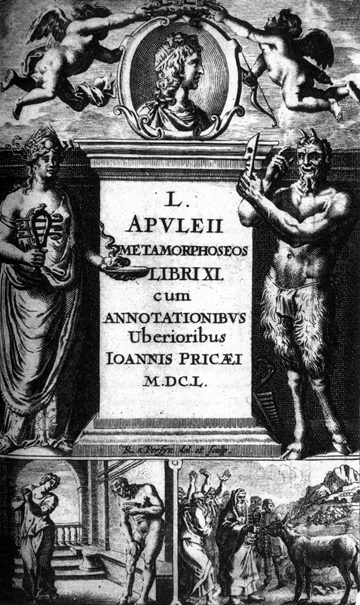
The Metamorphoses of Apuleius, which Augustine of Hippo referred to as The Golden Ass (Latin: Asinus aureus),[1] is the only ancient Roman novel in Latin to survive in its entirety.[2]

Key Information

The protagonist of the novel is Lucius.[3] At the end of the novel, he is revealed to be from Madaurus,[4] the hometown of Apuleius himself. The plot revolves around the protagonist's curiosity (curiositas) and insatiable desire to see and practice magic. While trying to perform a spell to transform into a bird, he is accidentally transformed into an ass. This leads to a long journey, literal and metaphorical, filled with inset tales. He finally finds salvation through the intervention of the goddess Isis, whose cult he joins.

Origin

[edit]
Lucius takes human form, in a 1345 illustration of the Metamorphoses (ms. Vat. Lat. 2194, Vatican Library).

The date of composition of the Metamorphoses is uncertain. It has variously been considered by scholars as a youthful work preceding Apuleius' Apology of 158–159, or as the climax of his literary career, and perhaps as late as the 170s or 180s.[5] Apuleius adapted the story from a Greek original of which the author's name is said to be an otherwise unknown "Lucius of Patrae", also the name of the lead character and narrator.[6]

This Greek text by Lucius of Patrae has been lost, but there is Lucius or the Ass (Λούκιος ἢ ὄνος, Loukios ē onos), a similar tale of disputed authorship, traditionally attributed to the writer Lucian, a contemporary of Apuleius. This surviving Greek text appears to be an abridgement or epitome of Lucius of Patrae's text.[7]

Manuscripts

[edit]

The Metamorphoses has survived in about 40 manuscripts, all or almost all of which are descendants of codex Laurentianus 68.2 (also called F in critical apparatuses), an extant 11th-century manuscript produced in Monte Cassino. Editors of the text have therefore seen it as their goal to apply textual criticism to this particular manuscript, ignoring the rest except for occasional consultation. The text is characterized by a number of non-standard spellings, notably the frequent interchange of the letters b and v.[8]

Plot

[edit]

Book One

[edit]

The prologue establishes an audience and a speaker, who defines himself by location, education, occupation, and his kinship with the philosophers Plutarch and Sextus of Chaeronea. The narrator journeys to Thessaly on business. On the way, he runs into Aristomenes and an unnamed traveler. The unnamed traveler refuses to believe Aristomenes' story. The narrator insults the unnamed traveler and tells a short story about a sword swallower. He promises Aristomenes a free lunch if he will retell his tale. The narrator believes Aristomenes' tale and becomes more eager to learn about magic. The narrator arrives at Hypata, where he stays with Milo, a friend and miser, and his wife Pamphile. Photis, a serving girl in Milo's household, takes the narrator to the baths, after which the narrator goes to the marketplace. There, he buys some fish and runs into his old friend Pytheas, who is now a market official. Pytheas reveals the narrator's name as Lucius. Pytheas says that Lucius overpaid for the fish and humiliates the fish-monger by trampling on the fish. Lucius returns to Milo's house, hungry and empty-handed. Milo asks Lucius about his life, his friends, and his wanderings, which Lucius grows bored with. Lucius goes to sleep hungry.

Book Two

[edit]

The next morning, Lucius meets up with his suspicious aunt Byrrhena in the town, and she brings him home and warns him that Milo's wife is an evil witch who wants to kill Lucius, who is interested in becoming a witch himself. He then returns to Milo's house, where he makes love to Photis. The next day, Lucius goes to his aunt's home for dinner, and there meets Thelyphron, who relates his tale about how witches cut off his nose and ears. After the meal, Lucius drunkenly returns to Milo's house in the dark, where he encounters three robbers, whom he soon slays before retiring to bed.

Book Three

[edit]
Lucius spies Milo's wife transforming into a vulture. Illustration by Jean de Bosschère

The next morning, Lucius is abruptly awoken and arrested for the murder of the three men. He is taken to court, where he is laughed at constantly, and witnesses are brought against him. They are just about to announce his guilt when the widow demands to bring out the dead bodies; but when the three bodies of the murdered men are revealed, they turn out to be puffed-up wineskins. It turns out that it was a prank, played by the town upon Lucius, to celebrate their annual Festival of Laughter. Later that day, Lucius and Photis watch Milo's wife perform her witchcraft and transform herself into a bird. Wishing to do the same, Lucius begs Photis to transform him, but she accidentally turns him into an ass, at which point Photis tells him that the only way for him to return to his human state is to eat a fresh rose. She puts him in the stable for the night and promises to bring him roses in the morning, but during the night Milo's house is raided by a band of thieves, who steal Lucius the ass, load him up with their plunder, and leave with him.

Book Four

[edit]

On a break in his journey with the bandits, Lucius the ass trots over to a garden to munch on what seem to be roses (but are actually poisonous rose-laurels) when he is beaten by the gardener and chased by dogs. The thieves reclaim him and he is forced to go along with them; they talk about how their leader Thrasileon has been killed while dressed as a bear. The thieves also kidnap a rich young woman, Charite, who is housed in a cave with Lucius the ass. Charite starts crying, so an elderly woman who is in league with the thieves begins to tell her the story of Cupid and Psyche.

Psyche is the most beautiful woman on earth, and Venus jealously arranges for Psyche's destruction, ordering her son Cupid to arrange for her to fall in love with a worthless wretch. An oracle tells Psyche's parents to expose her on a mountain peak, where she will become the bride of a powerful, monstrous being. Psyche is left on the mountain, and carried away by a gentle wind.

Book Five

[edit]

The elderly woman continues telling the story of Cupid and Psyche. Cupid, Venus's son, secretly protects Psyche; Cupid becomes Psyche's mysterious husband, who is invisible to her by day and visits her only at night. Psyche's jealous sisters arouse her curiosity and fear about her husband's identity; Psyche, against Cupid's commands, looks at him by lamplight which wakes Cupid; Cupid abandons Psyche, who wanders in search of him, and takes revenge on her wicked sisters.

Book Six

[edit]

The elderly woman finishes telling the story of Cupid and Psyche, as Psyche is forced to perform various tasks for Venus (including an errand to the underworld) with the help of Cupid and an assortment of friendly creatures, and is finally reunited with her husband. Then Jupiter transforms Psyche into a goddess. That is the end of the tale. Lucius the ass and Charite escape from the cave but they are caught by the thieves, and sentenced to death.

Charitë embraces Tlepolemus while Lucius looks on. From an illustration by Jean de Bosschère

Book Seven

[edit]

A man appears to the thieves and announces that he is the renowned thief Haemus the Thracian, who suggests that they should not kill the captives but sell them. Haemus later reveals himself secretly to Charite as her fiancé Tlepolemus, and gets all of the thieves drunk. When they are asleep he slays them all. Tlepolemus, Charite and Lucius the ass safely escape back to the town. Once there, the ass is entrusted to a horrid boy who intends to castrate him but the boy is later killed by a she-bear. Enraged, the boy's mother plans to kill the ass.

Book Eight

[edit]

A man arrives at the mother's house and announces that Tlepolemus and Charite are dead, caused by the scheming of the evil Thrasillus who wants Charite to marry him. After hearing the news of their master's death, the slaves run away, taking the ass Lucius with them. The large group of travelling slaves is mistaken for a band of robbers and attacked by farmhands of a rich estate. Several other misfortunes befall the travelers until they reach a village. Lucius as the narrator often digresses from the plot in order to recount several scandal-filled stories that he learns of during his journey. Lucius is eventually sold to a gallus priest of Cybele. He is entrusted with carrying the statue of Cybele on his back while he follows the group of priests on their rounds, who perform ecstatic rites in local farmsteads and estates for alms. While engaging in lewd activity with a local boy, the group of priests is discovered by a man in search of a stolen ass who mistakes Lucius' braying for that of his own animal. The priests flee to a new city where they are well received by one of its chief citizens. They are preparing to dine when his cook realizes that the meat that was to be served was stolen by a dog. The cook, at the suggestion of his wife, prepares to kill Lucius in order to serve his meat instead.

Lucius encounters the murderous wife. Illustration by Jean de Bosschère

Book Nine

[edit]

Lucius' untimely escape from the cook coincides with an attack by rabid dogs, and his wild behavior is attributed to their viral bites. The men barricade him in a room until it is decided that he is no longer infected. The band of galli eventually pack up and leave.

The narrative is interrupted by the Tale of the Wife's Tub.

Soon after, the galli are accosted by an armed troop who accuse them of stealing from their village temple, and are subsequently detained (with the treasures returned). Lucius is sold into labor, driving a baker's mill-wheel. Lucius, though bemoaning his labor as an ass, also realizes that this state has allowed him to hear many novel things with his long-ass ears.

The Tale of the Jealous Husband and the Tale of the Fuller's Wife mark a break in the narrative. The theme of the two intervening stories is adultery, and the text appropriately follows with the adultery of the baker's wife and the subsequent murder of the baker.

Lucius the ass is then auctioned off to a farmer. The Tale of the Oppressive Landlord is here told. The farmer duly assaults a legionary who makes advances on his ass, Lucius, but he is found out and jailed.

Lucius is returned to human form during the Navigium Isidis. From an illustration by Jean de Bosschère

Book Ten

[edit]

Lucius comes into the legionary's possession, and after lodging with a decurion, Lucius recounts the Tale of the Murderous Wife. He is then sold to two brothers, a confectioner and a cook, who treat him kindly. When they go out, Lucius secretly eats his fill of their food. At first a source of vexation, when the ass is discovered to be the one behind the disappearing food it is much laughed at and celebrated.

Again he is sold, and he is taught many amusing tricks. Rumor spreads, and great fame comes to the ass and his master. As it happens, a woman is so enamored with the sideshow ass that she bribes his keeper and takes Lucius the ass to her bed. Lucius is then scheduled to have sex in the arena with a multiple murderess before she is to be eaten by wild beasts; the Tale of the Jealous Wife tells her backstory.

After an enactment of the judgment of Paris, and a brief digression on philosophy and corruption, the time comes for Lucius to make his much-anticipated appearance. At the last moment he decides that copulating with such a wicked woman would be repugnant to him, and, moreover, the wild beasts would likely eat him along with her; and so he runs away to Cenchreae, eventually to nap on the beach.

Book Eleven

[edit]

Lucius wakes up in a panic during the first watch of the night. Considering Fate to be done tormenting him, he takes the opportunity to purify himself by seven consecutive immersions in the sea. He then offers a prayer to the Queen of Heaven, for his return to human form, citing all the various names the goddess is known by to people everywhere (Venus, Ceres, Diana, Proserpine, etc.). The Queen of Heaven appears in a vision to him and explains to him how he can be returned to human form by eating the crown of roses that will be held by one of her priests during a religious procession the following day. In return for his redemption, Lucius is expected to be initiated through the Navigium Isidis into Isis' priesthood, Isis being the Queen of Heaven's true name. Lucius follows her instructions and is returned to human form and, at length, initiated into her priesthood.

Lucius is then sent to his ancestral home, Rome, where he continues to worship Isis under the local name, Campensis. After a time, he is visited once more by the goddess, who speaks again of mysteries and holy rites which Lucius comes to understand as a command to be initiated into the mysteries of Isis. He does so.

Shortly afterwards, he receives a third vision. Though he is confused, the god appears to him and reassures him that he is much blessed and that he is to become once more initiated that he might supplicate in Rome as well.

The story concludes with the goddess, Isis, appearing to Lucius and declaring that Lucius shall rise to a prominent position in the legal profession and that he shall be appointed to the College of Pastophori ("shrine-bearer", from Ancient Greek: παστοφόρος) that he might serve the mysteries of Osiris and Isis. Lucius is so happy that he goes about freely exposing his bald head.

Inset stories

[edit]

Similar to other picaresque novels, The Golden Ass features several shorter stories told by characters encountered by the protagonist. Some act as independent short stories, while others interlock with the original novel's plot developments.

Aristomenes' Tale

[edit]

At the beginning of Book One, Lucius encounters two men arguing on the road about the truth of one's story. Lucius is interested, and offers the teller a free lunch for his tale.

Aristomenes goes on business for cheese and he runs into his friend Socrates, who is disheveled and emaciated. Aristomenes clothes Socrates and takes him to the bathhouse. Aristomenes berates Socrates for leaving his family. While they are eating lunch, Socrates tells about his affair with Meroë. Socrates tells Aristomenes that Meroë is an ugly witch who turns her ex-lovers into rather unfortunate animals. Aristomenes doesn't believe Socrates' tale but is nevertheless afraid. Aristomenes barricades the door and they both go to bed. In the middle of the night, Meroë and Panthia break in, cut open Socrates, drain his blood, rip out his heart, and replace it with a sponge. Before leaving, they urinate on Aristomenes. The witches spare Aristomenes because they want him to bury Socrates in the land. Aristomenes fears that he will be blamed for the death of his friend and attempts to hang himself, but is comically stopped when the rope is revealed to be too rotten to support his weight. In the morning, Socrates wakes up and everything seems to be normal. They continue travelling and reach a stream, where Socrates bends to take a drink, which causes the sponge to fall out and him to die. Aristomenes buries Socrates in the ground, and then proceeds on his way.

Thelyphron's Tale

[edit]

In Book Two, Thelyphron hesitantly relates a story requested at a dinner party that was previously popular with his friends:

While a student, Thelyphron partakes in many wanderings and eventually runs out of funds. At Larissa, he encounters a large sum being offered to watch over a corpse for the night. Thelyphron is bemused and asks if the dead are accustomed to flee in Larissa. When he asks, a citizen criticises him and tells Thelyphron not to make fun of the task and warns him that shape-shifting witches are quite common in the area, using pieces of human flesh to fuel incantations. Thelyphron takes the job for a thousand drachme and is warned to stay very alert all through the night. The widow is at first hesitant, taking inventory of the body's intact parts. Thelyphron requests a meal and some wine, to which she promptly refuses and leaves him with a lamp for the night. A weasel enters the room and Thelyphron, frightened by its appearance, quickly chases it out, then falls into a deep sleep. At dawn, Thelyphron awakes and rushes over to the body in the room; to his relief, he finds the body intact. The widow enters, and calls for Thelyphron to be paid, satisfied with the intact corpse. Thanking the widow, Thelyphron is suddenly attacked by the crowd and narrowly escapes. He witnesses an elder of the town approach the townspeople desperately and claim that the widow had poisoned her husband to cover up a love affair. The widow protests and supposedly fakes her sadness and a necromancer is called to bring back the deceased for the only truly reliable testimony. The corpse awakes, and affirms the widow's guilt. The corpse then continues to talk and thanks Thelyphron for his trouble; during the night the witches entered as small animals and began to call the corpse and wake him up. By chance, Thelyphron was both the name of the corpse and the guard. Consequently, the witches steal pieces of his ears and nose instead of from the corpse. The witches cleverly replace the missing flesh with wax to delay discovery. Thelyphron touches his nose and ears to find wax fall out of where they once were in the crowd. The crowd laughs at Thelyphron's humiliation.

Psyche et L'Amour (Psyche and Amor). William-Adolphe Bouguereau, 1889

Tale of Cupid and Psyche

[edit]

In Book Four, an elderly woman tells the story to comfort the bandits' captives. The story is continued through Books Five and Six.

Psyche, the most beautiful woman in the world, is envied by her family as well as by Venus. An oracle of Venus demands she be sent to a mountaintop and wed to a murderous beast. Sent by Venus to destroy her, Cupid falls in love and flies her away to his castle. There she is directed to never seek to see the face of her husband, who visits and makes love to her in the dark of night. Eventually, Psyche wishes to see her sisters, who jealously demand she seek to discover the identity of her husband. That night, Psyche discovers her husband is Cupid while he is sleeping, but accidentally burned him with her oil lamp. Infuriated, he flies to heaven and leaves her banished from her castle. In attempted atonement, Psyche seeks the temple of Venus and offers herself as a slave. Venus assigns Psyche four impossible tasks. First, she is commanded to sort through a great hill of mixed grains. In pity, many ants aid her in completing the task. Next, she is commanded to retrieve wool of the dangerous golden sheep. A river god aids Psyche and tells her to gather clumps of wool from thorn bushes nearby. Venus next requests water from a cleft high beyond mortal reach. An eagle gathers the water for Psyche. Next, Psyche is demanded to seek some beauty from Proserpina, Queen of the Underworld. Attempting to kill herself to reach the underworld, Psyche ascends a great tower and prepares to throw herself down. The tower speaks, and teaches Psyche the way of the underworld. Psyche retrieves the beauty in a box, and, hoping to gain the approval of her husband, opens the box to use a little. She is put into a coma. Cupid rescues her, and begs Jupiter that she may become immortal. Psyche is granted Ambrosia, and the two are forever united.

The story is the best-known of those in The Golden Ass and frequently appears in or is referred to directly in later literature.

Tale of the Wife's Tub

[edit]
The Wife and her lover near the Tub. Illustration by Jean de Bosschère

In the course of a visit to an inn in Book Nine, a smith recounts an anecdote concerning his wife's deceit:

During the day, her husband absent at his labors, the smith's wife is engaged in an adulterous affair. One day, the smith, work finished well ahead of schedule, returns home prematurely—obviously to his wife's great consternation. Panicked, the faithless woman hides her lover in an old tub. After absorbing his spouse's efforts at distraction, which take the form of bitter reproaches that his coming back so early betokens a laziness that can only worsen their poverty, the smith announces that he has sold the tub for six drachmae; to this his wife responds by saying that she has in fact already sold it for seven, and has sent the buyer into the tub to inspect it. Emerging, the lover complains that his supposed purchase is in need of a proper scrubbing if he is to close the deal, so the cuckolded smith gets a candle and flips the tub to clean it from underneath. The canny adulteress then lies atop of the tub and while her lover pleasures her, instructs her hapless husband as to where he should apply his energies. To add insult to injury, the ill-used man eventually has to deliver the tub to the lover's house himself.

Tale of the Jealous Husband

[edit]

In Book Nine, a baker's wife of poor reputation is advised by a female 'confidant' to be wary of choosing her lover, suggesting she find one very strong of body and will. She relates the story of one of the wife's previous school friends:

Barbarus, an overbearing husband, is forced to leave on a business trip, and commands his slave, Myrmex, to watch his wife, Aretë, closely to assure she is being faithful during his time away. Barbarus tells Myrmex that any failure will result in his death. Myrmex is so intimidated that he does not let Aretë out of his sight. Aretë's looks charm Philesietaerus who vows to go to any lengths to gain her love. Philesietaerus bribes Myrmex with thirty gold pieces and the promise of his protection for allowing him a night with Aretë. Becoming obsessed with gold, Myrmex delivers the message to Aretë and Philesietaerus pays Myrmex a further ten pieces. While Aretë and Philesietaerus are making love, Barbarus returns but is locked out of the house. Philesietaerus leaves in a hurry, leaving behind his shoes. Barbarus does not notice the strange shoes until the morning, at which point he chains Myrmex's hands and drags him through town, screaming, while looking for the shoes' owner. Philesietaerus spots the two, runs up, and with great confidence shouts at Myrmex, accusing him of stealing his shoes. Barbarus allows Myrmex to live, but beats him for the 'theft'.

Tale of the Fuller's Wife

[edit]

In Book Nine the baker's wife attempts to hide her lover from her husband, and entertains to her husband's story of the Fuller:

While coming home with the Baker for supper, the Fuller interrupts his wife's love-making with a lover. She frantically attempts to hide her lover in a drying cage in the ceiling, hidden by hanging clothes soaked in sulphur. The lover begins to sneeze, and at first the Fuller excuses his wife. After a few sneezes, the Fuller gets up and turns over the cage to find the lover waiting. The Fuller is talked out of beating the young man to death by the Baker, who points out that the young man will shortly die from the sulphur fumes if left in the cage. The Fuller agrees and returns the lover to the cage.

The tale is used to contrast the earlier tale told to the Baker's wife of high suspicion and quick judgments of character by her "auntie" with the overly naïve descriptions of nefarious people by her husband.

Tale of the Jealous Wife

[edit]

In Book Ten a woman condemned to public humiliation with Lucius tells him her crimes:

A man goes on a journey, leaving his pregnant wife and infant son. He commands his wife that if she bears a daughter, the child is to be killed. The child is indeed a daughter, and in pity, the mother convinces her poor neighbours to raise her. Her daughter grows up ignorant of her origin, and when she reaches a marriageable age, the mother tells her son to deliver her daughter's dowry. The son begins preparation to marry the girl off to a friend, and lets her into his home under the guise of her being an orphan to all but the two of them. His wife is unaware the girl is his sister, and believes he keeps her as a mistress. His wife steals her husband's signet ring and visits their country home accompanied by a group of slaves. She sends a slave with the signet to fetch the girl and bring her to the country home. The girl, aware that the husband is her brother, responds immediately, and on arrival at the country home is flogged by the wife's slaves, and put to death by a torch placed 'between her thighs'. The girl's brother takes the news and falls gravely ill. Aware of suspicions around her, his wife asks a corrupt doctor for instant poison. Accompanied by the doctor, she brings the poison to her husband in bed. Finding him surrounded by friends, she first tricks the doctor into drinking from the cup to prove to her husband the drink is benign, and giving him the remainder. Unable to return home in time to seek an antidote, the doctor dies telling his wife what happened and to at least collect a payment for the poison. The doctor's widow asks for payment but first offers the wife the remainder of her husband's collection of poisons. Finding that her daughter is next of kin to her husband for inheritance, the wife prepares a poison for both the doctor's widow and her daughter. The doctor's widow recognizes early the symptoms of the poison and rushes to the Governor's Home. She tells the Governor the whole of the connected murders and dies. The wife is sentenced to death by wild beasts and to have public intercourse with Lucius the ass.

Overview

[edit]
The episodic structure of The Golden Ass inspired the style of humorous travel in picaresque novels such as The Life and Opinions of Tristram Shandy, Gentleman (pictured) and The History of Tom Jones, a Foundling.

The text is a precursor to the literary genre of the episodic picaresque novel, in which Francisco de Quevedo, François Rabelais, Giovanni Boccaccio, Miguel de Cervantes, Voltaire, Daniel Defoe and many others have followed. It is an imaginative, irreverent, and amusing work that relates the ludicrous adventures of one Lucius, a virile young man who is obsessed with magic. Finding himself in Thessaly, the "birthplace of magic," Lucius eagerly seeks an opportunity to see magic being used. His overenthusiasm leads to his accidental transformation into an ass. In this guise, Lucius, a member of the Roman country aristocracy, is forced to witness and share the miseries of slaves and destitute freemen who are reduced, like Lucius, to being little more than beasts of burden by their exploitation at the hands of wealthy landowners.

The Golden Ass is the only surviving work of literature from the ancient Greco-Roman world to examine, from a first-hand perspective, the abhorrent condition of the lower classes. Yet despite its serious subject matter, the novel remains imaginative, witty, and often sexually explicit. Numerous amusing stories, many of which seem to be based on actual folk tales, with their ordinary themes of simple-minded husbands, adulterous wives, and clever lovers, as well as the magical transformations that characterize the entire novel, are included within the main narrative. The longest of these inclusions is the tale of Cupid and Psyche, encountered here for the first but not the last time in Western literature.

Style

[edit]

Apuleius' style is innovative, mannered, baroque and exuberant, a far cry from the more sedate Latinity familiar from the schoolroom. In the introduction to his translation of The Golden Ass, Jack Lindsay writes:

Let us glance at some of the details of Apuleius' style and it will become clear that English translators have not even tried to preserve and carry over the least tincture of his manner ... Take the description of the baker's wife: saeva scaeva virosa ebriosa pervicax pertinax...(IX.14)  The nagging clashing effect of the rhymes gives us half the meaning. I quote two well-known versions: "She was crabbed, cruel, cursed, drunken, obstinate, niggish, phantasmagoric." "She was mischievous, malignant, addicted to men and wine, forward and stubborn." And here is the most recent one (by R. Graves): "She was malicious, cruel, spiteful, lecherous, drunken, selfish, obstinate." Read again the merry and expressive doggerel of Apuleius and it will be seen how little of his vision of life has been transferred into English.

Lindsay's own version is: "She was lewd and crude, a toper and a groper, a nagging hag of a fool of a mule."

Sarah Ruden's recent translation is: "A fiend in a fight but not very bright, hot for a crotch, wine-botched, rather die than let a whim pass by—that was her."[9]

Apuleius' vocabulary is often eccentric and includes some archaic words. S. J. Harrison argues that some archaisms of syntax in the transmitted text may be the result of textual corruption.[10]

Final book

[edit]

In the last book, the tone abruptly changes. Driven to desperation by his asinine form, Lucius calls for divine aid, and is answered by the goddess Isis. Eager to be initiated into the mystery cult of Isis, Lucius abstains from forbidden foods, bathes and purifies himself. Then the secrets of the cult's books are explained to him and further secrets revealed, before going through the process of initiation which involves a trial by the elements in a journey to the underworld. Lucius is then asked to seek initiation into the cult of Osiris in Rome, and eventually becomes initiated into the pastophoroi, a group of priests that serves Isis and Osiris.[11]

Adaptations and influence

[edit]

The style of autobiographical confession of suffering in The Golden Ass influenced Augustine of Hippo in the tone and style—partly in polemic—of his Confessions.[12] Scholars note that Apuleius came from the Algerian city of M'Daourouch in Souk Ahras Province, where Augustine would later study. Augustine refers to Apuleius and The Golden Ass particularly derisively in The City of God.

In Giovanni Boccaccio's 14th-century work The Decameron, the tenth tale of the fifth day is based on the Tale of the Fuller's Wife, and the second tale of the seventh day is based on the Tale of the Wife's Tub.

The writing of William Shakespeare was influenced by The Golden Ass, e.g., A Midsummer Night's Dream from c. 1595, where the character Bottom's head is transformed to that of an ass.[13]

In 1517, Niccolò Machiavelli wrote his own version of the story, as a terza rima poem. It was uncompleted at the time of his death.[14]

In 1708, Charles Gildon published an adaptation of The Golden Ass, titled The New Metamorphosis. A year later in 1709, he published a re-adaptation, titled The Golden Spy, which is regarded as the first, fully-fledged it-narrative in English.[15]

In 1821, Charles Nodier published "Smarra ou les Demons de la Nuit" influenced by a reading of Apuleius.

In 1883, Carlo Collodi published The Adventures of Pinocchio which includes an episode in which the puppet protagonist is transformed into an ass. Another character who is transformed alongside him is named Lucignolo (Candlewick or Lampwick), a possible allusion to Lucius. The episode is frequently featured in its subsequent adaptations.

In 1885, Walter Pater published Marius the Epicurean, a coming-of-age novel set in Ancient Rome. In Chapter V, he included his own translation of Apuleius' tale of Cupid and Psyche, which profoundly influenced the protagonist's philosophical, aesthetic, and intellectual development.[16]

In 1915, Franz Kafka published the short story The Metamorphosis under a quite similar name, about a young man's unexpected transformation into an "Ungeziefer", a verminous bug.

In 1956, C. S. Lewis published the allegorical novel, Till We Have Faces, retelling the Cupid–Psyche myth from books four through six of The Golden Ass from the point of view of Orual, Psyche's jealous ugly sister. The novel revolves upon the threat and hope of meeting the divine face to face. It has been called Lewis's "most compelling and powerful novel".[17]

In 1985, comic-book artist Georges Pichard adapted the text into a graphic novel titled Les Sorcières de Thessalie.

In April 1999, the Canadian Opera Company produced an operatic version of The Golden Ass by Randolph Peters, the libretto of which was written by celebrated Canadian author Robertson Davies. An operatic production of The Golden Ass also appears as a plot device in Davies's novel A Mixture of Frailties (1958).

In 1999, comic-book artist Milo Manara adapted the text into a fairly abridged graphic novel version named Le metamorfosi o l'asino d'oro.

In the fantasy novel Silverlock by John Myers Myers, the character Lucius Gil Jones is a composite of Lucius, Gil Blas in Gil Blas by Alain-René Lesage, and Tom Jones in The History of Tom Jones, a Foundling by Henry Fielding.

English translations

[edit]
  • Apuleius; Adlington, William (Trans.) (1566). The Golden Ass. Wordsworth Classics of World Literature, Wordsworth Ed. Ltd.: Ware, GB. ISBN 1-85326-460-1
  • Apuleius; Taylor, Thomas (Trans.) (1822). The Metamorphosis, or The Golden Ass, and Philosophical Works, of Apuleius. London: J. Moyes (Suppressed (dirty) passages printed separately.)
  • Apuleius; Head, George (Trans.) (1851). The Metamorphosis of Apuleius; A Romance of the Second Century. London: Longman, Brown, Green, and Longmans. (Bowdlerized)
  • Apuleius; Anonymous Translator (Trans.) (1853). The Works of Apuleius. London: Bohn's Library.
  • Apuleius; Byrne, Francis D. (Trans.) (1904). The Golden Ass. London: The Imperial Press. (Dirty passages rendered in original Latin.)
  • Apuleius; Butler H. E. (Trans.) (1910). The Golden Ass. London: The Clarendon Press. (Dirty passages removed.)
  • Apuleius; Graves, Robert (Trans.) (1950). The Golden Ass. Penguin Classics, Penguin Books Ltd. ISBN 0-374-53181-1
  • Apuleius; Lindsay, Jack (Trans.) (1962). The Golden Ass. Bloomington: Indiana University Press. ISBN 0-253-20036-9
  • Apuleius; Hanson, John Arthur (Trans.) (1989). Metamorphoses. Loeb Classical Library, Harvard University Press. ISBN 0-674-99049-8 (v. 1), ISBN 0-674-99498-1 (v. 2)
  • Apuleius; Walsh, P.G. (Trans.) (1994). The Golden Ass. New York: Oxford UP. ISBN 978-0-19-283888-9
  • Apuleius; Kenney, E.J. (Trans.) (1998, rev. 2004). The Golden Ass. London: Penguin. ISBN 978-0-14-043590-0
  • Apuleius; Relihan, Joel C. (Trans.) (2007). The Golden Ass Or, A Book of Changes Hackett Publishing Company: Indianapolis. ISBN 978-0-87220-887-2
  • Apuleius; Ruden, Sarah (Trans.) (2011). The Golden Ass. Yale UP. ISBN 978-0-300-15477-1
  • Apuleius; Finkelpearl, Ellen D. (Trans.) (2021) The Golden Ass (edited and abridged by Peter Singer). New York: Liveright Publishing Corporation; London: W.W. Norton and Company, Ltd.

See also

[edit]

Footnotes

[edit]

References and further reading

[edit]
[edit]
Revisions and contributorsEdit on WikipediaRead on Wikipedia
from Grokipedia
The Golden Ass (Latin: Asinus aureus), formally titled Metamorphoses, is the sole ancient Roman novel to survive complete, composed in Latin by the North African author Apuleius in the mid-second century AD. It narrates the first-person adventures of Lucius, a curious young Greek traveling in Thessaly, who experiments with witchcraft and is accidentally transformed into a donkey, enduring a series of bawdy, perilous escapades that expose the follies and corruptions of human society before his restoration to human form through the merciful intervention of the goddess Isis. Apuleius of Madauros, born around 123 AD in what is now Algeria and dying circa 170 AD, was a Romanized Berber philosopher, orator, and polymath who studied Platonism in Athens and Carthage before practicing law and rhetoric across the empire. Likely written between 160 and 180 AD during Apuleius's later career, possibly after his acclaimed defense speech Apologia, the novel draws on Greek literary traditions like the lost Metamorphoses by Lucius of Patrae while infusing them with Roman, African, and mystery religion elements to create a unique blend of satire, erotica, and spirituality. Structured in eleven books, The Golden Ass alternates between the main plot of Lucius's asinine trials—including thefts, abductions, and spectacles—and embedded tales such as the myth of , a romantic of the soul's journey toward divine love that has inspired countless adaptations in art and literature. Central themes revolve around curiositas (insatiable ) as both a catalyst for downfall and a path to enlightenment, the fluidity of identity and transformation, and the redemptive power of worship, reflecting Apuleius's own interests in , , and eclectic amid the Roman Empire's . The work's enduring influence spans centuries, shaping medieval beast fables, romances like those of Boccaccio, and modern novels from Apuleius-inspired picaresque narratives to psychological explorations of , while its vivid portrayal of ancient social life—from festivals to —provides invaluable historical insight into second-century provincial Roman culture.

Background and Authorship

Apuleius and His Life

Apuleius, also known as Lucius Apuleius Madaurensis, was born around 125 CE in Madauros (modern M'Daourouch, ), a prosperous Roman colony in , Proconsularis, into a wealthy family whose father served as a leading (duumvir). He received an elite education, studying in , philosophy in —where he was initiated into the —and law in , before traveling extensively in the and . As a Platonist philosopher, he embraced , which influenced his intellectual pursuits and later writings. After completing his studies in the mid-150s CE, Apuleius fell ill while en route to Alexandria and was nursed back to health in Oea (modern Tripoli, Libya) by Aemilia Pudentilla, a wealthy widow; he married her shortly thereafter, a union that prompted accusations of sorcery from her relatives seeking to control her estate. In 158–159 CE, he stood trial for magic (maleficium) before the proconsul Claudius Maximus in Sabratha, Libya, where charges included using spells to seduce Pudentilla and practicing occult arts; Apuleius defended himself eloquently in his speech Apologia, securing acquittal and highlighting his rhetorical prowess as a lawyer and orator. Following the trial, he settled in Carthage, where he established a successful career as a rhetorician, public lecturer, and teacher of Platonic philosophy, even receiving imperial appointments. Apuleius's extensive travels and experiences with magic accusations directly informed themes in his novel The Golden Ass (), his only surviving complete work of fiction, likely composed in the 170s CE amid his later career in . His other extant works include the (c. 159 CE), a forensic oration from his ; the Florida, a collection of showpiece excerpts from his public speeches; and philosophical treatises such as De Mundo, De Deo Socratis, and De Platone, alongside fragments of lost works like botanical and medical texts. These writings position The Golden Ass as a unique literary achievement within his broader oeuvre of rhetorical and philosophical compositions, many of which are now lost. The novel's concluding into the Isis cult reflects brief Platonic undertones of spiritual ascent, echoing Apuleius's philosophical commitments.

Historical and Cultural Context

The Golden Ass was written during the Antonine dynasty (96–192 CE), a time of relative peace and prosperity in the following the expansive reigns of emperors (r. 98–117 CE) and (r. 117–138 CE), and continuing under (r. 138–161 CE) and (r. 161–180 CE). This era marked the height of Roman imperial stability, with advancements in administration, , and cultural exchange across provinces, though it also faced challenges like the (c. 165–180 CE). In the province of Africa Proconsularis, where was born around 125 CE in Madauros (modern M'Daourouch, ), life blended Roman governance with local Punic and Berber traditions, fostering a vibrant scene in cities like and supporting agricultural exports that sustained the empire. The 2nd-century Roman world exhibited significant , merging Greco-Roman deities with Eastern and Egyptian influences, particularly through mystery cults that promised personal salvation and esoteric knowledge. The cult of , originating in but Hellenized and Romanized, spread widely across the Mediterranean by the Antonine period, attracting devotees from diverse social strata with its rituals of initiation, healing, and moral renewal; temples to Isis existed in , Pompeii, and North African sites like . This blending reflected broader cultural dynamics in provincial areas like , where Egyptian elements intermingled with local Numidian practices and Roman , highlighting the empire's cosmopolitanism and tolerance for private cults amid official . Magic and superstition permeated Roman society, often viewed with ambivalence as both a tool for healing or love and a threat to social order, leading to legal restrictions under laws like the Lex Cornelia de sicariis et veneficis (81 BCE), which penalized harmful sorcery (maleficium) and poisoning (veneficium) with exile or death; these prohibitions traced back to the Twelve Tables (c. 450 BCE). In North Africa, magical practices drew from Punic, Greek, and Egyptian traditions, including amulets and incantations, but were scrutinized in Roman courts to curb perceived provincial excesses. Apuleius himself faced trial around 158–159 CE in Sabratha (modern Libya) on charges of using sorcery to seduce the wealthy widow Aemilia Pudentilla and secure her fortune, an accusation likely motivated by inheritance disputes; he successfully defended himself in his speech Apologia, framing philosophy and rhetoric as defenses against superstition while acknowledging magic's cultural role. Apuleius's work drew from Greek literary models, notably the lost by of (also known as the Onos or The Ass, a 2nd-century CE Greek text summarizing an earlier ), which provided the core of a man's transformation into a donkey amid erotic and adventurous escapades. By expanding this into a full-length Latin , innovated within the Roman tradition, infusing it with rhetorical flourishes, philosophical digressions, and religious themes to create the only surviving complete ancient Roman , bridging Greek storytelling with Latin sophistication.

Composition and Title

The Metamorphoses, commonly known as The Golden Ass, is estimated to have been composed in the 170s CE, in the later phase of Apuleius's career after his in at Sabratha around 158–161 CE. This dating is supported by internal allusions to Tripolitanian locales and legal customs, such as the handling of runaway slaves in Books 7–8, which align with practices postdating and reflect Apuleius's familiarity with provincial North African administration. Scholars like J. Harrison argue for this later period, emphasizing the novel's mature rhetorical sophistication and philosophical undertones as indicative of Apuleius's post-trial reflections on , , and transformation. The work's original title, , draws from the Greek tradition of transformation narratives, echoing Ovid's epic poem while signaling Apuleius's adaptation of Milesian tales into a Latin framework. However, it gained the sobriquet Asinus Aureus or The Golden Ass through early Christian reception, first recorded by in De Civitate Dei (18.18), where he derisively references the story's central metaphor of a "golden ass" from the protagonist's in Book 11, symbolizing the tale's ostensibly precious yet absurd content. This alternative title underscores the novel's dual nature—entertaining fable and allegorical depth—though manuscript evidence confirms Metamorphoses as Apuleius's intended designation. Evidence of intentional structure is evident in the division into 11 books, a deliberate choice that scholars interpret as mirroring the nine Muses of , augmented by two additional books to invoke broader divine inspiration, particularly in the transition from profane to sacred . This architectural highlights the narrative's progression: the first ten books focus on Lucius's picaresque misadventures and erotic escapades, while Book 11 culminates in his Isiac , blending Isiac cult elements with Platonic themes of ascent. Such design reflects Apuleius's rhetorical training, transforming a loose collection of tales into a cohesive exploration of and redemption. Debates persist among scholars regarding whether the Metamorphoses represents a unified original composition or an expansion of an earlier Greek prototype, such as the lost Lucius or the Ass attributed to . Proponents of expansion theory, like P.G. Walsh, suggest that Books 1–10 derive from a Milesian framework focused on bawdy adventures, with Book 11 appended later to impart religious and philosophical unity, aligning with Apuleius's mature interest in and mystery cults. Conversely, advocates of unity, including Carl Schlam, point to thematic consistencies—like recurring motifs of (curiositas) and divine intervention—as evidence of a single, intentional authorship, crafted to subvert genre expectations while promoting ethical transformation. These discussions underscore the novel's enigmatic blend of , , and .

Manuscripts and Editions

Surviving Manuscripts

The surviving manuscripts of Apuleius' Metamorphoses, commonly known as The Golden Ass, date exclusively from the medieval period, reflecting the work's obscurity during when it largely disappeared from circulation between approximately A.D. 550 and 750. No earlier papyri or codices have been identified, and the textual tradition depends on copies originating from the Benedictine abbey of in , where the text was preserved and recopied starting in the . This reliance on medieval exemplars underscores the challenges of transmission for a that was not widely read or commented upon in the intervening centuries. The oldest complete manuscript is , Biblioteca Medicea Laurenziana, Plut. 68.2 (designated F), produced at around 1075–1080 in on . This , comprising 191 folios measuring 340 x 270 mm, contains the full alongside Apuleius' and , making it a key witness to his collected works. As the archetype for all later copies, F exhibits some damage, including a tear affecting parts of Books 9 and 10, but its readings remain foundational for modern editions. The manuscript includes marginal annotations by early readers, likely Monte Cassino monks, noting rhetorical features, difficult passages, and possible glosses on philosophical or magical elements, which indicate scholarly interest despite the text's unconventional . While not elaborately illuminated, it features modest decorative initials in red and green ink at the start of major sections, typical of 11th-century southern Italian production. Among other significant early manuscripts, , Biblioteca Medicea Laurenziana, Plut. 29.2 (designated φ), a 12th-century copy also from , serves as the oldest direct transcript of F and is vital for reconstructing lacunae in the archetype, such as portions of the Metamorphoses damaged by wear. By the late 14th century, at least eight additional manuscripts had emerged, primarily in , facilitating the text's wider dissemination. In total, around 22 manuscripts predate 1400, with approximately 40–50 surviving overall, most being incomplete or excerpted, emphasizing F's central role in the stemma codicum.

Textual Transmission and Editions

During the early medieval period, known as the Dark Ages, ' Metamorphoses (commonly called The Golden Ass) experienced significant neglect, with few references or copies surviving amid the broader decline in classical learning following the fall of the . This obscurity ended with the revival in the 11th century at , ensuring its transmission through the . The first printed edition appeared in in February 1469, produced by the pioneers of Roman printing, Conrad Sweynheym and Arnold Pannartz, as part of ' complete works in an edition of 275 copies; however, it relied on inferior late medieval manuscripts, introducing errors that persisted in subsequent printings. Early scholarly efforts to improve the text culminated in Beroaldo's critical edition of 1500, which drew on better manuscript access and addressed some corruptions through philological analysis. In the 20th century, Rudolf Helm's Teubner edition (1905–1910, with revisions up to 1955) became a standard for its rigorous of manuscripts and emendations, establishing a reliable base for modern scholarship. More recently, E. J. Kenney's 1990 Classical Texts edition refined the text further by incorporating advances in paleography and rejecting earlier conjectures. Scholars have identified major textual variants, particularly interpolations in Book 10, such as the extended of a in 10.21, which some attribute to medieval scribes expanding elements; these are often excised in critical editions based on stemmatic analysis. Stemmatics, the genealogical study of manuscript families, has been pivotal in reconstructing the (ω), revealing two main branches—Class I (e.g., Parisinus 1652) and Class II—descending from a 9th-century common source, allowing editors to eliminate later additions and restore ' original wording.

Plot Summary

Books 1–3: Lucius's Transformation

The narrative of The Golden Ass (also known as ) is presented in the first person by the protagonist , who frames his tale as a cautionary account of the perils of excessive (curiositas), drawing from his own experiences in a world rife with and . , a young Roman of noble birth from , travels to —a region renowned for its —to satisfy his intellectual and sensual cravings for the arts. In Book 1, Lucius arrives in the town of Hypata and takes lodging with Milo, a miserly local whose wife, Pamphile, is a powerful sorceress. At an inn, he encounters Aristomenes, who recounts a harrowing inset tale of his companion being seduced and drained of life by witches led by Meroe. Later, at the home of his aunt Byrrhena, Lucius hears another inset story from Thelyphron about his grotesque disfigurement while guarding a corpse against nocturnal witches. These anecdotes heighten Lucius's fascination; that night, he spies on Pamphile as she anoints herself with ointment and transforms into a bird to pursue a lover, confirming the reality of Thessalian magic. Book 2 deepens Lucius's entanglement with the through his passionate affair with Photis, Pamphile's clever and alluring servant. Photis, amused by his eagerness, steals a box of magical ointments from her mistress and allows him to witness another transformation. Impatient and overconfident, Lucius applies what he believes to be the correct ointment but selects the one intended for birds instead of humans, resulting in his instantaneous into a while retaining his human mind. Photis explains that consuming roses will reverse the spell, but none are available in the chaotic aftermath, leaving Lucius trapped in his equine form amid the sounds of approaching danger. In Book 3, Lucius's predicament worsens as a band of robbers plunders Milo's house during the night, mistaking the transformed Lucius for a pack animal and loading him with their stolen goods. Exhausted from the journey, he arrives at the robbers' mountain cave, where he encounters the beautiful maiden Charite, already held captive after her abduction on her wedding night by the gang. An old woman among the robbers briefly recounts an inset tale of a similar abduction and thwarted revenge, but soon a heroic young man—Charite's intended husband—storms the hideout with allies. Lucius aids the rescue by kicking and biting the bandits, enabling Charite's escape alongside her liberators, though he himself remains in captivity as the robbers flee with him into the night. These early books establish Lucius's transformation as the consequence of his unchecked desire to penetrate forbidden mysteries, setting the stage for his prolonged trials in animal guise.

Books 4–6: Adventures as a Donkey

In the aftermath of the failed rescue, the surviving robbers retreat deeper into the mountains with , but their hideout catches fire during the chaos, allowing to escape into the wilderness, where he scavenges for survival while avoiding predators. is soon captured and sold to a servant of a of the Syrian , forced to serve in a traveling cult's debauched rituals, witnessing the of false prophets who exploit devotees through trickery and . To pass the time while chained near a weeping girl captured by the same band, recalls the tale told earlier to the captive Charite by the old woman among the robbers: the myth of , spanning Books 4 through 6, where Psyche endures jealous persecution from , completing impossible labors—sorting a mountain of mixed seeds with the aid of ants, fetching golden wool from savage sheep guided by a reed's whisper, and drawing water from the treacherous river with an eagle's help—before being captured by for further torment. The narrative of Psyche culminates as she fetches a box of beauty from in the , advised by a tower on how to evade and other perils; succumbing to curiosity, Psyche opens the box and falls into a deathlike sleep, only to be revived by , who intervenes with to grant her and secure their eternal union in a divine wedding feast. This allegorical tale briefly parallels Lucius's own quest for restoration, though he remains mired in animal form. After the abandons him, is bought by a Boeotian nobleman and stabled near the house, where he spies on adulterous affairs: a virtuous wife resisting her slave lover's advances, only for the slave to be tortured and killed by the jealous husband, highlighting the perils of forbidden desire observed from the donkey's hidden vantage. 's misadventures escalate when he joins a festive in honor of the goddess , carrying the nobleman's baggage, but his luck turns dire as he is seized by a group of priests of who plan to him in a , mistaking him for a fitting offering. In a moment of near-deliverance, spots a garland of carried by a during the —the key to his reversal—but a sudden scuffle causes him to miss the chance, prolonging his equine ordeal and intensifying his observations of human folly, , and the capriciousness of fortune from his degraded state. These episodes in Books 4–6 amplify 's humiliation, forcing him to endure servitude, witness moral decay, and narrowly evade , all while yearning for the transformative that eludes him.

Books 7–9: Further Misadventures

In Book 7, , remaining in his asinine form, is sold by the surviving bandits to a in a Carian town, where he is put to grinding alongside tortured slaves. The , a superstitious and tyrannical figure devoted to the god , subjects his to relentless abuse, including floggings and confinements in the mill's dark confines, illustrating the brutal exploitation of labor in rural Roman society. Lucius observes the 's engaging in an adulterous affair with a slave, the ; in one instance, he aids the lover's escape by battering down a with his horns, but later exposes a second liaison by charging at the man, causing him to tumble and reveal the intrigue. Enraged, the savagely beats his , who then plots by purchasing a young slave boy for sexual purposes, further underscoring the household's moral corruption. Amid these degradations, a fellow slave recounts to Lucius the tale of the jealous husband, a potter who confines his unfaithful wife and her lover in a storage jar, only for the cunning woman to substitute a maidservant and escape, mocking the husband's and highlighting themes of and . Transitioning to new ownership in Book 8, is acquired by a Thessalian nobleman whose exemplifies aristocratic and , as the ass is employed to haul and witness a series of familial murders. The noble, a hunter plagued by , first slays a groom suspected of , then executes his own son on fabricated charges of , dismembering the body and feeding it to dogs in a display of unchecked power. Grief-stricken slaves inform of the recent deaths of Charite—his former benefactress—and her husband, murdered by this same noble, who has seized their estate through treachery, including the poisoning and starvation of the family. The noble's daughter, wedding a from a prominent family, meets a similar fate when her new husband, seeking vengeance, stabs the but is himself killed in the ensuing chaos, leaving the in ruins. , passive observer to this carnage, embodies the of ambition and cruelty, with the satirizing the nobility's descent into barbarism under the guise of . In Book 9, Lucius's fortunes lead him to the service of a corrupt priest of the Syrian goddess, whose band of thieves uses the ass to transport stolen goods, including sacred robes pilfered from a temple, exposing the hypocrisy of religious authority. The priest, recognizing Lucius's intelligence, involves him in nocturnal raids, but when the gang falls into discord over dividing spoils, Lucius is sold to a boilermaker whose wife mirrors the adulterous patterns seen earlier, attempting to seduce a young servant boy. The wife's plot unravels when the boy resists, leading her to stab him in a fit of rage; to cover the crime, she enlists her husband in dismembering and cooking the corpse, unwittingly feeding it to customers, until Lucius exposes the horror by refusing to eat near the tainted meat. Interwoven are inset tales of adultery, including the story of the fuller's wife, who drugs her husband to pursue an affair but faces retribution, and another of a baker's wife engaging in similar deceit, culminating in the extended narrative of the jealous husband and his tub-bound wife, emphasizing lust's destructive folly. Through Lucius's enforced voyeurism, these episodes amplify the novel's satire on greed, sexual excess, and systemic injustice, portraying a world of moral inversion where the ass alone discerns truth amid human depravity.

Books 10–11: Resolution and Initiation

In Book 10, the plot advances through Lucius's ongoing misadventures as an ass, interspersed with an inset tale of familial treachery. A , consumed by for her stepson, attempts to him but mistakenly administers the draught to her own son, who dies. She then accuses the stepson of , but the household slave's under , corroborated by a physician's that the was a sleeping draught rather than , exonerates him. The is condemned to , while the slave faces . Lucius, desperate to end his equine torment, makes several futile attempts to consume roses, the to his transformation, such as during a public spectacle where hounds chase him away from a garland. He refuses degradation by feigning reluctance when nearly forced into public copulation with a condemned noblewoman, who is ultimately strangled after bribing her to avoid being devoured by beasts. Subsequently, Lucius is sold for eleven denarii to a , where he grinds grain at the under brutal conditions; the is ed by his adulterous wife and her lover, who are arrested for the and sentenced to , sparing Lucius from being fattened for slaughter only through his quick sale to a servant preparing for religious festivals. Book 11 marks the novel's resolution, as Lucius reaches and encounters the cult of . Exhausted and praying at the seaside, he receives a nocturnal vision of the majestic goddess , who reveals her divine identity and vows to liberate him from his asinine form through her sacred rites. Initiated into the Isiac mysteries in a secretive involving purification, , and symbolic death and rebirth, Lucius experiences profound visions during his nocturnal vigils. At the public festival of Isis, the high priest crowns Lucius with a garland of roses; upon devouring them, Lucius instantly reverts to human shape before the astonished crowd, his limbs trembling as he stands upright. Grateful, he shaves his head, dons a , and dedicates himself as a lifelong priest and initiate of , later undergoing further initiations into the cult of . The narrative abruptly shifts to a first-person voice, with —as the authorial stand-in—recounting his devotion in , intertwining fictional with autobiographical echoes of Apuleius's own life as a philosopher and accused sorcerer to underscore his moral renewal. The rites reflect the historical cult of , an Egyptian mystery religion that gained prominence across the in the second century AD, emphasizing personal and divine benevolence.

Narrative Elements

Frame Narrative

The Metamorphoses, commonly known as The Golden Ass, employs a frame narrative in which the protagonist narrates the entire work from a first-person perspective, presenting his story as a recounting his youthful , magical mishaps, and path to spiritual enlightenment. This autobiographical structure allows Lucius to reflect on his own errors in judgment, particularly his excessive curiosity about , which precipitates his transformation into a and the ensuing adventures that test his endurance and morals. By framing the tale as Lucius's personal testimony, the narrative gains an intimate, confessional quality that underscores themes of human fallibility and redemption. The work begins with a distinctive prologue delivered in the author's voice—presumed to be himself—directly addressing the reader and teasing "a " of rustic diversions and intricate fictions, thereby introducing metanarrative elements that comment on the composition and purpose of the story. This opening blends the episodic, salacious traditions of , originating from Greek storytelling practices noted for their bawdy humor and anecdotal variety, with the sustained, character-driven depth of the Roman novel form, resulting in a layered text that oscillates between entertainment and moral inquiry. The prologue's self-referential tone sets the stage for the narrative's playful manipulation of expectations, inviting readers to engage with the text as both a pleasurable diversion and a philosophical artifact. Central to the frame is Lucius's transformation into a donkey, which imposes a restricted animal viewpoint that yields voyeuristic insights into the hidden underbelly of society, as he silently observes human depravities, hypocrisies, and private moments while unable to communicate or act. This perspective amplifies the narrative's satirical edge, transforming Lucius from an active participant into a passive witness whose experiences reveal the follies of those around him, much like the ass's lowly status exposes societal illusions. The frame also integrates reflections through occasional authorial intrusions and Lucius's retrospective commentary, reinforcing the memoir's role as a deliberate construct designed to edify. Inset stories within the main plot serve as digressions that mirror Lucius's predicaments, further enriching the overarching structure without disrupting its unity.

Inset Stories

The Metamorphoses, commonly known as The Golden Ass, features several inset stories that interrupt the main narrative, providing embedded tales told by various characters to or overheard by him in his donkey form. These stories serve as self-contained narratives that echo themes from the , such as the perils of , , and transformation, while adding layers of irony and moral reflection. One of the earliest inset tales is Aristomenes' story in Book 1, where the traveler recounts his encounter with the witch Meroe and her sisters, who seduce and murder Aristomenes' companion through magical means, transforming him and draining his life force in a gruesome display of Thessalian sorcery. This tale functions as a cautionary warning about the dangers of and unchecked desire, directly paralleling Lucius's own impending transformation and foreshadowing the risks of his curiosity toward . Aristomenes escapes by binding himself and with cords, only to witness Socrates's death and disfigurement, emphasizing the inescapable consequences of meddling with forces. Following in Books 1 and 2, Thelyphron's tale elaborates on similar motifs of and , as the eponymous guard recounts his hiring to watch a corpse in to prevent witches from stealing its organs for spells. Deceived by a boyish witch who animates the body to mimic life, Thelyphron fails his duty, leading to his punishment: the crowd cuts off his nose and ears, which he replaces with wax prosthetics, turning him into a living emblem of illusion and bodily fragmentation. The story highlights themes of trickery and the unreliability of appearances, mirroring Lucius's voyeuristic experiences and the novel's broader exploration of perceptual through . The most extended inset narrative spans Books 4 through 6: the tale of , recounted by an old woman to console a kidnapped . Psyche, a beautiful mortal whose loveliness incites Venus's jealousy, is abandoned by her family on a rocky crag as a sacrifice to a rumored monster, only to be wafted by Zephyr to a hidden palace where the invisible (her divine lover) visits her nightly. Driven by curiosity—much like —Psyche lights a lamp to see him, wounding him with oil and incurring Venus's wrath; she then endures four arduous trials imposed by the goddess: sorting a mountain of seeds, fetching from savage sheep, procuring water from a forbidden spring, and descending to the to retrieve a box of Proserpina's beauty. Completing these quests with divine aid, Psyche opens the forbidden box out of curiosity, falls into deathlike sleep, but is revived by , who pleads with for their marriage; Psyche achieves , becoming immortal and symbolizing the soul's (psyche's) laborious journey toward divine union and enlightenment, a Platonic embedded within the novel's comic framework. In Books 9 and 10, shorter inset tales overheard by the ass-Lucius during his servitude focus on adulterous intrigues and their brutal punishments, reinforcing the frame story's voyeuristic perspective. These include the tale of the tub, where a smith's wife hides her lover in a tub and tricks her husband into unknowingly aiding their affair; the story of the jealous husband Barbarus, who leaves his wife Aretë guarded by an enslaved man, only for the guard to allow an intruder access, leading to the guard's beating upon discovery; the fuller's wife, whose lover is discovered hidden in a sulphur-soaked cage and dies from the fumes; and the tale of the jealous wife who murders her husband's mistress and poisons him, only to be exposed and sentenced to by wild beasts after public intercourse with the ass. Such stories, often involving hidden observers and ironic reversals, parallel Lucius's passive witnessing of human follies, underscoring themes of lust, betrayal, and . Collectively, these inset stories provide through their humor and exaggerated misfortunes, impart moral lessons on the perils of and excess, and introduce structural variety by nesting diverse genres—from folkloric warnings to mythic —within the picaresque frame, thereby enriching the novel's metafictional texture and inviting readers to reflect on the transformative power of itself.

Themes and Analysis

Magic and Metamorphosis

The novel The Golden Ass, also known as Metamorphoses, is set primarily in Thessaly, a region notorious in ancient literature for its association with witchcraft and sorcery, where magical practices permeate the narrative from the outset. Witches like Pamphile employ ointments and potions to effect animal transformations, as seen when she applies a magical unguent to shapeshift into a bird, enabling nocturnal flights and predatory acts. Similarly, the witches Meroe and Panthia bewitch and then murder Socrates by slitting his throat and replacing his heart with a sponge, leaving his revived body grotesquely deformed, highlighting the grotesque and vengeful potential of such sorcery. These incidents establish magic as a pervasive force driving the plot, with Thessaly's reputation for "endless sorceries" underscoring a world where the boundaries between human and animal are fluid and easily breached. Lucius's transformation into an ass serves as the central , triggered by his ill-fated attempt to replicate Pamphile's under the guidance of her servant Photis; instead of becoming a , he applies the wrong magical ointment provided by Photis and is transformed into a . The reversal requires him to consume sacred roses. This change is both literal, confining him to a beast's body and subjecting him to humiliating labors and abuses, and metaphorical, symbolizing the loss of human reason and rationality, as the ass embodies and base instincts in classical . It also represents a profound degradation in , stripping Lucius of his identity as a curious Roman traveler and reducing him to an object of exploitation, thereby illustrating the perils of unchecked (curiositas) in meddling with forbidden arts. The portrayal of in the reveals an inherent ambiguity, contrasting the destructive, deceptive practices of the witches—which lead to corruption, , and chaos—with the redemptive miracle performed by the goddess in the final book, who restores Lucius to human form through sacred rites. While Thessalian sorcery indulges sensual excesses and ends in degradation, Isis's intervention signifies purification and enlightenment, marking a shift from profane to divine power. This duality underscores the narrative's exploration of not merely as spectacle but as a spectrum, where misuse invites downfall and proper yields . These motifs connect to broader folkloric traditions, as draws on Greek oral tales of shape-shifting witches, evident in the inset stories like the tale of the baker's wife accused of , which echo widespread Mediterranean legends of harmful magic. Philosophically, the transformations evoke ideas of soul-body duality, reminiscent of Platonic concepts where the is trapped in a material form akin to Lucius's bestial imprisonment, awaiting liberation through spiritual insight; the ass's form thus symbolizes the soul's entanglement in carnal desires, separable only by . 's own for sorcery in 158–159 CE may reflect contemporary suspicions of such themes, lending authenticity to the novel's depiction.

Religion and Philosophy

In Book 11 of The Golden Ass, the cult of takes center stage as , restored to human form through divine intervention, undergoes into the mysteries of the . The narrative vividly describes 's appearance in a dream to , where she promises salvation and outlines the rituals required for his redemption, including processions, purifications, and nocturnal ceremonies held in her temple in . These depictions draw directly from historical practices of Egyptian worship adapted in the , such as the elaborate naval processions during the festival of (Isia) and the use of linen garments symbolizing purity, which mirrored the cult's integration into Roman religious life by the second century CE. The hymns to in the text, including her self-proclamation as the queen of , , and —"I am she that is the natural mother of all things, mistress and governess of all the elements"—echo authentic invocations from inscriptions and Roman inscriptions dedicated to , underscoring Apuleius's familiarity with the cult's syncretic form in cities like and Ostia. Apuleius infuses the novel with Platonic philosophy, particularly the theme of the soul's ascent through trials, paralleling the soul's purification and journey toward the divine as depicted in Plato's . Lucius's transformation into an ass and subsequent ordeals represent the soul's descent into bodily corruption due to (excessive curiosity), followed by a redemptive ascent via initiatory rites that purge earthly attachments and elevate the spirit. This mirrors the Phaedo's portrayal of the philosopher's soul achieving through philosophical discipline and separation from the body, with Lucius's multiple initiations symbolizing stages of enlightenment akin to the soul's release from the cycle of . Scholars interpret The Golden Ass itself as an initiatory text, guiding readers toward metaphysical insight, much like Apuleius's own philosophical works such as On the God of Socrates, where Platonic daemonology facilitates the soul's progress. The metamorphosis serves briefly as a metaphor for the soul's entrapment and liberation, aligning with Platonic ideas of . The novel critiques false or corrupt religions in contrast to the true providence of , exemplified by the satirical portrayal of the priests of the Syrian goddess () in Books 8–9. These priests, with their ostentatious begging, self-mutilation, and fraudulent , embody superstitious excess and decay, leading to their eventual exposure and , which highlights the perils of misguided devotion. This serves as a foil to 's , where divine intervention operates through genuine providence rather than deception, emphasizing a philosophical discernment between authentic mystery religions and vulgar impostures. Debates persist among scholars regarding autobiographical elements in Lucius's conversion to the Isis cult, fueled by Apuleius's own life as a North African Platonist initiated into multiple mystery religions. , in City of God (18.18), references Apuleius's conversion from pagan philosophy to divine worship, suggesting parallels between the author's experiences and Lucius's narrative, particularly the dream-vision and initiations in Book 11. However, modern analyses caution that while Apuleius likely drew from personal encounters with the cult in —evidenced by his trial in where he defends magical practices—these elements serve a literary purpose to blend autobiography with , promoting philosophical conversion without direct equivalence.

Satire and Social Critique

Apuleius' The Golden Ass employs to expose the widespread that afflicts all social classes in the Roman provinces, portraying a world where moral integrity is undermined by , deceit, and . Through Lucius's transformation into an ass, the narrative reveals the of bandits who rob and without remorse, adulterers who pursue illicit affairs with cunning, and greedy masters who exploit their slaves for personal gain, as seen in the exaggerated episodes of theft and scattered throughout the books. This critique underscores the decay of provincial society, where offers no protection from human folly. The novel's satirical lens particularly sharpens on dynamics, mocking the cunning of women and the folly of men in stories centered on and . In Book 9, the tale of the baker's wife, who orchestrates an affair with a young slave while her jealous husband seethes in suspicion, exemplifies how uses ironic twists to highlight marital discord and the absurd lengths to which lovers go to conceal their passions, often with erotic undertones that amplify the humor and critique. Such narratives draw from Roman satirical traditions to lampoon the instability of roles, where women's resourcefulness subverts patriarchal expectations and men's possessiveness leads to ridicule. Apuleius further critiques the injustices of Roman provincial life, , and the legal system through hyperbolic depictions that border on the . Lucius-as-ass endures brutal treatment from owners who beat and overwork him, mirroring the dehumanizing conditions of slaves and exposing the casual cruelty embedded in social hierarchies. In Book 10, the courtroom drama involving a stepmother's against her stepson satirizes the of , where bribes and perjured triumph over truth, reflecting broader flaws in provincial administration. These episodes use to denounce systemic inequities without direct confrontation. Central to the is the ass's lowly perspective, which provides ironic detachment and amplifies the humor in observing human pretensions. From this animal vantage, witnesses the lofty pretensions of humans crumble into baseness—masters abusing power, lovers entangled in deceit—creating a comedic inversion that critiques societal norms while inviting readers to laugh at universal vices. This viewpoint ensures the remains entertaining rather than didactic, blending detachment with sharp wit.

Style and Literary Techniques

Language and Rhetoric

Apuleius's prose in The Golden Ass (or Metamorphoses) is renowned for its innovative and eclectic , which incorporates archaic terms alongside neologisms to create a vivid, textured narrative. This linguistic experimentation draws heavily on models, evident in the frequent borrowing of Greek words and syntactic structures adapted into Latin, while also reflecting the peculiarities of African Latin spoken in his North African homeland of Madaura. Scholars have noted how this fusion produces a style that is both learned and playful, evoking the sophistic traditions of the Second Sophistic period. For instance, Apuleius revives obsolete Latin forms and coins new compounds, such as admirari in extended senses, to heighten the of his tale. The author's rhetorical training, honed through his career as an orator, manifests in elaborate flourishes that permeate the text, including alliterations, extended metaphors, and frequent digressions. These devices, reminiscent of his speeches in the and , serve to sculpt the prose like a physical artifact, emphasizing sonority and rhythmic flow through assonant patterns and poetic cadences. Metaphors often draw from natural and mythological imagery, such as comparing human folly to shifting sands, while digressions interrupt the plot to indulge in descriptive ecphrasis or moral asides, showcasing Apuleius's mastery of Asianist over the more restrained mode. This oratorical exuberance underscores the novel's performative quality, inviting readers to appreciate the language as an end in itself. Apuleius demonstrates remarkable versatility in register, shifting from colloquial vulgarity in comic episodes—employing slangy dialogue and lowbrow idioms to mimic everyday speech—to an elevated, tone in the revelation of the goddess in Book 11. The passage adopts a lofty, almost liturgical style with rhythmic clauses and divine epithets, contrasting sharply with the bawdy of earlier misadventures. Such variations not only suit the narrative's tonal shifts but also mirror the protagonist's transformation from to enlightenment. The dense wordplay and puns embedded throughout pose significant challenges for translators, as they rely on Latin's phonetic and semantic ambiguities that often evade direct equivalents in modern languages. For example, etymological puns on asellus (little ass) intertwine with moral double entendres, demanding creative solutions to retain the original's wit without sacrificing clarity. This linguistic sophistication, combined with the text's preciosity and archaisms, has led scholars to describe the Metamorphoses as a "honeyed" yet demanding work, where translation inevitably loses some of the rhetorical sparkle.

Humor and Eroticism

The novel's humor is predominantly , deriving from the Lucius's repeated bodily humiliations and his escapades as an ass, which underscore the of human through physical degradation. For instance, Lucius's transformation into a exposes him to a series of degrading situations, such as being forced to carry burdens, endure beatings, and witness human depravity from a lowly animal perspective, amplifying the comedic effect through the inversion of his former pretensions. This motif of prone asinine postures contrasts sharply with human uprightness, symbolizing and social in a way that elicits tinged with discomfort. Eroticism permeates the narrative as a driving force, blending sensuality with curiosity and often leading to comic mishaps. The seduction scene with Photis, Lucius's lover and servant of the witch Pamphile, is a key example, where Lucius's voyeuristic desire to witness results in his accidental transformation after applying an ointment provided by Photis, which he believed would turn him into a . Later, as an ass, Lucius becomes an unwilling voyeur to explicit human encounters, including his own coupling with a noblewoman who mistakes him for her lover, heightening the erotic tension through animalistic inversion and forbidden observation. The tale embedded in the novel further explores passion, depicting Psyche's trials and erotic reunion with as a mythic to the protagonist's base desires, infusing sensuality with allegorical depth. Apuleius employs satiric inversion by adapting the bawdy Milesian tale tradition—known for its short, licentious stories—into a longer that mixes crude humor with subtle undertones, critiquing social vices like and . This genre fusion allows for ribald episodes, such as the comic misadventures involving thievery and , to serve as vehicles for broader commentary on human excess, where laughter exposes ethical failings without overt . The work balances humor and effectively, as the protagonist's sufferings evoke both amusement and , a dynamic that influenced later picaresque traditions by modeling the rogue-hero's journey through comic degradation toward potential redemption. Rhetorical flourishes, such as exaggerated descriptions, enhance this interplay, making the erotic and humorous elements more vivid.

Role of the Final Book

Book 11 of The Golden Ass effects a profound tonal pivot from the ribald, picaresque adventures and satirical excesses of the earlier books to a mode of solemn piety and spiritual elevation, culminating in Lucius's initiation into the cult of as the allegorical climax of his transformative journey. This shift underscores the novel's overarching theme of redemption through divine intervention, where the protagonist's earlier curiositas and moral lapses are resolved via religious enlightenment, transforming the narrative from comic escapades into a philosophical of the soul's ascent. Scholars have noted the integration of autobiographical elements in this final book, suggesting that Apuleius drew upon his own devotion to —evidenced in his , where he defends his involvement in mystery cults—to infuse Lucius's experiences with personal authenticity, thereby elevating the initiation scenes to a sincere expression of the author's philosophical and religious commitments. This personal dimension positions Book 11 not merely as a conclusion but as a vehicle for Apuleius's advocacy of Isiac piety amid the era's syncretic religious landscape. Debates persist regarding the authenticity and intent of Book 11, with some interpreters arguing it was an intentional contrast to the novel's earlier irreverence, possibly added to provide a counterpoint, while others view it as an organic extension that subverts expectations through underlying irony, questioning the sincerity of Lucius's conversion. Regardless of these perspectives, the book achieves narrative closure by offering uplift, redeeming the protagonist's prior follies through his devotion to and framing the entire work as a of spiritual renewal.

Reception and Influence

Ancient and Medieval Reception

In , The Golden Ass received limited but significant attention through allegorical interpretations, most notably by the Christian writer in the early 6th century. In his Mitologiae, Fulgentius retold the embedded tale of as an representing the soul's (Psyche) trials and eventual union with divine love (Cupid as Christ), transforming the pagan narrative into a Christian moral lesson on spiritual ascent and redemption. This approach exemplified the era's tendency to sanitize classical texts for compatibility with emerging Christian doctrine, though Fulgentius focused primarily on the inset story rather than the full novel. Following ' time, the work largely fell into neglect amid the decline of pagan literature and the dominance of Christian writings. During the Middle Ages, The Golden Ass survived primarily through monastic preservation, with key manuscripts housed in institutions like , where an 11th-century served as a for later copies until its dissemination around 1350. The tale of was frequently extracted and adapted into moral tales, interpreted allegorically as a of human frailty, , and , often detached from the novel's broader context to align with . Manuscripts were sporadically copied in monastic scriptoria, reflecting cautious scholarly interest despite the text's unconventional form. The novel exerted subtle influence on medieval genres, particularly and beast fables, where motifs of animal transformation and moral redemption echoed ' journey. Parallels appear in saints' lives, such as tales of beasts aiding holy figures or undergoing divine conversion, mirroring the ass's path to spiritual enlightenment. In beast fables, motifs of anthropomorphic animals critiquing society parallel the use of the beast perspective in The Golden Ass for social allegory. Overall, The Golden Ass remained obscure through the , overshadowed by its perceived paganism, erotic elements, and incompatibility with monastic ideals, limiting its circulation until the revival of classical texts.

Renaissance to Modern Interpretations

The publication of Beroaldo's extensive commentary on Apuleius's in 1500 played a pivotal role in reviving humanist engagement with The Golden Ass, presenting the text as a rich repository of ancient wisdom, rhetoric, and moral allegory that resonated with scholars' pursuit of classical revival. This edition, spanning nearly 600 pages, emphasized the novel's philosophical depth and stylistic virtuosity, influencing subsequent readings that viewed it as a bridge between pagan antiquity and . Marsilio Ficino, a leading Neoplatonist, further shaped early modern interpretations by reading the embedded tale of as an of the soul's erotic ascent toward divine union, integrating it into his Platonic framework where Psyche represents the human anima striving for intellectual and spiritual enlightenment. Ficino's commentary highlighted the transformative power of love in the narrative, praising the ecphrasis of Cupid's palace as a of cosmic harmony and influencing later Neoplatonic appropriations of the story. In the , Romantic interpreters such as accentuated the exoticism and sensuality of The Golden Ass, celebrating its vivid depictions of mystery cults, , and Eastern influences as a vibrant escape from European and a testament to the allure of ancient otherness. This perspective framed the novel as a fantastical oriental tale, emphasizing its atmospheric richness over moral instruction. Psychoanalytic readings, inspired by Freudian theory, later analyzed Lucius's into an ass as a to instinctual drives and repressed desires, interpreting the narrative's transformations as manifestations of the unconscious conflict between curiosity and restraint. Twentieth- and twenty-first-century scholarship has increasingly adopted postcolonial lenses, examining Apuleius's North African origins to explore themes of hybrid identity, cultural displacement, and resistance to Roman imperialism within the novel's portrayal of provincial life and . Feminist critiques have focused on dynamics, highlighting the subversive agency of female figures like Photis and Psyche, who navigate and challenge patriarchal constraints through magic, sexuality, and spiritual , while critiquing the text's reinforcement of misogynistic stereotypes in other episodes. Contemporary debates persist over the genre of The Golden Ass, with scholars arguing whether it functions primarily as an innovative ancient blending picaresque adventure and romance, a targeting social follies and religious excesses, or a veiled spiritual mirroring Apuleius's own philosophical conversion to worship. These discussions underscore the text's ironic ambiguity, where elements of humor and critique complicate any singular classification.

Adaptations in Literature and Arts

*The tale of Cupid and Psyche from Apuleius's The Golden Ass has inspired numerous literary adaptations, including Robert Graves's 1950 translation of the full novel, which emphasizes the story's mythic and erotic elements for modern readers. In theater, Mary Zimmerman's 1996 play incorporates the narrative alongside other classical myths, staging it in a pool of water to evoke themes of transformation and immersion, earning a in 2002. Operatic adaptations draw on both the novel's central and its inset tales. Jean-Baptiste Lully's 1678 Psyché, with by Philippe Quinault and , dramatizes the story as a tragédie-ballet, blending music, , and spectacle to explore love's trials. More recently, Robertson Davies's for The Golden Ass (1999), composed by Randolph Peters, adapts the entire into a three-act , focusing on Lucius's ass adventures and spiritual redemption, premiered posthumously in . In visual arts, Edward Burne-Jones's series of paintings and drawings from the 1860s to 1890s, such as Cupid Finding Psyche (1870s) and Pan and Psyche (c. 1874), illustrate key scenes from the Cupid and Psyche myth as retold in William Morris's The Earthly Paradise (1868–1870), which draws directly from Apuleius, capturing Pre-Raphaelite ideals of beauty and enchantment. Film adaptations include the 1970 Italian comedy L'asino d'oro (The Golden Ass), directed by Sergio Spina, which follows Lucius's transformation and misadventures in ancient Mauretania with satirical humor. The 1999 Canadian film The Golden Ass, directed by Karel Kriz, reimagines the story in a modern North African setting, emphasizing erotic and magical elements from the original text. Modern reinterpretations extend to graphic novels and children's literature. Milo Manara's The Golden Ass (originally serialized 1991–1992) is an erotic graphic novel adaptation that heightens the novel's sensual episodes while preserving the picaresque structure. For younger audiences, M. Charlotte Craft's illustrated Cupid and Psyche (1995) retells the myth in accessible prose, focusing on themes of perseverance and divine love, with Kinuko Y. Craft's artwork evoking fairy-tale wonder. The novel's motif of human-animal transformation has influenced fantasy literature, notably Franz Kafka's The Metamorphosis (1915), where sudden bodily change explores alienation and absurdity.

Translations and Scholarship

Major Translations

The first complete English translation of The Golden Ass (also known as Metamorphoses) was undertaken by William Adlington in 1566, rendering Apuleius's Latin into Elizabethan prose that preserved the novel's archaic flavor and rhetorical flourishes. This edition, reprinted multiple times in the following decades, exerted significant influence on English literature, particularly on William Shakespeare's A Midsummer Night's Dream, where the ass-headed Bottom draws directly from Lucius's transformation and the Cupid and Psyche inset tale. Modern English translations have sought to refresh the text for broader audiences while grappling with its stylistic complexities. Robert Graves's 1950 version, published by , adopts a poetic approach that highlights the work's mythical and lyrical qualities, making it a staple for mid-century readers. Sarah Ruden's 2011 translation for employs a more colloquial and accessible style, praised for its wit and fidelity to the original's ironic tone and narrative pace. Ellen Finkelpearl's 2021 translation, published by Liveright (W.W. Norton) with an introduction by and illustrations by Anna and Varvara Kendel, offers a fresh, engaging rendition that emphasizes the novel's humor and philosophical depth. Scholarly editions provide annotated texts that aid academic study, informed by mid-20th-century analyses of Apuleian structure and influences, such as James Tatum's 1972 article on . Significant non-English translations emerged during the , facilitating the novel's dissemination across . Early French versions, such as those from the 1520s and 1550s, adapted the text amid the era's in classical esotericism and moral allegory. German translations followed in the , contributing to its reception in Protestant literary circles. Translators face formidable challenges in conveying Apuleius's linguistic ingenuity, including multilayered puns, rhythmic cadences in and narration, and the elevated solemnity of the Isis hymn in Book XI, which shifts from the novel's prevailing to mystical reverence. These elements demand compromises between literal accuracy and idiomatic flow to retain the text's blend of humor, , and .

Key Scholarly Works

One of the seminal studies on the techniques in 's (commonly known as The Golden Ass) is Ellen D. Finkelpearl's Metamorphosis of Language in Apuleius: A Study of in the (1998), which examines how the author employs allusions to classical texts, particularly Virgil's and Ovid's , to create layers of meaning and irony within the protagonist's transformation . Finkelpearl argues that these allusions not only enrich the text's rhetorical complexity but also reflect Apuleius's engagement with philosophical ideas of change and identity, drawing on intertextual references to underscore the 's metafictional elements. The work highlights specific instances, such as echoes of epic journeys in Lucius's adventures, to demonstrate how serves as a transformative device mirroring the story's central theme. Earlier scholarship on the structural aspects of the includes influential articles from the and , such as key discussions on in James Tatum's explorations of narrative unity, which build on mid-century debates about the integration of the Isis book with the preceding picaresque elements. These articles emphasize the 's episodic yet cohesive framework, where inserted tales reinforce the overarching theme of curiosity leading to redemption, influencing later structural interpretations. A more recent contribution is Paula James's chapter "Apuleius' The Golden Ass: The Nature of the Beast" in A Companion to the Ancient Novel (2014), which situates the work within the broader tradition of ancient fiction, exploring its thematic interplay of , , and social critique. James discusses how themes of and in the draw from Greek models like the Onos while innovating through Latin rhetorical flair, providing a thematic lens that connects the protagonist's personal arc to larger cultural anxieties about and . Anthologies such as Aspects of Apuleius' Golden Ass (with volumes spanning the late 20th century, including contributions around 1993 in related collections) compile essays on , textual transmission, and reception history, offering multidisciplinary analyses that trace the novel's evolution from ancient editions to medieval commentaries. These volumes cover topics like the F and M families' role in preserving the text and the work's influence on later European literature, emphasizing scholarly debates on authenticity and without delving into plot details.

References

Add your contribution
Related Hubs
User Avatar
No comments yet.