


Community hub
Recent from talks
Contribute something
Nothing was collected or created yet.
Hermetic Order of the Golden Dawn
View on Wikipedia
The Hermetic Order of the Golden Dawn (Latin: Ordo Hermeticus Aurorae Aureae), more commonly the Golden Dawn (Aurora Aurea), was a secret society devoted to the study and practice of occult Hermeticism and metaphysics during the late 19th and early 20th centuries. Known as a magical order, the Hermetic Order of the Golden Dawn was active in Great Britain and focused its practices on theurgy and spiritual development. Many present-day concepts of ritual and magic that are at the centre of contemporary traditions, such as Wicca[1] and Thelema, were inspired by the Golden Dawn, which became one of the largest single influences on 20th-century Western occultism.[a][b]
Key Information


The three founders, William Robert Woodman, William Wynn Westcott, and Samuel Liddell Mathers, were Freemasons and members of the Societas Rosicruciana in Anglia. Westcott appears to have been the initial driving force behind the establishment of the Golden Dawn. Hence the Golden Dawn system was based on hierarchy and initiation, similar to Masonic lodges.[2] While the grade structure was based on the SRIA, women were admitted on an equal basis with men.[3]
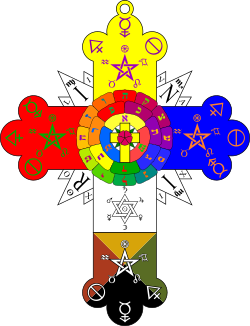
The "Golden Dawn" was the first of three Orders, although all three are often collectively referred to as the "Golden Dawn". The First Order taught esoteric philosophy based on the Hermetic Qabalah and personal development through study and awareness of the four classical elements, as well as the basics of astrology, tarot divination, and geomancy. The Second or Inner Order, the Rosae Rubeae et Aureae Crucis, taught magic, including scrying, astral travel, and alchemy. The Third Order was that of the Secret Chiefs, who were said to be highly skilled; they supposedly directed the activities of the lower two orders by spirit communication with the Chiefs of the Second Order.
History
[edit]Cipher Manuscripts
[edit]
The foundational documents of the original Order of the Golden Dawn, known as the Cipher Manuscripts, are written in English using the Trithemius cipher. The manuscripts give the specific outlines of the Grade Rituals of the Order and prescribe a curriculum of graduated teachings that encompass the Hermetic Qabalah, astrology, occult tarot, geomancy, and alchemy.
According to the records of the Order, the manuscripts passed from Kenneth R. H. Mackenzie, a Masonic scholar, to the Rev. A. F. A. Woodford, whom British occult writer Francis King describes as the fourth founder,[4] although Woodford died shortly after the Order was founded.[5] The documents did not excite Woodford, and in February 1886 he passed them on to Freemason William Wynn Westcott, who managed to decode them in 1887.[4]
Westcott, pleased with his discovery, called on fellow Freemason Samuel Liddell MacGregor Mathers for a second opinion. Westcott asked for Mathers's help to turn the manuscripts into a coherent system for lodge work. Mathers asked fellow Freemason William Robert Woodman to assist the two, and he accepted.[4]
Mathers and Westcott have been credited with developing the ritual outlines in the Cipher Manuscripts into a workable format.[c] Mathers is generally credited with the design of the curriculum and rituals of the Second Order, which he called the Rosae Rubae et Aureae Crucis ("Ruby Rose and Golden Cross" or the RR et AC).[6]
Founding of the First Temple
[edit]
In October 1887, Westcott claimed to have written to a German countess and prominent Rosicrucian named Anna Sprengel, whose address was said to have been found in the decoded Cipher Manuscripts. According to Westcott, Sprengel claimed the ability to contact certain supernatural entities, known as the Secret Chiefs, that were considered the authorities over any magical order or esoteric organization. Westcott purportedly received a reply from Sprengel granting permission to establish a Golden Dawn temple and conferring honorary grades of Adeptus Exemptus on Westcott, Mathers, and Woodman. The temple was to consist of the five grades outlined in the manuscripts.[7]
In 1888, the Isis-Urania Temple was founded in London.[8] In contrast to the SRIA and Masonry,[9] women were allowed and welcome to participate in the Order in "perfect equality" with men. The Order was more of a philosophical and metaphysical teaching order in its early years. Other than certain rituals and meditations found in the Cipher manuscripts and developed further,[10] "magical practices" were generally not taught at the first temple.
For the first four years, the Golden Dawn was one cohesive group later known as the "First Order" or "Outer Order". A "Second Order" or "Inner Order" was established and became active in 1892. The Second Order consisted of members known as "adepts", who had completed the entire course of study for the First Order. The Second Order was formally established under the name Ordo Rosae Rubeae et Aureae Crucis (the Order of the Red Rose and the Golden Cross).[11]
Eventually, the Osiris temple in Weston-super-Mare, the Horus temple in Bradford (both in 1888), and the Amen-Ra temple in Edinburgh (1893) were founded. In 1893, Mathers founded the Ahathoor temple in Paris.[8]
The Secret Chiefs
[edit]In 1890, Westcott's alleged correspondence with Anna Sprengel suddenly ceased. He claimed to have received word from Germany that she was dead and that her companions did not approve of the founding of the Order, and no further contact was to be made.[12] If the founders were to contact the Secret Chiefs, apparently, it had to be done on their own.[8]
In 1892, Mathers professed that a link to the Secret Chiefs had been established. Subsequently, he supplied rituals for the Second Order.[8] The rituals were based on the tradition of the tomb of Christian Rosenkreuz, and a Vault of Adepts became the controlling force behind the Outer Order.[13] Later in 1916, Westcott claimed that Mathers also constructed these rituals from materials he received from Frater Lux ex Tenebris, a purported Continental Adept.[14]
Some followers of the Golden Dawn tradition believe that the Secret Chiefs were not human or supernatural beings, but rather symbolic representations of actual or legendary sources of spiritual esotericism. The term came to stand for a great leader or teacher of a spiritual path or practice that found its way into the teachings of the Order.[15]
Golden Age
[edit]| Part of a series on the |
| Hermetic Order of the Golden Dawn |
|---|
 |
By the mid-1890s, the Golden Dawn was well established in Great Britain, with over one hundred members from every class of Victorian society.[5] Many celebrities belonged to the Golden Dawn, such as the actress Florence Farr, the Irish revolutionary Maud Gonne, the Irish poet William Butler Yeats, the Welsh author Arthur Machen, and the English authors Evelyn Underhill and Aleister Crowley.
In 1896 or 1897, Westcott broke all ties to the Golden Dawn, leaving Mathers in control. It has been speculated that his departure was due to his having lost a number of occult-related papers in a hansom cab. Apparently, when the papers were found, Westcott's connection to the Golden Dawn was discovered and brought to the attention of his employers. He may have been told to either resign from the Order or to give up his occupation as coroner.[16] After Westcott's departure, Mathers appointed Florence Farr to be Chief Adept in Anglia. Dr. Henry B. Pullen Burry succeeded Westcott as Cancellarius—one of the three Chiefs of the Order.
Mathers was the only active founding member after Westcott's departure. Due to personality clashes with other members and frequent absences from the center of Lodge activity in Great Britain, however, challenges to Mathers's authority as leader developed among the members of the Second Order.[17]
Revolt
[edit]Towards the end of 1899, the Adepts of the Isis-Urania and Amen-Ra temples had become dissatisfied with Mathers's leadership, as well as his growing friendship with Aleister Crowley. They had also become anxious to make contact with the Secret Chiefs themselves, instead of relying on Mathers as an intermediary.[18] Within the Isis-Urania temple, disputes were arising between Farr's The Sphere, a secret society within the Isis-Urania, and the rest of the Adepti Minores.[18]
Crowley was refused initiation into the Adeptus Minor grade by the London officials. Mathers overrode their decision and quickly initiated him at the Ahathoor temple in Paris on 16 January 1900.[19] Upon his return to the London temple, Crowley requested from Miss Cracknell, the acting secretary, the papers acknowledging his grade, to which he was now entitled.[19]
To the London Adepts, this was the final straw. Farr, already of the opinion that the London temple should be closed, wrote to Mathers expressing her wish to resign as his representative, although she was willing to carry on until a successor was found.[19] Mathers believed Westcott was behind this turn of events, and replied on 16 February.[20]
On 3 March a committee of seven Adepts was elected in London and requested a full investigation of the matter. Mathers sent an immediate reply, declining to provide proof, refusing to acknowledge the London temple, and dismissing Farr as his representative on 23 March.[20] In response, a general meeting was called on 29 March in London to remove Mathers as chief and expel him from the Order.[21]
Splinters
[edit]In 1901, W. B. Yeats privately published a pamphlet titled Is the Order of R. R. & A. C. to Remain a Magical Order?[22] After the Isis-Urania temple claimed its independence, there were even more disputes, leading to Yeats resigning.[23] A committee of three was to temporarily govern, which included P. W. Bullock, M. W. Blackden and J. W. Brodie-Innes. After a short time, Bullock resigned, and Dr. Robert Felkin took his place.[24]
In 1903, A. E. Waite and Blackden joined forces to retain the name Isis-Urania, while Felkin and other London members formed the Stella Matutina. Yeats remained in the Stella Matutina until 1921, while Brodie-Innes continued his Amen-Ra membership in Edinburgh.[25]
Reconstruction
[edit]Once Mathers realised that reconciliation was impossible, he made efforts to reestablish himself in London. The Bradford and Weston-super-Mare temples remained loyal to him, but their numbers were few.[26] He then appointed Edward Berridge as his representative.[27] According to Francis King, historical evidence shows that there were "twenty three members of a flourishing Second Order under Berridge-Mathers in 1913."[27]
J.W. Brodie-Innes continued leading the Amen-Ra temple, deciding that the revolt was unjustified. By 1908, Mathers and Brodie-Innes were in complete accord.[28] According to sources that differ regarding the actual date, sometime between 1901 and 1913 Mathers renamed the branch of the Golden Dawn remaining loyal to his leadership, to Alpha et Omega.[29][d]
Brodie-Innes assumed command of the English and Scottish temples, while Mathers concentrated on building up his Ahathoor temple and extending his American connections.[30] According to occultist Israel Regardie, the Golden Dawn had spread to the United States of America before 1900 and a Thoth-Hermes temple had been founded in Chicago.[31] By the beginning of the First World War in 1914, Mathers had established two to three American temples.
Most temples of the Alpha et Omega and Stella Matutina closed or went into abeyance by the end of the 1930s, with the exceptions of two Stella Matutina temples: Hermes Temple in Bristol, which operated sporadically until 1970, and the Smaragdum Thallasses Temple, commonly referred to as Whare Ra, in Havelock North, New Zealand, which operated regularly until its closure in 1978.[32]
Structure and grades
[edit]| Part of a series on |
| Hermeticism |
|---|
 |
Much of the hierarchical structure for the Golden Dawn came from the Societas Rosicruciana in Anglia, which was itself derived from the Order of the Golden and Rosy Cross.[33]
- First Order
- Neophyte 0=0
- Zelator 1=10
- Theoricus 2=9
- Practicus 3=8
- Philosophus 4=7
- Second Order
- Adeptus Minor 5=6
- Adeptus Major 6=5
- Adeptus Exemptus 7=4
- Third Order
- Magister Templi 8=3
- Magus 9=2
- Ipsissimus 10=1
The paired numbers attached to the Grades relate to positions on the Tree of Life. The Neophyte Grade of "0=0" indicates no position on the Tree. In the other pairs, the first numeral is the number of steps up from the bottom (Malkuth), and the second numeral is the number of steps down from the top (Kether).
The First Order Grades were related to the four elements of Earth, Air, Water, and Fire, respectively. The Aspirant to a Grade received instruction on the metaphysical meaning of each of these Elements and had to pass a written examination and demonstrate certain skills to receive admission to that Grade.
Membership
[edit]Selected known members
[edit]- Pamela Colman Smith (1878-1951), British artist, illustrator, publisher, and writer[34]
- Emily Katharine Bates (1846–1922), British spiritualist author, travel writer, and novelist[35]
- Charles Henry Allan Bennett (1872–1923), best known for introducing Buddhism to the West[36]
- Arnold Bennett (1867–1931), British novelist[37]
- Edward W. Berridge (ca. 1843–1923), British homeopathic physician[38]
- Algernon Blackwood (1869–1951), British writer and radio broadcaster of supernatural stories[39]
- Gabrielle Borthwick (1866–1952), British pioneering motorist, mechanic, garage owner, and driving teacher[40]
- Anna de Brémont (1849–1922), American singer and writer[41]
- Aleister Crowley (1875–1947), occultist, writer and mountaineer, founder of his own magical society[42]
- Florence Farr (1860–1917), London stage actress and musician[39]
- Robert Felkin (1853–1926), medical missionary, explorer and anthropologist in Central Africa, author, founder of the New Zealand branch of the Golden Dawn and the Smaragdum Thalasses / Whare Ra temple[43]
- Frederick Leigh Gardner (1857–1930), British stockbroker and occultist; published three-volume bibliography Catalogue Raisonné of Works on the Occult Sciences (1912)[44]
- Annie Horniman (1860–1937), British repertory theatre producer and pioneer; member of the wealthy Horniman family of tea-traders[39]
- Arthur Machen (1863–1947), leading London writer of the 1890s, author of acclaimed works of imaginative and occult fiction, such as "The Great God Pan", "The White People" and "The Hill of Dreams". Welsh by birth and upbringing[45]
- Moina Mathers (1865–1928), London trained artist, wife of S. L. MacGregor-Mathers and sister of philosopher Henri Bergson[46]
- Samuel Liddell MacGregor-Mathers (1854–1918), British Freemason, one of the three founders of the Golden Dawn, prolific writer, occultist, and researcher[47]
- Alfred John Pearce (1840–1923), medic, writer, pioneering weather forecaster and celebrated astrologer known as "Zadkiel"[48]
- Sax Rohmer (1883–1959), novelist, creator of the Fu Manchu character[45]
- William Sharp (1855–1905), poet and author; alias Fiona MacLeod[49]
- Violet Tweedale (1862–1936), Scottish writer and spiritualist[50]
- Arthur Edward Waite (1857–1942), British writer, Freemason and co-creator of the Rider–Waite tarot deck[39]
- William Wynn Westcott (1848–1925), founder of the Golden Dawn, doctor, London coroner, prolific writer, British Freemason, former Supreme Magus of the Societas Rosicruciana in Anglia (SRIA)[8]
- William Robert Woodman (1828–1891), doctor, British Freemason, former Supreme Magus of the Societas Rosicruciana in Anglia, one of the three founders of the Golden Dawn[8]
- W. B. Yeats (1865–1939), Irish poet, dramatist and writer.[51]
Alleged members
[edit]- E. Nesbit (1858–1924), English author and political activist. According to biographer Eleanor Fitzsimons: "Edith's reputed membership in the Hermetic Order of the Golden Dawn, the foremost occult organization of the day, is intriguing. … Most biographical accounts suggest that Edith was a member of the Golden Dawn, but evidence to support this is rarely cited. The organization was of course secretive by nature, but eyewitness accounts never mentioned her as they did others, and her name does not appear on the rolls."[52]
Contemporary Golden Dawn orders
[edit]While no temples in the original chartered lineage of the Golden Dawn survived past the 1970s,[32] several organizations have since carried on, revived or expanded upon the Order's teachings and rituals, including:
- The Hermetic Order of the Golden Dawn, Inc. (founded 1977)
- Thelemic Order of the Golden Dawn (founded 1990)
- Open Source Order of the Golden Dawn (2002 – 2019)
The Golden Dawn book
[edit]The Golden Dawn, by Israel Regardie; was published in 1937. The book is divided into several basic sections. First are the knowledge lectures, which describe the basic teaching of the Qabalah, symbolism, meditation, geomancy, etc. This is followed by the rituals of the Outer Order, consisting of five initiation rituals into the degrees of the Golden Dawn. The next section covers the rituals of the Inner Order including two initiation rituals and equinox ceremonies.
See also
[edit]- A∴A∴ § The Order of the G∴D∴ (Golden Dawn)
- Magical organization – Organization for the practice of occult magic
- Tattva vision – Subject related to ESP
Notes
[edit]- ^ Jenkins 2000, p. 74: "Also in the 1880s, the tradition of ritual magic was revived in London by a group of Masonic adepts, who formed the Order of the Golden Dawn, which would prove an incalculable influence on the whole subsequent history of occultism."
- ^ Smoley 1999, pp. 102–103: "Founded in 1888, the Golden Dawn lasted a mere twelve years before it was shattered by personal conflicts. At its height, it probably had no more than a hundred members. Yet its influence on magic and esoteric thought in the English-speaking world would be hard to overestimate."
- ^ Golden Dawn researcher R. A. Gilbert has found evidence which suggests that Westcott was instrumental in developing the Order's rituals from the Cipher Manuscripts. See Gilbert's article, "From Cipher to Enigma: The Role of William Wynn Westcott in the Creation of the Hermetic Order of the Golden Dawn" in Runyon 1997.
- ^ Anon 2001: "The Golden Dawn ceased to exist by that name after October 1901, replaced by Mathers's Alpha et Omega and the London group’s Order of the Morgan Rothe. No longer associated with the SRIA after 1902, Mathers continued to oversee a few temples until his death, when his wife, Moina, assumed supervision."
References
[edit]Citations
[edit]- ^ Colquhoun 1975, p. [page needed].
- ^ Gilbert, R. A. "The Masonic Career of A. E. Waite".
- ^ Gilbert, R. A. "The Masonic Career of A. E. Waite".
- ^ a b c King 1989, pp. 42–43.
- ^ a b King 1989, p. 47.
- ^ Regardie 1993, p. 92.
- ^ King 1989, p. 43; Regardie 1993, p. 11.
- ^ a b c d e f King 1989, p. 43.
- ^ Regardie 1993, p. 11.
- ^ King 1997, p. 35.
- ^ Decker & Dummett 2019, pp. 93–96.
- ^ Decker & Dummett 2019, p. 90.
- ^ King 1989, p. 44.
- ^ King 1989, p. 46.
- ^ Penczak 2002, p. 27.
- ^ King 1989, p. 48.
- ^ Raine 1976, p. 6.
- ^ a b King 1989, p. 66.
- ^ a b c King 1989, p. 67.
- ^ a b King 1989, pp. 68–69.
- ^ King 1989, p. 69.
- ^ Melton 2001, p. 1327.
- ^ King 1989, p. 78.
- ^ King 1989, p. 94.
- ^ King 1989, pp. 95–96.
- ^ King 1989, p. 109.
- ^ a b King 1989, p. 110.
- ^ Regardie 1993, p. 33.
- ^ King 1971, pp. 110–111; King 1989, p. 111; Cicero & Cicero 2002.
- ^ King 1989, p. 111.
- ^ King 1989, p. 111; Regardie 1993, p. 33.
- ^ a b Gilbert 1986; Cicero & Cicero 2002.
- ^ Gilbert 1986b.
- ^ White, Katie (2022). ""Pamela Colman Smith was the Artist and Occultist Who Designed the Iconic Tarot Deck. Why Has No One Ever Heard Her Name?"". artnet.com. Retrieved September 11, 2025.
- ^ Gilbert 1986, p. [page needed].
- ^ Harris 1998, p. 13.
- ^ Regardie 1982, p. 16.
- ^ Colquhoun 1975, pp. 148–149.
- ^ a b c d Regardie 1982, p. ix.
- ^ Cockin 2017.
- ^ Moyle 2011, p. 118.
- ^ Booth 2000, pp. 85, 93–94; Sutin 2000, pp. 54–55; Kaczynski 2010, pp. 60–61; Churton 2011, p. 35.
- ^ Ellwood 1993, p. [page needed].
- ^ Anon 1987.
- ^ a b Blackmore 1985.
- ^ Yeats 1927, p. 228.
- ^ Anon 2001.
- ^ Davis 2022, p. 16; Gilbert 1986, p. 145.
- ^ Denisoff 2013.
- ^ Davis 2022, p. 17.
- ^ Foster 1997, p. 103; Cullingford 1983.
- ^ Fitzsimons 2019 as quoted in Hine 2021.
Works cited
[edit]- Anon (1987). "Frederick Leigh Gardner". Ars Quatour Coronatorum. 100. Grand Lodge of British Columbia and Yukon: 19. Retrieved November 13, 2022.
- Anon (February 26, 2001). "Samuel Liddel MacGregor Mathers". freemasonry.bcy.ca. Grand Lodge of British Columbia and Yukon A.F. & A. M. Retrieved March 19, 2022.
- Blackmore, Leigh (1985). "Hermetic Horrors: Weird Fiction Writers and the Golden Dawn". Shadowplay. Archived from the original on November 9, 2009. Retrieved March 25, 2010.
- Booth, Martin (2000). A Magick Life: The Biography of Aleister Crowley. London: Coronet Books. ISBN 978-0-340-71806-3. OCLC 59483726.
- Churton, Tobias (2011). Aleister Crowley: The Biography. London: Watkins Books. ISBN 978-1-78028-012-7. OCLC 701810228.
- Cicero, Chic; Cicero, Sandra Tabatha (May 10, 2002). "Golden Dawn Time Line". Llewellyn Encyclopedia. Retrieved November 13, 2022.
- Cockin, Katharine (2017). Edith Craig and the Theatres of Art. Bloomsbury Publishing. ISBN 978-1472570611.
- Colquhoun, Ithell (1975). Sword of Wisdom: Macgregor Mathers and the Golden Dawn. Neville Spearman. ISBN 0-85435-092-6.
- Cullingford, Elizabeth (1983). "How Jacques Molay Got Up the Tower: Yeats and the Irish Civil War". English Literary History. 50 (4): 763–789. doi:10.2307/2872926. JSTOR 2872926.
- Davis, Sally (August 6, 2022). "Hermetic Order of the Golden Dawn: Biographies of Members". Zenodo.org. doi:10.5281/zenodo.6971255. Retrieved November 13, 2022.
- Decker, Ronald; Dummett, Michael (2019). A History of the Occult Tarot. London: Duckworth. ISBN 9780715645727.
- Denisoff, Dennis (2013). "The Hermetic Order of the Golden Dawn, 1888-1901". Branch: Britain, Representation and Nineteenth-Century History. Retrieved November 13, 2022.
- Ellwood, Robert S. (1993). Islands of the Dawn: The Story of Alternative Spirituality in New Zealand. Honolulu: University of Hawaii Press. ISBN 0-8248-1487-8.
- Fitzsimons, Eleanor (2019). The Life and Loves of E. Nesbit: Victorian Iconoclast, Children's Author, and Creator of The Railway Children. Overlook Press. ISBN 978-1468316759.
- Foster, R. F. (1997). W. B. Yeats: A Life. Vol. I: The Apprentice Mage. Oxford University Press. ISBN 978-0-19-288085-7.
- Gilbert, Robert A. (1986). The Golden Dawn Companion. Wellingborough: Aquarian. ISBN 0-85030-436-9. OCLC 60016501.
- Gilbert, R. A. (1986b). "The masonic career of A.E. Waite". Ars Quatour Coronatorum.
- Harris, Elizabeth J. (1998). "Ananda Metteya, the First British Emissary of Buddhism" (PDF). The Wheel Publication (420–422). ISBN 9552401798. Retrieved November 13, 2022.
- Hine, Phil (February 19, 2021). "Jottings: Edith Nesbit and the Golden Dawn". Enfolding.org. Retrieved November 15, 2022.
- Jenkins, Phillip (2000). Mystics and Messiahs: Cults and New Religions in American History. Oxford University Press. ISBN 978-0-19-512744-7.
- Kaczynski, Richard (2010). Perdurabo: The Life of Aleister Crowley (1st ed.). Berkeley, California: North Atlantic Books.
- King, Francis X. (1971). The Rites of Modern Occult Magic (1st ed.). Macmillan Co. ISBN 1-85327-032-6.
- King, Francis (1989). Modern Ritual Magic: The Rise of Western Occultism. Prism. ISBN 1-85327-032-6.
- King, Francis, ed. (1997). Ritual Magic of the Golden Dawn: Works by S. L. MacGregor Mathers and Others. Destiny Books. ISBN 0-89281-617-1.
- Melton, J. Gordon, ed. (2001). Encyclopedia of Occultism and Parapsychology. Vol. 2. Gale Group. ISBN 0-8103-9489-8.
- Moyle, Franny (2011). Constance: The Tragic and Scandalous Life of Mrs Oscar Wilde. Hachette UK. ISBN 9781848544611.
- Penczak, Christopher (2002). Spirit Allies. Red Wheel/Weiser Books. ISBN 1-57863-214-5.
- Raine, Kathleen (1976) [1972]. Miller, Liam (ed.). Yeats, the Tarot and the Golden Dawn. New Yeats Papers. Vol. II (2nd ed.). Dublin: Dolmen Press.
- Regardie, Israel; et al. (1982). The Golden Dawn: An Account of the Teachings, Rites, and Ceremonies of the Order of the Golden Dawn. Vol. 3–4. Llewellyn Publications. ISBN 0-87542-664-6.
- Regardie, Israel (1993). What You Should Know About the Golden Dawn (6th ed.). New Falcon Publications. ISBN 1-56184-064-5.
- Runyon, Carroll (1997). Secrets of the Golden Dawn Cipher Manuscripts. C.H.S. ISBN 0-9654881-2-8.
- Smoley, Richard (1999). Hidden Wisdom: A Guide to the Western Inner Traditions. Quest Books. ISBN 978-0-8356-0844-2.
- Sutin, Lawrence (2000). Do What Thou Wilt: A Life of Aleister Crowley. New York: St Martin's Press. ISBN 978-0-312-25243-4. OCLC 43581537.
- Yeats, William Butler (1927). Autobiographies: Reveries over Childhood and Youth and the Trembling of the Veil.
Further reading
[edit]- A.o.C., Fra. (2002). "A Short Treatise on the History, Culture and Practices of The Hermetic Order of the Golden Dawn". Osogd.org. Open Source Order of the Golden Dawn. Archived from the original on September 28, 2007. Retrieved August 3, 2007.
- Armstrong, Allan; Gilbert, R. A., eds. (1997). Golden Dawn: The Proceedings of the Golden Dawn Conference, London – 1997. Hermetic Research Trust.
- Cicero, Chic; Cicero, Tabatha (1991). The New Golden Dawn Ritual Tarot. St. Paul, MN: Llewellyn Publications. ISBN 0-87542-139-3.
- Gilbert, Robert A. (1983). The Golden Dawn: Twilight of the Magicians. The Aquarian Press. ISBN 0-85030-278-1.
- Gilbert, Robert A. (1998). Golden Dawn Scrapbook: The Rise and Fall of a Magical Order. Weiser Books. ISBN 1-57863-037-1.
- Greer, Mary K. (1994). Women of the Golden Dawn. Park Street. ISBN 0-89281-516-7..
- Greer, Mary K.; Kuntz, Darcy (1999). The Chronology of the Golden Dawn. Holmes Publishing Group. ISBN 1-55818-354-X.
- Howe, Ellic (1978). The Magicians of the Golden Dawn: A Documentary History of a Magical Order 1887–1923. Samuel Weiser. ISBN 0-87728-369-9..
- Kuntz, Darcy, ed. (1996). The Complete Golden Dawn Manuscript. Golden Dawn Studies. Translated by Darcy Kuntz. Holmes Publishing Group. ISBN 978-1558183254.
- Regardie, Israel; et al., eds. (1989). The Golden Dawn: A Complete Course in Practical Ceremonial Magic. Llewellyn. ISBN 0-87542-663-8.
- Suster, Gerald (1990). Crowley's Apprentice: The Life and Ideas of Israel Regardie. Weiser Books. ISBN 0-87728-700-7.
- Westcott, W. Wynn (n.d.). "The History of the Golden Dawn". Archived from the original on February 8, 2006.
External links
[edit]

- Term: Golden Dawn in Llewellyn Encyclopedia
- The Life and Work of WB Yeats. Material on display in exhibition includes Yeat's ritual notebooks.

Hermetic Order of the Golden Dawn
View on GrokipediaOrigins
The Cipher Manuscripts
The Cipher Manuscripts consist of 60 folios written in brown ink on cotton paper watermarked 1809, presenting an enciphered outline of rituals for a Hermetic initiatory order. The text is in English but encoded using a substitution cipher derived from Johannes Trithemius's Polygraphia (1518), rendered in a distinctive calligraphic script resembling a constructed medieval alphabet to evoke antiquity.[3] In August 1887, William Wynn Westcott, a London coroner and member of the Societas Rosicruciana in Anglia (SRIA), received the manuscripts from fellow Mason Reverend A.F.A. Woodford, who had obtained them from an unknown secondhand source. Westcott partially deciphered the documents himself before recruiting Samuel Liddell MacGregor Mathers for further translation in late 1887, uncovering detailed instructions for forming a secret society focused on esoteric advancement. Their collaborative efforts transformed the sparse outlines into the foundational rituals of the Hermetic Order of the Golden Dawn. The deciphered manuscripts delineate a progressive system of five grades within the Outer Order: Neophyte (0=0), Zelator (1=10), Theoricus (2=9), Practicus (3=8), and Philosophus (4=7), each aligned with specific sephiroth on the Kabbalistic Tree of Life to symbolize stages of spiritual initiation. They incorporate Rosicrucian and Hermetic elements, such as symbolic diagrams of the Tree of Life, elemental attributions, planetary influences, and early correlations between Tarot trumps and Kabbalistic paths—ideas drawing from Renaissance occultism and contemporary esotericism. Additional folios hint at a higher Inner Order, including the Adeptus Minor grade (5=6), emphasizing alchemical transformation and divine knowledge. Scholarly debates persist regarding the manuscripts' authenticity, with evidence pointing to a 19th-century fabrication rather than an ancient provenance. The inclusion of Tarot-to-Tree of Life associations, first detailed by Éliphas Lévi in works like Dogme et Rituel de la Haute Magie (1856), alongside the paper's post-1800 watermark, indicates modern composition. Suspicions of forgery often center on Westcott, who may have created or altered the documents to legitimize the Order, though some attribute them to SRIA scholar Kenneth R.H. Mackenzie or anonymous Masonic circles influenced by German Rosicrucian revivals. Despite these questions, the manuscripts' innovative synthesis of traditions undeniably shaped Western occultism.Founding of the Order
The Hermetic Order of the Golden Dawn was officially founded on March 1, 1888, in London, when William Wynn Westcott, Samuel Liddell MacGregor Mathers, and William Robert Woodman signed the warrant chartering the Isis-Urania Temple No. 3 as its inaugural lodge. This event marked the formal establishment of the order, inspired by the decoding of the Cipher Manuscripts, which provided the foundational rituals and structure.[1] The three signatories committed to the order's principles through an initial pledge of fidelity, positioning themselves as the Three Chiefs responsible for its governance.[1] The founders brought diverse expertise to the endeavor. Westcott, a coroner for North-East London and an active Freemason since 1871, had been involved in esoteric studies through the Theosophical Society and Societas Rosicruciana in Anglia (SRIA).[4] Mathers, a self-taught scholar of occult texts, had translated key works such as The Key of Solomon and contributed to the order's ritual development. Woodman, a physician and botanist who qualified in medicine in 1851, served as Supreme Magus of the SRIA and co-edited its journal The Rosicrucian, emphasizing his deep engagement with Rosicrucian traditions.[5] The initial organizational structure centered on the Isis-Urania Temple in London, designed as a secretive hierarchical society with progressive grades of initiation to ensure controlled dissemination of esoteric knowledge.[1] Bylaws mandated strict oaths of secrecy, prohibiting members from revealing teachings outside their attained grade, while the hierarchy mirrored Masonic models but admitted women equally, fostering a system of advancement through ritual and study.[1] Early recruitment began immediately, with Mina Bergson—later known as Moina Mathers after her marriage to Samuel Mathers—becoming the first initiate in March 1888. Among the subsequent early members was Dr. Edward Berridge, a physician who joined shortly after and contributed to the order's medical and occult intersections. These initial admissions laid the groundwork for the order's growth through personal networks in London's esoteric circles.Early Temples and Founders
Following the chartering of the Isis-Urania Temple No. 3 in London in March 1888, the Hermetic Order of the Golden Dawn quickly expanded with the establishment of secondary temples, reflecting the founders' vision for a nationwide network of initiatory centers. The Osiris Temple No. 4 was chartered in October 1888 in Weston-super-Mare, comprising exclusively members of the Societas Rosicruciana in Anglia (S.R.I.A.) to leverage existing esoteric ties. Later that month, on October 19, the Horus Temple No. 5 was consecrated in Bradford by T. H. Pattinson, with initial support from seven interested members, including early Golden Dawn initiate Dr. William Alexander Ayton, who eagerly advocated for its provincial foundation to extend the Order's reach. By 1890, the Order had grown to include at least three active temples, with further expansions underway, demonstrating rapid organizational momentum in its formative phase.[6] The three primary founders—William Robert Woodman, Samuel Liddell MacGregor Mathers, and William Wynn Westcott—played distinct yet complementary roles in these early developments, though Woodman's involvement was curtailed by health issues. As Supreme Magus of the S.R.I.A., Woodman lent institutional credibility to the Order but maintained a limited active role due to his advanced age and frailty, dying suddenly on December 20, 1891, after a brief illness at age 63. Mathers focused on doctrinal innovation, developing the foundational materials for the Second Order (Rosae Rubeae et Aureae Crucis) by refining rituals derived from the Cipher Manuscripts, which influenced temple designs and initiatory structures. Westcott provided essential administrative oversight, handling chartering processes, membership rolls, and correspondence to ensure operational cohesion across emerging temples.[6][7][6] Key organizational innovations emerged during this period, including the introduction of the Vault of the Adepti as a central symbolic ritual space for advanced grades, constructed by Mathers and his wife Moina by late 1891 to represent the mythical tomb of Christian Rosenkreuz and facilitate Second Order workings. The Order also emphasized gender equality from inception, admitting women on equal footing with men; for instance, Mrs. Pattinson became the first female member of the Horus Temple, aligning with broader Victorian occult efforts to include female initiates in esoteric pursuits. These features underscored the Golden Dawn's blend of Rosicrucian symbolism and progressive inclusivity.[6][8] Amid this growth, the early temples navigated significant challenges in maintaining secrecy within Victorian England's conservative social climate, where public exposure could invite scandal and legal repercussions. Members pledged strict confidentiality upon initiation, with temple operations conducted in private venues like rented rooms to evade scrutiny from authorities or the press, a precaution heightened by the era's moral panics over occultism. Ayton and others reinforced these measures through discreet recruitment, ensuring the Order's survival without early disruptions.[6][9]Doctrines and Practices
Philosophical Foundations
The Hermetic Order of the Golden Dawn synthesized diverse esoteric traditions to form its intellectual core, drawing primarily from Hermeticism as outlined in the Corpus Hermeticum, Jewish Kabbalah via the Zohar, classical alchemy, and Neoplatonic philosophy. This eclectic approach emphasized a universal wisdom underlying all mystical paths, explicitly rejecting a narrowly Christian esotericism in favor of a non-dogmatic framework that integrated pre-Christian and Renaissance sources.[10][11] Key philosophical concepts included the divine as an androgynous unity embodying both masculine and feminine principles, the macrocosm-microcosm correspondence famously expressed in the Hermetic axiom "as above, so below," and the process of spiritual evolution through initiatory knowledge and self-transformation. These ideas posited that the human soul mirrored the divine structure of the universe, enabling practitioners to ascend toward enlightenment by aligning personal development with cosmic harmonies.[10][11] The Order's initiatory grades provided structured pathways to embody these principles, progressing from elemental awareness to higher adeptship.[10] Influenced by Rosicrucianism, the Golden Dawn claimed a spiritual lineage from the legendary Order of the Rose Cross, portraying itself as a modern custodian of ancient, hidden wisdom traditions that blended alchemical transmutation with mystical revelation.[12] Uniquely, it incorporated tarot symbolism as a practical tool for self-realization, maintaining an absence of rigid theological dogma to allow for personal interpretation within its syncretic system.[13][10]Ritual Structure and Grades
The Hermetic Order of the Golden Dawn organized its initiatory system into a hierarchical structure of grades, modeled on the Qabalistic Tree of Life, to guide members through progressive spiritual and magical development.[14] This framework divided the Order into an Outer Order for foundational training and an Inner Order for advanced practices, with each grade corresponding to specific Sephiroth and elemental forces.[15] The grades symbolized an ascent from material existence toward divine union, emphasizing balance and purification.[16] The Outer Order, also known as the First Order or Hermetic Society of the G.D., comprised five grades focused on elemental mastery and basic esoteric knowledge. The Neophyte grade (0=0) served as a probationary initiation outside the Tree of Life, introducing candidates to the Order's principles through a ritual of symbolic death and rebirth, blindfolded entry, and an oath of secrecy.[14] Following this, the Zelator grade (1=10) aligned with Malkuth and the element of Earth, emphasizing grounding and physical discipline. The Theoricus grade (2=9) corresponded to Yesod and Air, exploring lunar and intellectual symbolism. The Practicus grade (3=8) linked to Hod and Water, focusing on mercurial analysis and emotional equilibrium. Finally, the Philosophus grade (4=7) tied to Netzach and Fire, cultivating Venusian creativity and will. A transitional Portal grade introduced the element of Spirit, preparing candidates for the Inner Order through rituals balancing the four elements.[15][16] The Inner Order, formally the Rosae Rubeae et Aureae Crucis (R.R. et A.C.), began after the Portal and encompassed higher grades centered on Rosicrucian and solar symbolism. The Adeptus Minor grade (5=6) connected to Tiphareth and the Sun, marking entry into advanced ceremonial magic involving practical applications such as astral projection through scrying and spirit vision, invocation of spiritual entities, and the pursuit of the Great Work—a process of spiritual transmutation akin to alchemical processes—with a profound vault ritual symbolizing resurrection.[14] Subsequent grades included Adeptus Major (6=5) at Geburah and Mars, emphasizing disciplined power; Adeptus Exemptus (7=4) at Chesed and Jupiter, focusing on merciful expansion; Magister Templi (8=3) at Binah and Saturn, involving mystical union; Magus (9=2) at Chokmah; and Ipsissimus (10=1) at Kether, representing ultimate transcendence. The latter three grades formed a theoretical Third Order, rarely attained and linked to the Order's "Secret Chiefs." These advanced energetic practices have been made accessible through published texts, such as those compiled by Israel Regardie.[16][15] Rituals across grades incorporated specific magical elements to invoke and balance forces. The Lesser Banishing Ritual of the Pentagram and its invoking variants were foundational, using divine names and visualizations at the cardinal points to purify space and align elemental energies, particularly in the Neophyte and elemental grades.[17] Hexagram rituals, employed in the Inner Order, invoked planetary influences through six-pointed star formations and names like ARARITA, harmonizing macrocosmic powers during initiations such as Adeptus Minor.[17] Enochian calls, derived from the 19 Keys of John Dee, were integrated into ceremonies like the Opening by Watchtower to summon elemental hierarchies, enhancing invocations in both Outer and Inner grades.[17] Symbolism included the Tattvas—five elemental emblems (Prithivi for Earth, Vayu for Air, Tejas for Fire, Apas for Water, Akasa for Spirit)—used in meditative skrying to attune to grade-specific forces. Flashing tablets, featuring contrasting colors on these symbols, created visual "flashes" to stimulate clairvoyance and manifest energies during ritual preparation.[17] Advancement required rigorous criteria, including study of Qabalah, astrology, alchemy, and Tarot; passing written and oral examinations on theoretical knowledge; and demonstrating practical magical skills, such as performing rituals proficiently.[14] Candidates swore progressive oaths of secrecy and obligation at each grade, binding them to ethical conduct and non-disclosure of teachings, with approval from temple officers like the Hierophant and Chiefs of the Second Order.[15] This system ensured gradual unveiling of knowledge, fostering personal transformation aligned with the Order's Hermetic goals.[16]Magical Systems and Symbolism
The Hermetic Order of the Golden Dawn employed a range of ceremonial practices centered on invocation, banishing, and elemental harmony to facilitate spiritual development and protection during rituals. Central to these was the Lesser Banishing Ritual of the Pentagram (LBRP), a foundational exercise designed to purify the ritual space, dispel negative influences, and establish protective barriers against impure forces.[18] Performed daily by initiates, the LBRP involved tracing banishing pentagrams in the four quarters—starting in the east—while vibrating divine names such as YHVH and Adonai, followed by the invocation of archangels Raphael, Gabriel, Michael, and Uriel to form a protective circle.[18] This ritual not only served as a shield against obsessing entities but also attuned the practitioner to higher consciousness, often preceding more complex workings.[18] Complementing the LBRP were the four elemental tools, each consecrated to represent and channel specific forces in magical operations. These implements—aligned with the suits of the Tarot and the Tetragrammaton—were placed upon the altar during ceremonies to invoke, balance, or banish elemental energies. The following table outlines their attributes and uses:| Tool | Element | Primary Function | Symbolic Associations |
|---|---|---|---|
| Wand | Fire | Directing will and creative energy | Scarlet shaft, lotus wand |
| Cup | Water | Purification and emotional intuition | Chalice with eight petals |
| Sword | Air | Intellectual discernment and banishing | Double-edged blade |
| Pentacle | Earth | Grounding and material manifestation | Hexagram-inscribed disk |