Hubbry Logo
OrongoOrongoMain
Open search
Orongo
Community hub
Orongo
logo
8 pages, 0 posts
0 subscribers
Be the first to start a discussion here.
Orongo
Orongo
from Wikipedia
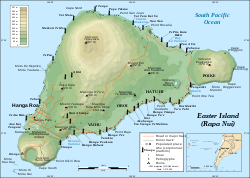
Map of the location of ꞌOrongo on Easter Island

Orongo (Rapa Nui pronunciation: [oˈɾoŋo]; Spanish pronunciation: [oˈɾoŋgo]) is a stone village and ceremonial center at the southwestern tip of Rapa Nui (Easter Island). It consists of a collection of low, sod-covered, windowless, round-walled buildings with even lower doors positioned on the high south-westerly tip of the large volcanic caldera called Rano Kau. Below Orongo on one side a 300-meter barren cliff face drops down to the ocean; on the other, a more gentle but still very steep grassy slope leads down to a freshwater marsh inside the high caldera.

In 1974 UNESCO sponsored a project to restore Orongo. Under the supervision of William Mulloy, with the support of Rapanui archaeologist Sonia Haoa Cardinali, the first half of the ceremonial village's 53 stone masonry houses was investigated and restored in 1974. The remainder was completed in 1976 and subsequently investigated in 1985 and again in 1995. Orongo now has World Heritage status as part of the Rapa Nui National Park.

History

[edit]

69 Between the 18th and mid-19th centuries Orongo was the centre of a birdman cult whose defining ritual was an annual race to bring the first manutara (sooty tern) egg back undamaged from the nearby islet of Motu Nui to Orongo. The race was very dangerous, and hunters often fell to their deaths from the cliff face or were killed by sharks. The site has numerous petroglyphs, mainly of tangata manu (birdmen), which may have been carved to commemorate some of the winners of this race.

In the 1860s, most of the Rapa Nui islanders died of disease or were enslaved, and when the survivors were converted to Christianity, Orongo fell into disuse. In 1868, the crew of HMS Topaze removed the huge basalt moai known as Hoa Hakananai'a from Orongo. It is now housed in the British Museum.

The site of Orongo was included in the 1996 World Monuments Watch by the World Monuments Fund, and listed again four years later, in 2000. The threat was soil erosion, caused by rainfall and exacerbated by foot traffic.[1] After 2000, the organization helped devise a site management plan with support from American Express, and in December 2009 more funding was announced for the construction of a sustainable visitor center.[2]

See also

[edit]

References

[edit]

Resources

[edit]
  • Mulloy, William. Investigation and Restoration of the Ceremonial Center of Orongo. International Fund for Monuments Bulletin No. 4. New York (1975).
  • Mulloy, W.T., and S.R. Fischer. 1993. Easter Island Studies: Contributions to the History of Rapanui in Memory of William T. Mulloy. Oxford: Oxbow Books.
  • Routledge, Katherine Pease (Scouresby). 1919. The Mystery of Easter Island; the Story of an Expedition. London, Aylesbury, Printed for the author by Hazell, Watson and Viney. ISBN 0-932813-48-8 (1998 US reprint)
[edit]
Revisions and contributorsEdit on WikipediaRead on Wikipedia
from Grokipedia
Orongo is a prehistoric ceremonial village comprising approximately 54 low, semi-subterranean stone houses located on the southwestern rim of the volcano crater on Rapa Nui (), . Constructed using dry-laid slabs for wind resistance, the site functioned seasonally as the hub for the birdman cult, where clan representatives competed in perilous rituals to secure the first egg of the (Sterna fuscata) from offshore islets. The village's architecture features elongated, oval-shaped dwellings with narrow crawl-in entrances and interiors limited to 1-2 meters in height, designed to shield participants from harsh coastal winds during spring ceremonies honoring the creator god Make-make. Over 1,700 petroglyphs adorn the surrounding boulders, depicting hybrid bird-man figures, vulva motifs (komari), and divine symbols, while interior rock paintings in red, black, and white pigments illustrate cult icons and later European influences. Archaeological evidence places the construction of the houses in the Huri A Moai period, around AD 1400-1600, marking a cultural shift from moai statue veneration to the birdman practices amid resource strains on the isolated Polynesian society. In the annual competition, selected hopu manu swimmers descended cliffs exceeding 200 meters, navigated shark-infested waters to islet, and retrieved the manutara egg to return victorious; the sponsoring clan's chief then assumed birdman status, enjoying ritual privileges including seclusion in Orongo for up to a year. The cult persisted from roughly AD 1540 until the mid-19th century, when Peruvian slave raids, introduced diseases, and Christian missionary activities led to its abandonment and the site's partial restoration in the 1970s under oversight as part of . This transition reflects adaptive responses to ecological pressures, prioritizing empirical ritual efficacy over prior monumental traditions.

Location and Physical Setting

Geographical Position

Orongo is situated at the southwestern tip of Rapa Nui, , on the rim of the volcanic crater, with precise coordinates of approximately 27°11′S 109°26′W. This location places it along a narrow strip between the crater's inner edge and sheer cliffs descending to the , directly overlooking the offshore islets of , Motu Iti, and Motu Kao Kao. The site rests at an elevation of roughly 300 meters above sea level, adjacent to the crater lake, which lies about 100 meters lower within the . These topographic features—steep volcanic slopes, high cliffs, and oceanic exposure—enhance the area's physical isolation, with the crater rim providing a inland. Accessibility from , located 6 kilometers to the northeast, occurs primarily via a winding or vehicular road ascending the volcano's flanks, underscoring the site's remote perch.

Architectural and Environmental Features

Orongo features a cluster of approximately 54 low, elongated stone houses, termed hare moa, arranged in three semi-independent groups along the southwestern rim of the volcanic crater. These structures exhibit boat-shaped foundations, typically 10-15 meters long and 3-4 meters wide, built atop low stone platforms or ahu-like bases using stacked slabs without mortar. The houses possess narrow, low entrances—often less than 1 meter high—forcing occupants to enter on hands and knees, a design that minimized exposure to the site's relentless winds exceeding 50 km/h on average. Construction relied on local volcanic resources, including fine-grained slabs known as kehu quarried from nearby outcrops and shaped using tools sourced from Rano Kau's own deposits. Roofs, originally thatched with local grasses, were supported by wooden rafters and now appear sod-covered due to and restoration efforts. The absence of windows and minimal interior space—divided into areas and storage—reflects utilitarian adaptations to the harsh, resource-scarce environment. The site's environmental context encompasses the steep, inward-facing crater walls of , a water-filled volcanic rising 300 meters above , surrounded by jagged lava fields devoid of soil cover. Prevailing southeast amplify on the exposed clifftop, while the terrain integrates directly with offshore islets—Motu Nui, Motu Iti, and the stack of Motu Kao Kao—approximately 1-2 km distant, providing isolated nesting habitats for sooty terns (Onychoprion fuscatus) amid otherwise limited avian resources on the island. This positioning underscores the interplay between Orongo's built forms and the volcanic archipelago's ecological constraints.

Historical Context

Pre-Orongo Developments on Rapa Nui

Polynesian voyagers settled Rapa Nui around AD 1200, as indicated by of early archaeological sites and genetic analyses confirming East Polynesian origins without pre-European admixture from other regions. This initiated a phase of agricultural adaptation, including the cultivation of crops like sweet potatoes and in stone-mulched gardens (manavai), which supported initial population growth to an estimated 3,000 individuals by the peak era, rather than the higher figures once proposed that implied subsequent collapse. Society organized into approximately ten clans (mata or mata'e), each controlling defined territories and led by hereditary chiefs (), fostering a hierarchical structure with distinct classes including priests (ivi-atua) and warriors (matatoa). This clan-based system emphasized lineage and , evident in oral traditions tracing descent from the founding chief Hotu Matu'a, and laid groundwork for inter-clan competition over resources and prestige. From roughly AD 1200 to 1600, Rapanui society entered the construction phase, carving nearly 1,000 monolithic statues from quarry to represent deified ancestors, which were erected on coastal platforms (ahu) facing inland settlements. Experimental replications demonstrate that could be transported upright over land using ropes and a small team rocking the statue side-to-side in a "walking" motion, requiring minimal timber and thus challenging claims of deforestation-driven transport crises. The island's palm-dominated forests declined during this period, but empirical evidence from studies and pollen cores attributes significant causation to introduced Polynesian rats (Rattus exulans) consuming palm nuts and inhibiting regrowth, rather than solely human clearing for or statue movement. Human activities contributed through fire and selective felling, yet archaeological data reveal no widespread pre-contact or ; instead, adaptations like rock gardening sustained productivity, with population levels remaining viable into European contact. This resilience in and clan dynamics positioned Rapanui for evolving competitions amid environmental pressures.

Emergence of the Birdman Cult

Archaeological evidence indicates that the Birdman cult, also known as the cult, emerged at Orongo during the mid-15th to early CE. of short-lived plant materials from house fills and contexts associated with petroglyphs at the site supports this chronology, with calibrated dates clustering around AD 1400–1550 for the initial construction and use phases of the ceremonial village. These dates derive from excavations of over 50 ahu (house platforms) at Orongo, revealing a rapid buildup of settlement layers linked to cult activities. The cult's rise coincided with a broader transition away from the earlier ancestor veneration, as evidenced by the cessation of transport and erection around the 15th–16th centuries, potentially driven by ecological pressures such as and resource scarcity documented in paleoenvironmental records. Oral traditions recorded by early European visitors describe periods of and conflict preceding the cult's prominence, though these accounts lack precise dating and may reflect later amplifications. Empirical data from pollen cores and soil analyses indicate declining agricultural productivity and episodes around this time, suggesting causal factors in the ritual shift without implying . Early manifestations include the appearance of petroglyphs depicting the Make-Make and hybrid birdman figures (), concentrated at Orongo with over 400 carvings identified, marking an innovation in Rapa Nui distinct from prior moai-related motifs. These rock arts, pecked into outcrops overlooking the motu islets, align temporally with the radiocarbon sequence, indicating the cult's ritual focus on avian symbols as a novel ideological adaptation. The absence of earlier birdman representations elsewhere on the island underscores Orongo's role as the cult's origin point.

Duration and Key Phases

The ceremonial use of Orongo spanned primarily from the mid-16th century to the mid-19th century, with peak activity occurring between the 16th and mid-18th centuries, coinciding with the height of the (Birdman) cult rituals. These annual ceremonies were synchronized with the breeding season of the (Onychoprion fuscatus), typically commencing in , when competitors swam to offshore islets to retrieve the first egg, symbolizing divine favor. Archaeological evidence delineates three key phases of development and intensification at Orongo. The early phase, around the mid-1500s, involved initial iconographic elaboration, including the carving of petroglyphs depicting birdman motifs and the construction of foundational stone houses along the crater rim, marking the emergence of cult-specific activities distinct from prior island-wide practices. This period is evidenced by the onset of stratified deposits in front of the houses, indicating ritual gatherings and offerings. Intensification characterized the , with expansion to approximately 54 houses forming clustered sets, reflecting increased participation and elaboration of ceremonial to accommodate larger-scale competitions and observances. from associated deposits supports this buildup, showing continuous reuse and accumulation of materials like tools and faunal remains from feasts. The late phase, extending into the 18th and early 19th centuries, featured modifications to existing structures, such as reinforcements and adaptations for prolonged use, corroborated by deeper stratigraphic layers revealing layered refuse and repair episodes without evidence of abandonment until external disruptions. This continuity underscores Orongo's role as a persistent focal point for the , with activities documented ethnohistorically up to around 1867.

Factors in Decline

The ceremonial activities at Orongo ceased in the mid-1860s, primarily due to the disruptive impacts of Peruvian slave raids and subsequent missionary interventions rather than pre-existing environmental collapse. Between late 1862 and mid-1863, Peruvian raiders abducted over 1,000 Rapa Nui inhabitants—constituting at least 75% of the island's of approximately 3,000–4,000—severely undermining the social structures necessary for sustaining the Birdman cult's rituals, including the annual competitions that required organized clans and knowledgeable participants. This demographic catastrophe, compounded by introduced diseases such as , reduced the surviving to around 111 individuals by 1864, disrupting continuity of oral traditions and ceremonial expertise essential to Orongo's functions. Missionary efforts further accelerated abandonment through active suppression of indigenous practices. Following the raids, Catholic and Protestant missionaries arrived in 1864–1868, converting survivors and prohibiting pagan s, including the competitions; eyewitness accounts from the period document the destruction of ritual paraphernalia and enforcement of Christian norms, leading to the physical neglect of Orongo's stone houses and petroglyphs as sacred sites lost their cultural relevance. Archaeological surveys indicate that post-1860s layers at Orongo show no evidence of continued use, with structures succumbing to erosion without maintenance, aligning with oral histories of ritual cessation under missionary influence rather than gradual internal decay. While some skeletal analyses reveal isolated instances of violence, such as cranial fractures in pre-contact remains, these do not indicate widespread warfare or sufficient to end Orongo's practices independently of external shocks; frequencies of violent trauma remain low (e.g., under 3% in sampled crania), suggesting intermittent conflict rather than a causal driver of the cult's demise. Declines in populations may have strained ritual resources, but empirical records prioritize contact-era events—raids, , and suppression—as the decisive factors, challenging narratives overemphasizing autonomous for the Birdman era's end.

The Tangata Manu Cult

Core Rituals and Competitions


The core ritual of the cult centered on an annual competition held in at Orongo, involving representatives known as hopu manu from competing clans who sought to retrieve the first egg of the (manu tara, Onychoprion fuscatus) laid on , a small offshore approximately 1.2 kilometers from the crater rim. Participants were often selected through dreams interpreted by an ivi-atua, a divinely inspired individual, or inherited rights within clans. The event commenced with clans assembling at Orongo, where the hopu manu departed from the cliff edge, propelling themselves across the channel using a reed bundle (pora) for flotation while facing strong currents and swells.
Upon reaching , the hopu manu took shelter in a to await the terns' arrival and nesting, then scaled the islet's cliffs to locate and secure the first egg in a reed basket or bundle. The successful competitor signaled victory by shouting across the water to observers on the mainland, after which they swam back to the shore, ascended the steep 300-400 meter cliffs to Orongo, and presented the egg to their sponsoring chief (moari). This return journey involved while safeguarding the egg, which was ritually dipped in the sea upon retrieval. The chief of the victorious clan was then declared and underwent a ceremonial to designated houses at Orongo for the egg's incubation and handling, including hanging it in the structure and blowing it empty on the third day to insert . The competition entailed severe physical risks, including shark attacks, drowning in rough seas, exhaustion from the multi-stage exertion, and fatal falls during cliff ascents or descents. Following victory, the tangata manu entered a year of isolation in a stone house, cave, or retreat such as Take near , adhering to strict taboos that prohibited washing and required extended periods of sleep, while being provisioned with food by servants. Markings of status included followed by red painting, later a hair crown (hau oho), and tattooing with designs such as forehead rings or body patterns resembling dark-blue . The tangata manu received a new name upon success and remained secluded for about five months under intensified restrictions before resuming limited activities.

Symbolic Elements and Deities

The central deity of the Orongo complex and the associated cult was Make-make, regarded as the creator of humanity and a figure embodying and generative power. Depictions of Make-make in petroglyphs typically feature an anthropomorphic face characterized by large, prominent eyes—sometimes interpreted as eye sockets suggesting a skull-like form—and a phallic symbolizing procreative force. These motifs appear frequently across the site's rock surfaces, underscoring Make-make's role as the patron deity of the birdman tradition, with associations to seabirds as divine vessels. Complementing Make-make was the tangata manu figure, a hybrid representing the bird-man victor, portrayed as a with a bird's head and elongated , often curled in a fetal or embryonic posture evoking renewal and rebirth. This symbol served as an avian-human intermediary, linking mortal agency to celestial or supernatural authority through motifs of the manutara (), whose egg embodied Make-make's essence. Accompanying these were komari carvings—stylized forms—superimposed on or near bird-man images, explicitly denoting and the cyclical potency of life forces. The ensemble at Orongo, exceeding 1,700 carvings in density, concentrated themes of , avian mediation, and authoritative symbolism on exposed outcrops, distinct from moai-era elsewhere on Rapa Nui. These elements reflect a localized of East Polynesian cosmology, where seabirds held omen value in and but lacked the centralized bird-man ; Make-make's singular emphasis on egg-based creation diverged from broader creator archetypes like , prioritizing insular resource symbolism over pan-Polynesian marine deities. Associated figures, such as Haua (a companion entity linked to lunar cycles), reinforced protective avian themes in oral traditions tied to the carvings.

Sociopolitical Functions

The Tangata Manu cult channeled inter-clan rivalries into a ritualized , allowing representatives from different —such as the Tu'u and Hotu-iti groups—to vie for prestige without escalating to widespread warfare, as evidenced by the spatial division of Orongo's ceremonial houses along clan lines. This mechanism fostered island-wide political cooperation amid tensions, reflecting a pragmatic adaptation to social stresses rather than idealized harmony. The victorious competitor's patron became the Tangata Manu, a temporary leader embodying the god Makemake's mana and granting elevated status to their clan for the year, but without establishing hereditary or absolute rule, in contrast to the moai-era chiefly authority derived from divine descent. This annual selection empowered socially mobile warriors from the matatoa class to challenge traditional elites, promoting a dynamic power structure responsive to demonstrated prowess over static lineage. Economically, the winning secured exclusive to wild eggs and fledglings from for the season, along with tributes of food, linking ritual success to resource control in an environment strained by depletion and droughts circa AD 1570–1720. This incentive structure tied spiritual authority to practical survival, incentivizing participation amid empirical population pressures on Rapa Nui's limited .

Archaeological Evidence

Petroglyphs and Rock Art

The petroglyphs at Orongo, located on the southwestern rim of the volcanic crater on Rapa Nui, represent the island's highest concentration of , with over 1,700 carvings documented on outcrops surrounding the ceremonial village and along paths leading to the crater edge. These incisions primarily depict (birdman) figures, characterized by human bodies with avian heads, elongated beaks, and outstretched wings; komari motifs, triangular symbols often linked to representations; and supplementary elements such as seabirds, fish, canoes, and abstract patterns. Carvings were executed using pecking (percussion with stone tools to create pitted surfaces) and incising (linear scratches with sharper implements) techniques on weathered , allowing for varying depths and densities that enhanced visibility against the dark . Concentrations cluster densely near ceremonial structures and descent paths, with some panels featuring superimposed motifs indicating repeated use over time. In 2021, analyses by researchers including Paul Horley and Georgia Lee restored traces of original reddish pigments applied to enhance the carvings, derived from burned local materials and confirming elements in the corpus. Pictographs—painted images rather than carvings—remain rare at Orongo compared to the dominant petroglyphs, with empirical studies of motif distributions revealing stylistic progression from elongated, naturalistic early forms to more abstracted, developed designs in later phases. This evolution is evident in birdman figures, where initial proportional representations transition to stylized, compact icons, as cataloged in surveys of over 375 birdmen and 195 komari across adjacent precincts.

Ceremonial Structures

The ceremonial structures at Orongo primarily consist of approximately 54 hare , elongated low-roofed houses arranged in clusters oriented toward the , identified through archaeological mapping and excavations. These structures feature thick walls constructed from local slabs forming narrow oval plans, typically 6 to 12 meters in length and about 2 meters in width, with interior heights ranging from 1 to 2 meters, and narrow, low entrances that restrict access. Some houses include interior stone benches, interpreted as seating for ritual participants, while others incorporate adjacent courtyards enclosed by low walls. The defensive-like design, evidenced by the constricted entrances and windowless facades, aligns with their function in housing competitors or safeguarding sacred items during the Birdman competitions, built using abundant local volcanic stone for walls and supplemented by imported or scavenged wood for roof supports under sod or thatch coverings. Excavations of representative hare moa reveal stratigraphic layers indicating multiple rebuilds and modifications over time, with associated samples yielding radiocarbon dates consistent with the 15th to 19th centuries AD, supporting their role in sustained ceremonial use.

Excavated Artifacts and Findings

Excavations within the Orongo ceremonial complex have yielded flakes and tools, consistent with cutting and scraping activities associated with preparation. Test units, such as O88, contained 29 pieces alongside charcoal-rich deposits, indicating localized tool production or maintenance during seasonal gatherings. Faunal remains from these digs include bones, bones, and marine shell fragments, pointing to feasting practices centered on avian and . In unit O88, 26 bones and 2 bones were recovered intermixed with 7 shells and over 6,000 charcoal fragments, suggesting intensive, short-term consumption events likely tied to cultic observances rather than sustained habitation. Upper stratigraphic layers at Orongo show evidence of extended use into the historic period, with imported European metal fragments, including nails, incorporated into structural modifications or refuse, reflecting post-contact adaptations of the site. Bioarchaeological analysis of deposits reveals patterns of temporary occupation, such as dispersed hearths and low-density artifact scatters, consistent with pilgrim encampments for the annual birdman competition; human-modified bird remains predominate, underscoring the symbolic focus on sooty terns and related species.

Interpretations and Debates

Theories on Origins and Purpose

Scholars propose that the cult at Orongo emerged around AD 1600 as a response to ecological stresses, including soil nutrient depletion and droughts from AD 1570–1720, which contributed to the abandonment of upland agricultural fields in the mid-to-late 1600s and prompted a reconfiguration of territorial resources. This resource adaptation theory, articulated by McCoy in 1978, posits the cult's focus on eggs and nesting islets as a ritualized exploitation of marine avifauna to offset terrestrial resource following moai-era , which impoverished island . However, this view is critiqued for insufficient direct evidence of or habitat alteration specifically at the Orongo site on the crater rim, where archaeological data indicate cult intensification occurred primarily after European contact around AD 1722, influenced by external factors such as introduced diseases rather than solely internal collapse. An alternative explanation frames the cult's origins in religious evolution, marking a shift from the moai-centric of the earlier period—abandoned around AD 1420—to a new ideology centered on the and achievement-based mana acquired through perilous bird-egg quests, reflecting adaptation to post-moai social conditions without implying societal breakdown. This transition is supported by chronological evidence from radiocarbon and hydration dating, showing Orongo's ceremonial activities commencing in the early 1600s after the decline of ancestral platforms (Complex A), with petroglyphs featuring birdman motifs () comprising 86% of the island's total, suggesting continuity in symbolic avian mediation from earlier linked to and divine intermediaries. The cult's purpose here appears ideological, elevating seabirds as conduits for divine power in a peripheral rite that democratized spiritual access beyond rigid chiefly lineages. The cult also served sociopolitical functions, functioning as an island-wide mechanism for and among matatoa clans, evidenced by the of Orongo's 55 stone houses into tribal sectors—Hotu-iti to the west and Tu'u to the east—allowing representatives (hopu manu) from rival groups to vie annually for the title and resultant privileges without escalating to total warfare. This competitive framework, peaking in use around AD 1653 and AD 1795 per data, redefined leadership selection as meritocratic through ritual ordeal, fostering temporary unity amid fragmented polities while channeling ambitions toward symbolic prestige tied to Makemake's favor. Archaeological findings, including food remains of sweet potatoes and yams in ceremonial contexts, underscore its role in sustaining gatherings rather than broad subsistence reform.

Relation to Broader Rapa Nui Society

Orongo, situated on the southwestern rim of the volcano, represented a shift from the northeastern -centric practices that dominated earlier Rapa Nui society, where statue worship focused on ancestor veneration around production centers like . This transition, evident from archaeological dating placing Orongo's primary use around AD 1600 onward, coincided with the decline of moai erection and possible toppling, suggesting a realignment toward competitive rituals emphasizing individual prowess over communal monumentality. The bird-man cult at Orongo thus served as a southwestern hub for island-wide political integration, contrasting the decentralized lineage-based authority implied by dispersed ahu platforms in the island's core regions. The rituals influenced Rapa Nui social dynamics by institutionalizing annual competitions that resolved leadership disputes among clans, fostering cooperation amid resource scarcity and inter-group tensions documented in oral histories. These practices persisted in post-contact oral traditions, with surviving chants and myths linking bird-man figures to seasonal bird migrations and divine intervention by , preserving cultural memory despite missionary suppression in the 1860s. Empirical links appear in recorded narratives attributing power abuses to bird-man winners, which informed Rapa Nui identity reconstruction after European contact disrupted traditional structures. Recent studies highlight Orongo's ceremonies as part of a broader Polynesian network, with 2025 research indicating Rapa Nui's export of motifs influencing East Polynesian and practices, challenging prior isolation narratives. Such parallels, including shared emphases on avian symbolism and competitive rites, underscore causal exchanges via voyaging rather than unidirectional , positioning Orongo's as a vector for regional cultural resilience.

Alternative Viewpoints on Causality

Archaeological syntheses indicate that the Orongo Birdman cult emerged in the mid-16th century, prior to European contact in 1722, as evidenced by radiocarbon dates from short-lived materials and associated with the site's ceremonial complexes, placing initial and use between approximately 1450 and 1650 CE. This timing refutes notions of the cult originating as a post-contact response to imported disruptions, aligning instead with indigenous driven by internal adaptations to resource variability rather than acute societal breakdown. Challenges to ecocide-centric explanations for the cult's rise emphasize empirical paleoenvironmental data showing managed vegetation regrowth on Rapa Nui, including indicators from records and analyses post-1400 CE, alongside sustained agricultural intensification via rock mulching that maintained productivity without evidence of widespread deforestation-induced . Genomic studies of pre-contact Rapanui remains further demonstrate population stability into the , with no genetic bottlenecks signaling internal from , implicating external vectors like Peruvian slave raids (1862–1863, removing up to 1,400 individuals) and syphilis introductions circa 1722 as primary precipitants of later demographic declines rather than endogenous mismanagement. hydration analyses from Orongo artifacts corroborate continuous elite activity without interruption markers of nutritional stress, such as elevated skeletal pathologies for , underscoring the cult's role in fostering resilience through ritualized access to seabird resources amid climatic fluctuations like the onset around 1550 CE. Interpretations framing the cult's decline similarly prioritize causal realism over monolithic internal narratives, with the system's suppression by Peruvian slavers and subsequent missionary interventions in the 1860s coinciding with tool distributions indicating phased abandonment of inland systems but persistent coastal ceremonial use until external depopulation reduced viable participants. This view posits the cult not as a desperate pivot from moai-era but as an adaptive stabilizing sociopolitical hierarchies via non-violent , evidenced by the absence of conflict-related trauma in Orongo-associated burials and the site's architectural signaling surplus capacity rather than exigency.

Preservation and Contemporary Relevance

Conservation History

Early documentation efforts at Orongo commenced with the 1914 survey conducted by Katherine Routledge as part of the Mana Expedition, which systematically mapped the ceremonial village's houses, petroglyphs, and associated features, thereby establishing a foundational record for future preservation initiatives. This work highlighted the site's vulnerability to erosion and neglect, contributing to growing international interest in Rapa Nui's archaeological heritage. The broader island received formal protection in 1935 when it was designated a by Chilean authorities, encompassing Orongo within efforts to safeguard cultural remains from and . Systematic restoration at Orongo began in 1974 through a -sponsored project directed by archaeologist William Mulloy, in collaboration with Rapanui specialist Sonia Haoa Cardinali; this involved excavating buried structures, reconstructing 15 stone houses using traditional foundations and grass-thatched roofs, and repairing ceremonial paths, with work extending into the . These interventions stabilized the site's against coastal and seismic activity while adhering to authentic construction methods. Orongo's inclusion in Rapa Nui National Park led to its designation as a World Heritage Site in 1995, prompting enhanced monitoring and restricted access to prevent further deterioration from foot traffic and climate exposure. Post-2000, conservation shifted toward Rapa Nui community participation, with organizations like the collaborating on site management plans that integrated local knowledge to regulate tourism flows, install interpretive signage, and enforce limits, thereby balancing cultural preservation with economic needs. These measures addressed risks, such as around petroglyphs, while fostering indigenous stewardship.

Modern Research and Discoveries

In 2021, researchers Paul Horley, Georgia Lee, and applied and historical analysis to reconstruct the pigmentation of Orongo's petroglyphs, demonstrating that the carvings originally featured vivid red ochre and applications symbolizing sacred attributes in Rapa Nui cosmology. These colors, drawn from local volcanic soils and seabird , enhanced the visibility and ritual potency of motifs such as the birdman () and creator god Make-Make against the substrate. A 2025 archaeological synthesis compiled 28 radiocarbon dates from Orongo, including short-lived plant samples like twigs, to establish precise chronologies for the Birdman cult's phases, dating primary ceremonial use from approximately AD 1200 to 1867. This work highlights a shift from ancestor-focused veneration to birdman rituals amid resource scarcity, with calibrated dates clustering around AD 1650–1800 for peak activity at the site's 53 ahu platforms and 16 houses. The findings underscore Orongo's role as a hub for competitive egg-gathering contests on offshore motu islets, linking local practices to adaptive responses in Polynesian seafaring traditions without evidence of external imposition. These advances, grounded in empirical dating and non-invasive pigment analysis, refine understandings of Orongo's ceremonial evolution while affirming its integration with broader Polynesian symbolic systems, where avian motifs denoted and chiefly authority across islands like and . Ongoing geophysical prospecting, though limited at Orongo due to terrain constraints, complements these efforts by mapping potential subsurface features beneath the village's stone foundations.

Ongoing Challenges and Future Prospects

The petroglyphs at Orongo face accelerated erosion due to -driven factors, including rising sea levels and intensified storm surges, which undermine the volcanic substrate and expose carvings to salt and abrasion. Monitoring data from indicate that coastal sites, including those near Orongo's cliffside location overlooking , have lost up to 0.5 meters of shoreline annually in recent decades, with projections estimating further inundation risks by under moderate emissions scenarios. exacerbates this, as visitor foot traffic—despite caps limiting annual arrivals to around 100,000—compacts soil and introduces contaminants that accelerate of exposed rock surfaces. Management tensions persist between the indigenous Ma'u Henua community, which assumed administration of (encompassing Orongo) in 2017, and Chilean authorities, amid reports of fiscal irregularities and disputes over revenue allocation from park fees. While co-management agreements aim to integrate Rapa Nui with state oversight, challenges include limited capacity for enforcement and ongoing calls for greater indigenous to prioritize cultural protocols over revenue. Future prospects hinge on non-invasive technologies, such as drone-based and terrestrial , which have enabled high-resolution of Orongo's petroglyphs without physical contact, facilitating erosion tracking and virtual preservation. These methods, applied island-wide since 2024 by groups like CyArk, support predictive modeling of site degradation and informed restoration. Speculative links between Orongo's birdman iconography and the undeciphered script suggest potential for glyph comparative analysis to advance decoding efforts, though mainstream scholars view such connections as unproven and emphasize empirical corpus studies over cult-specific interpretations. Enhanced co-management frameworks, bolstered by technical aid, could sustain these advances while aligning conservation with Rapa Nui .

References

Add your contribution
Related Hubs
User Avatar
No comments yet.