Parietal bone
Parietal bone
Main page
2227722

Parietal bone

logo
Community Hub0 subscribers
Read side by side
from Wikipedia
Parietal bone
Position of the parietal bones
Details
ArticulationsFive bones: the opposite parietal, the occipital, the frontal, the temporal, and the sphenoid
Identifiers
Latinos parietale
MeSHD010294
TA98A02.1.02.001
TA2504
FMA9613
Anatomical terms of bone

The parietal bones (/pəˈr.ətəl/ pə-RY-ə-təl) are two bones in the skull which, when joined at a fibrous joint known as a cranial suture, form the sides and roof of the neurocranium. In humans, each bone is roughly quadrilateral in form, and has two surfaces, four borders, and four angles. It is named from the Latin paries (-ietis), wall.

Surfaces

[edit]

External

[edit]

The external surface [Fig. 1] is convex, smooth, and marked near the center by an eminence, the parietal eminence (tuber parietale), which indicates the point where ossification commenced.

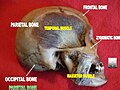
Crossing the middle of the bone in an arched direction are two curved lines, the superior and inferior temporal lines; the former gives attachment to the temporal fascia, and the latter indicates the upper limit of the muscular origin of the temporal muscle.

Above these lines the bone is covered by a tough layer of fibrous tissue – the epicranial aponeurosis; below them it forms part of the temporal fossa, and affords attachment to the temporal muscle.

At the back part and close to the upper or sagittal border is the parietal foramen which transmits a vein to the superior sagittal sinus, and sometimes a small branch of the occipital artery; it is not constantly present, and its size varies considerably.

Internal

[edit]

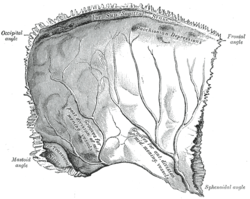
The internal surface [Fig. 2] is concave; it presents depressions corresponding to the cerebral convolutions, and numerous furrows (grooves) for the ramifications of the middle meningeal artery; the latter run upward and backward from the sphenoidal angle, and from the central and posterior part of the squamous border.

Along the upper margin is a shallow groove, which, together with that on the opposite parietal, forms a channel, the sagittal sulcus, for the superior sagittal sinus; the edges of the sulcus afford attachment to the falx cerebri.

Near the groove are several depressions, best marked in the skulls of old persons, for the arachnoid granulations (Pacchionian bodies).

In the groove is the internal opening of the parietal foramen when that aperture exists.

Borders

[edit]
  • The sagittal border, the longest and thickest, is dentated (has toothlike projections) and articulates with its fellow of the opposite side, forming the sagittal suture.
  • The frontal border is deeply serrated, and bevelled at the expense of the outer surface above and of the inner below; it articulates with the frontal bone, forming half of the coronal suture. The point where the coronal suture intersects with the sagittal suture forms a T-shape and is called the bregma.
  • The squamous border is divided into three parts: of these:
    • the anterior is thin and pointed, bevelled at the expense of the outer surface, and overlapped by the tip of the great wing of the sphenoid;
    • the middle portion is arched, bevelled at the expense of the outer surface, and overlapped by the squama of the temporal;
    • the posterior part is thick and serrated for articulation with the mastoid portion of the temporal.
  • The occipital border, deeply denticulated (finely toothed), articulates with the occipital bone, forming half of the lambdoid suture. That point where the sagittal suture intersects the lambdoid suture is called the lambda, because of its resemblance to the Greek letter.

Angles

[edit]
  • The frontal angle is practically a right angle, and corresponds with the point of meeting of the sagittal and coronal sutures; this point is named the bregma; in the fetal skull and for about a year and a half after birth this region is membranous, and is called the anterior fontanelle.
  • The sphenoidal angle (also Welcker's angle), thin and acute, is received into the interval between the frontal bone and the great wing of the sphenoid. Its inner surface is marked by a deep groove, sometimes a canal, for the anterior divisions of the middle meningeal artery.
  • The occipital angle is rounded and corresponds with the point of meeting of the sagittal and lambdoidal sutures—a point which is termed the lambda; in the fetus this part of the skull is membranous, and is called the posterior fontanelle.
  • The mastoid angle is truncated; it articulates with the occipital bone and with the mastoid portion of the temporal, and presents on its inner surface a broad, shallow groove which lodges part of the transverse sinus. The point of meeting of this angle with the occipital and the mastoid part of the temporal is named the asterion.

Ossification

[edit]

The parietal bone is ossified in membrane from a single center, which appears at the parietal eminence about the eighth week of fetal development.

Ossification gradually extends in a radial manner from the center toward the margins of the bone; the angles are consequently the parts last formed, and it is here that the fontanelles exist.

Occasionally the parietal bone is divided into two parts, upper and lower, by an antero-posterior suture.

In other animals

[edit]
Skull of the tuatara (Sphenodon punctatus), with the pineal foramen enclosed by the parietal bones

In non-human vertebrates, the parietal bones typically form the rear or central part of the skull roof, lying behind the frontal bones. In many non-mammalian tetrapods, they are bordered to the rear by a pair of postparietal bones that may be solely in the roof of the skull, or slope downwards to contribute to the back of the skull, depending on the species. In the living tuatara and some lizards, as well as in many fossil tetrapods, a small opening, the parietal foramen (also called the pineal foramen), is present between the two parietal bones at the midline of the skull. This opening is the location of the parietal eye (also called the pineal or third eye), which is much smaller than the two main eyes.[1][2][3]

In dinosaurs

[edit]

The parietal bone is usually present in the posterior end of the skull and is near the midline. This bone is part of the skull roof, which is a set of bones that cover the brain, eyes and nostrils. The parietal bones make contact with several other bones in the skull. The anterior part of the bone articulates with the frontal bone and the postorbital bone. The posterior part of the bone articulates with the squamosal bone, and less commonly the supraoccipital bone. The bone-supported neck frills of ceratopsians were formed by extensions of the parietal bone. These frills, which overhang the neck and extend past the rest of the skull is a diagnostic trait of ceratopsians. The recognizable skull domes present in pachycephalosaurs were formed by the fusion of the frontal and parietal bones and the addition of thick deposits of bone to that unit.[4]

Additional images

[edit]

See also

[edit]

References

[edit]
[edit]
Revisions and contributorsEdit on WikipediaRead on Wikipedia
from Grokipedia
The parietal bones are a pair of large, flat, quadrilateral cranial bones that form the superior and lateral walls of the cranium, contributing significantly to the protection of the brain.[1] These bones are essential components of the neurocranium, overlaying the parietal lobes of the cerebrum and covered externally by the epicranial aponeurosis.[1] Each parietal bone is slightly curved, with a convex external surface that is smooth and features the parietal eminence—a rounded elevation marking the site of ossification—and temporal lines for muscle attachments.[2] The internal surface is concave and irregular, accommodating grooves for the middle meningeal artery and branches of the superior sagittal sinus.[3] Positioned symmetrically on either side of the skull, the two parietal bones meet along the midline at the sagittal suture, while anteriorly they articulate with the frontal bone at the coronal suture and posteriorly with the occipital bone at the lambdoid suture.[2] Laterally, each bone connects with the greater wing of the sphenoid and the squamous part of the temporal bone at the sphenoparietal and squamosal sutures, respectively, forming key junctions such as the pterion (sphenoidal angle) and asterion (mastoid angle).[1] These articulations via fibrous cranial sutures provide structural integrity to the calvaria, the upper portion of the skull.[4] A notable feature is the parietal foramen, a small opening near the sagittal border that transmits an emissary vein connecting the extracranial veins to the superior sagittal sinus, though its presence and size can vary.[2] In terms of development, the parietal bones ossify intramembranously from a single center in the parietal eminence during the eighth week of fetal life, growing to form much of the cranial vault by adulthood.[3] Their robust yet thin structure—typically 5–7 mm thick—balances protection with minimal weight, making them vital for enclosing the brain while allowing for skull growth in infancy through suture patency.[1]

Anatomy

Location and structure

The parietal bones are a pair of flat, irregular, quadrilateral bones that form the superior and lateral aspects of the cranium, contributing significantly to the cranial vault or calvaria.[1][3] They are positioned symmetrically on either side of the skull, overlying the parietal lobes of the cerebrum, and are covered externally by the scalp and epicranial aponeurosis.[1][5] Together with the frontal and occipital bones, they enclose and protect the upper portion of the brain.[5] Structurally, each parietal bone exhibits a slightly curved, quadrilateral shape with a convex external surface and a concave internal surface, adapting to the contours of the underlying brain.[2][1] The external surface is generally smooth and convex, featuring the parietal eminence—a rounded elevation in its central region that marks the site of maximum skull breadth—and two temporal lines: the superior temporal line for attachment of the temporal fascia and the inferior temporal line for the temporalis muscle.[2][3] A small parietal foramen is often present near the superior border, transmitting an emissary vein to the superior sagittal sinus.[2][3] The internal surface is irregular and concave, accommodating cerebral structures; it includes the sagittal sulcus along the superior border for the superior sagittal sinus and grooves for branches of the middle meningeal artery.[1][3] The bone is bounded by four borders: the anterior frontal border, which is serrated and articulates with the frontal bone at the coronal suture; the posterior occipital border, irregular and meeting the occipital bone at the lambdoid suture; the superior sagittal border, the thickest, joining the contralateral parietal bone at the sagittal suture; and the inferior squamosal border, which articulates with the greater wing of the sphenoid and squamous part of the temporal bone via the sphenoparietal and squamous sutures, respectively.[1][6] At the corners where these borders meet, four angles form key landmarks: the anterior frontal angle at the bregma, the anteroinferior sphenoidal angle at the pterion, the posterosuperior occipital angle at the lambda, and the posteroinferior mastoid angle at the asterion.[1][3] These articulations connect the parietal bone to five other cranial bones, ensuring structural integrity through immovable fibrous joints.[3][6]

External surface

The external surface of the parietal bone is convex and smooth, contributing to the superior and lateral aspects of the cranial vault. This surface is gently curved to accommodate the overlying scalp and provides attachment points for muscular and fascial structures involved in mastication and scalp tension.[1][3] A prominent feature is the parietal eminence (or tuber), a rounded elevation located near the center of the bone, which represents the site of primary ossification during embryonic development. Arching across the anterosuperior portion of this surface are the superior and inferior temporal lines. The superior temporal line, a curved ridge, marks the attachment of the temporal fascia, separating the epicranial aponeurosis above from the temporal fossa below. The inferior temporal line, positioned parallel and slightly below, serves as the origin for the temporalis muscle fibers.[1][3][7] Near the posterior border, along the superior sagittal margin, the parietal foramen may be present as a small opening. This foramen transmits the parietal emissary vein, which connects the extracranial veins to the superior sagittal sinus, facilitating venous drainage and potential communication between intracranial and extracranial venous systems. The overall convexity of the external surface also supports the insertion of galea aponeurotica fibers indirectly through its relation to the scalp layers.[1][3][7]

Internal surface

The internal surface of the parietal bone is concave and irregular, featuring impressions that correspond to the convolutions of the underlying cerebral hemispheres.[8] These gyral impressions provide a molded fit against the brain's surface, accommodating the gyri and sulci for protection and stability within the cranial cavity.[1] Prominent vascular grooves mark this surface, including the sagittal sulcus along the superior border, which articulates with the corresponding sulcus on the opposite parietal bone to form a channel for the superior sagittal sinus.[3] This broad groove runs anterosuperiorly and is often surrounded by small pits known as granular foveolae, which house arachnoid granulations that facilitate the drainage of cerebrospinal fluid into the venous system.[1] Additionally, branching grooves for the middle meningeal artery and its vessels extend posterosuperiorly from the sphenoidal angle, originating near the foramen spinosum and supplying the dura mater.[8] In some individuals, a parietal foramen may pierce the posterosuperior region near the sagittal border, transmitting an emissary vein connecting to the superior sagittal sinus and branches of the occipital artery.[1] Near the mastoid angle, a small groove may overlie a portion of the sigmoid sinus, though this is more prominently associated with the adjacent occipital bone.[9] These features collectively support the bone's role in housing dural venous sinuses and arterial structures essential for intracranial circulation.[10]

Borders

The parietal bone, one of the paired flat bones forming the superior and lateral aspects of the cranium, features four distinct borders that facilitate its articulations with adjacent cranial bones via fibrous sutures, contributing to the structural integrity of the skull vault.[1] These borders are irregular and serrated to interlock securely, minimizing movement and providing robust protection for the brain.[11] The superior border, also known as the sagittal border, is the longest and thickest of the four, extending along the superomedial margin of the bone. It articulates with the corresponding superior border of the contralateral parietal bone, forming the interparietal (sagittal) suture that runs along the midline of the skull from the coronal to the lambdoid sutures.[1] This border meets the frontal bone anteriorly at the bregma and the occipital bone posteriorly at the lambda, key fontanelle sites in the fetal skull that ossify postnatally.[3] The anterior border, or frontal border, is highly serrated and lies along the anterosuperior edge, articulating with the lateral aspect of the frontal bone to form the superolateral portion of the coronal suture.[1] This suture extends transversely across the skull, separating the frontal bone from the parietals and serving as a critical landmark for surgical approaches to the anterior cranium.[11] The posterior border, termed the occipital border, is irregular and jagged, articulating with the superior aspect of the occipital bone to constitute the inferolateral half of the lambdoid suture.[1] This suture converges with the sagittal suture at the lambda and with the parietomastoid suture at the asterion, a clinically significant point for identifying underlying venous structures and mastoid air cells.[3] The inferior border, known as the squamosal or temporal border, is the most variable in thickness, being thin anteriorly and thickening as it arches posteriorly. Its anterior portion articulates with the greater wing of the sphenoid bone via the sphenoparietal suture, while the posterior segment connects with the squamous and mastoid parts of the temporal bone through the squamous (squamosal) and parietomastoid sutures, respectively.[1] This border forms the lateral wall of the skull and is adjacent to the pterion anteriorly, a weak region prone to fractures due to its thin bony structure overlying the middle meningeal artery.[11]

Angles

The parietal bone is an irregularly quadrilateral structure featuring four distinct angles, each formed by the convergence of two borders and serving as key anatomical landmarks for suture intersections. These angles are the frontal (anterosuperior), sphenoidal (anteroinferior), occipital (posterosuperior), and mastoid (posteroinferior). The frontal angle, located at the bregma—the junction of the coronal and sagittal sutures—is formed by the meeting of the frontal and sagittal borders and marks the anterior superior corner of the bone.[1] This angle articulates with the frontal bone superiorly and the opposite parietal bone medially, contributing to the stability of the cranial vault.[3] The sphenoidal angle, situated at the pterion, arises from the intersection of the frontal and squamosal (inferior) borders and is positioned at the confluence of the coronal, sphenoparietal, and sphenofrontal sutures.[1] This anteroinferior angle is clinically significant due to its proximity to the middle meningeal artery, where fractures can lead to epidural hematomas; the internal surface here features prominent grooves for the artery's anterior and posterior branches.[1] Posteriorly, the occipital angle, more rounded in contour, forms at the lambda—the union of the lambdoid and sagittal sutures—and results from the sagittal and occipital borders' convergence.[1] It connects with the occipital bone, reinforcing the posterior cranial architecture.[3] Completing the quadrilateral, the mastoid angle lies posteroinferiorly at the asterion, where the parietomastoid, lambdoid, and occipitomastoid sutures meet, defined by the squamosal and occipital borders.[1] This angle articulates with the mastoid portion of the temporal bone, providing attachment for muscles like the sternocleidomastoid and facilitating the transmission of auditory structures.[3] Collectively, these angles not only delineate the parietal bone's boundaries but also serve as reference points in neurosurgery and forensic anthropology for identifying cranial trauma or developmental variations.[1]

Development

Ossification process

The parietal bone develops through intramembranous ossification, a process in which bone forms directly from mesenchymal connective tissue without a preceding cartilaginous template.[12] This mode of ossification is characteristic of the flat bones of the cranial vault, including the parietal bones, which originate from paraxial mesoderm-derived mesenchyme.[12] Unlike endochondral ossification seen in long bones, intramembranous ossification allows for rapid expansion of the skull to accommodate the growing brain during fetal development.[13] The process begins with the aggregation of mesenchymal cells into condensations near the parietal eminence, a prominent region on the lateral aspect of the developing skull.[12] These cells differentiate into osteoprogenitor cells and then osteoblasts under the influence of signaling factors such as bone morphogenetic proteins (BMPs) and fibroblast growth factors (FGFs).[12] Each parietal bone typically arises from two primary ossification centers that appear simultaneously at the parietal eminence during the eighth week post-conception.[13] These centers lie in the same plane or slightly superimposed, initiating bone formation through the secretion of osteoid matrix by osteoblasts, which subsequently mineralizes to form woven bone.[14] Ossification progresses radially outward from these central foci, with osteoblasts depositing layers of bone matrix in an appositional manner, expanding the bone peripherally toward the sutures.[13] By the fourteenth week of gestation, extensive ossification has occurred in both parietal bones, though the process continues along the margins throughout fetal life.[13] The two primary centers fuse by the fourth month of gestation, resulting in a single cohesive bone plate per side.[13] As the bone matures, the initial woven bone is remodeled into lamellar bone, with compact cortical layers forming on the outer and inner surfaces and trabecular spongy bone in the diploë (the space between).[12] Postnatally, further growth of the parietal bone occurs primarily through apposition at the sutural edges, driven by mechanical forces from brain expansion and coordinated with adjacent cranial bones.[13] This sutural growth persists until early adulthood, when the sutures begin to fuse, typically completing between ages 20 and 30.[12] Accessory ossification centers may occasionally appear near the sutures, contributing to minor variations, but the primary process remains intramembranous throughout.[14]

Variations in ossification

The parietal bone typically undergoes intramembranous ossification from primary ossification centers (formed by the early fusion of two centers) per side, initiating at approximately 7–8 weeks of embryonic life and expanding radially to meet and articulate along the midline at the sagittal suture by late fetal development.[15] However, variations arise from disruptions in this process, such as the presence of multiple ossification centers, delayed fusion, or genetic defects, leading to segmented or incomplete bone formation.[16] One notable variation is os parietale partitum, a segmentation of the parietal bone into two or more parts due to failure of fusion between ossification centers, often manifesting as an additional suture in the anteroposterior or superoinferior direction. This trait is linked to embryological disturbances during the 7–8th prenatal week and is typically unilateral, with reported prevalence around 1.9% in specific populations such as Cypriot skulls.[16] It may associate with skull asymmetry but is generally asymptomatic.[16] Enlarged parietal foramina represent another ossification defect, characterized by symmetric, paired lucencies in the posterior parietal bones near the sagittal and lambdoid sutures, resulting from insufficient intramembranous ossification around the embryonic parietal notch. These foramina, with diameters from millimeters to centimeters, occur due to heterozygous mutations in the MSX2 or ALX4 genes and follow an autosomal dominant pattern with incomplete penetrance. Prevalence is estimated at 1:15,000 to 1:50,000, and while often resolving into smaller openings by adulthood, persistent cases may require surgical intervention if associated with risks like cerebrospinal fluid leakage.[17] Interparietal bone variations, though primarily involving the occipital squama, can influence parietal ossification at the lambdoid suture through shared developmental pathways, including non-fusion of 2–3 pairs of ossification centers leading to bipartite, tripartite, or pre-interparietal segments. Such anomalies, observed in adult skulls as symmetrical midline pieces, highlight the plasticity of posterior cranial ossification and are documented in classifications encompassing unipartite to multipartite forms.[18][19] Additional variations include parietal fissures and obelic (or os incae) bones, stemming from delayed or incomplete ossification that leaves persistent gaps or sutural ossicles at the obelion, often closing the third fontanel irregularly. These are less common and may relate to broader congenital defects like craniosynostosis, underscoring the parietal bone's sensitivity to gestational factors.[15]

Function

Protective role

The parietal bones, forming the superior and lateral aspects of the cranial vault, play a critical role in safeguarding the brain from external trauma by enclosing and supporting the underlying neural structures. As paired, quadrilateral elements, they contribute to the neurocranium's dome-like architecture, which shields the cerebral cortex, particularly the parietal lobes responsible for sensory processing and spatial awareness. This protective enclosure prevents direct injury to the fragile brain tissue during impacts, falls, or blunt force.[20] The bone's trilayered composition enhances its biomechanical resilience: an outer table of dense compact bone, a central diploë of trabecular bone, and an inner table of compact bone. The outer table, typically thicker and denser than the inner, provides initial resistance to compressive forces, while the diploë acts as an energy-absorbing core, dissipating impact through its porous, lightweight structure that offers cushioning and shear strength. This sandwich-like design functions akin to an engineering composite, distributing and attenuating forces to minimize transmission to the brain's meninges and parenchyma.[1] Additionally, the parietal bone's slight convexity on the external surface and concavity internally, combined with its articulations via interlocking cranial sutures, further optimize force deflection and structural stability. The curved morphology helps redirect lateral and superior impacts, reducing localized stress concentrations and promoting even load distribution across the vault. These features collectively ensure the bone's durability, with variations in thickness (up to 7-8 mm in adults) correlating with enhanced protection in high-risk areas like the parietal eminence.[1]

Attachment sites

The parietal bone serves as an attachment site for several key structures, primarily on its external and internal surfaces, facilitating muscular support, dural reflections, and vascular passages.[1][3] On the external surface, the superior temporal line provides attachment for the temporal fascia, which envelops the temporalis muscle and spans from the frontal bone to the parietal and temporal bones.[1][3] Inferior to this, the inferior temporal line marks the origin of the temporalis muscle fibers, contributing to the muscle's broad attachment area that extends onto the frontal and temporal bones for mandibular elevation during mastication.[1][3][21] These temporal lines arch across the convex external surface, with the inferior line serving as the primary muscular anchorage point on the parietal bone.[1] The internal surface, which is concave and molded to the cerebral contours, features grooves and borders that accommodate dural and vascular structures. Along the superior border, the sagittal sulcus houses the superior sagittal sinus and provides attachment for the falx cerebri, a dural fold that separates the cerebral hemispheres and runs from the crista galli to the internal occipital protuberance.[1][22] Arachnoid granulations project into this groove, facilitating cerebrospinal fluid drainage into the venous system.[1] Near the posterior angle, a shallow groove for the sigmoid sinus appears, while the tentorium cerebelli, another dural reflection that divides the cerebrum from the cerebellum, attaches at the posteroinferior angles of the parietal bone.[1][23] Additionally, branching grooves for the middle meningeal artery traverse the anteroinferior region, supplying the dura mater and calvaria.[1][3] The parietal foramen, typically located near the posterosuperior aspect of the internal surface (often corresponding to the external surface's midpoint), transmits emissary veins connecting the superior sagittal sinus to extracranial veins, as well as branches of the occipital artery.[1][3] These attachments collectively anchor the parietal bone within the cranial framework, supporting both mechanical stability and neurovascular integrity.[1]

Clinical significance

Fractures and trauma

The parietal bone is the most frequently fractured bone in the skull, accounting for a significant portion of cranial injuries in both adults and children due to its exposed lateral position.[24] Linear fractures, which are non-displaced cracks without bone fragmentation, represent the majority of parietal bone injuries and often result from low- to moderate-energy impacts.[25] These fractures typically heal without intervention but serve as markers for potential underlying brain trauma, necessitating thorough neurological evaluation.[26] In adults, parietal fractures commonly arise from high-impact events such as motor vehicle collisions (20-25% of cases), falls from height (28-35%), and assaults, with the parietal region involved in up to 48% of depressed skull fractures.[27] Depressed fractures, where bone fragments are driven inward by more than the thickness of the inner table (typically >5 mm), occur in severe trauma and carry higher risks, particularly if compound (open to skin) or associated with dural tears.[28] In pediatric populations, the thinner, more pliable skull predisposes infants and young children to parietal fractures from falls, sports, or non-accidental trauma, with simple linear parietal fractures being the most prevalent type in both accidental and inflicted injuries.[26] Bilateral parietal fractures in infants raise suspicion for abuse, though they can result from accidental mechanisms like compression or double impacts.[29] Diagnosis relies on non-contrast computed tomography (CT) as the gold standard, which detects linear fractures with high sensitivity and identifies associated intracranial injuries; skull radiographs are less reliable and reserved for resource-limited settings.[26] Clinical assessment includes Glasgow Coma Scale (GCS) scoring, with scores of 13-15 predicting good outcomes in 97% of depressed fracture cases, while GCS ≤8 correlates with poorer recovery.[30] Management of linear parietal fractures is conservative, involving hospital observation, pain control, and serial neurological exams, with most patients discharged within days if no complications arise.[31] Depressed or compound fractures require surgical intervention, such as elevation, debridement, and dural repair, especially if contaminated, causing neurological deficits, or involving cerebrospinal fluid (CSF) leaks; early surgery (within 24-48 hours) improves outcomes in 81% of cases for patients aged 20-40 years.[30] Antibiotics and tetanus prophylaxis are standard for open wounds, and anticonvulsants may be used prophylactically in high-risk scenarios.[26] Complications include intracranial hemorrhage (e.g., epidural or subdural hematoma in 30-55% of associated cases), infection (up to 10% in open fractures), posttraumatic seizures (5-10% risk), and rare growing fractures in children where leptomeningeal cysts form at the site.[26] Dural involvement worsens prognosis, leading to poor outcomes in 35% of cases, while contusions or multiple bone fractures further elevate mortality and morbidity.[30] In skull base-associated parietal fractures, seen in 11% of pediatric cases, brain edema or bleeding occurs in up to 55%, with conservative management succeeding in 75% but surgical needs in 25%.[32] Overall, isolated parietal fractures have a favorable prognosis, with >90% good recovery in uncomplicated linear cases, but associated brain injury drives clinical significance, emphasizing multidisciplinary trauma care to mitigate long-term neurological deficits.[26]

Surgical and pathological aspects

The parietal bone is susceptible to various pathological conditions, ranging from congenital defects to acquired lesions. Enlarged parietal foramina, also known as persistent parietal foramina, represent a rare inherited disorder characterized by symmetrical, circular openings in the parietal bones that fail to close during fetal development, typically measuring from a few millimeters to several centimeters in diameter.[33] This condition arises from mutations in the MSX2 or ALX4 genes, which encode transcription factors essential for cranial ossification, affecting approximately 1 in 15,000 to 50,000 individuals in an autosomal dominant pattern with variable penetrance.[33] Most cases are asymptomatic, but complications may include scalp defects, increased susceptibility to skull fractures or brain injury from trauma due to weakened bone integrity, and occasional neurological issues such as seizures or headaches from pressure on the openings.[33] Acquired pathological conditions of the parietal bone include fractures, tumors, and rare osteolytic disorders. Depressed skull fractures involving the parietal bone often result from high-impact trauma and can lead to underlying dural tears, brain contusions, or hematomas if the depression exceeds the inner table by more than 5 mm.[34] Benign tumors such as cavernous hemangiomas, which constitute less than 1% of bone tumors and preferentially affect the parietal bone in the fourth decade of life, present as expansile lytic lesions causing localized pain, headaches, or cosmetic deformities, sometimes precipitated by prior trauma.[35] Gorham's disease, an even rarer entity involving progressive osteolysis due to intraosseous vascular proliferation, can manifest as a painless, enlarging calvarial defect in the parietal region, with fewer than 150 reported skull cases worldwide.[36] Isolated parietal bone defects, potentially from defective intramembranous ossification or neural tube separation issues, may associate with encephalomalacia or epilepsy, necessitating thorough neuroimaging to rule out intracranial abnormalities.[37] Surgical interventions for parietal bone pathologies prioritize restoration of cranial integrity, prevention of complications, and access to underlying structures. For depressed parietal fractures, especially in children or cases with contamination, dural laceration, or pneumocephalus, elevation via craniectomy is indicated to debride, irrigate, and repair the dura, followed by potential cranioplasty using autologous bone or synthetic materials like bone cement.[34] In infants, minimally invasive techniques such as burr hole elevation may suffice for non-compound depressions, while open reduction is reserved for significant displacements or associated hematomas.[34] Craniotomy of the parietal bone, often performed through a horseshoe incision and burr holes along the superior temporal line, provides access to supratentorial lesions like parafalcine tumors or the atrium of the lateral ventricle via a transulcal approach, guided by landmarks such as the intraparietal point (5 cm lateral to the sagittal suture and 6 cm anterior to lambda).[38] This procedure spares eloquent motor and sensory cortices using neuronavigation or intraoperative mapping to minimize risks like injury to the superior sagittal sinus or vein of Labbé.[38] Tumor resection in the parietal bone, as seen in cavernous hemangiomas or Gorham's disease, typically involves en bloc excision with tumor-free margins to alleviate symptoms and achieve cosmesis, confirmed histopathologically post-surgery.[35][36] For congenital defects like enlarged foramina, surgery is rarely required unless complicated by trauma or neurological deficits, in which case cranioplasty reinforces the weakened area.[33] Overall, perioperative outcomes, including transfusion needs and hospital length of stay, correlate with parietal bone thickness; in pediatric spring-mediated cranioplasty for sagittal craniosynostosis, thicker bones are associated with higher risks of blood loss and transfusion.[39] Postoperative monitoring focuses on infection prevention through antibiotics and wound care, with most uncomplicated cases allowing discharge within a week.[34]

Comparative anatomy

In mammals and other vertebrates

In mammals, the parietal bones consist of a pair of flat, curved membrane bones that form the majority of the cranial vault's roof and lateral walls, articulating anteriorly with the frontal bones, posteriorly with the occipital bone, inferiorly with the temporal and sphenoid bones, and meeting each other along the sagittal suture.[40] These bones develop through intramembranous ossification from mesodermal mesenchyme, with contributions from neural crest cells in the rostral portion in some species like mice, and they expand to accommodate the enlarged braincase characteristic of mammalian evolution.[41] In derived mammals, such as humans and rabbits, the parietals remain distinct throughout life, providing structural support and attachment for temporalis muscles, though they may fuse with adjacent bones in certain taxa like monotremes.[42] In reptiles, the parietal bones are prominent dermal elements of the skull roof, typically paired and meeting along the midline, but they are often larger relative to the braincase compared to mammals, bordering the temporal fenestrae in diapsids such as lizards and snakes.[40] These bones articulate with frontals anteriorly, squamosals laterally, and occipitals posteriorly, contributing to the kinetic or akinetic skull configurations; for instance, in turtles and crocodilians, they form a robust, fused dorsal shield.[42] Homologically, reptilian parietals derive from the same dermal armor precursors as in early tetrapods, with mesodermal origins predominant, and they lack the extensive neural crest involvement seen variably in mammals.[41] Birds exhibit parietal bones that are reduced and fuse early in development with the frontal and other cranial elements, resulting in an obliterated sagittal suture and a single, solid frontoparietal complex in adults, which supports the lightweight, akinetic skull adapted for flight.[42] This fusion pattern, observed in species like chickens and pigeons, contrasts with the distinct parietals of mammals and reflects evolutionary modifications for reduced weight while maintaining protection, with the parietals forming part of the expanded orbital and temporal regions.[40] In amphibians, the parietal bones are present as paired dermal roof elements but frequently fuse with the frontals to form a frontoparietal bone, particularly in anurans like frogs, creating a simplified, anapsid-like skull without temporal fenestrae.[40] In urodele amphibians such as salamanders, they remain more distinct, articulating with surrounding bones via sutures that persist into adulthood, developing through intramembranous ossification similar to that in amniotes.[42] Evolutionarily, amphibian parietals represent a transitional form, homologous to those in reptiles but adapted to a more flexible, aquatic-terrestrial lifestyle with variable neural crest contributions.[41] Among fish, true parietal bones are absent, as the skull roof is instead composed of other dermal bones like the supraoccipital or extrascapulars in actinopterygians, reflecting the divergent evolution of the chondrocranium and dermatocranium without the expanded vault seen in tetrapods.[42] In basal vertebrates like placoderms, elements homologous to parietals may appear as part of the lateral line-associated dermal armor, but these do not persist in modern teleosts, underscoring the parietal's emergence as a tetrapod innovation.[41]

In reptiles and dinosaurs

In reptiles, the parietal bones are paired dermal elements that form the posterior portion of the skull roof, positioned dorsal to the braincase and immediately posterior to the frontal bones, where they typically meet along a midline suture. These bones contribute to enclosing the brain and supporting surrounding dermal roofing elements, with their shape and size varying by group to accommodate differences in cranial architecture. In many reptilian lineages, the parietals fuse medially, enhancing structural integrity, and often bear a parietal (pineal) foramen in the midline, which transmits the parietal nerve associated with the pineal organ or "third eye" for photoreception and thermoregulation.[43][44] Variations in parietal morphology reflect reptilian diversity. In crocodilians and basal amniotes, the parietals frequently fuse with the frontals to form a composite frontoparietal bone, creating a solid cranial vault. Squamates, such as lizards and snakes, retain distinct paired parietals that remain unfused with adjacent elements, allowing for greater cranial flexibility in kinetic skulls. In turtles (Testudines), the parietals form part of the primary dorsal roof but may integrate with postfrontals and squamosals to produce a secondary roofing layer in more primitive species, adapting to the encased cranial design. These differences underscore evolutionary adaptations in skull rigidity and sensory function across reptilian clades.[43] Dinosaurs, as archosauromorph reptiles, exhibit parietal bones that align with this general reptilian pattern but show clade-specific elaborations. The parietals are paired, flat to slightly convex bones forming the posterior midline of the skull roof, posterior to the frontals and contributing to the overall enclosure of the braincase. A pineal foramen is commonly present on the fused parietals, suggesting retention of parietal eye functionality similar to other reptiles. In ceratopsian dinosaurs, such as Triceratops, the parietals are dramatically expanded posteriorly to form the central midline of the iconic frill—a broad, bony shelf that likely served in display and defense—while remaining paired but tightly sutured. In contrast, sauropod and theropod dinosaurs typically feature more modest parietals integrated into the supratemporal fenestrae borders, supporting jaw musculature attachments without extensive expansions. These features highlight how parietal morphology in dinosaurs balanced neuroprotection with biomechanical and behavioral demands.[45][44][46]

References

User Avatar
No comments yet.