Hubbry Logo
Paromeos MonasteryParomeos MonasteryMain
Open search
Paromeos Monastery
Community hub
Paromeos Monastery
logo
8 pages, 0 posts
0 subscribers
Be the first to start a discussion here.
Paromeos Monastery
Paromeos Monastery
from Wikipedia

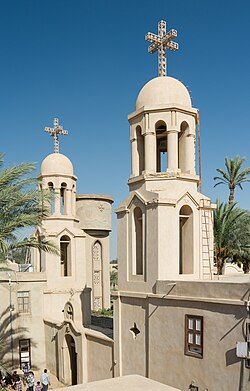
Paromeos Monastery (Coptic: ⲡⲁⲣⲟⲙⲉⲟⲥ), also known as Baramos Monastery (Arabic: البراموس), is a Coptic Orthodox monastery located in Wadi El Natrun in the Nitrian Desert, Beheira Governorate, Egypt. It is the most northern among the four current monasteries of Scetis, situated around 9 km northeast of the Monastery of Saint Pishoy. Ecclesiastically, the monastery is dedicated to and named after the Virgin Mary.

Key Information

Etymology, foundation and ancient history

[edit]

Paromeos Monastery is probably the oldest among the four existing monasteries of Scetes. It was founded c. 335 A.D. by Saint Macarius the Great. The name Pa-Romeos or that of the Romans may refer to Saints Maximus and Domitius, children of the Roman Emperor Valentinian I, who had their cell at the place of the modern monastery. According to Coptic tradition, the two saints went to Scetes during the time of Saint Macarius the Great, who tried in vain to dissuade them from staying. Nevertheless, they stayed and attained perfection before dying at a young age. A year after their departure, Saint Macarius the Great consecrated their cell by building a chapel, and told the monks "Call this place the Cell of the Romans". Another theory holds that the name refers to the Roman Emperors Arcadius and Honorius, disciples of Saint Arsenius. The latter was himself a Roman monk who established himself in Scetes, and it is possible that the two emperors had visited their teacher in his seclusion, thus giving to the monastery its name.

Following the destruction of the monastery in 405 A.D. by the Berbers and the Bedouins, Saint Arsenius returned to rebuild it. However, following a second raid also by the Berbers in 410 A.D., he retired to Troe, now a neighbourhood of Cairo known as Tura, where he died.

Beside Saint Macarius the Great and Saint Arsenius, other saints of the fourth and fifth century resided in Paromeos Monastery, such as Saint Isidore, and Saint Moses the Black who was martyred at the raid of 405 A.D.[1]

Early history

[edit]

As a result of the attacks by the Berbers and the Bedouins, Pope Shenouda I of Alexandria (859-880) built walls around the monasteries of the Nitrian Desert. Their height varies between ten and eleven meters, and their widths are about two meters. They were also covered with a thick layer of plaster.

During the first half of the fifteenth century, the historian Al-Maqrizi visited the monastery and was responsible for identifying it as that of Saint Moses the Black. At that time, he found it to have only a few monks. Other famous visitors included Jean Coppin in 1638, Jean de Thévenot in 1657, Benoît de Maillet in 1692, Du Bernat in 1710, Claude Sicard in 1712, Sonnini in 1778, Lord Prudhoe in 1828, Lord Curzon in 1837, Tattam in 1839, Tischendorf in 1845, Jullien in 1881 and Butler in 1883. Information from them and a few other travelers provide that there were 712 monks who lived in seven monasteries in this region, including twenty monks at Paromeos Monastery in 1088, twelve monks in 1712, nine in 1799, seven in 1842, thirty in 1905, thirty-five in 1937, twenty in 1960 and forty-six in 1970. Today, the monastery is inhabited by some fifty monks.

Though the community of monks was fairly insignificant during this period, Paromeos Monastery apparently supplied one monk to the patriarchal throne in 1047, Pope Christodolos of Alexandria, who proved to be a man of great holiness. The monastery also supplied two monks in the seventeenth century to the patriarchal throne, Pope Matthew III of Alexandria and Pope Matthew IV of Alexandria. In the 20th century the monastery also supplied one monk (Abouna Mina) to the patriarchal throne, Pope Kyrillos VI of Alexandria. The monastery also produced a number of outstanding theologians, including Father Naum, and Father Abdel Massih ibn Girgis el Masuudi, both of the nineteenth century.

Modern history

[edit]

Today, the monastery still preserves much of its ancient character. It has five churches. The oldest church is dedicated to the Virgin Mary and contains the relics of Saint Moses the Black. It is considered the oldest church in Scetes still in existence, dating back to the sixth century. The second church is dedicated to Saint Theodore of Amasea, the third to Saint George, the fourth to Saint John the Baptist, and the fifth to Archangel Michael. The walls built by Pope Shenouda I of Alexandria are still standing today. The monastery also contains a keep, a tower, two refectories, and a guest house.

About two and a half kilometers northwest of this monastery, there is also the limestone cave of the late Pope Cyril VI. Marked by twelve wooden crosses, it is known as the Rock of Sarabamun and has become a popular place of pilgrimage. An iron lattice-work protects the entrance to the site. Within, the one room cave is spacious. It is adorned with numerous pictures and icons of Pope Cyril VI. In the desert about the monastery there are also several caves that apparently continue to be inhabited by hermits.

Under Pope Shenouda III, a number of recent renovations were performed at the monastery. An asphalt road to the monastery was built, and there have been several major cultivation projects. In addition, six water pumps, a sheepfold, a henhouse and two generators were added, together with the construction of new residential cells both inside and outside the monastery proper. There is now a clinic and a pharmacy to serve the monks, as well as a spacious retreat center for conferences and a large, two story guesthouse that was opened in January 1981.

Ruins and excavations

[edit]

Since 1996, the Netherlands Organization for Scientific Research (NWO) and the Faculty of Archaeology of the University of Leiden have financed the archaeological research on the remains of the site commonly known as the Monastery of Saint Moses the Black, near Paromeos Monastery. This monastery was surrounded by an enclosure wall that was perhaps a somewhat late addition during the ninth century.

Within the old monastery, archaeologists discovered the remains of a square structure measuring some sixteen meters square, in the southeastern corner of the site. Though its original purpose was at first unclear, it has now been determined to have most likely been a defensive tower, or keep that may have stood some twenty-five meters in height. However, pottery from the 4th or early 5th century found on the site suggest that this tower was built very early for monastic purposes, particularly with regards to what was probably a fairly small community of monks. It has been suggested that this may have originally been built as a Roman military structure in order to defend the Nitrian Desert and its salt production. Then, after having been abandoned during the fourth century, it may have been put to use by newly arrived anchorites.

In 1998, excavations uncovered a structure that proved later to be that of a church immediately north of the tower. The walls of the nave are made from poor quality and improvised masonry that suggest that the church was perhaps rebuilt hastily after having been destroyed. The actual sanctuary of this church is of better quality, and was apparently reconstructed somewhat later, perhaps at the end of the ninth or the beginning of the tenth century. The altar, which is fairly well preserved, sits atop a one step high podium.

Remains, probably of an earlier structure and consisting of more solid masonry of finely cut limestone blocks, were found in the western part of the church's nave. Since one of these blocks was inscribed with a number of hieroglyphics in high relief, it is very plausible that an Ancient Egyptian monument existed in close proximity to this site.

Abbot

[edit]

The Bishop and Abbot of Paromeos Monastery in Wadi Al-Natrun is Bishop Anba Isidoros since 14 June 1992.

Popes from Paromeos Monastery

[edit]
  1. Pope Christodolos (1047–1077)
  2. Pope John XIV (1571–1586)
  3. Pope Matthew III (1631–1646)
  4. Pope Matthew IV (1660–1675)
  5. Pope Cyril V (1874–1927)
  6. Pope John XIX (1928–1942)
  7. Pope Cyril VI (1959–1971)

Other monasteries of the Nitrian Desert

[edit]

See also

[edit]

References

[edit]
Revisions and contributorsEdit on WikipediaRead on Wikipedia
from Grokipedia
The Paromeos Monastery, also known as Baramus Monastery or the Monastery of the Romans, is a Coptic Orthodox monastery situated in in the Nitrian Desert, , , making it the northernmost of the four surviving monasteries in the region. Founded around 335–340 AD by Saint Macarius the Great, it is dedicated to the Virgin Mary and derives its name from the Coptic term Pa-Rameos, meaning "that of the Romans," possibly in reference to early Roman Christian settlers or saints Maximus and Domitius. Historically, the monastery emerged as a pivotal center of early in the 4th century, housing renowned ascetics such as Saints Arsenius, Isidore, and , the latter of whom was martyred during a Berber raid in 407 AD. It endured multiple sackings by nomadic tribes in 407, 410, 444, 507, 817, and the 11th century, as well as severe declines from the and famine in the 14th century, leading to periods of near abandonment before rebuilding efforts, including fortified constructed under Pope Shenouda I (859–880 AD). The site preserves relics of in its oldest church, a 6th- or 7th-century featuring wall paintings from around 1200 AD, and encompasses five churches within a 9th-century enclosure standing 10–11 meters high. Today, Paromeos remains an active with approximately 50 monks under the leadership of Bishop Anba Isidoros since 1992, functioning as a spiritual retreat with modern facilities including a and guesthouse, while its archaeological remains highlight its enduring role in Coptic heritage. It is recognized on UNESCO's Tentative List for World Heritage since 2003 as part of the "Monasteries of the Arab Desert and Wadi Natrun," underscoring its cultural and historical significance in .

Etymology and Origins

Name and Meaning

The name Paromeos Monastery originates from the Coptic term "Pa-Romeos," which translates to "of the Romans" or "that of the Romans," reflecting its linguistic roots in the ancient Egyptian Christian dialect. The transliteration "Baramus" preserves this Coptic , underscoring the monastery's enduring connection to early practices in Coptic monastic communities. This designation is primarily linked to Saints Maximus and Domitius, sons of Roman Emperor Valentinian I (r. 364–375 AD), who withdrew from imperial life to pursue asceticism in the Wadi El-Natrun region, thereby associating the site with Roman heritage. An alternative interpretation ties the name to the sons of Emperor Theodosius I—Arcadius and Honorius—through their tutor, Saint Arsenius, who embraced monasticism around 394 AD and contributed to the spiritual legacy of the area. These Roman figures symbolize the transition from worldly power to Christian renunciation, a core theme in the monastery's identity. In Coptic tradition, the name carries symbolic weight as an emblem of cultural fusion, where Roman imperial lineage merges with the desert ascetic ideal, signifying and divine calling over earthly authority. Ecclesiastically, Paromeos is dedicated to the Virgin Mary alongside Saints Maximus and Domitius, reinforcing the name's devotional and historical resonance within Orthodox .

Foundation and Early Establishment

The Paromeos Monastery, also known as Dayr al-Baramus, was established in the desert of Scetes, now identified as Wadi al-Natrun in Egypt's Nitrian Desert, between 330 and 340 AD. This foundational period marked the gathering of early ascetics around Saint the Egyptian (also called the Great), who became the central figure in initiating organized monastic life in the region. , originally from Shabsheer in , had withdrawn to the desert seeking spiritual solitude, drawing followers who formed the initial settlement near the site's present location. As the earliest monastic foundation in Scetes, Paromeos holds the distinction of being the oldest among the four surviving monasteries in the Nitrian Desert—the others being those of , Anba Bishoy, and the . The settlement's name, derived from the Coptic "Pa-Romeos" meaning "of the Romans," briefly references the legendary arrival of Roman saints Maximus and Domitius, whose memory honored by constructing the first church dedicated to the Virgin Mary. This early establishment consisted of scattered cells for hermits, evolving into a cohesive community under 's guidance before 340 AD, serving as the pioneering monastic hub in al-Natrun. Saint Macarius introduced foundational ascetic practices that defined early at Paromeos, emphasizing communal yet solitary living for hermits focused on , manual labor, and spiritual contemplation. These practices drew from Macarius's own eremitic lifestyle, promoting of worldly ties to foster inner purification and devotion, which attracted disciples and laid the groundwork for the monastery's role as a center of Coptic monastic tradition. By the mid-4th century, the community had grown into a structured ascetic enclave, influencing the broader development of desert in .

Historical Development

Ancient and Early Periods

The Paromeos Monastery, originally established in the around 335 AD by Saint Macarius the Great as one of the earliest centers of , faced significant challenges in its formative centuries due to regional instability. In the early , the endured successive raids that nearly eradicated its community. It was first destroyed in 407 AD by Berber and attackers, prompting Abbot Arsenius the Great, a prominent who had joined the after fleeing Roman life, to lead the reconstruction efforts upon his return. However, a second devastating raid by in 410 AD razed the site once more, forcing Arsenius and surviving monks to temporarily relocate to Troe (modern-day Troja) before attempting further restoration. These events, documented in early Coptic hagiographies, underscored the precariousness of monastic life amid nomadic incursions in the desert frontier. The monastery's early periods also featured influential saints who shaped its spiritual ethos. Saint Moses the Black (c. 330–405 AD), a former Ethiopian bandit renowned for his dramatic conversion and ascetic rigor, resided at Paromeos, where he was martyred during a Berber raid around 405 AD after choosing non-violence over resistance, exemplifying repentance and interceding against temptations for his brethren. Similarly, Saint Isidore the Anchorite (d. c. 390 AD), a disciple of , contributed to monastic discipline at the site by advocating extreme solitude and prayer, as recounted in the Apophthegmata Patrum, influencing the community's emphasis on and communal confession. Their legacies, preserved in Coptic synaxaria, reinforced Paromeos as a hub for transformative spirituality amid adversity. By the 9th century, ongoing threats necessitated structural fortifications. Under (r. 859–880 AD), who oversaw broader Coptic resilience during Abbasid rule, defensive walls—reaching 10–11 meters in height and about 2 meters thick—were constructed around the monastery to protect against further assaults, remnants of which endure today as key archaeological features.

Medieval Period

Following repeated destructions by Berber invaders in the preceding centuries, the Paromeos Monastery underwent significant rebuilding efforts in the , including the construction of massive defensive enclosure walls by Pope Shenouda I of (r. 859–880 AD). These walls, reaching heights of 10-11 meters and widths of 2 meters, encircled the site to protect against further and Berber raids, marking a key phase of that sustained the monastery's continuity into the medieval era. During the 10th and early 11th centuries, expansions continued with additions to the Church of the Holy Virgin, the monastery's oldest structure, originally dating to the late 6th or early . An 8th- or 9th-century khurus ( enclosure) was incorporated, along with medieval pillars supporting the , enhancing the basilica's layout for liturgical use. By the late , a was added to the central , and finely carved wooden doors from the Fatimid period (10th-12th centuries) adorned the entrances, reflecting Islamic architectural influences adapted to Coptic designs. Under Fatimid rule (969-1171), the monastery maintained strong ties to Coptic Orthodox traditions, serving as a center for copying and theological scholarship, with monks producing illuminated texts that preserved Sahidic Coptic literature. The refectory's circular bench arrangement, a communal dining practice emblematic of early monastic , persisted until the end of this period. During the subsequent era (1250-1517), these traditions endured amid political shifts, as evidenced by 13th-century reconstructions of the Church of the Holy Virgin's sanctuary and wall paintings around 1200 AD depicting Christological cycles, which underscored the site's role in iconography and devotion to the Virgin Mary. The late medieval period brought decline through invasions and internal changes, with the monastery sacked multiple times in the by Bedouins, reducing its monastic community to just 20 monks by 1088. The in the and associated famines further devastated the population, leading to a shift toward smaller, more insular communities and partial abandonment of structures, as documented in historical accounts up to the 15th century.

Modern Era

Following a period of decline in the medieval era, the Paromeos Monastery experienced a revival in the , marked by increased interest from Coptic faithful and visitors. In the late , the monastery gained prominence through theological and apologetical publications by the Syrian monk Afram ‘Adad, who wrote under the "The Monk of Baramus," drawing greater attention to its . This period saw notable visitors, including Lord Prudhoe in 1828, Lord Curzon in 1837, and Henry Tattam in 1839, reflecting renewed engagement with the site. The monastic population, which stood at seven monks in 1842, grew to thirty by 1905, indicating a gradual resurgence in community size. Throughout the 20th and into the , the monastery's monastic community has remained stable, underscoring its enduring role in Coptic Orthodox tradition. By 1970, the population had reached 46 monks, a figure that has held steady at approximately 50 as of 2025, supporting the monastery's ongoing spiritual and communal functions. Significant modernizations occurred under Pope Shenouda III (1971–2012), who oversaw extensive upgrades to enhance the monastery's self-sufficiency and . These renovations included the of an asphalt road connecting the monastery to external routes, the installation of six water pumps for , a sheepfold, a henhouse, two generators for power, new residential cells for monks, a , a , and a two-story guesthouse opened in January 1981. These developments not only addressed practical needs but also facilitated greater cultivation projects, bolstering the monastery's agricultural output.

Physical Site and Archaeology

Current Structures and Layout

The Paromeos Monastery, also known as Deir al-Baramus, features a layout enclosed by massive defensive walls approximately 10-11 meters high and 2 meters thick, constructed during historical rebuilds to protect against invasions. These walls, plastered and equipped with a walkway, surround the central complex, which includes a single main entrance via a small eastern gate leading to internal courtyards, farms, and annexes. The overall design integrates functional monastic areas such as living quarters, a , a keep, and guesthouses, with modern additions like a retreat house and library enhancing contemporary use while preserving the site's ancient character. The monastery complex houses five churches, serving as focal points for liturgical and communal activities. The oldest and primary church is dedicated to the Virgin Mary, located in the eastern half south of the old tower; this basilica-style structure includes three sanctuaries, a khurus, and a , and it notably contains relics of and Saint Isidore preserved in a feretory. Other churches include the Church of Saint John the Baptist near the east gate, featuring a nine-bay with domes and three altars; the Church of the on the second floor of the keep; the Church of , a recent addition outside the old walls for visitor liturgies; and smaller chapels integrated within the Virgin Mary Church, such as those dedicated to Saint George and Saint Theodore. Living quarters for the monastic community consist of modern cells arranged along the inner walls and courtyards, accommodating around 50 who follow a structured daily routine of , work, and study. The keep (al-Qasr), a multi-story defensive tower with a entrance, provides additional residential space on its upper floors and historically served as a refuge during threats. Adjacent functional areas include a with a long brick table for communal meals, kitchens, storerooms, and a guesthouse for visitors, all integrated within the walled enclosure to support the monastery's ongoing role as a spiritual center.

Ruins and Excavation Findings

Archaeological excavations at the site of Paromeos Monastery, known as Deir al-Baramus, were initiated in 1996 by the Netherlands Organization for Scientific Research (NWO) in collaboration with the Faculty of Archaeology at Leiden University, focusing on the ruins of the original early monastic settlement north of the current monastery complex. These efforts, continuing through campaigns in 1999 and 2001, targeted the pre-modern remnants to uncover evidence of the site's foundational phases and subsequent developments. A key discovery was a large square defense tower measuring 16 by 16 meters, with walls up to 2 meters thick and no visible doors or windows, dated to the late 4th or early 5th century and potentially originating from Roman adapted for monastic use. The tower's robust construction suggests it served as a protective structure in the initial laura-style settlement, which consisted of dispersed residential cells enclosed by an irregular perimeter. Adjacent to the tower, excavators uncovered remains of a three-aisled church, with its earliest phase possibly dating to the or earlier, featuring a simple , on a with an altar, and a khurus (chancel screen). This church appears to have been rebuilt in the 9th or , incorporating higher-quality in the while retaining elements in the , indicating phases of and repair following regional instability. The digs revealed a broader settlement pattern evolving from an open 6th-7th century community of and dwellings—arranged in a rectangular outline of approximately 80 by 65 meters—to a more enclosed complex by the , marked by an added outer defensive wall and destruction layers attributable to early 9th-century raids. Reused blocks bearing hieroglyphs point to the proximity of a pre-Christian Pharaonic , providing for the site's strategic location in the Nitrian . These findings illuminate early Coptic monastic architecture, characterized by functional, adaptive designs that transitioned from communal lauras to fortified coenobia, offering tangible evidence of the monastery's role in the monastic tradition.

Religious and Cultural Role

Notable Figures and Saints

Saint the Great (c. 300–391 AD), revered as the founder of the monastic community at Paromeos Monastery in the Nitrian Desert, was born in the village of Shabsheer in to Christian parents. After a brief that remained unconsummated due to his ascetic inclinations, he distributed his possessions to the poor following his parents' death and withdrew to the desert near Nitria to live as a . Influenced by Saint Anthony the Great, was ordained a priest around age 40 and relocated to the wilderness of Scetis () circa 330 AD, where he established the first monastic cells that evolved into Paromeos Monastery around 335 AD. As spiritual father to thousands of monks, he organized the communal ascetic life, emphasizing solitude, manual labor, and unceasing prayer to combat spiritual temptations. Macarius's ascetic teachings, preserved in the Fifty Spiritual Homilies and other treatises attributed to him, underscore the transformative power of , , and in achieving union with God. He taught that the soul must wage war against invisible demonic forces through vigilant and , famously instructing monks with the prayer: "Lord, as Thou wilt and as Thou knowest, have mercy on me." His guidance fostered a balanced monastic discipline, blending eremitic isolation with communal support, which became foundational to and influenced early Christian spirituality across the Eastern Church. Macarius's relics were later translated to his namesake monastery, but his legacy endures at Paromeos as the originator of its desert tradition. Saint Moses the Black (c. 330–405 AD), an Ethiopian by birth and one of the most prominent disciples of , exemplifies radical conversion and heroic virtue within the Paromeos community. Originally a slave in who escaped to lead a band of robbers due to his immense physical strength, Moses terrorized the Valley until a divine intervention—often recounted as a vision or miraculous pursuit—prompted his repentance around 370 AD. Seeking , he journeyed to Scetis, where he submitted to the rigorous spiritual direction of Abba Isidore and , undergoing a period of testing that included carrying water for the elders and enduring insults to cultivate . Ordained a and later a , Moses attracted 75 followers to his cell, teaching and non-violence even in the face of aggression. Moses's life ended in martyrdom during the Berber raids on Scetis in 405 AD; forewarned by a dream, he and seven companions prepared for death by refusing to flee, declaring, "Those who are with have no need to fear." His relics, symbolizing redemption from a life of to one of sanctity, are enshrined in the Church of the Virgin Mary at Paromeos Monastery, the oldest structure still in use there, drawing pilgrims to venerate his example of transformative grace. Saint , the of Scetis (d. c. 390 AD), served as an early companion and key collaborator of in establishing the monastic framework at Paromeos, providing spiritual oversight and liturgical to the growing . As a disciple influenced by Macarius's teachings, Isidore resided among the cells of Paromeos, where he guided novices like through intense ascetic trials, including all-night vigils to witness divine light at dawn as a metaphor for spiritual enlightenment. His sayings in the Apophthegmata Patrum emphasize in and communal harmony, advising monks to pray for irritable brethren rather than judge them. Isidore's role extended to defending during Arian persecutions, reinforcing Paromeos as a bastion of pure doctrine. Saint Arsenius the Great (c. 350–445 AD), another disciple of who joined the Scetis community around 394 AD, contributed significantly to Paromeos's early resilience and spiritual depth after its initial foundations. Born in to a senatorial family and educated as a tutor to Theodosius I's sons in , Arsenius renounced worldly honors to embrace desert asceticism, settling in a remote cave near Paromeos for silent contemplation and mat-making. Renowned for his maxim "Fuge, tace, quiesce" (flee, be silent, be quiet), he modeled profound withdrawal from distractions to foster inner peace. Following the destructive Berber and raids of 405 AD that devastated Scetis, Arsenius returned to aid in rebuilding Paromeos, restoring its cells and guiding survivors in renewed spiritual discipline before relocating due to further incursions in 434 AD. His presence at Paromeos solidified its tradition of contemplative silence amid adversity.

Popes Associated with the Monastery

The Paromeos Monastery, also known as Baramous, has been a significant cradle for Coptic Orthodox leadership, producing seven popes who ascended to the patriarchal throne of between the 11th and 20th centuries. These figures, emerging from the monastery's monastic tradition, played pivotal roles in administering the Coptic Church amid political upheavals, doctrinal preservation, and administrative reforms. Their tenures often emphasized spiritual resilience, ecclesiastical organization, and adaptation to external pressures from Islamic rule and colonial influences. Pope Christodoulos, the 66th Patriarch (1047–1077), entered monastic life at Paromeos before his election, bringing its ascetic ethos to the patriarchate. He is renowned for establishing Cairo as the permanent residence of the Coptic Pope, relocating from Alexandria to the Church of Saints Cyrus and John (Abu Sayfayn) to facilitate closer ties with the Fatimid government and enhance administrative efficiency. Pope John XIV, the 96th Patriarch (1571–1586), was a monk from Paromeos who focused on maintaining church unity during Ottoman rule. His papacy involved diplomatic efforts, including correspondence with the Roman Catholic Church seeking support against persecution, which underscored attempts to bolster Coptic administrative autonomy through external alliances. Pope Matthew III, the 100th (1631–1646), originated from the monastery's community and contributed to inter-church relations by consecrating a metropolitan for the Ethiopian Orthodox Church from the of St. Antony, strengthening doctrinal ties and administrative oversight in . Pope Matthew IV, the 102nd (1660–1675), also hailed from Paromeos and navigated internal schisms by reinforcing monastic and relocating papal relics to secure them during turbulent times, thereby preserving Coptic liturgical and administrative continuity. Pope Cyril V, the 112th (1874–1927), drew from his Paromeos roots during one of the longest papacies in , marked by responses to British occupation following the . He advanced doctrinal dissemination by translating numerous religious texts into and founding the periodical El-Karma to promote Orthodox teachings and counter missionary influences. Pope John XIX, the 113th Patriarch (1928–1942), ascended as the first diocesan metropolitan from Paromeos, signaling a shift toward more structured episcopal administration. His tenure emphasized financial reforms and community support amid economic challenges, laying groundwork for modern Coptic organizational practices. Pope Cyril VI, the 116th Patriarch (1959–1971), took his monastic vows at Paromeos in 1928, adopting the name Father Mina el-Baramousy, which reflected his deep ties to the site. He spearheaded a spiritual renaissance, constructing in Abbasseya as the new patriarchal seat and fostering a revival in and lay , for which he was canonized as a in 2013.

Abbot and Monastic Community

The leadership of Paromeos Monastery is vested in Bishop Anba Isidoros, who has served as abbot since his appointment on June 14, 1992. As the spiritual and administrative head, he oversees the monastery's operations, guides the monks in their ascetic practices, and represents the community in ecclesiastical matters, a role affirmed in recent papal visits to the site. The monastic community at Paromeos follows the traditional Coptic Orthodox structure, comprising approximately 50 monks who live in communal obedience to the abbot. Upon tonsure, monks profess the three foundational vows of poverty, chastity, and obedience, committing to renounce personal possessions, celibacy, and submission to the community's authority as a path to spiritual purification and union with God. Roles within the community are assigned as "obediences," including liturgical service, maintenance of the grounds, scriptural study, and hospitality to pilgrims, ensuring a balanced life of prayer and labor under the abbot's direction. Daily routines emphasize rhythmic spiritual discipline, beginning with the midnight prayer (Tasbeha) around 4 a.m., followed by communal liturgies, personal meditation, and manual work such as farming or restoration tasks. Spiritual practices include the seven canonical hours of prayer, recitation of the Divine Liturgy on Sundays and feast days, and ongoing study of patristic texts to foster hesychia (inner stillness). The community also maintains an on-site clinic and pharmacy primarily to support the health needs of the monks, reflecting their commitment to holistic well-being amid monastic seclusion.

Location and Context

Geographical Setting

The Paromeos Monastery is located in , a depression in the Nitrian Desert of northern Egypt's , at coordinates 30°21′26″N 30°16′14″E. This site lies approximately 100 kilometers northwest of and about 9 kilometers northeast of the Monastery of Saint Bishoy. Wadi El Natrun features a harsh environment characterized by salt marshes, extensive natron salt deposits, freshwater marshes, and alkaline lakes, with around 12 such lakes covering a total surface area of 10 square kilometers and averaging 2 meters in depth. The valley sits 23 meters below and 38 meters below the River level, contributing to its unique reddish-blue lake colors formed by desert storm rainwater and a of hot summers exceeding 38°C and mild winters around 10°C. The isolation of this desolate wilderness in the Nitrian Desert made it an ideal setting for early , serving as one of three primary centers—alongside Nitria and Kellia—for and cenobitic communities starting around 330 AD. Known historically as Scetis, the area attracted figures like Saint Macarius the Great, fostering solitude and austerity that defined monastic life amid the barren landscape. The Nitrian Desert, also known as Scetis or Wadi al-Natrun, hosts four surviving monasteries that represent the enduring legacy of early : Paromeos Monastery (also called Baramus), the Monastery of Saint Macarius the Great, the Monastery of Saint Bishoy, and the Monastery of Saint Samuel the Confessor (Deir al-Surian). These institutions emerged in the late as semi-anchoritic communities, blending solitary contemplation with communal worship, and have maintained continuous monastic presence despite historical challenges. These monasteries share a profound historical tradition rooted in the Nitrian Desert's role as a cradle of Christian asceticism, heavily influenced by figures like Saint Macarius the Great, who is credited with founding or shaping early settlements there around 330–360 CE. Mutual influences are evident in their collective contributions to , including the development of liturgical practices, theological resilience during Chalcedonian controversies, and the preservation of apophthegmata () that emphasize humility, prayer, and communal support. For instance, monks frequently transferred between these sites for spiritual guidance or to evade external threats, fostering a networked tradition that reinforced Coptic Orthodoxy's miaphysite doctrine across the region. Comparatively, Paromeos , established around 335 CE, holds the distinction as the oldest and northernmost of the four, positioned approximately 9 km northeast of the of Bishoy. The of the Great, founded near Macarius's original cell around 360 CE, emerged as the most influential hub for leadership within the Coptic Church, while the of Bishoy and Deir al-Surian developed in closer proximity to the south and west, respectively, sharing fortified architectures adapted to the desert's harsh environment and Berber raids in 407, 434, and 444 CE. These inter-monastic relations, marked by shared defenses and ecclesiastical alliances, underscore their role as interdependent pillars of Coptic spiritual life without overshadowing their distinct patronal devotions.

References

Add your contribution
Related Hubs
User Avatar
No comments yet.