


Community hub
Recent from talks
Contribute something
Nothing was collected or created yet.
Patna State
View on Wikipedia
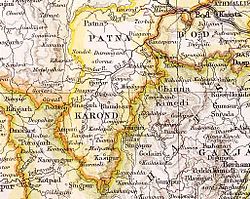
Patna State was a princely state in the Eastern States Agency of India during the British Raj. It had its capital at Balangir. Its area was 6,503 km2 (2,511 sq mi). It is now part of the Indian state of Odisha.[1]
Key Information


History
[edit]The foundation of the Patna kingdom was laid by Ramai Deva of the Chauhan dynasty in 1360 CE when he overthrew Hattahamir Deb, the administrator of the region as the Eastern Ganga Empire started weakening following invasions from the northern part of the subcontinent.[2][3][4][5] The Chauhan reign eventually extended over the region under its cadet branches which included the kingdoms of Sambalpur State, Sonepur State and the zamindaries of Khariar and Jarasingha.[6] The history of the Chauhan rule in the region is also obtained from the 16th century palm-leaf manuscript Kosalananda Kavya.[7]
After Indian independence, Patna's last ruler Rajendra Narayan Singh Deo acceded to the newly independent Dominion of India, on 1 January 1948 with the state forming much of the present day Balangir district. Rajendra Narayan Singh Deo, built a new career as an elected politician and served as Chief Minister of Orissa from 8 March 1967 to 9 January 1971.[1]
Rulers
[edit]The rulers of Patna state of the Chauhan Dynasty:[8][9]
- Ramai Deva (1360–1380)
- Mahalinga Deva (1380–1385)
- Vatsaraja Deva (1385–1410)
- Vaijala Deva I (1410–1430)
- Bhojaraj Deva (1430–1455)
- Pratap Rudra Deva I (1455–1480)
- Bhupal Deva I (1480–1500)
- Vikramaditya Deva I (1500–1520)
- Vaijal Deva II (1520–1540)
- Bajra Hiradhara Deva (1540–1570)
- Narsingh Deva (1570–1577)
- Hamir Deva (1577–1581)
- Pratap Deva II (1581–1620)
- Vikramaditya Deva II (1620–1640)
- Mukunda Deva (1640–1670)
- Balaram Deva (1670–1678)
- Hrdesha Deva (1678–1685)
- Rai Singh Deva (1685–1762)
- Prithviraj Deva (1762–1765)
- Ramchandra Singh Deo I (1765–1820)
- Bhupal Singh Deo (1820–1848)
- Hiravajra Singh Deo (1848–1866)
- Pratap Singh Deo (1866–25 November 1878)
- Ramchandra Singh Deo II (25 November 1878-1895)
- Lal Dalganjan Singh Deo (1895–1910)
- Prithviraj Singh (1910–1924)
- Rajendra Narayan Singh Deo (1924–1 January 1948)
Titular
[edit]- Rajendra Narayan Singh Deo (1 January 1948 – 23 February 1975)
- Rajraj Singh Deo (23 February 1975 – April 2004)
- Kanak Vardhan Singh Deo (April 2004 – present)
Gallery
[edit]-
-
-
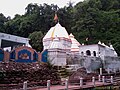
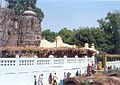
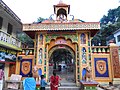 Nrusinghanath Temple entrance


See also
[edit]References
[edit]- ^ a b "Patna (Princely State)". Archived from the original on 22 May 2009. Retrieved 22 May 2010.
- ^ ODISHA DISTRICT GAZETTEERS BOLANGIR (PDF), GAD, Govt of Odisha, 1994, p. 55-65
- ^ ODISHA DISTRICT GAZETTEERS DEOGARH (PDF), GAD, Govt of Odisha, 1994, p. 17-19
- ^ "WESTERN ORISSA ON THE EVE OF CHAUHAN RULE" (PDF). www.shodhganga.inflibnet.ac.in. Retrieved 9 September 2017.
- ^ "CHAUHAN RULERS OP PATNA STATE" (PDF). www.shodhganga.inflibnet.ac.in. Retrieved 9 September 2017.
- ^ Brundaban Mishra (2012), Social Structure Of Western Orissa Under The Chauhans Of Sambalpur, JHSS, retrieved 10 March 2021
- ^ Ashok kumar Patnaik (December 2009), The Mirror Reflection of Sambalpur State through the Courtly Chronicle called Kosalananda Kavyam, Odisha History Congress, retrieved 12 March 2021
- ^ Raghumani Naik (3 March 2018), GENEALOGICAL ANALYSIS OF CHAUHAN RULERS OF PATNAGARH IN WESTERN ORISSA: A STUDY, IRJHRSS, retrieved 12 March 2021
- ^ "Patna Princely State (9 gun salute)". Archived from the original on 13 September 2017. Retrieved 17 June 2014.
20°43′N 83°29′E / 20.72°N 83.48°E
 | This article related to a location in Odisha is a stub. You can help Wikipedia by expanding it. |
Patna State
View on GrokipediaGeography and Origins
Territorial Extent and Location
Patna State was situated in the western region of present-day Odisha, India, within the Mahanadi river valley and forming part of the historical South Kosala empire. Its territory largely corresponded to the modern Balangir district, with the capital at Balangir (also spelled Bolangir).[1] The state covered an area of 2,530 square miles (approximately 6,553 square kilometers), as recorded in the 1941 census. Geographically, it extended between 20° 9' N and 22° 4' N latitude and 82° 41' E and 83° 40' E longitude, encompassing undulating plains, low hills, and riverine basins typical of the region's topography.[1] Its historical boundaries included Sambalpur district and Sonepur State to the north, Sonepur State, Boudh State, and Kalahandi State to the east, and Sambalpur district to the west, with Kalahandi extending influence southward. This positioning placed Patna State amid neighboring princely entities and British-administered territories in the Orissa States Agency during the colonial period.[1]Etymology and Founding Myth
The name Patnagarh, the historical capital of Patna State, derives from "Patna-garh," where "garh" signifies a fort or stronghold in regional Indo-Aryan languages, indicating a fortified settlement associated with an earlier place-name "Patna," possibly denoting a town or landing site from Sanskrit pattana (settlement or portage).[3] The precise etymology of "Patna" itself remains uncertain, with no contemporary inscriptions providing a definitive origin, though local traditions link it to the region's pre-Chauhan settlements without empirical corroboration.[4] The founding myth of Patna State centers on Ramai Deva, credited as its originator around 1360 CE, portrayed in Chauhan genealogical traditions as a descendant of Prithviraj Chauhan III of Delhi, whose defeat by Muhammad of Ghor in 1192 CE prompted familial migration. According to these accounts, after Prithviraj's fall, his descendant Vishal Deva (also called Hammir Deo) established a branch in Mainpuri, Uttar Pradesh; following Vishal's death at the hands of a Muslim ruler, his pregnant queen Jayanti Devi (or Ashvavati) fled southward, seeking refuge in Ramod village under the protection of Binjhal tribal chieftain Bariha.[5] There, she gave birth to Ramai Deva, who was adopted and educated by Brahman Chakradhara Panigrahi; as a youth, Ramai reportedly slew a man-eating tiger terrorizing the locality, earning tribal allegiance and enabling him to rally forces against the incumbent Mullick rulers (likely local Muslim administrators or chieftains).[5] He overthrew them, consolidating control over Patna and expanding into a confederacy of eighteen garhs (forts), marrying Bhanumati, sister of Ganga king Bhanu Deva III, to legitimize his dynasty.[5] [1] These narratives, preserved in Rajput bardic lore and Chauhan court records, serve to trace legitimacy to the Agnikula (fire-born) origins of the broader Chauhan clan, emphasizing martial prowess and divine favor amid post-Islamic conquest displacements, though archaeological evidence for Ramai's tiger-slaying or exact lineage remains absent, suggesting embellishment for dynastic prestige.[6] [5] Historical inscriptions and gazetteers confirm Ramai's establishment of Chauhan rule circa 1360 CE by displacing prior Telugu or local administrators like Hattahamir Deb, marking the transition from fragmented chiefdoms to a centralized state in western Odisha.[7][1]Historical Evolution
Establishment under Chauhan Rule
The Patna State was established in the mid-14th century by Ramai Deva, a Chauhan Rajput who migrated from northern India following the disruptions caused by the Delhi Sultanate's expansions. Originating from the Chauhan lineage, Ramai Deva—described in some accounts as a descendant of rulers from regions like Mainpuri or connected to the Ranthambore branch—arrived in the western Odisha region amid a power vacuum left by declining local dynasties, including the Kalachuris and Telugu Chodas. He overthrew the incumbent local chiefs, including figures like Hattahamir Deb, an administrator under prior rule, thereby laying the foundation for Chauhan dominion in the area previously known as part of South Kosala.[8][5] Ramai Deva's conquest, dated approximately to 1360 CE by several historical analyses, marked the inception of the Chauhan dynasty's rule, with Patnagarh selected as the capital due to its strategic location. He consolidated power by defeating neighboring chieftains and forging alliances, such as through marriage to the daughter of Eastern Ganga king Bhanudeva II, which helped legitimize his authority in the region. To symbolize the new regime, Ramai Deva constructed the Patneswari Temple, dedicating it to the tutelary goddess of the Chauhans, which became a central religious and political emblem of the state. This establishment transformed Patna into a fortified stronghold, enabling rapid territorial expansion.[5][9][10] Under Ramai Deva's leadership (r. circa 1360–1385), the nascent state quickly emerged as the head of a confederation of eighteen garhs (fortified territories), leveraging military prowess and administrative reforms rooted in Rajput traditions. This early phase emphasized defensive fortifications and agrarian stabilization, setting the stage for subsequent dynastic continuity. Historical records, including local inscriptions and genealogies, affirm the Chauhans' Rajput heritage and their displacement from northern strongholds as key causal factors in the migration and founding, distinguishing Patna's origins from indigenous Odia polities.[1][8]Medieval Expansion and Conflicts
The kingdom of Patna was founded in the mid-14th century by Ramai Deva, a Chauhan Rajput from Mainpuri in Uttar Pradesh, who conquered Patnagarh by overthrowing the local administrator Hattahamir Deb and defeating the ruling Asta-Mallik confederacy of chieftains.[8][11] Ramai Deva's reign, approximately 1355–1380 CE, marked the initial consolidation of Chauhan authority in western Odisha, leveraging military prowess to establish a Rajput foothold amid declining Ganga influence in the region following invasions by Delhi Sultanate forces.[5][12] Subsequent rulers pursued aggressive expansion, transforming Patna into the suzerain of a confederacy comprising eighteen garhs—fortified principalities—across the Tel, Ang, and Saleiya river valleys, including dependencies like Sambalpur that formed a garjat network under Patna's overlordship.[5][13] This territorial growth, achieved through conquests and feudal alliances, extended Patna's influence into adjacent areas of present-day Chhattisgarh by the late 14th century.[14] Key among these efforts was the campaign of Baijal Deo I (r. circa 1361–1374 CE), the third Chauhan ruler, who advanced into Chunderpur, forcibly displacing the rulers of Ratnapura and Bastar to secure eastern frontiers.[14][8] Conflicts during this period were characterized by raids and defensive wars against tribal chieftains, rival garh lords, and opportunistic incursions from the Gajapati kingdom of Odisha, with Chauhan forces relying on Rajput cavalry and fortified hill positions to repel threats.[1][12] Vaijala Deva I (r. circa late 14th century), the fourth ruler, exemplified cultural consolidation amid expansion by commissioning the Nrusinghanath Temple, symbolizing divine sanction for territorial gains while fending off local resistances.[11] These martial endeavors solidified Patna's regional dominance until the 15th century, when external pressures from Sultanate remnants began to test Chauhan resilience.[5]Encounters with Mughal and Maratha Powers
During the Mughal period, Patna State, situated in the rugged western interior of Odisha, evaded direct conquest by imperial forces, which primarily subdued coastal and eastern regions following the annexation of Odisha by Akbar's generals in 1593 CE.[15] The Chauhan rulers acknowledged nominal Mughal suzerainty through periodic tribute to the Subahdars of Bengal, who exercised oversight over the province encompassing Odisha, but this arrangement allowed substantial autonomy without military subjugation, as Mughal expeditions rarely penetrated the Garjat hill tracts.[16] No recorded battles occurred between Patna's forces and Mughals, reflecting the state's strategic isolation and the empire's focus on more accessible territories under emperors from Akbar to Aurangzeb. As Mughal authority fragmented after Aurangzeb's death in 1707 CE, the rising Maratha confederacy under the Bhonsle dynasty of Nagpur asserted influence over eastern India, including incursions into Odisha's tributary regions. Patna State faced indirect pressure from Maratha expansions, particularly after the Bhonsles subjugated neighboring Sambalpur in the late 18th century, but maintained de facto independence through tribute or alliances rather than sustained conflict.[13] By 1803 CE, amid the Second Anglo-Maratha War, Patna came under formal Maratha overlordship as part of the Sambalpur dependencies, evidenced by the Treaty of Deogaon, in which the Bhonsles ceded the state—along with Sambalpur—to the British East India Company, marking the end of Maratha claims without a decisive local battle.[17] This transition preserved the Chauhan dynasty's rule under British protection, highlighting Patna's pattern of adapting to imperial shifts via nominal submission over outright resistance.British Protectorate Period
Patna State came under British suzerainty following the conquest of Odisha from the Marathas in 1803, with the territory initially incorporated into British-controlled areas before being restored to the Bhonsle rulers of Nagpur under the Treaty of Deogaon in 1806.[5] The British reconquered the region in 1817 after further conflicts with Nagpur, establishing direct oversight over the Sambalpur division, which included Patna.[5] By 1820, under Raja Bhupal Deva (r. 1820–1848), the state received a sanad granting limited independence from Sambalpur while acknowledging subordination to British authority, reinforced by another sanad in 1827 that formalized protectorate status with internal autonomy in exchange for loyalty and tribute obligations.[5] During the mid-19th century, tensions arose as the state became embroiled in local rebellions against British expansion. Under Hira Brajadhar Deva (r. 1848–1865), Patna sheltered rebels during the Paik Rebellion and aided Surendra Sai's uprising against British rule in Sambalpur, leading to a £1,000 fine imposed by the British and increased supervision.[5] The earlier Chakra Bisoyee rebellion in 1856 also involved state figures providing refuge to insurgents, prompting British arrests and further assertions of control.[5] Sur Pratap Deva (r. 1866–1878) faced deposition in 1870 due to tyrannical governance, resulting in the state being placed under the British Court of Wards from 1871 to 1893, during which direct administration handled finances and justice to restore order.[5] Subsequent rulers oversaw modernization under British paramountcy. Rama Chandra Deva II (r. 1878–1895) was installed post-Court of Wards but ruled briefly before suicide in 1895.[5] Dalaganjana Singh (r. 1895–1910) managed the transfer of administrative oversight to the Orissa Division in 1905, aligning Patna more closely with British provincial structures.[5] Prithviraj Singh (r. 1910–1924) initiated infrastructure projects, including the construction of Badal Mahal palace and Wheeler Bridge, reflecting selective investment in public works while maintaining fiscal prudence under suzerainty.[5] In the early 20th century, Patna operated within the Orissa States Agency, handling internal affairs such as revenue collection and local judiciary, subject to British political agents' veto on external relations and succession approvals.[1] Maharaja Rajendra Narayan Singh Deo (r. 1931–1948) introduced progressive reforms, establishing a High Court in 1940, a Legislative Assembly in 1943 with 28 elected members, and departments for education, health, and public works, fostering limited self-governance amid growing nationalist pressures.[1] These measures balanced traditional monarchy with representative elements, though ultimate authority remained with the ruler under British oversight until independence in 1947.[1]Governance Structure
Administrative Organization
The administration of Patna State was headed by the ruling Maharaja, who exercised absolute authority, assisted by a Diwan as the chief executive officer responsible for day-to-day governance and policy implementation.[1] Under British paramountcy from 1803, the state retained internal autonomy while paying tribute, with revenue collection focused on land taxes forming the primary fiscal base; by 1892, annual revenue stood at INR 91,232.[8] Significant reforms occurred during the reign of Maharaja Rajendra Narayan Singh Deo (r. 1931–1948), who introduced a tripartite structure comprising legislative, executive, and judicial branches to modernize governance.[1] The state was territorially divided into three sub-divisions—Sadar (centered at Balangir), Titilagarh, and Patnagarh—each administered by a Sub-Divisional Officer overseeing local revenue, law enforcement, and development.[1] Key departments included Land Revenue for taxation and settlement, Land Records for cadastral maintenance, Nuzul for managing escheated properties, Customs for trade duties, and Excise for levies on liquor and narcotics.[1] Legislatively, the Patna State Responsible Government Act of 1943 established a unicameral assembly with 28 members—14 elected by limited franchise and 14 nominated by the Maharaja—for three-year terms, presided over ex officio by the Chief Minister.[1] The executive comprised an advisory cabinet formed in 1936–1937, evolving into a formal cabinet of two ministers (one elected, one nominated) by the 1940s, supplemented by a state ministry incorporating non-official members from groups like the Krushak Dal and Praja Mandal.[1][18] Judicially, a High Court was instituted in 1940, staffed by three judges under Chief Judge Rai Bahadur Subodh Chandra Dutta, handling appeals and civil matters.[1] At the local level, administration emphasized decentralization through 770 village panchayats for rural dispute resolution and resource management, alongside three Praja Sabhas for broader community representation; a District Magistrate and Additional District Magistrate managed urban and police affairs, including an armed constabulary.[1][18] These structures addressed grievances over practices like begar (forced labor) and high customs duties but faced criticism from movements demanding elected officials and tax reductions, reflecting tensions between autocratic traditions and emerging democratic pressures prior to the state's merger with Odisha on January 1, 1948.[18]Judicial and Military Systems
The judicial system in Patna State evolved under the absolute authority of the ruling Maharaja, with the Chief’s Court serving as the highest appellate body, exercising supreme power in both civil and criminal matters. Prior to 1934, adjudication was handled through a hierarchy including the courts of the Maharaja, the Dewan (prime minister), the Civil Office, and magistrates classified into first, second, and third classes, each with defined jurisdictional limits based on case value and severity of offenses.[1] Sub-divisional officers in key areas such as Sadar, Titilagarh, and Patnagarh subdivisions wielded concurrent judicial powers over local civil and criminal disputes, ensuring administrative integration with justice delivery.[1] Significant reforms occurred during the reign of Maharaja Rajendra Narayan Singh Deo (r. 1931–1948), who prioritized codification of laws, transparency, and equitable access to justice, partially separating judicial functions from executive control. In 1940, a formal High Court was established with three judges appointed by the Maharaja: Chief Judge Rai Bahadur Subodh Chandra Dutta and Puisne Judge Khettra Nath Sinha, supported by a part-time third judge for division benches; this body interpreted statutes, adjudicated appeals, and imposed penalties on offenders.[1] The High Court marked a modernization effort, though ultimate authority remained vested in the ruler, reflecting the princely state's semi-autonomous status under British paramountcy. Patna State maintained no dedicated standing military forces, as documented in British-era assessments from 1939, relying instead on local police for internal security and British Indian troops for external defense.[17] As a Class III salute state with a 9-gun honor, its limited resources—spanning 6,503 km² and a 1941 population of 632,220—precluded formal armies typical of larger principalities, with governance emphasizing administrative rather than martial capabilities.[17]Rulers and Dynastic Lineage
Early Chauhan Rulers
The Chauhan dynasty's rule over Patna State, located in present-day western Odisha, was initiated by Ramai Deva, a Rajput warrior of the Chauhan clan originating from branches in northern India, who established the kingdom circa 1360 CE by defeating and displacing Hattahamir Deb, the incumbent Nagavanshi ruler administering the region under the Gajapati suzerainty of Odisha.[5] [19] Ramai Deva, described in contemporary accounts as a devout Shaivite, consolidated power over the Patnagarh area—encompassing eight fortified settlements—and shifted the political center from tribal chieftaincies to a centralized Rajput monarchy, marking the onset of Hindu feudal governance in the Kosala region. His reign, lasting about 20 years until circa 1380 CE, focused on territorial stabilization amid threats from neighboring Gajapati forces and local tribal polities, with primary historical attestation derived from the 17th-century palm-leaf manuscript Kosalananda Kavyam by Gangadhar Mishra, a court poet whose work, while valorizing Chauhan legitimacy through solar dynasty affiliations, draws on earlier oral and inscriptional traditions but incorporates hagiographic elements typical of dynastic chronicles.[5] [19] Succeeding Ramai Deva, his son Mahalinga Deva ruled briefly from approximately 1380 to 1385 CE, maintaining the nascent dynasty's focus on internal consolidation and patronage of Shaivism, including the elevation of the clan deity Ashapuri as a state kuladevi, though his short tenure limited expansionary efforts.[5] [20] Vatsaraja Deva (r. circa 1385–1410 CE) extended paternal gains by fortifying Patnagarh against incursions from the Gajapatis of eastern Odisha, overseeing administrative reforms that integrated local agrarian systems under Rajput oversight and commissioning early inscriptions affirming Chauhan descent from ancient solar lineages, a claim echoed in Kosalananda but scrutinized by modern historiography for potential retroactive fabrication to legitimize rule over indigenous populations.[5] [1] Vaijala Deva I (r. circa 1410–1430 CE), noted for scholarly pursuits including authorship of the Vaijala Karika on Sanskrit grammar, presided over a period of relative stability, with the dynasty's early phase characterized by approximately 70 years of rule emphasizing military defense, temple endowments, and gradual assimilation of tribal elements into a hierarchical feudal order, as evidenced by copper-plate grants and the Kosalananda's genealogical framework, which, despite its courtly bias toward glorification, aligns with epigraphic records of land tenures.[5] [5] These foundational rulers laid the groundwork for Chauhan dominance in Patna, transitioning from conquest to institutionalization amid a landscape of fragmented polities, with their legacies preserved primarily through indigenous Sanskrit literature rather than external chronicles, underscoring the dynasty's self-reliant narrative construction free from overarching imperial oversight until later medieval encroachments.[19]Prominent Later Maharajas
Maharaja Sir Rajendra Narayan Singh Deo, KCIE (r. 1924–1947), stands out as the most prominent later ruler of Patna State, marking the final phase of its independent governance under British paramountcy. Born on 31 March 1912 to the royal family of Seraikella, he succeeded to the gaddi in 1924 following the demise of his predecessor and assumed full administrative powers in 1933 upon attaining majority. Educated at Columbia's College in Hazaribagh, Deo was knighted as a Knight Commander of the Indian Empire for his contributions to governance and was recognized for progressive reforms, including the abolition of untouchability, removal of barriers on widow remarriage, and establishment of educational institutions to promote literacy and modern skills among subjects.[21][22] He also patronized arts and culture, fostering local traditions while integrating administrative efficiencies suited to the era's transitioning political landscape.[23] Deo's reign emphasized economic and social development in Patna's agrarian economy, with initiatives to improve infrastructure and public welfare that laid groundwork for post-independence integration. In December 1947, he became one of the first princely rulers to sign the merger agreement acceding Patna State to the Union of India, facilitating a smooth transition without conflict.[22] Following the merger on 1 January 1948, Deo adapted to democratic politics, serving as a member of the Chamber of Princes and later as Chief Minister of Odisha from 8 March 1967 to 9 May 1971, where he continued advocating for regional development.[24] His legacy reflects a blend of traditional authority and forward-looking statesmanship, earning acclaim as an enlightened administrator amid the dissolution of princely rule.[1] Preceding Deo, Maharaja Hiravajra Singh Deo (r. 1848–1866) and Pratap Singh Deo (r. 1866–1878) managed the state's transition from zamindari status to formal princely recognition by the British in 1867, navigating tribute obligations and internal stability during a period of expanding colonial oversight.[17] These rulers maintained the Chauhan lineage's martial traditions while adapting to British alliances, though specific reforms under them are less documented compared to Deo's era. Earlier in the 19th century, Bhupal Singh Deo (r. 1820–1848) oversaw governance amid Maratha decline and rising British influence, preserving state autonomy through diplomatic engagements.[5]Titular Rulers Post-1948
Following the accession of Patna State to the Union of India on 1 January 1948, Maharaja Sir Rajendra Narayan Singh Deo KCIE (1912–1975), the last ruling sovereign, retained his titular style and privy purse until his death on 23 February 1975.[21][1] He had assumed full ruling powers in 1933 after being adopted as heir by his predecessor, Maharaja Prithviraj Singh Deo, and played a key role in the merger negotiations, signing the instrument of accession in December 1947 as one of the first princely rulers to do so.[22] He was succeeded as titular Maharaja by his son, Raj Raj Singh Deo (1934–2004), who held the title from 23 February 1975 until his death in April 2004.[8] Raj Raj Singh Deo, a member of the royal family, served as a Member of Parliament from the Balangir constituency in the 4th and 5th Lok Sabha, continuing the family's involvement in public life post-merger.[25] The title then passed to Raj Raj Singh Deo's son, Kanak Vardhan Singh Deo (b. 1956), the 32nd titular Maharaja of Patna since April 2004.[8][26] Kanak Vardhan Singh Deo, a Bharatiya Janata Party politician, has held positions including Deputy Chief Minister of Odisha and represents the erstwhile state's legacy in contemporary governance.| Titular Maharaja | Period | Notes |
|---|---|---|
| Rajendra Narayan Singh Deo | 1 January 1948 – 23 February 1975 | Last ruling Maharaja; former Chief Minister of Odisha. |
| Raj Raj Singh Deo | 23 February 1975 – April 2004 | Son of predecessor; former MP from Balangir. |
| Kanak Vardhan Singh Deo | April 2004 – present | Current holder; Deputy CM of Odisha. |