


Community hub
0 subscribers8 pages, 0 posts
Recent from talks
All channels
Be the first to start a discussion here.
Be the first to start a discussion here.
Be the first to start a discussion here.
Be the first to start a discussion here.
Contribute something
Welcome to the community hub built to collect knowledge and have discussions related to Penaeus.
Nothing was collected or created yet.
Penaeus
View on Wikipediafrom Wikipedia
Not found
Penaeus
View on Grokipediafrom Grokipedia
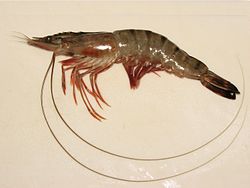
Penaeus is a genus of marine prawns in the family Penaeidae, comprising approximately 32 species of decapod crustaceans that are among the most economically important invertebrates in global fisheries and aquaculture.[1] These prawns are characterized by a robust body with a compressed abdomen, a rostrum armed with dorsal and ventral teeth, and movable chelae on the first three pairs of pereopods, distinguishing them within the suborder Dendrobranchiata.[2] Native to tropical and subtropical coastal waters across the Indo-West Pacific, eastern Atlantic, and western Atlantic regions, species in this genus inhabit diverse environments from shallow estuaries to deeper offshore areas.[3]
The taxonomy of Penaeus has undergone significant revisions, with recent molecular phylogenetic studies supporting its recognition as a single genus (sensu lato) containing 11 subgenera rather than the previously proposed split into six separate genera such as Litopenaeus and Farfantepenaeus.[1] This classification, proposed by Chan in 2023, includes subgenera like Penaeus, Melicertus, Fenneropenaeus, Litopenaeus, Marsupenaeus, Farfantepenaeus, and five newly established ones: Altiopeneaus, Eopenaeus, Ischiopeneaus, Oleopenaeus, and Plagosopenaeus.[1] Key species encompass the black tiger prawn (P. monodon) and whiteleg shrimp (P. vannamei), which together account for approximately 80% of global farmed shrimp production as of 2023, valued at around US$68 billion annually due to their rapid growth, adaptability to pond culture, and high market demand.[2][4][5] Other notable species include P. indicus, P. merguiensis, and P. aztecus, which support wild capture fisheries in regions like the Gulf of Mexico and Indian Ocean.[3]
Ecologically, Penaeus species play vital roles as both predators and prey in estuarine and marine food webs, with life cycles involving planktonic larval stages that facilitate wide dispersal before settlement in coastal habitats.[2] Their economic dominance has driven intensive aquaculture practices, particularly in Asia and Latin America, though challenges such as disease outbreaks (e.g., white spot syndrome virus) and overfishing have prompted sustainable management efforts, including selective breeding programs for disease-resistant strains.[2] Ongoing research focuses on genetic diversity and climate impacts to ensure the resilience of these foundational aquaculture taxa.[1]