Hubbry Logo
Phoenix ThronePhoenix ThroneMain
Open search
Phoenix Throne
Community hub
Phoenix Throne
logo
8 pages, 0 posts
0 subscribers
Be the first to start a discussion here.
Phoenix Throne
Phoenix Throne
from Wikipedia
Phoenix Throne
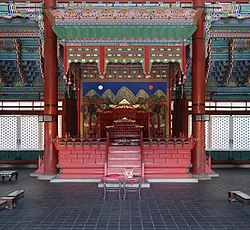
The central feature of Geunjeongjeon in Gyeongbokgung is the elevated Phoenix throne.
Korean name
Hangul
어좌; 옥좌; 보좌
Hanja
御座; 玉座; 寶座
RReojwa; okjwa; bojwa
MRŏjwa; okchwa; pojwa

The Phoenix Throne (Korean: 어좌; Hanja: 御座; MR: ŏjwa) is the term used to identify the throne of the hereditary monarchs of Korea. In an abstract sense, the Phoenix Throne also refers rhetorically to the head of state of the Joseon dynasty (1392–1897) and the Empire of Korea (1897–1910).

The phoenix motif[note 1] symbolizes the king's supreme authority.[1] The phoenix has a long association with Korean royalty — for example, in Goguryeo tomb murals like that of the Middle Gangseo Tumulus where the painted image of a phoenix is featured.[2]

History

[edit]
The portrait of Emperor Gojong enthroned. Lithograph by Joseph de la Nezière, 1903.

Enthronement ceremonies and the throne itself has evolved across the span of Korean history. For example, from 1399 to 1549, seven of twelve kings were enthroned in the royal throne hall (Geunjeongjeon) at the palace Gyeongbokgung. In other words, Jeongjong, Sejong, Danjong, Sejo, Seongjong, Jungjong, and Myeongjong ascended the Phoenix Throne in the same royal location.

Rhetorical usage

[edit]

This flexible English term is also a rhetorical trope. Depending on context, the Phoenix Throne can be construed as a metonymy, which is a rhetorical device for an allusion relying on proximity or correspondence, as for example referring to actions of the monarch or as "actions of the Phoenix Throne."

The Phoenix Throne is also understood as a synecdoche, which is related to metonymy and metaphor in suggesting a play on words by identifying a closely related conceptualization, e.g.,

  • referring to the whole with the name of a part, such as "Phoenix Throne" for the serial symbols and ceremonies of enthronement
  • referring to the general with the specific, such as "Phoenix Throne" for kingship—as in:
  • "... T'aejo mounted the phoenix throne in Kaesŏng as the first ruler of Chosŏn."[4]

See also

[edit]

Notes

[edit]

References

[edit]
[edit]
Revisions and contributorsEdit on WikipediaRead on Wikipedia
from Grokipedia
The Phoenix Throne, or eojwa (어좌) in Korean, is the ceremonial seat of authority occupied by the monarchs of Korea from the Dynasty (1392–1897) through the (1897–1910), prominently featured in the Geunjeongjeon Hall of Gyeongbokgung Palace in . Crafted with intricate designs symbolizing imperial legitimacy, including phoenix motifs evoking renewal and sovereignty, the throne elevated the ruler above courtiers during state rituals, audiences, and proclamations. Beyond its physical form, the Phoenix Throne rhetorically denotes the itself, embodying the continuity of the Yi family lineage that ruled Korea for over five centuries. Established under King Taejo in 1392 following the fall of the Dynasty, it represented centralized Confucian governance, with the hall serving as the epicenter for key ceremonies like coronations and diplomatic receptions. Under Emperor Gojong, who proclaimed the in 1897, the underscored attempts at modernization and independence amid encroaching foreign powers, though these efforts culminated in annexation by in 1910, leading to the monarchy's abolition. The throne's historical significance lies in its role as a focal point for royal legitimacy and state power, surviving wars and reconstructions—including the Japanese invasions of 1592–1598 that razed much of —through restorations that preserved its symbolic essence into modern preservation efforts. Today, as a preserved artifact, it highlights Korea's dynastic heritage, drawing visitors to reflect on the interplay of tradition and imperial ambition in East Asian history.

Etymology and Terminology

Linguistic Origins

The Korean term for the throne is eojwa (어좌), compounded from the Sino-Korean characters 御座, in which 御 (eo) signifies imperial governance or carriage, denoting royal authority, and 座 (jwa) denotes a seat or raised platform, collectively indicating the sovereign's exalted position. This nomenclature traces to ancient East Asian conventions for designating noble or divine seating arrangements, evolving from earlier systems like the sangjang (床帳), a curtained bed-like structure used for high-status repose and audiences in pre-modern Korea. In English-language and historical , eojwa is rendered as the "Phoenix Throne" to evoke role of the bonghwang (봉황), Korea's mythological phoenix analogous to the Chinese fenghuang, which embodies imperial harmony, virtue, and renewal—qualities integral to monarchic legitimacy. Unlike China's "," which emphasizes draconic masculinity and dominion, the phoenix motif in Korean royal contexts highlights auspicious femininity and balance, frequently adorning palace architecture, , and throne accoutrements to signify the ruler's and cosmic alignment. This terminological choice in Western translations, emerging prominently in 20th-century historiography, parallels designations like Japan's , underscoring Korea's distinct adaptation of shared Sinospheric symbolism while asserting cultural autonomy.

Symbolic Naming Conventions

The Phoenix Throne, designated in Korean as eojwa (어좌), embodies symbolic naming rooted in motifs of mythical creatures and auspicious materials that underscore the monarchy's divine mandate and enduring legitimacy. The term "Phoenix Throne" in English translation highlights the prominent bonghwang (phoenix) iconography, which signifies supreme royal authority, , and regenerative power, evoking the bird's mythical rebirth from ashes as a for the dynasty's resilience. This nomenclature parallels imperial thrones in neighboring traditions, such as China's , but uniquely emphasizes the phoenix's association with harmony and virtue in Korean cosmology. Alternative designations like okjwa (jade seat) and bojwa (treasure seat) further illustrate naming conventions that invoke purity, immortality, and inestimable value, drawing from Confucian ideals of virtuous rule and the . Jade, symbolizing uncorruptible integrity, and "treasure" denoting the throne's role as the repository of sovereign power, were employed to ritually affirm the ruler's celestial endorsement during state ceremonies. These names persisted across dynasties, with the throne's physical form—often adorned with dragons amid clouds for yang potency—complementing the phoenix's yin grace to represent balanced cosmic order. In the Joseon Dynasty (1392–1897), red-painted thrones reinforced yang symbolism through color, while the (1897–1910) shifted to yellow with five-clawed dragons, elevating imperial status yet retaining phoenix motifs for holistic . Such conventions avoided literal descriptors, instead layering metaphysical allusions to deter challenges to legitimacy and invoke awe in court rituals.

Physical Characteristics

Design and Construction

The Phoenix Throne, known as eojwa in Korean, consists of an elevated wooden seat positioned at the center of the northern wall within Geunjeongjeon Hall of Palace. It is situated beneath an ornate canopy and directly in front of the folding screen, which depicts the sun, moon, and five sacred peaks to symbolize the cosmic order and royal legitimacy. The design emphasizes elevation and centrality to reinforce the monarch's authority during state ceremonies. Originally constructed in 1395 as part of Geunjeongjeon Hall shortly after the founding of the Dynasty, the was destroyed during the Japanese invasions between 1592 and 1598. It was meticulously reconstructed in 1867 under the reign of King Gojong, utilizing advanced Joseon-era woodworking and assembly techniques to replicate the original form while incorporating refinements for durability and aesthetic grandeur. This restoration formed part of the broader rebuilding of Palace, reflecting a commitment to preserving dynastic traditions amid modernization pressures. The throne's structure features a red-lacquered frame adorned with dragon motifs, which signify imperial power and protection, aligning with Confucian ideals of hierarchical order. Its elevated platform, approximately one meter high, allows for clear visibility and separation from attendees, enhancing the ceremonial gravity of royal audiences and proclamations.

Materials and Craftsmanship

The Phoenix Throne, known as eojwa in Korean, was primarily constructed from , forming the base structure of the seat, armrests, footrest, and supporting canopy. This material choice allowed for detailed carving and shaping while providing durability for ceremonial use. Royal artisans applied layers of to protect the and achieve a smooth finish, often followed by in symbolic colors. In the Joseon Dynasty (1392–1897), the throne was painted red, a hue reserved exclusively for royal court items, signifying authority and imperial dignity. Decorative elements included intricate carvings of dragons amid gold clouds, with dragon heads at the corners gilded in yellow. or paint was applied to highlight these motifs, emphasizing the king's supreme power through fine and techniques. During the (1897–1910), the throne's color shifted to yellow to denote the emperor's elevated status, incorporating five-clawed cloud dragon patterns as a mark of imperial legitimacy. Craftsmanship involved specialized woodworkers and lacquerers from the royal workshops, who executed elaborate inlays and symbolic engravings to align with Confucian ideals of harmony and rule. These thrones were not mass-produced but custom-made for state rituals, reflecting the precision of Joseon-era artisanal guilds.

Historical Development

Pre-Joseon Precursors

The tradition of using thrones as central symbols of monarchical authority in Korean history predates the Joseon Dynasty, emerging during the Three Kingdoms period (c. 57 BCE–668 CE). In Goguryeo (37 BCE–668 CE), kings governed from elevated seats within fortified palace complexes, such as those in Pyongyang, where archaeological evidence from tomb murals depicts rulers in hierarchical court settings emphasizing royal centrality. Similarly, Baekje (18 BCE–660 CE) and Silla (57 BCE–935 CE) monarchs employed raised platforms or seats in audience halls for rituals, diplomacy, and judicial proceedings, as indicated by records of palace structures like Silla's Wolseong in Gyeongju, which included ceremonial spaces for the bone-rank aristocracy and king. These early thrones, typically wooden and perishable, functioned to visually and spatially assert the king's supremacy, drawing on indigenous shamanistic and imported Confucian ideas of hierarchical order. This practice persisted through Unified Silla (668–935 CE) and the concurrent Balhae kingdom (698–926 CE), where throne-like seats in royal halls reinforced the monarch's role in state cults and governance. Silla's palaces, rebuilt after unification, featured dedicated chambers for the king's audiences, with inscriptions and artifacts suggesting symbolic elevations akin to later thrones, symbolizing harmony between heaven and earth. Balhae's rulers, influenced by Tang Chinese models but adapted to northern contexts, similarly used ceremonial seats in their capital of Sanggyeong, as evidenced by excavated palace foundations indicating central raised platforms for imperial rituals. These precursors established the functional blueprint of thrones as focal points for legitimacy, though lacking the elaborate phoenix iconography of Joseon-era designs. The immediate precursor to Joseon's formalized Phoenix Throne appeared in the Goryeo Dynasty (918–1392 CE), whose kings utilized thrones in palace throne halls for official state affairs, coronations, and receptions. The primary royal complex, Manwoldae in , included Hoegyeongjeon as the dedicated throne hall, where monarchs like Taejo (r. 918–943 CE) conducted audiences amid symbolic regalia, continuing the elevated-seat tradition amid Buddhist and Confucian influences. Historical annals describe thrones as ornate wooden structures, often backed by screens depicting auspicious motifs, with court ceremonies mirroring those of successors; excavations at Manwoldae have uncovered foundations and tiles consistent with such halls, though organic throne components have not survived. 's throne usage emphasized the king's role in unifying the peninsula post-Later Three Kingdoms chaos, laying groundwork for Joseon's enhancements in craftsmanship and cosmological symbolism without the specific "phoenix" nomenclature, which emerged later.

Adoption in the Joseon Dynasty

The Phoenix Throne, known as eojwa in Korean, was adopted as the symbolic seat of the Joseon monarch upon the dynasty's founding on July 17, 1392, by Yi Seong-gye, who ascended as King Taejo after overthrowing the Goryeo regime. This adoption integrated the throne into the new Confucian-oriented monarchy, where it represented the king's heavenly mandate and authority, distinct from Goryeo's Buddhist influences. Early records and portraits confirm its use during Taejo's reign (1392–1398), with depictions showing the king seated on a throne featuring elaborate designs that conveyed imperial dignity. Construction of Palace began in 1395 under Taejo's orders, establishing the throne's primary physical setting in Geunjeongjeon Hall, the main ceremonial audience chamber. The elevated throne was positioned at the hall's rear, backed by a screen painted with auspicious motifs including the sun, moon, and five sacred peaks, symbolizing cosmic harmony and royal legitimacy. This setup formalized the throne's role in state rituals, with its craftsmanship reflecting standards of woodworking and symbolic ornamentation inherited and refined from prior dynasties. Throughout the Joseon period, the throne's design remained consistent, as evidenced by portraits like that of Taejo, which portray a structure with a canopy and supports evoking power and stability, later replicated in subsequent kings' . Adoption emphasized the throne's exclusivity to the , prohibiting replication outside the palace to maintain hierarchical order, aligning with Neo-Confucian ideals of governance.

Evolution During the Korean Empire

The , established on October 12, 1897, when King Gojong proclaimed himself Emperor Gwangmu, marked a symbolic elevation of the Phoenix Throne from royal to imperial status. This shift aimed to assert Korea's independence from and equal footing with other powers, with the throne in Geunjeongjeon Hall serving as the focal point for imperial ceremonies and state audiences. Physically, the throne retained its late reconstruction from 1867, featuring an elevated eojwa platform of red-lacquered wood adorned with gold dragon motifs on armrests and cushions, positioned atop a three-tiered stone dais. It was accompanied by the traditional , illustrating the sun, moon, and five sacred peaks to evoke cosmic harmony and legitimacy. No documented alterations to its design occurred during the empire's 13-year span, reflecting a deliberate continuity with traditions amid Gwangmu-era reforms in , , and administration. Ceremonially, Emperor Gojong utilized the Phoenix Throne for rituals reinforcing imperial sovereignty, including diplomatic receptions, until increasing Japanese pressure led to his 1907 in favor of Sunjong. The throne's unchanging form underscored causal persistence of symbolic authority despite geopolitical erosion, culminating in the empire's annexation on August 29, 1910.

Ceremonial and Functional Role

Use in Royal Audiences and Rituals

The Phoenix Throne, or eojwa, positioned at the center of Geunjeongjeon Hall in Palace, served as the king's primary seat during formal royal audiences in the Joseon Dynasty and . Constructed in 1395 alongside the hall, it facilitated the ujije (morning assembly), a routine gathering where civil and military officials assembled in the courtyard to report administrative matters and receive directives, embodying Confucian principles of diligent governance. In diplomatic contexts, the throne hosted audiences with foreign envoys, reinforcing Korea's sovereign interactions; during the era under Emperor Gojong (r. 1897–1907), these sessions emphasized imperial status amid modernization efforts. Officials positioned in hierarchical order below the elevated throne performed ritual bows, with the king issuing edicts or responding to petitions from this vantage. Key rituals centered on the throne included the yongjo ceremony on the first day of the , where assembled officials offered homage and renewed allegiance, often accompanied by musical performances from adjacent platforms. Other state rites, such as the proclamation of royal succession or significant policy announcements, similarly utilized the to symbolize unbroken monarchical authority, with ancillary screens depicting cosmic motifs like the sun, , and peaks placed behind it for auspicious reinforcement.

Coronation Procedures

Coronation procedures in the Joseon Dynasty centered on the new king's ascension to the Phoenix Throne within Geunjeongjeon Hall of Gyeongbokgung Palace, symbolizing the transfer of royal authority. This ritual, known as the enthronement ceremony, followed the death or abdication of the previous monarch and adhered to Confucian principles outlined in state rites compendia. Between 1399 and 1546, at least seven kings, including Taejong in 1400 and Sejong in 1418, conducted their coronations in this hall, affirming legitimacy through public assembly of officials. The procedure typically commenced with the transfer of the state seal (gukjang) to the successor, announcing the prior ruler's passing and the new king's selection by senior officials or the queen dowager. In Geunjeongjeon, the king, clad in ceremonial robes, ascended the elevated beneath a canopied flanked by the screen depicting sun, moon, and mountains. Court officials, arrayed by rank, performed three solemn calls to confirm the ascension, followed by the king's acceptance via three kowtows, with music from instruments like the pyeonjong bell accompanying the rites. Homage rituals involved bowing sequences by civil and military ranks, culminating in edicts from the throne proclaiming the new reign. During the Korean Empire (1897–1910), procedures evolved to reflect imperial status, as seen in Emperor Gojong's 1897 declaration at Hwangudan Altar, where he donned the emperor's crown amid modernized elements like national flags, diverging from the traditional throne-centric rite. Sunjong's 1907 enthronement after Gojong's abdication on July 19 retained core elements like seal transfer and homage in Deoksugung's Junghwajeon Hall, but under Japanese oversight, emphasizing continuity of the Yi dynasty's Phoenix Throne legitimacy. These ceremonies underscored causal links between ritual precision and monarchical stability, drawing from precedents in Gyeongguk Daeje to ensure empirical validation of succession.

Symbolism and Cultural Significance

The Phoenix Motif in Korean Cosmology

In Korean cosmology, the phoenix motif manifests primarily through the (주작), or , one of the four directional guardians collectively termed the Sasin (사신), which underpin the geomantic and astronomical framework for harmonizing heaven, earth, and human affairs. This system, adapted from ancient Chinese models during the period (57 BCE–668 CE), posits the Jujak as the protector of the south, embodying the fire element, summer season, and yang vitality to ward off malevolent forces and ensure directional equilibrium. The Jujak appears as a majestic, crimson-plumed bird perpetually wreathed in flames, symbolizing solar intensity, martial virtue, and imperishability rather than cyclical rebirth from ashes—a distinction from Western phoenix interpretations. Its fiery essence aligns with the five-phase (o-hang) theory, where fire generates earth and conquers metal, reflecting causal dynamics of cosmic transformation and renewal through elemental interplay. In practical cosmology, Jujak guided palace orientations, tomb alignments, and ritual placements, with southern exposures invoking its protective radiance to bolster imperial mandates against chaos. Complementing the Jujak, the broader phoenix archetype known as Bonghwang (봉황)—a paired male-female bird akin to the Chinese —signifies auspicious harmony and moral governance within cosmological order, purportedly descending only amid eras of profound prosperity and sagacious rule. Historical texts and artifacts, such as murals from the 5th–6th centuries CE, depict Bonghwang motifs to evoke this ideal, linking ruler legitimacy to celestial endorsement and the absence of discord. Unlike the directional Jujak, Bonghwang emphasizes ethical causality: its presence affirms a polity's alignment with tianming (heaven's mandate), while its absence signals disharmony from misrule. These motifs interweave in Korean shamanistic-Confucian synthesis, where phoenix imagery on altars and invoked fiery purification and southern geomantic potency, as evidenced in Joseon-era (1392–1910) celestial maps and tomb guardians. Empirical records from national collections confirm Jujak's red pigmentation in over 200 Baekje and relics, underscoring its role in empirical for state stability.

Representation of Imperial Legitimacy

The Phoenix Throne, or eojwa, functioned as a tangible assertion of imperial sovereignty during the Korean Empire's brief existence from 1897 to 1910, marking Gojong's elevation from king to on October 12, 1897, amid efforts to sever tributary ties with Qing China and affirm Korea's independent status. Positioned centrally in Geunjeongjeon Hall of Gyeongbokgung Palace, the throne's use in promulgating the empire's founding and hosting foreign diplomatic audiences symbolized the Yi dynasty's continuity while claiming universal legitimacy akin to other East Asian empires, countering perceptions of vassalage. Its elevated structure, often canopied and flanked by ritual screens depicting the sun, , and five peaks, embodied Confucian principles of heavenly mandate and cosmic , positioning the as the realm's harmonizer essential for dynastic legitimacy. This setup, refined during the period, distinguished imperial rule from prior kingship by emphasizing absolute sovereignty, as seen in Gojong's 1902 reception of envoys on the throne to project equality with powers like and the . The throne's and potential decorative phoenix elements further evoked renewal and virtuous , aligning with bonghwang symbolism of peace and moral order in Korean cosmology, which bolstered claims against internal factions and external threats like Japanese influence. Such representations were critical in an era of rapid modernization, where legitimacy hinged on blending with assertions of , though ultimately undermined by the 1910 annexation.

Rhetorical and Abstract Usage

Metaphorical Reference to Monarchical Authority

The term "Phoenix Throne" serves as a for the Korean monarch, embodying the institution of supreme authority during the Dynasty (1392–1897) and the subsequent (1897–1910). This substitutes the physical —ornamented with phoenix motifs symbolizing renewal and imperial legitimacy—for the himself, evoking the continuity and sanctity of dynastic rule without directly naming the individual ruler. Such usage parallels other thrones in East Asian monarchies, like Japan's , where the seat represents the enduring office rather than mere furniture. In historical discourse, invoking the Phoenix Throne underscores the monarch's role as the harmonizer of cosmic forces, as depicted in royal iconography such as the Irworobongdo screen placed behind the throne, which integrates sun, moon, and mountains to affirm the king's mandate. This abstraction facilitated allusions to political legitimacy in diplomatic correspondence and court rhetoric, where challenges to the throne equated to threats against the state itself, reinforcing hierarchical stability amid factional strife or external pressures. Unlike literal descriptions of the throne's craftsmanship, this metaphorical application highlights causal links between symbolic authority and governance, where the phoenix emblem implied resilience against adversity, as seen in Emperor Gojong's era (r. 1897–1907).

Persistence in Historical Narratives

The Phoenix Throne endures as a central motif in Korean historical narratives, symbolizing the continuity of monarchical authority across dynasties from to the . In accounts of Joseon's founding, it represents the contested seat of power, as seen in descriptions of Yi Bang-won's maneuvers to secure the throne against rivals, framing the transition from as a pivotal struggle for legitimacy. This usage highlights the throne's role not merely as furniture but as an emblem of dynastic renewal, echoed in official records detailing enthronements and royal decrees issued from its position in Palace. Post-monarchy, the Phoenix Throne persists in 20th- and 21st-century and , invoked to evoke the resilience of Korean sovereignty amid foreign domination. Scholarly works on King Taejo portray ascension to the throne as a foundational act of national consolidation, drawing on primary sources like the Annals of the Dynasty to underscore its ceremonial centrality. In modern fictional narratives set in historical Korea, such as those depicting princely rivalries in , the throne serves as a for exploring themes of ambition and , maintaining its symbolic potency in popular retellings of royal intrigue. These references, often blending empirical history with mythic elements, reinforce the throne's abstract representation of enduring kingship in cultural memory. Even in analyses of later periods, the throne's imagery recurs to critique or romanticize imperial legitimacy, as in examinations of Emperor Gojong's era where it embodied aspirations for autonomy. This persistence underscores a causal link between physical artifact and , where the phoenix motif—denoting rebirth—mirrors Korea's historical cycles of rise and restoration in scholarly and literary discourse.

Decline and Legacy

Abolition Under Japanese Rule

Following the Japan–Korea Annexation Treaty of August 22, 1910—which incorporated Korea as a effective September 1, 1910—the was dissolved, terminating all imperial institutions and ceremonies tied to the Phoenix Throne. The throne's role in state rituals, audiences, and coronations ended immediately, as Sunjong was demoted to the status of a titular king (Yeongchinwang) under Japanese oversight, with real authority vested in the . No further monarchical proceedings occurred in Geunjeongjeon Hall, rendering the Phoenix Throne symbolically inert during the 35-year occupation. Japanese colonial policy targeted symbols of Korean sovereignty, including Palace, where the throne resided. Authorities repurposed the complex for administrative use, systematically demolishing or altering structures to suppress imperial legacy, though Geunjeongjeon and its platform endured physical intactness amid broader neglect. The royal Yi family received a fixed but faced confinement and , precluding any revival of throne-centered traditions. By the , the occupation intensified cultural erasure, with the 1926 construction of the massive Government-General Building—a Western-style edifice—erected directly before Geunjeongjeon, visually and practically overshadowing the throne hall and reinforcing colonial dominance. Throughout the period to 1945, the Phoenix Throne remained unused and preserved as a relic within the altered grounds, its abolition embedded in the broader dismantling of Korean rather than through explicit destruction of the artifact itself. Japanese records and policies emphasized assimilation (dōka), prohibiting independent Korean rituals that might invoke the throne's pre-1910 prestige. This effective nullification persisted until Japan's surrender in August 1945, after which the throne's legacy shifted to post-colonial restoration efforts, though monarchical revival never materialized.

Modern Interpretations and Preservation Efforts

The Phoenix Throne, housed in Geunjeongjeon Hall of Palace, forms a central element of South Korea's preservation initiatives. After severe damage during the Japanese colonial period (1910–1945), when numerous palace structures were demolished or repurposed, the government initiated the Gyeongbokgung Restoration Project in 1990 under the Cultural Properties Administration (now the Cultural Heritage Administration). This effort aims to restore the palace to its late 19th-century appearance during the , drawing on , paintings, and archaeological findings to guide reconstructions using traditional wood-frame techniques and materials. Restoration of Geunjeongjeon Hall and its occurred progressively; the hall, originally rebuilt in after a , endured further threats but was preserved and enhanced through the , with the throne replicated to reflect Joseon-era designs adorned with phoenix and dragon motifs symbolizing harmony and authority. By the early , over half of the original layout had been reconstructed, though the full project extends to 2045, incorporating public access expansions and events like reconstructed ceremonies based on 1469 records. Ongoing maintenance, including a 2025 closure of the throne's elevated platform for safety evaluations, underscores commitments to structural integrity amid high visitor volumes exceeding 10 million annually. In modern contexts, the Phoenix Throne is interpreted as a testament to Korea's historical and cultural endurance, featured in national , , and media to evoke pre-colonial imperial legitimacy rather than active monarchical revival. Scholars and heritage experts emphasize its role in fostering , with the phoenix motif evoking themes of renewal paralleling South Korea's post-war economic resurgence, though preserved strictly as a historical artifact without political endorsement for restoration of the throne's former functions.

References

Add your contribution
Related Hubs
User Avatar
No comments yet.