Hubbry Logo
Piriform cortexPiriform cortexMain
Open search
Piriform cortex
Community hub
Piriform cortex
logo
8 pages, 0 posts
0 subscribers
Be the first to start a discussion here.
Contribute something
Piriform cortex
Piriform cortex
from Wikipedia
Piriform cortex
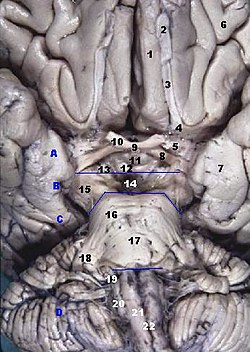
Human brainstem anterior (piriform cortex not labeled, but most of it is visible near #7)
Details
Identifiers
Latincortex piriformis
MeSHD066195
NeuroNames165
NeuroLex IDbirnlex_1097
FMA62484
Anatomical terms of neuroanatomy

The piriform cortex, or pyriform cortex, is a region in the brain, part of the rhinencephalon situated in the cerebrum. The function of the piriform cortex relates to the sense of smell.

Structure

[edit]

The piriform cortex is part of the rhinencephalon situated in the cerebrum.

In human anatomy, the piriform cortex has been described as consisting of the cortical amygdala, uncus, and anterior parahippocampal gyrus.[1] More specifically, the human piriform cortex is located between the insula and the temporal lobe, anteriorly and laterally of the amygdala.[2][3]

Function

[edit]

The function of the piriform cortex relates to olfaction, which is the perception of smell. This has been particularly shown in humans for the posterior piriform cortex.[2]

The piriform cortex in rodents and some primates has been shown to harbor cells expressing markers of plasticity such as doublecortin and PSA-NCAM which are modulated by the noradrenergic neurotransmitter system.[4][5]

Clinical significance

[edit]

The piriform cortex contains a critical, functionally defined epileptogenic trigger zone, "Area Tempestas".[6] From this site in piriform cortex chemical and electrically evoked seizures can be triggered. It is the site of action for the proconvulsant action of chemoconvulsants.[7]

Other animals

[edit]
Piriform cortex from a 14-day-old D2-eGFP (green) mouse stained for enkephalin (red) and DAPI (blue) to show nuclei. Epifluorescence.

Sometimes called the olfactory cortex, olfactory lobe or paleopallium, piriform cortical regions are present in the brains of amphibians, reptiles and mammals.

The piriform cortex is among three areas that emerge in the telencephalon of amphibians, situated caudally to a dorsal area, which is caudal to a hippocampal area. Further along the phylogenic timeline, the telencephalic bulb of reptiles as viewed in a cross section of the transverse plane extends with the archipallial hippocampus folding toward the midline and down as the dorsal area begins to form a recognizable cortex.

As mammalian brains developed, volume of the dorsal cortex increased in slightly greater proportion, as compared proportionally with increased overall brain volume, until it enveloped the hippocampal regions. Recognized as neopallium or neocortex, enlarged dorsal areas envelop the paleopallial piriform cortex in humans and Old World monkeys.

Among taxonomic groupings of mammals, the piriform cortex and the olfactory bulb become proportionally smaller in the brains of phylogenically younger species. The piriform cortex occupies a greater proportion of the overall brain and of the telencephalic brains of insectivores than in primates. The piriform cortex continues to occupy a consistent albeit small and declining proportion of the increasingly large telencephalon in the most recent primate species while the volume of the olfactory bulb becomes less in proportion.

See also

[edit]

References

[edit]
[edit]
Revisions and contributorsEdit on WikipediaRead on Wikipedia
from Grokipedia
The piriform cortex is a ribbon-shaped structure comprising the largest portion of the , located in the medial at the junction of the frontal and temporal lobes, where it lines the entorhinal sulcus and lies adjacent to key limbic structures such as the and hippocampus. As a three-layered —a form of —it features a superficial plexiform layer (layer I) for afferent inputs, a dense layer (layer II) for principal neurons, and a polymorphous layer (layer III) containing diverse cell types including . Divided into anterior () and posterior (pPC) subdivisions, with the aPC emphasizing molecular features and the pPC focusing on perceptual qualities, it is estimated to contain over 50,000 pyramidal neurons per hemisphere and spans a bilateral volume of about 280 mm³ in humans. The piriform cortex receives its primary sensory input directly from the mitral and tufted cells of the via the lateral , which synapses predominantly in layer I, enabling rapid and distributed encoding of ants through sparse neural ensembles where 3–15% of neurons activate per . This non-topographic organization supports key functions in olfaction, including identity coding, , quality perception, and the formation of object representations. Beyond basic , its reciprocal connections with limbic and cortical regions—such as projections to the , , , mediodorsal , and feedback loops to the —facilitate integration of olfactory signals with , , reward valuation, and multisensory cues; recent findings also highlight non-olfactory roles, including direct projections to shaping perception and amino acid-sensing neurons regulating . Notably, the piriform cortex exhibits high excitability due to its anatomical properties, including potent recurrent excitation and relatively weak inhibition, predisposing it to epileptogenic activity; it serves as a critical node in , where often originate or propagate through its networks, and surgical targeting of over 50% of its volume has been associated with improved seizure freedom rates, while also implicated in neurodegenerative diseases like Alzheimer's via elevated accumulation (as of 2024). These attributes underscore its evolutionary conservation across mammals and its broader implications for sensory, cognitive, and pathological processes.

Anatomy

Location and gross morphology

The piriform cortex constitutes a key component of the within the , positioned adjacent to the and , and serving as part of the . It lies at the junction of the frontal and temporal lobes, medial to the temporal stem, and lines the superior and inferior banks of the entorhinal sulcus. Specifically, the structure occupies the of the , situated ventral to the rhinal sulcus. The piriform cortex exhibits a gross morphology that is pear-shaped in many mammals, a feature reflected in its etymology from the Latin word pirum meaning "pear." In humans, however, this shape is less pronounced, often appearing more triangular in the frontal portion and curving in a U-shape around the in coronal views. The cortex is divided into two main regions: the anterior piriform cortex (), which is smaller and occupies the extending from the fundus of the entorhinal sulcus, and the posterior piriform cortex (PPC), which is larger and spans the from the limen insulae to the amygdaloid nuclei. Its blood supply is primarily derived from the anterior choroidal artery, which provides branches to the uncus and piriform cortex, with additional contributions from the posterior cerebral artery to the medial temporal structures.

Microscopic structure

The piriform cortex exhibits a characteristic three-layered architecture typical of paleocortex. Layer I, the most superficial layer, is a plexiform zone composed predominantly of dendrites and axons, with virtually no cell bodies present; it is subdivided into Layer Ia, which receives primary afferent inputs, and Layer Ib, which accommodates associative connections. Layer II consists of a dense packing of principal neuron somata, forming a compact band that serves as the primary site for excitatory cell bodies. Layer III, located deepest, features a sparser distribution of pyramidal cells and multiform (multipolar) neurons, contributing to the output pathways of the structure. The principal excitatory neurons in the piriform cortex are and include semilunar cells concentrated in the superficial portion of Layer II (sublayer IIa), which lack basal dendrites and exhibit radially oriented apical dendrites extending into Layer I. Pyramidal cells, the main output neurons, are distributed across Layer II (sublayer IIb, superficial pyramidal cells) and Layer III (deep pyramidal cells), characterized by triangular somata, extensive dendritic arbors, and axons projecting to distant targets. Inhibitory , primarily , include cells that form perisomatic synapses onto principal neurons, along with other types such as multipolar and neurogliaform cells that provide local inhibition within Layers II and III. Synaptically, the organization reflects the layered input patterns: Layer Ia is dominated by asymmetric synapses from afferents, featuring a mix of axospinous and axodendritic contacts with vesicle-containing terminals. Layer Ib hosts associative intracortical fibers, forming extensive recurrent connections among principal neurons. The structure lacks a prominent Layer IV, resulting in sparse staining in deeper regions where the endopiriform nucleus provides limited multipolar cell contributions. Dendrites of principal neurons display a high density of spines, typically around 1–2 per μm along apical and basal branches, facilitating dense synaptic integration. In humans, the piriform cortex is estimated to contain approximately 1 million neurons, underscoring its scale relative to models with approximately 1 million.

Neural connections

The piriform cortex receives its primary afferent inputs from the mitral and tufted cells of the main through the lateral (LOT), which terminates predominantly in layer Ia of the superficial dendrites. These direct olfactory inputs form the core sensory pathway, with the LOT fibers distributing broadly across the anterior piriform cortex before diminishing in density posteriorly. Associative afferents to layer Ib originate from the contralateral piriform cortex, , and periamygdaloid areas, providing intracortical integration of olfactory information. Efferent projections from the piriform cortex target several key brain regions, including the for higher-order sensory evaluation, the to relay signals toward the hippocampus, the for integration with emotional processing, and the for multisensory convergence. Reciprocal feedback connections arise from prefrontal areas, modulating piriform activity in a top-down manner. Long-range efferents travel via the ventral amygdalofugal pathway, facilitating connections to subcortical structures involved in and reward. The LOT serves as the dominant primary input pathway, with a significant portion of its fibers terminating in the anterior piriform cortex to support initial odor feature extraction. Modulatory inputs further shape piriform processing, including cholinergic projections from the that enhance signal-to-noise ratios in olfactory coding, and noradrenergic fibers from the that regulate arousal-dependent plasticity. Pyramidal neurons in the piriform cortex exhibit high connectivity density, forming approximately 9,000 synaptic boutons per cell, predominantly within local and associational networks to enable distributed representation.

Development

Embryonic origins

The piriform cortex originates from the telencephalic neuroepithelium, particularly the , where proneural genes such as Neurog1 and Neurog2 are coexpressed in progenitor pools that generate early neuronal populations, including Cajal-Retzius cells and subsequent piriform neurons. This derivation occurs under the influence of Sonic hedgehog (Shh) signaling emanating from the , which patterns the and establishes dorsoventral identities in the developing telencephalon. In and mammalian embryogenesis, the process begins with the formation of the olfactory placode as an ectodermal thickening around gestational weeks 4–5, followed by its to form the olfactory pit by weeks 6–8, marking the initial commitment to olfactory structures. The piriform cortex anlage emerges later, around postconceptional weeks 8–10 (equivalent to gestational weeks 10–12), as a distinct cortical protomap in the lateral , with specification driven by genes expressed in subpallial progenitors of the lateral (LGE). Patterning of the piriform cortex involves signaling molecules such as Fgf8, secreted from the anterior neural ridge, which induces formation and promotes subsequent outgrowth of piriform cortical regions. Additionally, transcription factors Emx1 and Emx2 confer pallial identity to progenitors in the lateral , ensuring the regional specification of the piriform area distinct from more medial cortical domains. A critical event in piriform cortex formation is the tangential migration of neuronal precursors from the LGE, which begins around embryonic day 12.5 (E12.5) in and contributes primarily to layers II and III by E13.5–E15.5, establishing the basic laminar organization. This migration corresponds to approximately gestational week 8 in humans, highlighting the precocious development of olfactory cortical circuits relative to neocortical areas.

Postnatal development

The postnatal development of the piriform cortex involves a series of maturation processes that refine its structure and function, particularly in where detailed timelines have been established. In mice, a occurs in the first two to three postnatal weeks, during which and myelination peak, shaping the circuitry for olfactory processing. refines connections, with numbers peaking at postnatal day (P) 2 and decreasing thereafter, stabilizing by P7 as proliferation ceases. Myelination of the lateral olfactory tract begins around P10 and progresses rapidly between P10 and P15, completing by the end of the first postnatal month, which supports efficient signal transmission. These changes are experience-dependent, as odor exposure during this window promotes refinement of afferent inputs and dendritic structures, enhancing olfactory discrimination capabilities. At the cellular level, postnatal growth features expansion of dendritic arborization in pyramidal neurons, which establish connections in layer Ia and contribute to the thickening of layer I from approximately 76 μm at P0 to over 200 μm by P60 in rats. Interneuron maturation, including cells, aligns with this period, with inhibitory responses fully developing by P17 in rats, marking the transition to mature olfactory coding around P10. These structural adaptations occur without significant neuronal death, emphasizing selective refinement over elimination. Molecular mechanisms drive these processes, with (BDNF) playing a key role in and dendritic growth across cortical regions, including the piriform cortex, by promoting neuronal survival and connectivity during early postnatal stages. Activity-dependent CREB signaling further stabilizes synapses, integrating sensory inputs to consolidate circuits. Sex differences emerge in , modulated by , which influences immature differentiation in the piriform cortex; perinatal exposure reduces doublecortin-positive (DCX-ir) cells more prominently in females, affecting and potentially olfactory plasticity. In humans, postnatal development of the piriform cortex follows a protracted trajectory, with MRI studies indicating linear growth in cortical thickness from early childhood onward, reflecting ongoing maturation of olfactory pathways.

Function

Olfactory processing

The piriform cortex serves as the primary site for higher-order olfactory processing, receiving direct monosynaptic inputs from mitral and tufted cells in the olfactory bulb, which relay signals from activated glomeruli corresponding to odorant molecules. These afferents terminate primarily in layer Ia of the piriform cortex, where they synapse onto pyramidal neurons in layers II and III. In these deeper layers, extensive recurrent connections enable nonlinear integration and mixing of olfactory features, synthesizing distributed representations of odor objects from the initial glomerular patterns. Olfactory information in the piriform cortex is encoded through sparse distributed representations, where approximately 10-20% of neurons exhibit -evoked activity per stimulus, distributed broadly without topographic organization across the cortex. This sparsity allows efficient coding of odor identity, with small ensembles of 100-200 neurons sufficient for reliable . recordings reveal that gamma oscillations in the 40-60 Hz range synchronize these ensembles, facilitating the binding of distributed features into coherent odor percepts and supporting accurate identification during sensory tasks. Synaptic plasticity in the piriform cortex underpins learning and memory formation, particularly through (LTP) at lateral (LOT) synapses, which is mediated by NMDA receptors and strengthens inputs from the . exposure and associative learning further stabilize these representations by sparsening activity patterns and countering representational drift—the gradual shift in neural responses to the same across sessions—via recurrent circuitry that maintains robustness against input variability. Functional specialization within the piriform cortex distinguishes anterior and posterior regions: the anterior piriform primarily encodes identity through rate-based distributed activity invariant to concentration changes, while the posterior piriform contributes to representations of intensity and contextual associations, such as in mixtures or learned discriminations. Multi-voxel activity patterns in the human piriform cortex also shift with semantic context, as identical odors elicit distinct ensembles when perceived differently (e.g., a scent interpreted as fruity versus medicinal), reflecting top-down modulation that refines perceptual categorization.

Non-olfactory roles

The piriform cortex contributes to multisensory integration by facilitating place-odor associations through its interactions with the lateral entorhinal cortex (LEC). In freely moving mice, neurons in the piriform cortex (PCx) and LEC differentially encode odor and spatial location, with PCx activity supporting the formation of odor-place memories during navigation tasks. This integration is evident in head-fixed mouse experiments where PCx neurons respond to multimodal cues, including auditory signals in rule-reversal tasks that combine olfactory and non-olfactory stimuli, enabling rapid behavioral adaptation. Additionally, direct projections from the PCx to the auditory cortex modulate auditory processing with olfactory influences, highlighting its role in cross-modal sensory binding beyond pure olfaction. In emotional and behavioral contexts, the piriform cortex influences stress responses via its pathway to the lateral septum. Activation of PCx projections to the lateral septum during chronic stress in mice promotes anxiety-like behaviors, as demonstrated by chemogenetic inhibition that alleviates these effects. Furthermore, in male mice, the (APC) shows increased gamma oscillations during , with higher incidence of gamma events correlating with affiliative interactions and social recognition. Cognitively, the piriform cortex supports memory formation through its involvement in the entorhinal-hippocampal loop. PCx activity orchestrates hippocampal encoding of olfactory-related information, modulating theta rhythms and to facilitate consolidation in . Network models of the further reveal that learning stabilizes representational drift—gradual shifts in neural activity patterns over time—via spike-timing-dependent plasticity, allowing adaptable yet persistent representations during repeated exposures. Recent studies underscore the piriform cortex's role in modulating semantic perception. In humans, multi-voxel patterns in the shift based on semantic context, such as verbal labels that alter perceived odor pleasantness, as shown in 7T fMRI experiments where contextual priming recalibrates neural representations. The also contributes to social transmission of food preferences through projections influencing the ; optogenetic manipulation of these pathways disrupts the consolidation of socially learned cues in mice, linking olfactory processing to reward-based social learning.

Clinical significance

Epilepsy and seizures

The piriform cortex serves as a critical site for seizure initiation and propagation in (TLE), with hyperexcitability in Layer II pyramidal cells arising from diminished inhibition. This hyperexcitability facilitates the generation of epileptic discharges, as Layer II neurons exhibit enhanced excitability due to weakened from local . often originate at the piriform-amygdala , where anatomical convergence amplifies seizure spread to limbic structures like the hippocampus and . Mechanistic studies using kindling models demonstrate the piriform cortex's low threshold for epileptogenesis, with repeated subconvulsive rapidly inducing generalized seizures. In these models, the anterior piriform cortex kindles more readily than other limbic regions, showing interictal as the earliest sign of network involvement. Lateral olfactory tract (LOT) evokes afterdischarges with a notably low threshold in the piriform cortex, mediated by NMDA receptor-dependent excitatory transmission that sustains prolonged depolarizations. Chronic further exacerbates this through loss of , reducing inhibitory tone and promoting recurrent excitation in Layer II circuits. Therapeutic strategies targeting the piriform cortex hold promise for TLE management, including to modulate its hyperexcitable networks and suppress propagation. Recent analyses position the piriform cortex as a "key node" in TLE, with its hyperconnectivity to the driving generalization; disrupting these pathways via or ablation yields reduction in animal models. In humans, EEG and fMRI studies reveal piriform cortex activation during interictal discharges and olfactory auras, such as perceptions of unpleasant odors like burning rubber, which localize seizures to the anterior in up to 16% of focal cases. Surgical outcomes improve significantly when resections include the piriform cortex; for instance, ablating at least 50% of its volume increases the odds of seizure freedom by 16-fold compared to lesser resections.

Olfactory disorders in neurodegeneration

In (PD), the piriform cortex exhibits significant volumetric and reduced functional connectivity, as evidenced by longitudinal MRI studies spanning up to four years. These changes include gradual reductions in cortical volume and thickness in olfactory-related regions, correlating with progressive olfactory decline. , a common early non-motor symptom in PD, often precedes motor manifestations by several years, highlighting the piriform cortex's vulnerability in disease onset. In (AD), amyloid-beta accumulation in the piriform cortex disrupts synaptic function, particularly in Layer I, leading to impaired neural output and olfactory processing deficits. High levels of amyloid-beta plaques are observed in the piriform cortex, contributing to selective neuronal vulnerability and thinning of this region. Piriform cortex thinning strongly correlates with deficits in olfactory identification, an early marker of AD progression that parallels amyloid pathology. Diffusion tensor imaging reveals decreased in the piriform cortex tracts in PD patients, indicating white matter microstructural loss and disrupted connectivity in the olfactory pathway. These alterations predict clinical progression and are more pronounced in advanced stages. Olfactory interventions, tested in 2024 clinical trials, have shown partial restoration of functional connectivity in the piriform cortex, suggesting potential in early intervention. Frontotemporal dementia, particularly variants involving semantic processing, is associated with failures in odor context recognition, implicating piriform cortex dysfunction in integrating sensory and semantic information. Patients exhibit impaired odor naming and categorization, distinct from perceptual deficits seen in other dementias. A 2025 connectomics review underscores widespread olfactory system alterations in PD, including piriform involvement, as key to understanding neurodegeneration across disorders.

Comparative anatomy

In rodents

In rodents, the piriform cortex exhibits a morphology adapted to their reliance on olfaction, occupying a larger proportion of the telencephalon relative to body size compared to , where neocortical expansion diminishes its relative volume. The structure is divided into anterior and posterior regions, with the posterior piriform cortex comprising a volume similar to that of the anterior in mice and rats (anterior ~2.5 mm³, posterior ~2.8 mm³), facilitating associative processing. This layered organization, particularly Layer II, which contains pyramidal neurons with dense superficial and deep sublayers, has made it a prime target for optogenetic manipulations to dissect intracortical circuits and coding. Functional studies in highlight the piriform cortex's role in dynamic olfactory representation. Miniendoscope calcium imaging in head-fixed mice reveals differential encoding of odor identity versus spatial context in the piriform cortex, with odor-selective responses persisting across locations while place-specific modulation emerges during tasks. In awake, behaving rats, -evoked activity in the piriform cortex undergoes representational drift over days, where neuronal ensembles shift their response patterns to the same stimuli, potentially reflecting experience-dependent plasticity and adaptation to behavioral demands. Development of the piriform cortex involves rapid postnatal circuit assembly from birth (P0) to weaning (P21), during which synaptic connections from the strengthen and intrinsic inhibitory networks mature to support odor discrimination. models of neurological disorders frequently implicate the piriform cortex due to its vulnerability to and perturbations. In the pilocarpine-induced model in rats, seizures originate in the anterior piriform cortex, leading to preferential neuronal loss in Layer II and propagation to limbic structures, recapitulating pathology. In 6-OHDA-based models in rats, early dopamine depletion in the piriform cortex—up to 40% reduction—precedes motor symptoms and correlates with , highlighting its role in non-motor deficits.

In primates and humans

In and humans, the piriform cortex exhibits notable evolutionary adaptations that reflect a shift toward integrated rather than primary olfactory reliance seen in many other mammals. The relative size of the piriform cortex is substantially reduced compared to , occupying approximately 0.02% of total cortical volume in humans (based on an average piriform volume of ~280 mm³ and volume of ~1,300,000 mm³) versus about 1% in mice (piriform volume ~5 mm³ in a ~450–500 mm³ ). This diminution aligns with the evolutionary prioritization of vision and in haplorhine primates, including humans, where olfaction plays a secondary role. In humans specifically, functional neuroimaging reveals bilateral activation of the piriform cortex during odor perception tasks, with fMRI studies demonstrating robust responses in both temporal and frontal subregions to monorhinal and birhinal stimulation. Postmortem histological analyses indicate similar allocortical in human and non-human primate piriform cortex, with layer III as the deepest layer, and subtle volumetric asymmetries (right piriform ~18% larger than left on average). Functionally, the piriform cortex demonstrates enhanced semantic integration, where multi-voxel patterns adapt to contextual cues, such as cultural or verbal associations with odors (e.g., linking scents to emotional or abstract concepts like "freshness"). Clinically, (PET) imaging identifies early hypometabolism in the piriform cortex as a for neurodegenerative diseases, with reduced observed in prodromal (AD) and (PD), correlating with olfactory deficits. Volumetric MRI establishes age-related decline in piriform volume beginning in the 40s, with significant correlations to waning olfactory identification; for instance, orbitofrontal and piriform-amygdala complex volumes decrease progressively, dropping ~10-15% by age 70, underscoring vulnerability to aging and early pathology.

References

Add your contribution
Related Hubs
Contribute something
User Avatar
No comments yet.