Hubbry Logo
Stem (ship)Stem (ship)Main
Open search
Stem (ship)
Community hub
Stem (ship)
logo
8 pages, 0 posts
0 subscribers
Be the first to start a discussion here.
Stem (ship)
Stem (ship)
from Wikipedia
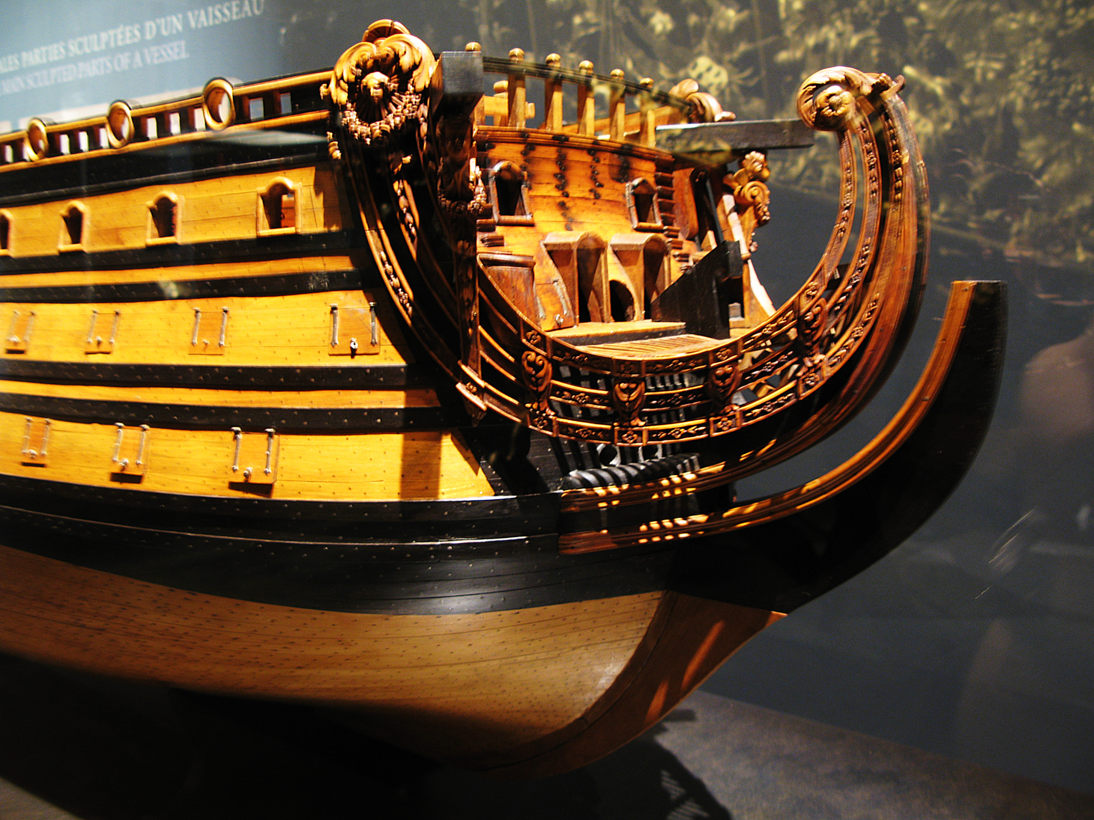
A model of the French ship Soleil Royal held at the Musée National de la Marine de Paris. The most forward and lowest curved part of the ship is the stem (not normally the extended part beyond the hull).
The bow of the oil and chemical tanker Bro Elizabeth in dry dock in Brest, France. This ship does not have a stem.

The stem is the most forward part of a boat or ship's bow[1] and is an extension of the keel itself. It is often found on wooden boats or ships, but not exclusively.

Description

[edit]

The stem is the curved edge stretching from the keel below, up to the gunwale of the boat. It is part of the physical structure of a wooden boat or ship that gives it strength at the critical section of the structure, bringing together the port and starboard side planks of the hull.[2]

Plumb and raked stem

[edit]

There are two styles of stems: plumb and raked. When the stem comes up from the water, if it is perpendicular to the waterline it is "plumb". If it is inclined at an angle to the waterline it is "raked".[1] (For example, "The hull is single decked and characterized by a plumb stem, full bows, straight keel, moderate deadrise, and an easy turn of bilge."[3])

Stemhead

[edit]

Because the stem is very sturdy, the top end of it may have something attached, either ornamental or functional in nature. On smaller vessels, this might be a simple wood carving (ornamental) or cleat (functional). On large wooden ships, figureheads can be attached to the upper end of the stem.[citation needed]

See also

[edit]

References

[edit]

Further reading

[edit]
Revisions and contributorsEdit on WikipediaRead on Wikipedia
from Grokipedia
The stem of a ship is the forwardmost part of the hull's bow, forming a robust, upright or angled frame that extends from the upward to the apex where the vessel's two sides converge, providing critical structural integrity and enabling the ship to part the waves efficiently. In ship design, the stem plays a pivotal role in hydrodynamics and stability, as its shape influences wave resistance, distribution, and the vessel's ability to maintain course through varying conditions; for instance, a well-designed stem minimizes drag while enhancing forward momentum. Common stem configurations include the plumb stem, a vertical profile that maximizes to boost and interior volume but can complicate anchor handling, and the raked stem, which slopes forward from the to offer greater flare for planking ease and added buoyancy in rough waters. Other notable variants are the spoon bow, featuring a concave curve at the for a smoother entry into waves and added forward , and the clipper bow, with its elegant reverse curves that combine fine entry lines below the water for speed with broader deck areas above for stability—designs that originated in 19th-century sailing vessels and persist in modern yachts. Historically, stems evolved from solid timbers in for strength at the bow's vulnerable junction to composite materials like in contemporary vessels, reflecting advances in that prioritize efficiency, safety, and performance across cargo carriers, warships, and recreational boats.

Definition and Function

Description

The stem is the forwardmost part of a ship's hull, serving as the curved, upright at the bow where the sides converge. It forms the apex of the hull's forward cross-section, extending from the at the bottom upward to the or deck level. In its basic form, the stem is typically constructed as a heavy, vertical or inclined timber in , often made from durable hardwoods like and shaped from a single piece or laminated sections to provide strength and curvature. In metal ships, it consists of a welded plate or heavy flat bar that forms the prow, ensuring rigidity and integration with the overall hull structure. Positioned at the leading edge of the bow, the stem integrates directly with the at its lower end through joints such as connections in wooden vessels or welds in metal ones, distinguishing it from the broader bow area by defining the sharp, central forward profile. Diagrams in illustrations commonly depict the stem as the pointed apex emerging from the keel, highlighting its role in shaping the hull's forward contour.

Structural Role

The stem serves as a primary longitudinal strength member in the ship's hull, acting to transfer hydrodynamic forces encountered at the bow—such as wave impacts and water pressure—directly to the keel and transverse frames, thereby preventing excessive deformation and maintaining overall structural integrity under dynamic loads. This role is essential in distributing bending and shear stresses along the forepeak, where the hull experiences concentrated forces during forward motion or in rough seas. In modern steel vessels, the stem bar is typically welded to the keel plate at its lower end and reinforced with internal plating and stiffeners to enhance load-bearing capacity. Integration of the stem with the hull occurs through precise joints that ensure seamless continuity and watertight sealing. In contemporary designs, the stem plate is welded to the side shell plating using butt welds or similar techniques, with additional reinforcements such as breast hooks and vertical stiffeners to secure the connection and resist separation under stress. These fastenings, including welds and bolts, are critical for upholding the hull's against water ingress while accommodating the curved bow geometry. The stem also contributes to the ship's transverse stability by helping to resist forces—twisting distortions that arise from rolling motions or beam seas—which could otherwise compromise the hull's rectangular framing. As part of the central system, it supports the longitudinal framework alongside the , providing rigidity to counter these shear effects and preserving the vessel's form during maneuvers. In historical wooden ships, the stem functioned as the foundational backbone for forward planking, typically scarfed to the using overlapping, tapered joints secured with iron rivets or treenails to achieve seamless strength and flexibility without weak points. This construction method, common from Viking-era clinker-built vessels through the Age of Sail, allowed the stem to bear the weight of overlapping planks while distributing loads evenly to prevent splitting or buckling under sail-induced stresses.

Types of Stems

Plumb Stem

The plumb stem, also known as a plumb bow, is defined as a vertical or unraked bow design in which the stem forms a perpendicular to the at an angle of 90 degrees, resulting in a sharp, upright bow profile. This geometry maximizes the relative to the overall hull length, allowing for a more efficient displacement hull form without overhangs at the bow. One key advantage of the plumb stem is its ability to enhance in calm conditions by increasing the effective , which reduces and supports higher displacement speeds. This design is particularly favored in modern ships, such as large container vessels, where it optimizes and capacity by providing additional deck forward. In racing yachts, the plumb stem minimizes hydrodynamic resistance and foredeck clutter, facilitating better sail handling with features like bow sprits for asymmetrical spinnakers, as seen in contemporary offshore racing designs. However, the plumb stem has notable disadvantages, including a tendency for excessive pitching in rough seas due to the absence of , which limits reserve and allows waves to more readily impact the bow. This can lead to increased wetness and potential structural stresses from slamming, making it less ideal for heavy-weather operations compared to flared alternatives. Modern applications persist in container vessels and performance-oriented yachts such as the Ngoni.

Raked Stem

The raked stem is characterized by a forward inclination of the stem from the vertical, typically at an angle of 5 to 30 degrees relative to the , creating a sloping profile toward the bow. This geometry extends the overall length of the vessel beyond the , distinguishing it from the plumb stem's vertical alignment. In , the is measured from the fore perpendicular to the bow slope, allowing the stem to integrate with flared bow for enhanced hydrodynamic interaction. This design provides several advantages, particularly in seakeeping and structural performance. The forward rake improves reserve buoyancy at the bow by increasing flare, which deflects waves more effectively and reduces water ingress onto the deck during heavy weather, thereby enhancing transverse stability through a higher center of buoyancy. It also eases pitching motions and creates crumple zones for collision absorption, while the inclined profile aids in protecting the hull during grounding by distributing impact forces over a longer surface. Additionally, the rake contributes to directional stability by shifting the center of lateral resistance aft, minimizing yaw in rough conditions. However, the raked stem has notable drawbacks related to hydrodynamic efficiency. By projecting the bow forward above the , it shortens the effective compared to a plumb stem of equivalent overall , which can limit maximum in calm waters due to reduced displacement-length ratio. This trade-off prioritizes seaworthiness over outright speed, making it less ideal for high-speed designs without compensatory features like bulbous bows. Historically, the raked stem was predominant in traditional sailing vessels, such as ships, galleons, and schooners, where its stability benefits outweighed speed limitations in open-ocean voyages. It also appeared in some naval warships, like frigates, to improve performance in variable weather and combat scenarios.

Key Components

Stemhead

The stemhead refers to the uppermost and forwardmost point of the stem on a ship, where it intersects the deck level or rail, typically featuring thickened construction for added structural reinforcement to withstand stresses from and . This endpoint serves as a critical juncture in the bow assembly, often integrated with adjacent timbers like knight heads that rise alongside it to provide lateral support. Functionally, the stemhead accommodates various attachments essential for vessel operation, including bow cleats and points for securing lines, as well as windlasses for handling ground tackle. In ships, it acts as the primary anchorage for fore stays and other elements, such as the that extends from the masthead to the stemhead to maintain mast stability under sail. These fittings distribute loads effectively, preventing excessive strain on the hull during or docking. Historically, the stemhead often incorporated ornamental features to enhance a ship's aesthetic and symbolic identity, including carved figureheads depicting animals, mythological figures, or human forms, typically fashioned from wood and painted for visibility at sea. Vessels without full figureheads might instead feature a , a scrolled decorative termination at the stemhead evoking a frond or similar motif. Trailboards, elongated carved panels flanking the stemhead, further adorned the area with intricate designs, sometimes gilded or inlaid, reflecting naval traditions from the Age of Sail. In terms of , particularly in , the stemhead was joined to the via joints or bolted connections to ensure seamless strength and alignment, allowing for the curved profile of the bow. For securing the , traditional wooden vessels employed gammoning—thick ropes wound tightly around the stemhead and bowsprit —or later, iron gammon bands to resist upward thrust from sails and stays. This method of attachment, common through the 18th and 19th centuries, balanced flexibility with durability in response to dynamic sea conditions.

Cutwater and Apron

The cutwater is the sharp, protruding lower edge of the stem that parts the water as the vessel advances, typically faired to minimize hydrodynamic resistance and ensure smooth passage through waves. In traditional wooden ship construction, it forms the forwardmost extension of the stem timbers, often assembled from multiple large pieces to create a robust leading edge capable of withstanding impacts. This design allows the cutwater to efficiently divide oncoming water, reducing the overall drag on the hull and contributing to the vessel's forward momentum. The , in contrast, is an internal reinforcing component fitted against the after side of the stem, functioning as a curved timber or plate that follows the stem's profile and backs the forward ends of the planking while distributing structural loads to the . In wooden hulls, the apron is typically scarfed longitudinally—joined end-to-end with overlapping cuts—for enhanced longitudinal strength and is securely bolted through the stem to form an integrated assembly. This construction method, often involving heavy throat bolts, ensures the apron provides critical support during planking and helps maintain the stem's alignment under stress. Together, the cutwater and play essential roles in the stem's performance: the cutwater's streamlined profile minimizes water resistance by parting the flow ahead of the bow, while the reinforces against from forward impacts, such as collisions or wave forces, by tying the stem firmly to the structure. In wooden vessels, this integration is vital for load distribution, with the acting as a landing surface for planking fastenings in designs like the free stem, where the inner rabbet aligns at their joint.

Historical Development

Origins in Ancient Vessels

The earliest known forms of ship stems emerged in ancient Egyptian watercraft around 3000 BCE, where they consisted of upturned ends formed by bundled reeds, providing flexibility and buoyancy for navigation along the . These curved prows facilitated beaching on riverbanks without damage and deflected waves to maintain stability in shallow or choppy waters, as evidenced by Predynastic and tomb depictions showing the stems flaring upward symmetrically with the . The use of lightweight, flexible reeds allowed for simple construction techniques, such as lashing bundles together, emphasizing functionality over rigidity in these early vessels designed for trade and transport. By around 500 BCE, Greek triremes introduced a more militarized stem design, integrating a forward-projecting bronze-sheathed ram directly into the bow for offensive in . This ram, a pointed wooden protrusion reinforced with mortise-and-tenon joints to the and wales, extended from the stem at the to concentrate impact force and puncture enemy hulls, as confirmed by archaeological evidence from vase paintings and early ship representations dating to the Archaic period. The design shifted from simple curved timbers to a robust, integrated structure using pine and oak elements, enhancing the vessel's speed and structural unity during battles like Salamis in 480 BCE. In Viking longships of the 8th to 9th centuries CE, the stem took on pronounced cultural symbolism through an upward-curving form topped with carved dragon prows, intended to intimidate foes and ward off evil spirits. These wooden dragonheads, often adorned with iron or , marked the ships of and served as identifiers of status, with sagas describing their removal near home to avoid frightening local land spirits, as per Icelandic laws around 930 CE. The curve not only aided in wave deflection but also evoked mythical protection, blending practical maritime needs with Norse beliefs in serpentine guardians. A key development occurred in Roman galleys from the BCE onward, where stems transitioned to rigid constructions of for greater durability and structural integrity in Mediterranean fleets. Archaeological analyses of wrecks, such as those from Caska inlet, reveal timbers used for the stem and , fastened with mortise-and-tenon and iron nails, allowing larger vessels to withstand and open-sea voyages while maintaining hull unity. This shift from flexible reeds to heavy, curved forms marked a foundational in stem design, prioritizing strength for imperial expansion.

Evolution in Age of Sail

During the transition from medieval to shipbuilding, the emerged as a pivotal design in the , featuring a raked stem that angled forward to improve stability and accommodate larger sail plans for extended ocean voyages. This configuration allowed carracks to carry more square and sails effectively, supporting greater crews and cargo loads compared to earlier cogs and caravels, which facilitated and Spanish and trade routes across the Atlantic. By the , galleons refined this approach through the integration of a with the stem, forming a triangular, projecting structure below the that broke incoming waves and enhanced while supporting the . This beakhead-stem assembly contributed to the galleon's low, sleek bow profile, balancing cargo capacity with maneuverability for warfare and treasure fleets, as seen in vessels like the ships that dominated transoceanic operations for over a century. In the , designs emphasized refined raked bows to prioritize speed and weatherliness, enabling these warships to escort convoys and conduct at higher velocities, often exceeding 12 knots in favorable conditions. This evolution, evident in French and British frigates like the Medée of 1741, reduced hull resistance and elevated armament above the for all-weather . Shipwrights in the 18th and 19th centuries advanced stem construction by employing composite assembly of multiple timbers, scarfed end-to-end and bolted to the , with early steam-bending techniques—such as heating planks on hot, wet sand from 1737 onward—allowing for compound curves that matched the hull's hydrodynamic profile without relying solely on scarce naturally curved timber. These methods ensured the stem's broadening upward taper and rabbeted edges for secure planking, enhancing overall in larger vessels. Influential warships like , launched in 1765, exemplified the raked stem's role in providing stability through its curved oak timbers integrated with the and stemson, tying the bow to the for resilience in battle and heavy weather during the . Similarly, American s of the 1840s, such as the Sea Witch (1846) and Flying Cloud (1851), adopted raked stems featuring sharp, concave clipper bows to minimize wave resistance, achieving speeds up to 22 knots in races along and trade routes that underscored their competitive edge in global commerce. The prominence of wooden stems waned in the late 19th century as iron hulls proliferated, with innovations like Robert Seppings' diagonal iron bracing from 1817 onward reducing dependence on wooden components; by the 1860s, iron-framed ships like HMS Warrior supplanted traditional stems, prioritizing larger scales and steam integration over wooden curvature.

Modern Design and Applications

Materials and Construction

In contemporary , the stem is primarily constructed using mild steel plating for commercial vessels, where plates are welded into a curved profile to form the forward extremity of the hull. This material, typically containing 0.15% to 0.23% carbon with low and content for enhanced weldability, provides the necessary strength and toughness to withstand structural loads. High-tensile steel variants, offering tensile strengths up to 690 MPa, are employed in stressed areas of larger ships to reduce weight while maintaining integrity. For smaller recreational boats, reinforced plastic (FRP) is molded directly onto forms to create the stem, leveraging E-glass fibers embedded in resin for a lightweight, corrosion-resistant structure with tensile strengths ranging from 3,100 to 4,800 MPa. In high-performance yachts, carbon fiber reinforced polymers (CFRP) are increasingly used, providing superior stiffness and a of 1.5–1.6 g/cm³, often infused with resins to shape the stem as part of the overall hull laminate. Construction processes have shifted from traditional riveting to industrial techniques, enabling precise fabrication of stems. For metal stems, computer (CNC) machines bend plates using heat-line methods to achieve the required , followed by submerged arc or manual to join plates and attach the stem bar—a solid round section extending from the to the . Butt welds secure the shell plating along the stem's edges, while fillet welds reinforce attachments to internal framing, with ensured through ultrasonic inspections to detect defects. stems are built via hand lay-up or resin infusion in female molds, layering directional plies (e.g., 0°/90° and ±45°) over a core or directly onto the mold surface for seamless integration with the hull. Wooden replicas, evoking historical forms, employ and joints with saturation to bond multiple thin layers into a curved stem profile, though this is rare in production vessels. In large commercial ships, stems are integrated with bulbous bows during block , where subassemblies are welded into larger units before final assembly. Stems must comply with standards set by classification societies to ensure durability against environmental and operational hazards. , for instance, mandates minimum plating thicknesses for stems, with reinforcement via increased web frames or doubling plates to resist collision impacts. For ice navigation, rules from societies like the require enhanced stem plating in the ice belt, typically 25–40 mm thick using high-tensile grades (e.g., AH36 or FH36) to prevent deformation under ice pressure. These standards also specify corrosion protection, such as epoxy coatings on welds, and notch-toughness testing for steels in cold climates (grades D or E). Icebreaker stems exemplify reinforced construction, as seen in polar research vessels like the U.S. Coast Guard's Healy, where the forward hull features reinforced steel plating up to 50 mm thick, backed by internal ribs and a rounded profile to distribute ice loads effectively. Similarly, the Korean polar research vessel Araon incorporates ice-strengthened stems with reinforced steel plating welded to form a sloped bow, enabling 1-meter icebreaking at 3 knots while complying with International Association of Classification Societies (IACS) polar class requirements.

Hydrodynamic Influences

The hydrodynamic performance of a ship's stem is fundamentally tied to its influence on water flow dynamics, particularly in managing . The stem shape dictates the initial interaction with oncoming water, affecting the formation of bow waves. For slender hull bodies, plumb stems are designed to minimize transverse wave components, as predicted by Michell's , which computes wave resistance through a model integrating hull geometry and the . This approach assumes small hull slopes and high length-to-beam ratios, enabling precise estimation of far-field wave patterns where the stem's vertical profile reduces wave energy dissipation. In modern designs, stems often integrate bulbous bows positioned below the to optimize residuary resistance. These protrusions generate secondary waves that interfere destructively with the primary , yielding reductions of 10-15% in total resistance at design speeds corresponding to moderate Froude numbers (typically 0.15-0.25). For instance, computational studies on containership hulls demonstrate up to 13% lower total resistance in calm and head waves when bulbous configurations are tuned to the vessel's operational speed, though benefits diminish at very low Froude numbers due to increased wetted surface area. Seakeeping characteristics are enhanced by raked stems incorporating , which mitigate slamming impacts in rough seas. The allows the bow to slice through waves rather than pound vertically, reducing vertical accelerations and green water events, while increases to lift the hull over incoming crests. Optimization of these features relies on (CFD) simulations, such as unsteady Reynolds-averaged Navier-Stokes solvers, to predict distributions and slamming loads on the bow—critical for vessels encountering resonant wave lengths where peak pressures can exceed 5 kPa. In specialized applications, stem designs are tailored to operational demands. For LNG carriers, which operate at low speeds (Froude numbers around 0.1-0.15), sharper bow profiles minimize added resistance in waves across trade routes, improving attainable speeds by 5-10% compared to blunter forms without compromising cargo capacity. Similarly, vessels employ stems with optimized buttock angles (e.g., 22°) to lower resistance by enhancing bending moments on floes, reducing propulsion power needs by up to 20% in level ice while maintaining open-water .

References

Add your contribution
Related Hubs
User Avatar
No comments yet.