Hubbry Logo
search
logo
1476799

Point reflection

logo
Community Hub0 Subscribers
Read side by side
from Wikipedia
Example of a 2-dimensional figure with central symmetry, invariant under point reflection
Dual tetrahedra that are centrally symmetric to each other

In geometry, a point reflection (also called a point inversion or central inversion) is a geometric transformation of affine space in which every point is reflected across a designated inversion center, which remains fixed. In Euclidean or pseudo-Euclidean spaces, a point reflection is an isometry (preserves distance).[1] In the Euclidean plane, a point reflection is the same as a half-turn rotation (180° or π radians), while in three-dimensional Euclidean space a point reflection is an improper rotation which preserves distances but reverses orientation. A point reflection is an involution: applying it twice is the identity transformation.

An object that is invariant under a point reflection is said to possess point symmetry (also called inversion symmetry or central symmetry). A point group including a point reflection among its symmetries is called centrosymmetric. Inversion symmetry is found in many crystal structures and molecules, and has a major effect upon their physical properties.[2]

Terminology

[edit]

The term reflection is loose, and considered by some an abuse of language, with inversion preferred; however, point reflection is widely used. Such maps are involutions, meaning that they have order 2 – they are their own inverse: applying them twice yields the identity map – which is also true of other maps called reflections. More narrowly, a reflection refers to a reflection in a hyperplane ( dimensional affine subspace – a point on the line, a line in the plane, a plane in 3-space), with the hyperplane being fixed, but more broadly reflection is applied to any involution of Euclidean space, and the fixed set (an affine space of dimension k, where ) is called the mirror. In dimension 1 these coincide, as a point is a hyperplane in the line.


In terms of linear algebra, assuming the origin is fixed, involutions are exactly the diagonalizable maps with all eigenvalues either 1 or −1. Reflection in a hyperplane has a single −1 eigenvalue (and multiplicity on the 1 eigenvalue), while point reflection has only the −1 eigenvalue (with multiplicity n).

The term inversion should not be confused with inversive geometry, where inversion is defined with respect to a circle.

Examples

[edit]
2D examples

Hexagonal parallelogon

Octagon

In two dimensions, a point reflection is the same as a rotation of 180 degrees. In three dimensions, a point reflection can be described as a 180-degree rotation composed with reflection across the plane of rotation, perpendicular to the axis of rotation. In dimension n, point reflections are orientation-preserving if n is even, and orientation-reversing if n is odd.

Formula

[edit]

Given a vector a in the Euclidean space Rn, the formula for the reflection of a across the point p is

In the case where p is the origin, point reflection is simply the negation of the vector a.

In Euclidean geometry, the inversion of a point X with respect to a point P is a point X* such that P is the midpoint of the line segment with endpoints X and X*. In other words, the vector from X to P is the same as the vector from P to X*.

The formula for the inversion in P is

x* = 2px

where p, x and x* are the position vectors of P, X and X* respectively.

This mapping is an isometric involutive affine transformation which has exactly one fixed point, which is P.

Point reflection as a special case of uniform scaling or homothety

[edit]

When the inversion point P coincides with the origin, point reflection is equivalent to a special case of uniform scaling: uniform scaling with scale factor equal to −1. This is an example of linear transformation.

When P does not coincide with the origin, point reflection is equivalent to a special case of homothetic transformation: homothety with homothetic center coinciding with P, and scale factor −1. (This is an example of non-linear affine transformation.)

Point reflection group

[edit]
The composition of two offset point reflections in 2-dimensions is a translation.

The composition of two point reflections is a translation.[3] Specifically, point reflection at p followed by point reflection at q is translation by the vector 2(q − p).

The set consisting of all point reflections and translations is Lie subgroup of the Euclidean group. It is a semidirect product of Rn with a cyclic group of order 2, the latter acting on Rn by negation. It is precisely the subgroup of the Euclidean group that fixes the line at infinity pointwise.

In the case n = 1, the point reflection group is the full isometry group of the line.

Point reflections in mathematics

[edit]

Point reflection in analytic geometry

[edit]

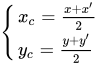
Given the point and its reflection with respect to the point , the latter is the midpoint of the segment ;

Hence, the equations to find the coordinates of the reflected point are
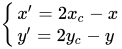
Particular is the case in which the point C has coordinates (see the paragraph below)

Properties

[edit]

In even-dimensional Euclidean space, say 2N-dimensional space, the inversion in a point P is equivalent to N rotations over angles π in each plane of an arbitrary set of N mutually orthogonal planes intersecting at P. These rotations are mutually commutative. Therefore, inversion in a point in even-dimensional space is an orientation-preserving isometry or direct isometry.

In odd-dimensional Euclidean space, say (2N + 1)-dimensional space, it is equivalent to N rotations over π in each plane of an arbitrary set of N mutually orthogonal planes intersecting at P, combined with the reflection in the 2N-dimensional subspace spanned by these rotation planes. Therefore, it reverses rather than preserves orientation, it is an indirect isometry.

Geometrically in 3D it amounts to rotation about an axis through P by an angle of 180°, combined with reflection in the plane through P which is perpendicular to the axis; the result does not depend on the orientation (in the other sense) of the axis. Notations for the type of operation, or the type of group it generates, are , Ci, S2, and 1×. The group type is one of the three symmetry group types in 3D without any pure rotational symmetry, see cyclic symmetries with n = 1.

The following point groups in three dimensions contain inversion:

  • Cnh and Dnh for even n
  • S2n and Dnd for odd n
  • Th, Oh, and Ih

Closely related to inverse in a point is reflection in respect to a plane, which can be thought of as an "inversion in a plane".

Inversion centers in crystals and molecules

[edit]

Inversion symmetry plays a major role in the properties of materials, as also do other symmetry operations.[2]

Some molecules contain an inversion center when a point exists through which all atoms can reflect while retaining symmetry. In many cases they can be considered as polyhedra, categorized by their coordination number and bond angles. For example, four-coordinate polyhedra are classified as tetrahedra, while five-coordinate environments can be square pyramidal or trigonal bipyramidal depending on the bonding angles. Six-coordinate octahedra are an example of centrosymmetric polyhedra, as the central atom acts as an inversion center through which the six bonded atoms retain symmetry. Tetrahedra, on the other hand, are non-centrosymmetric as an inversion through the central atom would result in a reversal of the polyhedron. Polyhedra with an odd (versus even) coordination number are not centrosymmtric. Polyhedra containing inversion centers are known as centrosymmetric, while those without are non-centrosymmetric. The presence or absence of an inversion center has a strong influence on the optical properties;[4] for instance molecules without inversion symmetry have a dipole moment and can directly interact with photons, while those with inversion have no dipole moment and only interact via Raman scattering.[5] The later is named after C. V. Raman who was awarded the 1930 Nobel Prize in Physics for his discovery.[6]

In addition, in crystallography, the presence of inversion centers for periodic structures distinguishes between centrosymmetric and non-centrosymmetric compounds. All crystalline compounds come from a repetition of an atomic building block known as a unit cell, and these unit cells define which polyhedra form and in what order. In many materials such as oxides these polyhedra can link together via corner-, edge- or face sharing, depending on which atoms share common bonds and also the valence. In other cases such as for metals and alloys the structures are better considered as arrangements of close-packed atoms. Crystals which do not have inversion symmetry also display the piezoelectric effect. The presence or absence of inversion symmetry also has numerous consequences for the properties of solids,[2] as does the mathematical relationships between the different crystal symmetries.[7]

Real polyhedra in crystals often lack the uniformity anticipated in their bonding geometry. Common irregularities found in crystallography include distortions and disorder. Distortion involves the warping of polyhedra due to nonuniform bonding lengths, often due to differing electrostatic interactions between heteroatoms or electronic effects such as Jahn–Teller distortions. For instance, a titanium center will likely bond evenly to six oxygens in an octahedra, but distortion would occur if one of the oxygens were replaced with a more electronegative fluorine. Distortions will not change the inherent geometry of the polyhedra—a distorted octahedron is still classified as an octahedron, but strong enough distortions can have an effect on the centrosymmetry of a compound. Disorder involves a split occupancy over two or more sites, in which an atom will occupy one crystallographic position in a certain percentage of polyhedra and the other in the remaining positions. Disorder can influence the centrosymmetry of certain polyhedra as well, depending on whether or not the occupancy is split over an already-present inversion center.

Centrosymmetry applies to the crystal structure as a whole, not just individual polyhedra. Crystals are classified into thirty-two crystallographic point groups which describe how the different polyhedra arrange themselves in space in the bulk structure. Of these thirty-two point groups, eleven are centrosymmetric. The presence of noncentrosymmetric polyhedra does not guarantee that the point group will be the same—two non-centrosymmetric shapes can be oriented in space in a manner which contains an inversion center between the two. Two tetrahedra facing each other can have an inversion center in the middle, because the orientation allows for each atom to have a reflected pair. The inverse is also true, as multiple centrosymmetric polyhedra can be arranged to form a noncentrosymmetric point group.

Inversion with respect to the origin

[edit]

Inversion with respect to the origin corresponds to additive inversion of the position vector, and also to scalar multiplication by −1. The operation commutes with every other linear transformation, but not with translation: it is in the center of the general linear group. "Inversion" without indicating "in a point", "in a line" or "in a plane", means this inversion; in physics 3-dimensional reflection through the origin is also called a parity transformation.

In mathematics, reflection through the origin refers to the point reflection of Euclidean space Rn across the origin of the Cartesian coordinate system. Reflection through the origin is an orthogonal transformation corresponding to scalar multiplication by , and can also be written as , where is the identity matrix. In three dimensions, this sends , and so forth.

Representations

[edit]

As a scalar matrix, it is represented in every basis by a matrix with on the diagonal, and, together with the identity, is the center of the orthogonal group .

It is a product of n orthogonal reflections (reflection through the axes of any orthogonal basis); note that orthogonal reflections commute.

In 2 dimensions, it is in fact rotation by 180 degrees, and in dimension , it is rotation by 180 degrees in n orthogonal planes;[a] note again that rotations in orthogonal planes commute.

Properties

[edit]

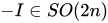
It has determinant (from the representation by a matrix or as a product of reflections). Thus it is orientation-preserving in even dimension, thus an element of the special orthogonal group SO(2n), and it is orientation-reversing in odd dimension, thus not an element of SO(2n + 1) and instead providing a splitting of the map , showing that as an internal direct product.

Analogously, it is a longest element of the orthogonal group, with respect to the generating set of reflections: elements of the orthogonal group all have length at most n with respect to the generating set of reflections,[b] and reflection through the origin has length n, though it is not unique in this: other maximal combinations of rotations (and possibly reflections) also have maximal length.

Geometry

[edit]

In SO(2r), reflection through the origin is the farthest point from the identity element with respect to the usual metric. In O(2r + 1), reflection through the origin is not in SO(2r+1) (it is in the non-identity component), and there is no natural sense in which it is a "farther point" than any other point in the non-identity component, but it does provide a base point in the other component.

Clifford algebras and spin groups

[edit]

It should not be confused with the element in the spin group. This is particularly confusing for even spin groups, as , and thus in there is both and 2 lifts of .
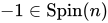
Reflection through the identity extends to an automorphism of a Clifford algebra, called the main involution or grade involution.

Reflection through the identity lifts to a pseudoscalar.

See also

[edit]

Notes

[edit]

References

[edit]
Revisions and contributorsEdit on WikipediaRead on Wikipedia
from Grokipedia
In geometry, point reflection, also known as central inversion or point symmetry, is a transformation that maps every point PP to a point PP' such that a fixed center OO serves as the midpoint of the line segment PPPP'.[1] This operation inverts the position of points relative to the center; in two dimensions, it is equivalent to a rotation by 180 degrees around OO, producing a congruent figure.[2] As a rigid transformation and isometry, point reflection preserves distances between points, angle measures, parallelism of lines, collinearity, and midpoints of segments; in even dimensions, it maintains the orientation of the figure.[1] In the Cartesian coordinate plane, if the center is at the origin (0,0)(0, 0), the transformation is explicitly given by (x,y)(x,y)(x, y) \mapsto (-x, -y).[3] For a general center at (h,k)(h, k), the image of a point (x,y)(x, y) is (2hx,2ky)(2h - x, 2k - y), ensuring the center acts as the midpoint.[1] Point reflection is fundamental in studying symmetries, appearing in structures like parallelograms and centrosymmetric crystals, where the figure coincides with its image under the transformation.[2] It forms part of the dihedral group in two dimensions and the full orthogonal group in higher dimensions, contributing to classifications of geometric symmetries and isometries.[2] Unlike line reflections, which reverse orientation, point reflection preserves orientation in even dimensions, making it useful in applications ranging from computer graphics to crystallographic analysis.[1]

Definition and Terminology

Core Definition

Point reflection, also known as central symmetry, is a geometric transformation in Euclidean space that maps any point P\mathbf{P} to a point P\mathbf{P}' with respect to a fixed point O\mathbf{O} (the center) such that O\mathbf{O} is the midpoint of the segment PP\mathbf{PP}'. Formally, this is expressed in vector notation as P=2OP\mathbf{P}' = 2\mathbf{O} - \mathbf{P}.[4][5] This transformation is an isometry, preserving distances between all pairs of points.[6] It reverses orientation in odd-dimensional spaces, classifying it as an improper isometry in those cases.[4] In contrast to line reflection, which inverts points through a line as the perpendicular bisector, point reflection inverts through a single point as the midpoint.[4]

Historical and Alternative Terms

The concept of point reflection developed within the broader study of symmetries and transformations during the 19th century, particularly through foundational works on projective and affine geometry. August Ferdinand Möbius's 1827 publication Der Barycentrische Calcul advanced affine geometry via barycentric coordinates, facilitating the study of transformations like affinities, which include point reflections as special cases.[7] Similarly, Jean-Victor Poncelet's contributions around 1822 on homologies and similitudes contributed to understanding central projections and similarities, where homothety with ratio -1 corresponds to point reflection.[7] Felix Klein's Erlangen Program of 1872 classified geometries according to their underlying transformation groups, incorporating point reflections as isometries (orientation-preserving in even dimensions, reversing in odd) in Euclidean symmetry groups, alongside direct isometries like rotations.[8] The formal study of point reflection as a transformation gained prominence in the late 19th century through group-theoretic approaches, though the specific terminology "point reflection" is more common in 20th-century geometry education.[9] Alternative terms for point reflection include central inversion, point inversion, central symmetry, and point symmetry, reflecting its role as an inversion through a fixed center that maps each point to its antipode relative to that center.[10] In specific contexts, such as spherical geometry, it is known as antipodal mapping, where points are paired across the sphere's center.[4] Additionally, it is equivalent to a homothety (or dilation) with ratio -1, a terminology rooted in studies of similitudes.[7] The etymological root of "reflection" traces to the Latin reflectere ("to bend back"), borrowed from optical principles of light bouncing off surfaces, and adapted in 19th-century mathematical texts to describe symmetry operations that "fold" space back onto itself, with "point reflection" specifically denoting the central case as opposed to linear mirror reflections.[11]

Geometric Interpretation

In Two Dimensions

In two dimensions, point reflection, also known as central symmetry, is a geometric transformation that maps every point PP in the plane to a point PP' such that the center OO is the midpoint of the segment PPPP'.[6] This operation can be visualized as an inversion through the point OO, where the entire figure is "turned inside out" relative to OO, effectively repositioning each element to the opposite side at an equal distance. A key intuitive visualization of point reflection in the plane is its equivalence to a 180-degree rotation around the center OO. For instance, consider a square centered at OO; under point reflection, the square maps onto itself, but the positions of its vertices are interchanged such that opposite vertices swap places, resulting in the figure appearing unchanged yet with its internal structure rotated halfway around OO. This half-turn preserves distances and shapes, classifying it as a rigid transformation or isometry.[6] The effects of point reflection on common geometric shapes further illustrate its behavior. A circle centered at OO maps directly onto itself, as every point on the circumference is equidistant from OO and its image lies on the same circle. Lines passing through OO remain fixed as sets, mapping to themselves under the transformation, while lines not passing through OO map to distinct parallel lines positioned at an equal distance on the opposite side of OO. For example, a line parallel to the x-axis above OO would reflect to a parallel line equidistant below OO.[6] Regarding orientation, point reflection in two dimensions preserves the handedness of figures, meaning a clockwise traversal of a shape's boundary remains clockwise after transformation, unlike line reflections which reverse it. This preservation aligns with its rotational nature, distinguishing it from orientation-reversing isometries while maintaining congruence to the original figure.[12]

In Higher Dimensions

In three dimensions, point reflection with respect to a center O maps every point P to the point P' such that O is the midpoint of the segment PP', effectively inverting the object's configuration through O. This transformation preserves distances and volumes, making it an isometry, but it reverses the handedness of chiral objects, such as mapping a right-handed coordinate system to a left-handed one. For example, applying point reflection to a cube centered at O yields the identical cube, as the cube possesses central symmetry, with each vertex mapping to the opposite vertex across O.[13][14] In general n-dimensional Euclidean space, point reflection extends this vector-based interpretation: relative to coordinates centered at O, it sends every position vector v\mathbf{v} to v-\mathbf{v}, inverting the entire configuration. This central inversion transforms simplices or polytopes into their centrally symmetric counterparts when O is suitably chosen, such as the centroid, thereby highlighting symmetry properties in higher-dimensional geometry. The operation maintains the overall scale and shape but alters the arrangement in a way that emphasizes antipodal relationships among points.[4] The effect on orientation depends on the dimension: point reflection preserves orientation in even dimensions (where it behaves like a rotation) but reverses it in odd dimensions, flipping chirality as indicated by the determinant (1)n(-1)^n of the associated linear transformation. An intuitive analogy in three dimensions compares this to turning a glove inside out through the point O, which converts a right-handed glove to a left-handed one without tearing, underscoring the reversal of handedness.[15][14]

Mathematical Formulation

Coordinate-Based Formula

In coordinate geometry, the point reflection of a point $ P $ with position vector $ \vec{p} $ over a center $ O $ with position vector $ \vec{o} $ is given by the vector equation $ \vec{p'} = 2\vec{o} - \vec{p} $.[16][17] This formula expresses the transformation algebraically, where $ \vec{p'} $ is the position vector of the reflected point $ P' $. The derivation follows directly from the defining property that $ O $ is the midpoint of the segment joining $ P $ and $ P' $. Using the midpoint formula in vector terms, $ \vec{o} = \frac{\vec{p} + \vec{p'}}{2} $. Solving for $ \vec{p'} $, multiply both sides by 2 to obtain $ 2\vec{o} = \vec{p} + \vec{p'} $, then subtract $ \vec{p} $ from both sides, yielding $ \vec{p'} = 2\vec{o} - \vec{p} $.[18] This formulation demonstrates translation invariance: by shifting the coordinate system so that $ O $ coincides with the origin (i.e., setting $ \vec{o} = \vec{0} $), the formula simplifies to $ \vec{p'} = -\vec{p} $, which is the negation of the position vector.[17][18] In this centered case, each coordinate component is simply multiplied by -1, as seen in two dimensions where a point $ (x, y) $ maps to $ (-x, -y) $.[18]

Matrix Representation

In the case where the fixed point OO coincides with the origin, point reflection is a linear transformation represented by multiplication with the negative identity matrix In-I_n in nn-dimensional Euclidean space.[13] This matrix takes the diagonal form
In=(100010001), -I_n = \begin{pmatrix} -1 & 0 & \cdots & 0 \\ 0 & -1 & \cdots & 0 \\ \vdots & \vdots & \ddots & \vdots \\ 0 & 0 & \cdots & -1 \end{pmatrix},
where each of the nn diagonal entries is 1-1.[13] The determinant of In-I_n equals (1)n(-1)^n, resulting in +1+1 for even nn (an orientation-preserving proper orthogonal transformation) and 1-1 for odd nn (an orientation-reversing improper orthogonal transformation).[13] For a general fixed point OO, point reflection becomes an affine transformation, decomposed as the composition TO(In)TOT_{\mathbf{O}} \circ (-I_n) \circ T_{-\mathbf{O}}, where TvT_{\mathbf{v}} is the translation by vector v\mathbf{v}. In homogeneous coordinates, this affine map is represented by the (n+1)×(n+1)(n+1) \times (n+1) matrix
(In2O0T1), \begin{pmatrix} -I_n & 2\mathbf{O} \\ \mathbf{0}^T & 1 \end{pmatrix},
which applies the operation P=2OP\mathbf{P}' = 2\mathbf{O} - \mathbf{P} to a point P\mathbf{P}.[19] The linear component of this matrix retains the form In-I_n and its associated determinant (1)n(-1)^n.[13]

Properties and Relations

Fundamental Properties

Point reflection, also known as central inversion, exhibits several fundamental properties as a geometric transformation in Euclidean space. These include its status as an isometry, its involutory nature, the uniqueness of its fixed point, and its role in compositions that generate other isometries. As an isometry, point reflection preserves Euclidean distances between points. To see this, consider the transformation centered at the origin for simplicity, where a point P\mathbf{P} maps to P=P\mathbf{P}' = -\mathbf{P}. For any two points P\mathbf{P} and Q\mathbf{Q}, the distance between their images is $| \mathbf{P}' - \mathbf{Q}' | = | (-\mathbf{P}) - (-\mathbf{Q}) | = | -(\mathbf{P} - \mathbf{Q}) | = | \mathbf{P} - \mathbf{Q} | $, since the Euclidean norm is unchanged under scalar multiplication by -1. For a general center O\mathbf{O}, the mapping is P=2OP\mathbf{P}' = 2\mathbf{O} - \mathbf{P}, and PQ=(2OP)(2OQ)=QP\mathbf{P}' - \mathbf{Q}' = (2\mathbf{O} - \mathbf{P}) - (2\mathbf{O} - \mathbf{Q}) = \mathbf{Q} - \mathbf{P}, so $| \mathbf{P}' - \mathbf{Q}' | = | \mathbf{P} - \mathbf{Q} | $. This preservation of distances follows from the congruence of triangles formed by the center and the segments, as established by the side-angle-side (SAS) criterion.[2][5] Point reflection is involutory, meaning it is its own inverse: applying the transformation twice yields the identity mapping. For a center O\mathbf{O}, the second application gives 2O(2OP)=P2\mathbf{O} - (2\mathbf{O} - \mathbf{P}) = \mathbf{P}. Thus, the composition of the reflection with itself returns every point to its original position.[2][5] The only fixed point of a point reflection is the center O\mathbf{O} itself. A point P\mathbf{P} satisfies P=P\mathbf{P}' = \mathbf{P} if and only if 2OP=P2\mathbf{O} - \mathbf{P} = \mathbf{P}, which simplifies to P=O\mathbf{P} = \mathbf{O}. All other points are mapped to distinct locations antipodal with respect to O\mathbf{O}.[2][5] Compositions involving point reflection generate other elements of the Euclidean isometry group. Specifically, the composition of two point reflections over distinct centers A\mathbf{A} and B\mathbf{B} is a translation by the vector 2(BA)2(\mathbf{B} - \mathbf{A}). When combined with translations or rotations, such compositions produce broader symmetry groups, including the full group of orientation-preserving isometries in even dimensions. In matrix form relative to the center, point reflection corresponds to scalar multiplication by -1, resulting in a determinant of (1)d(-1)^d where dd is the dimension of the space.[2][5]

Connections to Other Transformations

Point reflection, also known as central inversion, can be interpreted as a specific case of a homothety, which is a transformation that scales objects by a fixed factor relative to a center point. Specifically, it corresponds to a homothety with center O and scale factor k = -1, where every point P is mapped to P' such that the vector from O to P' is the negative of the vector from O to P. This negative scaling distinguishes it from positive homotheties, as it reverses the direction of vectors from the center, leading to an orientation-reversing effect in odd-dimensional spaces while preserving orientation in even dimensions.[20][21] In two-dimensional Euclidean space, point reflection through a point O is precisely equivalent to a rotation by 180 degrees (or π radians) around O, as both transformations map each point P to the antipodal point on the circle centered at O with radius OP. This equivalence holds because the transformation matrix -I in 2D has determinant 1, placing it within the special orthogonal group SO(2), which consists of orientation-preserving rotations. In higher even dimensions, such as 4D or 6D, the central inversion (-I) remains orientation-preserving and can be decomposed as the composition of n pairwise orthogonal 180-degree rotations, each acting in a 2D plane that spans the space, reflecting the structure of rotations in even-dimensional orthogonal groups.[21] Point reflection differs fundamentally from geometric inversion, which is a transformation with respect to a circle (in 2D) or sphere (in higher dimensions) that maps points inside to outside and vice versa while preserving angles but distorting distances nonlinearly. Unlike geometric inversion, which generally maps circles to circles or lines but does not preserve collinearity of points unless they pass through the center, point reflection is a linear isometry that rigidly maps lines to parallel lines and preserves all affine structures. Point reflection represents a special linear case of inversion, confined to the origin without the conformal but nonlinear properties of circle- or sphere-based inversions.[22] In the context of projective geometry, point reflection functions as a type of polarity, a correlation that duality maps points to hyperplanes (or lines in 2D) in a reciprocal manner, particularly when considering absolute circle or sphere geometries where reflections generate the transformation group. This role arises in projective metrics, where central inversion aligns with polar mappings that preserve incidence relations across the projective plane or space.[23]

Group-Theoretic Aspects

Point Reflection Group

The point reflection group is the cyclic group generated by a single point reflection σ\sigma, consisting of the elements {id,σ}\{\mathrm{id}, \sigma\}, where σ2=id\sigma^2 = \mathrm{id}. This structure yields a group of order 2, which is isomorphic to the cyclic group Z/2Z\mathbb{Z}/2\mathbb{Z}.[24] The action of this group on Euclidean space generates central symmetries, transforming each point into its antipodal point relative to the fixed center of reflection. In nn-dimensional Euclidean space, the point reflection group forms a subgroup of the orthogonal group O(n)O(n), specifically the subgroup generated by the central inversion matrix I-I.[24][25] When combined with translations, the point reflection extends to non-abelian structures, forming wallpaper groups in two dimensions or space groups in three dimensions that incorporate inversion symmetry. For instance, among the 17 wallpaper groups, types such as p2mm (or pmm) and cmm include inversion centers alongside translational lattices, resulting in infinite discrete symmetry groups of the plane.

Role in Symmetry Groups

Point reflection, also known as central inversion, plays a central role in the structure of the orthogonal group O(n)O(n), the group of all linear isometries of Rn\mathbb{R}^n. Represented by the matrix I-I, where II is the identity matrix, it belongs to the center of O(n)O(n) for n2n \geq 2, which consists precisely of the elements {[I,I](/page/I,I)}\{[I, -I](/page/I,_I)\}. This centrality implies that point reflection commutes with every element of O(n)O(n), making it a fundamental scalar multiple that preserves the group's defining properties of distance and angle conservation.[26] For even dimensions n=2kn = 2k, the determinant of I-I is 1, so point reflection lies within the special orthogonal group SO(n)SO(n), where it generates the order-2 central subgroup {[I,I](/page/I,I)}\{[I, -I](/page/I,_I)\}, highlighting its role in distinguishing connected components and quotients of rotation groups. In finite symmetry groups of regular figures, point reflection emerges as a key element in dihedral and polyhedral groups. For the dihedral group DnD_n, the symmetry group of a regular nn-gon, point reflection through the center coincides with the 180-degree rotation when nn is even, serving as an essential generator in the cyclic rotation subgroup and contributing to the overall structure that balances rotations and reflections. Extending to three dimensions, in the full polyhedral groups such as the octahedral group OhO_h for the cube or octahedron, point reflection acts as the inversion ii, and the group decomposes as the direct product of the rotational polyhedral group and the inversion subgroup {1,i}\{1, i\}, enabling the inclusion of improper rotations and reflections while preserving centrosymmetry.[27][28] Crystallographic point groups, which classify the discrete symmetries compatible with lattice translations, incorporate point reflection as a core operation in their 11 centrosymmetric variants out of the total 32 groups. Denoted by the symbol 1-1 in the International Tables for Crystallography, this operation represents a center of symmetry (or onefold inversion axis) that maps each lattice point to its antipodal counterpart through the origin, ensuring the group's compatibility with periodic crystal structures.[29] In infinite discrete symmetry groups like frieze and wallpaper groups, which describe repeatable patterns in the plane, point reflection manifests as 180-degree rotations and integrates with glide reflections to form more complex motifs. For instance, in frieze group F5F_5 (or p211p211), it combines with glide reflections along the strip direction to generate patterns with alternating orientations, while in wallpaper groups such as pggpgg, point reflections at lattice points pair with perpendicular glide reflections to produce centrosymmetric tilings without mirror symmetries. These combinations extend the basic point reflection group into translationally invariant structures essential for analyzing periodic designs.[30]

Applications

In Analytic Geometry

In analytic geometry, point reflection provides a powerful tool for analyzing the symmetry properties of curves and figures, particularly conic sections. Ellipses and hyperbolas possess central symmetry with respect to their center, meaning the curve remains unchanged under point reflection over that point, as substituting (x,y)(x, y) with (2hx,2ky)(2h - x, 2k - y) (where (h,k)(h, k) is the center) yields the original equation.[31] Parabolas, by contrast, do not exhibit this point symmetry, lacking invariance under such a transformation due to their open, non-central structure.[32] A representative example is the circle, a special case of the ellipse, whose equation x2+y2=r2x^2 + y^2 = r^2 (centered at the origin) maps to itself under point reflection over the origin, confirming its central symmetry.[32] This property extends to general ellipses and hyperbolas translated to standard position, where the transformation preserves the quadratic form.[32] Point reflection also aids in solving locus problems by identifying symmetric positions analytically. For instance, it is useful for constructing perpendicular bisectors in coordinate terms via vector midpoint calculations.[1] In vector-based applications, such as computer graphics, point reflection enables efficient central flipping of polygons by applying the formula P=2CP\mathbf{P}' = 2\mathbf{C} - \mathbf{P} to each vertex, where C\mathbf{C} is the center, preserving shape while inverting orientation for rendering symmetric models or animations. This linear operation is computationally straightforward, often implemented via homogeneous coordinates for batch transformations.

In Crystallography and Molecular Structures

In crystallography, point reflection manifests as an inversion center, a key symmetry element present in 11 of the 32 crystallographic point groups, enabling the classification of centrosymmetric crystals.[33] These groups, often denoted by the presence of the 1ˉ\bar{1} operation, describe the external symmetry of crystals and are fundamental to understanding their physical properties, such as optical behavior and piezoelectricity. For instance, the diamond crystal structure, with space group Fd3ˉmFd\bar{3}m, incorporates inversion centers at positions like (1/8,1/8,1/8)(1/8, 1/8, 1/8), where the operation maps carbon atoms from one face-centered cubic sublattice to the other, contributing to the overall cubic symmetry despite the local tetrahedral coordination lacking inversion.[34] In molecular structures, point reflection appears in centrosymmetric molecules, where an inversion center ensures that the molecule is superimposable on its mirror image through this operation, often leading to achiral configurations. A representative example is trans-1,2-dichloroethene ($ \ce{(ClHC=CHCl)} $), which belongs to the C2hC_{2h} point group and features an inversion center at the midpoint of the C-C bond, balancing the chlorine atoms on opposite sides.[35] This symmetry has significant spectroscopic implications: in centrosymmetric molecules, the rule of mutual exclusion applies, rendering vibrations that are infrared (IR) active inactive in Raman spectroscopy, and vice versa, due to the parity selection rules enforced by the inversion center.[36] For trans-1,2-dichloroethene, this results in only three IR-active modes out of its six vibrational degrees of freedom, simplifying spectral analysis and aiding in symmetry assignment.[37] Experimental detection of inversion centers in crystals and molecular solids primarily relies on X-ray diffraction, where the technique reveals the space group symmetry through the analysis of diffraction intensities and electron density maps. While inversion itself does not produce systematic absences—those arise from translational symmetries like centering or glide planes—the presence of an inversion center is confirmed during structure refinement when the model fits the data only with centrosymmetric constraints, such as equal intensities for Friedel pairs in the absence of anomalous scattering.[38] In practice, for structures like diamond, the centrosymmetric space group is validated by the absence of certain reflections consistent with the full symmetry operations, including inversion, ensuring the atomic arrangement aligns with the observed diffraction pattern.[38] This method has been pivotal in elucidating the symmetries of countless materials, from minerals to pharmaceuticals.

Advanced Mathematical Contexts

Inversion with Respect to the Origin

Inversion with respect to the origin is the special case of point reflection where the center of inversion coincides with the origin of the coordinate system. In this configuration, the transformation simplifies to negating the position vector of each point, mapping a point $ \mathbf{P} = (x_1, x_2, \dots, x_n) $ in $ n $-dimensional Euclidean space to $ \mathbf{P}' = (-x_1, -x_2, \dots, -x_n) $. This operation, represented by multiplication by the scalar 1-1 or the matrix $ -I $ (the negative identity matrix), arises directly from the general point reflection formula when the center is at the origin, reducing $ \mathbf{P}' = 2\mathbf{O} - \mathbf{P} $ to $ \mathbf{P}' = -\mathbf{P} $.[21][14] Geometrically, this inversion preserves distances and angles as an isometry of Euclidean space, but reverses orientation in odd dimensions (transforming right-handed coordinate systems to left-handed ones) and preserves orientation in even dimensions. Lines and planes passing through the origin are mapped onto themselves, though the direction along these subspaces is reversed—for instance, a ray emanating from the origin in one direction is sent to the opposite ray. Spheres centered at the origin are invariant under this transformation, as the Euclidean norm $ |\mathbf{P}| = |\mathbf{P}'| $ ensures every point on such a sphere is mapped to another point on the same sphere. The origin itself is the sole fixed point, remaining unchanged.[21][14][9] In the complex plane, inversion with respect to the origin corresponds to the mapping $ z \mapsto -z $, which negates both the real and imaginary parts of the complex number $ z = x + iy $, sending it to $ -x - iy $. This operation is a 180-degree rotation about the origin, which preserves orientation, distinct from complex conjugation $ \overline{z} = x - iy $ (which reflects over the real axis and reverses orientation), but sharing the property of fixing only the origin. It preserves the modulus $ |z| = |-z| $, thus mapping circles centered at the origin to themselves.[39]

Representations in Clifford Algebras

In Clifford algebras, geometric transformations such as reflections are represented using versors, which are products of invertible vectors corresponding to reflections in hyperplanes. A simple reflection of a vector $ \mathbf{v} $ across a hyperplane with unit normal $ \mathbf{n} $ (where $ \mathbf{n}^2 = \pm 1 $) is given by the sandwich product $ \mathbf{v}' = -\mathbf{n} \mathbf{v} \mathbf{n} $, an operation inherent to the geometric product of the algebra.[40] Point reflection, or central inversion through the origin, maps every vector $ \mathbf{x} $ to $ -\mathbf{x} $. This transformation is an element of the Pin group, the group generated by unit vectors under the geometric product, and can be realized as the scalar multiplication by $ -1 $, which lies in the center of the algebra for dimensions greater than zero. Equivalently, it arises as the composition of reflections across all $ n $ orthogonal hyperplanes in an $ n $-dimensional space, yielding a versor of grade $ n $ modulo signs.[40] In the context of the pseudoscalar $ I $, the unit element of highest grade in $ \mathrm{Cl}(n,0) $, the central inversion is represented by the conjugation $ \mathbf{x}' = I \mathbf{x} \tilde{I} $, where $ \tilde{I} $ denotes the reverse of $ I $. For Euclidean signature, $ I^2 = (-1)^{n(n-1)/2} $, and the reverse satisfies $ \tilde{I} = (-1)^{n(n-1)/2} I $; this conjugation yields $ -\mathbf{x} $ when the dimension $ n $ is even and $ \mathbf{x} $ when $ n $ is odd (as in 3D space, where $ I = \mathbf{e}_1 \mathbf{e}_2 \mathbf{e}_3 $ and $ I^2 = -1 $, $ \tilde{I} = -I $, but vectors commute with $ I $, so $ I \mathbf{x} (-I) = -I \mathbf{x} I = -I (I \mathbf{x}) = -I^2 \mathbf{x} = -(-1) \mathbf{x} = \mathbf{x} $). In odd dimensions, central inversion is instead achieved via scalar multiplication by -1. This pseudoscalar-based representation highlights the orientation-reversing nature of point reflection in odd dimensions, with determinant $ \det = (-1)^n $.[40][41] For point reflection through an arbitrary center $ \mathbf{a} $, the transformation combines translation with central inversion: first translate by $ -\mathbf{a} $ to the origin, apply $ -\mathbf{x} $, then translate back by $ +\mathbf{a} $, yielding $ \mathbf{x}' = 2\mathbf{a} - \mathbf{x} $. In Clifford algebra, translations are even-grade versors (bivectors in the flat subspace), ensuring the full isometry remains a product within the Pin or Spin group extensions. This framework extends naturally to conformal geometric algebra $ \mathrm{Cl}(n+1,1) $, where points are represented as null vectors, and inversion through a point corresponds to a spherical inversion versor centered at that point, preserving angles and enabling unified treatment of Euclidean and spherical geometries.[40]

References

User Avatar
No comments yet.