Hubbry Logo
Pontoon boatPontoon boatMain
Open search
Pontoon boat
Community hub
Pontoon boat
logo
8 pages, 0 posts
0 subscribers
Be the first to start a discussion here.
Pontoon boat
Pontoon boat
from Wikipedia
A pleasure boat with two lengthwise pontoons

A pontoon boat is a flattish boat that relies on floats to remain buoyant. These pontoons (also called tubes) contain much reserve buoyancy and allow designers to create large deck plans fitted with a variety of accommodations including expansive lounge areas, stand-up bars, and sun pads. More horsepower is now able to be applied to the stern due to design improvements.[1] Pontoon boat drafts may be as shallow as eight inches (20 centimetres), which reduces risk of running aground and underwater damage; this allows it to come close to shore to pick up and drop off loads.

History

[edit]
A pontoon ferry crossing the Zambezi at Kazungula

The 1952 invention of the pontoon motorboat in the United States is credited to a farmer who lived on the Horseshoe Chain of Lakes, near Richmond, Minnesota. Ambrose Weeres put a wooden platform on two columns of steel barrels welded together end-to-end, creating a sturdy deck that would be more stable on a lake than a conventional boat.[2] Living in the "Land of 10,000 Lakes," Weeres thought this idea might be marketed. The first boat was "The Empress". He built a few boats and sold them with the help of dealers. He started Weeres Industries to meet unexpected demand. Weeres, later called "Mr. Pontoon", was elected to the Minnesota Marina Hall of Fame.[3]

Designs and uses

[edit]

Common pontoon boat designs are a catamaran with two hulls, or a trimaran with three hulls. Boats with three hulls are sometimes called tri-toons.[4]

Pontoon boat designs have changed significantly since the early 2000s, with boats now featuring larger tubes, increased engine horsepower, and cuddy cabins.[4]

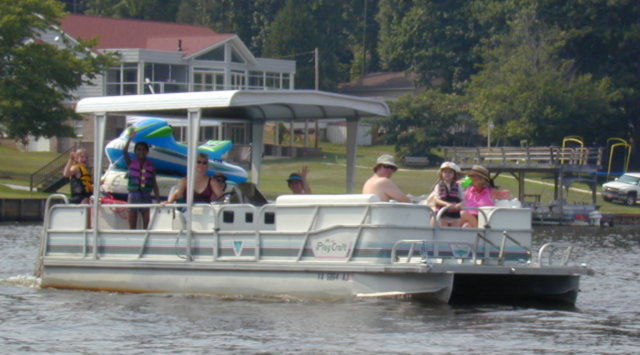
Pontoon boats are used for pleasure on lakes and rivers, and in some cases on oceans close to shore. Pontoon watersport activities include tubing, waterskiing, and wakeboarding. Common pontoon accessories include inflatable slides, diving boards, sun shades, and Bimini tops.[5]

They are also used as small vessel ferries to cross rivers and lakes in many parts of the world, especially in Africa. Pontoon ferries may be motorized, such as the Kazungula Ferry across the Zambezi River, or powered by another boat, or pulled by cables. A type of ferry known as the cable ferry (also called punts in medieval times and in modern Australia and New Zealand) pull themselves across a river using a motor or human power applied to the cable, which also guides the pontoon. Pontoons may support a platform, creating a raft. A raft supporting a house-like structure is a houseboat. A pontoon boat keeping a sauna cabin is called a sauna boat or sauntoon.[6]

Small inflatable pontoon boats are one or two-person, catamaran-type boats, designed for leisure and fishing. Their pontoons are made out of abrasion-resistant PVC and nylon with aluminum, steel, and plastic frames for support. In today's setting, more and more people prefer to use frameless pontoon boats.[7] They are powered with paddles, oars and often with electric trolling motors using deep cycle lead batteries. Commonly they are equipped with motor mount, battery storage area, fishing rod holders, canopy, fishfinder mount, small anchor, and other required fishing gear. Such boats are suitable for ponds, lakes, rivers, and seas during calm weather. However, due to their light weight, they are susceptible to waves and windy conditions. Nonetheless, such boats are often used even for big game fishing.

Jumbo pontoon boats are used to give guided tours to tourists.

Odyssey Cruises jumbo pontoon boat

Hydrodynamic design and analysis of lift and drag characteristics of round pontoon planing surfaces is complex, since the deadrise angle is changing with pontoon arc (circumference), but this is resolved with this paper.[8]

Safety

[edit]

The pontoon effect is when a large force applied to the side capsizes a pontoon boat without much warning, particularly a top-heavy boat.

See also

[edit]
  • Pontoon bridge – Type of floating bridge
  • Barge – Flat-bottomed watercraft for transport of bulk goods
  • Raft – Flat structure for support or transportation over water
  • Buoy – Floating structure or device
  • Rhino ferry – A barge made from pontoons powered by outboard engines
  • Rigid buoyant boat – Type of boat
  • Airboat – Type of watercraft propelled by an aircraft propeller

References

[edit]
Revisions and contributorsEdit on WikipediaRead on Wikipedia
from Grokipedia
A pontoon boat is a flat-decked watercraft that achieves buoyancy and stability through two or more sealed, cylindrical pontoons—typically constructed from aluminum—positioned beneath the deck, allowing for spacious seating and easy access for passengers. While earlier designs existed, such as a 1905 patent by Daniel W. Porter, Ambrose Weeres, a farmer from Richmond, Minnesota, is credited with inventing the modern recreational pontoon boat in 1952 as a simple wooden platform attached to two columns of steel barrels for family outings on local lakes, marking the beginning of its evolution from basic utility craft to a widely produced leisure vessel. This design drew from ancient pontoon principles used for bridges and rafts dating back centuries, but Weeres' innovation popularized the flat-deck format for personal use in the United States. Over the decades, pontoon boats have grown in popularity due to their affordability, with production emphasizing lightweight aluminum construction that reduces building costs compared to traditional hulls. As of 2025, the global pontoon market is valued at over USD 8.5 billion and continues to grow. Pontoon boats typically range from 15 to over 30 feet in length and about 8.5 feet in width, accommodating 8 to 20 or more passengers depending on the model, and are powered by outboard motors for on calm inland waters like lakes and rivers. Their key advantages include exceptional stability from the wide pontoon base, which minimizes rocking and enhances for families and beginners; ample deck space for lounging, , or watersports; and ease of due to the simple, open layout and corrosion-resistant materials. Fuel efficiency is another benefit, as the design creates less resistance, making them economical for leisurely cruising. Today, they are favored for recreational activities such as family outings, social gatherings, and light , with modern variants like tritoons—featuring three pontoons—offering improved speed and handling for more versatile use.

Introduction

Definition and Characteristics

A pontoon boat is a flattish vessel that relies on buoyant pontoons—sealed tubes or floats—for flotation, typically featuring a flat deck that maximizes open space for passengers and leisure activities. These boats exhibit core characteristics that emphasize stability and versatility, including a wide beam measuring 8 to 11 feet, which lowers the center of gravity and enhances balance on the water. Their shallow draft, typically 12 to 24 inches (30 to 61 cm) depending on load and motor trim, allows navigation in calm inland waters like lakes and rivers where deeper-draft vessels cannot venture. Pontoon boats commonly range from 16 to 30 feet in length and support capacities of 8 to 20 or more passengers, making them ideal for group outings. Buoyancy in a pontoon boat derives from air-filled tubes, usually constructed of aluminum or composite materials, that displace water to support the vessel's weight. This design provides reserve , enabling the boat to remain afloat even if the deck becomes swamped, as the sealed pontoons maintain displacement. In distinction from traditional boats featuring a V-shaped for planing at high speeds, pontoon boats adopt a configuration akin to a , with widely spaced cylindrical floats that favor exceptional stability over rapid acceleration or rough-water performance.

Basic Components

A pontoon boat's core structure relies on its pontoons, which are typically two or more sealed, cylindrical aluminum tubes measuring 23 to 25 inches in diameter, providing the primary and stability for the vessel. These tubes, often constructed with aluminum walls of 0.080 to 0.090 inches thick, are welded and airtight to support the boat's weight and passengers while resisting in marine environments. The deck forms the flat, walkable platform atop the pontoons, constructed from 3/4-inch marine-grade plywood or composite panels overlaid on aluminum cross-members that span between the tubes for structural support. Risers, welded brackets on the pontoon tops, elevate and secure the deck, ensuring even load distribution during use, while the rear transom—a reinforced aluminum assembly—provides the mounting point for the outboard motor and enhances overall rigidity. Railings, typically aluminum fencing panels bolted around the perimeter, serve as safety barriers to prevent falls and define the boat's edges. Furniture components, including bolt-on bench seats, lounges, and tables, are affixed to the deck via aluminum frames, offering modular seating arrangements that prioritize passenger comfort and storage under hinged cushions. Standard features such as a Bimini top—a collapsible canopy on an aluminum frame—provide overhead shade, and a rear , often a four-step stainless-steel model, facilitates safe entry and exit from the water. Component sizes vary by boat length: compact models under 20 feet use narrower tubes and simpler railings for maneuverability and trailering, whereas larger party boats exceeding 24 feet incorporate extended cross-members, broader decks, and additional furniture to accommodate more occupants.

History

Origins and Invention

The pontoon boat was invented in 1951 by Ambrose Weeres, a farmer residing in Richmond, . Seeking a stable and versatile vessel for navigating the shallow waters of local lakes, Weeres constructed the first prototype by mounting a flat wooden platform atop two 55-gallon steel drums serving as pontoons. This simple design addressed his practical needs for transporting family members, goods, and recreational gear across the Horseshoe Chain of Lakes near his property, where traditional boats often struggled with low drafts and uneven bottoms typical of Midwestern waters. The motivation stemmed from Minnesota's abundant lake culture and the desire for an accessible, buoyant craft that prioritized safety and ease over speed. Weeres tested the prototype on Horseshoe Lake in collaboration with local resident Edwin Torborg, who is sometimes credited as a co-inventor, refining it by adding breathing tubes to the drums to prevent collapse in cold weather. Impressed by its performance, he built four additional boats that year and displayed the design at the 1952 Boat Show, securing 40 orders and sparking over 100 more. This demand prompted him to establish Weeres Industries in 1952 as the first company dedicated to pontoon boat production. By 1955, Weeres had launched the inaugural commercial model, "The Empress," named after his wife, marking the transition from homemade raft to marketable product. In 1990, the officially recognized Weeres as the inventor of the pontoon boat through a resolution. Early adoption in the 1950s remained limited, with production focused on regional demand in the Midwest, but the invention aligned with the post-World War II boating boom, where surplus military pontoons were repurposed for civilian recreation and fueled a surge in affordable watercraft enthusiasm. The pontoon's multihull configuration offered inherent stability akin to catamaran principles, appealing to novice boaters and families seeking low-maintenance options for lake outings amid rising leisure boating trends. This foundational period established the pontoon as a practical innovation tailored to shallow-water environments, setting the stage for broader industry development.

Evolution and Modernization

In the 1960s, pontoon boat manufacturers transitioned from steel to aluminum pontoons, which offered lighter weight and superior corrosion resistance compared to earlier designs. This shift was pioneered by companies such as Waco Manufacturing, which began producing aluminum models in 1960 and introduced innovations like upper sundecks. Similarly, MonArk Boat Company adopted aluminum construction during this decade, as evidenced by their 1960s brochures showcasing lightweight, durable pontoon designs. The and marked a period of rapid industry growth, with manufacturers expanding production and incorporating luxury amenities to appeal to a broader recreational market. Builders added features such as upholstered seating, sound systems, and enclosed cabins on larger models, transforming pontoons from basic platforms into comfortable family vessels. Tritoons, featuring a third central pontoon for enhanced stability and performance, were introduced in the early by innovators like the Menne brothers and later refined by companies such as Bennington Marine and Harris FloteBote in the . During the and , advancements focused on performance, with manufacturers integrating higher-horsepower engines—reaching up to 150 HP on many models—and structural enhancements like lifting strakes to improve speed, handling, and . Harris Boats led this trend by launching the HP Classic in 1993, a high-performance model equipped with lifting strakes for better lift and reduced drag. The market experienced a significant boom, with annual sales surpassing 50,000 units by the , driven by demand for versatile, family-oriented boats. In the 2020s, pontoon evolution has emphasized and , incorporating eco-friendly materials like recycled composites and bioplastics to reduce environmental impact. Smart integrations, including GPS navigation and autopilot systems from brands like and , have enhanced usability and safety on the water. Post-2020 demand has spurred faster, more robust models capable of handling coastal and rougher waters, with tritoon designs achieving speeds over 50 mph through advanced hull shaping and powerful outboards.

Design and Construction

Pontoon Structure

The pontoon structure forms the foundational buoyant elements of a pontoon boat, primarily consisting of extruded aluminum tubes designed to provide stable flotation. In modern models, these tubes typically measure 25 to 30 feet in length and 25 to 27 inches in diameter, allowing for efficient displacement of while supporting the deck and load. The tubes are constructed from marine-grade aluminum 5052 , valued for its high resistance, strength, and in saltwater and freshwater environments. While the aluminum alloy provides excellent inherent corrosion resistance in both freshwater and saltwater environments, additional protective measures are often recommended depending on usage conditions. In freshwater or when the boat is trailered and not left moored in water, painting the submerged portions of the tubes is typically optional, primarily for aesthetics or minor extra protection. In saltwater or when moored in water for extended periods, it is advisable to apply an aluminum-safe, copper-free anti-fouling paint to the submerged portions to prevent marine growth (such as barnacles, algae, and slime), corrosion, and electrolytic damage. Proper surface preparation—including thorough cleaning, sanding, and application of a compatible primer—is critical to ensure paint adhesion and avoid problems like crevice corrosion or paint failure. This practice enhances long-term durability, especially in harsh marine conditions, though many owners in freshwater settings forgo it due to the aluminum's natural resistance. To enhance , the tubes are sealed with internal baffles that divide them into compartmentalized sections, preventing a single puncture from flooding the entire length and maintaining overall . The under-deck framework joins these pontoon tubes using aluminum cross-members, such as hat-channel or designs, which are either bolted or welded to the tubes for structural integrity and load distribution. Deck risers, often 6 inches wide and integrated with the cross-members, elevate the deck 12 to 18 inches above the pontoons, providing essential clearance for systems and facilitating water runoff to prevent deck submersion. Common enhancements to the pontoon structure include lifting strakes—longitudinal fins welded along the lower exterior of the tubes—that channel water flow to generate hydrodynamic lift, reducing drag and improving planing efficiency. Underfloor pods, typically attached to the rear sections of the tubes, integrate engine mounting while adding localized to counterbalance motor weight, particularly for heavier four-stroke outboards. Buoyancy in the pontoon structure is engineered for and , with each tube capable of providing 1,000 to 2,000 pounds of lift based on partial submersion and typical dimensions. The overall design ensures total reserve exceeds the boat's loaded weight by 50 to 100 percent, offering a margin against swamping or uneven loading. US-made pontoon boats generally provide advantages over imported models, including higher build quality, use of superior materials, extended warranties such as limited lifetime structural coverage and 10-year bow-to-stern protection, robust dealer networks for maintenance and support, better resale values due to brand reputation, and comprehensive after-sales services. Industry discussions note concerns with imported boats, particularly from China, regarding inconsistent quality control, thinner materials, and limited warranty and support options.

Deck and Accessories

The deck of a pontoon boat serves as the primary platform for passengers, typically constructed over an aluminum frame with materials chosen for durability and weather resistance. Common decking bases include marine-grade , which provides a lightweight and strong foundation, often sealed to prevent rot, or composite panels that offer superior water resistance without the need for additional treatments. These are covered with non-slip surfaces such as vinyl flooring or interlocking tiles, which mimic wood grains while ensuring traction even when wet. Decks generally measure 16 to 30 feet in length and 8 to in width, accommodating various boat sizes while maintaining stability above the pontoon structure. Seating configurations on pontoon boats emphasize modularity and comfort, with bolt-on lounges, benches, and a central captain's allowing flexible arrangements for lounging or socializing. is predominantly marine-grade vinyl, designed to withstand UV exposure, , and for long-term outdoor use. Passenger capacity varies by deck size, typically supporting 10 to 18 people on standard models, with larger layouts enabling up to 25 in party-oriented designs through perimeter seating and convertible rear lounges. Common accessories enhance functionality and leisure on the deck, including Bimini tops—folding canvas or aluminum-framed roofs that provide adjustable shade from the sun. Integrated coolers and built-in stereos with weatherproof speakers facilitate extended outings, while LED lighting strips, often mounted under rails or along edges, improve visibility for evening use. Optional add-ons such as rail-mounted grills for cooking, compact in bow enclosures, and inflatable slides for water entry further customize the experience. In the 2020s, customization trends have shifted toward luxury finishes, with synthetic or alternatives replacing traditional materials for a premium aesthetic that resists fading and requires minimal maintenance. Integrated tech mounts for tablets, wireless chargers, and smart lighting systems have become standard, reflecting a blend of high-end comfort and modern connectivity in deck designs.

Types and Variants

Standard Pontoons

Standard pontoon boats feature a classic two-tube design consisting of two parallel aluminum pontoons that provide and stability. These pontoons are typically constructed from marine-grade aluminum , such as 5052, with a wall thickness of around 0.080 inches to ensure durability against corrosion, particularly in freshwater environments where additional protective coatings are often unnecessary. In saltwater use, application of anti-fouling paint is recommended as detailed in the pontoon structure section. The overall beam width for these boats generally measures 8 to 9 feet, allowing for a spacious deck without excessive width that could complicate transport. Draft is shallow, ranging from 12 to 18 inches when the tubes are up, making them suitable for accessing shallow waters. Dry weights for standard models fall between 1,500 and 3,000 pounds, depending on length and features, which contributes to their maneuverability on land and water. In terms of capacity, standard pontoons support maximum horsepower ratings of 90 to 140, accommodating outboard engines that balance power with the boat's lighter frame. Passenger load limits typically range from 1,000 to 1,500 pounds, enabling 8 to 12 people aboard for day trips, though actual numbers depend on weight distribution. These boats excel in calm lakes and rivers, where their platform supports leisurely activities like or socializing without the need for high-speed performance. The advantages of standard two-tube pontoons include their affordability, with entry-level models starting around $20,000, making them accessible for first-time buyers. Their lighter weight facilitates ease of trailering with standard vehicles and hitches, often requiring no special setup. Maintenance is straightforward, involving annual cleaning of the aluminum tubes and minimal mechanical complexity compared to more advanced hull designs. Common entry-level models in the 18- to 22-foot range include the Sun Tracker Party Barge 18 DLX and 20 DLX, which offer basic seating and bimini tops for shaded cruising. Similarly, Lowe's SS series, such as the Lowe SS 210, provides comparable simplicity with optional packages for inland waters.

Tritoons and Advanced Designs

Tritoons represent an in pontoon boat design, featuring a third central pontoon tube that enhances and overall structural integrity compared to traditional two-tube models. This central tube, typically positioned between the two outer pontoons, provides additional flotation and , allowing for greater load capacities and improved performance in varied conditions. Introduced in the as builders experimented with modifications to boost speed and stability, tritoons gained significant popularity in the amid rising demand for versatile, high-performance recreational vessels. These boats commonly exhibit a beam width of 9 to , enabling expansive deck spaces suitable for larger groups, with dry weights ranging from 2,500 to 4,000 pounds depending on length and configuration. The added tube increases the boat's displacement, contributing to superior balance and reducing the risk of listing under uneven loads. Manufacturers such as Harris and Bennington have refined this , incorporating larger-diameter tubes—often 27 inches or more—to further amplify and rigidity. Advanced tritoon configurations integrate features like lifting strakes and keels along the pontoon undersides to optimize hydrodynamics, minimizing drag and enhancing directional control during turns. Some models employ reinforced aluminum construction with internal bulkheads for durability, while emerging uses of hybrid composite materials in tube fabrication aim to reduce weight without compromising strength. Luxury variants from Bennington and Harris often include premium amenities such as enclosed lounging areas akin to compact cuddy cabins, providing shelter for overnight or extended outings. The primary benefits of tritoons lie in their capacity to higher horsepower ratings, typically supporting engines from to 450 HP, which enables far beyond standard pontoons. This power upgrade facilitates better performance in rough waters, with improved planing and reduced porpoising due to the enhanced and keel integration. Consequently, tritoons can achieve speeds of up to 50 mph or more under optimal conditions, making them suitable for dynamic activities while maintaining the inherent stability of the pontoon platform. Emerging variants push the boundaries further, including quad-toons with four pontoon tubes arranged for ultra-stability in extreme conditions or heavy-load scenarios. These designs amplify flotation and resistance to rolling, though they remain niche due to increased complexity and cost. In parallel, has seen the introduction of electric and hybrid prototypes, such as the Harris e-210 and Crest Current models, which comply with growing eco-regulations by utilizing battery-powered outboards for low-emission operation and quiet cruising. These innovations prioritize sustainability, with ranges supported by efficient propulsion systems tailored for inland waters.

Uses and Applications

Recreational Boating

Pontoon boats are widely used for leisurely cruising on lakes and rivers, providing a relaxed way to explore inland waters. They support activities through integrated rod holders and ample deck space for lines, making them a favorite for casual anglers. Social gatherings, often called partying, are facilitated by built-in bars and seating arrangements that accommodate groups comfortably. Additionally, these boats enable watersports , such as and tubing, typically at speeds of 20-30 mph when equipped with sufficient horsepower. Their inherent stability serves as an ideal platform for families, including children and the elderly, allowing safe movement on deck during day trips that can carry 8 to 15 passengers depending on boat size. Pontoon boats are particularly popular in the U.S. Midwest and South, regions abundant with lakes and rivers that align with their design for calm-water navigation. The vast majority of pontoon sales—leading the recreational boating segment—are dedicated to such leisure pursuits. To enhance enjoyment, owners often add fun accessories like waterslides, diving boards, and marine stereo systems for music during outings. These features contribute to seasonal trends, with summer rentals surging as families seek affordable water-based vacations. Culturally, pontoon boats have earned the nickname "party barge" for their spacious, social-oriented layouts that foster group bonding on the water. They integrate seamlessly with activities like picnics, where deck space doubles as a dining area, or setups using enclosures for overnight stays near shorelines.

Commercial and Specialized Uses

Pontoon boats find extensive application in commercial tour operations, leveraging their stability and spacious decks for guided eco-tours, dolphin-watching excursions, and sunset cruises. Jumbo models, typically over 30 feet in length, are particularly suited for these purposes, offering capacity for 20 to 50 passengers while navigating calm inland waterways and coastal areas. For instance, operators like River Cruises in utilize pontoon vessels for public sunset cruises along the , providing scenic views and relaxed group experiences. Similarly, eco-tour providers on the offer private pontoon charters for environmental education and wildlife observation, emphasizing the boats' shallow draft for accessing sensitive habitats. In the realm of workboats, pontoon designs excel in shallow-water ferries, charters, and specialized roles due to their durable and load-bearing capabilities. Manufacturers such as Pontoons produce heavy-duty commercial models configured as water taxis and ferries for short-haul passenger services in harbors and rivers, with some variants supporting industrial cargo . A&M Manufacturing's workboats, built on pontoon hulls, are deployed for operations and marine in shallow drafts, including relief and island supply missions. Specialized uses of pontoon boats extend to event staging, capitalizing on their modular and buoyant structure. Floating docks derived from pontoon systems serve as platforms for events, such as concerts or fireworks displays, with the Rigifloat Containerized Pontoon System enabling quick assembly for temporary stages and barriers. The commercial segment of the pontoon boat market, encompassing tourism and utility applications, has experienced notable growth post-2020, fueled by increased demand for outdoor leisure amid the COVID-19 pandemic and advancements in modular designs. The global pontoon market, valued at USD 8.5 billion in 2024, is projected to expand at a compound annual growth rate of 7.9% through 2034, with commercial tourism models benefiting from customizable, heavy-duty configurations. This surge reflects a broader trend in recreational boating, where pontoons capture a growing share of tour and charter services due to their passenger-friendly stability.

Propulsion and Performance

Engine Options

The primary propulsion system for pontoon boats is the , typically gasoline-powered four-stroke engines ranging from 40 to 450 horsepower, with popular brands including and Yamaha. These motors are mounted externally on a transom bracket at the rear of the boat, allowing for easy access, maintenance, and tilting to navigate shallow waters. Engine sizing depends on boat length, weight, and intended use, with guidelines recommending 50 to 90 horsepower for standard 18-foot pontoons to ensure adequate performance without excess fuel consumption. For larger 24-foot or longer tritoon models, 150 to 300 horsepower is typical to handle increased load and wind resistance, while high-end luxury variants may employ twin engines totaling over 600 horsepower for enhanced towing and speed potential. Alternatives to traditional outboards include (inboard/outboard) systems, which position the engine inside the hull for quieter operation and a cleaner deck layout, though they are less common on pontoons due to higher maintenance complexity. Emerging electric options, such as Torqeedo's Cruise and Deep Blue series, provide sustainable propulsion with power outputs from 10 to 50 kilowatts (approximately 13 to 67 horsepower equivalents), suitable for eco-conscious users on smaller or low-speed pontoons. Pontoon boats generally feature integrated fuel systems with 25- to 50-gallon tanks to support extended outings, paired with gasoline outboards achieving 4 to 6 miles per gallon at cruising speeds of 15 to 25 mph.

Handling and Speed Characteristics

Pontoon boats exhibit moderate speed capabilities suited to leisurely cruising rather than high-performance racing. Standard two-pontoon models equipped with a 90 horsepower outboard engine typically achieve cruising speeds of 15 to 25 miles per hour under medium load conditions, while tritoon variants with 200 horsepower or more engines can reach top speeds exceeding 30 to 50 miles per hour, depending on hull design and water conditions. Several factors influence these speeds, including passenger and gear load, which can reduce performance by 20 to 30 percent as added weight increases drag and requires more power to maintain . Wind also plays a role, with headwinds or crosswinds potentially decreasing effective speed by altering course and adding resistance, while tailwinds may provide a minor boost. Handling on pontoon boats is characterized by stability at rest but requires careful operation in motion due to their multihull design. The wide beam results in broader turning radii compared to monohull vessels, necessitating gradual, sweeping maneuvers to avoid discomfort or loss of control during turns at speed. In choppy water, pontoons experience noticeable pitching and rolling motions, as the flat-bottomed pontoons slap against waves rather than slicing through them, though entering waves at a 45-degree angle can mitigate some impact. Lifting strakes—hydrodynamic fins along the pontoons—enhance handling by promoting planing at speeds above 15 , reducing porpoising and improving directional stability once on plane. Key performance metrics for pontoon boats include acceleration times of approximately 10 to 15 seconds to reach 20 from a standstill, reflecting their displacement hull nature rather than planing efficiency at low speeds. Fuel consumption peaks at higher engine , typically 5,000 to 6,000 RPM during wide-open operation, where rates can exceed 10 gallons per hour on mid-sized models, contrasting with more efficient mid-range cruising around 3,000 to 4,000 RPM. Modern advancements have improved handling and efficiency on pontoon boats. Hydraulic steering systems provide smoother control for higher-horsepower setups, reducing steering effort and enhancing responsiveness at cruising speeds. piloting controls, particularly for single-engine models, enable precise low-speed maneuvering such as sideways movement and 360-degree rotation, simplifying docking in tight spaces or adverse conditions. Since 2020, propellers have offered notable gains, increasing by 20 to 30 percent in mid-range speeds through their looped blade design, which minimizes and improves thrust across RPM ranges.

Safety Considerations

Stability and Risks

Pontoon boats exhibit strong stability in calm waters owing to their characteristically wide beam, measuring 8 to 10 feet, which provides a broad base that resists rolling, combined with a low center of gravity from the submerged pontoons positioned directly beneath the deck. This configuration minimizes tipping risks during normal operation and passenger movement, making them suitable for leisurely cruising on lakes and protected inland waterways. Furthermore, the airtight, sealed pontoons deliver substantial reserve buoyancy, enabling the vessel to remain afloat and support its load even if fully swamped with water, as the displaced air volume in the tubes prevents complete submersion. Despite these stability advantages, pontoon boats are susceptible to under certain conditions, notably the "pontoon effect," where lateral forces from waves or gusty high winds cause the flat-bottomed hull to lift unevenly on one side, leading to rapid and unpredictable rollover without prior warning. Improper loading exacerbates this vulnerability; uneven shifts the center of laterally, promoting listing and increasing the chance of tipping, while the boat's inherent reduced maneuverability—due to its shallow draft and wide profile—elevates collision risks in congested or windy areas. Environmental and operational hazards further compound these risks for pontoon boats, which are generally limited to nearshore coastal or use within 1 to 2 miles of protected inlets in mild conditions, as rougher seas beyond this range can overwhelm the design with breaking waves and swells. accumulation from outboard or inboard engines poses a silent threat, particularly during idling or low-speed operation when exhaust gases pool near seating areas on the open deck, leading to poisoning symptoms like and among occupants. strikes represent another peril, often occurring during boarding or when individuals re-enter from the water near the transom while the engine remains engaged, resulting in severe injuries from the unguarded blades. U.S. Coast Guard recreational statistics from 2020 to 2024 indicate relatively low incident rates for pontoon boats attributable to their robust features. For example, in 2024 there were 477 reported incidents involving pontoon boats, resulting in 44 fatalities and 139 injuries, highlighting the ongoing need for vigilant passenger management to prevent falls overboard and other accidents.

Safety Features and Regulations

Pontoon boats, classified as recreational power vessels under U.S. federal regulations, must comply with the U.S. Coast Guard (USCG) requirements for safety equipment based on vessel length, typically ranging from 16 to 26 feet for standard models. All pontoon boats require one USCG-approved wearable of Type I, II, III, or V per person on board, plus one Type IV throwable device for vessels 16 feet or longer. Children under 13 must wear an approved PFD while underway unless in an enclosed cabin. Fire extinguishers are mandatory if the boat has closed compartments, permanent fuel tanks, or inboard engines; for boats under 26 feet built after 2017, at least one 5-B or 20-B USCG-approved extinguisher is required. Visual distress signals, such as three pyrotechnic devices or an orange flag and electric distress light, are required on coastal waters, the , and territorial seas. Sound-producing devices (whistle or horn) and navigation lights for low visibility or nighttime operation are also compulsory. In addition to federal mandates, pontoon boats adhere to industry standards set by the American Boat & Yacht Council (ABYC) and certified by the National Marine Manufacturers Association (NMMA), which exceed basic USCG rules for enhanced safety. ABYC Standard H-35 specifically governs powering, load capacity, and stability for pontoon boats, requiring manufacturers to calculate maximum gross load (persons, gear, and propulsion weight) to prevent under normal conditions. This includes standards under ABYC H-8 to ensure the vessel remains afloat with reserves after swamping. NMMA , mandatory for most U.S.-built pontoons, verifies compliance across 31 categories, including flotation and structural integrity. Key safety features on modern pontoon boats include high-strength railings and fencing designed to ABYC H-41 standards, with a minimum height of 24 inches to reduce fall-overboard risks, often featuring self-closing gates on entry points. Non-skid decking and ample handholds along rails and furniture comply with ABYC H-41 for secure footing and grip during movement. Capacity plates, required by USCG and ABYC H-35, prominently display maximum persons, weight, and horsepower limits to guide safe operation. Many models incorporate lifting strakes and under-deck wave shields to improve stability in choppy water, as outlined in ABYC H-35 for handling characteristics. labels and signage, per ABYC T-5, warn against exceeding loads or operating in rough conditions. Operator regulations vary by state but generally follow NASBLA guidelines; most require a boating safety certificate for operators born after a certain date (e.g., 1982 in many states) when powering over 10 horsepower, applicable to pontoons with outboard or inboard engines. All states mandate registration for motorized pontoons and prohibit alcohol-impaired operation (BAC over 0.08%). NMMA-certified boats undergo annual inspections to maintain safety compliance.

References

Add your contribution
Related Hubs
User Avatar
No comments yet.