


Community hub
Recent from talks
Contribute something
Nothing was collected or created yet.
Multihull
View on Wikipedia
A multihull is a boat or ship with more than one hull, whereas a vessel with a single hull is a monohull. The most common multihulls are catamarans (with two hulls), and trimarans (with three hulls). There are other types, with four or more hulls, but such examples are very rare and tend to be specialised for particular functions.[1]
Multihull history
[edit]
Single-outrigger boats, double-canoes (catamarans), and double-outrigger boats (trimarans) of the Austronesian peoples are the direct antecedents of modern multihull vessels. They were developed during the Austronesian Expansion (c. 3000 to 1500 BC) which allowed Austronesians to colonize maritime Southeast Asia, Micronesia, Island Melanesia, Madagascar, and Polynesia. These Austronesian vessels are still widely used today by traditional fishermen in Austronesian regions in maritime Southeast Asia, Oceania and Madagascar; as well as areas they were introduced to by Austronesians in ancient times like in the East African coast and in South Asia.[2][3][4][5][6]
Greek sources also describe large third-century BC catamarans, one built under the supervision of Archimedes, the Syracusia,[7] and another reportedly built by Ptolemy IV Philopator of Egypt, the Tessarakonteres.[8][9]
Modern developers
[edit]Modern pioneers of multihull design include James Wharram (UK), Derek Kelsall (UK), Tom Lack (UK), Lock Crowther (Aust), Hedly Nicol (Aust), Malcolm Tennant (NZ), Jim Brown (USA), Arthur Piver (USA), Chris White (US), Ian Farrier (NZ), LOMOcean (NZ), Darren Newton (UK), Jens Quorning (DK) and Dick Newick (USA).[citation needed]
Multihull types
[edit]Single-outrigger ("proa")
[edit]_-_Woleai_Atoll_in_Federated_States_of_Micronesia_-_Collected_in_1985.jpg)
A single-outrigger canoe is a canoe with a slender outrigger ("ama") attached by two or more struts ("akas"). This craft will normally be propelled by paddles. Single-outrigger canoes that use sails are usually inaccurately referred to by the name "proa". While single-outrigger canoes and proas both derive stability from the outrigger, the proa has the greater need of the outrigger to counter the heeling effect of the sail. The outrigger on a proa can either be on the lee or windward side, or in a tacking proa, interchangeable. However, more recently, proas tend to keep the outrigger either to leeward or to wind which means that instead of tacking, a "shunt" is required, whereby the bow becomes the stern, and the stern becomes the bow.
Catamaran (twin-hull)
[edit]A catamaran is a vessel with twin hulls. Commercial catamarans began in 17th century England. Separate attempts at steam-powered catamarans were carried out by the middle of the 20th century. However, success required better materials and more developed hydrodynamic technologies. During the second half of the 20th century catamaran designs flourished. Catamaran configurations are used for racing, sailing, tourist and fishing boats.
The hulls of a catamaran are typically connected by a bridgedeck, although some simpler cruising catamarans[10] simply have a trampoline stretched between the crossbeams (or "akas").[11] Small beachable catamarans, such as the Hobie Cat, also have only a trampoline between the hulls.
Catamarans derive stability from the distance between the hulls—transverse clearance—the greater this distance, the greater the stability.[12] Typically, catamaran hulls are slim, although they may flare above the waterline to give reserve buoyancy.[13] The vertical clearance between the design waterplane and the bottom of the bridge deck determines the likelihood of contact with waves. Increased vertical clearance diminishes such contact and increases seaworthiness, within limits.[14]
The twin-hull (catamaran) design is effective in enhancing the stability of very small, lightweight and narrow personal boats designed for paddling and powering with portable outboard motors. The 100 lbs (45 kg), 38 inches (96 cm) wide Wavewalk S4 Microskiff catamaran is sufficiently stable to allow for three adult anglers to stand in it and fish in full confidence, and it allows for three adults to stand in it and paddle in full confidence.
Trimaran (double-outrigger)
[edit].jpg)
A trimaran (or double-outrigger) is a vessel with two outrigger floats attached on either side of a main hull by a crossbeam, wing, or other form of superstructure. They are derived from traditional double-outrigger vessels of maritime Southeast Asia.[2][3][4] Despite not being traditionally Polynesian,[5][6] western trimarans use traditional Polynesian terms for the hull (vaka), the floats (ama), and connectors (aka).[15] The word trimaran is a portmanteau of tri and (cata)maran,[16] a term that is thought to have been coined by Victor Tchetchet, a pioneering modern multihull designer, born in Ukraine (at that time part of the Russian Empire).[17]
Some trimaran configurations use the outlying hulls to enhance stability and allow for shallow draft, examples include the experimental ship RV Triton[18] and the Independence class of littoral combat ships (US).[19]
Four and five hulls
[edit]Some multihulls with four (quadrimaran) or five (pentamaran) hulls have been proposed; few have been built.[20] In 2018 a Swiss entrepreneur sought funding[21] to build a sail-driven quadrimaran called Manta that would use solar power to scoop plastic from the ocean.[22] Manta was still under development as of the end of 2023.[23] A French manufacturer, Tera-4, produces motor quadrimarans which use aerodynamic lift between the four hulls to promote planing and reduce power consumption.[24]
Design concepts for vessels with two pair of outriggers have been referred to as pentamarans. The design concept comprises a narrow, long hull that cuts through waves. The outriggers then provide the stability that such a narrow hull needs. While the aft sponsons act as trimaran sponsons do, the front sponsons do not touch the water normally; only if the ship rolls to one side do they provide added buoyancy to correct the roll.[25][26] BMT Group, a shipbuilding and engineering company in the UK, has proposed a fast cargo ship and a yacht using this kind of hull.[27][28]
SWATH multihulls
[edit]
Multihull designs may have hull beams that are slimmer at the water surface ("waterplane") than underwater. This arrangement allows good wave-piercing, while keeping a buoyant hydrodynamic hull beneath the waterplane. In a catamaran configuration this is called a small waterplane area twin hull, or SWATH.[29] While SWATHs are stable in rough seas, they have the drawbacks, compared with other catamarans, of having a deeper draft, being more sensitive to loading, and requiring more power because of their higher underwater surface areas.[30] Triple-hull configurations of small waterplane area craft had been studied, but not built, as of 2008.[31]
Performance
[edit]Each hull of a multihull vessel can be narrower than that of a monohull with the same displacement[32] and long, narrow hulls, a multihull typically produces very small bow waves and wakes, a consequence of a favorable Froude number.[33][34][35] Vessels with beamy hulls (typically monohulls) normally create a large bow wave and wake. Such a vessel is limited by its "hull speed", being unable to "climb over" its bow wave unless it changes from displacement mode to planing mode. Vessels with slim hulls (typically multihulls) will normally create no appreciable bow wave to limit their progress.
In 1978, 101 years after catamarans like Amaryllis were banned from yacht racing[36][37] they returned to the sport. This started with the victory of the trimaran Olympus Photo, skippered by Mike Birch in the first Route du Rhum. Thereafter, no open ocean race was won by a monohull. Winning times dropped by 70%, since 1978. Olympus Photo's 23-day 6 hr 58' 35" success dropped to Gitana 11's 7d 17h 19'6", in 2006. Around 2016 the first large wind driven foil-borne racing catamarans were built. These cats rise onto foils and T-foiled rudders only at higher speeds.[citation needed]
Sailing multihulls and workboats
[edit]
.jpg)
The increasing popularity of catamaran since the 1960s is down to the added space, speed, shallow draft, and lack of heeling underway. The stability of a multihull makes sailing much less tiring for the crew, and is particularly suitable for families. Having no need for ballast for stability, multihulls are much lighter than monohull sailboats; but a multihull's fine hull sections mean that one must take care not to overload the vessel. Powerboats catamarans are increasingly used for racing, cruising and as workboats and fishing boats. Speed, the stable working platform, safety, and added space are the prime advantages for power cats.
"The weight of a multihull, of this length, is probably not much more than half the weight of a monohull of the same length and it can be sailed with less crew effort."[38]
Racing catamarans and trimarans are popular in France, New Zealand and Australia. Cruising cats are commonest in the Caribbean and Mediterranean (where they form the bulk of the charter business) and Australia. Multihulls are less common in the US, perhaps because their increased beam require wider dock/slips. Smaller multihulls may be collapsible and trailerable, and thus suitable for daybooks and racers. Until the 1960s most multihull sailboats (except for beach cats) were built either by their owners or by boat builders; since then companies have been selling mass-produced boats, of which there are more than 150 models.[39]
See also
[edit]Notes
[edit]- ^ Dubrovsky, V (2004) Ships with Outriggers, Backbone Publishing Co, ISBN 0-9742019-0-1
- ^ a b Mahdi, Waruno (1999). "The Dispersal of Austronesian boat forms in the Indian Ocean". In Blench, Roger; Spriggs, Matthew (eds.). Archaeology and Language III: Artefacts languages, and texts. One World Archaeology. Vol. 34. Routledge. pp. 144–179. ISBN 0415100542.[dead link]
- ^ a b Doran, Edwin B. (1981). Wangka: Austronesian Canoe Origins. Texas A&M University Press. ISBN 9780890961070.
- ^ a b Beheim, B. A.; Bell, A. V. (23 February 2011). "Inheritance, ecology and the evolution of the canoes of east Oceania". Proceedings of the Royal Society B: Biological Sciences. 278 (1721): 3089–3095. doi:10.1098/rspb.2011.0060. PMC 3158936. PMID 21345865.
- ^ a b Hornell, James (1932). "Was the Double-Outrigger Known in Polynesia and Micronesia? A Critical Study". The Journal of the Polynesian Society. 41 (2 (162)): 131–143.
- ^ a b Doran, Edwin Jr. (1974). "Outrigger Ages". The Journal of the Polynesian Society. 83 (2): 130–140. Archived from the original on 2020-01-18. Retrieved 2021-02-02.
- ^ Casson, Lionel (1971). Ships and Seamanship in the Ancient World. JHU Press. ISBN 9780801851308. Retrieved 22 May 2011.
- ^ Athenaeus (1854). "V:37". The Deipnosophists. Vol. I. Translated by C. D. Yonge. Henry G. Bohn. pp. 324–325. Archived from the original on 2021-05-17. Retrieved 2021-02-02.
- ^ Athenaeus. "V:37". The Deipnosophists. Translated by C. D. Yonge. pp. 203–204. Archived from the original on 2021-11-01. Retrieved 2021-02-02.
- ^ Such as some Wharram designs
- ^ Dubrovsky, V, Laykhovitsky, A (2001) Multi Hull Ships. Backbone Publishing Co. ISBN 97809644311-2-6
- ^ Garrett, Ross (January 1, 1996). The Symmetry of Sailing: The Physics of Sailing for Yachtsmen. Sheridan House, Inc. p. 133. ISBN 9781574090000.
- ^ As in all the Catalac designs
- ^ Tuck, E. O.; Lazauskas, L. (June 11, 1998), "Optimum Hull Spacing of a Family of Multihulls" (PDF), Applied Mathematics Department, The University of Adelaide: 38, retrieved 2016-01-15[permanent dead link]
- ^ White, Chris. (1997). The cruising multihull. Camden, Me.: International Marine. p. 45. ISBN 0-07-069868-6. OCLC 39033104.
- ^ Collins English Dictionary – 2007 – Harper Collins – ISBN 978-0-00-780072-8
- ^ "Victor Tchetchet". Multihull Maven. Archived from the original on 2014-12-15. Retrieved 2021-02-02.
- ^ "Northern Patrol Vessel ACV Triton Fact Sheet Australian Customs Service" (PDF). Archived (PDF) from the original on 2012-02-27. Retrieved 2019-03-22.
- ^ "US Navy Fact File: Littoral Combat Ship Class – LCS". US Navy. Archived from the original on 2 March 2015. Retrieved 14 March 2015.
- ^ William Hockberger (2007). "Quadrimaran Ferries". Transportation Research Record. 2033: 1–7. doi:10.3141/2033-01. S2CID 109720261.
- ^ Müller, Kristina (January 3, 2018). "Ein Quadrimaran für saubere Meere". Yacht Magazin (in German). Archived from the original on 2019-03-22. Retrieved 2019-03-22.
- ^ Staff (2018-04-11). "Mit einem Quadrimaran will Schweizer Plastik aus Meer holen". Blick (in German). Archived from the original on 2019-03-22. Retrieved 2019-03-22.
- ^ "The SeaCleaners | The SeaCleaners in action: retrospective 2023". The SeaCleaners. Archived from the original on 2024-02-01. Retrieved 2024-02-01.
- ^ "Tera-4 signe la vente de son tout premier quadrimaran". ActuNautique.com (in French). April 10, 2017. Archived from the original on 2019-03-22. Retrieved 2019-03-22.
- ^ "Five Hulls Make Ships Faster". marinetalk.com. June 21, 1999. Archived from the original on 2018-12-25. Retrieved 2019-03-09.
- ^ "In the ocean fast lane". BBC News. December 11, 2001. Archived from the original on 2019-03-22. Retrieved 2019-03-09.
- ^ Martin, Jack (September 4, 2008). "Project Veloce - 130 metre 40 knot Pentamaran Super Yacht". newatlas.com. Archived from the original on 2019-02-20. Retrieved 2019-03-09.
- ^ "Ships power into faster future". BBC News. December 7, 2005. Archived from the original on 2019-02-25. Retrieved 2019-03-09.
- ^ Misra, Suresh Chandra (2015). Design Principles of Ships and Marine Structures. CRC Press. p. 474. ISBN 9781482254471.
- ^ Kaharl, Victoria (May 4, 1986). "Ships on Stilts". chicagotribune.com. Archived from the original on 2019-03-25. Retrieved 2019-03-25.
- ^ Dubrovsky, V. (2008-08-22). "An example of a triple-hull SWA ship of ultimate longitudinal shift (hull structure mass estimation)". Ships and Offshore Structures. 3 (3): 263–265. doi:10.1080/17445300801989014. ISSN 1744-5302. S2CID 110921016.
- ^ Most ships (excluding hydrofoils and planing hulls) stay afloat by displacing their weight in water. A multihull can divide that displacement between multiple, narrow hulls. A monohull must be deeper, longer, or wider to displace the same amount of water. A single long, deep hull would be unstable and hard to maneuver, so monohulls are almost always wider than the individual hulls of a multihull vessel.
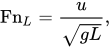
- ^ The Froude number of any hull is calculated by where u is the relative flow velocity between the sea and ship, g is in particular the acceleration due to gravity, and L is the length of the ship at the water line level, or Lwl in some notations. It is an important parameter with respect to the ship's drag, or resistance, especially in terms of wave making resistance.
- ^ J.W., Park; J.J., Kim; D.S., Kong (2001), Wu, You-Sheng; Zhou, Guo-Jun; Cui, Wei-Cheng (eds.), Numerical computation of ship's effective wake and its validation in large cavitation tunnel, Practical Design of Ships and Other Floating Structures: Eighth International Symposium - PRADS 2001, vol. 1, Elsevier, p. 1422, ISBN 9780080539355
- ^ Instructors. "Resistance and powering of ships" (PDF). US Naval Academy. pp. 7–9. Archived (PDF) from the original on 2020-04-08. Retrieved 2019-03-09.
- ^ Randy Thomas (June 1985). "Multihulls Discovered: Part 1: Their origins, myths, magic, mana... and caveats that go along with these craft that have evolved from ancient heritage". Yachting. pp. 84–87. Retrieved January 7, 2015.
- ^ L. Francis Herreshoff. "The Spirit of the Times, November 24, 1877 (reprint)". Marine Publishing Co., Camden, Maine. Archived from the original on 2008-01-24.
- ^ Jim Howard; Charles J. Doane (2000). Handbook of offshore cruising: The Dream and Reality of Modern Ocean Cruising. Sheridan House. ISBN 9781574090932.
- ^ "Sailor's Multihull Guide" - 3rd edition
References and Bibliography
[edit]- Jim Howard, Charles J. Doane (2000). Handbook of offshore cruising: The Dream and Reality of Modern Ocean Cruising. Sheridan House, Inc. p. 280. ISBN 1-57409-093-3.
- C. A. Marchaj (2000). Aero-Hydrodynamics of Sailing. Tiller Publishing. ISBN 1-888671-18-1.
- C. A. Marchaj. Sail Performance. McGraw Hill. p. 400. ISBN 0-07-141310-3.[permanent dead link]
- C. A. Marchaj. Seaworthiness:The Forgotten Factor. Tiller Publishing. p. 372. ISBN 1-888671-09-2.[permanent dead link]
- Gavin le Sueur. Multihull Seamanship. Fernhurst books. p. 148. ISBN 9781912177080.
- Harvey, Derek, Multihulls for Cruising and Racing, Adlard Coles, London 1990, ISBN 0-7136-6414-2
External links
[edit]
- The Multihull Offshore Cruising & Racing Association
- The UK Catamaran Racing Association
- The Multihull Yacht Club of Queensland (Australia) Archived 2011-07-26 at the Wayback Machine
- Multihull Boatbuilding Information / Community
- Articles and news on multihulls, profiles of boats, designers, yards, etc. Archived 2005-12-13 at the Wayback Machine
- Multihulls designer & builder Archived 2013-10-18 at the Wayback Machine
- International Sailing Federation Archived 2017-05-07 at the Wayback Machine
- The multihulls reference magazine
- The multihulls reference magazine (Australia) Archived 2013-05-24 at the Wayback Machine


| |||||||||||||||||||||||||||||||||||||||||
| |||||||||||||||||||||||||||||||||||||||||
| |||||||||||||||||||||||||||||||||||||||||
| |||||||||||||||||||||||||||||||||||||||||
| |||||||||||||||||||||||||||||||||||||||||
| |||||||||||||||||||||||||||||||||||||||||
| |||||||||||||||||||||||||||||||||||||||||


Multihull
View on GrokipediaOverview
Definition and Basic Principles
A multihull is a watercraft featuring two or more parallel hulls connected by a rigid frame or bridging structure, which provides inherent transverse stability primarily through the wide separation of the hulls rather than relying on ballast weight.[5] This design contrasts with traditional monohulls by distributing buoyancy across multiple slender hulls, enabling reduced hydrodynamic resistance while maintaining equilibrium.[6] The basic principles of multihull stability center on transverse stability derived from the geometry of hull separation, which generates a righting moment to counteract heeling forces such as wind or waves.[7] This stability is quantified by the metacentric height (GM), calculated as the difference between the height of the metacenter (KM) above the keel and the height of the center of gravity (KG) above the keel:A positive GM indicates that the vessel will return to an upright position after small disturbances, with multihulls typically exhibiting higher initial GM values due to their beam width, resulting in reduced heeling angles compared to monohulls.[8] Multihulls thus experience less pronounced rolling, enhancing passenger comfort and operational efficiency in moderate conditions.[7] Key components of a multihull include the crossbeams, often termed akas in traditional designs, which serve as the primary bridging structures to connect the hulls and transfer loads such as heeling moments and torsional forces between them.[9] In configurations like outriggers or trimarans, the central hull is known as the vaka, while the outer hulls or floats are amas, with the akas providing the structural linkage to ensure overall integrity.[10] In comparison to monohulls, multihulls emphasize form stability—achieved through the physical separation and buoyancy distribution of the hulls—over weight-based stability from keels or ballast, allowing for lighter construction and shallower draft without compromising initial uprightness.[6] This form-dependent approach minimizes the need for heavy internal weighting, though it requires careful engineering of the bridging elements to handle dynamic loads effectively.[9]