Hubbry Logo
Extended real number lineExtended real number lineMain
Open search
Extended real number line
Community hub
Extended real number line
logo
8 pages, 0 posts
0 subscribers
Be the first to start a discussion here.
Extended real number line
from Wikipedia
Extended real numbers (top) vs projectively extended real numbers (bottom)

In mathematics, the extended real number system[a] is obtained from the real number system by adding two elements denoted and [b] that are respectively greater and lower than every real number. This allows for treating the potential infinities of infinitely increasing sequences and infinitely decreasing series as actual infinities. For example, the infinite sequence of the natural numbers increases infinitively and has no upper bound in the real number system (a potential infinity); in the extended real number line, the sequence has as its least upper bound and as its limit (an actual infinity). In calculus and mathematical analysis, the use of and as actual limits extends significantly the possible computations.[1] It is the Dedekind–MacNeille completion of the real numbers.

The extended real number system is denoted , , or .[2] When the meaning is clear from context, the symbol is often written simply as .[2]

There is also a distinct projectively extended real line where and are not distinguished, i.e., there is a single actual infinity for both infinitely increasing sequences and infinitely decreasing sequences that is denoted as just or as .

Motivation

[edit]

Limits

[edit]

The extended number line is often useful to describe the behavior of a function when either the argument or the function value gets "infinitely large" in some sense. For example, consider the function defined by

.

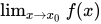
The graph of this function has a horizontal asymptote at . Geometrically, when moving increasingly farther to the right along the -axis, the value of approaches 0. This limiting behavior is similar to the limit of a function in which the real number approaches except that there is no real number that approaches when increases infinitely. Adjoining the elements and to enables a definition of "limits at infinity" which is very similar to the usual definition of limits, except that is replaced by (for ) or (for ). This allows proving and writing

Measure and integration

[edit]

In measure theory, it is often useful to allow sets that have infinite measure and integrals whose value may be infinite.

Such measures arise naturally out of calculus. For example, in assigning a measure to that agrees with the usual length of intervals, this measure must be larger than any finite real number. Also, when considering improper integrals, such as

the value "infinity" arises. Finally, it is often useful to consider the limit of a sequence of functions, such as

.

Without allowing functions to take on infinite values, such essential results as the monotone convergence theorem and the dominated convergence theorem would not make sense.

Order and topological properties

[edit]

The extended real number system , defined as or , can be turned into a totally ordered set by defining for all . With this order topology, has the desirable property of compactness: Every subset of has a supremum and an infimum[2] (the infimum of the empty set is , and its supremum is ). Moreover, with this topology, is homeomorphic to the unit interval . Thus the topology is metrizable, corresponding (for a given homeomorphism) to the ordinary metric on this interval. There is no metric, however, that is an extension of the ordinary metric on .

In this topology, a set is a neighborhood of if and only if it contains a set for some real number . The notion of the neighborhood of can be defined similarly. Using this characterization of extended-real neighborhoods, limits with tending to or , and limits "equal" to and , reduce to the general topological definition of limits—instead of having a special definition in the real number system.

Arithmetic operations

[edit]

The arithmetic operations of can be partially extended to as follows:[3]

For exponentiation, see Exponentiation § Limits of powers. Here, means both and , while means both and .

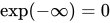
The expressions , , and (called indeterminate forms) are usually left undefined. These rules are modeled on the laws for infinite limits. However, in the context of probability or measure theory, is often defined as 0.[4]

When dealing with both positive and negative extended real numbers, the expression is usually left undefined, because, although it is true that for every real nonzero sequence that converges to 0, the reciprocal sequence is eventually contained in every neighborhood of , it is not true that the sequence must itself converge to either or Said another way, if a continuous function achieves a zero at a certain value then it need not be the case that tends to either or in the limit as tends to . This is the case for the limits of the identity function when tends to 0, and of (for the latter function, neither nor is a limit of , even if only positive values of are considered).

However, in contexts where only non-negative values are considered, it is often convenient to define . For example, when working with power series, the radius of convergence of a power series with coefficients is often defined as the reciprocal of the limit-supremum of the sequence . Thus, if one allows to take the value , then one can use this formula regardless of whether the limit-supremum is 0 or not.

Algebraic properties

[edit]

With the arithmetic operations defined above, is not even a semigroup, let alone a group, a ring or a field as in the case of . However, it has several convenient properties:

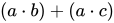
  • and are either equal or both undefined.
  • and are either equal or both undefined.
  • and are either equal or both undefined.
  • and are either equal or both undefined
  • and are equal if both are defined.
  • If and if both and are defined, then .
  • If and and if both and are defined, then .

In general, all laws of arithmetic are valid in as long as all occurring expressions are defined.

Miscellaneous

[edit]

Several functions can be continuously extended to by taking limits. For instance, one may define the extremal points of the following functions as:

,
,
,
.

Some singularities may additionally be removed. For example, the function can be continuously extended to (under some definitions of continuity), by setting the value to for , and 0 for and . On the other hand, the function cannot be continuously extended, because the function approaches as approaches 0 from below, and as approaches 0 from above, i.e., the function not converging to the same value as its independent variable approaching to the same domain element from both the positive and negative value sides.

A similar but different real-line system, the projectively extended real line, does not distinguish between and (i.e. infinity is unsigned).[4] As a result, a function may have limit on the projectively extended real line, while in the extended real number system only the absolute value of the function has a limit, e.g. in the case of the function at . On the other hand, on the projectively extended real line, and correspond to only a limit from the right and one from the left, respectively, with the full limit only existing when the two are equal. Thus, the functions and cannot be made continuous at on the projectively extended real line.

See also

[edit]

Notes

[edit]

References

[edit]

Further reading

[edit]
Revisions and contributorsEdit on WikipediaRead on Wikipedia
from Grokipedia
The extended real number line, denoted R\overline{\mathbb{R}} or [,+][-\infty, +\infty], is the real number system R\mathbb{R} augmented by two additional elements: ++\infty (positive ) and -\infty (negative ). This construction extends the standard real line to handle limits and bounds that approach , forming a linearly ordered set where <x<+-\infty < x < +\infty for every real number xRx \in \mathbb{R}. The order is total and complete, ensuring every nonempty subset has a least upper bound (supremum) and greatest lower bound (infimum), which may be infinite. Topologically, R\overline{\mathbb{R}} is the two-point compactification of R\mathbb{R}, homeomorphic to the closed interval [1,1][-1, 1], with neighborhoods of ±\pm\infty defined as rays like (a,+](a, +\infty] and [,b)[-\infty, b). Arithmetic operations are partially defined: addition and multiplication extend naturally (e.g., x+(+)=+x + (+\infty) = +\infty for finite xx, and x(+)=+x \cdot (+\infty) = +\infty if x>0x > 0), but indeterminate forms like \infty - \infty or 00 \cdot \infty remain undefined to preserve consistency. This partial algebra avoids contradictions while enabling rigorous treatment of extended operations in . In mathematics, the extended real line is fundamental in for studying convergence of sequences and functions via limits superior and inferior (limsup and liminf), which always exist in R\overline{\mathbb{R}}. It underpins measure theory, where integrals can take infinite values, and optimization problems, such as finding maxima over unbounded domains. Additionally, it serves as a in and appears in applications like and topological semigroups, providing a compact framework for infinite processes without algebraic closure.

Definition and Notation

Formal Construction

The extended real number line, commonly denoted R\overline{\mathbb{R}}, is formally defined as the set R=[R](/page/R){,+}\overline{\mathbb{R}} = [\mathbb{R}](/page/R) \cup \{-\infty, +\infty\}, where R\mathbb{R} denotes the set of real numbers and -\infty, ++\infty are two distinct symbolic elements adjoined to R\mathbb{R}. These infinities are treated as distinct points that are not identified with each other or with any element of R\mathbb{R}, serving as idealized representations of unbounded behavior in the positive and negative directions, respectively. The primary method of construction is this direct set-theoretic union, which augments numbers without altering their internal . Alternative formalizations exist, such as extending the of R\mathbb{R} from by incorporating improper cuts (where the lower set is empty for ++\infty or the upper set is empty for -\infty), or topologically adjoining two points at to the real line to form the two-point compactification; however, the union provides the essential set-theoretic foundation. With this set in place, R\overline{\mathbb{R}} is endowed with a linear order by preserving the standard order relation << on R\mathbb{R} and extending it via the rules x<+x < +\infty for all xR{}x \in \mathbb{R} \cup \{-\infty\} and <x-\infty < x for all xR{+}x \in \mathbb{R} \cup \{+\infty\}, with <+-\infty < +\infty. This ordering ensures that R\overline{\mathbb{R}} is totally ordered and complete in the sense that every nonempty subset has a least upper bound (supremum) within R\overline{\mathbb{R}}.

Common Notations and Symbols

The extended real number line is commonly denoted by R\overline{\mathbb{R}}, which represents the union of the real numbers R\mathbb{R} with the two additional elements ++\infty and -\infty. This notation emphasizes the closure or completion of the real line, as introduced in formal constructions. Alternative symbols include [,][-\infty, \infty], which highlights the ordered interval structure, or R\mathbb{R}_\infty in some contexts to indicate the affine extension. The infinite elements are typically symbolized as ++\infty for positive infinity and -\infty for negative infinity, with the signed forms preferred to distinguish direction in ordered contexts. The shorthand ±\pm \infty is occasionally used when referring collectively to both, but explicit signs like ++\infty and -\infty are recommended to prevent ambiguity, especially in expressions involving limits or arithmetic. In some texts, \infty alone denotes positive infinity by convention, though this can lead to confusion and is less common in precise work. In the context of limits, standard conventions express divergence to infinity using these symbols, such as limxaf(x)=+\lim_{x \to a} f(x) = +\infty to indicate the function approaches positive infinity as xx nears aa. Similarly, limx+f(x)=\lim_{x \to +\infty} f(x) = -\infty denotes approach to negative infinity. These notations extend classical limit definitions without altering the underlying topology. Notational variations appear across mathematical literature; for instance, R^\hat{\mathbb{R}} sometimes denotes the extended line, though it more frequently refers to the projectively extended version with a single infinity. Another variant is R\mathbb{R}^*, but this is often reserved for nonzero reals, so care is needed to avoid overlap. For typesetting, especially in LaTeX, the infinity symbol is rendered as \infty, with superscripts for signs: ++\infty and -\infty, ensuring upright orientation and proper spacing to distinguish from variables. This avoids confusion with the unsigned complex infinity, which is typically just \infty in the , lacking directional distinction.

Motivations and Applications

Role in Limits and Convergence

In the standard real number system, limits such as limx0+1x\lim_{x \to 0^+} \frac{1}{x} cannot be assigned a finite value, as the expression grows arbitrarily large without bound, leading to a declaration of divergence rather than convergence. The extended real number line R=R{,+}\overline{\mathbb{R}} = \mathbb{R} \cup \{-\infty, +\infty\} addresses this limitation by incorporating the points ++\infty and -\infty, permitting the assignment limx0+1x=+\lim_{x \to 0^+} \frac{1}{x} = +\infty. This extension facilitates a unified treatment of sequences and functions, where behaviors previously classified as divergent to infinity are now regarded as convergent within R\overline{\mathbb{R}}. A key example is the monotone convergence theorem for sequences. An increasing sequence of real numbers that is bounded above converges to its supremum in R\mathbb{R}; however, in R\overline{\mathbb{R}}, if the sequence is unbounded above, it converges to ++\infty. Similarly, a decreasing sequence bounded below converges to its infimum, while an unbounded below decreasing sequence converges to -\infty. This ensures every monotone sequence in R\overline{\mathbb{R}} converges to an element of the extended line. Convergence in R\overline{\mathbb{R}} is defined topologically: a sequence (xn)(x_n) converges to LRL \in \overline{\mathbb{R}} if, for every neighborhood UU of LL, there exists NNN \in \mathbb{N} such that xnUx_n \in U for all n>Nn > N. Neighborhoods of finite points LRL \in \mathbb{R} are the standard open intervals (Lϵ,L+ϵ)(L - \epsilon, L + \epsilon) for ϵ>0\epsilon > 0, while neighborhoods of ++\infty take the form (a,+](a, +\infty] for aRa \in \mathbb{R}, and those of -\infty are [,b)[-\infty, b) for bRb \in \mathbb{R}. This topological structure, induced by a homeomorphism to the compact interval [1,1][-1, 1], aligns with the order on R\overline{\mathbb{R}} and supports the extended monotone convergence results.

Applications in Measure Theory and Integration

In measure theory, the extended real number line is essential for defining measures that may attain infinite values, such as the on the entire real line R\mathbb{R}, which has measure ++\infty. This extension allows the to be defined on all subsets of R\mathbb{R} with values in [0,+][0, +\infty], accommodating unbounded sets whose "size" exceeds any finite bound. For instance, the λ(R)=+\lambda(\mathbb{R}) = +\infty, enabling the theory to handle infinite total length without collapsing to undefined states. In Lebesgue integration, the of a non-negative f:X[0,+]f: X \to [0, +\infty] with respect to a measure μ\mu is defined as fdμ=sup{hdμ:0hf,h simple}\int f \, d\mu = \sup \{ \int h \, d\mu : 0 \leq h \leq f, \, h \text{ simple} \}, taking values in [0,+][0, +\infty]. This formulation naturally incorporates improper s that diverge, such as 011xdx=+\int_0^1 \frac{1}{x} \, dx = +\infty under the on [0,1][0,1], where the singularity at x=0x=0 leads to infinite area. The extended range ensures that integration remains well-defined even when functions or domains yield unbounded contributions, preserving the additivity and monotonicity properties of the . The exemplifies the role of the extended real line: if {fn}n=1\{f_n\}_{n=1}^\infty is a of non-negative measurable functions with fnff_n \uparrow f pointwise, where f:X[0,+]f: X \to [0, +\infty], then fndμfdμ\int f_n \, d\mu \uparrow \int f \, d\mu, allowing the limit integral to be ++\infty if the supremum diverges. This theorem facilitates passing limits inside for increasing , crucial for approximating via simple functions or partial sums. Similarly, states that for non-negative measurable fnf_n, lim infnfndμlim infnfndμ\int \liminf_{n \to \infty} f_n \, d\mu \leq \liminf_{n \to \infty} \int f_n \, d\mu, with all terms in [0,+][0, +\infty], providing a lower bound that holds even when are infinite. The extends to the extended reals when fng|f_n| \leq g with gdμ<+\int g \, d\mu < +\infty: if fnff_n \to f almost everywhere, then fndμfdμ\int f_n \, d\mu \to \int f \, d\mu, where ff may take infinite values on sets of measure zero, ensuring convergence in the extended sense without requiring finite bounds on the limit. These results underpin much of real analysis by allowing infinite quantities while maintaining rigorous inequalities and limits.

Uses in Optimization and Other Fields

In optimization, the extended real number line facilitates the formulation of extended-real-valued functions, where the objective function takes the value ++\infty at infeasible points outside the constraint set, enabling a unified treatment of constrained problems as unconstrained minimizations over R\overline{\mathbb{R}}. This approach is particularly useful in convex optimization, as it allows the epigraph of the function to incorporate infinite values naturally. In linear programming, if the feasible region is unbounded in the direction that improves the objective (e.g., minimizing cxc^\top x subject to AxbAx \geq b with an unbounded ray where cd<0c^\top d < 0), the optimal value is -\infty, signaling an unbounded problem. In probability theory, the extended real number line accommodates expectations that diverge for heavy-tailed distributions, where the mean is assigned ++\infty or -\infty rather than being undefined. For instance, the Pareto distribution with shape parameter α<1\alpha < 1 and scale xm>0x_m > 0 has f(x)=αxmαxα1f(x) = \alpha x_m^\alpha x^{-\alpha-1} for xxmx \geq x_m, and its expectation E[X]=+\mathbb{E}[X] = +\infty. This formalization aids in analyzing risk measures and tail behaviors without requiring ad hoc adjustments for divergence. The extended real number line provides a two-point compactification of R\mathbb{R} by adjoining ++\infty and -\infty, yielding a compact ordered space homeomorphic to [1,1][-1,1] under the , which is instrumental in studying convergence and boundedness in non-compact settings. This structure is applied in to examine filters and ultrafilters converging to , as well as in the of non-compact manifolds, where analogous end compactifications model asymptotic at spatial boundaries. In , the extended real line supports utility representations for preference orderings on unbounded domains, allowing utility functions to take values in R\overline{\mathbb{R}} for orders with open gaps, as in Debreu-like embeddings that preserve ordinal properties. In physics, it formalizes diverging quantities such as energy functionals in ; for example, the Lieb variation principle for density functionals assigns ++\infty to invalid states, ensuring the ground-state energy lies in R\overline{\mathbb{R}}.

Order and Topological Structure

Extension of the Order Relation

The order relation on the real numbers R\mathbb{R} is extended to the extended real number line R=R{,+}\overline{\mathbb{R}} = \mathbb{R} \cup \{-\infty, +\infty\} by defining <x<+-\infty < x < +\infty for all xRx \in \mathbb{R}, and <+-\infty < +\infty, while preserving the standard order on R\mathbb{R}. This extension ensures that the relation << remains a strict total order on R\overline{\mathbb{R}}, with the additional conventions that \infty \not< \infty and -\infty \not> -\infty. The trichotomy property holds: for any x,yRx, y \in \overline{\mathbb{R}}, exactly one of x<yx < y, x=yx = y, or x>yx > y is true. Transitivity is preserved, so if xyx \leq y and yzy \leq z, then xzx \leq z, and totality ensures that for any x,yx, y, either xyx \leq y or yxy \leq x. These properties directly extend those of R\mathbb{R}, making R\overline{\mathbb{R}} a totally ordered set. While R\mathbb{R} is Dedekind-complete—every nonempty subset bounded above in R\mathbb{R} has a least upper bound in R\mathbb{R}—unbounded subsets lack suprema there. In R\overline{\mathbb{R}}, every nonempty subset has a supremum (and infimum) in R\overline{\mathbb{R}}, achieving full order completeness as a complete lattice. For instance, the set of natural numbers, unbounded above in R\mathbb{R}, has supremum ++\infty in R\overline{\mathbb{R}}. Similarly, every non-empty subset has an infimum, rendering R\overline{\mathbb{R}} a complete lattice under the order, where the meet (infimum) and join (supremum) exist for any subset. For any two elements, such as inf(+,a)=a\inf(+\infty, a) = a for aRa \in \overline{\mathbb{R}}, these operations are well-defined and compatible with the order.

Topological Properties and Compactification

The order topology on the extended real number line R=R{,+}\overline{\mathbb{R}} = \mathbb{R} \cup \{-\infty, +\infty\} is induced by its total order, where <x<+-\infty < x < +\infty for all xRx \in \mathbb{R}. The subbasis for this topology consists of all left-unbounded open rays (,b)(-\infty, b) for bRb \in \overline{\mathbb{R}} and all right-unbounded open rays (a,+)(a, +\infty) for aRa \in \overline{\mathbb{R}}, with the conventions that (,+)=R(-\infty, +\infty) = \overline{\mathbb{R}}, (a,+)=(a,+](a, +\infty) = (a, +\infty] if aRa \in \mathbb{R}, and similarly (,b)=[,b)(-\infty, b) = [-\infty, b) if bRb \in \mathbb{R}. A basis for the topology is then given by finite intersections of these subbasis elements, yielding open intervals (c,d)(c, d) for c,dRc, d \in \mathbb{R} with c<dc < d, right rays (a,+](a, +\infty] for aRa \in \mathbb{R}, and left rays [,b)[-\infty, b) for bRb \in \mathbb{R}. This structure ensures that basic open neighborhoods of finite points xRx \in \mathbb{R} are the usual open intervals (xϵ,x+ϵ)(x - \epsilon, x + \epsilon) for ϵ>0\epsilon > 0, while neighborhoods of ++\infty (resp., -\infty) contain some ray (a,+](a, +\infty] (resp., [,b)[-\infty, b)) for sufficiently large aa (resp., small bb). The resulting topological space is Hausdorff, as distinct points can be separated by disjoint open sets: for example, to separate a finite xRx \in \mathbb{R} from ++\infty, take (x1,x+1)(x - 1, x + 1) and (x+2,+](x + 2, +\infty]. It is also metrizable, with a compatible metric given by d(u,v)=u1+uv1+vd(u, v) = \left| \frac{u}{1 + |u|} - \frac{v}{1 + |v|} \right|
Add your contribution
Related Hubs
User Avatar
No comments yet.