


Community hub
Recent from talks
Contribute something
Nothing was collected or created yet.
Division by infinity
View on Wikipedia


In mathematics, division by infinity is division where the divisor (denominator) is infinity. In ordinary arithmetic, this does not have a well-defined meaning, since ∞ is a mathematical concept that does not correspond to a specific number, and moreover, there is no nonzero real number that, when added to itself an infinite number of times, gives a finite number, unless you address the concept of indeterminate forms. However, "dividing by ∞" can be given meaning as an informal way of expressing the limit of dividing a number by larger and larger divisors.[1]: 201–204
Using mathematical structures that go beyond the real numbers, it is possible to define numbers that have infinite magnitude yet can still be manipulated in ways much like ordinary arithmetic. For example, on the extended real number line, dividing any real number by infinity yields zero,[2] while in the surreal number system, dividing 1 by the infinite number yields the infinitesimal number .[3][4]: 12 In floating-point arithmetic, any finite number divided by is equal to positive or negative zero if the numerator is finite. Otherwise, the result is NaN.


The challenges of providing a rigorous meaning of "division by infinity" are analogous to those of defining division by zero.
Use in technology
[edit]
As infinity is difficult to deal with for most calculators and computers, many do not have a formal way of computing division by infinity.[5][6] Calculators such as the TI-84 and most household calculators do not have an infinity button so it is impossible to type into the calculator 'x divided by infinity' so instead users can type a large number such as "1e99" () or "-1e99". By typing in some number divided by a sufficiently large number the output will be 0. In some cases this fails as there is either an overflow error or if the numerator is also a sufficiently large number then the output may be 1 or a real number. In the Wolfram language, dividing an integer by infinity will result in the result 0.[7] Also, in some calculators such as the TI-Nspire, 1 divided by infinity can be evaluated as 0.

Use in calculus
[edit]Integration
[edit]In calculus, taking the integral of a function is defined finding the area under a curve. This can be done simply by breaking up this area into rectangular sections and taking the sum of these sections. These are called Riemann sums. As the sections get narrower, the Riemann sum becomes an increasingly accurate approximation of the true area. Taking the limit of these Riemann sums, in which the sections can be heuristically regarded as "infinitely thin", gives the definite integral of the function over the prescribed interval. Conceptually this results in dividing the interval by infinity to result in infinitely small pieces.[1]: 255–259
On a different note when taking an integral where one of the boundaries is infinity this is defined as an improper integral.[8] To determine this one would take the limit as a variable a approaches infinity substituting a in for the infinity sign. This would then allow the integral to be evaluated and then the limit would be taken. In many cases evaluating this would result in a term being divided by infinity. In this case in order to evaluate the integral one would assume this to be zero. This allows for the integral to be assumed to converge meaning a finite answer can be determined from the integral using this assumption.[8]
L'Hôpital's rule
[edit]When given a ratio between two functions, the limit of this ratio can be evaluated by computing the limit of each function separately. Where the limit of the function in the denominator is infinity, and the numerator does not allow the ratio to be well determined, the limit of the ratio is said to be of indeterminate form.[9] An example of this is:

Using L'Hôpital's rule to evaluate limits of fractions where the denominator tends towards infinity can produce results other than 0.
If

then
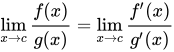
So if

then
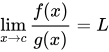
This means that, when using limits to give meaning to division by infinity, the result of "dividing by infinity" does not always equal 0.
References
[edit]- ^ a b Cheng, Eugenia (2018). Beyond Infinity: An Expedition to the Outer Limits of Mathematics. Basic Books. ISBN 9781541644137. OCLC 1003309980.
- ^ Hansen, Eldon R.; Walster, G. William (2004). Global Optimization using Interval Analysis (2nd ed.). New York: Marcel Dekker. p. 57. ISBN 0-8247-5870-6. OCLC 55013079.
- ^ Knuth, Donald Ervin (1974). Surreal Numbers: How two ex-students turned on to pure mathematics and found total happiness. Boston, Mass.: Addison-Wesley. p. 109. ISBN 978-0-201-03812-5. OCLC 1194979.
- ^ Conway, John H. (2001). On Numbers and Games (2nd ed.). A K Peters. ISBN 1-56881-127-6.
- ^ Zhang, Yin (1998). "Solving large-scale linear programs by interior-point methods under the Matlab ∗ Environment †". Optimization Methods and Software. 10 (1): 1–31. doi:10.1080/10556789808805699. ISSN 1055-6788.
- ^ Maniatakos, M.; Kudva, P.; Fleischer, B. M.; Makris, Y. (2013). "Low-Cost Concurrent Error Detection for Floating-Point Unit (FPU) Controllers". IEEE Transactions on Computers. 62 (7): 1376–1388. doi:10.1109/TC.2012.81. ISSN 0018-9340. S2CID 1300358.
- ^ "Wolfram|Alpha: Making the world's knowledge computable". www.wolframalpha.com. Retrieved 2018-10-30.
- ^ a b Introduction to improper integrals, retrieved 2018-10-30
- ^ Menz, Petra; Mulberry, Nicola (July 13, 2020). "Indeterminate Form & L'Hôpital's Rule". Calculus Early Transcendentals: Differential & Multi-Variable Calculus for Social Sciences. Simon Fraser University. Retrieved 2022-08-10.
- ^ "IMOmath: L'Hopital's Theorem". www.imomath.com. Retrieved 2018-11-29.
External links
[edit]Division by infinity
View on GrokipediaInformal Understanding
Heuristic Interpretation
In mathematics, the heuristic interpretation of division by infinity conceptualizes infinity as an extraordinarily large quantity, such that dividing any finite number by it results in zero. Formally expressed as and more generally for any finite , this shorthand simplifies reasoning about expressions where the denominator increases without bound, effectively treating the result as vanishingly small.[5] This intuitive device aids in grasping behaviors like the reciprocal of a growing quantity approaching zero, without invoking rigorous analysis. Such heuristics prove valuable for rapid approximations in practical contexts, enabling quick insights into asymptotic trends while acknowledging their non-rigorous nature. In contrast to division by zero, which remains undefined due to its potential to produce contradictory outcomes, division by infinity consistently yields zero, offering an opposite behavioral analogy that reinforces its utility for estimating negligible contributions from unbounded growth.[5] Everyday reasoning often employs this concept in physics, where non-relativistic approximations treat the speed of light as infinite, implying that the time to traverse a finite distance is zero since time equals distance divided by speed, or . This simplification facilitates initial models in classical mechanics but highlights the need for formal methods to capture precise dynamics. The relation to limits provides a rigorous framework for refining these intuitions.Historical Context and Misconceptions
The concept of infinity in mathematics traces its origins to ancient Greek philosophers, particularly Zeno of Elea in the 5th century BCE, whose paradoxes, such as the Dichotomy and Achilles and the Tortoise, challenged the notion of infinite divisibility by arguing that motion through space requires traversing infinitely many points, leading to apparent contradictions.[6] Aristotle, in the 4th century BCE, distinguished between potential infinity—endless processes without completion—and actual infinity, which he deemed philosophically problematic and unnecessary for mathematics, influencing Greek avoidance of direct infinite operations.[6] By the 17th century, Isaac Newton and Gottfried Wilhelm Leibniz independently developed calculus using informal notions of infinity: Newton's "fluxions" treated rates of change as limits of infinitely small increments (moments), while Leibniz employed differentials as infinitesimals in divisions, such as , neglecting higher-order infinitesimal terms to derive results intuitively.[7] These approaches heuristically divided by infinitesimal quantities approaching zero, akin to division by infinity yielding finite outcomes, but lacked rigorous justification, drawing criticism from contemporaries like George Berkeley for relying on "ghosts of departed quantities."[7] In the 18th century, Leonhard Euler advanced the informal treatment of infinity in his work on infinite series, explicitly manipulating as if it were a large number; for instance, he summed the divergent geometric series to -1 by applying the formula at , yielding .[8] Euler's Introductio in analysin infinitorum (1748) frequently invoked heuristically to evaluate sums, enabling breakthroughs like the Basel problem solution but risking inconsistencies in non-convergent cases.[6] The 19th century brought rigorization: Augustin-Louis Cauchy, in Cours d'analyse (1821), defined limits using inequalities to avoid direct infinity manipulations, stating that a function approaches a limit if the difference is less than any assignable quantity, thus formalizing derivatives and integrals without infinitesimals.[9] Karl Weierstrass further refined this in the 1850s–1860s with epsilon-delta proofs, emphasizing uniform convergence and excluding informal infinite operations to resolve paradoxes in series and continuity.[9] Common misconceptions about division by infinity persist, often stemming from treating as a regular number, leading to errors like assuming is determinate or that any finite number divided by always equals zero, ignoring cases where the numerator grows proportionally (e.g., forms in limits).[10] For example, in probability, flawed arguments claim the probability of an infinite sequence event is zero by dividing by , overlooking that infinite sample spaces require careful measure theory; similarly, in geometry, dividing a finite area by infinite perimeter subdivisions incorrectly suggests zero density.[11] These errors arise from conflating potential and actual infinity, where students view as a static endpoint rather than a process, resulting in indeterminate forms mishandled algebraically.[12] Despite formal alternatives like limits, informal uses of division by infinity linger in education, where textbooks and curricula warn against it to prevent conceptual pitfalls, yet introductory explanations often reinforce intuitive but imprecise heuristics.[13] Modern critiques highlight that such persistence fosters misconceptions among teachers and students, who may equate infinity with "very large" numbers, leading to overgeneralizations in calculus; studies recommend emphasizing historical transitions to rigorous methods to build accurate understanding.[14]Mathematical Foundations
Limits and Asymptotic Behavior
In mathematical analysis, the concept of division by infinity is formalized through limits at infinity, particularly for quotients of functions. Consider two functions and where as . The limit describes the asymptotic behavior of the ratio. If remains bounded, this limit equals 0, intuitively interpreting .[15][16] The formal definition adapts the epsilon-delta framework for infinity. Specifically, if, for every , there exists such that for all , . When , this captures the notion that becomes negligible relative to as grows unbounded.[17][18] Asymptotic notation provides a concise way to express these behaviors. The little-o notation states that as if , meaning grows strictly slower than . In contrast, big-O notation holds if , allowing to grow at most as fast as , while big-Theta holds if and , or equivalently, there exist positive constants , and such that for all . These notations, introduced by Paul Bachmann in 1894 and popularized by Donald Knuth, formalize growth comparisons essential for analyzing algorithms and functions.[19][20][21] A key theorem for positive functions and with states: if , then grows slower than , in the sense that for any and sufficiently large . This directly formalizes "division by infinity" as yielding zero when the numerator grows sublinearly relative to the denominator.[22][23] Representative examples illustrate these ideas. For the bounded oscillatory function, because while , so the ratio vanishes. For polynomials and of degrees and respectively with , , as the leading term of dominates.[24][15] A proof sketch for the basic case where and uses the adapted epsilon-delta definition. Given , by the limit definition, there exists such that for , , implying . For the polynomial example, divide by the leading terms: since .[17][16]Extended Real Number System
The extended real number system, often denoted or , is constructed by augmenting the set of real numbers with two additional elements: and , resulting in .[25] These infinite elements are not real numbers but symbolic adjoins that represent unbounded behavior, and the system is equipped with the order topology, which forms a two-point compactification of the real line.[25] In this topology, neighborhoods of consist of sets like for finite , and similarly for with where is finite, ensuring the space is compact and Hausdorff.[25] The order on extends the usual total order on by stipulating for all , with . This ordered set is a complete lattice, meaning every non-empty subset has a supremum (least upper bound) and infimum (greatest lower bound) in ; for instance, if a bounded subset has no upper bound in , then , and the empty set has .[26][27] Such completeness properties preserve the Dedekind completeness of while handling unbounded sets naturally.[26] Arithmetic operations in are partially defined to extend real arithmetic continuously where possible. For any finite , division by infinity yields and , reflecting the intuitive limit behavior as denominators grow unbounded.[25] However, operations involving infinities are indeterminate in cases like , , or , which remain undefined to avoid inconsistencies.[25] Addition follows rules such as for finite , but is undefined.[26] In mathematical analysis, facilitates the definition of improper integrals over unbounded domains or with unbounded integrands. For a non-negative measurable function , the improper integral is defined as , which may equal if the supremum is unbounded. This construction leverages the suprema property to rigorously assign infinite values to divergent integrals without relying solely on limits. Despite its utility, is not a field because certain operations, such as , remain undefined, preventing closure under subtraction and division in all cases.[25] Treating infinities as ordinary numbers leads to inconsistencies; for example, assuming would contradict the indeterminate form, as sequences approaching infinity differently yield varying results.[25] Thus, the structure is a partially ordered algebraic system rather than a complete ring or field, requiring careful specification of defined operations in applications.[25]Applications in Calculus
Indeterminate Forms and Limits
In calculus, indeterminate forms arise when evaluating limits where direct substitution yields expressions that do not provide a definitive value, such as , , , , , , and . These forms occur because the behaviors of the numerator and denominator (or other components) are both unbounded or zero, making "division by infinity" conceptually ambiguous without further analysis. For instance, the form frequently appears in limits as , where both terms grow without bound, requiring resolution to determine if the limit is finite, infinite, or nonexistent.[28] To resolve these indeterminate forms, algebraic manipulation techniques are employed, such as dividing numerator and denominator by the highest power of the variable or factoring dominant terms. For example, consider ; rewriting gives , as the linear term dominates. In contrast, for slower growth relative to exponentials, , since exponential growth outpaces linear, verifiable by recognizing the rapid increase of . Substitution, such as letting to transform the limit as to , can also simplify expressions, though care is needed to avoid introducing new indeterminacies.[29][28] Series expansions provide another method to approximate and evaluate indeterminate forms near infinity, often by substituting to convert the limit to one at zero, where Taylor series apply. For instance, the asymptotic expansion of functions like or around allows term-by-term analysis to identify leading behaviors in the original limit. Laurent series, extended to the neighborhood of infinity in complex analysis, similarly reveal dominant terms for meromorphic functions at large , aiding in real-variable limits by providing power series in . This approach is particularly useful for transcendental functions where algebraic simplification alone is insufficient.[30] Specific examples illustrate these techniques: via simplification, highlighting polynomial growth comparison where higher degrees dominate. Another is ; substitute with , yielding , as linear growth is asymptotically negligible compared to exponential. These resolutions depend on established growth hierarchies, such as logarithms growing slower than any positive power of .[31][29] In optimization, evaluating such limits determines asymptotic dominance, where one function overshadows others for large arguments, simplifying objective functions or constraint analyses. For example, identifying that polynomials dominate logarithms ( for ) allows focusing on leading terms in asymptotic approximations, crucial for bounding error in algorithms or scaling behaviors in large-scale problems. This dominance order—logarithmic < power < exponential—guides efficient computation of minima or maxima at infinity.[32]Integration by Parts and Residues
Improper integrals arise when evaluating the area under a curve over an unbounded domain, such as , where the infinite upper limit can be interpreted as dividing the accumulated area by an infinitely extending width, yet yielding a finite value under suitable conditions.[33] For instance, the integral demonstrates this, as the exponential decay ensures the limit exists despite the infinite interval.[33] Integration by parts extends to these infinite domains via the formula , adapted as , where the boundary term at must approach zero to formalize the "division by infinity" at the endpoint.[34] This condition ensures convergence, allowing techniques from finite intervals to handle asymptotic behavior at infinity.[34] In complex analysis, the residue theorem evaluates integrals over the real line by considering residues at infinity, obtained through the substitution , yielding . For functions meromorphic in the extended plane with appropriate decay, the principal value integral satisfies , treating the point at infinity as a pole.[35] A classic application is the Gaussian integral, evaluated using residues at infinity on the contour integral of over a wedge-shaped path, confirming .[36] Similarly, the Dirichlet integral is computed via the residue theorem on over a semicircular contour indented at the origin, with the residue at infinity contributing to the result.[37] Convergence of improper integrals over infinite domains requires criteria such as absolute convergence, where implies convergence, versus conditional convergence for oscillatory functions. For p-integrals, converges if and only if , providing a benchmark for tail behavior akin to series tests.L'Hôpital's Rule and Derivatives
L'Hôpital's rule provides a method to evaluate limits of quotients that result in indeterminate forms of type or , particularly relevant when addressing divisions involving infinity through asymptotic behavior as . Formally, suppose and are differentiable functions in a neighborhood of (or on for ), with near , and is of the form or . If , where is a real number, , or , then .[38] This rule extends naturally to limits as by considering the behavior at large values, where the indeterminate form often arises in contexts like polynomial over exponential growth.[39] The rule requires that and be differentiable near , excluding points where , to ensure the derivatives form a valid quotient; if the limit of the derivatives is again indeterminate, the process can be repeated by differentiating numerator and denominator multiple times until a determinate form is obtained.[38] For higher-order applications, if differentiations are needed such that exists and all intermediate forms are indeterminate, then the original limit equals , provided the functions remain sufficiently differentiable.[40] This iterative differentiation resolves "division by infinity" by reducing the problem to comparing rates of growth via slopes, rather than absolute values.[41] A proof for the finite case relies on the Cauchy mean value theorem, which states that if and are continuous on and differentiable on with , then there exists such that . Assuming without loss of generality (by considering auxiliary functions), rearranging yields ; as , , so the limit passes to the derivatives.[39] For the case as , substitute , transforming the limit to and applying the finite case after verifying conditions on the new functions.[42] Consider the limit , which is . Differentiating gives , still indeterminate; applying again yields , so the original limit is 0, illustrating exponential dominance over polynomials.[38] Another example is , a form; differentiating produces , still indeterminate, and a second application gives , but correcting the prior step confirms the limit is via proper sequencing.[43] An important extension is the Stolz–Cesàro theorem, which analogizes L'Hôpital's rule to sequences, treating "division by infinity" in discrete limits as . For sequences and with strictly increasing and unbounded, if , then , provided the form is indeterminate; this uses finite differences instead of derivatives.[44][45]Practical Applications
Numerical Methods in Computing
In floating-point arithmetic, the IEEE 754 standard defines representations for positive and negative infinity (±∞) using an all-ones exponent field and a zero significand, allowing computations to handle extreme values explicitly.[46] For single-precision format, positive infinity is encoded as the bit pattern 0x7F800000, while division by zero produces ±∞ based on the sign of the dividend when the dividend is finite and non-zero, 0/0 produces NaN, and overflow from large finite divisions also results in ±∞.[46] Programming languages adhering to IEEE 754, such as Python and C++, implement division by infinity to yield zero for finite numerators, as in1.0 / float('inf') returning 0.0 in Python or equivalent operations in C++ using INFINITY.[47][48] Algorithms often avoid direct division by infinity for stability by employing scaling techniques, such as normalizing denominators before iteration to prevent overflow.[47]
In iterative numerical methods like the Newton-Raphson algorithm for root-finding, large denominators (corresponding to steep derivatives) can lead to small update steps that promote convergence to fixed points, but excessive magnitudes risk numerical instability or divergence if the initial guess amplifies round-off errors.[49] For solving ordinary differential equations (ODEs) on infinite domains, truncation approximates the unbounded region by mapping to a finite interval, where boundary conditions at infinity are enforced through methods like exponential Chebyshev neural networks that discretize the problem while minimizing truncation errors.[50]
Software tools such as MATLAB's Symbolic Math Toolbox compute limits as variables approach infinity using the limit function on symbolic expressions, enabling asymptotic analysis without direct infinite divisions.[51] Similarly, SciPy integrates SymPy for symbolic limits at infinity, such as limit(x**2 / exp(x), x, oo) yielding 0, and supports asymptotic expansions via the series method to approximate behaviors near infinity.[52] These tools handle indeterminate forms like ∞/∞ by producing NaN, which propagates through computations and can be detected with functions like isnan in MATLAB to trigger error recovery or symbolic resolution.[53]
A practical case study in finite element methods involves approximating infinite domains through domain truncation, where artificial boundaries simulate conditions at infinity via series expansions of infinite boundary operators, reducing the problem to a bounded finite element discretization while preserving accuracy for elliptic problems.[54]