Hubbry Logo
Printer's devilPrinter's devilMain
Open search
Printer's devil
Community hub
Printer's devil
logo
8 pages, 0 posts
0 subscribers
Be the first to start a discussion here.
Printer's devil
Printer's devil
from Wikipedia

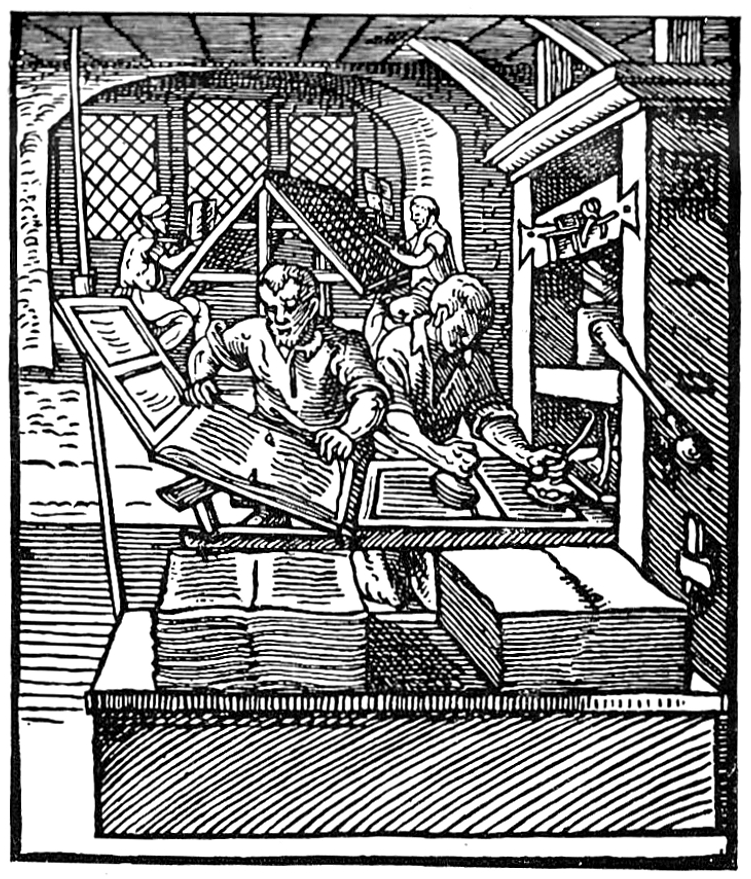
Printing press, circa 1568

A printer's devil was a young apprentice in a printing establishment who performed a number of tasks, such as mixing tubs of ink and fetching type. Writers including Benjamin Franklin, Walt Whitman, Ambrose Bierce, Bret Harte, Sherwood Anderson, and Mark Twain served as printer's devils in their youth along with indentured servants.

There are religious, literary, and linguistic hypotheses for the etymology. Printers blamed the mischievous devil Titivillus or confused a name with the legend Faust. Other theories include racism, Gallicisms, or misspellings.

Etymology

[edit]
York's little devil on a former printer shop in Stonegate, York

The term "printer's devil" has been ascribed to the apprentices' hands and skin getting stained black with ink when removing sheets of paper from the tympan.[1] In 1683, English printer Joseph Moxon wrote that "devil" was a humorous term for boys who were covered in ink: "whence the Workmen do Jocosely call them Devils; and sometimes Spirits, and sometimes Flies."[2][3] Once cast metal type was used, worn, or broken, it was thrown into a "hellbox", after which it was the printer's devil's job to either put it back in the job case, or take it to the furnace to be melted down and recast.[4]

Many explanations have been given for the religious or supernatural connotations of the term.[5] From the Middle Ages onward, particularly in Catholic countries, technological inventions such as the printing press were often regarded with suspicion, and associated with Satan and the "Dark Arts".[6][7] Some have suggested that the term was coined as an epithet by scribes who feared that the printing press would make the hand-copying of manuscripts obsolete.[8] Several theories of the term's origins are included below.

Titivillus

[edit]

One popular theory is linked to the fanciful belief among printers that a special demon, Titivillus (also referred to as "the original printer's devil"[9]), haunted every print shop, performing mischief such as inverting type, misspelling words, and removing entire lines of completed type.[citation needed] Titivillus was said to execute his pranks by influencing the young apprentices – or "printer's devils" – as they set up type, or by causing errors to occur during the actual casting of metal type.[10] High-profile printing errors "blamed" on Titivillus included the omission of the word not in the 1631 Authorised Version of the Bible, which resulted in Exodus 20:14 appearing as "Thou shalt commit adultery."[10] Often depicted as a creature with claw-like feet and horns on his head, the origins of the Titivillus legend date back to the Middle Ages, when he was said to collect "fragments of words" that were dropped or misspoken by the clergy or laiety in a sack to deliver to Satan daily, and later, to record poorly recited prayers and gossip overheard in church with a pen on parchment, for use on Judgement Day.[10][11] Over the centuries, Titivillus was also blamed for causing monks to make mistakes while copying manuscripts by hand; meddling with block and plate printing; and eventually, playing pranks with movable type.[10]

Johann Fust

[edit]

Regarding the origins of the term "devil" to refer to "the errand boy or youngest apprentice in a printing office", Pasko's American Dictionary of Printing and Bookmaking (1894) states: "It is said that it is derived from the belief that John Fust was In league with the devil, and the urchin covered with ink certainly made a very good representation of his Satanic majesty."[2] Johann Fust (c.1400–1466), also known as Faust, loaned money to Johannes Gutenberg to perfect his printing process using movable type, and sued Gutenberg for repayment, with interest, in 1455.[12] Fust, together with Gutenberg's son-in-law Peter Schoeffer, then set up their own printing business and published the Mainz Psalter, a Bible which introduced colour printing, in 1457.[12] Over the centuries, biographical accounts of Fust, the printer, have often become confused or intertwined with the legend of Johann Georg Faust (c.1480–1540), the alchemist and necromancer who became the subject of numerous "Faust books" published in Germany starting in 1587, which in turn inspired Christopher Marlowe's work, Doctor Faustus (c.1591–1593).[13] The legendary Faustus is said to have sold his soul to the demon Mephistopheles, in exchange for a book or encyclopedia of magical spells.[13] In 1570, even before publication of the first Faustbuch, English church historian John Foxe credited "a Germaine...named Joan. Faustus, a goldesmith" for the invention of the printing press, in the second edition of Actes and Monuments, although he had previously attributed its invention to "Jhon Guttenbergh".[13] Literary scholar Sarah Wall-Rendell argues that the association of the Doctor Faustus legend with books and printing technology reflected ongoing ambivalence among Reformation writers about the impact that books would have on an increasingly literate populace.[13]

Aldus Manutius

[edit]

Yet another possible origin is ascribed to Aldus Manutius, a Venetian printer (fl. 1450-1515), who was denounced by detractors for practicing the black arts as early printing was long associated with devilry.[14] The assistant to Manutius was a young boy of African descent who was accused of being the embodiment of Satan and dubbed the printer's devil.[15]

William Caxton

[edit]

Some boys claimed their names descended from an apprentice William Caxton had in the 1470s.[16] His name changed from De Vile, to DeVille and Deville.[16]

Malayalam root

[edit]

While the term "printer's devil" in India may stem from the European legend of Titivillus, another theory is that it might stem from the Malayalam term for "printing error" (achadi pisaku), which is only one change of a Malayalam letter away from "printing devil" (achadi pisachu).[17]

Famous devils

[edit]

Usage

[edit]

United States

[edit]

In North America during the late 18th and early 19th centuries, young boys were indentured to printers by their parents, or in the case of orphans, by the municipal or church authorities.[20] More than apprentices in other trades, printer's devils were boys who had expressed an interest in printing.[20] By 1894, American Dictionary of Printing and Bookmaking noted that with the decline of the apprenticeship system in the United States, the term "printer's devil" was going out of use.[2]

India

[edit]

The printer's devil is also known in other languages such as Bengali, where it is called Chhapakhanar Bhoot.[17]

References

[edit]
Revisions and contributorsEdit on WikipediaRead on Wikipedia
from Grokipedia
A was a , typically a boy, in a printing establishment who performed menial tasks such as mixing , fetching type, dampening paper, and running errands. The role originated in the 15th century following the invention of the movable-type by around 1450, when shops required low-level labor to support master printers and journeymen. The term itself first appeared in English in , referring to these errand boys who were often covered in black from their duties. Its remains uncertain, though one early account from 1663 describes the boys as "bedaubed" with ink and jokingly dubbed "devils" by workers, while other theories link it to superstitions about demonic mischief causing printing errors, such as the medieval demon blamed for scribal mistakes. Apprenticeships as a were typically indentured arrangements lasting several years, involving arduous labor for minimal or no pay, long hours, and strict discipline; runaways were sometimes pursued like escaped slaves until labor reforms in the mid-19th century. Despite the hardships, the position provided opportunities for literate youths to learn the trade, read widely, and even contribute to publications, serving as an entry point into the printing industry that fueled the spread of knowledge during the Enlightenment and beyond. Several prominent American figures began their careers as printer's devils, including , who apprenticed in his brother's shop in 1718 and secretly published satirical letters under the pseudonym ; Samuel Clemens (), who worked in his brother's Hannibal newspaper in the 1850s and composed humorous pieces; and , who set type and wrote for early New York papers in the 1830s, experiences that influenced his later poetry and . In modern usage, "printer's devil" can also denote an inexplicable printing error, such as missing text or misspellings, evoking the historical blame placed on mischievous apprentices for shop mishaps.

Definition and Role

Definition

A is a , typically a aged 10 to 15, employed in a shop to perform menial tasks such as running errands, cleaning equipment, and assisting with basic operations before progressing to skilled work like setting type. This role emerged in the wake of the invention of the movable-type by in the 1440s, which revolutionized book production and created demand for specialized labor in printing establishments across and later the , primarily from the 16th to 19th centuries. The English term "printer's devil" first appeared in print around 1716, reflecting the system's adaptation to the burgeoning print industry. Printer's devils started as the lowest rung in a shop's , showing early aptitude for the craft that could lead to status or even mastery.

Duties and Responsibilities

A printer's devil primarily performed menial tasks essential to the operation of a pre-industrial shop, such as sweeping floors, mixing from pigments and oils, cleaning type cases and presses to remove accumulated and debris, fetching supplies like and type from storage or external vendors, and running errands including deliveries to clients or the . These duties often extended to sorting used metal type back into cases after , a process that could take up to two hours per column. In supportive roles, the assisted more skilled workers by inking rollers for , distributing sorted type to compositors, and occasionally basic galleys under supervision to catch obvious errors before full production. They might also help with ancillary tasks like washing compositors' ink-stained hands at the end of shifts or preparing paper for , ensuring the continued smoothly in small shops that often employed only a handful of workers. Working conditions were arduous, with shifts lasting 12 to 14 hours daily in dimly lit, noisy environments filled with the smells of grease, , and chemicals; exposure to these substances frequently resulted in blackened skin and clothing, along with risks of burns or injury from machinery. Pay was minimal, often limited to in or near the shop, reflecting the exploitative nature of apprenticeship in 18th- and 19th-century trades. Advancement typically occurred after a 7-year apprenticeship, during which the printer's devil might learn to read and write on the job through exposure to texts; the initial devil phase served as entry, with successful individuals progressing to roles as compositors, handling type arrangement, or pressmen, operating the machinery, potentially achieving journeyman status thereafter. The role was predominantly filled by boys aged 12 to 15, due to the physical demands of lifting heavy type cases and operating equipment, as well as prevailing cultural norms that excluded girls from such workshops in early periods, though rare female equivalents existed in exceptional cases.

Etymology and Historical Origins

Folklore Influences

The legend of Titivillus, a demon originating in medieval Christian around the 13th century, played a pivotal role in shaping the mythical associations of the printer's devil. Titivillus was depicted as a mischievous entity tasked with collecting scribes' errors—such as omitted letters or words—during the laborious hand-copying of religious texts, storing them in a sack or to present as evidence against the scribes at . This belief served as a , attributing human fallibility in sacred work to demonic rather than mere . Following the invention of the by in the mid-15th century, the legend adapted to the new technology, evolving into a "mechanical version" that haunted printing operations. Folklore extended the demon's domain to typographical mistakes, portraying Titivillus as interfering with compositors by inverting type or introducing misspellings, thereby linking scribal errors to the emerging mechanical reproduction of texts. This adaptation reflected anxieties over the press's potential to multiply inaccuracies in disseminated knowledge, particularly in religious materials. In printing lore, shops were commonly believed to be inhabited by imps or lesser demons that caused practical disruptions, such as type mix-ups, spills, or jammed presses, with the lowly apprentice often scapegoated as the "devil" responsible. These supernatural attributions stemmed from the era's limited understanding of machinery, where any malfunction could be blamed on infernal meddling rather than technical issues. The apprentice's -blackened appearance further reinforced this imagery, evoking a devilish figure amid the sooty environment. Early 15th- and 16th-century tales amplified these beliefs, weaving narratives of interference in as a counterforce to the technology's rapid spread, often tied to broader fears that the press enabled the dissemination of and . For instance, the proliferation of texts like the (1487), a witch-hunting manual printed in multiple editions, fueled perceptions of the press as a vector for demonic ideas, intertwining with Europe's escalating witch hunts. Such stories persisted culturally into later centuries, providing a framework to explain mechanical failures in an age before systematic , thereby perpetuating the as a symbol of inevitable error in textual production.

Key Historical Figures

Johann Fust (c. 1400–1466), a and financier, played a pivotal role in early by lending money to to develop the movable-type press, but he later seized control of the operation through a lawsuit in 1455. Fust and his son-in-law Peter Schöffer then produced exquisite editions of the , which they sold across Europe, including to King Louis XI of France. Upon arriving in around 1462 to market these volumes, Fust faced witchcraft accusations from locals who marveled at the books' uniformity and quality, suspecting he had invoked demonic forces to replicate sacred texts so flawlessly. This incident fueled legends that Fust had sold his soul to the devil for knowledge, directly inspiring the myth as recounted in later works like Christopher Marlowe's Doctor Faustus. Aldus Manutius (1449–1515), a scholarly printer in , revolutionized book production with innovations like italic typeface in 1501 and compact formats, enabling affordable, portable classics for a wider audience. His rapid output and high standards sparked rumors of assistance, particularly tied to his young assistant of African descent, whose dark, ink-smeared appearance led superstitious visitors to label him a "little black " or Satan's emissary in the workshop. Manutius countered these claims by publicly exhibiting the boy in 1501, inviting doubters to pinch his skin to verify his humanity, thus highlighting the era's prejudices and fears surrounding printing's transformative power. William Caxton (c. 1422–1491), 's pioneering printer who established the first press in Westminster in 1476, encountered similar suspicions as printed books disrupted traditional , with his workshop's errors often attributed to mischievous apprentice "devils" in folk tales. As the introducer of mechanical printing to , Caxton's operations were viewed by some as unnaturally swift and error-prone, echoing continental fears of infernal involvement in the spread of knowledge. The controversies surrounding these figures, from Fust's ordeal in the 1460s to Manutius's Venetian demonstrations in the early 1500s, entrenched "devil" associations with by the late , portraying the trade as a blend of and suspected sorcery that apprentices embodied as elusive troublemakers.

Linguistic Theories

The etymology of "printer's devil" remains uncertain, with several linguistic theories proposed to explain its origins in the context of early modern practices. One prominent attributes the term to the physical appearance of apprentices, whose hands, clothes, and faces were often blackened by and during the labor-intensive of inking type and operating presses, evoking the image of a soot-covered . This idea is reflected in 18th-century accounts, such as a 1790s poem by describing the apprentice's "inky" and "sooty" state as devilish, underscoring the term's association with the grimy realities of print shops. The earliest attested uses of "printer's devil" in English appear in the early 18th century, with the Oxford English Dictionary citing 1716 as the first recorded instance in John Kersey's Dictionarium Anglo-Britannicum, where it denotes a printing apprentice. Earlier potential references, such as in 17th-century dramatic works, have been suggested but lack firm linguistic evidence, pointing instead to the term's emergence alongside the expansion of English printing after the Restoration. Scholars have explored possible continental European influences, noting parallels in Dutch and German printing terminology; for instance, the Dutch "zetduivel" (typesetting devil) refers to printing errors in guild contexts, potentially contributing to the English adoption of "duivel"-derived terms for mischievous or error-prone elements in the trade. Alternative theories link the phrase to medieval , particularly the demon , a figure in clerical lore who collected scribal errors and was later adapted to mishaps, implying apprentices as "devils" responsible for similar faults. However, linguistic dismisses connections to unrelated trades, such as (e.g., no ties it to "devil's " confections) or non-European roots, emphasizing instead the term's rootedness in European culture. These folk etymologies, while colorful, often lack direct philological support and appear as later rationalizations. By the mid-18th century, the phrase had evolved from any literal demonic to primarily designate the lowly, mischievous status of the apprentice, with "" serving as a colloquial marker of their errand-running and menial role in print shops. This semantic shift aligns with broader English usage of "" for underlings or troublemakers, solidifying the term's occupational specificity by the 1700s.

Notable Examples

American Figures

Benjamin Franklin (1706–1790) is one of the most prominent American figures who began his career as a printer's devil. At age 12 in 1718, he was apprenticed to his older brother James in the latter's Boston printing shop, where he performed menial tasks such as washing presses, carrying paper, and learning the basics of typesetting. During this period, Franklin anonymously contributed essays to his brother's newspaper, The New-England Courant, honing his writing skills amid the rigors of the trade. Dissatisfied with the apprenticeship's restrictions, he fled to Philadelphia in 1723, where his printing experience propelled him into journalism and publishing. Mark Twain, born Samuel Langhorne Clemens (1835–1910), also started as a printer's devil at age 12 in Hannibal, Missouri. From 1847 to 1850, he worked for the local Missouri Courier, setting type and running errands in the newspaper office, an experience that immersed him in the world of words and satire. This early exposure to the mechanics of printing and the content of periodicals significantly shaped his satirical writing style, as explored in analyses of his career amid the evolving American publishing industry. Walt Whitman (1819–1892) entered the printing trade similarly, apprenticing as a at age 12 in a shop around 1831. He performed tasks like mixing ink and fetching type for weekly newspapers, including the Long-Island Star, which provided him with practical and exposure to diverse texts. Whitman later credited this formative period with sparking his literary ambitions, as it allowed him to engage deeply with language while operating the presses. Other notable Americans with brief or indirect ties to the role include (1842–c. 1914), who served as a in , during the late 1850s after leaving high school, gaining initial insights into before his . These experiences collectively underscore a common theme among 18th- and 19th-century American s: the trade served as a for self-education, fostering skills in composition and observation that launched careers in , , and public discourse within the burgeoning U.S. press.

British and Other Figures

In Britain, the served as the foundational role in the printing trade's apprenticeship system, deeply embedded in the guild structures that regulated the industry from the onward. Organizations like the Stationers' Company in controlled entry into the profession, binding young boys—often aged 12 or 13—to seven-year terms where they performed menial, ink-soaked tasks such as mixing , fetching type, and cleaning presses before advancing to skilled work. This guild-regulated approach emphasized collective oversight, quality control, and trade secrets, contrasting with the more entrepreneurial, less formalized setups in early American print shops during the revolutionary period. The system's rigidity helped maintain high standards in London's hub but also limited for apprentices, who endured long hours and strict hierarchies. While few British literary giants are recorded as having begun their careers as printer's devils, the trade's influence permeated cultural figures through indirect connections and later involvement. (1834–1896), though apprenticed initially to , immersed himself in as an adult by founding the in the 1890s, where his hands-on approach to type design and book production revived medieval craftsmanship and shaped the Arts and Crafts movement's emphasis on beauty in everyday objects. (1812–1870) drew on his familiarity with London's world—gained through observations during his early clerkships and reporting—for vivid depictions in (1836–1837), where chaotic print shop scenes and references to the "printer's devil" at the door captured the trade's frenetic energy and inspired generations with its humorous portrayal of apprentices as mischievous imps. Beyond Britain, the played a pivotal role in colonial printing operations, particularly in regions like during the , where European-style presses disseminated imperial propaganda, newspapers, and . In these outposts, young apprentices—often local boys under British supervisors—handled the labor-intensive setup of for publications in English and Indian languages, contributing to the spread of amid colonial expansion; by the mid-1800s, presses in Calcutta and Bombay employed dozens of such devils to meet the demand for official gazettes and early nationalist tracts. (1865–1936), exposed to Anglo-Indian printing environments in the 1870s through his family's journalistic circles in Bombay, later evoked the term in his early poem "Ye Printer's Devil, Verie Wyse," reflecting the trade's blend of British tradition and colonial adaptation. In , the role echoed British models but with local variations, as seen in early 19th-century , where brief apprenticeships in Parisian shops introduced youths to the revolutionary potential of amid post-Napoleonic . This European context highlighted the printer's devil's function in bridging artisanal guilds and emerging industrial presses, fostering a generation of writers attuned to print's social power. Across other British-influenced regions, such as , the apprenticeship system produced notable figures who leveraged skills for public life. Joseph Lyons (1879–1939), Australia's 10th , began as a printer's messenger boy and devil in Tasmanian shops at age nine, using his experience to unionize workers and advocate labor reforms before entering politics. Similarly, Chris Watson (1867–1941), the nation's third , apprenticed as a compositor in during the 1880s, crediting the trade's discipline for his rise in socialist organizing and federal governance. These examples underscore how the printer's devil role, exported via empire, enabled social ascent in colonial settings, distinct from Britain's guild-bound traditions.

Cultural and Modern Usage

In Literature and Media

The printer's devil has appeared in various literary works as a symbol of youthful mischief and the gritty beginnings of those entering the printing trade. In Mark Twain's autobiographical sketches, he humorously recounts his early experiences as a in , portraying the role with witty anecdotes of pranks and mishaps that shaped his career in and writing. Similarly, , who began his career as a printer's devil, infused his cynical tales and (1911) with references to the term, using it to evoke themes of error, deception, and irreverent energy in the world of print. In theater, the 1833 burlesque The Printer's Devil, or A Type of the Old One, a one-act published in New York, satirized the apprentice's antics through exaggerated depictions of print shop chaos and devilish ties. This play highlighted the role's association with pranks and humble labor, influencing later comedic portrayals. Comics and cartoons further popularized the figure's mischievous side. The early 20th-century strip Mickie the Printer's Devil by C.W. Kahles (running from around 1912 to the 1920s) featured the young apprentice's humorous escapades in a bustling print shop, capturing the era's fascination with life. In film, early cinema nodded to the printer's devil in journalism settings. The 1923 silent drama The Printer's Devil, directed by William Beaudine, centers on a young apprentice (played by Wesley Barry) who aids in launching a local newspaper, emphasizing themes of ambition and print shop ingenuity. Later works like the 1931 adaptation of The Front Page evoked similar newsroom dynamics, where copy boys and apprentices mirrored the traditional devil's supportive yet chaotic role in the fast-paced world of reporting. Television also referenced the figure, notably in the 1964 episode "Printer's Devil" of , where the Devil (played by ) poses as a printer's devil to take over a struggling , blending elements with the historical role's themes of mischief and media production. Overall, these depictions often symbolized youthful vigor and the potential for error in printing, transforming the historical apprentice into a of humble, spirited origins in media production.

Regional Variations and Decline

In the United States, the role of the reached its peak during the 19th century, when newspapers and houses relied heavily on manual and hand-operated presses, employing young apprentices for menial tasks in bustling print shops. However, the role began to decline sharply after 1900 with the widespread adoption of the , invented in 1886, which automated the process and drastically reduced the demand for manual labor and apprentice assistants in composing rooms. In , particularly the , the was a fixture in establishments from the onward, but the position phased out in the early as mechanization transformed the industry. Traditional apprenticeships, including those for errand boys and junior helpers, dwindled due to the introduction of powered machinery and shifts in labor organization, making the role largely obsolete in major printing centers like . Several interconnected factors contributed to the global decline of the . Industrialization, beginning with steam-powered presses in the , accelerated production and minimized the need for hand labor, shifting print shops from artisanal workshops to mechanized operations. Child labor regulations further eroded the role; in the U.S., the 1938 Fair Labor Standards Act prohibited oppressive child employment in industries like , effectively barring minors from such apprenticeships. By the 1970s, the rise of offset lithography and technologies eliminated traditional altogether, rendering the position extinct in most developed regions. Today, the term "" survives primarily in metaphorical usage within , referring to typographical errors or glitches akin to mischievous "" that introduce mistakes into printed or digital text. By the , the literal role had become outdated in virtually all contexts worldwide, surviving only as a historical curiosity or for unexplained printing faults.

References

Add your contribution
Related Hubs
User Avatar
No comments yet.