


Community hub
Priority queue
View on WikipediaIn computer science, a priority queue is an abstract data type similar to a regular queue or stack abstract data type.
In a priority queue, each element has an associated priority, which determines its order of service.[1] Priority queue serves highest priority items first.[1] Priority values have to be instances of an ordered data type, and higher priority can be given either to the lesser or to the greater values with respect to the given order relation. For example, in Java standard library, PriorityQueue's the least elements with respect to the order have the highest priority.[2] This implementation detail is without much practical significance, since passing to the opposite order relation turns the least values into the greatest, and vice versa.
While priority queues are often implemented using heaps, they are conceptually distinct. A priority queue can be implemented with a heap or with other methods; just as a list can be implemented with a linked list or with an array.
Operations
[edit]A priority queue has the following operations:[3][4][5]
Max-priority queue
[edit]maximum(S): return the element with highest priority.- This is also known as "
find_max".
- This is also known as "
extract_max(S): remove the element from setSwith highest priority, and return it.
increase_key(S, element, k): increase the associated priority with an element to the new valuek.
Min-priority queue
[edit]minimum(S): return the element with lowest priority.- This is also known as "
find_min".
- This is also known as "
extract_min(S): remove the element from setSwith lowest priority, and return it.
decrease_key(S, element, k): decrease the associated priority with an element to the new valuek.
Stacks and queues can be implemented as particular kinds of priority queues, with the priority determined by the order in which the elements are inserted. In a stack, the priority of each inserted element is monotonically increasing; thus, the last element inserted is always the first retrieved. In a queue, the priority of each inserted element is monotonically decreasing; thus, the first element inserted is always the first retrieved.
In some implementations, if two elements have the same priority, they are served in the same order in which they were enqueued. In other implementations, the order of elements with the same priority is undefined.
Implementation
[edit]Naive implementations
[edit]One can create a simple, but inefficient priority queue in a number of ways. These naive implementations can demonstrate the expected behaviour of a priority queue in a simpler manner.
- insert elements into an unsorted array; find and extract element with highest priority
- Performance: "
insert" performs in constant time, where "extract_max" performs in linear time.
- Performance: "


insert(element, priority):
    node.element ← element
    node.priority ← priority
    list.append(node)

extract_max():
    highest ← 0
    foreach node in list:
        if highest.priority < node.priority:
            highest ← node
    list.remove(highest)
    return highest.element
- insert elements into a sorted array; extract first element
- Performance: "
insert" performs in linear time, where "extract_max" performs in constant time.
- Performance: "
insert(element, priority):
    node.element ← element
    node.priority ← priority
    for i in [0...N]:
        element ← list.get_at_index(i)
        if element.priority < node.priority:
            list.insert_at_index(node, i + 1)
            return

extract_max():
    highest ← list.get_at_index(0)
    list.remove(highest)
    return highest.element
Usual implementation
[edit]To improve performance, priority queues are typically based on a heap, giving performance for inserts and removals, and to build the heap initially from a set of elements. Variants of the basic heap data structure such as pairing heaps or Fibonacci heaps can provide better bounds for some operations.[6]


Alternatively, when a self-balancing binary search tree is used, insertion and removal also take time, although building trees from existing sequences of elements takes time; this is typical where one might already have access to these data structures, such as with third-party or standard libraries. From a space-complexity standpoint, using self-balancing binary search tree with linked list takes more storage, since it requires to store extra references to other nodes.

From a computational-complexity standpoint, priority queues are congruent to sorting algorithms. The section on the equivalence of priority queues and sorting algorithms, below, describes how efficient sorting algorithms can create efficient priority queues.
Specialized heaps
[edit]There are several specialized heap data structures that either supply additional operations or outperform heap-based implementations for specific types of keys, specifically integer keys. Suppose the set of possible keys is .

- When only
insert,find-minandextract-minare needed and in case of integer priorities, a bucket queue can be constructed as an array of linked lists plus a pointer , initially . Inserting an item with key appends the item to the 'th list, and updates , both in constant time.extract-mindeletes and returns one item from the list with index , then increments if needed until it again points to a non-empty list; this takes time in the worst case. These queues are useful for sorting the vertices of a graph by their degree.[7]: 374 - A van Emde Boas tree supports the
minimum,maximum,insert,delete,search,extract-min,extract-max,predecessorandsuccessor]operations in time, but has a space cost for small queues of about , where is the number of bits in the priority value.[8] The space can be reduced significantly with hashing. - The Fusion tree by Fredman and Willard implements the
minimumoperation in time andinsertandextract-minoperations in time. However it is stated by the author that, "Our algorithms have theoretical interest only; The constant factors involved in the execution times preclude practicality."[9]



For applications that do many "peek" operations for every "extract-min" operation, the time complexity for peek actions can be reduced to in all tree and heap implementations by caching the highest priority element after every insertion and removal. For insertion, this adds at most a constant cost, since the newly inserted element is compared only to the previously cached minimum element. For deletion, this at most adds an additional "peek" cost, which is typically cheaper than the deletion cost, so overall time complexity is not significantly impacted.
Monotone priority queues are specialized queues that are optimized for the case where no item is ever inserted that has a lower priority (in the case of min-heap) than any item previously extracted. This restriction is met by several practical applications of priority queues.
Summary of running times
[edit]Here are time complexities[10] of various heap data structures. The abbreviation am. indicates that the given complexity is amortized, otherwise it is a worst-case complexity. For the meaning of "O(f)" and "Θ(f)" see Big O notation. Names of operations assume a min-heap.
| Operation | find-min | delete-min | decrease-key | insert | meld | make-heap[a] |
|---|---|---|---|---|---|---|
| Binary[10] | Θ(1) | Θ(log n) | Θ(log n) | Θ(log n) | Θ(n) | Θ(n) |
| Skew[11] | Θ(1) | O(log n) am. | O(log n) am. | O(log n) am. | O(log n) am. | Θ(n) am. |
| Leftist[12] | Θ(1) | Θ(log n) | Θ(log n) | Θ(log n) | Θ(log n) | Θ(n) |
| Binomial[10][14] | Θ(1) | Θ(log n) | Θ(log n) | Θ(1) am. | Θ(log n)[b] | Θ(n) |
| Skew binomial[15] | Θ(1) | Θ(log n) | Θ(log n) | Θ(1) | Θ(log n)[b] | Θ(n) |
| 2–3 heap[17] | Θ(1) | O(log n) am. | Θ(1) | Θ(1) am. | O(log n)[b] | Θ(n) |
| Bottom-up skew[11] | Θ(1) | O(log n) am. | O(log n) am. | Θ(1) am. | Θ(1) am. | Θ(n) am. |
| Pairing[18] | Θ(1) | O(log n) am. | o(log n) am.[c] | Θ(1) | Θ(1) | Θ(n) |
| Rank-pairing[21] | Θ(1) | O(log n) am. | Θ(1) am. | Θ(1) | Θ(1) | Θ(n) |
| Fibonacci[10][22] | Θ(1) | O(log n) am. | Θ(1) am. | Θ(1) | Θ(1) | Θ(n) |
| Strict Fibonacci[23][d] | Θ(1) | Θ(log n) | Θ(1) | Θ(1) | Θ(1) | Θ(n) |
| Brodal[24][d] | Θ(1) | Θ(log n) | Θ(1) | Θ(1) | Θ(1) | Θ(n)[25] |
- ^ make-heap is the operation of building a heap from a sequence of n unsorted elements. It can be done in Θ(n) time whenever meld runs in O(log n) time (where both complexities can be amortized).[11][12] Another algorithm achieves Θ(n) for binary heaps.[13]
- ^ a b c For persistent heaps (not supporting decrease-key), a generic transformation reduces the cost of meld to that of insert, while the new cost of delete-min is the sum of the old costs of delete-min and meld.[16] Here, it makes meld run in Θ(1) time (amortized, if the cost of insert is) while delete-min still runs in O(log n). Applied to skew binomial heaps, it yields Brodal-Okasaki queues, persistent heaps with optimal worst-case complexities.[15]
- ^ Lower bound of [19] upper bound of [20]
- ^ a b Brodal queues and strict Fibonacci heaps achieve optimal worst-case complexities for heaps. They were first described as imperative data structures. The Brodal-Okasaki queue is a persistent data structure achieving the same optimum, except that decrease-key is not supported.


Equivalence of priority queues and sorting algorithms
[edit]Using a priority queue to sort
[edit]The semantics of priority queues naturally suggest a sorting method: insert all the elements to be sorted into a priority queue, and sequentially remove them; they will come out in sorted order. This is actually the procedure used by several sorting algorithms, once the layer of abstraction provided by the priority queue is removed. This sorting method is equivalent to the following sorting algorithms:
| Name | Priority Queue Implementation | Best | Average | Worst |
|---|---|---|---|---|
| Heapsort | Heap | |||
| Smoothsort | Leonardo Heap | n | ||
| Selection sort | Unordered Array | |||
| Insertion sort | Ordered Array | |||
| Tree sort | Self-balancing binary search tree |


Using a sorting algorithm to make a priority queue
[edit]A sorting algorithm can also be used to implement a priority queue. Specifically, Thorup says:[26]
We present a general deterministic linear space reduction from priority queues to sorting implying that if we can sort up to keys in time per key, then there is a priority queue supporting
deleteandinsertin time andfind-minin constant time.


That is, if there is a sorting algorithm which can sort in time per key, where is some function of and word size,[27] then one can use the given procedure to create a priority queue where pulling the highest-priority element is time, and inserting new elements (and deleting elements) is time. For example, if one has an sort algorithm, one can create a priority queue with pulling and insertion.


Libraries
[edit]A priority queue is often considered to be a "container data structure".
The Standard Template Library (STL), and the C++ 1998 standard, specifies std::priority_queue as one of the STL container adaptor class templates. However, it does not specify how two elements with same priority should be served, and indeed, common implementations will not return them according to their order in the queue. It implements a max-priority-queue, and has three parameters: a comparison object for sorting such as a function object (defaults to less<T> if unspecified), the underlying container for storing the data structures (defaults to std::vector<T>), and two iterators to the beginning and end of a sequence. Unlike actual STL containers, it does not allow iteration of its elements (it strictly adheres to its abstract data type definition). STL also has utility functions for manipulating another random-access container as a binary max-heap. The Boost libraries also have an implementation in the library heap.
Python's heapq module implements a binary min-heap on top of a list.
Java's library contains a PriorityQueue (java.util.PriorityQueue) class, which implements a min-priority-queue as a binary heap.
.NET's library contains a System.Collections.Generic.PriorityQueue class, which implements an array-backed, quaternary min-heap.
Scala's library contains a scala.collection.mutable.PriorityQueue class, which implements a max-priority-queue.
Go's library contains a container/heap module, which implements a min-heap on top of any compatible data structure.
Rust's standard library contains a std::collections::BinaryHeap struct, which implements a priority queue with a binary heap.
The Standard PHP Library extension contains the class SplPriorityQueue.
Apple's Core Foundation framework contains a CFBinaryHeap structure, which implements a min-heap.
Applications
[edit]Bandwidth management
[edit]Priority queuing can be used to manage limited resources such as bandwidth on a transmission line from a network router. In the event of outgoing traffic queuing due to insufficient bandwidth, all other queues can be halted to send the traffic from the highest priority queue upon arrival. This ensures that the prioritized traffic (such as real-time traffic, e.g. an RTP stream of a VoIP connection) is forwarded with the least delay and the least likelihood of being rejected due to a queue reaching its maximum capacity. All other traffic can be handled when the highest priority queue is empty. Another approach used is to send disproportionately more traffic from higher priority queues.
Many modern protocols for local area networks also include the concept of priority queues at the media access control (MAC) sub-layer to ensure that high-priority applications (such as VoIP or IPTV) experience lower latency than other applications which can be served with best-effort service. Examples include IEEE 802.11e (an amendment to IEEE 802.11 which provides quality of service) and ITU-T G.hn (a standard for high-speed local area network using existing home wiring (power lines, phone lines and coaxial cables).
Usually a limitation (policer) is set to limit the bandwidth that traffic from the highest priority queue can take, in order to prevent high priority packets from choking off all other traffic. This limit is usually never reached due to high level control instances such as the Cisco Callmanager, which can be programmed to inhibit calls which would exceed the programmed bandwidth limit.
Discrete event simulation
[edit]Another use of a priority queue is to manage the events in a discrete event simulation. The events are added to the queue with their simulation time used as the priority. The execution of the simulation proceeds by repeatedly pulling the top of the queue and executing the event thereon.
See also: Scheduling (computing), queueing theory
Dijkstra's algorithm
[edit]When the graph is stored in the form of adjacency list or matrix, priority queue can be used to extract minimum efficiently when implementing Dijkstra's algorithm, although one also needs the ability to alter the priority of a particular vertex in the priority queue efficiently.
If instead, a graph is stored as node objects, and priority-node pairs are inserted into a heap, altering the priority of a particular vertex is not necessary if one tracks visited nodes. Once a node is visited, if it comes up in the heap again (having had a lower priority number associated with it earlier), it is popped-off and ignored.
Huffman coding
[edit]Huffman coding requires one to repeatedly obtain the two lowest-frequency trees. A priority queue is one method of doing this.
Best-first search algorithms
[edit]Best-first search algorithms, like the A* search algorithm, find the shortest path between two vertices or nodes of a weighted graph, trying out the most promising routes first. A priority queue (also known as the fringe) is used to keep track of unexplored routes; the one for which the estimate (a lower bound in the case of A*) of the total path length is smallest is given highest priority. If memory limitations make best-first search impractical, variants like the SMA* algorithm can be used instead, with a double-ended priority queue to allow removal of low-priority items.
ROAM triangulation algorithm
[edit]The Real-time Optimally Adapting Meshes (ROAM) algorithm computes a dynamically changing triangulation of a terrain. It works by splitting triangles where more detail is needed and merging them where less detail is needed. The algorithm assigns each triangle in the terrain a priority, usually related to the error decrease if that triangle would be split. The algorithm uses two priority queues, one for triangles that can be split and another for triangles that can be merged. In each step the triangle from the split queue with the highest priority is split, or the triangle from the merge queue with the lowest priority is merged with its neighbours.
Prim's algorithm for minimum spanning tree
[edit]Using min heap priority queue in Prim's algorithm to find the minimum spanning tree of a connected and undirected graph, one can achieve a good running time. This min heap priority queue uses the min heap data structure which supports operations such as insert, minimum, extract-min, decrease-key.[28] In this implementation, the weight of the edges is used to decide the priority of the vertices. Lower the weight, higher the priority and higher the weight, lower the priority.[29]
Parallel priority queue
[edit]Parallelization can be used to speed up priority queues, but requires some changes to the priority queue interface. The reason for such changes is that a sequential update usually only has or cost, and there is no practical gain to parallelize such an operation. One possible change is to allow the concurrent access of multiple processors to the same priority queue. The second possible change is to allow batch operations that work on elements, instead of just one element. For example, extractMin will remove the first elements with the highest priority.


Concurrent parallel access
[edit]If the priority queue allows concurrent access, multiple processes can perform operations concurrently on that priority queue. However, this raises two issues. First of all, the definition of the semantics of the individual operations is no longer obvious. For example, if two processes want to extract the element with the highest priority, should they get the same element or different ones? This restricts parallelism on the level of the program using the priority queue. In addition, because multiple processes have access to the same element, this leads to contention.

The concurrent access to a priority queue can be implemented on a Concurrent Read, Concurrent Write (CRCW) PRAM model. In the following the priority queue is implemented as a skip list.[30][31] In addition, an atomic synchronization primitive, CAS, is used to make the skip list lock-free. The nodes of the skip list consists of a unique key, a priority, an array of pointers, for each level, to the next nodes and a delete mark. The delete mark marks if the node is about to be deleted by a process. This ensures that other processes can react to the deletion appropriately.
insert(e): First, a new node with a key and a priority is created. In addition, the node is assigned a number of levels, which dictates the size of the array of pointers. Then a search is performed to find the correct position where to insert the new node. The search starts from the first node and from the highest level. Then the skip list is traversed down to the lowest level until the correct position is found. During the search, for every level the last traversed node will be saved as parent node for the new node at that level. In addition, the node to which the pointer, at that level, of the parent node points towards, will be saved as the successor node of the new node at that level. Afterwards, for every level of the new node, the pointers of the parent node will be set to the new node. Finally, the pointers, for every level, of the new node will be set to the corresponding successor nodes.extract-min: First, the skip list is traversed until a node is reached whosedeletemark is not set. Thisdeletemark is than set to true for that node. Finally the pointers of the parent nodes of the deleted node are updated.
If the concurrent access to a priority queue is allowed, conflicts may arise between two processes. For example, a conflict arises if one process is trying to insert a new node, but at the same time another process is about to delete the predecessor of that node.[30] There is a risk that the new node is added to the skip list, yet it is not longer reachable. (See image)
K-element operations
[edit]In this setting, operations on a priority queue is generalized to a batch of elements.
For instance, k_extract-min deletes the smallest elements of the priority queue and returns those.
In a shared-memory setting, the parallel priority queue can be easily implemented using parallel binary search trees and join-based tree algorithms. In particular, k_extract-min corresponds to a split on the binary search tree that has cost and yields a tree that contains the smallest elements. k_insert can be applied by a union of the original priority queue and the batch of insertions. If the batch is already sorted by the key, k_insert has cost. Otherwise, we need to first sort the batch, so the cost will be . Other operations for priority queue can be applied similarly. For instance, k_decrease-key can be done by first applying difference and then union, which first deletes the elements and then inserts them back with the updated keys. All these operations are highly parallel, and the theoretical and practical efficiency can be found in related research papers.[32][33]

The rest of this section discusses a queue-based algorithm on distributed memory. We assume each processor has its own local memory and a local (sequential) priority queue. The elements of the global (parallel) priority queue are distributed across all processors.

k_extract-min is executed on a priority queue with three processors. The green elements are returned and removed from the priority queue.A k_insert operation assigns the elements uniformly random to the processors which insert the elements into their local queues. Note that single elements can still be inserted into the queue. Using this strategy the global smallest elements are in the union of the local smallest elements of every processor with high probability. Thus each processor holds a representative part of the global priority queue.
This property is used when k_extract-min is executed, as the smallest elements of each local queue are removed and collected in a result set. The elements in the result set are still associated with their original processor. The number of elements that is removed from each local queue depends on and the number of processors .
[34]
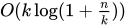
By parallel selection the smallest elements of the result set are determined. With high probability these are the global smallest elements. If not, elements are again removed from each local queue and put into the result set. This is done until the global smallest elements are in the result set. Now these elements can be returned. All other elements of the result set are inserted back into their local queues. The running time of k_extract-min is expected , where and is the size of the priority queue.[34]




The priority queue can be further improved by not moving the remaining elements of the result set directly back into the local queues after a k_extract-min operation. This saves moving elements back and forth all the time between the result set and the local queues.
By removing several elements at once a considerable speedup can be reached. But not all algorithms can use this kind of priority queue. Dijkstra's algorithm for example can not work on several nodes at once. The algorithm takes the node with the smallest distance from the priority queue and calculates new distances for all its neighbor nodes. If you would take out nodes, working at one node could change the distance of another one of the nodes. So using k-element operations destroys the label setting property of Dijkstra's algorithm.
See also
[edit]References
[edit]- ^ a b Miller Jr., Robert G. (1960). "Priority queues" (PDF). The Annals of Mathematical Statistics. 31. Stanford University: 86–103. doi:10.1214/aoms/1177705990.
- ^ "PriorityQueue (Java SE 9 & JDK 9 )". docs.oracle.com. Retrieved 2025-03-13.
- ^ Cormen, Thomas H.; Leiserson, Charles E.; Rivest, Ronald L.; Stein, Clifford (2022) [1990]. "Chapter 6.5: Priority queues". Introduction to Algorithms (4th ed.). MIT Press and McGraw-Hill. pp. 172–176. ISBN 0-262-04630-X.
- ^ a b c d e Rönngren, Robert; Ayani, Rassul (1997-04-01). "A comparative study of parallel and sequential priority queue algorithms". ACM Trans. Model. Comput. Simul. 7 (2): 157–209. doi:10.1145/249204.249205. ISSN 1049-3301.
- ^ a b c d e Ayani, R. (December 1990). "LR-algorithm: Concurrent operations on priority queues". Proceedings of the Second IEEE Symposium on Parallel and Distributed Processing 1990. pp. 22–25. doi:10.1109/SPDP.1990.143500. ISBN 0-8186-2087-0.
- ^ Cormen, Thomas H.; Leiserson, Charles E.; Rivest, Ronald L.; Stein, Clifford (2001) [1990]. "Chapter 20: Fibonacci Heaps". Introduction to Algorithms (2nd ed.). MIT Press and McGraw-Hill. pp. 476–497. ISBN 0-262-03293-7. Third edition, p. 518.
- ^ Skiena, Steven (2010). The Algorithm Design Manual (2nd ed.). Springer Science+Business Media. ISBN 978-1-849-96720-4.
- ^ P. van Emde Boas. Preserving order in a forest in less than logarithmic time. In Proceedings of the 16th Annual Symposium on Foundations of Computer Science, pages 75–84. IEEE Computer Society, 1975.
- ^ Michael L. Fredman and Dan E. Willard. Surpassing the information theoretic bound with fusion trees. Journal of Computer and System Sciences, 48(3):533-551, 1994
- ^ a b c d Cormen, Thomas H.; Leiserson, Charles E.; Rivest, Ronald L. (1990). Introduction to Algorithms (1st ed.). MIT Press and McGraw-Hill. ISBN 0-262-03141-8.
- ^ a b c Sleator, Daniel Dominic; Tarjan, Robert Endre (February 1986). "Self-Adjusting Heaps". SIAM Journal on Computing. 15 (1): 52–69. CiteSeerX 10.1.1.93.6678. doi:10.1137/0215004. ISSN 0097-5397.
- ^ a b Tarjan, Robert (1983). "3.3. Leftist heaps". Data Structures and Network Algorithms. pp. 38–42. doi:10.1137/1.9781611970265. ISBN 978-0-89871-187-5.
- ^ Hayward, Ryan; McDiarmid, Colin (1991). "Average Case Analysis of Heap Building by Repeated Insertion" (PDF). J. Algorithms. 12: 126–153. CiteSeerX 10.1.1.353.7888. doi:10.1016/0196-6774(91)90027-v. Archived from the original (PDF) on 2016-02-05. Retrieved 2016-01-28.
- ^ "Binomial Heap | Brilliant Math & Science Wiki". brilliant.org. Retrieved 2019-09-30.
- ^ a b Brodal, Gerth Stølting; Okasaki, Chris (November 1996), "Optimal purely functional priority queues", Journal of Functional Programming, 6 (6): 839–857, doi:10.1017/s095679680000201x
- ^ Okasaki, Chris (1998). "10.2. Structural Abstraction". Purely Functional Data Structures (1st ed.). pp. 158–162. ISBN 9780521631242.
- ^ Takaoka, Tadao (1999), Theory of 2–3 Heaps (PDF), p. 12
- ^ Iacono, John (2000), "Improved upper bounds for pairing heaps", Proc. 7th Scandinavian Workshop on Algorithm Theory (PDF), Lecture Notes in Computer Science, vol. 1851, Springer-Verlag, pp. 63–77, arXiv:1110.4428, CiteSeerX 10.1.1.748.7812, doi:10.1007/3-540-44985-X_5, ISBN 3-540-67690-2
- ^ Fredman, Michael Lawrence (July 1999). "On the Efficiency of Pairing Heaps and Related Data Structures" (PDF). Journal of the Association for Computing Machinery. 46 (4): 473–501. doi:10.1145/320211.320214.
- ^ Pettie, Seth (2005). Towards a Final Analysis of Pairing Heaps (PDF). FOCS '05 Proceedings of the 46th Annual IEEE Symposium on Foundations of Computer Science. pp. 174–183. CiteSeerX 10.1.1.549.471. doi:10.1109/SFCS.2005.75. ISBN 0-7695-2468-0.
- ^ Haeupler, Bernhard; Sen, Siddhartha; Tarjan, Robert E. (November 2011). "Rank-pairing heaps" (PDF). SIAM J. Computing. 40 (6): 1463–1485. doi:10.1137/100785351.
- ^ Fredman, Michael Lawrence; Tarjan, Robert E. (July 1987). "Fibonacci heaps and their uses in improved network optimization algorithms" (PDF). Journal of the Association for Computing Machinery. 34 (3): 596–615. CiteSeerX 10.1.1.309.8927. doi:10.1145/28869.28874.
- ^ Brodal, Gerth Stølting; Lagogiannis, George; Tarjan, Robert E. (2012). Strict Fibonacci heaps (PDF). Proceedings of the 44th symposium on Theory of Computing - STOC '12. pp. 1177–1184. CiteSeerX 10.1.1.233.1740. doi:10.1145/2213977.2214082. ISBN 978-1-4503-1245-5.
- ^ Brodal, Gerth S. (1996), "Worst-Case Efficient Priority Queues" (PDF), Proc. 7th Annual ACM-SIAM Symposium on Discrete Algorithms, pp. 52–58
- ^ Goodrich, Michael T.; Tamassia, Roberto (2004). "7.3.6. Bottom-Up Heap Construction". Data Structures and Algorithms in Java (3rd ed.). pp. 338–341. ISBN 0-471-46983-1.
- ^ Thorup, Mikkel (2007). "Equivalence between priority queues and sorting". Journal of the ACM. 54 (6): 28. doi:10.1145/1314690.1314692. S2CID 11494634.
- ^ "Archived copy" (PDF). Archived (PDF) from the original on 2011-07-20. Retrieved 2011-02-10.
{{cite web}}: CS1 maint: archived copy as title (link) - ^ Cormen, Thomas H.; Leiserson, Charles E.; Rivest, Ronald L.; Stein, Clifford (2009) [1990]. Introduction to Algorithms (3rd ed.). MIT Press and McGraw-Hill. p. 634. ISBN 0-262-03384-4. "In order to implement Prim's algorithm efficiently, we need a fast way to select a new edge to add to the tree formed by the edges in A."
- ^ "Prim's Algorithm". Geek for Geeks. 18 November 2012. Archived from the original on 9 September 2014. Retrieved 12 September 2014.
- ^ a b Sundell, Håkan; Tsigas, Philippas (2005). "Fast and lock-free concurrent priority queues for multi-thread systems". Proceedings International Parallel and Distributed Processing Symposium. Vol. 65. pp. 609–627. CiteSeerX 10.1.1.67.1310. doi:10.1109/IPDPS.2003.1213189. ISBN 0-7695-1926-1. S2CID 20995116.
- ^ Lindén, Jonsson (2013), "A Skiplist-Based Concurrent Priority Queue with Minimal Memory Contention", Technical Report 2018-003 (in German)
- ^ Blelloch, Guy E.; Ferizovic, Daniel; Sun, Yihan (2016), "Just Join for Parallel Ordered Sets", Symposium on Parallel Algorithms and Architectures, Proc. of 28th ACM Symp. Parallel Algorithms and Architectures (SPAA 2016), ACM, pp. 253–264, arXiv:1602.02120, doi:10.1145/2935764.2935768, ISBN 978-1-4503-4210-0, S2CID 2897793
- ^ Blelloch, Guy E.; Ferizovic, Daniel; Sun, Yihan (2018), "PAM: parallel augmented maps", Proceedings of the 23rd ACM SIGPLAN Symposium on Principles and Practice of Parallel Programming, ACM, pp. 290–304
- ^ a b Sanders, Peter; Mehlhorn, Kurt; Dietzfelbinger, Martin; Dementiev, Roman (2019). Sequential and Parallel Algorithms and Data Structures - The Basic Toolbox. Springer International Publishing. pp. 226–229. doi:10.1007/978-3-030-25209-0. ISBN 978-3-030-25208-3. S2CID 201692657.
Further reading
[edit]- Cormen, Thomas H.; Leiserson, Charles E.; Rivest, Ronald L.; Stein, Clifford (2001) [1990]. "Section 6.5: Priority queues". Introduction to Algorithms (2nd ed.). MIT Press and McGraw-Hill. pp. 138–142. ISBN 0-262-03293-7.
External links
[edit]- C++ reference for
std::priority_queue - Descriptions by Lee Killough
- libpqueue is a generic priority queue (heap) implementation (in C) used by the Apache HTTP Server project.
- Survey of known priority queue structures by Stefan Xenos
- UC Berkeley - Computer Science 61B - Lecture 24: Priority Queues (video) - introduction to priority queues using binary heap
- Methods and operations of Priority queue in C++
- Implementation of Priority Queue in Java
- Implementation of Priority Queue in C
Priority queue
View on GrokipediaFundamentals
Definition and motivation
A priority queue is an abstract data type similar to a regular queue or stack, but it stores a collection of elements where each is associated with a priority value, and elements are dequeued based on priority order rather than first-in, first-out (FIFO) insertion sequence.[2][1] This structure ensures that the element with the highest (or lowest, depending on convention) priority is always accessible for removal, providing selective access to the most relevant item in the collection.[2] The motivation for priority queues arises in scenarios requiring urgent or importance-based processing over strict temporal order, such as task scheduling in operating systems, where higher-priority processes are executed before lower ones to optimize resource allocation.[4] They are also essential in event-driven simulations, where events like arrivals or state changes are processed in priority order, often timestamped, to model real-world systems accurately.[5] A practical example is medical triage in emergency rooms, where patients are prioritized by condition severity—such as treating critical cases immediately—over arrival time to maximize life-saving outcomes.[6] Priority queues support dynamic insertion and removal of elements while maintaining priority ordering, with priorities typically represented as numeric keys or via custom comparators for more complex types; ties in priority are often resolved using secondary criteria, like insertion timestamps, to ensure deterministic behavior.[2][7] The concept was formalized in 1964 by J. W. J. Williams, who introduced it in the context of heap structures for selection and sorting tasks.Comparison to queues and stacks
A standard queue is an abstract data type (ADT) that adheres to the First-In-First-Out (FIFO) principle, where elements are inserted at the rear (enqueue) and removed from the front (dequeue), preserving the order of insertion.[8] In contrast, a priority queue dequeues the element with the highest (or lowest, depending on convention) priority regardless of its insertion position, allowing non-sequential access based on associated priority keys.[2] This enables priority queues to handle scenarios where urgency or importance dictates processing order, such as in task scheduling systems.[9] A stack, another fundamental ADT, follows the Last-In-First-Out (LIFO) principle, with insertions (push) and removals (pop) occurring exclusively at the top, effectively reversing the order of operations relative to insertion.[8] Priority queues differ fundamentally by ignoring insertion order entirely and instead extracting based on priority, which may require maintaining a partial order across all elements rather than endpoint access.[10] Stacks are commonly used for recursion or undo mechanisms in applications like expression evaluation, where the most recent item must be processed next.[8] Key differences between these structures lie in their access patterns and use cases: queues and stacks permit only endpoint operations for efficient O(1) time complexity, enforcing strict FIFO or LIFO sequencing suitable for order-preserving tasks like breadth-first search or function call management.[2] Priority queues, however, support priority-based extraction, often at O(log n) cost, ideal for urgency-driven processing in simulations or operating system schedulers where elements must be dynamically reordered.[9] From an ADT perspective, all three are collections of elements, but priority queues uniquely require a total order on priorities (via comparable keys) to determine extraction, distinguishing them from the positional ordering in queues and stacks.[8] To illustrate these contrasts, consider simple pseudocode for core operations: Queue operations:enqueue(Q, x): // Add to rear
[append](/page/Append) x to Q
dequeue(Q): // Remove from front
return remove front of Q
push(S, x):     // Add to top
    [append](/page/Append) x to S

pop(S):         // Remove from top
    return remove end of S
insert(PQ, x):  // Add with priority key
    add x to PQ and maintain priority order

extract-max(PQ): // Remove highest priority
    return and remove max-key element from PQ
Core Operations
Insertion and extraction
The insertion operation in a priority queue adds a new element paired with its priority value to the data structure, preserving the overall priority ordering without immediately altering the positions of existing elements. In a max-priority queue, higher numerical priority values denote greater urgency or importance, ensuring that elements with larger priorities are positioned to be serviced ahead of those with smaller ones.[2][11] The extract-max operation removes and returns the element possessing the highest priority from the queue, effectively dequeuing the most urgent item while maintaining the integrity of the remaining structure. For an empty queue, this operation commonly raises an exception to indicate the error or returns a sentinel value like null to signal the absence of elements.[2][12] A high-level pseudocode representation of extract-max, at the abstract data type level, is as follows:function extractMax(PQ):
if PQ is empty:
return null // or [raise](/page/Raise!) an exception
else:
maxElement = the element with highest priority
remove maxElement from PQ
return maxElement
Priority updates and peeking
In priority queues, the peek operation provides a non-destructive way to access the element with the highest priority without removing it from the structure. This is particularly useful for inspecting the current top priority before deciding on further actions, such as in event simulation where the next event needs to be examined.[16] In typical implementations using heaps, the peek function simply returns the root element if the queue is not empty, assuming the root holds the extremal priority. The following pseudocode illustrates a basic peek implementation in an abstract priority queue:function peek():
if queue is empty:
return null // or raise an [error](/page/Error)
return root // the highest-priority element
Implementations
Unsorted and sorted lists
One of the simplest ways to implement a priority queue is using an unsorted list, where elements are stored in arbitrary order without maintaining any specific sequence based on priorities.[20] In this approach, insertion is efficient as new elements can be appended to the end of the list in constant time, O(1), regardless of the current size.[21] However, extraction of the maximum (or minimum) priority element requires scanning the entire list to identify the highest-priority item, followed by its removal, resulting in O(n time complexity in the worst case, where n is the number of elements.[20] This makes the unsorted list suitable for scenarios with a high ratio of insertions to extractions, such as when building the queue with many additions before any removals.[22] An alternative basic implementation uses a sorted list, where elements are maintained in non-decreasing (or non-increasing) order of priority.[20] Insertion involves first locating the appropriate position using binary search, which takes O(log n) time, but then shifting existing elements to accommodate the new one, which requires O(n) time due to the linear relocation in a list structure.[23] Extraction of the maximum priority element is then straightforward, as it is always at one end of the list, allowing removal in O(1) time.[20] This variant performs better in situations dominated by extractions after initial insertions, though the overall worst-case time for key operations remains O(n).[21] Both unsorted and sorted list implementations offer trade-offs in efficiency: the unsorted list prioritizes fast insertions at the expense of slower extractions, while the sorted list favors quick extractions but slows insertions.[20] Despite their simplicity, these approaches are generally inefficient for large-scale applications due to the linear factors in their primary operations, though they provide a foundational understanding before exploring more balanced structures like heaps.[22] To illustrate the extract-max operation in an unsorted list, the following pseudocode demonstrates iterating through the list to find and remove the highest-priority element:function extractMax(priorityQueue):
if priorityQueue is empty:
return null
maxIndex = 0
maxPriority = priorityQueue[0].priority
for i from 1 to length(priorityQueue) - 1:
if priorityQueue[i].priority > maxPriority:
maxPriority = priorityQueue[i].priority
maxIndex = i
maxElement = priorityQueue[maxIndex]
remove priorityQueue at maxIndex // O(n) shift in array-based list
return maxElement
Balanced binary search trees
Priority queues can also be implemented using balanced binary search trees (BSTs), such as AVL trees or red-black trees, where elements are stored ordered by their keys.[2] Insertion and extraction of the minimum (or maximum) both take O(log n) time due to the tree's height, with extract-min simply removing the leftmost (or rightmost) node. These structures support additional operations like searching for a specific key in O(log n) time and deleting arbitrary elements efficiently, making them suitable when such flexibility is needed beyond basic priority queue operations. However, they typically require more space and have higher constant factors compared to heap implementations.[1]Binary heaps
A binary heap is a common implementation of a priority queue based on a complete binary tree that satisfies the heap property: in a max-heap, the key of each node is greater than or equal to the keys of its children, ensuring the maximum key is at the root.[25] This structure provides efficient support for insertion and extraction operations, each in time, where is the number of elements, outperforming the linear-time operations of simpler list-based implementations.[26] The binary heap is typically represented as an array to exploit the complete tree property, where the tree is filled level by level from left to right, with no gaps except possibly at the last level. For a 0-based array index , the left child is at and the right child at , while the parent of a node at (for ) is at .[25] This implicit indexing avoids explicit pointers, enabling compact storage and fast navigation. The original formulation of the binary heap as a data structure for heapsort, introduced by J. W. J. Williams in 1964, used this array-based complete binary tree to facilitate efficient sorting.[27] To construct a binary heap from an unsorted array of elements, the build-heap procedure starts from the bottom of the tree and applies heapify-down (also called sink) operations upward from the last non-leaf node at index to the root. This bottom-up approach, developed by Robert W. Floyd in 1964 as an improvement to Williams' initial method, achieves time complexity overall, rather than the of naive repeated insertions.[28] The heapify-down operation at a node compares it with its children, swaps with the larger child if necessary to restore the heap property, and recurses downward, taking time per call but amortizing to linear time across the build.[25] Insertion into a max-heap adds the new element at the end of the array (the next available leaf position) and then performs heapify-up (also called swim) to bubble it upward by repeatedly swapping with its parent if it is larger, until the heap property is satisfied; this takes time in the worst case.[26] Extraction of the maximum element swaps the root with the last element, reduces the heap size by one, and applies heapify-down from the root to restore the property, again in time.[25] Peeking at the maximum is , simply accessing the root. The following pseudocode illustrates these operations for a max-heap (adapted from standard implementations): Insert (push):function insert(heap, key):
heap.append(key) // Add to end
i = len(heap) - 1
heapify_up(heap, i)
function heapify_up(heap, i):
while i > 0:
parent = (i - 1) // 2
if heap[i] <= heap[parent]:
break
swap(heap[i], heap[parent])
i = parent
function extract_max(heap):
    if len(heap) == 0:
        return null
    max = heap[0]
    heap[0] = heap.pop()  // Move last to root
    if len(heap) > 0:
        heapify_down(heap, 0)
    return max

function heapify_down(heap, i):
    n = len(heap)
    while True:
        left = 2 * i + 1
        right = 2 * i + 2
        largest = i
        if left < n and heap[left] > heap[largest]:
            largest = left
        if right < n and heap[right] > heap[largest]:
            largest = right
        if largest == i:
            break
        swap(heap[i], heap[largest])
        i = largest
Advanced heap variants
Fibonacci heaps represent a significant advancement over binary heaps by achieving better amortized time bounds for key operations through a more flexible structure consisting of a collection of heap-ordered trees connected via a root list.[29] Introduced by Michael L. Fredman and Robert E. Tarjan in 1984 and published in 1987, these heaps support insertion and decrease-key operations in amortized O(1) time, extract-min in amortized O(log n) time, and deletion in amortized O(log n) time.[29] The efficiency stems from lazy merging of trees during unions (linking by size or degree) and delayed propagation of structural changes via marking for lazy deletions, which defers cuts until necessary during extract-min to consolidate the forest.[29] This amortized analysis relies on a potential function that accounts for the number of trees and marked nodes, enabling applications like faster shortest-path algorithms.[29] Pairing heaps offer a simpler alternative to Fibonacci heaps while maintaining competitive performance, particularly in practice, by avoiding complex degree tracking and potential functions in their basic implementation.[30] Developed by Michael L. Fredman, Robert Sedgewick, Daniel D. Sleator, and Robert E. Tarjan in 1986, pairing heaps are represented as heap-ordered trees where unions are performed by recursively pairing roots in a tournament-like manner.[30] They support insert, meld, and decrease-key in amortized O(1) time, with extract-min in amortized O(log n) time, using a two-pass linking strategy for decrease-key that first attaches the node to its parent and then restructures via sibling pairing.[30] Although their worst-case analysis was refined later, pairing heaps excel in empirical speed due to their straightforward code and reduced constant factors.[30] d-ary heaps generalize binary heaps to trees where each node has up to children, allowing tunable trade-offs between operation speeds based on the arity . As detailed in standard algorithmic texts, the height of a d-ary heap is , making insert operations, which bubble up the tree, take time, while extract-min, which sifts down and may compare up to children, takes time. For , larger arities reduce the tree height for faster extracts at the cost of more comparisons per level, proving useful in scenarios like Dijkstra's algorithm where decrease-key is less frequent than extracts. The structure maintains the complete d-ary tree property in array representation, with parent-child indexing adjusted for children. Soft heaps introduce approximation to priority queues, permitting a controlled number of "corruptions" (errors in reported minima) to achieve faster operations, particularly for selection problems like finding medians.[31] Invented by Bernard Chazelle in 2000, a soft heap supports insert in amortized O(1) time, meld in O(1), find-min in O(1), and delete in amortized O(log n / log log n) time, while allowing up to corruptions for error rate .[31] The design uses a forest of binomial-like trees with "carpooling" to lazily release excess elements, ensuring the minimum is approximate but enabling optimal error rates for applications in deterministic linear-time selection and minimum spanning trees.[31] Recent post-2020 research has explored cache-oblivious variants of heap structures, leveraging van Emde Boas layouts to minimize cache misses and enhance parallelism in multi-core environments without tuning to specific cache parameters.[32] For instance, generalizations of tree layouts to B-tree-like heaps achieve O(log_B n) I/O complexity for operations, where B is the cache line size, improving scalability on modern hardware.[32]Runtime analysis
The runtime performance of priority queues varies significantly depending on the underlying implementation, with key operations including insertion, extraction of the minimum (or maximum), decrease-key (updating a priority to a lower value), and building the structure from elements. These complexities are analyzed under the assumption that priority comparisons take constant time.[33] The following table summarizes the time complexities for common implementations, distinguishing between worst-case and amortized bounds where applicable:| Operation | Unsorted List | Sorted List | Binary Heap | Fibonacci Heap |
|---|---|---|---|---|
| Insert | amortized | |||
| Extract-min | amortized | |||
| Decrease-key | amortized | |||
| Build ( elements) |
Theoretical Foundations
Equivalence to sorting algorithms
A priority queue maintains a partial ordering on its elements through properties such as the heap invariant, where for every node, its priority is greater than or equal to (in a max-heap) or less than or equal to (in a min-heap) the priorities of its children. This establishes a partial sort, as the structure ensures that the highest (or lowest) priority element is always accessible at the root, while the remaining elements satisfy a recursive ordering without guaranteeing a total linear order like a fully sorted array.[38] The connection to sorting arises from the selection problem, where repeatedly extracting the minimum (or maximum) element from a priority queue containing n elements produces them in sorted order. Inserting all n elements followed by n extractions simulates a sorting process, directly linking the efficiency of priority queue operations to sorting performance. In the comparison model of computation, where decisions rely solely on pairwise comparisons, a priority queue supporting insert and extract-min in O(log n) time per operation enables sorting in O(n log n) time, matching the known lower bound for comparison-based sorting algorithms, which requires at least Ω(n log n) comparisons in the worst case due to the decision tree height needed to distinguish n! permutations.[38][39] Conversely, efficient sorting implies efficient priority queues through reductions that simulate priority queue operations using a sorter. A general deterministic linear-space reduction transforms a sorting oracle into a priority queue by sorting batches of elements and maintaining sorted access to simulate inserts and extracts, ensuring that the per-operation cost of the priority queue matches the per-key sorting cost asymptotically. This equivalence holds in the comparison model, establishing that priority queues and sorting are computationally equivalent up to constant factors.[40][39] The theoretical ties between priority queues and sorting efficiency trace back to the 1960s, when J. W. J. Williams introduced the binary heap as a data structure for achieving O(n log n) sorting through partial ordering maintenance. Binary heaps serve as a practical bridge to this equivalence by realizing the O(log n) operations that align with sorting lower bounds.Heap sort and selection sort connections
One approach to sorting using a priority queue involves inserting all elements into the queue, which requires time for a binary heap implementation, followed by extractions of the maximum (or minimum) element, each taking time, for a total of time.[2] This method, often called priority queue sort or PQ-sort, produces a stable sort if the priority queue implementation preserves the order of elements with equal priorities, such as by using insertion order as a secondary key.[2] The total time complexity can be expressed more precisely as , reflecting the varying heap sizes during extractions. Heap sort represents an efficient, in-place adaptation of this priority queue-based sorting paradigm, leveraging the binary heap data structure. The algorithm begins with a build-heap operation on the array, which constructs a max-heap in time using a bottom-up heapify process starting from the last non-leaf node. It then performs iterations of swapping the root (maximum element) with the last unsorted element, reducing the heap size by one, and heapifying the reduced heap in time per iteration, yielding an overall time complexity.[27] Originally proposed by Williams in 1964, heap sort is unstable due to the swapping mechanism, which can reorder equal elements, but it achieves optimal asymptotic performance and requires no additional space beyond the input array.[27] Selection sort can also be viewed through the lens of priority queue operations, where the unsorted portion of the array acts as an implicit priority queue implemented via an unsorted list. In each of passes, the maximum element is selected and swapped to the end of the prefix, mimicking an extract-max operation; however, finding the maximum in an unsorted list takes time per pass, resulting in overall time. For linear-time selection of the -th largest element (a building block for sorting), the median-of-medians algorithm partitions the array around a good pivot in time, enabling recursive selection.[41] Conversely, a priority queue can be constructed from a sorted array using a binary search tree-based implementation, where the sorted elements seed the tree and balance is maintained to support logarithmic-time insertions, extractions, priority updates, and peeks.[2]Applications
Shortest path and spanning tree algorithms
Priority queues play a central role in efficient implementations of shortest path and minimum spanning tree algorithms on graphs, particularly by managing the selection of the next vertex or edge based on priority values such as distances or weights.[42] Dijkstra's algorithm, introduced in 1959, computes the shortest paths from a single source vertex to all other vertices in a graph with non-negative edge weights.[43] It employs a min-priority queue to store tentative distances to unvisited vertices, where the queue holds pairs of (distance, vertex). The algorithm repeatedly extracts the vertex with the minimum distance using extract-min, marks it as visited, and relaxes the distances to its adjacent vertices via decrease-key operations if shorter paths are found. With a binary heap implementation, the time complexity is O((V + E) log V), where V is the number of vertices and E is the number of edges, due to V extract-min operations and up to E decrease-key operations, each taking O(log V) time.[42] The following pseudocode illustrates the core use of the priority queue in Dijkstra's algorithm:Initialize priority queue Q with (0, source) and infinity for others
While Q is not empty:
u = extract-min(Q)
If u is marked visited, continue
Mark u visited
For each neighbor v of u:
If dist[v] > dist[u] + weight(u, v):
dist[v] = dist[u] + weight(u, v)
decrease-key(Q, v, dist[v])