Hubbry Logo
Inverse limitInverse limitMain
Open search
Inverse limit
Community hub
Inverse limit
logo
7 pages, 0 posts
0 subscribers
Be the first to start a discussion here.
Inverse limit
Inverse limit
from Wikipedia

In mathematics, the inverse limit (also called the projective limit) is a construction that allows one to "glue together" several related objects, the precise gluing process being specified by morphisms between the objects. Thus, inverse limits can be defined in any category although their existence depends on the category that is considered. They are a special case of the concept of limit in category theory.

By working in the dual category, that is by reversing the arrows, an inverse limit becomes a direct limit or inductive limit, and a limit becomes a colimit.

Formal definition

[edit]

Algebraic objects

[edit]

We start with the definition of an inverse system (or projective system) of groups and homomorphisms. Let be a directed poset (not all authors require I to be directed). Let (Ai)iI be a family of groups and suppose we have a family of homomorphisms for all (note the order) with the following properties:

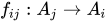
  1. is the identity on ,

Then the pair is called an inverse system of groups and morphisms over , and the morphisms are called the transition morphisms of the system.

The inverse limit of the inverse system is the subgroup of the direct product of the 's defined as

The definition above of an inverse system implies, that is closed under pointwise multiplication, and therefore a group, since

for all and every

The inverse limit comes equipped with natural projections πi: AAi which pick out the ith component of the direct product for each in . The inverse limit and the natural projections satisfy a universal property described in the next section.

This same construction may be carried out if the 's are sets, semigroups, topological spaces, rings, modules (over a fixed ring), algebras (over a fixed ring), etc., and the homomorphisms are morphisms in the corresponding category. The inverse limit will also belong to that category.[1] More generally, this construction applies when the belong to a variety in the sense of universal algebra, that is, a type of algebraic structures, whose axioms are unconditional (fields do not form an algebra, since zero does not have a multiplicative inverse).

General definition

[edit]

The inverse limit can be defined abstractly in an arbitrary category by means of a universal property. Let be an inverse system of objects and morphisms in a category C (same definition as above). The inverse limit of this system is an object X in C together with morphisms πi: XXi (called projections) satisfying πi = πj for all ij. The pair (X, πi) must be universal in the sense that for any other such pair (Y, ψi) there exists a unique morphism u: YX such that the diagram

commutes for all ij. The inverse limit is often denoted

with the inverse system and the canonical projections being understood.

In some categories, the inverse limit of certain inverse systems does not exist. If it does, however, it is unique in a strong sense: given any two inverse limits X and X' of an inverse system, there exists a unique isomorphism X′ → X commuting with the projection maps.

Inverse systems and inverse limits in a category C admit an alternative description in terms of functors. Any partially ordered set I can be considered as a small category where the morphisms consist of arrows ij if and only if ij. An inverse system is then just a contravariant functor IC. Let be the category of these functors (with natural transformations as morphisms). An object X of C can be considered a trivial inverse system, where all objects are equal to X and all arrow are the identity of X. This defines a "trivial functor" from C to The inverse limit, if it exists, is defined as a right adjoint of this trivial functor.

Examples

[edit]
  • The ring of p-adic integers is the inverse limit of the rings (see modular arithmetic) with the index set being the natural numbers with the usual order, and the morphisms being "take remainder". That is, one considers sequences of integers such that each element of the sequence "projects" down to the previous ones, namely, that whenever The natural topology on the p-adic integers is the one implied here, namely the product topology with cylinder sets as the open sets.
  • The p-adic solenoid is the inverse limit of the topological groups with the index set being the natural numbers with the usual order, and the morphisms being "take remainder". That is, one considers sequences of real numbers such that each element of the sequence "projects" down to the previous ones, namely, that whenever Its elements are exactly of form , where is a p-adic integer, and is the "remainder".
  • The ring of formal power series over a commutative ring R can be thought of as the inverse limit of the rings , indexed by the natural numbers as usually ordered, with the morphisms from to given by the natural projection.
  • Pro-finite groups are defined as inverse limits of (discrete) finite groups.
  • Let the index set I of an inverse system (Xi, ) have a greatest element m. Then the natural projection πm: XXm is an isomorphism.
  • In the category of sets, every inverse system has an inverse limit, which can be constructed in an elementary manner as a subset of the product of the sets forming the inverse system. The inverse limit of any inverse system of non-empty finite sets is non-empty. This is a generalization of Kőnig's lemma in graph theory and may be proved with Tychonoff's theorem, viewing the finite sets as compact discrete spaces, and then applying the finite intersection property characterization of compactness.
  • In the category of topological spaces, every inverse system has an inverse limit. It is constructed by placing the initial topology (with respect to the projection maps into the constituent spaces of the inverse system) on the underlying set-theoretic inverse limit. This is known as the limit topology.

Derived functors of the inverse limit

[edit]

For an abelian category C, the inverse limit functor

is left exact. If I is ordered (not simply partially ordered) and countable, and C is the category Ab of abelian groups, the Mittag-Leffler condition is a condition on the transition morphisms fij that ensures the exactness of . Specifically, Eilenberg constructed a functor

(pronounced "lim one") such that if (Ai, fij), (Bi, gij), and (Ci, hij) are three inverse systems of abelian groups, and

is a short exact sequence of inverse systems, then

is an exact sequence in Ab.

Mittag-Leffler condition

[edit]

If the ranges of the morphisms of an inverse system of abelian groups (Ai, fij) are stationary, that is, for every k there exists jk such that for all ij : one says that the system satisfies the Mittag-Leffler condition.

The name "Mittag-Leffler" for this condition was given by Bourbaki in their chapter on uniform structures for a similar result about inverse limits of complete Hausdorff uniform spaces. Mittag-Leffler used a similar argument in the proof of Mittag-Leffler's theorem.

The following situations are examples where the Mittag-Leffler condition is satisfied:

An example where is non-zero is obtained by taking I to be the non-negative integers, letting Ai = piZ, Bi = Z, and Ci = Bi / Ai = Z/piZ. Then

where Zp denotes the p-adic integers.

Further results

[edit]

More generally, if C is an arbitrary abelian category that has enough injectives, then so does CI, and the right derived functors of the inverse limit functor can thus be defined. The nth right derived functor is denoted

In the case where C satisfies Grothendieck's axiom (AB4*), Jan-Erik Roos generalized the functor lim1 on AbI to series of functors limn such that

It was thought for almost 40 years that Roos had proved (in Sur les foncteurs dérivés de lim. Applications.) that lim1 Ai = 0 for (Ai, fij) an inverse system with surjective transition morphisms and I the set of non-negative integers (such inverse systems are often called "Mittag-Leffler sequences"). However, in 2002, Amnon Neeman and Pierre Deligne constructed an example of such a system in a category satisfying (AB4) (in addition to (AB4*)) with lim1 Ai ≠ 0. Roos has since shown (in "Derived functors of inverse limits revisited") that his result is correct if C has a set of generators (in addition to satisfying (AB3) and (AB4*)).

Barry Mitchell has shown (in "The cohomological dimension of a directed set") that if I has cardinality (the dth infinite cardinal), then Rnlim is zero for all nd + 2. This applies to the I-indexed diagrams in the category of R-modules, with R a commutative ring; it is not necessarily true in an arbitrary abelian category (see Roos' "Derived functors of inverse limits revisited" for examples of abelian categories in which limn, on diagrams indexed by a countable set, is nonzero for n > 1).

[edit]

The categorical dual of an inverse limit is a direct limit (or inductive limit). More general concepts are the limits and colimits of category theory. The terminology is somewhat confusing: inverse limits are a class of limits, while direct limits are a class of colimits.

Notes

[edit]

References

[edit]
Revisions and contributorsEdit on WikipediaRead on Wikipedia
from Grokipedia
In and its applications across , the inverse limit (also called the projective limit) is a universal construction that assembles compatible elements from an inverse system of objects into a single object, serving as the categorical dual to the . An inverse system consists of objects AiA_i in a category C\mathcal{C}, indexed by a directed II, together with transition fij:AjAif_{ij}: A_j \to A_i for iji \leq j satisfying compatibility conditions such as fii=idAif_{ii} = \mathrm{id}_{A_i} and fik=fijfjkf_{ik} = f_{ij} \circ f_{jk} for ijki \leq j \leq k. The inverse limit lim{Ai}\lim_{\leftarrow} \{A_i\} is then an object in C\mathcal{C} equipped with πi:lim{Ai}Ai\pi_i: \lim_{\leftarrow} \{A_i\} \to A_i for each iIi \in I, such that πi=fijπj\pi_i = f_{ij} \circ \pi_j whenever iji \leq j, and it satisfies a : for any object BB with compatible ϕi:BAi\phi_i: B \to A_i, there exists a unique ϕ:Blim{Ai}\phi: B \to \lim_{\leftarrow} \{A_i\} such that πiϕ=ϕi\pi_i \circ \phi = \phi_i for all ii. In concrete categories like sets, abelian groups, or rings, the inverse limit can be explicitly realized as a of the product iIAi\prod_{i \in I} A_i consisting of those "threads" or tuples (ai)iI(a_i)_{i \in I} where ai=fij(aj)a_i = f_{ij}(a_j) for all iji \leq j, with the projections πi\pi_i being the natural componentwise maps. This construction exists in many categories, including topological spaces (where the inverse limit inherits the from the product) and modules over a ring, and it preserves exactness in abelian categories under certain conditions. The inverse limit is unique up to unique , ensuring its robustness as a foundational tool. Notable examples illustrate its versatility: the ring of p-adic integers Zp\mathbb{Z}_p is the inverse limit of the system Z/pnZ\mathbb{Z}/p^n\mathbb{Z} with transition maps given by reduction modulo pnp^n, where elements are coherent sequences (anmodpn)(a_n \mod p^n) representing k=0bkpk\sum_{k=0}^\infty b_k p^k with digits bk{0,1,,p1}b_k \in \{0, 1, \dots, p-1\}. Similarly, profinite groups, such as the profinite completion of the integers Z^=pZp\hat{\mathbb{Z}} = \prod_p \mathbb{Z}_p, arise as inverse limits of finite groups under surjective homomorphisms, endowing them with a compact . These constructions are pivotal in for studying completions and Galois representations, in for defining schemes via inverse limits of affine schemes, and in for the inverse limit topology on spaces like the .

Formal definition

Algebraic objects

In concrete algebraic categories such as groups and rings, the inverse limit is defined for sequences of objects indexed by the natural numbers. An inverse system of groups consists of a sequence of groups (Gn)nN(G_n)_{n \in \mathbb{N}} together with bonding homomorphisms ϕn,m:GmGn\phi_{n,m}: G_m \to G_n for all mnm \geq n, satisfying the conditions ϕn,n=idGn\phi_{n,n} = \mathrm{id}_{G_n} and ϕn,mϕm,k=ϕn,k\phi_{n,m} \circ \phi_{m,k} = \phi_{n,k} whenever kmnk \geq m \geq n. The inverse limit limGn\lim_{\leftarrow} G_n is the subset of the direct product n=1Gn\prod_{n=1}^\infty G_n consisting of all threads (xn)nN(x_n)_{n \in \mathbb{N}} such that ϕn,m(xm)=xn\phi_{n,m}(x_m) = x_n for all mnm \geq n. Formally, limGn={(xn)n=1Gn | ϕn,m(xm)=xn mn}.\lim_{\leftarrow} G_n = \left\{ (x_n) \in \prod_{n=1}^\infty G_n \ \middle|\ \phi_{n,m}(x_m) = x_n \ \forall m \geq n \right\}.
Add your contribution
Related Hubs
User Avatar
No comments yet.