Hubbry Logo
Propaganda MovementPropaganda MovementMain
Open search
Propaganda Movement
Community hub
Propaganda Movement
logo
8 pages, 0 posts
0 subscribers
Be the first to start a discussion here.
Propaganda Movement
Propaganda Movement
from Wikipedia

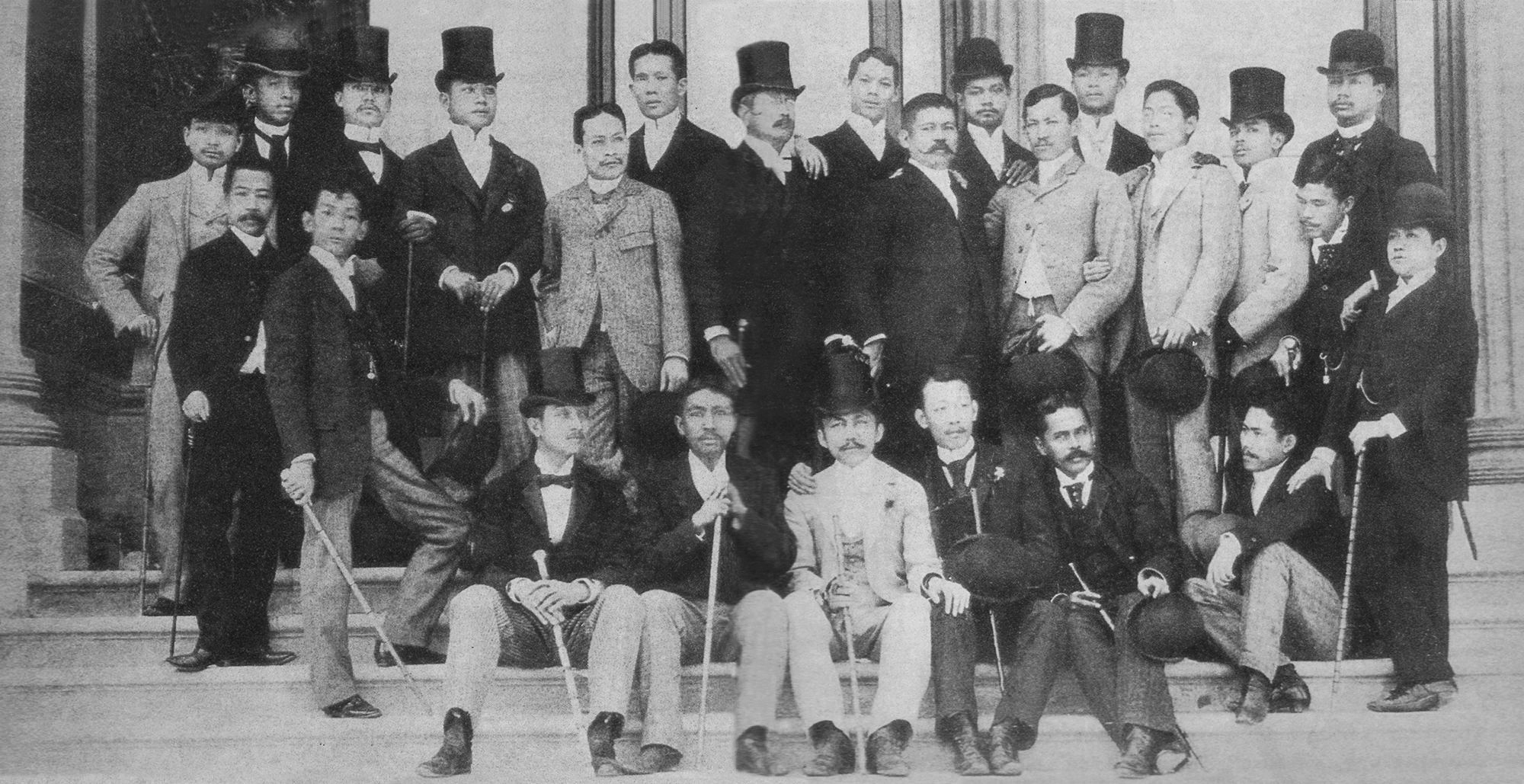
Filipino expatriates in Europe formed the Propaganda Movement. Photographed in Madrid, Spain in 1890.

The Philippine Propaganda Movement encompassed the activities of a group based in Spain but coming from the Philippines, composed of Indios (indigenous peoples), Mestizos (mixed race), Insulares (Spaniards born in the Philippines, also known as "Filipinos" as that term had a different, less expansive meaning prior to the death of Jose Rizal in Bagumbayan) and Peninsulares (Spaniards born in Spain) who called for political reforms in the Philippines in the late 19th century, and produced books, leaflets, and newspaper articles to educate others about their goals and issues they were trying to solve. They were active approximately from 1880 to 1898, and especially between 1880 and 1895, before the Philippine Revolutionary War against Spain began.[1][2]

Prominent members included José Rizal, the Philippine National Hero, author of novels Noli Me Tángere and El filibusterismo, and various essays, who was later executed by firing squad by the Spanish colonial authorities; Graciano López Jaena, publisher of La Solidaridad, the movement's principal organ; Mariano Ponce, the organization's secretary,[3] and Marcelo H. del Pilar.

The movement received very strong intellectual influence from the European Enlightenment, as evidenced by their specific aims, as follows:

  • Reinstate the former representation of the Philippines in the Cortes Generales or Spanish Parliament granted in the 1812 Spanish Constitution but retracted by Conservative forces in 1837
  • Secularize the clergy (i.e. use a secular or diocesan priest rather than clergy from a religious order)[4][5]
  • Legalize equality between Peninsulares (Spaniards born in Spain) and the other classes in the Philippine archipelago like the Indios, Mestizos and Insulares (old definition of the term "Filipino")
  • Reestablish Spanish citizenship for Indios and Mestizos that was retracted by Conservative forces in 1837
  • Reestablish the Philippines as a formal province of Spain, and not as a colony nor as an "overseas province"[6]
  • Abolish polo y servicios (labor service) and the bandala (forced sale of local products to the government)
  • Guarantee basic civil freedoms for all living in the archipelago
  • Provide opportunity for Indios, Mestizos and Insulares/Filipinos equal to Peninsulares to enter government service

Dr. Domingo Abella, Director of the National Archives between 1967 and 1976, had suggested that the Propaganda Movement was misnamed. He believes that it should have been called the Counterpropaganda Movement because its essential task was to counteract the campaign of misinformation that certain Spanish groups were disseminating in Spain and later in Rome (the Vatican).[7] It was a campaign of information, as well as a bid to build sympathy for political reform.

It is notable in contrast to the Katipunan, or the "K.K.K.", a Filipino revolutionary movement seeking the total independence of the Philippines from Spain. The Propaganda Movement instead sought to have the Philippines assimilated as a formal province of Spain, rather than being governed as a colony or an ¨overseas province.¨ The Katipunan revolutionary movement arose in response to the failure of the Spanish-based Propagandist Movement to achieve its goals.

The Filipinos of this movement were using "propaganda" in its Latin sense, not the pejorative connotation it has acquired in English. For instance, the Catholic institution called Sacra Congregatio de Propaganda Fide - Sacred Congregation for the Propagation of the Faith, is now translated as 'For the Evangelization of Peoples'). It was in the latter sense that the word was used by the Filipino group that sent Marcelo H. del Pilar to Spain to continue the "propaganda" on behalf of the Philippines.

References

[edit]
Revisions and contributorsEdit on WikipediaRead on Wikipedia
from Grokipedia

The Propaganda Movement was a late-19th-century reformist effort by Filipino ilustrados—educated elites primarily based in —to advocate for equal rights, representation in the Spanish Cortes, and assimilation of the as a province of through peaceful , , and lobbying against colonial abuses by officials and friars. Key figures included , , and , who established the Asociación Hispano-Filipina and the newspaper in in 1889 to publicize grievances and demand reforms such as of parishes, , and legal equality for Filipinos. The movement's writings, including Rizal's novels Noli Me Tángere (1887) and (1891), heightened national consciousness but failed to secure substantive changes from Spanish authorities, ultimately contributing to disillusionment and the outbreak of the in 1896.

Historical Context

Spanish Colonial Abuses and Stagnation

The Spanish colonial administration in the , established after Miguel López de Legazpi's conquest in 1565, relied on a centralized structure under a appointed by the Spanish Crown, but real power often resided with the Catholic religious orders, particularly the , , Dominicans, and , who controlled vast estates comprising thousands of hectares of prime agricultural land by the late . These orders monopolized parish administration, resisting efforts that sought to replace them with priests, as exemplified by their opposition to native appointments starting in the , which fueled grievances over denied positions and cultural suppression. Friars frequently intervened in , leveraging their influence to expand landholdings through purchases, donations, and legal maneuvers, often at the expense of native tenure rights, leading to tenant exploitation on haciendas where paid rents in crops or labor. Administrative and fiscal abuses compounded these ecclesiastical dominances, including the system, which initially granted Spaniards rights to collect tributes from assigned indigenous communities but devolved into exploitative labor extraction and revenue withholding, prompting revolts such as those in in the 17th century. The tribute system imposed annual payments in kind or cash on able-bodied males aged 16 to 60, often exceeding legal limits due to corrupt collectors who added unauthorized fees like the bandala (forced purchase of goods at inflated prices), while exemptions for the wealthy highlighted class disparities. Forced labor under polo y servicio required 40 days of unpaid annual service from males aged 16 to 60 for public works like road-building and ship construction, but extensions to 60 days or more were common amid enforcement abuses, contributing to depopulation and unrest, as seen in the triggered by the abolition of privileges without compensation replacement. Economic stagnation persisted due to the Manila-Acapulco galleon trade's dominance from 1565 to 1815, which funneled wealth into silver inflows and export of Chinese goods via Philippine ports but fostered no local industrialization or diversification, leaving agriculture subsistence-oriented and reliant on cash crops like under state monopolies that stifled private enterprise. Post-galleon decline, the economy showed limited growth, with population increases—from approximately 667,000 tribute payers in 1591 to over 5 million by 1894—outpacing infrastructure development, as forced labor built churches and fortifications but neglected modern railways or factories until the American era. Educational access remained restricted, with friars controlling curricula in parish schools and the (founded 1611) serving primarily elites, resulting in widespread illiteracy that perpetuated dependency and hindered intellectual progress. These systemic failures, rather than deliberate malice from , arose from distant oversight and local corruption, setting the stage for reformist discontent.

Emergence of the Filipino Educated Elite

The emergence of the Filipino educated , known as the ilustrados, was facilitated by in the Spanish colony beginning with the opening of to world in 1834 under the Royal Statute, which empowered the principalia—the native hereditary —and mestizos with unprecedented financial resources to invest in education. This shift from the closed system to open commerce fostered a nascent , particularly among Chinese mestizos and affluent indios, who accumulated wealth through like abaca and , enabling them to send children abroad or to local institutions. A pivotal development occurred with the 1863 Educational Decree issued by the Spanish Crown, which centralized and expanded the public education system by mandating compulsory primary instruction, free for the poor, and establishing normal schools for teacher training, such as the one in opened in 1864 that graduated approximately 60 teachers annually. By 1870, these reforms had resulted in 1,779 primary schools serving 385,907 students and enrolling about 2,300 pupils across the archipelago, though access remained skewed toward urban elites and the principalia, whose numbers had grown with the creation of 627 pueblos by 1858–1859. Higher education, previously dominated by Spaniards and clergy, began admitting native Filipinos more systematically; for instance, the opened courses in medicine and pharmacy to locals in 1875, with enrolling in 1877. Colonial schooling policies, despite their religious emphasis and friar oversight, inadvertently cultivated an autonomous educated class through exposure to secular subjects and eventual opportunities for study in , where ilustrados encountered Enlightenment , , and scientific . This elite, drawn from the principalia and comprising s across ethnic lines, began articulating grievances against clerical abuses and demands for representation in the , laying the intellectual groundwork for the Propaganda Movement's push for assimilation as provinces of Spain rather than outright . Their rise marked a causal break from prior stagnation, as economic agency combined with limited educational access produced a cadre capable of critiquing colonial asymmetries empirically observed in and resource allocation.

Origins and Development

Early Precursors in the Philippines

The secularization movement among Filipino clergy in the mid-19th century represented a primary precursor to the Propaganda Movement, as native secular priests challenged the dominance of Spanish friars in parish administration. Filipino priests, ordained through local seminaries established under royal decrees like the 1771 seminary in Manila, demanded the application of canon law granting them priority for curacies over regular orders such as the Augustinians and Franciscans. This push intensified after the Philippines' opening to global trade in 1834, which facilitated the spread of Enlightenment ideas and exposed colonial inconsistencies, including the friars' economic privileges and resistance to native advancement. Father Pedro Peláez, a Cebuano and rector, emerged as a leading advocate, petitioning church authorities from the 1840s onward for rights and criticizing friar encroachments on diocesan jurisdiction. Peláez's campaigns, supported by figures like Father Francisco Rioja, highlighted systemic , as Spanish orders retained control over most lucrative parishes despite a shortage of clergy. His death in the 1863 Manila earthquake did not halt the momentum; his student, Father , continued the fight through writings in periodicals like El Eco Filipino, decrying friar abuses and advocating educational reforms for natives. Burgos's 1864 article "Siempre Pobres y Miserables" underscored economic exploitation under colonial rule, linking clerical grievances to broader societal stagnation. Tensions culminated in the Cavite Mutiny of January 20-22, 1872, when indigenous arsenal workers and soldiers revolted against the revocation of exemptions from tribute and forced labor, killing Spanish officers before being suppressed. Spanish authorities implicated secular priests in instigating the unrest, leading to the arrest and garrote execution of Fathers Mariano Gomez, , and —known as —on February 17, 1872, in Bagumbayan (now Luneta Park). Despite scant evidence of direct involvement, the trial served as a pretext to eliminate reformist voices, with Rafael de Izquierdo viewing as a threat to friar influence. The martyrdom profoundly impacted the nascent Filipino elite, or ilustrados, fostering a collective sense of injustice and catalyzing covert discussions on reform. Young observers like , then a student, witnessed the event and later dedicated his novel (1891) to the trio, framing their deaths as emblematic of colonial oppression. This incident, amid ongoing friar abuses and administrative corruption, transitioned local discontent from isolated clerical disputes to organized intellectual resistance, prompting ilustrados to seek platforms abroad for advocacy.

Expatriation and Organization in Europe

Filipino reformists began expatriating to in the early 1880s, primarily to , seeking advanced education and respite from intensifying colonial surveillance and friar influence in the . , a key figure, departed on May 3, 1882, aboard the Salvadora, arriving in via and other ports before proceeding to in the fall to study medicine, philosophy, and languages at the Universidad Central de . Other early expatriates, including , who fled to around 1880 amid local persecutions for his satirical writings, joined scattered Filipino student communities in and , where they initially formed informal circles to discuss colonial grievances and Enlightenment-inspired reforms. By late 1888, escalating threats prompted further exoduses; Marcelo H. del Pilar, facing arrest warrants for anti-friar publications in the Philippines, sailed from Manila and reached Barcelona in early 1889, linking up with López Jaena and assuming leadership roles in the emerging network. These expatriates, numbering around 50-80 active members by 1890 including students and exiles, coalesced into structured organizations to amplify their advocacy. On January 12, 1889, they established the Asociación Hispano-Filipina in Madrid, a bipartisan group of Filipinos and sympathetic Spaniards divided into political (led by del Pilar), literary (under Mariano Ponce), and athletic sections to lobby Spanish legislators, host lectures, and disseminate pamphlets targeting assimilation and representation in the Cortes. Complementing these efforts, López Jaena launched on February 15, 1889, in as the movement's principal organ, a fortnightly publication in Spanish that critiqued colonial abuses and petitioned for equal rights, with del Pilar succeeding as editor upon the paper's relocation to later that year. The expatriates coordinated from affordable boarding houses and Masonic lodges, forging alliances with Spanish liberals like , while navigating internal divisions over tactics—Rizal favoring measured intellectual appeals versus del Pilar's sharper polemics. This European base enabled sustained pressure on 's policy circles until funding shortages and leadership fractures, exacerbated by Rizal's 1891 withdrawal, eroded cohesion by the mid-1890s.

Key Figures and Leadership

José Rizal's Role and Contributions


José Rizal (1861–1896), a Filipino polymath trained as a physician, scholar, and writer, emerged as the foremost intellectual leader of the Propaganda Movement during his studies and residence in Europe from 1882 onward. His advocacy focused on nonviolent reforms, including the assimilation of the Philippines as a Spanish province with representation in the Cortes, secularization of education, expulsion of Spanish friars from political influence, and extension of civil liberties to Filipinos.
Rizal's most influential contributions were his novels Noli Me Tángere, published in on March 21, 1887, and its sequel , released in in 1891. Noli Me Tángere depicted the social cancer of clerical abuses, corruption among colonial officials, and oppression of natives, while El Filibusterismo portrayed the futility of reform through a revolutionary lens, critiquing failed peaceful efforts. These works, serialized and circulated clandestinely in the , galvanized Filipino national consciousness and exposed systemic colonial ills, prompting Spanish authorities to ban them and contributing to the movement's propaganda aims without directly calling for independence. From 1889 to 1891, Rizal contributed essays, poems, allegories, and editorials to , the movement's principal organ founded by in on February 15, 1889, using pseudonyms such as "Laong Laan" and "Dimasalang" to advocate for equality and reform. Although offered the initial editorship, Rizal prioritized his literary projects; his articles emphasized Filipino-Spanish fusion and rational critique over radicalism. He also annotated and published an edition of Antonio de Morga's in 1890, highlighting pre-colonial Filipino civilization to counter narratives of barbarism. In July 1892, shortly after returning to , Rizal founded , a civic league promoting mutual aid, education, and lawful agitation for reforms, which served as a domestic extension of propaganda efforts before his arrest and exile to . Internal movement rivalries, including disputes with over La Solidaridad's direction, underscored Rizal's preference for intellectual persuasion over partisan journalism, though his on December 30, 1896, catalyzed the shift from propaganda to armed revolution.

Marcelo H. del Pilar and Editorial Leadership

Marcelo H. del Pilar, born on August 30, 1850, in Cupang, San Nicolas, , to Julian H. del Pilar and Blasa Gatmaitan, became a leading journalist and propagandist against Spanish colonial rule. In 1882, he founded and edited Diariong Tagalog, the first bilingual newspaper in the , which critiqued friar abuses and promoted native interests through articles in Tagalog and Spanish. Facing for his anti-clerical campaigns, del Pilar fled to , arriving in on January 1, 1889, where his organizational skills invigorated the expatriate Filipino reform efforts. On December 15, 1889, del Pilar assumed the role of editor-in-chief of , succeeding , and held the position until the paper's suspension on November 15, 1895. Under his direction, the fortnightly publication—printed in Spanish—intensified exposés of colonial injustices, advocating for Filipino assimilation as Spanish provinces, representation in the Cortes, , and legal equality while emphasizing non-violent, legalistic reform through evidence-based arguments. Del Pilar often managed the editorial process single-handedly, contributing prolifically under pseudonyms like Plaridel, amid chronic funding shortages offset by remittances from the Manila-based Comité de Propaganda, of which he was a key member. His leadership sustained La Solidaridad through 160 issues across seven volumes, fostering unity among propagandists despite internal frictions, such as leadership disputes with , by prioritizing collective advocacy over personal prominence. Del Pilar's pragmatic approach contrasted with more idealistic tones from predecessors, focusing on pragmatic critiques of dominance and administrative corruption to appeal to Spanish liberals and policymakers. Financial strain and waning support ultimately forced the paper's closure, after which del Pilar, ill and destitute, died of on July 4, 1896, in , buried in a pauper's grave.

Graciano López Jaena and Oratory

Graciano López Jaena (1856–1896) served as the preeminent orator of the Propaganda Movement, leveraging his rhetorical prowess to advocate for colonial reforms in Spain. Born on December 18, 1856, in Jaro, Iloilo, to a modest family, he demonstrated early intellectual promise by studying medicine at the University of Santo Tomas before fleeing the Philippines in 1880 amid persecution for his satirical writings against friar abuses, including the unfinished novella Fray Botod, which depicted clerical corruption through a caricatured obese friar exploiting parishioners. His exile propelled him into European circles, where he honed his speaking skills, associating with Spanish liberals and Freemasons to amplify Filipino grievances. In and , López Jaena delivered numerous speeches to mixed audiences of expatriates, politicians, and intellectuals, emphasizing assimilation into as equals rather than outright , arguing that merited representation in the Cortes and an end to discriminatory policies like tribute taxes and forced labor. His oratory contrasted with the more literary focus of compatriots like ; while Rizal produced novels and essays, López Jaena's extemporaneous addresses—over 100 documented—galvanized support by evoking shared Iberian heritage and decrying friar monopolies on education and land. A notable example occurred at the 1887 Philippine Exposition in , where he lauded indigenous contributions to Spanish while subtly critiquing colonial neglect, earning applause from attendees and bolstering the movement's visibility. López Jaena's founding of in February 1889 further integrated his oratory with print propaganda, as he used the organ's launch events to rail against administrative stagnation and judicial biases favoring . His persuasive style, marked by wit and eloquence, secured alliances within Spain's progressive factions, though internal rivalries—such as leadership disputes with —later diminished his influence. Despite these setbacks, his speeches laid rhetorical groundwork for reformist demands, influencing parliamentary debates on Philippine until his death from on January 20, 1896, in poverty-stricken . López Jaena's legacy in oratory underscores the Propaganda Movement's reliance on verbal advocacy to penetrate metropolitan indifference, complementing written critiques with direct, emotive appeals.

Supporting Propagandists and Internal Rivalries

The Propaganda Movement drew support from a network of Filipino expatriates beyond its primary leaders, including artists whose works symbolized national potential. and Felix Resurrección Hidalgo, acclaimed painters, received gold medals at the 1884 Madrid Exposition for and Las Virgenes Cristianas e Infieles, respectively, achievements that highlighted in a June 25, 1884, speech to argue for Filipino equality and assimilation under Spanish rule. , Juan's brother and a pharmacist-turned-general later, contributed pseudonymous articles on scientific topics and critiques of colonial policies to from 1889 onward, bolstering the periodical's intellectual output. Other backers, such as businessman Valentín Ventura, provided financial aid to Rizal and the group, funding publications and living expenses amid chronic shortages. Internal rivalries undermined organizational cohesion, most notably between Rizal and over leadership of the Madrid-based Filipino expatriate community. In December 1890, elections for president of the Filipino association (Asociación de Filipinos en España) resulted in ties after multiple ballots, with Rizal securing initial support for his emphasis on disciplined intellectual reform but facing opposition from del Pilar's allies favoring pragmatic lobbying. Rizal withdrew on December 15, 1890, to avert and refocus on writing , ceding control to del Pilar, whose editorial style in prioritized anti-friar agitation and alliances with Spanish progressives over Rizal's calls for austerity and cultural uplift. This power struggle, exacerbated by personal slights and divergent tactics—Rizal's principled detachment versus del Pilar's compromise-prone politicking—fragmented resources and morale, hastening the movement's decline by diverting energy from unified advocacy. Minor tensions also arose with , whose oratory clashed with Rizal's reservations about overt radicalism, though these remained secondary to the Rizal-del Pilar divide.

Objectives and Ideological Foundations

Core Demands for Assimilation and Reform

The 's primary objective was the assimilation of the as an integral province of , which would grant equal comparable to those enjoyed by in the peninsula, rather than maintaining colonial subordination. This demand emphasized full integration into the Spanish , including the cessation of discriminatory practices such as the payment of taxes by indios (native ) and exemption from forced labor systems like the polo y servicios. Central to this was the call for direct representation of the in the Spanish Cortes, allowing elected Filipino deputies to influence legislation affecting the archipelago. A key reform targeted the dominant role of Spanish friars, who controlled vast haciendas, , and local administration, often through coercive means. Propagandists demanded the expulsion or replacement of these religious orders with secular Filipino priests to secularize parishes and curb clerical abuses, including land monopolization and interference in , as exemplified by the March 1, 1888, petition signed by over 30 native Filipinos and mestizos urging the deportation of friars and the Archbishop of . This anti-friar stance stemmed from historical grievances, such as the execution of reformist priests like in 1872, which propagandists attributed to friar intrigue. Further demands included of commerce to foster economic equality, establishment of a public school system free from clerical oversight, and guarantees of freedoms such as and assembly to enable open discourse on . These reforms were pursued through legalistic appeals and publications, reflecting the movement's commitment to peaceful evolution within the Spanish framework, though Spanish authorities largely dismissed them as subversive.

Philosophical Underpinnings from Enlightenment and Liberalism

The drew its intellectual foundations from Enlightenment principles emphasizing reason, empirical inquiry, and human progress over tradition and superstition, which Filipino ilustrados encountered through European education and Freemasonic networks in the . These ideas critiqued absolutist and clerical dominance, advocating instead for rational and , as propagators like adapted them to challenge Spanish colonial abuses in the . Rizal's annotations of European texts reveal direct engagement with Voltaire's anti-clerical satire and Rousseau's theory, integrating them into calls for and legal equality by 1887. Classical liberalism further informed the movement's demands for constitutional representation and assimilation, viewing Filipinos as entitled to the same civic liberties as peninsular Spaniards under . , editing reformist publications from 1882, propagated these liberal tenets—such as democratic participation and anti-friar campaigns—through Diariong Tagalog, framing colonial inequities as violations of rational equity rather than divine order. , initiated into Spanish in 1882, embodied liberal fraternity by orating against privileges, aligning the movement's with Enlightenment-derived ideals of and equality that permeated Masonic lodges opposing Catholic . This synthesis rejected revolutionary upheaval in favor of evolutionary reform within Spain's liberalizing framework post-1868 Revolution, prioritizing evidence-based critique of estates' economic stranglehold—estimated to control 400,000 acres by surveys—over unsubstantiated loyalty to colonial absolutism. While sources like Rizal's correspondence affirm these borrowings, their application remained pragmatic, tempered by Catholic cultural persistence among ilustrados, avoiding full in favor of .

Methods and Propaganda Efforts

Establishment of La Solidaridad

was established on February 15, 1889, in , , as the primary journalistic organ of the Propaganda Movement. Filipino , a and orator exiled from the due to his reformist activities, founded and initially edited the fortnightly newspaper. The publication emerged from the need to disseminate critiques of Spanish colonial administration beyond the restrictions in the , targeting Spanish liberals, intellectuals, and policymakers with exposés on administrative abuses, economic exploitation, and demands for equal rights. Printed in Spanish to reach a metropolitan audience, La Solidaridad relied on contributions from key propagandists including and , though internal coordination occurred via correspondence among the scattered ilustrados in . Funding proved precarious, drawn from subscriptions among Filipino communities abroad and sporadic donations, which limited print runs to around 2,000 copies per issue initially. López Jaena's tenure as editor extended until October 1890, marked by fiery editorials that emphasized assimilation into rather than , reflecting the movement's reformist rather than revolutionary ethos at the time. The newspaper's launch coincided with heightened Spanish parliamentary debates on colonial policy, positioning it as a tool for through public advocacy. Despite its modest resources, the establishment of La Solidaridad formalized the propagandists' shift toward organized media efforts, bridging oratory and written to foster awareness of Filipino grievances.

Literary and Journalistic Outputs

The propagandists produced a body of literary works, including novels and essays, that critiqued Spanish colonial governance and clerical influence while advocating for enlightened reforms. José Rizal's Noli Me Tángere, published in on March 21, 1887, portrayed the fictional town of to illustrate systemic abuses by friars and officials, drawing from real events and fostering awareness of social inequities among educated and . Its sequel, , released in on September 18, 1891, shifted toward a more urgent call for intellectual awakening and subtle resistance, serialized elements of which appeared in related publications to evade . Rizal also authored essays like "The Indolence of the ," serialized in from July to September 1890, which refuted claims of inherent Filipino laziness by linking socioeconomic stagnation to prohibitive colonial taxes, lack of incentives, and disrupted pre-colonial trade networks. Journalistic efforts centered on La Solidaridad, the movement's flagship fortnightly publication launched February 15, , in , which ran 160 issues until November 15, 1895, featuring reformist articles in Spanish to target metropolitan audiences. , under the pseudonym Pláridel, contributed over 100 editorials and essays, including the inaugural "Our Purpose" on February 15, , which articulated the paper's mission to combat "reaction in all its forms" through factual exposure of Philippine conditions without descending into personal attacks. Graciano López Jaena, the founding editor, penned satirical pieces like those critiquing ecclesiastical power, while Rizal submitted approximately 10 articles under pseudonyms such as Laong Laan, notably "The Philippines a Century Hence" serialized from to , forecasting potential futures under continued misrule or assimilation. Contributors like added analytical essays on science, education, and governance, emphasizing empirical arguments for equal representation. These outputs prioritized reasoned persuasion over inflammatory , with literary forms providing allegorical depth to evade direct suppression and journalistic pieces supplying data-driven indictments, such as on forced labor and tribute burdens. Circulation reached expatriate circles and smuggled copies in the , influencing networks despite limited print runs of under 1,000 copies per issue due to funding constraints. Earlier precursors included López Jaena's short-lived La Libertad (1880s) and del Pilar's Diariong Tagalog (1882–1885), which tested reformist themes in and Spanish presses before the movement's consolidation in .

Lobbying and Public Advocacy in Spain

The Filipino propagandists pursued lobbying and public advocacy primarily through organized associations in and , aiming to influence Spanish policymakers toward colonial reforms. On January 12, 1889, they established the Asociación Hispano-Filipina, a bipartisan group of and that met monthly to deliberate on Philippine issues and draft reform proposals. The organization divided into three sections—political, literary, and sports—to amplify advocacy, with the political section under coordinating petitions and negotiations with deputies and senators. This structure enabled targeted campaigns, including demands for restoring Filipino representation in the Spanish Cortes, a privilege intermittently granted earlier in the colonial period but suspended by the . Del Pilar, as the association's political head, directed efforts to forge alliances with liberal Spanish figures, such as Overseas Minister Manuel Becerra, by presenting exposés on friar abuses and administrative inequities. These initiatives included submitting formal memorials to the Cortes advocating assimilation of the as a with equal rights, alongside pushes for of parishes and expanded local autonomy. The group lobbied for the Maura Law, promulgated on May 19, 1893, by , which restructured municipal elections to reduce dominance and introduce broader voter eligibility, though implementation delayed until 1895 amid colonial resistance. Public advocacy extended to cultivating metropolitan sympathy through dinners, lectures, and journalistic alliances, with del Pilar leveraging his editorial role to intrigue politicians for pledges. Despite gaining sporadic attention from progressive factions, these endeavors faced entrenched opposition from colonial bureaucrats and , yielding no fundamental changes in representation or governance before the movement's decline. The efforts nonetheless demonstrated strategic adaptation of parliamentary tactics to press assimilationist goals within Spain's liberal framework.

Challenges and Decline

Spanish Indifference and Repression

The Spanish metropolitan government and colonial officials in the demonstrated marked indifference to the Propaganda Movement's reformist agenda, ignoring petitions for equal representation in the Cortes, assimilation as a , and curbs on clerical abuses despite sustained from onward. This apathy persisted even as published over 160 issues between February 15, 1889, and November 15, 1895, exposing specific grievances such as friar land encroachments and discriminatory taxation, yet failing to sway Spanish policymakers amid domestic instability during the Restoration monarchy and competing colonial crises in . The entrenched power of the Augustinian, Franciscan, and Dominican orders, who controlled vast estates and influenced through , further insulated the status quo against change, rendering the ilustrados' appeals politically marginal. Repression against the movement escalated in the archipelago, where Governor-General Emilio Terrero initially tolerated some discourse but successors like José Basco y Vargas imposed stricter controls, including the 1887 ban on José Rizal's Noli Me Tángere for its depiction of clerical corruption, leading to Rizal's surveillance and forced departure from on February 8, 1888. Colonial authorities deported or imprisoned suspected sympathizers, such as the 1891 expulsion of reformist tenants from Calamba amid disputes, and monitored native presses to prevent emulation of Spanish liberal journalism. Such tactics, coupled with the friars' role in denouncing ilustrados as heretics, stifled domestic dissemination of propaganda, driving leaders like to rely on distant advocacy in while facing resource depletion. The culmination of repression manifested in the 1896 arrests following the Katipunan's exposure, though the Propaganda Movement itself had waned; Rizal's rearrest on July 6, , upon returning from , and subsequent on December 30, , in Bagumbayan, exemplified the regime's shift from indifference to outright elimination of reformist voices, accelerating toward armed revolution. This pattern of selective but escalating —totaling dozens of deportations and suppressions by mid-decade—underscored the limits of peaceful assimilationism against a colonial system prioritizing control over concession.

Internal Divisions and Resource Shortages

The Propaganda Movement suffered from significant internal divisions, particularly a leadership rivalry between and that undermined unified efforts. In December 1890, an election for the presidency of the Filipino expatriate committee in pitted Rizal against del Pilar, with Rizal securing victory by a narrow margin of 12 votes to del Pilar's 10; however, Rizal soon departed for to focus on his literary work, leaving del Pilar in effective control of and allowing personal animosities to persist. This conflict, characterized by mutual suspicions and competing visions—Rizal favoring measured intellectual advocacy while del Pilar emphasized journalistic militancy—led Rizal to withdraw from active propagandist roles, contributing to fragmented and diluted strategic focus. Further exacerbating these rifts were ideological differences and interpersonal intrigues among other figures, such as Graciano López Jaena's initial editorship of giving way to del Pilar's in 1890 amid health and organizational strains, which highlighted the lack of a cohesive agenda. The movement's reliance on a small cadre of ilustrados fostered petty bickering and duplicated efforts, as evidenced by the failure to sustain collaborative initiatives beyond sporadic publications. These divisions weakened the propagandists' ability to present a to Spanish authorities, allowing internal discord to erode momentum by the early 1890s. Compounding these fractures were chronic resource shortages, primarily financial constraints that hampered publication and advocacy. La Solidaridad, the movement's flagship organ launched on February 15, 1889, grappled with high printing costs in and inconsistent funding from Philippine-based committees and wealthy donors like Valentin Ventura, leading to irregular issues and ultimate cessation on November 15, 1895. The propagandists, mostly impecunious students and professionals in exile, lacked stable income streams, relying on subscriptions and remittances that proved insufficient amid economic pressures and the 1896 revolution's distractions. This scarcity not only limited outreach—such as printing pamphlets or lobbying in —but also intensified leadership tensions, as control over meager funds became a flashpoint, ultimately hastening the movement's decline before meaningful reforms could be achieved.

Impact and Consequences

Short-Term Failures in Achieving Reforms

Despite sustained lobbying efforts in and publications exposing colonial abuses, the Spanish government rejected the core demands of the Propaganda Movement, including representation for in the Cortes, assimilation of the as a regular Spanish , and curtailment of friar privileges. Spanish authorities viewed these reformist appeals as subversive threats to colonial control, prioritizing the economic interests of and the Catholic orders over concessions that could erode imperial authority. No legislative changes materialized; for instance, petitions submitted during the , such as those advocating for and equal civil rights, received no favorable response from , where political instability and Carlist conflicts diverted attention from peripheral colonies. Repression intensified as a direct counter to propaganda activities, undermining the movement's non-violent strategy. Colonial officials in , influenced by friar lobbying, imposed and deportations on key figures; was expelled from in 1890, and succumbed to in 1896 amid financial destitution and isolation. The execution of on December 30, 1896, for alleged sedition—despite his disavowal of violence—exemplified this hardening stance, extinguishing hopes for negotiated reforms and accelerating disillusionment among ilustrados. Financial shortages further crippled operations, with La Solidaridad ceasing publication in June 1895 due to unpaid debts exceeding 300 pesos, preventing broader dissemination of reformist ideas. These short-term setbacks stemmed from a mismatch between the propagandists' reliance on enlightened discourse and Spain's entrenched colonial inertia, where reforms threatened entrenched privileges without offering reciprocal benefits to metropolitan elites. Limited in the , confined largely to the educated elite, failed to generate domestic pressure sufficient to compel concessions, as rural masses remained insulated from metropolitan advocacy. Consequently, by mid-1896, the absence of tangible gains shifted momentum toward revolutionary alternatives, as peaceful assimilation proved unattainable under existing power structures.

Long-Term Fostering of National Consciousness

The Propaganda Movement's publications and advocacy cultivated a enduring Filipino national consciousness by highlighting colonial injustices and reclaiming pre-Hispanic cultural heritage as a basis for collective identity. José Rizal's historical annotations in his 1887 edition of Antonio de Morga's emphasized the advanced state of pre-colonial Philippine societies, countering Spanish narratives of barbarism and instilling ethnic pride among educated . This reframing of history from indigenous perspectives fostered a view of Filipinos as a distinct people capable of self-rule, influencing subsequent . Rizal's novels Noli Me Tángere, serialized in Berlin in 1887, and El filibusterismo, published in Ghent in 1891, depicted friar exploitation and administrative corruption, galvanizing resentment and solidarity across social classes in the archipelago. These works, circulated clandestinely despite bans, reached thousands and sparked discussions on liberty, education, and civic virtue, embedding reformist ideals into popular discourse. The organ La Solidaridad, issued from February 15, 1889, to 1895 in Barcelona, amplified these themes through essays by figures like Marcelo H. del Pilar and Graciano López Jaena, building intellectual networks that sustained awareness of Filipino grievances in Europe and the Philippines. The movement's formation of on July 3, 1892, in , aimed at economic cooperation and mutual aid, further institutionalized national unity by bridging regional divides and promoting self-reliance. Though short-lived due to Rizal's arrest, it prefigured revolutionary organizations like the , founded in 1892, which drew directly from propagandist rhetoric to mobilize armed resistance. Rizal's on December 30, 1896, elevated him to martyrdom, unifying diverse factions under a shared symbol of sacrifice and accelerating the shift from to demands during the 1896 . In the decades following, this awakened consciousness persisted through American colonial and persisted in shaping the 1935 Commonwealth and 1946 independence, as evidenced by the tripartite historical framework—pre-colonial , Spanish oppression, and modern aspirations—traced to propagandist legacies. Scholarly analyses attribute the movement's role in transcending elite circles, as its ideas permeated and , embedding in despite initial class limitations. Thus, by prioritizing rational critique over and assimilation over , the Propaganda Movement provided ideological scaffolding for enduring Filipino .

Criticisms and Alternative Perspectives

Elitist Nature and Class Disconnect

The Propaganda Movement was predominantly led by the ilustrados, a narrow stratum of educated from privileged backgrounds, including landowners and professionals who had studied in Europe, such as from a prosperous Calamba family and , a from a middle-class lineage. This elite composition inherently restricted the movement's scope, as its campaigns—conducted through Spanish-language publications like and lobbying in —targeted colonial authorities and liberal intellectuals rather than disseminating ideas in local dialects to the largely illiterate peasantry, who formed over 90% of the in the 1880s and 1890s. Critics highlight a profound class disconnect, noting that the movement's assimilationist demands for representation in the Spanish Cortes and equal rights overlooked the masses' pressing issues, including friar-controlled haciendas that dispossessed tenant farmers and perpetuated and forced labor. Historian argued in The Philippines: A Past Revisited () that the ilustrados reinforced colonial hierarchies by seeking integration into the elite colonial order, treating "Filipino" identity as an exclusionary concept that marginalized indios and perpetuated elite dominance over popular aspirations for and . This bourgeois orientation, as termed in later analyses, clashed with the self-serving of the ilustrados, whose reforms preserved principalia privileges without challenging the socioeconomic structures oppressing laborers and smallholders. The absence of grassroots mobilization evidenced this elitism; while the movement awakened national sentiments among the educated few, it elicited indifference or incomprehension among the rural masses, whose grievances fueled subsequent radical actions like Andres Bonifacio's in 1892, which drew from plebeian ranks and emphasized armed independence over elite petitioning. John N. Schumacher, in his analysis of the period, acknowledged the movement's confinement to the ilustrado sphere, where its intellectual efforts damaged friar prestige but failed to bridge the gulf to popular consciousness until revolutionary escalation. Such critiques, prominent in , underscore how the Propaganda Movement's class-bound focus contributed to its short-term inefficacy in galvanizing widespread reform.

Overreliance on Peaceful Means and Assimilationism

The Propaganda Movement's leaders, including , , and , pursued reforms through non-violent channels such as journalistic writings in (published from February 15, 1889, to November 15, 1895) and lobbying in the Spanish Cortes, emphasizing petitions for representation, secularization of clergy, and freedom of assembly. This approach stemmed from their belief in the Enlightenment ideals of rational discourse and Spanish liberalism, assuming that exposing abuses would prompt metropolitan reforms. However, critics argue this overreliance on peaceful advocacy underestimated the Spanish colonial administration's entrenched resistance, as evidenced by prior suppressions like the execution of three priests () on February 17, 1872, following the Cavite Mutiny, which signaled intolerance for dissent rather than yielding to persuasion. The assimilationist ideology—seeking to integrate the as an integral province of with equal rights for —further compounded the strategy's limitations, as it presupposed a willingness to extend to colonial subjects viewed racially as inferior by many . Historians like contend that this reformist framework confined the movement to incremental changes within , failing to mobilize mass resistance or question the sovereignty deficit inherent in overseas rule, thus delaying more decisive action. 's domestic turmoil, including the 1874 Restoration under and ongoing , prioritized peninsular stability over colonial equity, rendering appeals to liberal principles futile; no substantive reforms, such as Filipino seats in Cortes beyond token gestures, materialized despite campaigns from to 1895. This pacific orientation alienated potential allies among the lower classes, who faced abuses and encroachments without the ilustrados' access to European platforms, fostering perceptions of detachment from suffering. The movement's collapse, marked by del Pilar's death on July 4, 1896, and Rizal's execution on December 30, 1896, underscored the naivety of non-violent dependence, catalyzing the Katipunan-led under Andres Bonifacio, founded secretly in 1892 as an alternative emphasizing armed over assimilation. While principled, the strategy's insistence on loyalty oaths and rejection of violence—Rizal explicitly opposed uprisings in his 1887 annotations to Morga's Sucesos—ignored causal realities of power imbalances, where colonial powers rarely concede without coercion, as subsequent independence struggles worldwide affirm.

Historiographical Debates on Effectiveness

Historians widely concur that the Propaganda Movement failed to secure its immediate objectives of political assimilation, representation in the Spanish Cortes, and ecclesiastical reforms, as Spain's Restoration government under figures like prioritized colonial stability over concessions to colonial subjects, resulting in intensified repression such as the 1896 execution of . This short-term ineffectiveness stemmed from structural barriers, including the propagandists' limited access to Spanish power centers, reliance on sympathetic liberals who held minority influence post-1874, and opposition from powerful religious orders like the , who blocked demands for . Debates intensify over long-term effectiveness in cultivating national consciousness, with John N. Schumacher arguing in his archival study that the movement forged a distinct Filipino identity among the ilustrado elite through publications like (1889–1895) and Rizal's novels Noli Me Tángere (1887) and (1891), which critiqued colonial abuses and inspired revolutionary figures such as , who cited Rizal's works as catalysts for founding the in 1892. Schumacher's analysis, based on primary sources including propagandist correspondence, posits this consciousness as a causal precursor to the 1896 , shifting from reformist assimilationism to separatist momentum, though he notes the movement's elite focus limited direct mass mobilization. Critics, including some revisionist interpretations, contend the movement's impact on is overstated, attributing its reformist failures to an assimilationist ideology that preserved privileges rather than challenging Spanish sovereignty outright, thus disconnecting from the broader indio population whose grievances—such as dispossession and forced labor—drove revolutionary fervor independently via local uprisings predating influence. These views highlight internal divisions, such as Rizal's 1890 break with over , and the propagandists' Spanish-language , which reached few locals until translated post-1896, suggesting causal credit belongs more to repression events like the executions than to elite lobbying. counters such critiques by emphasizing of texts circulating among emerging middle classes, fostering a proto-national that evolved into anti-colonial action despite initial .

References

Add your contribution
Related Hubs
User Avatar
No comments yet.