Hubbry Logo
Hip roofHip roofMain
Open search
Hip roof
Community hub
Hip roof
logo
8 pages, 0 posts
0 subscribers
Be the first to start a discussion here.
Hip roof
Hip roof
from Wikipedia
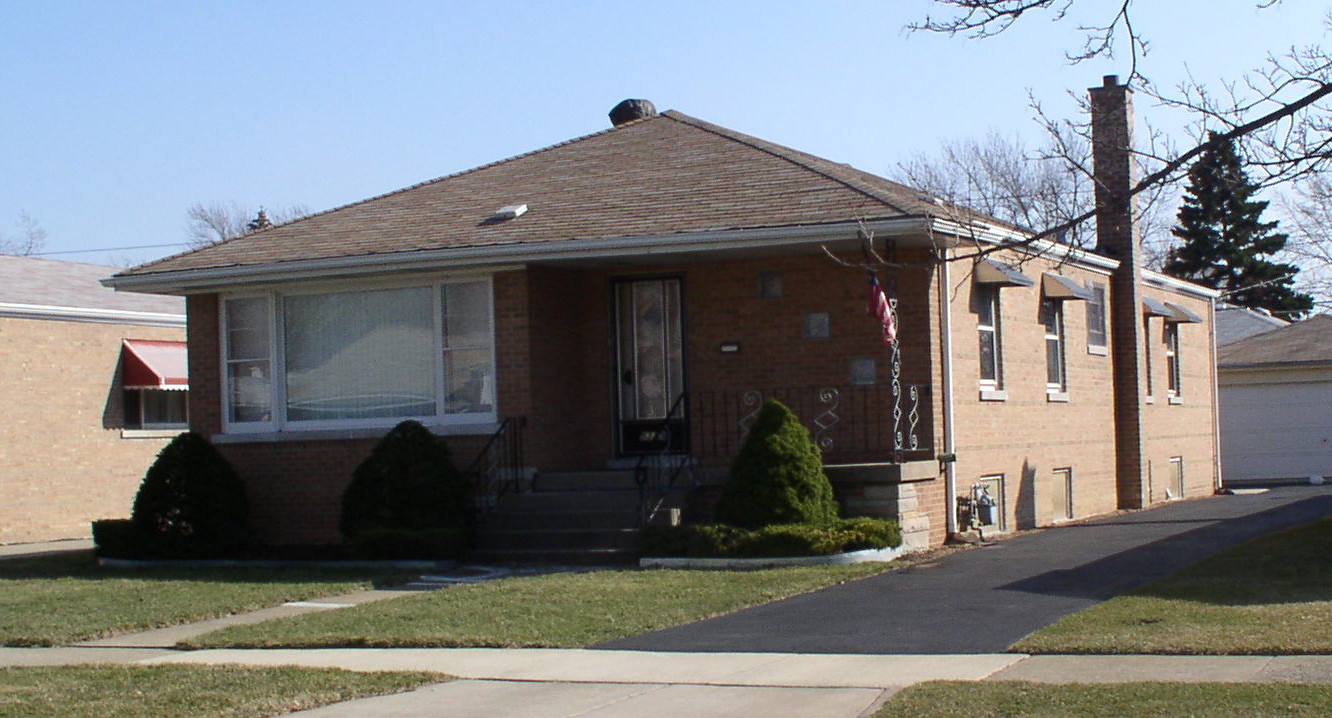
A raised bungalow in Chicago with a hipped roof
A hip-roof type house in Khammam city, India

A hip roof, hip-roof[1] or hipped roof, is a type of roof where all sides slope downward to the walls — thus, a hipped roof has no gables or other vertical sides to the roof. Variants of hipped roofs include the Simple Hip Roof (most common, four slopes meeting at a central ridge), Pyramid Hip Roof (a square base where all four triangular sides meet at a single peak), Cross Hip Roof (with multiple intersecting ridges for L- or T-shaped buildings), and Half Hip Roof (where gable ends are partially "clipped" with a small hip section). Other variations include the Dutch Gable Roof (a gable section on top of a hip roof), the Mansard Roof (a hip roof with two different pitches on each side), and the Hip-and-Valley Roof (often a blend for complex structures).

A square hip roof is shaped like a pyramid. Hip roofs on houses may have two triangular sides and two trapezoidal ones. A hip roof on a rectangular plan has four faces. They are almost always at the same pitch or slope, which makes them symmetrical about the centerlines. Hip roofs often have a consistent level fascia, meaning that a gutter can be fitted all around. Hip roofs often have dormer slanted sides.

Construction

[edit]
A hip roof construction in Northern Australia showing multinail truss construction. The blue pieces are roll-formed metal roof battens or purlins
Common hip roof on a rectangular plan with pitches rising to a ridge.
"Pavilion" hip roof on a square plan with pitches rising to a peak.

Hip roofs can be constructed on a wide variety of plan shapes. Each ridge is central over the rectangle of the building below it. The triangular faces of the roof are called the hip ends, and they are bounded by the hips themselves. The "hips" and hip rafters sit on an external corner of the building and rise to the ridge. Where the building has an internal corner, a valley makes the join between the sloping surfaces (and is underlain by a valley rafter). Hip roofs have the advantage of giving a compact, solid appearance to a structure. The roof pitch (slope) may vary.

Use

[edit]

In modern domestic architecture, hip roofs are commonly seen in bungalows and cottages, and have been integral to styles such as the American Foursquare. However, they have been used in many styles of architecture and in a wide array of structures.

Advantages and disadvantages

[edit]
A hip roof on a varied plan, "h" denotes a hip, "v" denotes a valley

A hip roof is self-bracing, requiring less diagonal bracing than a gable roof. Hip roofs are thus much more resistant to wind damage than gable roofs. Hip roofs have no large, flat, or slab-sided ends to catch wind and are inherently much more stable than gable roofs. However, for a hurricane region, the roof also has to be steep-sloped; at least 35 degrees from horizontal or steeper in slope is preferred. When wind flows over a shallow sloped hip roof, the roof can behave like an airplane wing. Lift is then created on the leeward side.[citation needed] The flatter the roof, the more likely this is to happen. A steeper pitched hip roof tends to cause the wind to stall as it goes over the roof, breaking up the effect. If the roof slopes are less than 35 degrees from horizontal, the roof is subject to uplift. Greater than 35 degrees, and not only does wind blowing over it encounter a stalling effect, but the roof is actually held down on the wall plate by the wind pressure.

A disadvantage of a hip roof, compared with a gable roof on the same plan, is that there is less room inside the roof space; access is more difficult for maintenance; hip roofs are harder to ventilate; and there is not a gable with a window for natural light.[2][3] Elegant, organic additions are relatively difficult to make on houses with hip roofs.

Variants

[edit]

Mansard roof

[edit]
Mansard roof

A mansard roof is a variation on a hip roof, with two different roof angles, the lower one much steeper than the upper.

Gablet roof or Dutch gable

[edit]
Gablet roof

Another variation is the gablet (UK terminology) or Dutch gable roof (U.S. and Australasian terminology), which has a hip with a small gable (the gablet) above it. This type simplifies the construction of the roof; no girder trusses are required, but it still has level walls and consistent eaves.

The East Asian hip-and-gable roof is similar in concept to the gablet roof.

Half-hip roof

[edit]
Half-hip roof

A half-hip, clipped-gable or jerkinhead roof has a gable, but the upper point of the gable is replaced by a small hip, squaring off the top of the gable. The lower edge of the half-hip may have a gutter that leads back on to the remainder of the roof on one or both sides. Both the gablet roof and the half-hipped roof are intermediate between the gabled and fully hipped types: the gablet roof has a gable above a hip, while a half-hipped roof has a hip above a gable.

Half-hipped roofs are common in England, Denmark, Germany and especially in Austria and Slovenia. They are also typical of traditional timber-frame buildings in the Wealden area of South East England.

Half-hip roofs are sometimes referred to as "Dutch hip", but this term is easily confused with "Dutch gable".

Pavilion roof

[edit]

A roof with equally hipped pitches on a square or regular polygonal plan having a pyramidal or almost pyramidal form.[4] Low variants are typically found topping gazebos and other pavilion structures. Steep tower or church tower variants are known as pyramid roofs.

Rhenish helm or Helm roof

[edit]

A pointed roof seen on a spire or a tower, oriented so that it has four gable ends. See the Church of St Mary the Blessed Virgin, Sompting, in England; or Speyer Cathedral and Limburg Cathedral in Germany.

Tented roof

[edit]

A tented roof is a type of polygonal hipped roof with steeply pitched slopes rising to a peak or intersection.

See also

[edit]

References

[edit]
[edit]
Revisions and contributorsEdit on WikipediaRead on Wikipedia
from Grokipedia
A hip roof, also known as a hipped roof, is a in which all four sides slope downward from a central or peak toward the building walls, with no vertical ends or flat sections. This design typically features uniformly pitched planes that meet at external angles called hips, creating a seamless, enclosed appearance from all elevations. On square buildings, it forms a pyramid-like , while rectangular structures often incorporate valleys where sections intersect. Hip roofs trace their prominence in North American architecture to the early 1700s, influenced by British colonial styles, with early examples from the colonial period in the 17th and 18th centuries. They have since become integral to various historical and revival styles, including Georgian, Colonial Revival, , and homes, valued for their symmetrical aesthetics and adaptability to diverse building forms. In European contexts, subtypes like the Dutch hip emerged in the for functional stone structures, emphasizing weather resistance. Key advantages of hip roofs include enhanced structural stability due to their self-bracing, symmetrical form, which distributes loads evenly and resists uplift forces better than gable roofs. They perform exceptionally in high-wind regions, such as hurricane-prone areas, by experiencing lower wind pressures and promoting efficient drainage of rain, snow, and debris. Aesthetically versatile, hip roofs complement both traditional and contemporary designs while offering energy efficiency through better insulation against heat and cold. Common variations include the simple hip for basic rectangular plans, the cross-hipped for L- or T-shaped buildings, and the pyramid hip where all sides converge equally at a point without a . Half-hipped versions feature truncated ends for added space, while more complex forms like the bonnet or Dutch integrate elements of other roof types for specific regional or stylistic needs. Despite these benefits, hip roofs can be more costly and complex to construct due to additional framing and seams, potentially increasing leak risks if not properly sealed.

Definition and Characteristics

Definition

A hip roof is a roof in which all sides slope downward toward the walls of the building, typically featuring no vertical ends or gables. This configuration creates a continuous sloping surface around the structure, providing a pyramid-like enclosure from the peak to the . The term "" specifically denotes the external formed where two adjacent sloping sides of the meet. Geometrically, a hip roof comprises four or more planar surfaces that converge along a central line in rectangular plans or form a pyramidal shape in square buildings, ensuring all edges direct water away from the structure. The name " roof" originates from the word "hype," which referred to a projection or , similar to the human , and was later applied in architecture to describe these sloping junctions. Unlike roofs, which incorporate triangular vertical sections, hip roofs fully slope on all faces for a more enclosed profile.

Key Features

A hip roof is characterized by its sloping planes on all four sides, which pitch downward from a central ridge or peak to the eaves, forming a continuous sloped surface around the structure. This design contrasts with gable roofs, which feature vertical end walls, by enclosing the roof entirely with inclined surfaces. Key structural elements include hips, which are the diagonal rafters formed at the corners where two sloping planes meet and extend outward from the ridge. In more complex multi-part hip roofs, valleys may appear as inward-angled intersections between planes, facilitating water drainage but requiring additional framing support. Common pitches for hip roofs are around 4:12, providing an optimal balance between aesthetic appeal and effective water shedding. These moderate slopes ensure stability while allowing for varied architectural expressions. The visual profile of a hip roof offers a compact and symmetrical enclosure, eliminating ends for a more unified and balanced appearance on rectangular or square buildings.

Historical Context

Origins

In , archaeological evidence from the 8th to 7th centuries BCE reveals the adoption of hipped roofs in early temples, transitioning from simpler thatched structures to more permanent forms using terracotta tiles. For instance, fragments from the Temple of Apollo at indicate hipped ends on both sides of the roof, providing better weather resistance and aesthetic harmony with columnar facades while distributing loads evenly to support the building's weight. This design was particularly suited to temple roofs, shielding interiors from rain and heat in the . Roman engineering from the BCE onward spread hip roof applications through the , adapting Greek models for practical use in villas and basilicas, where the design enhanced stability in seismically active regions like and Asia Minor. Examples include rural villas near Pompeii, where hip roofs with tegula tiles offered resistance to lateral forces from earthquakes by lowering the center of gravity and minimizing wind uplift. In pre-19th century , hip roof designs proliferated in Chinese pagodas and Japanese temples, refined for earthquake-prone environments. Similarly, Chinese pagodas like the Fogong Temple Pagoda (1056 CE) employed hip configurations to distribute weight and enhance resilience, surviving multiple quakes due to their elastic wooden frameworks.

Architectural Evolution

The hip roof saw significant stylistic and functional evolution in medieval Europe, with early examples in timber-framed buildings providing practical, weather-resistant coverage. By the period, particularly in 16th-century , the hip roof became a hallmark of chateau , where steeply pitched variants with dormers and cresting enhanced aesthetic opulence and structural integrity against heavy loads, as seen in estates like those inspired by prototypes. This adoption reflected a shift toward integrating Italianate with French regional needs for expansive, fortified residences. In the 18th and 19th centuries, the hip roof gained widespread popularity in colonial American architecture, particularly within the Georgian style, where hipped roofs—often low-pitched and balanced with classical pediments—conveyed and proportion, adapting European Palladian influences to the New World's climate and materials like siding. British Georgian examples frequently employed full hipped roofs for their elegant enclosure of corners, influencing American variants in urban row houses and plantations from the mid-Atlantic to the South. Victorian adaptations further diversified the form, incorporating steeper hip roofs with cross-gables in Queen Anne substyles to accommodate ornate detailing and attic spaces, blending functionality with eclectic ornamentation amid rapid . These developments marked a functional evolution toward roofs that supported growing domestic complexity while maintaining visual harmony. The 20th century integrated the hip roof into modernist paradigms, notably through Frank Lloyd Wright's Prairie style, where low-pitched hipped roofs with wide overhanging eaves emphasized horizontal lines to evoke the Midwestern landscape, fostering a sense of organic integration and shelter. This stylistic shift prioritized simplicity and site-specific harmony over historical ornament, influencing broader American residential design from the 1900s onward. Globally, the hip roof evolved in Islamic architecture under Ottoman influence, particularly in Balkan regions like Bosnia-Herzegovina, where modest neighborhood mosques featured wooden hipped roofs over prayer halls, adapting to local timber resources and seismic conditions while maintaining communal scale, as in 16th- to 19th-century constructions. Colonial adaptations in India and Africa further transformed the form: in India, British imperial bungalows from the 19th century employed hipped or hipped-gabled roofs with verandas to maximize shade and ventilation in tropical climates, indigenizing the design with local thatch or tile. In sub-Saharan Africa, colonial forest dwellings retained hipped roofs—often pitched and covered in corrugated iron—for rainwater runoff and heat dissipation, blending European imports with indigenous thatching traditions to suit humid environments. These global variations underscored the hip roof's adaptability to cultural and environmental contexts.

Construction Principles

Basic Techniques

The framing process for a hip roof typically begins with the installation of the ridge board, which forms the horizontal peak along the roof's length and serves as a nailing surface for the tops of the rafters. Common rafters are then positioned parallel to the primary roof slopes, extending from the ridge board down to the exterior walls on each side. Hip rafters follow, placed diagonally at the building's corners to connect the ends of the ridge board to the wall plates, creating the sloped edges characteristic of the design. Layout methods rely on tools such as the framing square to mark precise angles for cuts, ensuring a uniform pitch across all four sides of the roof. The framing square is used to measure and transfer the roof pitch—expressed as a ratio of rise over run—onto each rafter, aligning the plumb and level lines for accurate assembly. This step verifies that the slopes converge properly at the ridge and corners without deviation. Support structures integrate the rafters with the building walls through birdsmouth cuts, which are V-shaped notches carved into the underside of each near its lower end. These cuts allow the rafter to seat securely and flush against the top of the wall plate, distributing the load evenly while preventing slippage. Proper depth of the birdsmouth is critical to maintain the rafter's full depth along the without weakening the connection. A common challenge in hip roof framing involves calculating rafter lengths, especially for the longer hip rafters, which require adjustments beyond simple common rafter measurements. The Pythagorean theorem provides the foundational calculation for these lengths, where the rafter length LL is derived as L=rise2+run2L = \sqrt{rise^2 + run^2}
Add your contribution
Related Hubs
User Avatar
No comments yet.