
Hubbry Logo
PyrrolidinePyrrolidineMain
Open search
Pyrrolidine
Community hub
Pyrrolidine
logo
7 pages, 0 posts
0 subscribers
Be the first to start a discussion here.
Pyrrolidine
Pyrrolidine
from Wikipedia
Pyrrolidine
Names
Preferred IUPAC name
Pyrrolidine[1]
Other names
Azolidine
Azacyclopentane
Tetrahydropyrrole
Prolamine
Azolane
Identifiers
3D model (JSmol)
102395
ChEBI
ChEMBL
ChemSpider
ECHA InfoCard 100.004.227 Edit this at Wikidata
EC Number
  • 204-648-7
1704
RTECS number
  • UX9650000
UNII
UN number 1922
  • InChI=1S/C4H9N/c1-2-4-5-3-1/h5H,1-4H2 checkY
    Key: RWRDLPDLKQPQOW-UHFFFAOYSA-N checkY
  • InChI=1/C4H9N/c1-2-4-5-3-1/h5H,1-4H2
    Key: RWRDLPDLKQPQOW-UHFFFAOYAX
  • C1CCNC1
Properties
C4H9N
Molar mass 71.123 g·mol−1
Appearance Clear colorless liquid
Density 0.866 g/cm3
Melting point −63 °C (−81 °F; 210 K)
Boiling point 87 °C (189 °F; 360 K)
Miscible
Acidity (pKa) 11.27 (pKa of conjugate acid in water),[2]

19.56 (pKa of conjugate acid in acetonitrile)[3]

−54.8·10−6 cm3/mol
1.4402 at 28°C
Hazards
Occupational safety and health (OHS/OSH):
Main hazards
highly flammable, harmful, corrosive, possible mutagen
GHS labelling:
GHS02: FlammableGHS05: CorrosiveGHS07: Exclamation mark
Danger
H225, H302, H314, H332
P210, P233, P240, P241, P242, P243, P260, P261, P264, P270, P271, P280, P301+P312, P301+P330+P331, P303+P361+P353, P304+P312, P304+P340, P305+P351+P338, P310, P312, P321, P330, P363, P370+P378, P403+P235, P405, P501
NFPA 704 (fire diamond)
NFPA 704 four-colored diamondHealth 3: Short exposure could cause serious temporary or residual injury. E.g. chlorine gasFlammability 3: Liquids and solids that can be ignited under almost all ambient temperature conditions. Flash point between 23 and 38 °C (73 and 100 °F). E.g. gasolineInstability 1: Normally stable, but can become unstable at elevated temperatures and pressures. E.g. calciumSpecial hazards (white): no code
3
3
1
Flash point 3 °C (37 °F; 276 K)
345 °C (653 °F; 618 K)
Safety data sheet (SDS) MSDS
Related compounds
Related nitrogen heterocyclic compounds
Pyrrole (aromatic with two double bonds)
Pyrroline (one double bond)
Pyrrolizidine (two pentagonal rings)
Except where otherwise noted, data are given for materials in their standard state (at 25 °C [77 °F], 100 kPa).
checkY verify (what is checkY☒N ?)

Pyrrolidine, also known as tetrahydropyrrole, is an organic compound with the molecular formula (CH2)4NH. It is a cyclic secondary amine, also classified as a saturated heterocycle. It is a colourless liquid that is miscible with water and most organic solvents. It has a characteristic odor that has been described as "ammoniacal, fishy, shellfish-like".[4] In addition to pyrrolidine itself, many substituted pyrrolidines are known.

Production and synthesis

[edit]

Industrial production

[edit]

Pyrrolidine is prepared industrially by the reaction of 1,4-butanediol and ammonia at a temperature of 165–200 °C and a pressure of 17–21 MPa in the presence of a cobalt- and nickel oxide catalyst, which is supported on alumina.[5]

Reaction of 1,4-butanediol with ammonia to form pyrrolidine and water in the presence of a nickel oxide catalyst supported on alumina

The reaction is carried out in the liquid phase in a continuous tube- or tube bundle reactor, which is operated in the cycle gas method. The catalyst is arranged as a fixed-bed and the conversion is carried out in the downflow mode. The product is obtained after multistage purification and separation by extractive and azeotropic distillation.[5]

Laboratory synthesis

[edit]

In the laboratory, pyrrolidine was usually synthesised by treating 4-chlorobutan-1-amine with a strong base:

Synthesis of pyrrolidine

Furthermore, 5-membered N-heterocyclic ring of the pyrrolidine derivatives can be synthesized via cascade reactions.[6]

Occurrence

[edit]

Many modifications of pyrrolidine are found in natural and synthetic drugs and drug candidates.[6] The pyrrolidine ring structure is present in numerous natural alkaloids i.a. nicotine and hygrine. It is found in many drugs such as procyclidine and bepridil. It also forms the basis for the racetam compounds (e.g. piracetam, aniracetam). The amino acids proline and hydroxyproline are, in a structural sense, derivatives of pyrrolidine.
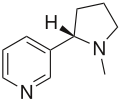
Nicotine contains an N-methylpyrrolidine ring linked to a pyridine ring.

Reactions

[edit]

Pyrrolidine is a base. Its basicity is typical of other dialkyl amines.[7] Relative to many secondary amines, pyrrolidine is distinctive because of its compactness, a consequence of its cyclic structure.

Pyrrolidine is used as a building block in the synthesis of more complex organic compounds. It is used to activate ketones and aldehydes toward nucleophilic addition by formation of enamines (e.g. used in the Stork enamine alkylation):[8]

References

[edit]
[edit]
Revisions and contributorsEdit on WikipediaRead on Wikipedia
from Grokipedia
Pyrrolidine is a five-membered saturated with the molecular formula C₄H₉N, featuring a ring composed of four carbon atoms and one atom, making it the parent compound of the pyrrolidine family. It appears as a colorless to pale yellow liquid with an ammonia-like odor and is miscible with , , and ethyl . Physically, pyrrolidine has a of 86.56–89°C, a of -63°C, and a of 0.847–0.853 g/cm³ at 20°C. Chemically, it acts as a strong base with a pKa of 11.31 for its conjugate acid, enabling reactivity with acids and participation in nucleophilic reactions due to the . It is flammable with a of 3°C and corrosive to skin and eyes, requiring careful handling as it is toxic if inhaled or ingested. Pyrrolidine serves as a versatile intermediate in , particularly in the production of pharmaceuticals, antibiotics, resins, and accelerators. In , its three-dimensional structure and stereochemical flexibility enhance , properties, and exploration; as of 2020, over 60 FDA-approved drugs contain the pyrrolidine scaffold as a non-aromatic heterocycle. Notable examples include pyrrolidine-based agonists for G-protein coupled receptor 40 in treatment, antagonists for estrogen receptor alpha in therapy, and anticonvulsants for management, as well as more recent approvals like danicopan (Voydeya) for in 2024. It also functions as a flavoring agent in and occurs naturally in plants like Cannabis sativa and Vitis vinifera.

Structure and properties

Molecular structure

Pyrrolidine is an with the molecular formula C₄H₉N, featuring a five-membered saturated heterocyclic ring composed of four methylene (CH₂) groups and one secondary (NH) group. This cyclic secondary structure positions the atom within the ring, connected to two carbon atoms and bearing a . The is pyrrolidine; azolidine is a systematic alternative, and it is also commonly referred to as tetrahydropyrrole. In terms of atomic hybridization and , all carbon and atoms in the pyrrolidine ring exhibit sp³ hybridization, resulting in bond angles approximating the ideal tetrahedral value of 109.5°. The ring adopts a puckered conformation to minimize angle strain, with the atom often positioned out of the plane formed by the adjacent four carbon atoms, as determined by calculations and studies. This flexible pseudorotational behavior allows the ring to interconvert between forms, contributing to its . Unlike its aromatic counterpart (C₄H₅N), which features a conjugated π-system where the participates in delocalization, pyrrolidine's full saturation renders it non-aromatic and enables the on to remain available in an sp³ orbital for and basic behavior. Similarly, compared to pyrroline, the partially unsaturated analog with one C=C , pyrrolidine lacks such unsaturation, emphasizing its aliphatic nature. The structural diagram of pyrrolidine can be depicted as a with the atom at one vertex bonded to two adjacent CH₂ groups, and the remaining three CH₂ groups completing the saturated ring.

Physical properties

Pyrrolidine appears as a clear, colorless to pale yellow liquid at , characterized by a strong ammoniacal, fishy odor. Its molecular is C₄H₉N, with a of 71.12 g/mol. The exhibits a dipole moment of 1.57 D, arising from the asymmetry of its five-membered ring structure. Under standard conditions, pyrrolidine has a of 0.86 g/cm³ at 20 °C and a of 1.443 at 20 °C. It melts at -63 °C and boils at 87 °C, with the low attributable to the flexible ring structure that limits intermolecular forces. The is 128 mmHg at 39 °C. Pyrrolidine is miscible with and most organic solvents such as , , and . It has a of 3 °C (closed cup) and an of 345 °C.
PropertyValueConditions/Source
Density0.86 g/cm³20 °C [Sigma-Aldrich]
Refractive index1.443n₂₀/D [Sigma-Aldrich]
Melting point-63 °C[ChemicalBook]
Boiling point87 °C[Sigma-Aldrich]
Vapor pressure128 mmHg39 °C [Sigma-Aldrich]
Flash point3 °CClosed cup [Sigma-Aldrich]
Autoignition temperature345 °C[Fisher Scientific]

Basic chemical properties

Pyrrolidine is classified as a secondary aliphatic , consisting of a five-membered saturated heterocyclic ring in which the nitrogen atom is bonded to two carbon atoms and one hydrogen, leaving its available for and enabling basic behavior. This basicity is quantified by the pKa of its conjugate acid, which measures 11.27 in , indicating moderate strength comparable to other cyclic secondary amines such as with a pKa of 11.22. In less polar solvents like , the pKa rises to 19.56, reflecting reduced of the protonated form and enhanced basicity relative to aqueous conditions. The five-membered ring geometry influences this basicity by constraining the nitrogen in a manner that supports effective proton acceptance, though detailed structural effects are addressed in the molecular structure section. Pyrrolidine demonstrates under standard ambient conditions, remaining resistant to oxidation in neutral environments due to the absence of readily oxidizable functional groups beyond the itself. Unlike its unsaturated analog , which can exhibit NH tautomerism in derivatives leading to alternative isomers, pyrrolidine's saturated structure precludes such tautomerism, maintaining a single stable form without relocation of the nitrogen hydrogen or double bonds.

Synthesis

Industrial production

The primary industrial method for producing pyrrolidine involves the catalytic reaction of with under high pressure and temperature conditions, typically conducted in a continuous fixed-bed tubular to ensure efficiency and scalability. This process operates at 165–200°C and 17–21 MPa, utilizing a composed of and oxides supported on alumina, which facilitates the cyclization and while minimizing byproducts such as and . is often introduced to enhance selectivity, achieving conversions near 100% and pyrrolidine yields up to 78% based on optimized formulations. The reaction's economic viability stems from the availability of as a in processes, allowing for cost-effective large-scale operation with space-time yields exceeding 150 kg/(m³ ·h). Following the reaction, crude pyrrolidine is purified through a series of distillation steps to remove unreacted ammonia, water, and low-boiling impurities, followed by extractive or azeotropic distillation to break azeotropes and achieve purity levels greater than 99%. Extractive distillation employs solvents like water or polar agents to enhance separation efficiency, while azeotropic methods use entrainers to facilitate phase separation, ensuring the final product meets industrial standards for use in pharmaceuticals and agrochemicals. These purification techniques are critical for economic recovery, as they recycle ammonia and minimize energy inputs in multi-column setups. Alternative routes include the gas-phase catalytic ammoniation of with over acidic catalysts like modified zeolites at around 250–300°C, offering high yields above 95% in some configurations but requiring careful control to manage side reactions forming . Another approach is the of using supported metal catalysts such as on magnesia, though this is less common industrially due to pyrrole's higher cost and issues. Global production capacity for pyrrolidine is estimated in the thousands of tons annually, driven by demand in fine chemicals, with major producers including SE and Chinese firms like Shandong Longyuan New Material Technology Co. Ltd. (700 tons/year), Changyi Ruihai Biotechnology Co. Ltd. (800 tons/year), and Cynovate Chemical Technology Co. Ltd. (1,200 tons/year, announced 2024).

Laboratory synthesis

Pyrrolidine can be synthesized in the through the classic intramolecular cyclization of 4-chlorobutan-1-amine treated with a strong base such as in . This reaction proceeds via an SN2 displacement where the deprotonated attacks the carbon bearing the , forming the five-membered ring with yields typically ranging from 70-90% after basification, extraction, and . The method, first described by in 1891, remains a straightforward option for small-scale preparation due to the availability of the starting material and simple conditions. Alternative routes include the reduction of using lithium aluminum hydride in , followed by careful , which directly affords pyrrolidine in 70-90% yield. This approach leverages the selective reduction of the imide carbonyls to methylene groups, avoiding over-reduction when using high-quality hydride reagent. of succindialdehyde (generated in situ from precursors like 2,5-dimethoxytetrahydrofuran and acid) with under catalytic conditions also provides pyrrolidine in comparable yields, offering versatility for or derivative synthesis. Modern laboratory methods emphasize one-pot cascade reactions, such as the dehydrogenative coupling of with over metal catalysts like Cu- or Ru-modified zeolites or pincer complexes, achieving up to 95% yield at 200-250°C. These catalytic processes mimic industrial routes but are adapted for lab scale with reduced catalyst loadings and shorter reaction times. Purification across all methods involves under reduced pressure (typically 50-60°C at 50-100 mbar) to isolate pure pyrrolidine and minimize or oxidation.

Natural occurrence

In alkaloids and amino acids

Pyrrolidine serves as the core in , a where the pyrrolidine ring is substituted at the 2-position with a group, making it the only secondary amine among the standard . , a post-translationally modified derivative, features a hydroxyl group at the 4-position of the pyrrolidine ring and is abundant in , comprising along with and about 57% of the in this protein. These residues impart rigidity and conformational flexibility to collagen's ; specifically, in Gly-Pro-Hyp repeats enables local twisting and stability essential for and structural integrity in connective tissues. Proline's pyrrolidine ring also influences broader protein dynamics by restricting backbone dihedral angles, thereby guiding folding pathways and interactions in various proteins. In alkaloids, pyrrolidine forms a key heterocyclic component, as seen in , where an N-methylpyrrolidine ring is attached by a to the 3-position of a moiety, derived from the leaves of plants ( species). Similarly, hygrine, another pyrrolidine alkaloid isolated from coca leaves (), features an N-methylpyrrolidine ring acylated at the 2-position with an acetonyl group. The of these alkaloids proceeds through the pathway: is decarboxylated to , which cyclizes to form the pyrrolidine ring precursor, ultimately incorporating into nicotine's pyrrolidine moiety and hygrine's structure via enzymatic condensation. Beyond these prominent examples, pyrrolidine occurs in trace amounts in tobacco smoke, where it appears as a volatile component in the gas phase alongside related heterocycles from of material. It is also present in certain fungi through degradation pathways of alkaloids like , though direct endogenous production remains less documented. These pyrrolidine-containing alkaloids, such as and hygrine, contribute to defense by deterring herbivores and pathogens, with exemplifying that protects against predation. The pyrrolidine motif holds evolutionary significance in biomolecules, as its five-membered ring size provides near-planar geometry without strain, facilitating efficient incorporation into early structures and enzymatic active sites. In proline biosynthesis, evolutionary adaptations of reductases from δ1-pyrroline-5-carboxylate highlight the motif's role in stress tolerance, suggesting its ancient conservation for environmental resilience in primitive organisms. Pyrrolidine itself occurs naturally in various plants, including and . It has also been detected in foods such as , , cheese, carrots, , , , and fatty fish.

Reactions and applications

As a base and nucleophile

Pyrrolidine functions as a base through proton transfer reactions, where its nitrogen lone pair accepts a proton to form the pyrrolidinium cation. The acid-base equilibrium is represented as: C4H8NH+H+C4H8NH2+\mathrm{C_4H_8NH + H^+ \rightleftharpoons C_4H_8NH_2^+} The pKa of the pyrrolidinium ion is 11.31 in water at 25°C, indicating moderate basicity relative to other amines. This value corresponds to a protonation equilibrium constant K=1011.312.04×1011K = 10^{11.31} \approx 2.04 \times 10^{11} M1^{-1}, favoring the protonated form in acidic conditions. For salt formation with strong acids like HCl (pKa ≈ -6.3), the equilibrium strongly favors the pyrrolidinium chloride salt, with an association constant K1017.6K \approx 10^{17.6}, ensuring nearly complete ionization in aqueous solution. This high affinity makes pyrrolidine salts stable and commonly used in isolation and storage. As a , pyrrolidine's enables attacks on electrophilic centers, such as in alkyl halides via SN2 mechanisms. A representative example is its quaternization with methyl iodide, proceeding through initial to the N-methylpyrrolidine salt, followed by further to yield the 1,1-dimethylpyrrolidin-1-ium . This reaction highlights its reactivity toward primary alkyl halides, often conducted in polar solvents like . Pyrrolidine also participates in nucleophilic addition to carbonyl groups, where the attacks the electrophilic carbon to form a tetrahedral intermediate, such as a carbinolamine. For instance, reaction with aldehydes or ketones initiates further transformations, underscoring its utility in carbon-carbon bond-forming processes. In terms of nucleophilicity, pyrrolidine is stronger than and primary amines, with a nucleophilicity parameter N=17.21N = 17.21 in (versus N=9.48N = 9.48 for and N=12.0N = 12.0 for ), reflecting its enhanced basicity and inductive effects from the alkyl ring. However, relative to acyclic primary amines, the cyclic structure introduces moderate steric hindrance around the , potentially reducing reactivity in sterically demanding substitutions compared to less hindered analogs like . This balance makes pyrrolidine a versatile in both protic and aprotic media.

In organic synthesis

Pyrrolidine serves as a key reagent in , particularly through its ability to form enamines with carbonyl compounds, enabling selective functionalizations at the α-position. Enamine formation involves the condensation of pyrrolidine, a secondary , with aldehydes or ketones having α-hydrogens, typically under dehydrating conditions such as Dean-Stark apparatus or molecular sieves, often catalyzed by removal of acid byproducts like . The general reaction is represented as: RCH2C(O)R+C4H8NHRCH=CRN(C4H8)+H2O\mathrm{R-CH_2-C(O)-R' + C_4H_8NH \rightarrow R-CH=CR'-N(C_4H_8) + H_2O} where the enamine tautomerizes from the initial carbinolamine intermediate, providing a nucleophilic alkene surrogate for enolates. A prominent application is the Stork enamine alkylation, developed by Gilbert Stork and colleagues, which allows regioselective α-alkylation of carbonyl compounds without self-condensation issues common in enolate chemistry. The process begins with enamine formation from the carbonyl substrate and pyrrolidine, followed by nucleophilic attack of the enamine's β-carbon on an alkyl halide (e.g., primary or allylic), generating an alkylated iminium ion intermediate. Hydrolysis under aqueous acidic conditions then regenerates the pyrrolidine and yields the α-alkylated carbonyl product. For instance, the pyrrolidine enamine of cyclohexanone reacts with methyl iodide to afford, after hydrolysis, 2-methylcyclohexan-1-one in high yield, demonstrating the method's utility for introducing alkyl groups at the less substituted α-position. This reaction has been widely adopted for synthesizing complex natural products and pharmaceuticals due to its mild conditions and compatibility with sensitive functional groups. Beyond , pyrrolidine functions as a in certain organometallic reactions, such as Grignard additions or palladium-catalyzed couplings, owing to its ability to solvate metal centers without proton donation. It also serves as a in chiral ligands for asymmetric ; for example, pyrrolidine-derived ligands coordinate to or to facilitate enantioselective C-C bond formations, achieving up to 99% ee in hydroalkylation reactions. In , pyrrolidine acts as an efficient nucleophilic base for deprotecting 9-fluorenylmethoxycarbonyl (Fmoc) groups during , enabling Fmoc removal in greener, less polar solvents like mixtures, which improves coupling efficiency and reduces waste compared to traditional use. Industrially, pyrrolidine is a vital intermediate in agrochemical production, serving as a building block for herbicides like and insecticides through derivatization into substituted pyrrolidines that enhance bioactivity. It also contributes to as a precursor for (PVP) synthesis via N-vinylation, used in adhesives and coatings. Global pyrrolidine production reached approximately 78 million USD in the region in 2023, with projections to grow to 103 million USD by 2030 at a CAGR of 3.5%, driven by demand in these sectors.

Safety and toxicology

Handling hazards

Pyrrolidine is a highly , designated under the (GHS) as H225 for highly flammable liquid and vapor, with a of 3°C that enables easy ignition even at . This low , combined with its volatility, allows vapors to form mixtures with air over a wide range of concentrations from 1.6% to 10.6% by volume, necessitating strict control of ignition sources during handling and storage to prevent fires or explosions. Reactivity hazards include exothermic reactions with strong oxidizing agents, which can generate heat and potentially hazardous decomposition products, as well as the formation of explosive mixtures under certain conditions. Additionally, pyrrolidine exhibits corrosivity toward metals like aluminum and , especially in moist environments, where it can promote degradation and evolution. It is incompatible with acids, acid chlorides, acid anhydrides, and other reactive substances that may lead to violent reactions or pressure buildup in containers. For safe storage, pyrrolidine should be kept in tightly sealed containers constructed of or under an inert atmosphere to minimize oxidation and moisture exposure, stored in a cool, dry, well-ventilated area away from heat, sparks, flames, and oxidizing materials. Compatibility with non-reactive solvents is generally acceptable, but segregation from incompatibles is essential to avoid unintended reactions. In the event of a spill, immediately evacuate non-essential personnel, ventilate the area to disperse flammable vapors, and contain the liquid using inert absorbents like sand, earth, or ; all equipment must be grounded to prevent static ignition, and the collected material should be disposed of as .

Health effects

Pyrrolidine exhibits primarily through ingestion, , and dermal contact, classified under the Globally Harmonized System (GHS) as (H302) or inhaled (H332), and causing severe skin burns and eye damage (H314). Oral exposure in rats yields an LD50 of approximately 430 mg/kg, indicating moderate via this route. Inhalation of vapors results in an LC50 of 11.7 mg/L over 4 hours in rats, with symptoms including irritation, coughing, and potential effects such as headaches or . Dermal contact leads to due to its basic nature, causing burns, redness, and pain upon exposure. Chronic exposure to pyrrolidine may result in persistent respiratory irritation, including of the mucous membranes and potential long-term damage to the lungs from repeated . As a secondary , pyrrolidine has the potential to form nitrosamines under certain conditions (e.g., in the presence of nitrites), which are associated with carcinogenicity, though direct evidence of mutagenicity or carcinogenicity for pyrrolidine itself is lacking in standard classifications. No specific reproductive or developmental toxicity has been identified in available toxicological data. Primary exposure routes include of vapors, which carry an ammonia-like, fishy detectable at low concentrations, facilitating early awareness of airborne presence; dermal absorption through contact; and , though less common in occupational settings. Upon absorption, pyrrolidine is expected to undergo metabolic ring-opening, potentially leading to amines and carboxylic acids, though detailed studies are limited. Regulatory limits include no specific occupational exposure limits (e.g., ACGIH TLV or OSHA PEL) established for pyrrolidine. The U.S. Environmental Protection Agency lists pyrrolidine under the Toxic Substances Control Act (TSCA) as an active , but it lacks a specific beyond general communication requirements. For acute exposures, measures emphasize immediate : flush eyes with water for at least 15 minutes while holding eyelids open, rinse skin with copious water, and seek medical attention for or cases, where inducing is contraindicated due to corrosivity.

References

Add your contribution
Related Hubs
User Avatar
No comments yet.