


Community hub
0 subscribers8 pages, 0 posts
Recent from talks
All channels
Be the first to start a discussion here.
Be the first to start a discussion here.
Be the first to start a discussion here.
Be the first to start a discussion here.
Contribute something
Welcome to the community hub built to collect knowledge and have discussions related to Quarter dollar.
Nothing was collected or created yet.
Quarter dollar
View on Wikipediafrom Wikipedia

 | This article needs additional citations for verification. (June 2025) |
The term "quarter dollar" refers to a quarter-unit of several currencies that are named "dollar". One dollar ($1) is normally divided into subsidiary currency of 100 cents, so a quarter dollar is equal to 25 cents. These quarter dollars (aka quarters) are denominated as either coins or as banknotes. Although more than a dozen countries have their own unique dollar currency, not all of them use quarters. This article only includes quarters that were intended for circulation, those that add up to units of dollars, and those in the form of a coin.
Currently minted
[edit]| Circulating Quarter dollars by country | |||||||||
|---|---|---|---|---|---|---|---|---|---|
| Country(s) / City | Unit of currency |
Technical parameters[a] | Description | Date of first minting[b] | |||||
| Diameter | Thickness | Weight | Composition | Edge | Obverse | Reverse | |||
 Anguilla Anguilla
|
XCD | 24.0 mm | N/A | 6.5 g | 75% copper 25% nickel | Ribbed | British monarch | Value, year of minting, "East Caribbean States", sailing ship | 2002 |
 Antigua and Barbuda Antigua and Barbuda
|
XCD | 24.0 mm | N/A | 6.5 g | 75% copper 25% nickel | Ribbed | British monarch | Value, year of minting, "East Caribbean States", sailing ship | 2002 |
 Barbados Barbados
|
BBD | 23.7 mm | 1.8 mm | 5.1 g | Nickel-plated steel | Reeded | Coat of arms of Barbados | Morgan Lewis windmill | 2007 |
 Bahamas Bahamas
|
BSD | 24.26 mm[1] | 1.7 mm[1] | 5.1 g[1] | Coat of arms of the Bahamas[1] | A native sloop[1] | |||
 Belize Belize
|
BZD | N/A | N/A | N/A | 75% copper 25% nickel | N/A | British monarch | Ornamental - Country/Value/Date | 1981 |
 Bermuda Bermuda
|
BMD | 25.0 mm | N/A | 5.9 g | 75% copper 25% nickel | Milled | British monarch | Coat of arms | 1970 |
 Canada Canada
|
CAD | 23.9 mm | 1.6 mm | 4.4 g | 94% steel, 3.8% copper, 2.2% nickel plating | Milled | British monarch | Caribou | 2000 |
 Cayman Islands Cayman Islands
|
KYD | 24.3 mm | 1.6 mm | 5.1 g | Nickel-plated steel | Smooth | British monarch | Schooner "Kirk B" | 1999 |
 Dominica Dominica
|
XCD | 24.0 mm | N/A | 6.5 g | 75% copper 25% nickel | Ribbed | British monarch | Value, year of minting, "East Caribbean States", sailing ship | 2002 |
 Grenada Grenada
|
XCD | 24.0 mm | N/A | 6.5 g | 75% copper 25% nickel | Ribbed | British monarch | Value, year of minting, "East Caribbean States", sailing ship | 2002 |
 Liberia Liberia
|
LRD | 23.0 mm | 1.8 mm | 4.5 g | Nickel Clad Steel | Reeded | Head with headress and country name | Value/Date within wreath | 2000 |
 Montserrat Montserrat
|
XCD | 24.0 mm | N/A | 6.5 g | 75% copper 25% nickel | Ribbed | British monarch | Value, year of minting, "East Caribbean States", sailing ship | 2002 |
 Saint Kitts and Nevis Saint Kitts and Nevis
|
XCD | 24.0 mm | N/A | 6.5 g | 75% copper 25% nickel | Ribbed | British monarch | Value, year of minting, "East Caribbean States", sailing ship | 2002 |
 Saint Lucia Saint Lucia
|
XCD | 24.0 mm | N/A | 6.5 g | 75% copper 25% nickel | Ribbed | British monarch | Value, year of minting, "East Caribbean States", sailing ship | 2002 |
 Saint Vincent and the Grenadines Saint Vincent and the Grenadines
|
XCD | 24.0 mm | N/A | 6.5 g | 75% copper 25% nickel | Ribbed | British monarch | Value, year of minting, "East Caribbean States", sailing ship | 2002 |
| The Bahamas
|
BSD | 24.3 mm | 1.7 mm | 5.0 g | Nickel-plated steel | Reeded | Coat of Arms | Bahamian sloop | 2007 |
 Trinidad and Tobago Trinidad and Tobago
|
TTD | N/A | N/A | N/A | 75% copper 25% nickel | N/A | Coat of Arms | Value | 1976 |
 United States and others United States and others
|
USD | 24.3 mm | N/A | 5.7 g | 75% copper 25% nickel | Reeded | George Washington | Eagle | 2022 |
 Zimbabwe Zimbabwe
|
N/A | 23.0 mm | N/A | 4.8 g | Nickel-plated steel | N/A | RBZ in various positions with coin date | Enclosed in circle with "25" surrounded by "TWENTY-FIVE CENTS BOND COIN" | 2014 |
See also
[edit]Notes
[edit]References
[edit]


Quarter dollar
View on Grokipediafrom Grokipedia
The quarter dollar, commonly known as the quarter, is a circulating coin of the United States with a face value of 25 cents, equivalent to one-fourth of a dollar.[1] First authorized by the Coinage Act of 1792 and minted in 1796 as a silver coin featuring Liberty on the obverse and an eagle on the reverse, it has been continuously produced since 1831 and serves as legal tender for everyday transactions.[1] Since 1932, the obverse has depicted George Washington to commemorate the 200th anniversary of his birth, designed by John Flanagan, while reverse designs have evolved to include heraldic eagles, commemorative motifs, and educational programs highlighting American history and culture.[1]
The history of the quarter dollar reflects broader changes in U.S. numismatics and economic policy. Early silver quarters from 1796 to 1964 were composed of 90% silver and 10% copper, but rising silver prices led to the Coinage Act of 1965, which transitioned to a copper-nickel clad composition for circulating coins to preserve resources.[1] Notable design shifts include the Standing Liberty quarter (1916–1930) by Hermon A. MacNeil, which portrayed Liberty in a dynamic pose, and the Bicentennial reverse (1975–1976) featuring a colonial drummer to mark the nation's 200th anniversary.[1] From 1999 to 2008, the 50 State Quarters Program issued five unique reverses annually to honor each state, followed by the America the Beautiful Quarters Program (2010–2021), which celebrated national parks and historic sites across all states, territories, and the District of Columbia.[1] The current American Women Quarters Program (2022–2025) features reverses honoring influential American women, such as Maya Angelou in 2022 and Celia Cruz in 2024, with the 2025 designs to include Ida B. Wells, Juliette Gordon Low, Dr. Vera Rubin, Stacey Park Milbern, and Althea Gibson.[1]
Modern quarter dollars adhere to standardized specifications established for clad circulating coins. They consist of an 8.33% nickel and balance copper composition, with a pure copper core clad in outer layers of 75% copper and 25% nickel, weighing 5.670 grams.[1] The coin measures 0.955 inches (24.26 mm) in diameter, 1.75 mm in thickness, and features a reeded edge with 119 reeds for anti-counterfeiting and tactile identification.[1] Inscriptions include "LIBERTY," "IN GOD WE TRUST," the minting year on the obverse, and "UNITED STATES OF AMERICA," "E PLURIBUS UNUM," "QUARTER DOLLAR," and the honoree's name or site on the reverse, ensuring both aesthetic and functional integrity.[1] Produced at the U.S. Mint facilities in Philadelphia, Denver, San Francisco, and West Point, quarters remain one of the most commonly circulated denominations, with billions minted annually to meet public demand.[1]
The clad era, beginning in 1965, eliminated silver entirely from circulation strikes, using a sandwich-like structure with a pure copper core bonded between two cupronickel layers, as authorized under the Coinage Act of 1965. This resulted in a lighter coin at 5.670 grams while maintaining the same diameter of 24.26 mm, thickness of 1.75 mm, and reeded edge. The overall alloy equates to 91.67% copper and 8.33% nickel, providing corrosion resistance and cost efficiency for high-volume production. Special silver versions for collectors, such as proofs, have occasionally reverted to 90% silver since 1976, but these are not part of regular circulation.[45][1][43]
The 1976 Bicentennial quarters, featuring a special reverse design but dual dating (1776–1976) on the obverse, adhered to the standard clad specifications without alteration in weight or composition. No edge lettering has been incorporated into Washington quarters through the present series, though future programs may introduce such features starting in 2026. These specifications ensure consistency in the coin's tactile and visual identification across decades.[1]
Early designs (1796–1930)
Draped Bust and Capped Bust (1796–1838)
The quarter dollar was first authorized by the Coinage Act of 1792, which established the United States Mint and specified denominations including a quarter dollar valued at one-fourth of a silver dollar, equivalent to 25 cents.[2] This coin, often called "two bits" in early American slang, drew its informal name from the Spanish real de a ocho—a widely circulating silver dollar divided into eight reales, where two reales equaled a quarter dollar's value.[3] Actual production began in 1796 at the Philadelphia Mint, the only U.S. mint at the time, with an initial mintage of just 6,146 pieces, reflecting the nascent Mint's limited capacity and the era's economic constraints. The Draped Bust design, the quarter's inaugural obverse, featured a right-facing portrait of Liberty with flowing hair, a ribbon headband inscribed "LIBERTY," and a draped bust symbolizing classical elegance, initially engraved by Chief Engraver Robert Scot in 1796. John Reich, Scot's assistant and a skilled German immigrant engraver, refined the obverse in 1801, producing sharper details and more consistent strikes through 1807. The reverse depicted a heraldic eagle with outstretched wings clutching arrows and an olive branch, perched above a banner reading "E PLURIBUS UNUM," also by Scot for the small eagle version from 1796 to 1803; Reich enlarged the eagle and added a more detailed shield in 1804, enhancing the coin's heraldic symbolism until 1807.[4] No quarter dollars were minted from 1808 to 1814, a gap attributed to silver shortages exacerbated by the Embargo Act of 1807 and the War of 1812, which disrupted imports and strained the Mint's resources.[5] Production resumed in 1815 with the Capped Bust design, also by Reich, portraying a left-facing Liberty wearing a Phrygian cap secured by a band, her hair cascading in curls and secured with a fillet, emphasizing neoclassical ideals of freedom.[6] This obverse, used through 1828 in a larger 27 mm diameter, transitioned to a smaller 24.3 mm size in 1831 under modifications by Christian Gobrecht, the Mint's second engraver, who refined the portrait for better striking quality while retaining the left-facing bust until the series ended in 1838.[7] Notable die varieties include overdates such as the rare 1823/2, where the final digit was repunched over a 2, resulting from die preparation errors and contributing to the coin's collectible appeal. All Draped and Capped Bust quarters were produced exclusively at the Philadelphia Mint, with no branch mint involvement until the introduction of the Liberty Seated design in 1840, leading to inherently low mintages and high rarity for many dates—such as the 1804 issue at 6,738 pieces—due to manual coining processes and fluctuating silver supplies.[4] To combat clipping and counterfeiting, edge reeding was introduced in 1803, replacing the earlier lettered edge on silver coins like the quarter. Quarters in this series weighed 6.74 grams through 1836 and 6.68 grams in 1837-1838, composed of approximately 90% silver and 10% copper for durability, aligning with the Coinage Act's standards for intrinsic value.[2]Liberty Seated (1838–1891)
The Liberty Seated quarter design, introduced in 1838, was created by Chief Engraver Christian Gobrecht as a continuation of neoclassical motifs from earlier American coinage, evolving from the standing Liberty figures of the Capped Bust series.[8] The obverse features Liberty seated beside a rock, her right hand resting on a shield inscribed with "LIBERTY," while her left hand holds a staff topped by a Phrygian cap symbolizing freedom; the date appears below, encircled by 13 stars representing the original states.[9] On the reverse, a heraldic eagle grasps three arrows in its right talon and an olive branch in its left, with "UNITED STATES OF AMERICA" arched above and "QUARTER DOLLAR" below, initially without any motto.[8] This design emphasized national symbolism amid growing demand for circulating silver coinage in the expanding United States. The series encompassed several subtypes reflecting compositional and design adjustments over its 53-year run. Early issues from 1838 to 1840 lacked drapery on Liberty's arm (Type 1), while subsequent No Motto varieties from 1840 to 1865 added drapery for a more refined appearance (Type 2).[10] The reverse bore no motto above the eagle until 1866, when "IN GOD WE TRUST" was added following an 1864 act of Congress mandating the phrase on all silver coinage; this With Motto type persisted through 1891.[11] Temporary modifications included arrows flanking the date from 1853 to 1855, signaling a weight reduction, and rays emanating from the eagle in 1853 only to denote the change.[12] Branch mint production expanded to meet regional needs, beginning with the New Orleans Mint (mintmark "O") striking its first Liberty Seated quarters in 1840 to serve southern commerce.[13] The San Francisco Mint (mintmark "S") joined in 1855, initially focusing on Pacific trade routes, followed by the Carson City Mint (mintmark "CC") from 1870 to support western expansion.[10] Philadelphia remained the primary facility, producing the bulk of circulation strikes throughout the era. In response to gold discoveries in California that prompted hoarding and melting of silver coins—whose bullion value exceeded face value—Congress enacted legislation on February 21, 1853, reducing the quarter's weight from 6.68 grams (90% silver, 10% copper) to 6.22 grams while maintaining the alloy.[14] This adjustment aligned the coin's intrinsic value with its denomination, enabling higher mintages to restore circulation; for instance, Philadelphia output reached 15,210,020 pieces in 1853 alone, the highest in the series.[15] The American Civil War severely disrupted production from 1861 to 1865, as economic uncertainty led to widespread hoarding of silver coins, draining mint reserves and halting specie payments by banks.[16] Mintage totals plummeted, with Philadelphia striking only 178,000 quarters in 1862, while branch mints like San Francisco produced limited quantities under wartime constraints.[17] The Liberty Seated quarter concluded in 1891, supplanted by the Barber design to achieve uniformity across U.S. silver denominations under Chief Engraver Charles E. Barber's vision for cohesive aesthetics.[18] Over its duration, the series yielded millions of coins, with key subtypes including the No Drapery (1838–1840) and Drapery (1840–1865) No Motto types, alongside later With Motto variants.[10]Barber (1892–1916)
The Barber quarter, minted from 1892 to 1916, marked a shift to a more classical neoclassical design inspired by European coinage, replacing the long-running Liberty Seated motif that had been in production since 1838.[19] Crafted by Charles E. Barber, the seventh Chief Engraver of the United States Mint, the coin's obverse portrays a right-facing profile of Liberty wearing a Phrygian cap encircled by a laurel wreath and a beaded coronet inscribed with "LIBERTY." "IN GOD WE TRUST" appears above her head, encircled by 13 six-pointed stars representing the original states, while the date sits below her chin.[20] The reverse features a heraldic eagle with a shield on its breast, clutching an olive branch in its left talon and three arrows in its right—an adaptation of the Great Seal of the United States, though with the emblems reversed for artistic reasons. "UNITED STATES OF AMERICA" arches across the top, and "QUARTER DOLLAR" curves along the bottom.[21] This uniform design, struck without major modifications over its run, emphasized symmetry and detail suited to the era's industrial expansion. Production occurred at the Philadelphia Mint (no mintmark), New Orleans Mint (O mintmark, ceasing in 1909), San Francisco Mint (S mintmark from 1892), and Denver Mint (D mintmark starting in 1906).[20] Overall mintage reached approximately 264.7 million pieces, reflecting robust demand during the Gilded Age's economic boom and events like the Spanish-American War in 1898, when Philadelphia alone produced over 11 million coins to support wartime circulation needs.[22] For instance, the 1899 Philadelphia issue achieved the series' highest output at 12,624,000 pieces, underscoring the coin's role in everyday commerce amid rapid urbanization and trade growth.[22] The quarters were composed of 90% silver and 10% copper, weighing 6.25 grams with a diameter of 24.3 millimeters, making them durable for heavy use yet valuable for their silver content.[20] While the series featured few significant varieties, notable exceptions include the 1892 Type 1 and Type 2 reverses, where the eagle's wing partially obscures the "E" in "QUARTER" on early strikes before hub modifications improved stacking for commercial handling.[23] The 1900-O from New Orleans bears a micro-O mintmark variety, characterized by an unusually small "O" that collectors prize for its subtlety, though it lacks the drama of true overdates.[24] These minor hub changes highlight the Mint's efforts to refine production efficiency without altering the core aesthetic. Mintage volumes began to decline after 1913, influenced by a nationwide economic recession that curtailed demand for small-denomination silver coins.[25] The final year, 1916, saw reduced outputs across mints, with Philadelphia striking only 1,788,000 pieces, signaling the end of the design's 25-year mandate under the Coinage Act of 1873.[22] Throughout its tenure, the Barber quarter facilitated daily transactions in the Gilded Age and Progressive Era, from retail purchases to emerging automated devices like early vending machines for gum and stamps, which accelerated wear on circulated examples due to frequent handling.[26]Standing Liberty (1916–1930)
The Standing Liberty quarter, minted from 1916 to 1930, represented a significant artistic departure from its predecessor, the Barber quarter, introducing a dynamic depiction of Liberty to symbolize American strength and readiness during World War I. Designed by sculptor Hermon A. MacNeil, the obverse features Liberty striding forward through a gateway, holding an olive branch in her raised right hand to signify peace and a shield in her left hand for defense, with the inscription "LIBERTY" arched above and the date below. The reverse portrays a soaring eagle in flight, encircled by "UNITED STATES OF AMERICA," "QUARTER DOLLAR," and "E PLURIBUS UNUM," flanked by thirteen stars representing the original colonies.[27][28] The series underwent several modifications to address aesthetic, moral, and practical concerns. The initial Type 1 design, produced in 1916 and early 1917, showed Liberty with her breast exposed, intended as a classical allusion to freedom, but this drew public criticism for immodesty, prompting a swift redesign. In mid-1917, the Type 2 version added chain mail drapery over Liberty's chest for modesty, repositioned stars on the reverse below the eagle, and raised the date numerals from their recessed position to improve visibility. Further refinements in 1925 introduced the Type 3, which recessed the date again to reduce wear from circulation, alongside smoother fields for better striking. These changes reflected ongoing efforts to balance artistic integrity with public sentiment and coin durability.[29][27] Production occurred at the Philadelphia, Denver, and San Francisco mints, with mint marks "D" and "S" appearing on the obverse below the date starting in 1917. The 1916 issue, released unexpectedly late in the year from Philadelphia only, had a low mintage of 52,000 coins, making it a key date prized by collectors due to limited public awareness and distribution. Subsequent years saw higher outputs, though semi-key dates like the 1923-S (1,360,000) and 1927-S (396,000) arose from reduced production at branch mints. No quarters were struck in 1922, and the final year, 1930, totaled approximately 7.2 million across all mints (Philadelphia: 5,632,000; San Francisco: 1,556,000), as economic pressures from the onset of the Great Depression curtailed silver coinage. Each coin weighed 6.25 grams and consisted of 90% silver and 10% copper, maintaining the standard composition for U.S. quarters at the time.[29][27][30] Despite its innovative symbolism, the Standing Liberty design faced persistent criticisms for rapid wear, particularly on Liberty's head, shield, and date, which often faded in circulation due to the high-relief elements and soft silver alloy. Public modesty concerns over the initial bare-breasted figure accelerated the 1917 modification, while the overall series' susceptibility to bag marks and weak strikes limited its longevity. Production ceased after 1930, with the design replaced by the Washington quarter in 1932. Over 226 million Standing Liberty quarters were minted in total, cementing its status as a numismatic icon of early 20th-century American coinage.[28][27]Washington quarter (1932–present)
Obverse designs
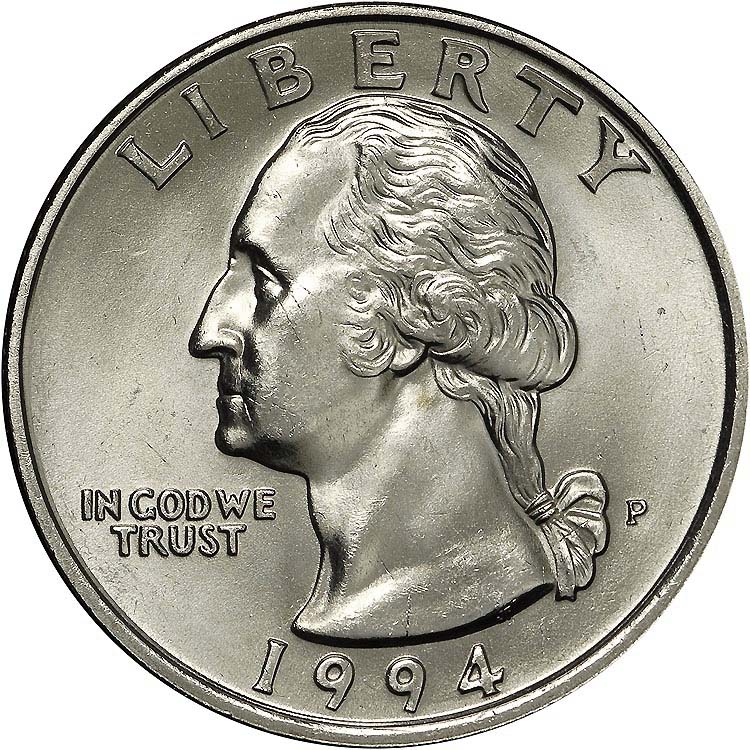
The obverse of the Washington quarter, introduced in 1932, features a left-facing profile portrait of George Washington designed by sculptor John Flanagan.[1] This design draws inspiration from an 18th-century bust of Washington created by French sculptor Jean-Antoine Houdon, capturing the first president's dignified expression with powdered hair tied in a queue.[31] Surrounding the portrait are the inscriptions "IN GOD WE TRUST" arched above, "LIBERTY" to the left, and the minting year below, with the design maintaining a classical profile orientation that emphasizes Washington's leadership role.[1] Flanagan's obverse remained in continuous use from 1932 through 1998, with subtle modifications over the decades to enhance clarity and production, such as adjustments to the lettering style in the 1970s to improve legibility on modern minting equipment.[32] For the 1976 Bicentennial issue, the obverse retained Flanagan's portrait with the dual date "1776–1976" replacing the single year to commemorate the nation's 200th anniversary while preserving the core design elements.[33] These quarters, paired with a new reverse depicting a drummer boy, circulated alongside standard issues but marked a temporary variation in obverse formatting.[34] In 2022, the obverse underwent a significant redesign for the American Women Quarters Program, adopting an alternate portrait of Washington created by sculptor Laura Gardin Fraser during the original 1932 design competition.[35] This right-facing depiction shows Washington in military attire, including an epaulet on his shoulder, offering a fresh perspective that honors his Revolutionary War service while integrating with thematic reverses.[36] The change was authorized by the Circulating Collectible Coin Redesign Act of 2020, which mandated periodic updates to circulating coin designs starting in 2022 to refresh numismatic appeal and reflect historical diversity.[37] Fraser's design, long overlooked in favor of Flanagan's, now serves as the standard obverse through at least 2025.[38] Throughout its history, the Washington quarter obverse has adhered to consistent physical specifications, measuring 24.3 mm in diameter with a reeded edge to deter counterfeiting and facilitate handling.[1]Reverse designs
The reverse of the Washington quarter, introduced in 1932, features a heraldic eagle designed by John Flanagan, with wings spread and the bird standing atop a bundle of arrows while olive branches lie beneath; the eagle clutches an olive branch in its right talon and arrows in its left, with a shield superimposed on its breast.[1] Inscriptions include "UNITED STATES OF AMERICA" arching at the top, "E PLURIBUS UNUM" on a banner held in the eagle's beak, and "QUARTER DOLLAR" at the bottom.[1] This design symbolized national strength and peace, remaining in use from 1932 to 1998.[1] For the United States Bicentennial in 1976, the reverse was temporarily modified to depict a colonial drummer boy marching with a drum at his side, designed by Jack L. Ahr and selected through a national competition.[39] The coins bore the dual date "1776-1976," but the obverse portrait of Washington remained unchanged.[1] This design honored the revolutionary era and was minted from 1975 to 1976 before reverting to the original eagle.[40] From 1999 to 2021, the reverse incorporated thematic designs from special circulating programs, such as state symbols, national parks, and territories, replacing the standard eagle motif.[1] Special reverse designs have continued since 1999, with the American Women Quarters Program (2022–2025) featuring reverses honoring prominent American women alongside the updated obverse by Laura Gardin Fraser.[1][41] Prior to these programs, the reverse lacked additional mottos beyond the original inscriptions.[1] In 2021, ahead of further program integrations, the reverse was redesigned to show General George Washington leading his troops across the ice-choked Delaware River on December 25, 1776, prior to the Battle of Trenton, as envisioned by Artistic Infusion Program designer Benjamin Sowards and sculpted by Medallic Artist Michael Gaudioso.[42] Inscriptions read "UNITED STATES OF AMERICA," "E PLURIBUS UNUM," "CROSSING THE DELAWARE," and "QUARTER DOLLAR."[42] This design, authorized under the Circulating Collectible Coin Redesign Act of 2020, was released into circulation on April 5, 2021, marking a transitional historical theme before subsequent series.[42][37]Specifications and composition
The Washington quarter, introduced in 1932, has undergone significant changes in its material composition and physical specifications over time, primarily to address economic needs and resource availability. From its inception through 1964, the coin was struck in a silver alloy, reflecting the standard for U.S. circulating silver coinage during that era. In 1965, due to rising silver prices and hoarding, the U.S. Mint transitioned to a copper-nickel clad composition that has remained in use to the present day, with minor exceptions for special collector issues.[1][43] During the silver era (1932–1964), the quarter consisted of 90% silver and 10% copper, with a gross weight of 6.25 grams, containing 0.18084 troy ounces of pure silver. The coin's diameter measured 24.3 mm, its thickness was approximately 1.75 mm, and it featured a reeded edge for anti-counterfeiting and handling purposes. This composition provided durability and intrinsic value tied to precious metal content, aligning with the Coinage Act of 1792's legacy for silver denominations. Notably, the quarters produced from 1942 to 1945 during World War II retained this standard 90% silver alloy, unlike the wartime modifications applied to nickels; no special inscriptions or markings indicated the silver content to discourage hoarding.[43][44]| Era | Composition | Gross Weight | Pure Silver Content | Diameter | Thickness | Edge |
|---|---|---|---|---|---|---|
| Silver (1932–1964) | 90% silver, 10% copper | 6.25 g | 0.18084 oz | 24.3 mm | 1.75 mm | Reeded |
| Clad (1965–present) | Copper core (91.67% of total weight) clad with outer layers of 75% copper and 25% nickel (8.33% nickel overall) | 5.670 g | None | 24.26 mm | 1.75 mm | Reeded |