


Community hub
Radcliffe College
View on Wikipedia
Radcliffe College was a women's liberal arts college in Cambridge, Massachusetts, that was founded in 1879. In 1999, it was fully incorporated into Harvard College. The college was named for the early Harvard benefactor Anne Mowlson (née Radcliffe) and was one of the Seven Sisters colleges.[1]
Key Information


For the first 70 years of its existence, Radcliffe conferred undergraduate and graduate degrees. Beginning in 1963, it awarded joint Harvard-Radcliffe diplomas to undergraduates. In 1977, Radcliffe signed a formal "non-merger merger" agreement with Harvard, and completed a full integration with Harvard in 1999.
Within Harvard University, Radcliffe's former administrative campus, Radcliffe Yard, is home to the Radcliffe Institute for Advanced Study. Former Radcliffe housing at the Radcliffe Quadrangle, including Pforzheimer House, Cabot House, and Currier House, has been incorporated into Harvard College's house system. Under the terms of the 1999 consolidation, Radcliffe Yard and the Radcliffe Quadrangle retain the "Radcliffe" designation in perpetuity.
History
[edit]19th century
[edit]
The "Harvard Annex," a private program for the instruction of women by Harvard faculty, was founded in 1879 after prolonged efforts by women to gain access to Harvard College. Arthur Gilman, a Cambridge resident, banker, philanthropist and writer, was the founder of what became The Annex/Radcliffe.[2] At a time when higher education for women was a sharply controversial topic, Gilman hoped to establish a higher educational opportunity for his daughter that exceeded what was generally available in female seminaries and the new women's colleges such as Vassar and Wellesley. These schools were in their early years and had substantial numbers of faculty who were not university trained.
In conversations with the chair of Harvard College's classics department, Gilman outlined a plan to have Harvard faculty deliver instruction to a small group of Cambridge and Boston women. He approached Harvard President Charles William Eliot with the idea, and Eliot approved.[3] Gilman and Eliot recruited a group of prominent and well-connected Cambridge women to manage the plan. These women were Elizabeth Cary Agassiz, Mary H. Cooke, Stella Scott Gilman, Mary B. Greenough, Ellen Hooper Gurney, Alice Mary Longfellow, and Lillian Horsford.
Building upon Gilman's premise, the committee convinced 44 members of the Harvard faculty to consider giving lectures to female students in exchange for extra income paid by the committee. The program came to be known informally as "The Harvard Annex." The course of study for the first year included 51 courses in 13 subject areas, an "impressive curriculum with greater diversity than that of any other women's college at its inception. Courses were offered in Greek, Latin, English, German, French, Italian, and Spanish; philosophy, political economy, history, music, mathematics, physics, and natural history."[4] The first graduation ceremonies took place in the library of Longfellow House on Brattle Street, just above where George Washington's generals had slept a century earlier.[5]
The committee members hoped that by raising an endowment for The Annex, they could persuade Harvard to admit women directly into Harvard College, but the university resisted.[6] In his 1869 inaugural address as president of Harvard, Charles Eliot summed up the official Harvard position toward female students when he said,
"The world knows next to nothing about the capacities of the female sex. Only after generations of civil freedom and social equality will it be possible to obtain the data necessary for an adequate discussion of woman's natural tendencies, tastes, and capabilities...It is not the business of the University to decide this mooted point."[7]
Harvard Examinations for Women
[edit]From 1874 to 1881, Harvard administered the Harvard Examinations for Women to increase women's educational opportunities, after being pressured by the Women's Education Association of Boston. During these seven years, 107 women participated; 36 received certificates.[8] The low number of certificates received by women led Harvard to change the exam in 1881. At the time, women could also be admitted into the "Harvard Annex", the women's version of a college education. The "Harvard Examinations for Women" included subjects such as history; literature of Shakespeare and Chaucer; languages such as Latin, French, and German; botany; and mathematics. These tests were similar to the admittance exam given to men applying to Harvard College. When a woman passed a subject, she would receive a signed certificate from Harvard's president acknowledging her passing mark.[8]
The Harvard Examinations for Women were ended two years after "Harvard Annex" officially became Radcliffe College, the women's equivalent to Harvard College.
When confronted in 1883 with the notion of females receiving Harvard degrees, the university's treasurer stated, "I have no prejudice in the matter of education of women and am quite willing to see Yale or Columbia take any risks they like, but I feel bound to protect Harvard College from what seems to me a risky experiment."[9]
In 1888, Harvard President Eliot communicated to a faculty member he intended to hire, that "There is no obligation to teach at The Annex. Those professors who on general grounds take an interest in the education of women...feel some obligation but there are many professors who think it their duty NOT to teach there, in which opinion some of the Corporation and Overseers agree."[10]
Eliot was strongly against co-education, saying, "The difficulties involved in a common residence of hundreds of young men and women of immature character and marriageable age are very grave. The necessary police regulations are exceedingly burdensome."[11]
In December 1893, The Boston Globe reported, "President of Harvard To Sign Parchments of the Fair Graduates".[12] Students seeking admission to the new women's college were required to sit for the same entrance examinations required of Harvard College students.
The committee persevered despite Eliot's skepticism. The project proved to be a success, attracting a growing number of students. As a result, the Annex was incorporated in 1882 as the Society for the Collegiate Instruction of Women, with Elizabeth Cary Agassiz, widow of Harvard professor Louis Agassiz, as president.[13] This society awarded certificates to students but did not have the power to confer academic degrees.
In subsequent years, ongoing discussions with Harvard about admitting women directly into the university still came to a dead end. Instead, Harvard and the Annex negotiated the creation of a degree-granting institution, with Harvard professors serving as its faculty and visiting body. This modification of the Annex was chartered by the Commonwealth of Massachusetts as Radcliffe College in 1894.
By 1896, the Globe could headline a story: "Sweet Girls. They Graduate in Shoals at Radcliffe. Commencement Exercises at Sanders Theatre. Galleries Filled with Fair Friends and Students. Handsome Mrs. Agassiz Made Fine Address. Pres Eliot Commends the Work of the New Institution." The Globe said, "Eliot stated that the percentage of graduates with distinction is much higher at Radcliffe than at Harvard" and that although "[i]t is to yet to be seen whether the women have the originality and pioneering spirit which will fit them to be leaders, perhaps they will when they have had as many generations of thorough education as men."[14]
20th century
[edit]In 1904, a historian Mary Caroline Crawford wrote the following about the genesis of Radcliffe College:
"...it set up housekeeping in two unpretending rooms in the Appian Way, Cambridge....Probably in all the history of colleges in America there could not be found a story so full of color and interest as that of the beginning of this woman's college. The bathroom of the little house was pressed into service as a laboratory for physics, students and instructors alike making the best of all inconveniences. Because the institution was housed with a private family, generous mothering was given to the girls when they needed it."[15]
In the first two decades of the 20th century, Radcliffe championed the beginnings of its own campus, consisting of the Radcliffe Yard and the Radcliffe Quadrangle in Cambridge, Massachusetts, not far from Harvard University. The original Radcliffe gymnasium and library, and the Bertram, Whitman, Eliot, and Barnard dormitories were constructed during this period. With the 1920s and 1930s, dormitories Briggs Hall (1924) and Cabot Hall (1937) were built on the Quadrangle, and in the Radcliffe Yard, the administrative building Byerly Hall (1932) and the classroom building Longfellow Hall (1930). Mary Almy was the architect.[16]
English professor Barrett Wendell warned his colleagues about continued cooperation with Radcliffe, saying that Harvard could "suddenly find itself committed to coeducation somewhat as unwary men lay themselves open to actions for breach of promise."[17] In Wendell's view, Harvard needed to remain "purely virile."[17]
In 1923, Ada Comstock, a leader in the movement to provide women with higher education, who hailed from the University of Minnesota and Smith College, became the college's third president. She was a key figure in the college's early 20th-century development. Speaking of her, one alumna remembers that "we were in awe of 'Miss Comstock... and knew even then that we had been touched by a vanishing breed of female educator. Ada Comstock had an extraordinary presence—she radiated dignity, strength, and decisiveness."[18] In the early 1940s, she negotiated a new relationship with Harvard that vastly expanded women's access to the full Harvard course catalog.
Growth
[edit]

David McCord set the college apart from the other Seven Sister institutions, saying "there is one respect in which Radcliffe differs from her sisters, and this should be made clear. Although she divides with Barnard, Bryn Mawr, and Wellesley all advantages of a large city, and enjoys the further privilege of being front-fence neighbor to Harvard University, Radcliffe alone has had from the first the strength of a university faculty....Thus, from the beginning, Radcliffe has been a woman's Harvard. It is still a separate institution, with its own corporation, receiving from Harvard no financial aid."[19] Because it had a university – as opposed to "collegiate" – faculty, Radcliffe was unique among the Seven Sisters in being able to provide a graduate program with a wide number of opportunities for students to pursue advanced studies.
M. Carey Thomas, the second president and chief visionary of Bryn Mawr College, lobbied against the conversion of the Society for the Collegiate Instruction of Women into Radcliffe College precisely because the Cambridge rival's access to a university faculty competed with Bryn Mawr's own academic ambitions.[20] Between 1890 and 1963, Radcliffe awarded more than 750 PhDs and more than 3000 masters degrees to women. During the 1950s, the school conferred more PhDs to women than any schools other than Columbia and the University of Chicago.[21] In 1955–56, the college produced more female PhDs than any other institution in the United States.[22]
Because Radcliffe's faculty was Harvard's, in the college's first 50 years, professors from Harvard, each under individual contracts with the Radcliffe administration – duplicated lectures, providing them first for men in the Harvard Yard and then crossing the Cambridge Common to provide the same lectures to women in the Radcliffe Yard. Professor Elwood Byerly wrote that he "always found the spirit, industry, and ability of the girls admirable—indeed, the average has been higher in my mathematics classes in the Annex than in my classes at the college.[23]
In March 1915, The New York Times reported in 1915 that all of the prizes offered in a playwriting competition at Harvard and Radcliffe that year were won by Radcliffe students. One of the Harvard contributions received honorable mention.[24]
In the early 1960s, the newspaper also reported that "taking the same courses and exams as Harvard, 60 percent of Radcliffe's girls [sic] were on the Dean's List as compared with 42 percent of Harvard men [sic]."[25]
Dorothy Howells noted that, "Allegations were made that Radcliffe was a "vampire" and a "temptress" enticing the teacher from his career-advancing research and publication with the lure of additional income."[26]
Ruth Hubbard, a member of the Harvard faculty from 1974 to 1990 and a member of the Radcliffe class of 1944, noted that "the senior (Harvard) professors were less than thrilled to have to repeat their lectures at Radcliffe. The lower rank faculty members, who were sometimes detailed off to teach the introductory science courses at Radcliffe instead of teaching Harvard students, felt even more declasse."[27]
Marion Cannon Schlesinger, Radcliffe Class of 1934, noted that "there were, to be sure, certain professors who looked with horror at the incursions of women into the sacred precincts of Harvard College, even at the safe distance of the Radcliffe Yard, and would have nothing to do with the academic arrangements by which their colleagues taught the Radcliffe girls. Professor Roger Merriman, for example, the first master of Eliot House and a professor of history, would not have been caught dead teaching a Radcliffe class.".[28]
During World War II, declines in male enrollment at Harvard and heightened sensitivity about the use of resources called for a new, more efficient arrangement concerning faculty time. Under the leadership of President Comstock, Radcliffe and Harvard signed an agreement that for the first time allowed Radcliffe and Harvard students to attend the same classes in the Harvard Yard, officially beginning joint instruction in 1943. Equally significant, the agreement ended the era in which individual faculty members at Harvard could choose whether to enter contracts with Radcliffe.
The agreement instead opened the entire Harvard catalogue to Radcliffe students, in exchange for which Radcliffe made a payment to Harvard of a fixed portion of Radcliffe tuitions. President Comstock noted that the agreement was "the most significant event since our charter was granted in 1894."[29] All Harvard faculty, whether interested or not, had a legal obligation to teach Radcliffe students. In practice a few holdouts on the Harvard faculty maneuvered around this obligation by announcing that their classes had "limited enrollment" and then limiting enrollment solely to male students. At the time, both Harvard and Radcliffe were adamant in telling the press that this arrangement was "joint instruction" but not "coeducation." Reacting to the agreement, Harvard President James Bryant Conant said, "Harvard was not coeducational in theory, only in practice."[30] Indeed, Radcliffe continued to maintain a separate admissions office which, by general acknowledgment, was more stringent in its academic requirements of applicants than Harvard's. Most extra-curricular activities at the two colleges remained separate.
Following World War II, Radcliffe negotiated a higher ceiling on its student enrollment. This success was orchestrated in tandem with additional housing construction. Moors Hall was completed in 1949, Holmes Hall in 1952, the Cronkhite Graduate Center in 1956, and Comstock Hall in 1958.[31] The added dormitory space and national recruiting campaigns led to an increasingly national and international student body.
In 1961, the Jordan Cooperative Houses, an option for students to engage in more communal living, with student responsibility for shopping for food, preparing meals and housekeeping, were built, and the college purchased Wolbach Hall, an apartment building also known as 124 Walker Street, in 1964. Radcliffe constructed Hilles Library in 1966[32] and the Radcliffe Quadrangle Athletic Center in 1982.
Also in 1961, then President Mary Bunting reorganized the autonomous Radcliffe dormitories into "houses," mirroring Harvard's houses and Yale University's residential colleges.
The three houses (North, South, and East) were eventually consolidated into two (North and South). In 1970, the college completed construction of Currier House, the first Radcliffe House designed with the "House Plan" in mind.[33] South House eventually was renamed Cabot House in 1984 while North House became Pforzheimer House in 1995.
Bunting felt that the house system would give Radcliffe students an intellectual community comparable to what Harvard students were getting, bringing together faculty and students in a way the free-standing Radcliffe dormitories did not, and allowing all to see with greater clarity the aspirations, capabilities, and interests of undergraduate women. Speaking generally about her philosophy for Radcliffe, President Bunting noted that "part of our special purpose is to convey to our students and through them to others that there is no basic conflict between being intellectual and being feminine."[34]
Bunting also established the Radcliffe Institute in 1961. The institute – a precursor to the current Radcliffe Institute for Advanced Study – gave financial support, access to research libraries and facilities, and recognition to scholarly women who had taken time away from intellectual pursuits to focus on home and family. In providing women with a venue to return to academia, Bunting was recognizing that traditional academic institutions were premised on a male life trajectory where a scholar's domestic concerns were taken care of by someone else (usually a wife).
The Radcliffe Institute, later renamed the Bunting Institute, was an institution premised on the needs of a female life trajectory, providing opportunities that might otherwise have been truncated by women's decisions during early adulthood to leave academia to raise children.
In the 1930s, Harvard president A. Lawrence Lowell took a dim view of Radcliffe, maintaining that the time Harvard professors spent providing lectures to women distracted the faculty from their scholarship, and providing Radcliffe women access to research facilities and Harvard museums was – in his view – an unnecessary burden on the university's resources. He threatened to scuttle the relationship between the two institutions. Radcliffe was forced to agree to a limitation on the size of its student body, with 750 spaces for undergraduates and 250 for graduate students.[35]
A ceiling on enrollment of women when compared to the enrollment of men was renegotiated upward at various points throughout the relationship with Harvard and remained constant in Radcliffe's operations until it began its ultimate incorporation into Harvard University in 1977.
Presidents of Radcliffe College
[edit]The office of the president was created with the incorporation of the Society for the Collegiate Instruction of Women in 1882. The society became Radcliffe College in 1894.
The following persons have led Radcliffe College until it was absorbed by Harvard University in 1999:[36][37]
| No. | Image | President | Term started | Term ended | Refs. |
|---|---|---|---|---|---|
| 1 | 
|
Elizabeth Cary Agassiz | 1882 | 1903 | [38] |
| 2 | 
|
LeBaron Russell Briggs[a] | 1903 | 1923 | [39] |
| 3 | 
|
Ada Louise Comstock | September 1, 1923 | August 31, 1943 | [40][41][42] |
| 4 | Wilbur Kitchener Jordan | October 1, 1943 | June 30, 1960 | [43][44][45][46] | |
| 5 | Mary Bunting | July 1, 1960 | June 30, 1972 | [47][48][49][50] | |
| 6 | .jpg)
|
Matina Souretis Horner | July 1, 1972 | June 30, 1989 | [51][52][53] |
| 7 | .jpg)
|
Linda S. Wilson | July 1, 1989 | June 30, 1999 | [54][55][56][57] |
| acting | Mary Maples Dunn [b] | July 1, 1999 | September 30, 1999 | [58][59][60] |
Table notes:
Graduate and post-graduate opportunities
[edit]Radcliffe staff were invested in assisting women graduates with career planning and placement, as well as providing a number of different programs to provide post-graduate study for women. The Harvard-Radcliffe Program in Business Administration was begun as career training for alums interested in business. It grew to become a vehicle for women to pursue study at Harvard's Business School.
Other post-graduate courses of study at Radcliffe grew as the undergraduate women students became more a part of Harvard University. The Radcliffe Publishing Course offered students experience in editing and other skills needed to enter the field of publishing. The Radcliffe Seminars Program in Landscape Design gave students a chance to study landscape design before it was a course of study at the Harvard Design School, and in a less formal environment.
Radcliffe first granted PhDs starting in 1902. Between 1894 and 1902, multiple students completed all course and thesis requirements for a PhD degree in the department of zoology, working in the Radcliffe Zoological Laboratory, without receiving the title.[61]
Student life and notable extracurricular activities
[edit]Beyond the life of the mind, another appeal of Radcliffe was the comparative freedom that its undergraduates enjoyed compared to students at other women's colleges. Cambridge and Boston provided diversions that were denied to women at more geographically isolated institutions. In his history of the college, David McCord noted that "the music, theaters and museums were surprisingly close."[62] While students at many women's colleges only had social interactions with men on weekends, Radcliffe students saw men in town and, after 1943, in classes and laboratories on a daily basis while still having their own institution, student organizations and activities, and space. In the 1950s, an era of "in loco parentis" at many postsecondary institutions, it was common at women's colleges for housemothers to keep diligent watch of the time when women returned to their dorms, locking the doors when check-in hour had arrived and punishing women who missed their check-in times. Radcliffe students, by contrast, had their own dormitory keys and filled out sign-in sheets when they arrived in the evening. Their lives were not as cloistered as those of some of their counterparts at the sister schools, and according to an article in Mademoiselle Magazine, "it was the richness and freedom of life at Radcliffe" which left its mark on the student body.[63] One graduate of the class of 1934 noted, "We were getting the best education in the country, and besides, we weren't banished to the sticks to rusticate. Weekends at Yale and Princeton may have been the answer to a maiden's prayer at Vassar, but we did not have to wait for ceremonial weekends for our entertainment: there were those among the Harvard population who recognized our "merits."[64] A student from the early 1960s picked up on this theme, contrasting the Radcliffe experience with that of Smith. "There are smart girls at Smith, all right," she said. "But they don't seem to get much out of them there. Four years later they don't seem to be any brighter. And they have this crazy week-end system. You spend all week in Bermuda shorts, with your hair in curlers, worrying over who's going to take you to Amherst or New Haven Friday night. It seems to me that sort of thing actually retards you in the long run."[65] (Conversely, the greater seclusion of places such as Smith, Vassar and Mt. Holyoke sometimes made these latter institutions more attractive to socially conservative families.)
Reflecting on her time at Radcliffe, writer Alison Lurie stated that "most of the time we were in a mild state of euphoria...our lives were luxurious by modern undergraduate standards...We had private rooms, cleaned and tidied by tolerant Irish maids; a laundry called for our dirty clothes every week and returned them carefully washed and ironed; we ate off of china in our own dining room and sat in drawing rooms that resembled those of a good women's club."[66]
"Pluck" was a quality attributed to some Radcliffe students. Beth Gutcheon of the class of 1967 wrote in a reminiscence that "One night a classmate of mine was leaving the library alone at eleven when somebody jumped her from behind and knocked her to the ground. She yelled, 'Oh, Christ, I don't have time for this. I have an exam tomorrow!' and after a disappointed pause, her attacker got up and went away."[67]
Throughout most of the college's history, residential life and student activities at Radcliffe remained separate from those at Harvard, with separate dormitories and dining facilities (located on the Radcliffe Quadrangle), newspapers (The Radcliffe News, Percussion), radio stations (WRRB and WRAD, a.k.a. Radio Radcliffe), drama society (The Idler), student government (Radcliffe Student Government Association and later, The Radcliffe Union of Students), yearbooks, athletic programs, choral associations (The Radcliffe Choral Society, the Cliffe Clefs, and later the Radcliffe Pitches), etc. (located in the Radcliffe Yard). Radcliffe had greater diversity in housing options than Harvard, with college-owned frame houses, an apartment building, and co-operative housing for students who were not interested in immersion in dormitory life or life within the House System.
Dances were popular features of undergraduate life. "At different times there were class dances, club dances, junior and senior proms, sophomore tea dances, Christmas dances, and spring formals. Dormitory-based dances were known as 'jolly-ups.'"[68] One particularly popular event during the 1950s was the Radcliffe Grant in Aid show, which was sponsored by the student government. The show raised money for scholarships and always ended with a student kick-line in red shorts. Perhaps because of the shorts, Harvard students were particularly drawn to the event.[68]
The Radcliffe Choral Society was a popular and influential student group. Started in 1899 and conducted by Marie Gillison, a German-born singing teacher, the group cultivated an interest in sophisticated classical music at a time when many collegiate choral groups were devoted to college songs and more popular ditties. Archibald Davidson, who took up the reins of conducting the Choral Society after Gillison (he also conducted the Harvard Glee Club), stated, "I sometimes wonder how much, if anything, Harvard realizes that it owes to Radcliffe... Harvard...should not forget that while its Glee Club was slowly progressing toward enlightenment, Radcliffe, just across the Common, had for a long time under Mrs. Gillison's direction set an example of devotion to the best music."[69] Davidson added that "without the early and enthusiastic cooperation of 'the young ladies of Radcliffe' the impressive tradition of college choral singing, which is now nationwide and which is always associated first with Cambridge, would almost certainly have been established much later here or would have originated elsewhere."[69] Arranged by Mrs. Gillison, the 1917 Choral Society concert with the Harvard Glee Club and the Boston Symphony Orchestra was a footnote in music history, the first time a university chorus sang with a major orchestra. The concert became an annual tradition for many years.
The Radcliffe Crew is the oldest women's rowing program in the Ivy League. Even after the merger of Harvard and Radcliffe, the team maintains the Radcliffe name and Radcliffe colors as a sign of respect for the tradition of Radcliffe and the women who fought to establish the rowing program. The crew has a distinguished history. The team won the national championship in 1973 and thus got to represent the United States at the Eastern European Championships in Moscow. In 1974, the Eastern Association of Women's Rowing Colleges (EAWRC) was formed. In both 1974 and 1975, Radcliffe won consecutive Eastern Sprints titles. In 1987, Radcliffe's heavyweight varsity eight completed an undefeated season with a victory at Eastern Sprints and an Ivy championship title. Six of the crew's eight rowers went on to compete in the Olympic Games. In 1989, Radcliffe was also undefeated with a Sprints championship and Ivy title. The season finale was a victory in the Open Eight at the Henley Women's Regatta in England.
Growing consolidation with Harvard
[edit]
The parallel Radcliffe and Harvard student universes—with formal intersections only in the classroom—continued until the 1960s. At this point, awareness of the comparative benefits of Radcliffe vis-a-vis the other Seven Sisters was increasingly eclipsed by growing sensitivity to the disadvantages that Radcliffe students had vis-a-vis Harvard students. Harvard students lived closer to the Harvard Yard, while Radcliffe students had a longer walk to Yard-based classes from the Radcliffe Quadrangle. Harvard housing was more luxurious than Radcliffe dormitories, and much more of the schools' shared intellectual life took place on the Harvard campus. Financial aid and student prizes at Harvard were larger than those at Radcliffe, even though students from the two schools were enrolled in the same courses. By the late 1950s, the terms of the "joint instruction" agreement still imposed a ceiling on the enrollment of Radcliffe students, with Harvard males getting four times the number of spots in a freshman class that Radcliffe students got. And at the end of four years of study, students at Harvard received a diploma from Harvard while Radcliffe students taking the same courses received a diploma from Radcliffe.
These asymmetries did not bother all students, as some viewed the differences as a matter of course between two different institutions. This perspective was particularly strong with Radcliffe students who graduated before the turbulent 1960s. One alumna from the 1940s mused that at Radcliffe "we were supremely happy in our own environment. For us, Harvard remained 'the other.' Most of us felt no connection to it;...instead, we enjoyed our own collegiate activities and traditions.[18] Another graduate from the class of 1949 noted that she was "having my cake and eating it, too. In addition to my Harvard education, I was enjoying the benefits of a small women's college. The Radcliffe Quadrangle was quiet and peaceful, life in the dormitories was friendly and gracious. ... The women who had chosen to come to Radcliffe all were intelligent, quite independent, and concerned with the world around them."[70] Additionally, Radcliffe offered a cultural advantage over Harvard: even when enrolled in the same courses, Harvard and Radcliffe student took exams separately, as Radcliffe College's honor code necessitated a vastly different exam-taking environment: "Where the men's exam rituals included proctors, dress codes, and a strict requirement of silence, the Radcliffe women took un-proctored exams, relished the chance to wear informal pants instead of skirts, and could enter and exit the building as they wished so long as they did not cheat."[71] Similarly, the Radcliffe honor code provided for more generous library and campus space privileges (for student groups) than the more bureaucratic Harvard systems allowed.
However, some people within the Radcliffe community were less sanguine about the differences between the two schools, seeing the relationship with Harvard as an institutionalized separate but unequal experience for women. Writer Alison Lurie reflected that "for Radcliffe students of my time the salient fact about Harvard was that it so evidently was not ours. Our position was like that of poor relations living just outside the walls of a great estate: patronized by some of our grand relatives, tolerated by others, and snubbed or avoided by the rest."[72]
Famed poet Adrienne Rich, class of 1951, described receiving an "insidious double message" when she was at Radcliffe. Radcliffe students "were told that we were the most privileged college women in America," but "while intellectual and emotional life went on with intensity in all-female dorms, and we had our own newspaper, our own literary magazine, clubs, and student government, we knew that the real power (and money) were invested in Harvard's institutions, from which we were excluded."[73]
Acceptance of the 19th-century rationales for this exclusion was fading, particularly as during the 1960s, a nationwide movement for co-education grew. Reflecting this movement, many Radcliffe students began to insist upon receiving Harvard diplomas for their academic work and upon merging Radcliffe and Harvard extra-curricular activities. Growing budgetary problems at Radcliffe encouraged this insistence. The Radcliffe Graduate School merged with Harvard's in 1963, and from that year onward Radcliffe undergraduates received Harvard University diplomas signed by the presidents of Radcliffe and Harvard. (Harvard students' diplomas were signed only by the president of Harvard.) Radcliffe students were fully and permanently admitted to Harvard's Lamont Library in 1967.[74][75] Many Radcliffe and Harvard student groups combined during the 1960s and joint commencement exercises between the two institutions began in 1970. In 1971, largely in response to gains made by newly co-ed Princeton and Yale in their respective yields of students admitted to Harvard, Yale and Princeton,[76] and to comparable admissions competition posed by the increasing national popularity of co-ed Stanford,[77] Harvard president Derek Bok reduced the admissions ratio of Harvard students to Radcliffe students from 4:1 to 5:2.[76] That same year, several Harvard and Radcliffe dormitories began swapping students through an experimental program, and in 1972 full co-residence between the two colleges was instituted. The schools' departments of athletics merged shortly thereafter.
By the late 1960s there were open discussions between Radcliffe and Harvard about complete merger of the two institutions—which in truth meant abolition of Radcliffe. However, a merger study committee of the Radcliffe Alumnae Association recommended caution. In a prepared statement, the committee reported that "it would be a mistake to dissolve Radcliffe at this time. Women's self-awareness is increasing as the 'women's liberation movement develops and as moderate groups call attention to the life styles and problems particular to women. This is precisely the wrong time to abolish a prestigious women's college which should be giving leadership to women as they seek to define and enlarge their role in society."[78]
Instead of a complete merger, in 1977 Radcliffe president Matina Horner and Harvard president Derek Bok signed an agreement that, through their admission to Radcliffe, put undergraduate women entirely in Harvard College. The so-called "non-merger merger" combined the Radcliffe and Harvard admissions offices and ended the forced ceiling on female enrollment. In practice most of the energies of Radcliffe (which remained an autonomous institution) were then devoted to the institution's research initiatives and fellowships, rather than to female undergraduates. The Harvard and Radcliffe undergraduate communities and classes came to be known officially as "Harvard and Radcliffe" or "Harvard-Radcliffe", and female students continued to be awarded degrees signed by both presidents. Radcliffe continued to own its campus and provided financial aid, undergraduate prizes, and externship and fellowship opportunities to Radcliffe students, and the college continued to sponsor academic access programs for high school girls and continuing education opportunities for people outside the traditional college age. The college also continued to support programs and workshops targeting female undergraduates.
In practice, though, Radcliffe at this point had minimal impact on the average undergraduate's day to day experiences at the university. This minimal role fueled still more talk about a full merger of the two schools. Conversely, supporters of the "non-merger merger" maintained that the agreement gave Radcliffe students the full benefits of Harvard citizenship while allowing maintenance of the proud Radcliffe identity, an institution with its own mission, programs, financial resources and alumnae network.
On October 1, 1999, Radcliffe College was fully absorbed into Harvard University; female undergraduates were henceforward members only of Harvard College while Radcliffe College evolved into the Radcliffe Institute for Advanced Study.[79]
Radcliffe after the merger
[edit]The Radcliffe Institute for Advanced Study, now a division of Harvard University, carries on many of the research and professional development programs that Radcliffe College pioneered and has introduced other programs to the worldwide community of scholars. The end of Radcliffe's role as an undergraduate institution, however, still has its detractors. "Although I realize the merger was inevitable," a member of the class of 1959 commented, "...I nevertheless regret the loss of my college, which gave me so much.[80] Another noted that she "feels sad that Radcliffe College no longer exists. It, far more than Harvard, defined my college experience. I can't remember a single Harvard classmate, but two of my best friends are fellow Cliffies and I exchange correspondence with about a dozen more."[81] Indeed, many Radcliffe alumnae feel their institution has relinquished its distinguished identity in favor of a male-oriented one that remains steadfastly dismissive of women's concerns. This latter perspective gained some traction when, in a voice reminiscent of Presidents Eliot and Lowell, Harvard's early 21st-century president Lawrence Summers publicly stated that women were not as capable in the sciences as men. Additionally, shortly after full merger of the two schools, Harvard undergraduate women feeling a void in Harvard's support for women's intellectual and personal development started to lobby Harvard to create a women's center. Perhaps not surprisingly, memories of Harvard's historical indifference to women have led many Radcliffe alumnae to maintain primary ties to Radcliffe College and not to Harvard University. "Womenless history has been a Harvard specialty," Laurel Thatcher Ulrich noted.[82] The Annex gained some vindication against Presidents Eliot, Lowell, and Summers when Drew Gilpin Faust, Dean of the Radcliffe Institute, replaced Summers and became Harvard's first female president.
Radcliffe College alumnae continue to press Harvard on the question of the university's commitment to women, and increasing the number of female faculty members at Harvard is a particular alumnae interest. Former Radcliffe president Matina Horner once told the New York Times of her surprise when she first delivered a lecture at Harvard in 1969 and four male students approached her. One of these students told her that they "just wanted to see what it felt like to be lectured by a woman and if a woman could be articulate."[83] Picking up on the perceived common Harvard blind-eye to women's intellectual competence and reflecting on the fact that while at Radcliffe they had had very few female faculty members, in the late 1990s a group of Radcliffe alumnae established the Committee for The Equality of Women at Harvard. The group chose to boycott Harvard's fundraising campaigns and sent letters to all 27,000 Radcliffe alumnae and to 13,000 Harvard alumni asking them to shift their donations to an escrow account until the university stepped up its efforts to add women to its tenured faculty. The group has not established quotas that it wants Harvard to meet. Rather, it has stated that individual Harvard departments should measure their percentage of tenured women faculty against a "realistically available pool" and create a plan to increase the number of women if that percentage falls short. The group also said that when departments do so, the escrow account (now called the Harvard Women's Faculty Fund) will be turned over to Harvard.[84]
In the meantime, enriched by hundreds of millions of dollars that Harvard conferred unto Radcliffe at the time of the full merger, the Radcliffe Institute today awards dozens of annual fellowships to prominent academics. Although it does not focus solely on women returning to academe, it is a major research center within Harvard University. Its Schlesinger Library is one of America's largest repositories of manuscripts and archives relating to the history of women.
Several undergraduate student organizations in Harvard College still refer to Radcliffe in their names, (for example the Radcliffe Union of Students, Harvard's feminist organization; the Radcliffe Choral Society, Harvard's female choir (now one of the Holden Choirs), which has alumnae from both Radcliffe and Harvard and maintains a repertoire of Radcliffiana; the Harvard Radcliffe Orchestra; the Harvard-Radcliffe Gilbert and Sullivan Players; the Radcliffe Pitches, a female a cappella singing group; and the Harvard-Radcliffe Dramatic Club). Two athletic teams still compete under the Radcliffe name: varsity crew, which still rows with Radcliffe's black-and-white oarblades and uniforms instead of Harvard's crimson-and-white (in 1973 the team had been the only varsity team which voted not to adopt the Harvard name); and club rugby union. In addition, the Harvard University Band still plays a Radcliffe fight song.
Notable alumnae
[edit]- Notable Radcliffe alumnae include:
-
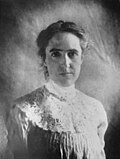 Astronomer and computer Henrietta Swan Leavitt (AB, 1892)
 -
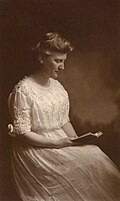 Civil rights activist and journalist Mary White Ovington (1891–1893, no degree)
 -
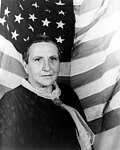 Novelist, playwright, poet Gertrude Stein (AB, 1898)
 -
 Author, political activist, and lecturer Helen Keller (AB, 1904)
 -
 Spy for the United Kingdom and United States Virginia Hall (1924–1925, no degree)
 -
 Author Margaret Atwood, (AM, 1962)
 -
 11th and 13th Prime Minister of Pakistan Benazir Bhutto (AB, 1973)


.jpg)


A number of Radcliffe alumnae have gone on to become notable in their respective fields:
- Jill Abramson, former executive editor of the New York Times
- Alice Adams, novelist
- Encarnacion Alzona, National Scientist of the Philippines, first Filipino woman to obtain a PhD
- Alice Arlen, screenwriter
- Margaret Atwood, author
- Deborah Batts, U.S. District Court Judge, Southern District of New York; first openly LGBT African American federal judge
- Susan Berresford, Ford Foundation president
- Benazir Bhutto, former prime minister of Pakistan
- Melissa Block, journalist and host of National Public Radio's All Things Considered
- Marita Bonner, poet, essayist and writer associated with the Harlem Renaissance and New Negro Movements
- Alice Bourneuf, economist, educator
- Sylvia Mathews Burwell, Secretary of Health and Human Services
- Caroline Walker Bynum, medieval historian
- Stockard Channing, actress
- Sarah Norcliffe Cleghorn, educator, author, social reformer, and poet
- Leda Cosmides, psychologist
- Lindsay Crouse, actress
- Martha Derthick, academic and noted scholar of public administration
- Anne d'Harnoncourt, curator and former CEO and director of the Philadelphia Museum of Art
- Eva Beatrice Dykes, Ph.D., first black American woman to fulfill the requirements for a doctoral degree
- Elizabeth Eisenstein, historian
- Barbara Epstein, founder of The New York Review of Books
- Mathea Falco, Assistant Secretary of State for International Narcotics and Law Enforcement Affairs
- Lucy Nettie Fletcher (1886-1918), WWI nurse
- Amy Goodman, journalist and host of Democracy Now!
- Ellen Goodman, Boston Globe columnist
- Jamie Gorelick, Deputy U.S. Attorney General
- Linda Greenhouse, Pulitzer Prize-winning reporter.
- Lani Guinier, Harvard Law professor and civil rights activist
- Amy Gutmann, University of Pennsylvania president
- Martha Hackett, actor
- Virginia Hall, American spy with the Special Operations Executive during WWII
- Elizabeth Holtzman, member of U.S. Congress
- Elizabeth Hubbard, actor
- Josephine Hull, Oscar-winning stage and film actress
- Catharine Sargent Huntington, (class of 1911) actress, producer, director, founder of multiple theater companies, activist
- Rona Jaffe, popular novelist
- Miriam M. Johnson, sociologist
- Roberta Karmel (born 1937), Centennial Professor of Law at Brooklyn Law School, and first female Commissioner of the U.S. Securities and Exchange Commission.
- Helen Keller, deafblind author and activist
- Sinah Estelle Kelley, chemist
- Caroline Kennedy, U.S. Ambassador to Japan, daughter of President John F. Kennedy and Jacqueline Kennedy Onassis
- Margaret Kivelson, space physicist and planetary scientist
- Maxine Kumin, Pulitzer Prize–winning poet
- Ursula Le Guin, author
- Henrietta Swan Leavitt, early Harvard College Observatory astronomer
- Judith Ledeboer, architect
- Ann Lewis, Democratic Party political strategist
- Alison Lurie, academic and Pulitzer Prize-winning author
- Grace Macurdy, classicist
- Pauline Maier, historian at Massachusetts Institute of Technology
- Ursula Marvin, Smithsonian geologist who analyzed Sputnik 4; first woman on American research teams to travel to Antarctica
- Empress Masako of Japan[85]
- Margaret Mayall, astronomer
- Laura Meneses, political activist
- Ruth Messinger, politician and CEO of American Jewish World Service
- Jane Nickerson, first New York Times food editor and restaurant critic
- Andrea Nye, feminist philosopher and writer
- Soledad O'Brien, broadcast journalist
- Ursula Oppens, classical pianist
- Mary White Ovington, co-founder of the NAACP and women's rights activist
- Maud Wood Park, suffragette and women's rights activist
- Diane Paulus, artistic director of the American Repertory Theater
- Carol Potter, television actress
- Eve Troutt Powell, historian, winner of MacArthur Foundation "genius award"
- Naomi Quinn, anthropologist
- Bonnie Raitt, blues musician
- Lois Rice, vice president of the College Board and architect of the Pell Grant[86]
- Adrienne Rich, poet and feminist
- Margaret W. Rossiter, historian of science, recipient of MacArthur Fellows Program "genius grant", Margaret W. Rossiter History of Women in Science Prize awarded by the History of Science Society is named after her
- Christina Schlesinger, painter
- Alberta Virginia Scott, first African-American Radcliffe graduate (1898)
- Edie Sedgwick, Andy Warhol's superstar of 1965
- Carla Shatz, neurobiologist at Stanford University; member of National Academy of Sciences and Institute of Medicine
- Ann Loomis Silsbee, composer and poet
- Elsie Singmaster, author
- Anna Deavere Smith, performance artist
- Muriel S. Snowden, social worker, founder of Freedom House, MacArthur Foundation "genius award" winner
- Gertrude Stein, author
- Doris Zemurray Stone, archaeologist and ethnographer
- Renee Tajima-Peña, Academy Award-nominated filmmaker and director of Who Killed Vincent Chin? and No más bebés
- Frances Euphemia Thompson, art educator
- Barbara Tuchman, historian
- Marina von Neumann Whitman, economist
- Julia Grace Wales, peace activist
- Suzy Welch, business writer and former editor of Harvard Business Review
- Lally Weymouth, senior associate editor of the Washington Post
In popular culture
[edit]Literature
[edit]- Rona Jaffe's novel Class Reunion and Alice Adams' novel Superior Women both deal with the lives of Radcliffe women in their college years and afterwards.
- Love with a Harvard Accent is a 1962 novel written jointly by Bill Bayer and Nancy Jenkin under the pen name Leonie St. John. It tells the stories of three Radcliffe students coming of age along the bridge between the late 50s and early 1960s. The Harvard Crimson reviewed the book when it was published in an article entitled "Radcliffe's New Catalog."[87]
- Splendor & Misery is a 1983 novel by Faye Levine that follows the college experience of Sarah Galbreath, a Radcliffe student in Cambridge in the early and mid 1960s.
- A Small Circle of Friends is a film set at Harvard and Radcliffe in the Vietnam era. In it Karen Allen plays Jessica Bloom, a Radcliffe student caught up with two Harvard students in the activism and feminist awakening of the time.
- Phillip Roth's novel Goodbye, Columbus is set in part at Radcliffe. The movie version was filmed in part at the college.
- Tom Miller's fantasy novel The Philosopher's Flight is about a male student at Radcliffe in 1917.
Writing
[edit]- In 1963, as a Radcliffe undergraduate, Faye Levine wrote an article for the Harvard Crimson that became a classic and thereafter frequently quoted characterization of Radcliffe undergraduates, entitled "The Three Flavors of Radcliffe." The three flavors were peach, chocolate, and lime.[88]
Film
[edit]- The film and novel versions of Love Story are set partly at Radcliffe and involve a student named Jennifer Cavalleri and her romance with Harvard student Oliver Barrett IV. The movie was filmed in part at Radcliffe.
- Katey Miller, the protagonist of Dirty Dancing: Havana Nights, is a star student who aspires to attend Radcliffe.[89]
- A large part of Professor Marston and the Wonder Women is based on and portrays events which occurred at the college.
See also
[edit]References
[edit]- ^ Horn, Miriam, quoting The Boston Globe, in Rebels in White Gloves: Coming of Age with Hillary Clinton's Class—Wellesley '68, p. 8, co. 2000, Anchor. See also McCarthy, Mary, How I Grew, pp. 119–120, 1987, Harcourt, Brace, Jovanovich. See Berman, Susan, The Underground Guide to the College of Your Choice, pp. 234, 242, 246 and 404, 1971, Signet. See also Yale Daily News, "The Insiders Guide to the Colleges," 1975–76, co. 1975, G.P. Putnam and Sons. Finally, see Kendall, Elaine, Peculiar Institutions: An Informal History of the Seven Sister Colleges, p. 30, 1975, G.P. Putnam and Sons, NY
- ^ "Obituary of Arthur Gilman, founder of Radcliffe College, The New York Times, Dec. 29, 1909" (PDF).
- ^ Howells, Dorothy Elias, A Century to Celebrate Radcliffe College, 1879–1979, p. 1, 1978, Radcliffe College.
- ^ Howells, Dorothy Elia, A Century to Celebrate Radcliffe College, 1879–1979, p. 6, 1978, Radcliffe College.
- ^ "Alice Longfellow - Longfellow House Washington's Headquarters National Historic Site (U.S. National Park Service)".
- ^ Sally Schwager, "Taking up the Challenge: The Origins of Radcliffe," in Yards and Gates: Gender in Harvard and Radcliffe History, ed. Laurel Thatcher Ulrich (New York: Palgrave Macmillan, 2004), ISBN 978-1-4039-6098-6. pp. 92–103
- ^ Howells, Dorothy Elia, A Century to Celebrate Radcliffe College, 1879–1979, p.viii, 1978, Radcliffe College.
- ^ a b "Open Collections Program: Women Working, The Harvard Examination for Women". ocp.hul.harvard.edu. Retrieved March 2, 2018.
- ^ Baker, Liva, I'm Radcliffe. Fly Me!. The Seven Sisters and the Failure of Women's Education, p. 46, New York: MacMillan Publishing Company, 1976
- ^ Baker, Liva, I'm Radcliffe. Fly Me! The Seven Sisters and the Failure of Women's Education, p. 47, 1976, MacMillan Publishing.
- ^ Charles Eliot, as quoted by Liva Baker (1976) in I'm Radcliffe!, p. 21
- ^ "Christened 'Radcliffe;' Annex Girls May Receive A College Degree. Overseers Vote to Carry Out Plans of the Friends of Fay House. President of Harvard To Sign Parchments of the Fair Graduates." The Boston Daily Globe, Dec. 7, 1893, p. 6
- ^ "Radcliffe College". Archived from the original on November 1, 2007.
- ^ "Sweet Girls. They Graduate in Shoals at Radcliffe. Commencement Exercises at Sanders Theatre. Galleries Filled with Fair Friends and Students. Handsome Mrs. Agassiz Made Fine address. Pres Eliot Commends the Work of the New Institution." The Boston Daily Globe, June 24, 1896, p. 4
- ^ Crawford, Mary Caroline (1904). The College Girl of America. Boston: L. C. Page., p. 99-100
- ^ "Guide to the Records of Howe, Manning & Almy, Inc. and the Papers of Lois Lilley Howe, Eleanor Manning O'Connor, and Mary Almy MC.0009". Massachusetts Institute of Technology, Institute Archives and Special Collections. Archived from the original on July 1, 2019. Retrieved May 18, 2016.
- ^ a b Barrett Wendell, as quoted by Elaine Kendall in Peculiar Institutions: An Informal History of the Seven Sister Colleges, pp. 153–154, New York: G.P. Putnam and Sons, 1975
- ^ a b Solomon, Barbara Miller, "Happy in Our Own Environment," from College in a Yard II, edited by David Aloian, p. 122, 1985, President and Fellows of Harvard College.
- ^ David McCord, An Acre for Education: Being Notes on the History of Radcliffe College, p. 7–8, 1958
- ^ see Horowitz, Helen, The Power and Passion of M. Carey Thomas, 1999, University of Illinois Press.
- ^ Howells, Dorothy Elia, A Century to Celebrate Radcliffe College, 1879–1979, p. 62, 1978, Radcliffe College
- ^ McCord, David, An Acre for Education: Being Notes on the History of Radcliffe College, p. 63, Radcliffe College.
- ^ Radcliffe College, 1879–1929, p. 10, 1929, Harvard University Press.
- ^ "Girls Won All Prizes, in "The New York Times," March 3, 1915, p. 10.
- ^ Arlen, M.J., "The Girl with the Harvard Degree," in The New York Times Magazine, June 10, 1962, p.15.
- ^ Howells, Dorothy Elia, "A Century to Celebrate Radcliffe College, 1879–1979, p. 44, 1978, Radcliffe College
- ^ Hubbard, Ruth, "Memories of Life at Radcliffe, 1941–1944," from remarks presented at the April 29, 2000 "History and Memory: Gender at Harvard and Radclffe" conference, as reprinted in The Women's Guide to Harvard, p. 45, 2002, The Harvard-Radcliffe Women's Leadership Project.
- ^ Schlesinger, Marion Cannon, "Across the Common," in My Harvard, My Yale, p.18, edited by Diana Dubois, co. 1982, Random House (New York)
- ^ McCord, David, An Acre for Education: Being Notes on the History of Radcliffe College, p. 57–58, 1958, Radcliffe College.
- ^ Karabel, Jerome, The Chosen: The Hidden History of Admission and Exclusion at Harvard, Yale, and Princeton, p. 439, 2005, Houghton, Mifflin Company.
- ^ Howells, Dorothy Elia, A Century to Celebrate Radcliffe College, 1879–1979, p. 21, 1978, Radcliffe College.
- ^ "Hilles Library". Harvardplanning.emuseum.com. Harvard University. Retrieved November 9, 2019.
- ^ Howells, Dorothy Elia, A Century to Celebrate Radcliffe College, 1879–1979, p. 29–33, 1978, Radcliffe College.
- ^ Bunting, Mary I., "Address to Alumnae," Radcliffe Quarterly, August 1968, p. 7, as reprinted in Dorothy Elia Howells' A Century to Celebrate Radcliffe College, 1879–1979, p. 65, 1978, Radcliffe College.
- ^ Howells, Dorothy Elia, A Century to Celebrate Radcliffe College, 1879–1979, p. 22, 1978, Radcliffe College.
- ^ "Presidents of Radcliffe College". Radcliffe Institute for Advanced Study. Harvard University.
- ^ "It's Complicated: 375 Years of Women at Harvard". Radcliffe Institute for Advanced Study. Harvard University. Spring 2012.
- ^ "Elizabeth Cary Agassiz". Radcliffe Institute for Advanced Study. Harvard University.
- ^ "Le Baron Russell Briggs". Radcliffe Institute for Advanced Study. Harvard University.
- ^ "Ada Louise Comstock". Radcliffe Institute for Advanced Study. Harvard University.
- ^ "RADCLIFFE NEW HEAD EXPECTED TODAY; Miss Ada Louise Comstock to Begin Duties at Once". The Boston Globe. September 1, 1923. p. 16 – via newspapers.com.
Miss Ada Louise Comstock, new president of Radcliffe College, as successor of Le Baron Russell Briggs, is expected to arrive in Cambridge some time today. Although renovation of the president's house on Brattle st. is not quite finished, Miss Comstock will take up her new work at once, depending upon temporary accommodations until the house is ready.
- ^ "Miss Comstock, Radcliffe Head for 20 Years, to Retire in Fall". The Boston Globe. May 22, 1943. p. 1 – via newspapers.com.
Announcement this noon of the coming retirement of Pres. Ada Louise Comstock, 66, head of Radcliffe College for the past 20 years, evoked surprise and regret among the hundreds of graduates gathered for the alumnae luncheon today in Cambridge. Miss Comstock's retirement becomes effective Sept. 1.
- ^ "Wilbur Kitchener Jordan". Radcliffe Institute for Advanced Study. Harvard University.
- ^ "Jordan Named President of Radcliffe; Here Oct. 1". The Boston Globe. August 26, 1943. p. 1 – via newspapers.com.
Wilbur Kitchener Jordan, professor of English history at the University of Chicago, has been named president of Radcliffe College and will take office Oct. 1, the Radcliffe board of trustees announced last night.
- ^ "W. Kitchener Jordan, New Radcliffe Head, Assumes Post Today". The Boston Globe. October 1, 1943. p. 11 – via newspapers.com.
W. Kitchener Jordan will take office today as president of Radcliffe College, a position to which he was elected, late in August as successor to Ada L. Comstock, now Mrs. Wallace Notestein.
- ^ Miller, Martha E. (January 6, 1959). "President Jordan Will Resign Post". The Harvard Crimson.
- ^ "Mary (Polly) Ingraham Bunting". Radcliffe Institute for Advanced Study. Harvard University.
- ^ Demos, John P. (June 9, 1959). "Mrs. Bunting Will Become Radcliffe President in 1960". The Harvard Crimson.
- ^ Gale, Mary ELLEN (June 15, 1961). "Mrs. Bunting Restores 'Climate of Expectation'". The Harvard Crimson.
- ^ Heard, Joyce (March 13, 1972). "Princeton Hires President Bunting". The Harvard Crimson.
- ^ "Matina Souretis Horner". Radcliffe Institute for Advanced Study. Harvard University.
- ^ Hurt, Harry; Lubow, Arthur H. (May 15, 1972). "Horner to Be New Radcliffe President". The Harvard Crimson.
- ^ Forman, Ross G. (June 9, 1988). "Radcliffe President Resigns". The Harvard Crimson.
- ^ "Linda S. Wilson". Radcliffe Institute for Advanced Study. Harvard University.
- ^ Walkowitz (May 31, 1989). "Wilson Selected as New Radcliffe President Rebecca L." The Harvard Crimson.
- ^ Helderman, Rosalind S. (April 22, 1999). "Wilson Resigns to Advance Deal". The Harvard Crimson.
- ^ Helderman, Rosalind S. (April 22, 1999). "Campus Reacts to Radcliffe Decision". The Harvard Crimson.
- ^ "Mary Maples Dunn". Radcliffe Institute for Advanced Study. Harvard University.
- ^ Sofen, Adam A. (June 10, 1999). "How the Deal Was Done". The Harvard Crimson.
- ^ Rakoczy, Kate L. (January 5, 2001). "Faust Takes Over At Radcliffe". The Harvard Crimson.
- ^ Tonn, Jenna (August 1, 2017). "Extralaboratory Life: Gender Politics and Experimental Biology at Radcliffe College, 1894-1910". Gender & History. 29 (2): 329–358. doi:10.1111/1468-0424.12292. ISSN 1468-0424. S2CID 149438967.
- ^ McCord, David, An Acre for Education: Being Notes on the History of Radcliffe College, p. 51, 1958, Radcliffe College.
- ^ McCord, David, An Acre for Education: Being Notes on the History of Radcliffe College, p. 87, 1958, Radcliffe College.
- ^ Schlesinger, Marian Cannon, "Across the Common," in My Harvard, My Yale, edited by Diana Dubois, p.19,1982, Random House, New York.
- ^ Arlen, M.J. "The Girl with the Harvard Degree," in "The New York Times Magazine," Sunday, June 10, 1962, p. 16.
- ^ Lurie, Alison, "Their Harvard," from My Harvard, My Yale, p.36, edited by Diana Dubois, co. 1982, Random House (New York).
- ^ Gutcheon, Beth, "Folk Tales," in My Harvard, My Yale, edited by Diane Dubois, p. 108, 1982, Random House, New York.
- ^ a b Howells, Dorothy Elia, A Century to Celebrate Radcliffe College, 1879–1979, p. 99, 1978, Radcliffe College.
- ^ a b Davidson, Archibald, as quoted by Dorothy Elia Howells in "A Century to Celebrate Radcliffe College: 1879-1979", p. 75, co. 1978, Radcliffe College
- ^ Bradley, Jane "How to Have a Cake and Eat it, Too," from College in a Yard II, edited by David Aloian, p. 141, 1985, President and Fellows of Harvard College.
- ^ Delreal, Jose (September 13, 2012). "Past Tense: Radcliffe, Cheating, and the Honor Code". The Harvard Crimson. Retrieved March 29, 2013.
- ^ Lurie, Alison, "Their Harvard," from My Harvard, My Yale, p.34, edited by Diana Dubois, co. 1982, Random House (New York).
- ^ Rich, Adrienne, "Issues of Feminine Survival," adapted from The Radcliffe Quarterly, March 1979, as reprinted in The Women's Guide to Harvard, p. 49, 2002, Harvard-Radcliffe Women's Leadership Project.
- ^ When the Cliffies Finally Conquered Lamont | News | The Harvard Crimson
- ^ Walsh, Colleen (April 26, 2012). "Hard-earned gains for women at Harvard". The Harvard Gazette. Harvard University. Retrieved November 20, 2019.
- ^ a b Karabel, Jerome, The Chosen: The Hidden History of Admission and Exclusion at Harvard, Yale, and Princeton, p. 442, 2005, Houghton Mifflin Co.
- ^ Karabel, Jerome, The Chosen: The Hidden History of Admission and Exclusion at Harvard, Yale, and Princeton, p. 511, 2005, Houghton Mifflin Co.
- ^ Howells, Dorothy Elia, A Century to Celebrate Radcliffe College, 1879–1979, p. 34, 1978, Radcliffe College.
- ^ "Radcliffe: Merged and Ready" Archived June 30, 2012, at archive.today. Harvard Magazine, Nov/Dec 1999
- ^ Stephanie Lang Martin, Harvard and Radcliffe Colleges Class of 1959 50th Reunion Book, p. 851, co. 2009, President and Fellows of Harvard College.
- ^ Cynthia Morss Travis, Harvard and Radcliffe Colleges Class of 1959 50th Reunion Book, p. 872, co. 2009, President and Fellows of Harvard College.
- ^ Ulrich, Laurel Thatcher, Yards and Gates: Gender in Harvard and Radcliffe History, p. 10, 2004. Palgrave Macmillan.
- ^ "Matina Horner: A Decade of Leadership at Radcliffe," from The New York Times, November 20, 1982, [1], downloaded October 1, 2014.
- ^ McLarin, Kimberly, "Radcliffe Alumnae Get Tough on Harvard," in "The New York Times, January 7, 1996, [2], downloaded October 1, 2014
- ^ "Royal life takes its toll on Japan's crown princess". China Daily. August 2, 2004. Archived from the original on June 6, 2011. Retrieved November 16, 2011.
- ^ Roberts, Sam (January 18, 2017). "Lois Dickson Rice, Trailblazing Executive Behind Pell Grants, Dies at 83". The New York Times. Archived from the original on May 7, 2023. Retrieved March 29, 2024.
- ^ "Radcliffe's New Catalogue | Arts | the Harvard Crimson".
- ^ The full article can be found here [3].
- ^ Mitchell, Elvis (February 27, 2004). "Spilled Drinks Make the Dancing Dirty". The New York Times.
Further reading
[edit]- Baker, Liva (1976). I'm Radcliffe. Fly Me! The Seven Sisters and the Failure of Women's Education. MacMillan Publishing.
- Howells, Dorothy Elia (1978). A Century to Celebrate: Radcliffe College, 1879–1979.
- Horowitz, Helen Lefkowitz. Alma Mater: Design and Experience in the Women's Colleges from Their Nineteenth-Century Beginnings to the 1930s. Amherst: University of Massachusetts Press, 1993 (2nd edition).
- Horowitz, Helen Lefkowitz (1999). The Passion of M. Carey Thomas. University of Illinois Press.
- Kendall, Elaine. Peculiar Institutions: An Informal History of the Seven Sister Colleges, G.P. Putnam and Sons, NY, 1975.
- McCord, David (1958). An Acre for Education: Being Notes on the History of Radcliffe College. Radcliffe College.
- Salie, Robert Douglas. The Harvard Annex Experiment in the Higher Education of Women: Separate but Equal? Ph.D. dissertation, Emory U. 1976. 399 pp.
- Schwager, Sally. "Harvard Women": A History of the Founding of Radcliffe College. Ed.D. diss., Harvard University, 1982.
- Sollors, Werner; Titcomb, Caldwell; and Underwood, Thomas A., eds. (1993). Blacks at Harvard: A Documentary History of African-American Experience at Harvard and Radcliffe. 548 pp.
- Ulrich, Laurel Thatcher, ed. (2004). Yards and Gates: Gender in Harvard and Radcliffe History. 337 pp.
- Books about Radcliffe
- Dowst, Henry Payson; John Albert Seaford (1913). Radcliffe College. H. B. Humphrey Company. Brief text; content is mostly illustrations by John Albert Seaford. Online page images and PDF at Google Books.
External links
[edit]

| Arts and Sciences |
| ||||||||||||||
|---|---|---|---|---|---|---|---|---|---|---|---|---|---|---|---|
| Business | |||||||||||||||
| Design | |||||||||||||||
| Divinity |
| ||||||||||||||
| Education |
| ||||||||||||||
| Government | |||||||||||||||
| Law | |||||||||||||||
| Medicine | |||||||||||||||
| Public Health |
| ||||||||||||||
| Museums and arboretum | |||||||||||||||
| Cambridge campus | |||||||||||||||
| Centers and institutes | |||||||||||||||
| People | |||||||||||||||
| Athletics |
| ||||||||||||||
| Miscellaneous | |||||||||||||||

| Life history |  | |
|---|---|---|
| Schools attended | ||
| Related foundations | ||
| Related works | ||
| Related | ||

Radcliffe College
View on GrokipediaOrigins and Early Development
Precursors to Formal Education
In the mid-19th century, Harvard University admitted no women to its degree programs, reflecting prevailing views that higher education was unsuitable for females. Initial efforts to address this exclusion focused on assessment rather than instruction, culminating in the Harvard Examinations for Women, instituted in 1872 by the Women's Education Association of Boston (WEA), a group advocating for expanded educational opportunities.[5] These examinations allowed women to demonstrate proficiency in Harvard's academic standards without enrollment or classroom access, covering subjects including Latin, Greek, mathematics, English literature, history, and modern languages such as French and German.[6] Successful candidates received certificates from Harvard's Board of Overseers, with the first formal exams administered in 1874; by the late 1870s, dozens of women had passed, providing empirical evidence of female intellectual capacity comparable to male undergraduates.[7] The WEA, established on November 30, 1872, in Boston, comprised educators, philanthropists, and reformers who organized conferences, lobbied Harvard officials, and coordinated the examinations to challenge institutional barriers.[8] Key figures like Elizabeth Cary Agassiz, a naturalist and future Annex leader, participated in WEA activities, emphasizing self-study and private tutoring as preparation methods since no Harvard lectures were open to women.[9] This non-instructional approach served as a diagnostic tool rather than a pathway to credentials, with certificates holding no degree value but signaling readiness for advanced work; participation grew modestly, involving primarily New England women from affluent backgrounds able to afford independent preparation.[10] These precursors highlighted systemic resistance at Harvard, where President Charles W. Eliot initially opposed women's admission citing physiological differences and social disruption, yet the examinations' success—evidenced by pass rates akin to men's in select subjects—fueled demands for structured teaching.[11] By 1879, mounting pressure from WEA advocates led directly to the Harvard Annex's formation, transitioning from evaluative testing to formal, albeit separate, instruction by Harvard faculty. The examinations thus represented a critical, evidence-based stepping stone, underscoring women's preparedness without granting institutional integration.[1]Establishment of the Harvard Annex (1879)
In 1879, Harvard University declined to admit women as degree candidates despite growing demands for female access to higher education, prompting the creation of the Society for the Collegiate Instruction of Women, informally known as the Harvard Annex.[1] This private initiative, led by Elizabeth Cary Agassiz—widow of Harvard professor Louis Agassiz and an advocate for women's intellectual capabilities—aimed to replicate Harvard's curriculum through instruction by its faculty, held in separate sessions to circumvent university policies barring coeducation.[12] [2] Agassiz, who served as the society's first president, emphasized rigorous academic standards equivalent to Harvard's without seeking formal affiliation, viewing the arrangement as a pragmatic experiment in female collegiate education.[13] The Annex opened its doors in the fall of 1879 on Appian Way in Cambridge, Massachusetts, enrolling 27 women as its inaugural class.[14] [13] Classes were conducted by volunteer Harvard professors, including notable figures like William James in philosophy and Edward Charles Pickering in astronomy, who delivered lectures and supervised examinations mirroring those at Harvard.[15] However, Annex students received no official Harvard recognition; certificates of completion were issued by the society itself, reflecting its status as an independent entity reliant on private funding and philanthropy rather than university resources.[1] This establishment marked a compromise between exclusionary traditions at elite male institutions and the era's push for women's advancement, driven by reformers who argued that denying educated women harmed societal progress.[11] Initial enrollment grew modestly, reaching over 200 by 1890, as the program demonstrated women's aptitude for Harvard-level work despite skepticism from some faculty and alumni who questioned coeducational viability.[12] The Annex's structure preserved Harvard's autonomy while providing women substantive access to its intellectual resources, laying groundwork for future integration.[1]Transition to Radcliffe College (1894–1900)
In 1894, the Harvard Annex, formally known as the Society for the Collegiate Instruction of Women, received a charter from the Commonwealth of Massachusetts, transforming it into Radcliffe College as an independent degree-granting institution while preserving its close affiliation with Harvard University.[1] [16] The college was named in honor of Ann Radcliffe (later Lady Ann Moulson), Harvard's first known female benefactor, who donated £100 in 1643 to support scholars in need.[14] Elizabeth Cary Agassiz, who had chaired the Annex's governing body since its inception in 1879, assumed the role of Radcliffe's first president, guiding the transition through negotiations that ensured continuity in academic standards and Harvard faculty instruction.[1] [17] The charter formalized Radcliffe's autonomy in governance and degree conferral, with its diplomas bearing the attestation of equivalence to Harvard's, countersigned by the Harvard president to verify that coursework and examinations matched those of Harvard College.[1] Instruction remained provided by Harvard professors, often delivered in separate sessions at Radcliffe's facilities, primarily Fay House at 10 Garden Street, which served as the college's sole building and administrative center in 1894.[18] This arrangement addressed Harvard's reluctance to admit women directly while enabling Radcliffe students to pursue the same rigorous curriculum, including advanced studies leading to A.B. and A.M. degrees.[19] By late 1894, enrollment exceeded 200 students, straining Fay House's capacity and necessitating immediate expansions for lecture rooms and accommodations.[20] [12] Under Agassiz's leadership, which emphasized fundraising and diplomatic relations with Harvard, the college solidified its operations through the remainder of the decade, awarding degrees that upheld Harvard's academic rigor without formal integration.[21] By 1900, Radcliffe had established itself as a viable coordinate institution, graduating women equipped with credentials recognized as equivalent to those of Harvard men, though still reliant on external faculty and resources for instruction.[1]Academic Structure and Programs
Undergraduate Curriculum and Standards
The undergraduate curriculum at Radcliffe College was structured to parallel that of Harvard College, providing women with access to the same liberal arts program encompassing classics, mathematics, natural sciences, history, philosophy, government, economics, and modern languages, with instruction delivered by Harvard faculty.[22] This equivalence extended to course content and sequencing, though early classes were often held separately before gradual integration into joint sessions with Harvard men by the early 20th century.[23] Admission standards matched Harvard's rigor, requiring candidates to pass comprehensive entrance examinations in subjects such as Latin, Greek, algebra, geometry, English composition, and ancient history, typically after preparation equivalent to four years of secondary schooling.[24] These exams, administered without modification for gender, ensured that entering students possessed the foundational knowledge demanded for Harvard-level work, with successful applicants numbering around 30-50 annually in the college's formative years post-1894.[24] Grading and academic evaluation adhered to Harvard's standards, with faculty assessing Radcliffe students via the same examinations and coursework criteria, often resulting in higher average performance metrics for Radcliffe women compared to their male counterparts at Harvard. For example, in 1962, President John F. Kennedy noted that the curve of academic excellence at Radcliffe surpassed Harvard's, attributing this to the selective nature of the women's cohort and their focused application amid restricted social distractions.[25] This parity in rigor was formalized through Harvard's oversight, where Radcliffe degrees were certified by the university's faculty, underscoring the absence of diluted expectations despite separate administrative identity.[22]Graduate and Advanced Opportunities
Radcliffe College provided women with access to graduate education through instruction delivered by Harvard University faculty, awarding Master of Arts (AM) and Doctor of Philosophy (PhD) degrees that were deemed equivalent to Harvard's own.[1] [26] The first such PhD was conferred in 1902, prior to the formal organization of dedicated graduate structures.[26] The Radcliffe Graduate School was established in 1934 specifically to administer master's and doctoral programs, enabling structured advanced study in fields such as the humanities, social sciences, and natural sciences.[14] [26] These degrees required completion of Harvard's rigorous coursework and examinations, with Radcliffe serving as the degree-granting entity to maintain separate administration for women.[1] By the mid-20th century, specialized advanced opportunities emerged, including the Harvard-Radcliffe Program in Business Administration launched in 1956, which provided management training tailored to women through case-based instruction and Harvard resources.[27] In 1960, amid evolving gender policies, the Radcliffe Institute for Independent Study was founded to support non-degree advanced research and creative work for established women scholars, artists, and professionals, offering stipends and facilities independent of traditional degree tracks.[1] The Radcliffe Graduate School ceased operations as a distinct entity in 1963, following Harvard's decision to admit women directly to its Graduate School of Arts and Sciences and issue joint degrees, thereby integrating advanced opportunities under Harvard's umbrella.[26] [14] This transition reflected broader efforts to equalize access while preserving Radcliffe's role in fostering women's scholarly pursuits.[1]Intellectual Rigor and Harvard Equivalence
Radcliffe College's academic framework was structured to mirror Harvard College's standards, providing women with instruction equivalent to that available to men. Upon its chartering in 1894, Radcliffe degrees were countersigned by the Harvard president to certify their equivalence "in all respects" to Harvard degrees, including requirements and rigor, as affirmed by Harvard President Charles William Eliot despite his initial reservations about coeducation.[1] This equivalence was rooted in the use of Harvard faculty for teaching, identical entrance examinations after 1883, and a curriculum aligned with Harvard's liberal arts model, encompassing philosophy, history, science, and languages.[1] By the early 1900s, Radcliffe students increasingly attended Harvard lectures and sections, though classes were initially segregated; full joint instruction, allowing women into Harvard classrooms without separate sessions, was formalized in a 1943 agreement between the institutions. Examinations and coursework demands were the same as those for Harvard students, with Radcliffe women evaluated by the same professors on identical material, ensuring comparable intellectual demands despite administrative separation. Grading remained distinct until 1963, when Harvard faculty began directly assigning grades to Radcliffe students, culminating in the issuance of Harvard AB degrees to the first Radcliffe seniors that year.[28][29] While academic standards were equivalent, some mid-20th-century assessments noted differences in the broader intellectual environment. A 1960 Harvard-Radcliffe Affiliation Committee report, prepared by student representatives, critiqued Radcliffe for lacking a structured intellectual community akin to Harvard's house system, recommending enhancements like resident tutors to foster deeper engagement, though it upheld the shared 4:1 enrollment ratio and did not question curricular rigor.[30] Radcliffe President Mary Ingraham Bunting later addressed a perceived "climate of unexpectation" for women in 1961, attributing it to societal pressures rather than institutional shortcomings, and responded by establishing programs like the Radcliffe Institute for Independent Study to promote advanced scholarly pursuits.[1] These elements underscored that, despite equivalent academic rigor, Radcliffe's separate governance occasionally limited communal intellectual dynamics compared to Harvard's integrated male environment.Governance and Leadership
Presidents and Administrative Evolution
Radcliffe College's first president, Elizabeth Cary Agassiz, led from its chartering in 1894 until 1903, overseeing the transition from the Harvard Annex while maintaining Harvard's oversight through countersigned degrees.[1] Her administration emphasized rigorous instruction by Harvard faculty, establishing foundational administrative structures for women's higher education without full coeducation.[2] LeBaron Russell Briggs succeeded as president from 1903 to 1923, focusing on infrastructural and financial growth; he raised the endowment to $4 million, acquired the Greenleaf estate for expansion, and constructed five dormitories, which supported a growing student body of over 500 women.[2] Ada Louise Comstock's tenure from 1923 to 1943 marked a shift toward formalized ties with Harvard, culminating in the 1943 joint instruction agreement that standardized course access and grading equivalence.[1]| President | Tenure | Key Administrative Contributions |
|---|---|---|
| Elizabeth Cary Agassiz | 1894–1903 | Established core governance with Harvard degree countersigning; transitioned from Annex model.[1] |
| LeBaron Russell Briggs | 1903–1923 | Expanded physical campus and endowment; increased enrollment capacity.[2] |
| Ada Louise Comstock | 1923–1943 | Negotiated 1943 Harvard-Radcliffe joint instruction agreement for shared academic resources.[1] |
| Wilbur Kitchener Jordan | 1943–1960 | Implemented 1943 agreement with lump-sum tuition to Harvard; founded Schlesinger Library in 1943 for women's archives.[2] |
| Mary Ingraham Bunting | 1960–1972 | Created Radcliffe Institute for Independent Study in 1961 to support women's advanced scholarly pursuits amid societal barriers.[31] [1] |
| Matina Souretis Horner | 1972–1989 | Merged admissions offices with Harvard; eliminated women's enrollment quota; secured 1977 agreement affirming financial autonomy while deepening educational integration.[1] |
| Linda S. Wilson | 1989–1995 | Launched Radcliffe Research Partnership Program in 1991 and Public Policy Institute in 1993, fostering interdisciplinary initiatives.[2] |