Hubbry Logo
search
logo
Raphoe
Raphoe
current hub
1970589

Raphoe

logo
Community Hub0 Subscribers
Read side by side
from Wikipedia

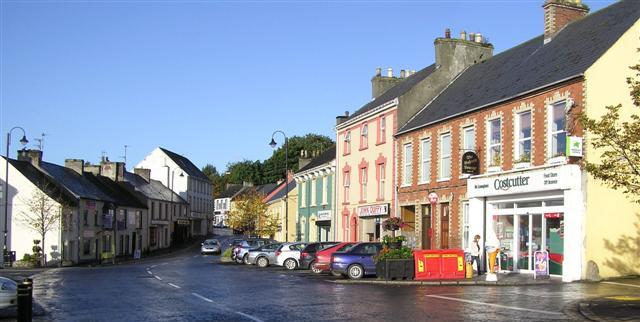
Raphoe (/rəˈf/ rə-FOH; Irish: Ráth Bhoth) is a small town in County Donegal in the north-west of Ulster, the northern province in Ireland. It is the main town in the fertile district of East Donegal known as the Laggan. It gave its name to the Barony of Raphoe, which was later divided into the baronies of Raphoe North and Raphoe South, as well as to the Roman Catholic Diocese of Raphoe and the Church of Ireland (Anglican) Diocese of Derry and Raphoe. There is also a civil parish of Raphoe.[2]

Key Information

The Burn Dale (also known in English as the Burn Deele) is a burn (a small river) that flows a short distance to the south of Raphoe. The Burn Dale eventually flows, via the village of Ballindrait, into the River Foyle just north of Lifford.

Name

[edit]

Raphoe, historically Raffoe,[2] comes from the Irish Ráth Bhoth, which is made up of the words ráth (fort) and both (hut). This likely refers to clay and wattle huts surrounded with a strong fortified mound.[3] It is believed these huts were built by monks in the early Christian period.[citation needed]

History

[edit]

The rich agricultural land around Raphoe has been inhabited and cultivated for thousands of years, and evidence of this can be seen through monuments such as the Beltany stone circle, just outside the town. The stone circle is one of the largest in Ireland with a diameter of 44 metres (144 ft) and is made up of more than sixty stones in all. The site is believed to date to around 2000 BC, and it was originally an enclosed cairn. Its name is believed to be linked to the Celtic festival of fertility Beltane.[4] Around 550 AD Columba (also known as Colmcille), one of the three patron saints of Ireland, founded a monastic settlement in the area. This site was further developed by his kinsman Eunan, (Irish form of the name Adamnan), who gives his name to the town's cathedral and is the patron saint of the Diocese of Raphoe.

Raphoe Castle

In 1198, John de Courcy, a Norman knight who had invaded Ulster in 1177, returned to County Donegal to devastate Inishowen and on his way destroyed churches at Ardstraw, County Tyrone, and Raphoe.[5]

The design of the modern town is traced to the Ulster Plantation of the early 17th century when the town was granted to English and Scottish settlers. It was these settlers who laid out the town with the 'Diamond' at its centre, in a similar manner to other Plantation towns like Derry and Donegal.[citation needed]

Raphoe Castle

[edit]

Built in the 1630s as the Bishop's Palace, the 'castle', which is now a ruin, was laid siege to during the Irish Rebellion of 1641, captured by Cromwell's troops in 1650 and was damaged by supporters of King James II & VII in 1689. Although still awaiting restoration, Raphoe Castle is probably the most impressive castle in Donegal. In 1633, John Leslie was translated from the Scottish See of the Isles to become the bishop of Raphoe. Marrying at the age of 67, and absorbing the Bishopric of Clogher at the age of 90, Leslie dominated the area until his death, aged 100, in 1671. Feeling threatened in his new location, he built himself a new palace on a hill overlooking the town using stone from an ancient Round Tower in 1637. This proved fortuitous when a rebellion broke out in 1641 and the Bishop was forced to shelter in the "castle", as it has come to be known until relieved by the Lagganeer army. Eight years later, Leslie, a Royalist was besieged by Cromwellian troops. This time, he was forced to surrender but unlike virtually every other bishop in Ireland, Leslie survived and was returned to his see at the Restoration in 1660. A leading figure in the Established Church, Bishop Leslie was no friend of either Catholic or Non-conformist. In 1664, he ordered four dissenting Presbyterian ministers to appear before his court, and when they failed to appear, had them arrested and imprisoned in Lifford gaol.[6] A century later, in 1798, the castle was attacked again, this time by the United Irishmen, three of whom were killed. The castle was destroyed in an accidental fire in 1838[7]

Raphoe Catholic Church, usually known locally as 'the Chapel'.

Raphoe Cathedral

[edit]

St. Columcille and St. Eunan, the ninth abbot of Iona, had churches at Raphoe in the fifth and sixth centuries. Several ninth-century blocks of stone can be found on the porch and the north wall of the present cathedral. The southeast corner dates from the twelfth century. The latest building dates from the 1730s. The communion plate is also noteworthy.

Notable bishops include Bishop George Montgomery, the first Protestant bishop, 1605 to 1610, a Scot, who was mainly involved in reclaiming church lands, and Bishop Andrew Knox, 1611 to 1633, who set about repairing and rebuilding the cathedral. A stone inscribed "And. Knox II. Epi. Cura", set in the porch, commemorates him. Bishop John Leslie had formerly been a soldier and had his own private army which he led into battle. Bishop Philip Twysden, 1747–1752, spent little time in Raphoe but squandered the family fortune in London; according to later reports, he was shot whilst robbing a stagecoach.[citation needed]

Sandy Montgomery, a kinsman of Bishop Montgomery, lies within the churchyard. His inscription reads, "Here lyeth the Body of Alexander Montgomery Esq., who departed this Life 29 September 1800, aged 78. He Represented this once Independent Country, 32 years".[6]

St Eunan's Church of Ireland Cathedral, Raphoe

Beltany Stone Circle

[edit]

On the summit of Beltany Hill, just over 1.5 kilometres (1 mi) from Raphoe, there stands one of the finest stone circles in Ireland. Reputedly older than Stonehenge, it consists of 64 standing stones out of an original 80. The stones range in height from 1.2–2.7 m (4–9 ft) while the diameter of the circle is 45 m (145 ft). Southeast of the circle is a standing stone two metres (6+12 ft) high. Beltony is a corruption of Baal tine, the fire of Baal; this suggests that the inhabitants of this area worshipped Baal, the sun god, and ruler of nature. Tradition tells us that the principal ceremonies were performed at the summer solstice; a sacred fire was lit in the centre of the circle of stones, which represented the stars and fire of the sun god Baal.[8]

Religion

[edit]

The town lends its name to both the Roman Catholic and Church of Ireland dioceses, which cover nearly all except the very southern section of County Donegal including Inishowen as well as County Londonderry and the northern section of County Tyrone in Northern Ireland. Raphoe's status has declined significantly in recent centuries, however, with the Anglican diocese being merged with Derry, while the Roman Catholic bishop now has his see in the larger town of Letterkenny. The Church of Ireland Cathedral, built on the site of Columba's monastery, is named for St Eunan (as is the Roman Catholic Cathedral in Letterkenny). There is also a Presbyterian church and a Congregational Church in Raphoe.

Transport

[edit]

Raphoe railway station opened on 1 January 1909 and finally closed on 31 January 1959.[9]

Royal School Boarding House, Raphoe.

The nearest railway station is operated by NI Railways and runs from Derry~Londonderry railway station via Coleraine to Belfast Lanyon Place and Belfast Grand Central. The strategically important Belfast-Derry railway line is to be upgraded to facilitate more frequent trains and improvements to the permanent way such as track and signalling to enable faster services.[citation needed]

Education

[edit]

Raphoe has two secondary schools and two primary schools. The Royal and Prior School is of the Protestant ethos and Deele College is non-denominational.[10]

Recent history

[edit]

In recent years, Raphoe has come under the media spotlight following the establishment of the Morris Tribunal to investigate allegations of corrupt and dishonest policing in the county by the Garda Síochána. The Tribunal's second report related to Garda attempts to frame a local publican, Frankie McBrearty, for the murder of cattle dealer Richie Barron.[11]

On 27 August 2005, the first main Royal Black Preceptory demonstration in Ireland was held in Raphoe, although local preceptories have been parading in the county for decades.[12]

The businessman and television personality Sir Gerry Robinson lived in Raphoe. He was the former non-executive chairman of Allied Domecq and the ex-chairman/chief executive of Granada. He owned an estate on the outskirts of Raphoe named Oakfield Park (often known locally as Stoney's Estate), which contains a Georgian country house and a botanical garden with a 15 in (381 mm) gauge[13] railway, the Difflin Lake Railway. The gardens and railway are open to the public.

Notable people

[edit]

See also

[edit]

References

[edit]
Revisions and contributorsEdit on WikipediaRead on Wikipedia
from Grokipedia
Raphoe is a small town and historical episcopal see in County Donegal, Republic of Ireland, situated in the fertile Laggan district of east Donegal amid low hills and lush farmland near the River Deele.[1] Its population stood at 1,161 in the 2022 census.[2] Established as a monastic site by Saint Columba in the 6th century and elevated to diocesan status by the early 8th century under Saint Eunan (Adomnán of Iona), Raphoe served as the seat of both Church of Ireland and Roman Catholic bishops until the latter's transfer to Letterkenny in the 19th century.[3][4] The town's modern layout originated during the Ulster Plantation of the early 1600s, when lands were allocated to English and Scottish Protestant settlers, fostering a grid-patterned marketplace known as the Diamond and agricultural economy centered on dairy and crops.[1] Key landmarks include the Cathedral Church of St. Eunan, a Church of Ireland structure rebuilt circa 1610 with later 18th- and 19th-century alterations, and the fragmentary remains of a 17th-century castle built by Sir Paul Gore.[5]

Etymology

Origins and Historical Names

The name Raphoe derives from the Irish Ráth Bhoth, translating to "ringfort of the huts" or "enclosure of the huts," with ráth denoting a circular earthen fort or enclosure and both referring to huts, tents, or booths, likely alluding to the temporary dwellings or monastic cells at the site.[6][7] The ancient form Rathboth appears in early records, reflecting this Gaelic origin.[3] The earliest documented reference to the location occurs in the Annals of Ulster for 628 AD, recording the "Battle of Both" (Cath Botha) between the Cenél Conaill and Cenél nEógain tribes, indicating the site's prominence as a fortified or settled area by the early 7th century.[6] Origins trace to a 6th-century monastic foundation established by Saint Colmcille (Columba), making Raphoe one of his early Irish sites and eventually the seat of a diocese.[3] This monastery was later developed under Saint Eunan (Adamnán, c. 627–704 AD), abbot of Iona and kinsman to Colmcille, who is venerated as Raphoe's patron saint and credited with formalizing the ecclesiastical establishment.[3][6]

Geography and Demographics

Location and Physical Features

Raphoe is situated in County Donegal, within the province of Ulster in the Republic of Ireland, at geographic coordinates approximately 54°52′N 7°36′W.[8] The town serves as the primary settlement in the Laggan district, a fertile lowland area in eastern Donegal characterized by rich agricultural land that has supported cultivation for millennia.[9] The local terrain consists of gently rolling low hills and lush hedgerows, with the town positioned on the lower slopes of Mongorry Hill amid expansive farmlands.[1] The River Deele flows in proximity, its wooded banks contributing to the area's scenic and ecologically diverse landscape.[1] Elevation in Raphoe averages around 76 to 87 meters above sea level, reflecting its position in a relatively flat to undulating inland valley rather than the rugged coastal or mountainous features prevalent elsewhere in County Donegal.[10][11] This topography supports intensive farming, with the surrounding soils derived from glacial deposits fostering productive arable and pastoral activities.[9]

Population and Demographics

As of the 2022 census conducted by Ireland's Central Statistics Office, Raphoe had a population of 1,161 residents, marking a slight increase from 1,089 in the 2016 census.[2] This followed a period of fluctuation, including a decline to 949 in 2002 before rebounding in subsequent counts.[12] The town's small size places it among smaller settlements in County Donegal, with population density reflecting broader rural patterns in the region.[13] Historical census data illustrate modest growth and variability:
Census YearPopulation
19911,090
19961,065
2002949
20061,065
20111,157
20161,089
20221,161
[12] Demographically, the 2022 population was nearly evenly divided by sex, with males comprising 49.2% (571 individuals) and females 50.8% (590 individuals).[2] Detailed breakdowns by age group or ethnicity for the town itself are not published separately in census profiles due to its limited scale, which risks identifying individuals; however, the surrounding Raphoe area aligns with County Donegal's profile of an aging population and high rates of Irish nationality (over 90% in the county).[14] Religiously, while town-specific figures are unavailable, the locality features a notable Protestant minority, including 273 Presbyterians in the Raphoe electoral division per the 2016 census, alongside its role as the episcopal seat for both Roman Catholic and Church of Ireland dioceses, contrasting with Donegal's overall 77% Catholic majority in 2022.[15][14]

History

Prehistoric and Early Christian Periods

The region surrounding Raphoe contains notable prehistoric archaeological remains, indicating human activity from the Neolithic and Bronze Ages. The most prominent site is Beltany Stone Circle, situated approximately 2 kilometers south of the town on Beltony Hill. This megalithic monument features 64 surviving standing stones, originally numbering around 80, arranged in a circle roughly 45 meters in diameter, with stone heights ranging from 1.2 to 2.7 meters.[16][17] Dating to the late Bronze Age (circa 1400–800 BC), the circle may have originated as an earlier Neolithic structure, potentially a passage tomb or ritual site, and its name derives from the Celtic festival of Beltane, associated with fire rituals.[18][17] The concentration of such monuments in the Raphoe vicinity highlights the area's ritual and ceremonial significance in pre-Christian Ireland.[19] Raphoe's early Christian period is marked by the establishment of a monastic settlement, traditionally attributed to Saint Adomnán (c. 627–704 AD), also known as Saint Eunan, the patron of the Diocese of Raphoe. Adomnán, a native of the Donegal region and ninth abbot of Iona, authored the Life of Columba and convened synods promoting Roman Easter observance; local tradition holds that he founded the monastery near his birthplace in Raphoe during the late 7th century.[6][5][20] Surviving traces of this foundation, including early ecclesiastical enclosures, are linked to the grounds of the present St. Eunan's Cathedral, though the original wooden structures have not endured.[6] Some accounts suggest an antecedent foundation by Saint Columba in the 6th century, but primary historical association remains with Adomnán's era.[21] As of 2025, a community-led archaeological initiative seeks to pinpoint the exact location of this long-lost monastery site through geophysical surveys and excavations, reflecting ongoing scholarly interest in verifying early monastic topography.[7]

Medieval and Early Modern Era

The Diocese of Raphoe emerged as an ecclesiastical center during the medieval period, with records indicating its elevation to a full diocesan see by the 12th century, reflecting its growing importance in Ireland's church hierarchy.[3] The first documented bishop, Gilbert O'Caran, was appointed around 1160, serving until his transfer to Armagh in 1175, followed by successors such as Maelisa O'Dorrigh, who died in 1203.[22] Several abbeys were founded within the diocese during the Middle Ages, underscoring its religious significance amid the monastic traditions of the era.[3] In the early modern period, Raphoe underwent transformation through the Ulster Plantation, initiated in the early 1600s, when lands were granted to English and Scottish settlers, shaping the town's modern layout with a central diamond-shaped market square.[23] This resettlement introduced Protestant influences, particularly Presbyterianism, altering the demographic and cultural fabric previously dominated by Gaelic Irish Catholics. In 1633, John Leslie, a Scottish bishop, was appointed to Raphoe, where he constructed the fortified Bishop's Palace—known as Raphoe Castle—between 1636 and 1637 using stone from a ruined round tower, primarily as a defensive stronghold amid rising tensions.[24] During the Irish Rebellion of 1641, Bishop Leslie staunchly defended Raphoe Castle against insurgent forces, holding out for 17 weeks with a garrison of soldiers and refugees until relieved by Royalist troops under the Earl of Antrim in 1642, an event that highlighted the castle's strategic role in the conflicts of the period.[25] Leslie remained bishop until his death in 1661, overseeing the diocese through the tumultuous Cromwellian conquest and Restoration. The castle sustained further damage in later sieges, including during the 1689 Williamite War, but its early construction marked a pivotal shift toward fortified ecclesiastical residences in plantation-era Ireland.[24]

19th and 20th Centuries

In the 19th century, Raphoe's economy centered on self-sufficient agriculture, with local production of wool, flax, and livestock supporting the town's trade and reducing reliance on external markets.[26] The Great Famine of 1845–1852 severely impacted County Donegal, including Raphoe, contributing to widespread death and emigration that reduced the county's population by approximately 40,000 individuals through compounded effects of starvation, disease, and exodus.[27] East Donegal areas like Raphoe, with relatively more diversified farming than the potato-dependent west, experienced moderated but still significant hardship, as evidenced by the establishment of poor law unions and workhouses across the region to manage pauper relief amid rising destitution.[28] Entering the 20th century, Raphoe exhibited strong unionist mobilization ahead of World War I, highlighted by Edward Carson's inspection of Ulster Volunteer Force (UVF) volunteers in the town in 1913, part of a broader effort where around 1,800 Donegal Protestants armed themselves to resist Home Rule.[29] [30] The Londonderry and Lough Swilly Railway's Raphoe-Strabane branch, opened on January 1, 1909, facilitated access to Derry and Strabane markets but eroded local commerce by enabling cheaper imports, leading to economic stagnation, halted housing development from 1910 to 1937, and gradual population decline.[26] During the Irish War of Independence (1919–1921) and subsequent Civil War, Raphoe saw limited revolutionary activity compared to other regions, influenced by conservative elements within the Catholic Church, including the Diocese of Raphoe's bishop, who helped restrain militant nationalism in east Donegal.[31] The 1921 Anglo-Irish Treaty partitioned Ireland, placing Raphoe in the Irish Free State despite its unionist heritage, rendering it one of Ulster's "lost counties" and prompting emigration among Protestant loyalists.[32] The railway line, undermined by post-World War I motorization and road improvements, ceased operations on December 31, 1959, further integrating Raphoe into broader regional economies.[26]

Involvement in Conflicts

Raphoe's involvement in conflicts centers primarily on the 17th-century upheavals associated with the castle, constructed in 1637 by Bishop John Leslie as a fortified residence. During the Irish Rebellion of 1641, the castle was besieged by rebel forces, with Leslie and his garrison holding out until relief arrived from the Laggan Army, a Protestant militia composed of Scottish and English settlers in the region.[25] This defense underscored the town's strategic position in the Plantation of Ulster, where British Protestant fortifications faced native Irish Catholic resistance. The castle faced further sieges amid the Cromwellian conquest of Ireland. In 1650, parliamentary forces under Colonel Tuthill captured Raphoe after a brief engagement, though Leslie had already evacuated much of his household. By 1653, Sir Charles Coote laid siege to the structure again, prompting Leslie to surrender the castle and adjacent cathedral to Presbyterian forces to avert bloodshed, reflecting the bishop's pragmatic approach amid escalating religious and political strife.[25] The castle sustained damage during these campaigns, emblematic of broader efforts to subdue royalist and Confederate holdouts in Ulster. In 1689, en route to the Siege of Derry, Jacobite supporters of King James II attacked and damaged the castle, targeting Protestant strongholds in the Williamite War. Repairs were completed by 1695, but the incident highlighted Raphoe's recurring role as a flashpoint in Anglo-Irish dynastic conflicts.[33] During the Irish Civil War (1922–1923), Raphoe served as a base for anti-Treaty IRA forces in east Donegal, augmented by activists fleeing Northern Ireland amid partition violence. National Army troops, building strength in the area, compelled the evacuation of Raphoe and nearby towns like Lifford and Castlefinn by anti-Treaty units, contributing to the suppression of irregular resistance in the region.[34] Local engagements remained limited compared to border hotspots, with no major battles recorded directly in the town. Later 20th-century conflicts, such as the Troubles, saw peripheral activity, including a 1970 UVF bombing of a nearby radio mast, but Raphoe itself avoided significant paramilitary incidents.[35]

Landmarks and Heritage Sites

Raphoe Castle

Raphoe Castle, also known as the Bishop's Palace, is a ruined fortified residence constructed between 1636 and 1637 on a hill overlooking the town of Raphoe in County Donegal, Ireland.[36] It was commissioned by John Leslie, Church of Ireland Bishop of Raphoe from 1633 to 1661, using stones salvaged from a nearby ruined round tower.[24] The design emphasized defense, featuring thick walls and a strategic elevated position, reflecting the insecure conditions of the Ulster Plantation era and Leslie's experiences in Scottish conflicts.[25] Bishop Leslie, a staunch royalist, defended the castle during the Irish Rebellion of 1641 and withstood a siege in 1650 amid Cromwellian forces.[37] The structure sustained further damage from Jacobite supporters in 1689 during the Williamite War in Ireland.[37] It was partially rebuilt around 1695 under Bishop Alexander Cairncross, who served from 1693 to 1701 before transferring to the Archbishopric of Dublin.[25] The castle endured another attack in 1798, linked to the Rebellion under the United Irishmen.[38] Its final destruction occurred in 1838 via fire, with reports attributing it to either accident from fallen coals or deliberate arson by a local seeking reduced demesne lease costs post-damage.[36] [33] Today, the ivy-clad ruins stand as a testament to 17th-century ecclesiastical architecture and military history, though not maintained by the Office of Public Works.[38] In 2022, the site received funding from the Historic Structures Fund for conservation works, underscoring efforts to preserve its structural integrity against weathering.[38]

Raphoe Cathedral

The Cathedral Church of Saint Eunan serves as the principal church of the Diocese of Raphoe, part of the United Dioceses of Derry and Raphoe in the Church of Ireland, situated at The Diamond in Raphoe, County Donegal, Ireland.[39][5] It is dedicated to Saint Eunan, known as Adomnán of Iona, who was abbot of Iona from 679 to 704.[39] The cathedral's origins trace to the 12th century, when Raphoe was established as a diocesan see, with the south-east corner of the present structure representing the oldest surviving fabric from that era.[39] A major rebuilding occurred around 1605 under George Montgomery, the first Protestant bishop of Raphoe and former chaplain to King James I, transforming the medieval site into a more substantial edifice.[39][5] Subsequent modifications shaped its form across centuries, including alterations circa 1622, 1695, 1700–1720, and 1830.[5] Bishop Nicholas Forster (1716–1743) added the porch beneath the four-stage tower in 1738, contributing Baroque elements, while transepts erected during his tenure were demolished during later works in 1888–1892.[39][5] In the 1870s and 1892, architect Sir Thomas Drew conducted restorations that exposed 13th-century remains and incorporated medievalizing features, including clock faces on the tower.[39][5] Architecturally, the cathedral features a nave, a chancel longer than the nave to accommodate elaborate liturgies, and a choir, constructed primarily of rubble stone walls with cut-stone quoins and ashlar sandstone dressings.[39][5] Pointed-arch windows, some with stained glass, and a slate roof define its Gothic-influenced profile, blended with later Victorian interventions.[5] The structure, largely dating to the 1730s with medieval fragments possibly from around 1000, holds national architectural importance for its layered history tied to Raphoe's early Christian monastic foundations.[39][5] A comprehensive restoration followed a 16-month closure, replacing the roof, installing new lighting, repairing defective stonework, and redecorating the interior at a cost of €450,000, funded by the cathedral's fabric fund, the Department of Heritage, the AllChurches Trust, and local efforts.[39] This work preserved the building's integrity as a key heritage site in Donegal.[5]

Beltany Stone Circle

Beltany Stone Circle is a prehistoric monument located on the summit of Tops Hill, approximately 3 kilometers northwest of Raphoe in County Donegal, Ireland.[40][17] Measuring 44 to 45 meters in diameter, it ranks among Ireland's largest stone circles, comprising 64 surviving upright stones arranged in a near-circular formation, with heights ranging from 1.2 to 2.7 meters.[40][16][17] Originally, the circle likely included up to 80 stones, though disturbance over millennia has reduced their number.[16] Archaeological evidence dates the structure to the Bronze Age, roughly 1400 to 800 BCE, based on typological comparisons with similar Irish megalithic sites.[41][17] Some researchers hypothesize an earlier Neolithic origin, potentially incorporating a passage tomb at its center, inferred from the site's morphology and regional precedents like those at Loughcrew, though no direct excavations confirm this.[40][41] The circle's elevated position offers panoramic views, suggesting possible astronomical alignments, such as solar observations, consistent with patterns in other Bronze Age Irish stone circles.[17] One distinctive feature is a large recumbent stone at the northeastern entrance, interpreted by some as a capstone or axial marker, potentially aligned with seasonal events like the Bealtaine festival, from which the site's name derives (anglicized from Beal Átha na nDúle, or "mouth of the ford of the elements").[19][41] Artifacts recovered from the vicinity, including Bronze Age tools, indicate prolonged ritual or ceremonial use, though systematic surveys have been limited, preserving the site as an unguided heritage location managed by the Office of Public Works.[40][41] Local folklore associates the circle with supernatural practices, but these lack empirical substantiation beyond 19th-century accounts.[19]

Other Archaeological and Historical Sites

Raphoe's early Christian heritage includes remnants of its 6th-century monastic foundation by Saint Eunan, comprising the Monastic Rath—an earthen ringfort that enclosed the initial settlement and provided defensive boundaries typical of Irish early medieval ecclesiastical sites—and the Close, the precinct around the cathedral that preserves elements of the medieval church layout. The Secular Enclosure, adjacent to these, historically separated lay habitation from the sacred monastic core, reflecting the dual structure of early Irish religious communities where monks coexisted with dependent populations. These earthworks and boundaries, though integrated into the modern town, attest to Raphoe's status as a key ecclesiastical center in pre-Norman Donegal, with the rath's survival documented through historical surveys of the area's topography.[6] In 2025, a community-driven archaeological project launched in Raphoe aims to pinpoint the precise site of the original monastery, encouraging local input to detect subsurface features like foundations or artifacts via non-invasive methods, building on prior recognition of the town's layered early Christian deposits.[7][42] Among later historical sites, the Second Raphoe Presbyterian Church, constructed in 1876, exemplifies 19th-century ecclesiastical architecture in a town noted as one of Ulster's earliest Presbyterian strongholds following the Plantation of Ulster.[43] Similarly, the Masonic Hall, erected in 1900, represents fraternal and civic building traditions from the town's post-famine development phase.[43] These structures, while not prehistoric, contribute to Raphoe's historical fabric beyond its primary landmarks.

Religion

Historical Religious Significance

Raphoe's religious history traces to the early Christian period, with its Gaelic name Ráth Bhoth ("ringfort of the huts") indicating a monastic enclosure of simple cells likely built by monks around the 6th or 7th century.[7] Tradition attributes the foundation of the monastery to Saint Adamnán (Eunan), a 7th-century scholar-abbot of Iona, biographer of Saint Columba, and probable native of the Raphoe area, who established the settlement before his death in 704 AD.[44] Some historical accounts, however, credit Saint Columba himself with founding the monastery in the mid-6th century, marking it as the first of his Irish sites to evolve into an episcopal see.[3] The Diocese of Raphoe emerged from these monastic origins, established by successors of Saint Patrick in the early Christian era and roughly aligning with the ancient Kingdom of Tír Conaill's boundaries. Initially functioning as an abbacy nullius around 700 AD, it was formally promoted to diocesan status by 1111 during ecclesiastical reforms under the Synod of Rathbreasail.[6] Surviving architectural remnants, including the 12th-century south-east corner of the present cathedral, attest to medieval consolidation of the see, which served as a key ecclesiastical center in northwest Ireland amid Viking raids and Norman influences.[20] Post-Reformation, Raphoe retained its significance as the seat of the Church of Ireland Diocese of Raphoe and Killybegs, with Bishop George Montgomery initiating cathedral reconstruction around 1605 under royal patronage from James I.[45] The site's enduring role bridged Celtic monasticism and later Protestant episcopacy, underscoring Raphoe's position as one of Ulster's ancient Christian hubs despite subsequent conflicts and demographic shifts.[23]

Modern Religious Composition and Institutions

The religious composition of Raphoe reflects the broader demographics of East Donegal, where Roman Catholics form the majority, comprising approximately 77% of County Donegal's population according to the 2022 Census, though local Protestant communities remain more prominent than the county average of under 10% due to historical Plantation-era settlements in the Laggan district.[14][46][47] Protestants, primarily Church of Ireland and Presbyterian, constitute a notable minority in Raphoe, with 273 Presbyterians recorded in the Raphoe Electoral Division in the 2016 Census, underscoring sustained community presence amid national declines in affiliation.[15] No significant non-Christian populations are reported, and those identifying with no religion align with the county's 8.1% rate.[48] Key Catholic institutions include the Parish of Raphoe within the Roman Catholic Diocese of Raphoe, which encompasses St. Eunan's Church in the town center, alongside St. Mary's in Convoy and St. Patrick's in Drumkeen; the diocese overall serves about 82,600 Catholics across 33 parishes and 71 churches with 48 priests as of 2023, amid efforts to address aging clergy and attendance patterns where 35.3% of Mass-goers are under 40.[49][50] The former medieval cathedral site now hosts the Church of Ireland's St. Eunan's Cathedral, a pro-cathedral of the united Diocese of Derry and Raphoe spanning Donegal, Derry, Tyrone, and parts of Antrim, maintaining active services and community roles despite broader Protestant demographic shifts.[51][52] Evangelical presence is represented by Raphoe Congregational Church, affiliated with the Congregational Union of Ireland, emphasizing personal faith and Bible teaching in weekly gatherings.[53] Religious orders, such as the Sisters of Mercy, operate convents in nearby areas like Ballybofey, supporting educational and pastoral work tied to local parishes.[54] Interdenominational tensions have historically been low, with shared community events, though national trends of secularization and emigration continue to influence participation across denominations.[55]

Clerical Abuse Scandals and Responses

The Roman Catholic Diocese of Raphoe, centered in Raphoe, faced significant scrutiny over historical cases of child sexual abuse by clergy, as detailed in a 2011 review by the National Board for Safeguarding Children in the Catholic Church.[56] The review examined complaints from 1975 to 2010 and identified 52 allegations against 14 priests, a proportionately high number compared to other Irish dioceses.[56] [57] Among these, four priests were convicted of offenses, while eight others left the priesthood or were removed from ministry.[56] Notable cases included Fr. Eugene Greene, who sexually abused at least 26 boys over two decades but was not removed from ministry due to the abuse until his alcohol problems surfaced.[58] Another involved Fr. Con Cunningham, who indecently assaulted two sisters, Margaret and Paula Martin, in the 1970s when they were aged 9–13; the sisters reported the abuse to the diocese in 1994, but authorities were not alerted until 2002, and Cunningham received a 15-month prison sentence in 2021 for eight counts of indecent assault.[59] The review highlighted systemic failures, including frequent delays or failures to report allegations to civil authorities and a prioritization of the Church's reputation over victims' needs, with bishops making "significant errors of judgment."[56] [57] In response, Bishop Philip Boyce, who led the diocese from 1994 to 2017, publicly described the abuse as "horrific" and acknowledged "very poor judgments and mistakes" by predecessors, issuing apologies to survivors and committing to victim support through counseling services like Towards Healing.[56] [57] The diocese cooperated with Garda Síochána investigations and implemented updated safeguarding policies aligned with national standards, including mandatory reporting and vetting procedures.[57] More recently, in July 2024, the diocese issued a formal apology to the Martin sisters for its "profound failure" in handling their case from 1994 to 2018, which was publicized in September 2025 at the victims' request to encourage other survivors to come forward.[59] These measures followed broader Irish Church audits, though critics noted ongoing challenges in accountability for past cover-ups.[60]

Economy and Infrastructure

Local Economy and Agriculture

Raphoe's local economy is predominantly agrarian, centered on agriculture as the primary economic driver in this fertile eastern Donegal district. The town's surrounding valley features productive soils supporting mixed farming practices, including grassland-based livestock production typical of the region, with dairy, beef cattle, and sheep rearing prominent due to the area's temperate climate and topography.[61][62] Crop cultivation, historically focused on potatoes, wheat, oats, barley, and flax in the Raphoe barony, continues on a smaller scale, with local enterprises like Ballyholey Farm Shop supplying field-fresh vegetables and potatoes grown on nearby holdings.[63][64] Livestock markets have long underpinned the area's economic activity, with Raphoe's traditional cattle ring facilitating sales of beef and sheep, contributing to regional trade and farmer incomes during periods of agricultural emphasis in Ireland's economy.[65] Supporting this sector are specialized services such as farm relief milking, scanning for cows and sheep, fencing, and supply stores like Gibson Farm Services, which provide essentials for animal health and equipment to local producers.[66][67] Beyond farming, the economy includes modest retail and community services, with establishments like a Centra supermarket and post office serving residents and sustaining basic commerce in a town of approximately 1,000 people.[68] Unemployment rates in Raphoe stood at around 17% as of mid-2010s assessments within Donegal's Local Economic Plan, reflecting challenges in peripheral rural areas but also opportunities tied to agricultural resilience and local enterprise support.[69] Recent efforts emphasize sustaining these sectors through flood relief schemes to protect farmland and businesses from environmental risks.[70]

Transport and Connectivity

Raphoe is primarily accessible via regional roads, with the R264 and R257 linking it to larger centers such as Letterkenny to the northwest and Strabane to the southeast. The town lies approximately 14 km southeast of Letterkenny and 20 km northeast of Lifford, facilitating road travel within County Donegal.[71] Public bus services connect Raphoe to nearby towns and cities, operated mainly by Bus Éireann and local providers under the Transport for Ireland network. Route 487 provides service from Strabane through Raphoe to Letterkenny, with multiple daily departures linking to Derry and beyond.[72] Additional routes, such as 480, serve connections to Derry, Donegal town, and Sligo, passing near Raphoe and offering onward travel options six times weekly to Donegal town in about 54 minutes.[73] Local Link services in Donegal supplement these, enhancing rural connectivity to essential services.[74] Raphoe lacks a railway station, with the nearest rail access in Derry (approximately 40 km away) via the Belfast-Derry line. For air travel, the closest commercial airport is City of Derry Airport (LDY), situated 38 km northeast, reachable by car in roughly 35 minutes or via bus connections from Derry.[75] Donegal Airport (CFN) at Carrickfinn, serving regional flights, is farther at about 70 km southwest.[76] Overall, private vehicle use predominates due to the town's rural setting and limited public transport frequency outside peak hours.[77]

Education and Community Services

Raphoe features two primary schools serving the local population. Raphoe Central National School is a co-educational institution under joint patronage of the Presbytery of Derry and Donegal and the Church of Ireland, providing mainstream primary education in English.[78] St. Eunan's National School operates as a co-educational Catholic primary school, emphasizing a structured and supportive environment for pupils.[79] Secondary education in Raphoe includes Deele College, a co-educational non-denominational school focused on high-quality teaching and individualized learning.[80] The Royal and Prior Comprehensive School offers a broad curriculum across six years, including Junior Certificate, Transition Year, and Leaving Certificate programs, as a co-educational day and boarding facility; its origins trace to a free school relocated to Raphoe in 1661.[81][82] Community services encompass healthcare through Raphoe Health Centre, a Health Service Executive (HSE) facility providing primary care; it operates Monday to Thursday from 9:00 a.m. to 11:30 a.m. and 2:00 p.m. to 4:30 p.m., and Friday from 2:00 p.m. to 4:30 p.m., with closures on weekends.[83] The Raphoe Family Resource Centre, established in 1995 as the Raphoe Youth and Community Project, delivers support services for families and individuals rooted in local needs.[84] Public library access is available via Raphoe Library, integrated into Donegal County Council's network, offering free membership, book loans, and community resources.

Recent Developments

Urban Regeneration and Housing

In July 2025, Donegal County Council initiated a Heritage-Led Regeneration Strategy and Action Plan for Raphoe's town centre, aimed at revitalizing the built environment through enhancements to public realms, streetscapes, and historic structures in alignment with Ireland's "Town Centre First" national policy.[85][86] The project, funded under the Historic Towns Initiative with contributions from the Department of Housing, Local Government and Heritage and the Heritage Council as part of a €2 million allocation across 14 historic towns, emphasizes place-making to attract investment while preserving Raphoe's heritage assets.[87] Public consultation commenced with an event on July 24, 2025, at the Diamond, inviting input to shape draft proposals focused on sustainable town centre renewal.[88] Early outcomes include the approved revitalization of a 19th-century building in Raphoe, converting it into a café, beauty salon, and apartments, alongside a new communal bin area and renovated storage facilities to support mixed-use functionality.[89] These efforts build on broader county initiatives to address underutilized sites and promote economic viability without specified residential quotas in the core strategy.[90] On housing, eleven energy-efficient social homes were completed in the Meadow Hill estate in August 2025, comprising one three-bedroom specially adapted bungalow and ten two-bedroom two-storey houses constructed by John O'Donnell Construction Ltd. at a cost of €2.4 million, following the demolition of four existing dwellings.[91][92] Tenants received keys shortly thereafter, contributing to Donegal's ongoing delivery of approximately 500 social housing units county-wide amid national shortages.[93][94] This development prioritizes sustainability and accessibility but remains peripheral to the town centre's heritage-focused regeneration.[95]

Environmental and Planning Controversies

In 2021, An Bord Pleanála refused planning permission for the reactivation of a disused quarry at Magherasolis and Craigs on the outskirts of Raphoe, following an appeal supported by over 400 local residents organized through Raphoe Community In Action and environmental group An Taisce.[96] The refusal cited unacceptable risks of environmental pollution, including inadequate surface water management that could adversely affect tributaries of the Foyle and Finn rivers—designated as special areas of conservation—as well as potential dust emissions, noise from blasting, health impacts, and excessive strain on local roads, deeming the project contrary to proper planning and sustainable development.[96][97] A subsequent application by quarry operator Patrick Bonar prompted Donegal County Council to grant conditional permission in late 2022, but this decision faced immediate criticism for alleged lack of transparency, including unrecorded pre-planning meetings between the applicant and council officials, which objectors claimed violated the Planning and Development Act 2000 and ethics guidelines by potentially providing undue influence without public disclosure.[98] Raphoe Community In Action, representing affected homeowners, lodged an appeal with An Bord Pleanála, highlighting 22 public submissions opposing the project on grounds of pollution risks, biodiversity loss, and community distress, amid broader concerns over the applicant's history of non-compliance in prior quarry operations elsewhere in Donegal.[98][99] On September 25, 2024, An Bord Pleanála overturned the local council's grant and approved the redevelopment for quarrying 5.37 hectares over 25 years, with an annual output limit of 110,000 tonnes of rock extraction, processing, and ancillary works, subject to 31 conditions including an environmental management system, berms and tree planting for mitigation, restricted operating hours (8 a.m. to 6 p.m. weekdays, limited Saturdays), and blasting protocols with advance notice.[97][99] Proponents argued the conditions sufficiently addressed prior water quality and habitat risks, though opponents, including local residents and figures like Lady Heather Robinson, maintained that unresolved threats to nearby watercourses and ecosystems persisted, fueling ongoing debates over enforcement and the balance between economic extraction and environmental protection in rural Donegal.[99] Raphoe has also experienced recurrent flooding, notably severe events in July 2023 that damaged homes and businesses, exacerbating local vulnerabilities in a region prone to overland pollutant flows and water supply disruptions as identified in broader county climate risk assessments.[100][101] While not directly tied to specific planning approvals, these incidents have highlighted deficiencies in flood defense planning, with residents historically resorting to self-funded barriers following the 2007 deluge due to delays in public infrastructure responses.[102] Donegal County Council's documented lag in agricultural and environmental enforcement standards has further amplified scrutiny of development consents in flood-prone areas like Raphoe.[103]

Notable People

Chloe Magee, born 29 November 1988 in Raphoe, is an Irish badminton player who competed for Ireland at the 2008, 2012, and 2016 Summer Olympics, winning multiple European mixed team medals including bronze in 2014 and 2016.[104][105] Her brother Sam Magee, born 9 January 1990 in Raphoe, is a retired badminton player who secured the European Junior Boys' Doubles title in 2009 and represented Ireland internationally, including at the 2016 Olympics.[106][107] Paul Hegarty, born 30 May 1967 in Raphoe, is a former professional footballer who played as a defender for Derry City, Finn Harps, and other clubs, earning caps for the Republic of Ireland national team and later serving as an assistant manager.[108][109] Sarah Leech (1809–c. 1830), an Ulster-Scots poet from the area near Raphoe, published Poems on Various Subjects in 1830, one of the few collections by a female writer in the Ulster-Scots tradition during that era.[110][111]

References

User Avatar
No comments yet.