


Community hub
Recent from talks
Contribute something
Nothing was collected or created yet.
Red lionfish
View on Wikipedia
| Red lionfish | |
|---|---|

| |
Scientific classification 
| |
| Kingdom: | Animalia |
| Phylum: | Chordata |
| Class: | Actinopterygii |
| Order: | Perciformes |
| Family: | Scorpaenidae |
| Genus: | Pterois |
| Species: | P. volitans
|
| Binomial name | |
| Pterois volitans | |

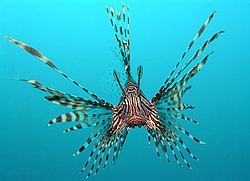
The red lionfish (Pterois volitans) is a venomous coral reef fish in the family Scorpaenidae, order Scorpaeniformes. It is mainly native to the Indo-Pacific region, but has become an invasive species in the Caribbean Sea, as well as along the East Coast of the United States and East Mediterranean and also found in Brazil at Fernando de Noronha.[2]
P. volitans and a similar relative, Pterois miles, have both been deemed invasive species. Red lionfish are clad in white stripes alternated with red, maroon or brown stripes. Adults in this species can grow as large as 47 cm (18.5 in)[3] in length, making it one of the largest species of lionfish in the ocean, while juveniles are typically shorter than 1 inch (2.5 cm). The average red lionfish lives around 10 years.[4] As with many species within the family Scorpaenidae, it has large, venomous spines on its dorsal fin (13) as well as other venomous spines on its pelvic fins (2) and anal fins (3). It is these fins together with the other long non-venomous fins which create an appearance similar to a mane, giving it the common name "lionfish". The dorsal spines deter most potential predators. Lionfish reproduce monthly and are able to quickly disperse during their larval stage for expansion of their invasive region. No definitive predators of the lionfish are known, and many organizations are promoting the harvest and consumption of lionfish in efforts to prevent further increases in the already high population densities.

Taxonomy
[edit]The red lionfish was first formally described in 1758 as Gasterosteus volitans by Carl Linnaeus in the 10th edition of his Systema Naturae in which he gave the type locality as Ambon Island in Indonesia.[5] In 1856 the French naturalist Eugène Anselme Sébastien Léon Desmarest designated Scorpaena volitans, which had been named by Bloch in 1787 and which was the same as Linnaeus's 1758 Gasterosteus volitans, as the type species of the genus Pterois which had been originally described by Oken in 1817.[6] A molecular study of this species, the common lionfish, the luna lionfish and Russell's lionfish found that the common lionfishes in the western Indian Ocean formed a lineage, that a second lineage consisted of both the luna lionfish and Russell's lionfish, suggesting these two taxa are conspecific, while the red lionfish formed a third lineage which appeared to have genetic contributions from the other two lineages. This suggests that the red lionfish arose from hybrids between P. miles and P. russelii sensu lato.[7] The specific name volitans means "flying", presumed to be a reference to the large pectoral fins resembling wings.[8]
Distribution
[edit]P. volitans is native to the Indo-Pacific region,[9] including the western and central Pacific and off the coast of western Australia. However, the species has been introduced into the Western Atlantic, becoming an invasive species there as well as in the northern Gulf of Mexico and the Caribbean.[10]
Life history and behavior
[edit]Reproduction
[edit]They are mainly a solitary species and courting is the only time they aggregate, generally one male with several females.[4] Both P. volitans and P. miles are gonochoristic and only show sexual dimorphism during reproduction. Similar courtship behaviors are observed in all Pterois species, including circling, sidewinding, following, and leading. The lionfish are mostly nocturnal, leading to the behaviors typically around nightfall and continuing through the night. After courtship, the female releases two egg masses, fertilized by the male before floating to the surface. The embryos secrete an adhesive mucus allowing them to attach to nearby intertidal rocks and corals before hatching. During one mating session, females can lay up to 30,000 eggs. However, it has been observed that females will lay more eggs in the warmer months.[11]
Predators and prey
[edit]In its invasive range, few predators of the lionfish have been documented. Most larger Atlantic and Caribbean fish and sharks that should be able to eat the lionfish have not recognized them as prey, likely due to the novelty of the fish in the invaded areas. Lionfish have, however, been found in the stomachs of Nassau and tiger groupers in the Bahamas,[12] but the former is critically endangered and therefore highly unlikely to provide significant predation. In its native range, two species of moray eels were found preying on lionfish.[13] The Bobbit worm, an ambush predator, has been filmed preying upon lionfish in Indonesia;[14] similar species inhabit the Caribbean.
The lionfish themselves are voracious feeders and have outcompeted and filled the niche of the overfished snapper and grouper. They are known to feed mostly on crustaceans, as well as other invertebrates, and small fishes, which include juveniles of their own species.[15][16] When hunting, they corner prey using their large fins, then use their quick reflexes to swallow the prey whole. They hunt primarily from late afternoon to dawn. Among their tactics is a "persistent-pursuit strategy" in which they capture fish twice as fast as them in spite of lacking crypsis by exploiting the periodic pauses in swimming of their prey with their uninterrupted slow approach. When they get within 9 cm, they strike using a "rapid expansion of the rostrum and low pressure within the buccal cavity to draw in prey that are immediately in front of the mouth".[17]
High rates of prey consumption, a wide variety of prey, and increasing abundance of the fish lead to concerns the fish may have a very active role in the already declining trend of fish densities.[18] As the fish become more abundant, they are becoming a threat to the fragile ecosystems they have invaded. Between outcompeting similar fish and having a varied diet, the lionfish is drastically changing and disrupting the food chains holding the marine ecosystems together. As these chains are disrupted, declining densities of other fish populations are found, as well as declines in the overall diversity of coral reef areas.
Early life history and dispersal
[edit]Although little is known about the larval stage of the lionfish, some traits of the larvae include a large head, a long, triangular snout, long, serrated head spines, a large pelvic spine, and coloration only in the pelvic fins. Larvae hatch 36 hours after fertilization.[4] They are good swimmers and can eat small ciliates just four days after conception.[4] The larval stage is the shortest stage of the lionfish's life, with a duration of about one month.[19]
Venom
[edit]Lionfish venomous dorsal spines are used purely for defense.[disputed – discuss] They are slow swimmers, so when threatened, the fish turns these spines towards its attacker, even if this means swimming upside down. However, its sting is usually not fatal to humans. Envenomed humans will experience extreme pain, and possibly headaches, vomiting, and breathing difficulties. A common treatment is soaking the afflicted area in hot water, as very few hospitals carry specific treatments.[20][21][22] However, immediate emergency medical attention is strongly recommended, as some people are more sensitive to the venom than others.
As an invasive species
[edit]Two of the 15 species of Pterois, P. volitans and P. miles, have established themselves as significant invasive species off the East Coast of the United States and in the Caribbean. About 93% of the invasive lionfish population is the red lionfish.[23] The red lionfish was likely first introduced off the Florida coast in the early to mid-1980s,[24] almost certainly from the aquarium trade.[25] Adult lionfish specimens are now found along the East Coast from Cape Hatteras, North Carolina, to Florida, and in Bermuda, the Bahamas, and throughout the Caribbean, including the Turks and Caicos, Haiti, Cuba, the Dominican Republic, Guadeloupe, Puerto Rico, St. Croix, Belize, Honduras, Aruba, Cayman Islands, Colombia, Saint Lucia, St. Martin, and Mexico.[26] It also is in Brazil at Fernando de Noronha.[27]
References
[edit]- ^ Motomura, H.; Matsuura, K. (2016). "Pterois volitans". IUCN Red List of Threatened Species. 2016 e.T190468A78940195. doi:10.2305/IUCN.UK.2016-3.RLTS.T190468A78940195.en. Retrieved 19 November 2021.
- ^ "lionfish (Pterois volitans/miles)". Species Profile. 2019-06-11. Retrieved 2021-06-19.
- ^ "World Record Size Lionfish | What is the Largest Lionfish Ever Caught?". Archived from the original on 2013-12-02. Retrieved 2013-08-08.
- ^ a b c d Encyclopedia of Life (EOL). (2011, January 19). Retrieved 4 May 2011 from (http://eol.org)
- ^ Fricke, Ron; Eschmeyer, William N. & van der Laan, Richard (eds.). "Species in the genus Pterois". Catalog of Fishes. California Academy of Sciences. Retrieved 12 March 2022.
- ^ Fricke, Ron; Eschmeyer, William N. & van der Laan, Richard (eds.). "Genera in the family Scorpaenidae". Catalog of Fishes. California Academy of Sciences. Retrieved 12 March 2022.
- ^ Christie L Wilcox; Hiroyuki Motomura; Mizuki Matsunuma; Brian W Bowen (2018). "Phylogeography of Lionfishes (Pterois) Indicate Taxonomic Over Splitting and Hybrid Origin of the Invasive Pterois volitans". Journal of Heredity. 109 (2): 162–175. doi:10.1093/jhered/esx056. PMID 28637254.
- ^ Christopher Scharpf & Kenneth J. Lazara, eds. (2 October 2021). "Order Perciformes (Part 9): Suborder Scorpaenoidei: Family Scorpaenidae". The ETYFish Project Fish Name Etymology Database. Christopher Scharpf and Kenneth J. Lazara. Retrieved 12 March 2022.
- ^ Lougher, Tristan (2006). What Fish?: A Buyer's Guide to Marine Fish. Interpet Publishing. p. 197. ISBN 0-7641-3256-3.
Where is it from? Eastern Indian Ocean and the Pacific Ocean.
- ^ "Lionfish In The Virgin Islands". Island Roots Boat Charters. Retrieved 2024-07-23.
- ^ Leis, Carson-Ewart. The Larvae of Indo-Pacific Coastal Fishes. Australian Museum.
- ^ Maljković, A.; Van Leeuwen, T. E.; Cove, S. N. (September 2008). "Predation on the invasive red lionfish, Pterois volitans (Pisces: Scorpaenidae), by native groupers in the Bahamas". Coral Reefs. 27 (3): 501. Bibcode:2008CorRe..27..501M. doi:10.1007/s00338-008-0372-9. S2CID 29564920. ProQuest 235788303.
- ^ Bos, Arthur R.; Sanad, Ashraf M.; Elsayed, Khamis (June 2017). "Gymnothorax spp. (Muraenidae) as natural predators of the lionfish Pterois miles in its native biogeographical range". Environmental Biology of Fishes. 100 (6): 745–748. doi:10.1007/s10641-017-0600-7. S2CID 25045547.
- ^ "Who Named the Bobbit Worm (Eunice sp.)? And WHAT species is it.. truly??". 2014-08-13.
- ^ "Pterois volitans (Red Lionfish)" (PDF). University of the West Indies. Retrieved 18 May 2023.
- ^ "Pterois volitans (Red firefish)". Animal Diversity Web.
- ^ Peterson, Ashley N.; McHenry, Matthew J. (2022-08-03). "The persistent-predation strategy of the red lionfish (Pterois volitans)". Proceedings of the Royal Society B: Biological Sciences. 289 (1980). The Royal Society. doi:10.1098/rspb.2022.1085. ISSN 0962-8452. PMC 9346346.
- ^ Côté, Im; Maljkovic, A (8 April 2010). "Predation rates of Indo-Pacific lionfish on Bahamian coral reefs". Marine Ecology Progress Series. 404: 219–225. Bibcode:2010MEPS..404..219C. doi:10.3354/meps08458. JSTOR 24873867.
- ^ Leis, Jeffrey Martin; Carson-Ewart, Brooke M., eds. (2000). "Scorpaeniformes". The Larvae of Indo-Pacific Coastal Fishes: An Identification Guide to Marine Fish Larvae. BRILL. pp. 217–225. ISBN 978-90-04-11577-4.
- ^ Aldred B, Erickson T, Lipscomb J (November 1996). "Lionfish envenomations in an urban wilderness". Wilderness Environ Med. 7 (4): 291–6. doi:10.1580/1080-6032(1996)007[0291:LEIAUW]2.3.CO;2. PMID 11990126.
- ^ Taylor, G. (2000). "Toxic fish spine injury: Lessons from 11 years experience". South Pacific Underwater Medicine Society Journal. 30 (1). ISSN 0813-1988. OCLC 16986801. Archived from the original on June 29, 2008. Retrieved 2008-08-13.
- ^ Vetrano SJ, Lebowitz JB, Marcus S (November 2002). "Lionfish envenomation". J Emerg Med. 23 (4): 379–82. doi:10.1016/s0736-4679(02)00572-3. PMID 12480019.
- ^ Hamner, R. M.; Freshwater, D. W.; Whitfield, P. E. (October 2007). "Mitochondrial cytochrome b analysis reveals two invasive lionfish species with strong founder effects in the western Atlantic". Journal of Fish Biology. 71 (sb): 214–222. doi:10.1111/j.1095-8649.2007.01575.x.
- ^ Whitfield, Paula; Gardner, Todd; Vives, Stephen P.; Gilligan, Matthew R.; Courtney, Walter R.; Ray, Carleton; Hare, Jonathan A. (2003). "The Introduction and Dispersal of the Indo-Pacific Lionfish (Pterois volitans) Along the Atlantic Coast of North America". Diving for Science 2003: Proceedings of the American Academy of Underwater Sciences 22nd Annual Scientific Diving Symposium. pp. 84–. OCLC 647601034.
- ^ Is the Aquarium Trade to Blame?
- ^ Whitfield, Paula E.; Hare, Jonathan A.; David, Andrew W.; Harter, Stacey L.; Muñoz, Roldan C.; Addison, Christine M. (28 December 2006). "Abundance estimates of the Indo-Pacific lionfish Pterois volitans/miles complex in the Western North Atlantic". Biological Invasions. 9 (1): 53–64. doi:10.1007/s10530-006-9005-9. S2CID 41535139.
- ^ Marinho, Ana Clara (28 August 2021). "Quarto peixe invasor venenoso é capturado em Fernando de Noronha em menos de um mês" [Fourth invasive poisonous fish is caught in Fernando de Noronha in less than a month]. Grupo Globo (in Portuguese). Retrieved 18 May 2023.
External links
[edit]

- Species Profile - Lionfish (Pterois volitans), National Invasive Species Information Center, United States National Agricultural Library. Lists general information and resources for Lionfish.
- Malpica-Cruz, Luis; Chaves, Laís C. T.; Côté, Isabelle M. (1 December 2016). "Managing marine invasive species through public participation: Lionfish derbies as a case study". Marine Policy. 74: 158–164. doi:10.1016/j.marpol.2016.09.027.
- Photos of Red lionfish in the Sealife Collection
| National | |
|---|---|
| Other | |

Red lionfish
View on GrokipediaTaxonomy and Morphology
Taxonomy
The red lionfish (Pterois volitans) is a species of venomous marine fish classified in the order Scorpaeniformes, family Scorpaenidae (scorpionfishes and rockfishes), and subfamily Pteroinae (butterfly-cods).[8][9] Its full taxonomic hierarchy is as follows: Kingdom Animalia, phylum Chordata, class Actinopterygii (ray-finned fishes), order Scorpaeniformes, family Scorpaenidae, genus Pterois, species P. volitans.[9][10] The genus name Pterois derives from the Greek pteron, meaning "wing" or "fin," referring to the elongated, fan-like pectoral fins; the specific epithet volitans comes from the Latin for "flying," alluding to the fish's fluttering swimming motion.[8] First formally described by Carl Linnaeus in 1758 as Gasterosteus volitans in the tenth edition of Systema Naturae, the species was later reclassified into Pterois by Marcus Elieser Bloch in 1785.[11] Synonyms include Pterois ruselli (a junior synonym) and occasional confusion with the morphologically similar Pterois miles (devil firefish), which differs in meristic counts such as dorsal fin rays (11 in P. miles versus 10-11 in P. volitans).[8][12] Genetic analyses published in 2016 indicated that P. volitans may represent a hybrid origin between P. miles (Indian Ocean lineage) and P. russelii (western Pacific lineage), with invasive Atlantic populations showing homogenized hybrid genotypes due to a genetic bottleneck.[13] This hybrid hypothesis challenges traditional morphological taxonomy but does not alter its current species designation under Linnaean classification, as supported by integrated morphological and molecular data from sources like the World Register of Marine Species.[9] The International Union for Conservation of Nature (IUCN) assesses P. volitans as Least Concern globally, reflecting its wide native range despite invasive impacts elsewhere.[4]Physical characteristics
The red lionfish (Pterois volitans) possesses an almond-shaped, laterally compressed body with a large head comprising one-third to one-half of its standard length, featuring numerous spines and fleshy tentacles above the eyes and below the mouth.[14][5] The body exhibits a white or cream base coloration overlaid with vertical red to reddish-brown stripes that alternate between wide and narrow bands, providing effective camouflage among coral reefs; coastal specimens may appear darker, occasionally nearly black in estuarine environments.[5][4] Adults typically reach lengths of 30 to 38 cm (12 to 15 inches), though maximum recorded lengths approach 47 cm, with maturity attained as early as 10 to 18 cm in length depending on sex.[2][4] The species is distinguished by its elaborate fins, including fan-like pectoral fins resembling wings and greatly elongated dorsal-fin spines, with membranes between fin rays often spotted.[7][5] The dorsal fin comprises 13 venomous spines and 9 to 12 soft rays, while the anal fin has 3 spines and 6 to 8 soft rays; pelvic fins also bear venomous spines.[4][14] These spines, particularly the 10 most prominent dorsal ones, deliver a potent venom containing neurotoxins like acetylcholine, serving as a primary defense mechanism against predators.[15] Fibrous "horns" often cover the eyes, enhancing the fish's ornate, intimidating appearance.[16]Distribution and Habitat
Native range
The red lionfish (Pterois volitans) is native to tropical and subtropical marine waters of the Indo-Pacific Ocean, with its range extending from the Red Sea and East Africa across the Indian Ocean to the central Pacific.[17] This distribution encompasses areas from western Australia and Malaysia eastward to French Polynesia and the Pitcairn Islands, northward to southern Japan, and southward to Lord Howe Island off the coast of Australia.[7] Within this vast area, spanning approximately from 40°N to 24°S latitude, the species occupies a variety of habitats including coral reefs, rocky crevices, seagrass beds, and mangrove fringes.[5] In its native range, P. volitans is commonly found at depths ranging from shallow intertidal zones to about 50 meters, though records exist up to 300 meters in some Pacific localities.[2] The species overlaps with the closely related Pterois miles in parts of the Indian Ocean and Red Sea, where hybridization may occur, contributing to the morphological variability observed across the complex.[18] Population densities in native habitats are typically low due to predation and competition, maintaining ecological balance in reef ecosystems.[19]Introduced range
The red lionfish (Pterois volitans) was first documented in the introduced range off Dania Beach, Florida, in 1985, likely via release or escape from the aquarium trade.[20] Since then, it has rapidly expanded throughout the tropical western Atlantic, establishing self-sustaining populations in the Gulf of Mexico, Caribbean Sea, and along coastal waters from North Carolina to Brazil.[5][17] By the early 2000s, sightings had proliferated across the southeastern U.S. Atlantic coast, Bermuda, and the Greater and Lesser Antilles, with densities reaching up to 390 individuals per acre in some Bahamian reefs by 2008.[14] Larval dispersal via ocean currents has facilitated southward spread into the southwestern Atlantic, with confirmed establishments in Colombian Caribbean waters by 2009 and Brazilian coastal reefs by 2010, extending to depths of 0–55 meters.[18][21] In the Gulf of Mexico, populations have densified since the mid-2000s, with genetic studies confirming a single source population from the initial Florida introduction, indicating high propagule pressure and minimal genetic bottlenecks.[22] Isolated reports exist in the eastern Atlantic and Mediterranean, but these lack evidence of widespread establishment compared to the core invasive front in the western Atlantic.[23] The species' success in this range exceeds native Indo-Pacific densities, attributed to abundant prey, low predation, and rapid reproduction, though climate variability may influence future southward limits near Brazil.[24][25]Biology and Ecology
Reproduction and development
Red lionfish (Pterois volitans) are gonochoristic, with males attaining sexual maturity at approximately 100 mm standard length and females at 180 mm.[14] Spawning takes place year-round in pairs after courtship rituals, during which females release buoyant gelatinous egg masses typically containing 1,800 to 41,945 hydrated oocytes, with batch fecundity increasing with female size (204–332 mm total length).[26] In temperate invaded regions such as North Carolina, spawning occurs every 4 days, though frequencies of 2–3 days have been observed in subtropical areas, yielding an annual fecundity of approximately 2 million eggs per female.[14] [26] Gonad development is asynchronous and indeterminate, allowing multiple spawning events, with peaks in gonadosomatic indices during periods of stable water temperatures.[26] Eggs have a mean diameter of 804 μm and remain afloat near the surface for 36–72 hours encased in mucus before hatching.[14] [27] Hatched larvae initially rely on a yolk sac, which is resorbed as they transition to planktivory.[14] The pelagic larval phase lasts 20–35 days, facilitating broad dispersal via ocean currents.[14] During this period, larvae advance through developmental stages—preflexion (mean body length 3.03 mm), flexion (4.64 mm), and postflexion (6.54 mm)—with exponential growth influenced by warmer temperatures (e.g., ~29°C).[28] Postflexion larvae exhibit vertical migrations, often concentrating at 20–30 m depths, which aids retention near reef systems.[28] Settlement occurs in shallow benthic environments, including coral reefs, mangroves, and seagrass beds, marking the shift to a demersal juvenile phase.[14]Feeding behavior and diet
Red lionfish (Pterois volitans) are ambush predators that employ a distinctive hunting strategy, using their elongated pectoral fins to corral schools of small fish toward their mouths before executing a rapid strike to engulf prey whole.[29] This behavior allows them to target evasive prey in complex reef environments, with observations in controlled trials showing individuals consuming an average of three prey fish per predation event across multiple trials.[30] They are primarily diurnal feeders, exhibiting peak predation activity in the morning between 08:00 and 11:00, though activity persists throughout daylight hours.[29] The diet of red lionfish consists predominantly of teleost fishes, supplemented by crustaceans and occasionally mollusks, rendering them generalist carnivores whose prey selection reflects local availability.[31] Stomach content analyses from invasive populations in the western Atlantic reveal that fishes comprise over 90% of prey items by number in many samples, with crustaceans (particularly decapods like shrimp and mantis shrimp) contributing significantly to biomass—up to 45% by volume and weight in some regions such as the southeastern United States.[32] Juveniles consume a higher proportion of crustaceans, shifting toward piscivory as they grow larger, a pattern observed in the northern Gulf of Mexico where larger individuals (>300 mm) prey almost exclusively on fish.[33] In seagrass habitats, crustacean intake increases compared to hard-bottom reefs, while overall diet breadth varies by location due to opportunistic foraging.[31][34] In their invasive Atlantic range, red lionfish demonstrate elevated predation rates compared to native Indo-Pacific populations, consuming biomass at rates exceeding 8.5 grams of prey per day for individuals around 300–400 grams body weight, facilitated by reduced competition and predation pressure.[35] This voracity contributes to substantial impacts on prey populations, with field studies linking lionfish abundance to rapid declines in native fish biomass.[36] Digestive physiology supports frequent feeding, with specific dynamic action (energy cost of digestion) enabling sustained activity and growth rates up to twice those in native ranges.[37] Prey items are typically swallowed alive or stunned, with venomous spines aiding in handling larger or resistant quarry, though the venom's primary role remains defensive.[38]Predators, prey, and defenses
The red lionfish (Pterois volitans) functions as a generalist predator, primarily consuming small reef fishes, with crustaceans and other invertebrates comprising a lesser portion of its diet. Stomach content analyses from invaded Atlantic reefs reveal that teleost fishes account for approximately 96% of prey items, often species under 10 cm in length, including juveniles of commercially important taxa such as grunts and snappers.[32] In native Indo-Pacific habitats, the diet similarly emphasizes piscivory, supplemented by shrimps, crabs, mollusks, and echinoderms, though composition varies with local prey availability.[18] This opportunistic feeding strategy enables high consumption rates, with individuals ingesting up to nine prey fish per feeding event.[30] In its native Indo-Pacific range, P. volitans experiences limited predation from larger reef inhabitants, including groupers, moray eels, sharks, cornetfish, and frogfish, which can overcome its defenses to consume adults or juveniles.[39] Predation events are infrequent, as evidenced by low lionfish densities in native ecosystems compared to invaded areas. In the introduced western Atlantic and Caribbean, native predators such as groupers rarely target lionfish, resulting in negligible top-down control and facilitating explosive population increases.[6] Experimental introductions of native predators have shown potential but limited efficacy without sustained pressure.[2] Defenses against predation rely chiefly on 18 venomous spines—13 dorsal, 3 anal, and 2 pelvic—equipped with grooves that deliver a heat-labile neurotoxic venom upon puncture, inducing severe pain, swelling, and paralysis in predators.[40] The spines' tri-lobed structure and tapered tips enhance puncturing efficiency, functioning as a passive mechanical barrier.[41] Conspicuous white-and-red striped coloration acts as aposematic warning, reinforced by diurnal displays and nocturnal sheltering in crevices, further reducing encounter risks.[1] These adaptations, evolved in the presence of co-occurring predators, prove highly effective in novel environments lacking evolutionary familiarity.[18]Venom apparatus
The red lionfish (Pterois volitans) is equipped with 18 venomous spines distributed across its fins: 13 in the dorsal fin, 3 in the anal fin, and 2 in the pelvic fins.[42] [41] These spines are solid and dentine-like in composition, featuring a trilobed cross-section with anterolateral grooves that accommodate glandular tissue responsible for venom production.[42] At the base of each spine lies paired venom glands composed of large, polygonal secretory cells with granular cytoplasm, enveloped by an integumentary sheath that protects the apparatus during normal swimming.[42] The pectoral and caudal fins lack spines and are non-venomous.[43] Envenomation occurs defensively when the fish erects its spines in response to perceived threats; penetration of skin or tissue tears the sheath, and subsequent mechanical pressure—often from associated musculature—compresses the glands, forcing venom through the spinal grooves directly into the wound.[42] [40] Unlike hollow injection systems in some venomous fish, lionfish spines rely on this passive diffusion augmented by pressure, enabling rapid toxin delivery without specialized ducts.[40] This mechanism immobilizes predators or incidentally captured prey, such as during handling by humans, though it is not adapted for active predation.[42] The venom is predominantly proteinaceous, comprising peptides (molecular weights 6–200 kDa) such as pteroicidins (antimicrobial), β-defensins, and hepcidins, alongside enzymes including hyaluronidase, proteases, and phospholipase A2.[42] Key toxin families include cytolysins for membrane disruption, neurotoxins targeting nerve function, and proteolytic components that facilitate tissue breakdown.[44] An ichthyotoxic fraction of approximately 327 Da contributes to prey lethality by inducing rapid paralysis.[42] In biological effects, the venom primarily induces local cytolytic damage, causing intense pain, edema, paresthesia, and potential necrosis in humans, with systemic symptoms like tachycardia or cramps in under 50% of cases; fatalities are rare, though secondary infections occur in about 20% of stings.[42] Mouse LD50 values approximate 210 µg, reflecting moderate potency with cardiotoxic, hepatotoxic, and nephrotoxic potentials.[42] Against prey fish, it promotes swift immobilization via neurotoxic and hemolytic actions, enhancing the lionfish's defensive posture in native and invaded habitats.[42]Invasion Dynamics
Introduction pathways
The red lionfish (Pterois volitans) was introduced to the western Atlantic Ocean predominantly via releases associated with the aquarium trade, where the species is popular among hobbyists for its striking appearance and relatively straightforward care.[45] Isolated sightings began in South Florida waters in 1985, with additional reports through the 1990s indicating early establishment along the southeastern U.S. coast, particularly in the Miami and Florida Keys areas.[7] A documented intentional release occurred on August 24, 1992, when six lionfish were freed in Biscayne Bay, Florida, contributing to the founding population.[46] Genetic analyses and population simulations estimate that dozens to scores of individuals were introduced, supporting a scenario of multiple small-scale releases rather than a single event, with the U.S. East Coast serving as the primary entry point before larval dispersal and adult migration facilitated spread.[47][48] Evidence favoring aquarium releases over maritime vectors includes the species' prevalence in U.S. pet trade imports from the Indo-Pacific—primarily Indonesia and the Philippines—concentrated through ports like Los Angeles, followed by domestic transport and release by owners unable to maintain large specimens.[49] Pre-1992 sightings undermine hypotheses attributing the invasion solely to Hurricane Andrew's damage to aquaria in 1992, as records from 1985–2000 document sporadic but consistent presence in south Florida, inconsistent with a singular post-storm event.[50] Low genetic diversity in Atlantic populations aligns with bottleneck effects from captive-bred or wild-caught aquarium stock, rather than broad oceanic transport.[51] Alternative pathways, such as ballast water uptake or hull fouling on ships, have been proposed but lack strong supporting evidence for P. volitans, given the species' poor survival in low-oxygen, turbid ballast conditions and the absence of concurrent invasions in high-ballast ports without aquarium hubs.[45][52] While not entirely ruled out, these mechanisms are considered improbable compared to deliberate or accidental human-mediated releases, as confirmed by integrated assessments emphasizing trade-driven introductions.[53] By the early 2000s, self-sustaining populations were evident, with densities increasing exponentially from these initial pathways.[54]Dispersal mechanisms
The primary mechanism of red lionfish (Pterois volitans) dispersal in its invasive western Atlantic range is passive transport of planktonic larvae via ocean currents, facilitated by a pelagic larval duration of 20–35 days that permits distances exceeding hundreds of kilometers.[55] This larval phase, characterized by high fecundity and year-round spawning in tropical waters, enables rapid colonization of distant reefs following initial adult establishments.[18] Biophysical modeling of larval trajectories in the Atlantic has demonstrated that currents such as the Gulf Stream drive northward connectivity from southeastern U.S. spawning sites to regions like the mid-Atlantic coast and Bermuda, with backtracking analyses confirming origins in southern areas like the Florida Straits.[56][57] Adult lionfish contribute minimally to long-range dispersal due to limited swimming mobility, with adult migration playing a secondary role compared to larval drift; genetic studies reveal high connectivity across invaded populations attributable to ongoing larval-mediated gene flow rather than localized adult movement.[58] While rare instances of human-mediated transport via shipping or aquarium releases may occur, empirical evidence from particle-tracking simulations and field observations underscores passive oceanic advection as the dominant propagator, allowing invasion even across potential barriers like the Amazon outflow in South America.[55][14] In the emerging Mediterranean invasion, similar larval dispersal dynamics have been modeled, with durations sufficient for trans-basin spread from initial Red Sea introductions.[59]Population trends
Invasive red lionfish (Pterois volitans) populations in the western Atlantic, Caribbean Sea, and Gulf of Mexico underwent rapid exponential growth following introductions in the mid-1990s, with sightings escalating dramatically after 2000 and widespread establishment by 2009.[60] Densities on coral reefs surged, reaching averages of 0.25–0.26 individuals per 100 m² in areas like Cuba, with peaks up to 1.11 individuals per 100 m², and up to 158 individuals per acre in parts of the Atlantic.[18] [61] This expansion was fueled by high reproductive rates, lack of predators, and effective larval dispersal, leading to fourfold density increases at some sites between 2015 and 2018.[62] By the mid-2010s, population trajectories shifted toward stabilization or decline in core invaded regions due to density-dependent effects on growth and condition, intensive human removal efforts, and potential environmental factors like hurricanes. In the Bahamas' Exuma Cays, densities rose 70.6% annually on small and medium reefs until peaking in 2010–2011, followed by annual declines of 16.6% through 2015, with steeper drops (up to 71.5%) on larger reefs possibly linked to reduced larval supply, intraspecific competition, or storm mortality rather than culling.[63] Similarly, in the northern Gulf of Mexico, densities on natural reefs peaked at 0.57 individuals per 100 m² in 2014 before stabilizing or declining, while artificial reefs saw exponential rises to 32.98 individuals per 100 m² by 2014, then stabilization through 2017; overall, a 75% drop occurred on natural reefs by 2018.[64] [65] These patterns reflect negative density dependence, where higher abundances correlated with slower growth, smaller sizes-at-age, and poorer condition due to competition.[64] [66] Despite localized declines, populations remain elevated in many areas and continue expanding into peripheral regions, such as the southwestern Atlantic where records spanned ~2800 km of coast from 2020 to 2023, indicating no overall waning of the invasion.[67] Trawl and camera surveys in the Gulf and Atlantic showed rapid increases through 2016–2017 followed by stabilization or decreases in 2018–2019, underscoring the role of sustained management in curbing trends.[68] On Saba Bank, initial rises leveled off with abrupt post-2014 declines, briefly interrupted by a resurgence.[69]Ecological and Economic Impacts
Effects on native ecosystems
The red lionfish (Pterois volitans), an invasive predator in the western Atlantic, Caribbean Sea, and Gulf of Mexico, disrupts native coral reef ecosystems primarily through high rates of direct predation on small reef fishes and invertebrates, with limited competition from native predators due to its novel hunting behavior and lack of effective controls.[6] Experimental evidence shows that a single lionfish on small patch reefs reduces recruitment of native Atlantic coral-reef fishes by an average of 79% over five weeks, as recruits comprise over 80% of its diet during this period.[70] In broader invaded areas, lionfish densities exceeding 300 individuals per hectare have led to local reductions in the abundance of small native reef fishes by up to 95%.[71] These effects cascade to alter community structure, with documented declines in native reef fish biomass by 65% in experimental enclosures.[72] Predation extends to ecologically key groups, including herbivores such as parrotfishes and surgeonfishes, which lionfish consume alongside juveniles of commercial species like snappers and groupers; this reduces grazing pressure on algae, promoting overgrowth that further stresses corals already vulnerable to bleaching and pollution.[6] In the Bahamas and other sites, lionfish exhibit generalist diets overlapping with those of native mesopredators, but their diurnal activity and prey-flushing techniques—such as pectoral fin jets—enhance capture efficiency against naïve native prey, amplifying per capita impact.[18] Non-consumptive effects, including fear-induced reductions in native herbivore foraging by up to 50%, compound these pressures by limiting prey behaviors essential for ecosystem maintenance.[73] Biodiversity losses manifest in decreased species richness and evenness on reefs, with lionfish favoring high-diversity juvenile assemblages that support long-term community resilience; in the northern Gulf of Mexico, such invasions have induced rapid shifts in trophic dynamics, favoring algae-dominated states over coral-fish equilibria.[65] While some studies in isolated Cuban reefs report no significant changes in competitor densities, meta-analyses confirm region-wide native fish declines correlating with lionfish abundance, underscoring the invasion's role in homogenizing reef assemblages.[18] Absent natural predators in these ranges, lionfish populations sustain these disruptions, posing ongoing risks to ecosystem services like habitat provision and fisheries recruitment.[6]Impacts on fisheries and biodiversity
The red lionfish (Pterois volitans) exerts profound negative effects on native biodiversity in the invaded western Atlantic, Gulf of Mexico, and Caribbean regions through intense predation pressure on reef-associated fishes. A single lionfish can reduce recruitment of native reef fish larvae and juveniles by 79% on coral reefs, as demonstrated in experimental enclosures.[6] This selective predation targets over 70 species of small native fishes, including ecologically critical herbivores from families such as Scaridae and Acanthuridae, leading to altered community structures, diminished species richness, and shifts toward algal dominance on reefs.[18] In the Bahamas, lionfish presence has correlated with a 65% reduction in native prey fish biomass within two years of establishment.[18] Such non-linear density-dependent effects intensify at higher invasion levels, potentially driving local extirpations of vulnerable endemics and compounding stressors like overfishing and climate change on already fragile ecosystems.[6] Lionfish impacts extend to fisheries by depleting juveniles of commercially and recreationally targeted species, including snappers (Lutjanidae), groupers (Epinephelidae such as Epinephelus striatus), and other reef-dependent stocks.[18] This consumption disrupts recruitment into adult populations, reducing overall biomass available for harvest and threatening the sustainability of artisanal, small-scale, and sport fisheries reliant on reef productivity.[6] In Jamaica, the invasion has been linked to economic losses exceeding $11 million USD from biodiversity declines that underpin reef-associated fisheries and tourism.[74] Regional studies indicate that unchecked lionfish densities (e.g., up to 12 individuals per 100 m²) amplify these risks by competing directly with native predators and altering prey availability, though quantitative fishery yield reductions remain site-specific and under ongoing assessment.[18]Potential benefits of invasion
The invasion of red lionfish (Pterois volitans) in the western Atlantic has prompted efforts to utilize the species commercially, potentially offsetting some economic costs through harvesting and consumption. Lionfish flesh is nutritionally comparable to or superior to many native reef fish, offering high levels of protein and polyunsaturated fatty acids, including elevated n-3 fatty acids such as eicosapentaenoic acid (EPA), with low mercury concentrations that make it suitable for regular human consumption. Sensory evaluations indicate broad consumer acceptability, supporting its promotion as a food source in invaded regions.[75][76][77] Targeted fisheries for lionfish have emerged as a market-based approach, providing income opportunities for small-scale fishers in areas like the Caribbean and southeastern United States, where removal derbies and commercial sales generate revenue from meat, fins, and by-products such as fish oils and collagen. Consumers exhibit willingness to pay premiums for lionfish products when linked to environmental benefits like reef restoration, enhancing economic incentives for sustained harvesting. In regions with high lionfish densities, such activities can support local livelihoods while indirectly aiding native species recovery through population reductions, though markets remain limited by supply chain challenges and processing costs.[6][78][79] Ecological benefits remain unsubstantiated, as lionfish primarily disrupt food webs by outcompeting native predators without filling compensatory roles; no empirical evidence supports net positive effects on biodiversity or ecosystem function in invaded areas. Any purported advantages, such as potential bioaccumulation of pollutants for monitoring, are speculative and unproven at scale.[18][80]Management and Control
Removal strategies
The primary removal strategy for invasive red lionfish (Pterois volitans) involves targeted culling by scuba divers using spearfishing techniques, which allow selective harvesting while minimizing damage to reef habitats.[81] This method has demonstrated local efficacy, with single-day derbies reducing lionfish densities by over 50% immediately post-event in southern Caribbean sites.[82] Divers typically target lionfish during crepuscular periods (dawn and dusk), when the fish exhibit heightened activity and are more detectable, improving capture efficiency.[83] Organized removal events, such as multi-day lionfish derbies, coordinate volunteer divers to maximize harvests; for instance, expeditions in the Atlantic have documented teams removing hundreds of individuals per event while collecting data on population metrics.[84] These efforts require sustained intensity, as models indicate that achieving 75% biomass reduction on reefs may necessitate 200-300 dives per hectare over multiple years, given the species' rapid reproductive rates and recruitment from untreated areas.[81] Small-scale culling on linear reefs, such as in southwest Puerto Rico, has shown short-term density declines but underscores the need to account for lionfish abundance relative to native species before resource allocation.[85] For deeper waters beyond typical diving depths, traps designed specifically for lionfish—often baited and deployed on reefs—offer a supplementary approach, though with lower efficiency (12-24% capture rates) compared to spearfishing.[86] Detection efficiency during surveys influences overall removal success, with studies in the northern Gulf of Mexico revealing that visibility, diver experience, and lionfish behavior modulate catchability, emphasizing the value of trained teams for consistent outcomes.[87] Despite these tactics, complete eradication remains infeasible due to the species' high fecundity and larval dispersal, necessitating ongoing, localized interventions rather than one-time efforts.[88]Biological controls and research
Research into biological controls for the invasive red lionfish (Pterois volitans) in the Atlantic has primarily focused on leveraging native predators, as lionfish exhibit few natural enemies in invaded regions due to their Indo-Pacific origins and defensive venomous spines. Experimental tethering studies off Little Cayman Island demonstrated that naïve native predators, including groupers (Epinephelus spp.) and moray eels (Muraenidae), are capable of consuming healthy lionfish, with attack rates indicating potential for learned predation behavior.[89] However, field observations suggest that such predation remains opportunistic and insufficient to regulate lionfish densities at scales observed in reef ecosystems, where lionfish abundances often exceed 300 adults per hectare without corresponding predator suppression.[90] Parasitological surveys reveal low infection prevalence in Atlantic lionfish populations—typically under 10% for common helminths—contrasting with higher loads in native Pacific ranges, consistent with the enemy release hypothesis that reduced parasite pressure facilitates invasion success.[91] Peer-reviewed analyses conclude that native parasites pose negligible biotic resistance, as lionfish immune responses and behaviors limit transmission, precluding them as reliable controls.[18] Proposals for classical biological control, such as importing lionfish-specific parasites or pathogens from native habitats, have been discussed in management reviews but remain untested due to ecological risks, including non-target effects on Atlantic biodiversity.[92] Broader research efforts, including NOAA-funded assessments since 2010, integrate biotic factors into invasion models, evaluating predator-prey dynamics and genetic variability for potential sterile mating or RNA interference strategies, though these remain experimental and non-deployed.[93] Studies emphasize that enhancing native predator efficacy through habitat restoration or conditioning may offer supplementary control, but empirical data indicate biological methods alone cannot achieve population reductions comparable to targeted removals, which have suppressed densities by up to 80% in localized trials.[54]Commercial harvesting and utilization
Commercial harvesting of the red lionfish (Pterois volitans) has emerged as a strategy in invaded regions of the Western Atlantic and Caribbean to control population densities while generating economic value through targeted fisheries. Programs incentivize removal by divers and fishers, often using spears or traps, with no bag limits imposed by bodies like the South Atlantic Fishery Management Council.[94] In the U.S., initiatives such as the Reef Environmental Education Foundation's Commercial Lionfish Harvest Program reimburse participants $3 per pound for delivered specimens, requiring licensing and purchase orders to facilitate processing.[95] Pilot operations, like the one launched in Cozumel, Mexico, in 2012, demonstrated initial success in reducing local abundances by 2015 through cooperative efforts, though sustained market development proved challenging.[96] Landings data reflect modest but growing commercial activity. In Florida, annual lionfish harvests peaked in 2017 at 54,431 kg, generating over $600,000 in ex-vessel value, before declining due to market saturation and logistical hurdles.[97] Whole fish have sold at retailers like Whole Foods in Florida for approximately $7 per pound, with fillets comprising about 30% of the carcass weight after accounting for spines and waste.[98] In the U.S. Virgin Islands, assessments indicate potential for local markets to support small-scale fisheries, providing alternative income and easing pressure on native reef species, though high harvest costs—driven by labor-intensive spearfishing—limit scalability.[99] Primary utilization centers on human consumption, promoted via recipes emphasizing the fish's mild, flaky white meat despite venomous spines requiring careful preparation.[100] NOAA Fisheries deems a lionfish food market practical and feasible, with secondary end-uses including curios from spines or skins, though these remain underdeveloped.[6] Butchering yields average 26% edible portions, constraining profitability, as processing demands specialized handling to mitigate risks from dorsal spines.[97] Economic models suggest that expanding demand through marketing could enhance viability, potentially offsetting invasion costs estimated in millions for affected fisheries, but consumer hesitancy and supply inconsistencies have kept markets small.[101]References
- https://www.[researchgate](/page/ResearchGate).net/publication/337485359_Assessment_of_the_Economic_Impacts_of_the_Lion_Fish_Pterois_volitans_Invasion_in_Jamaica