Hubbry Logo
search
logo

Regular cardinal

logo
Community Hub0 Subscribers
Read side by side
from Wikipedia

In set theory, a regular cardinal is a cardinal number that is equal to its own cofinality. More explicitly, this means that is a regular cardinal if and only if every unbounded subset has cardinality . Infinite well-ordered cardinals that are not regular are called singular cardinals. Finite cardinal numbers are typically not called regular or singular.

In the presence of the axiom of choice, any cardinal number can be well-ordered, and so the following are equivalent:

  1. is a regular cardinal.
  2. If and for all , then .
  3. If , and if and for all , then . That is, every union of fewer than sets smaller than is smaller than .
  4. The category of sets of cardinality less than and all functions between them is closed under colimits of cardinality less than .
  5. is a regular ordinal (see below).

Crudely speaking, this means that a regular cardinal is one that cannot be broken down into a small number of smaller parts.

The situation is slightly more complicated in contexts where the axiom of choice might fail, as in that case not all cardinals are necessarily the cardinalities of well-ordered sets. In that case, the above equivalence holds for well-orderable cardinals only.

An infinite ordinal is a regular ordinal if it is a limit ordinal that is not the limit of a set of smaller ordinals that as a set has order type less than . A regular ordinal is always an initial ordinal, though some initial ordinals are not regular, e.g., (see the example below).

Examples

[edit]

The ordinals less than are finite. A finite sequence of finite ordinals always has a finite maximum, so cannot be the limit of any sequence of type less than whose elements are ordinals less than , and is therefore a regular ordinal. (aleph-null) is a regular cardinal because its initial ordinal, , is regular. It can also be seen directly to be regular, as the cardinal sum of a finite number of finite cardinal numbers is itself finite.

is the next ordinal number greater than . It is singular, since it is not a limit ordinal. is the next limit ordinal after . It can be written as the limit of the sequence , , , , and so on. This sequence has order type , so is the limit of a sequence of type less than whose elements are ordinals less than ; therefore it is singular.

is the next cardinal number greater than , so the cardinals less than are countable (finite or denumerable). Assuming the axiom of choice, the union of a countable set of countable sets is itself countable. So cannot be written as the sum of a countable set of countable cardinal numbers, and is regular.

is the next cardinal number after the sequence , , , , and so on. Its initial ordinal is the limit of the sequence , , , , and so on, which has order type , so is singular, and so is . Assuming the axiom of choice, is the first infinite cardinal that is singular (the first infinite ordinal that is singular is , and the first infinite limit ordinal that is singular is ). Proving the existence of singular cardinals requires the axiom of replacement, and in fact the inability to prove the existence of in Zermelo set theory is what led Fraenkel to postulate this axiom.[1]

Uncountable (weak) limit cardinals that are also regular are known as (weakly) inaccessible cardinals. They cannot be proved to exist within ZFC, though their existence is not known to be inconsistent with ZFC. Their existence is sometimes taken as an additional axiom. Inaccessible cardinals are necessarily fixed points of the aleph function, though not all fixed points are regular. For instance, the first fixed point is the limit of the -sequence and is therefore singular.

Properties

[edit]

If the axiom of choice holds, then every successor cardinal is regular. Thus the regularity or singularity of most aleph numbers can be checked depending on whether the cardinal is a successor cardinal or a limit cardinal. Some cardinalities cannot be proven to be equal to any particular aleph, for instance the cardinality of the continuum, whose value in ZFC may be any uncountable cardinal of uncountable cofinality (see Easton's theorem). The continuum hypothesis postulates that the cardinality of the continuum is equal to , which is regular assuming choice.

Without the axiom of choice: there would be cardinal numbers that were not well-orderable. [citation needed] Moreover, the cardinal sum of an arbitrary collection could not be defined.[citation needed] Therefore, only the aleph numbers could meaningfully be called regular or singular cardinals.[citation needed]Furthermore, a successor aleph would need not be regular. For instance, the union of a countable set of countable sets would not necessarily be countable. It is consistent with ZF that be the limit of a countable sequence of countable ordinals as well as the set of real numbers be a countable union of countable sets.[citation needed] Furthermore, it is consistent with ZF when not including AC that every aleph bigger than is singular (a result proved by Moti Gitik).

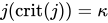
If is a limit ordinal, is regular iff the set of that are critical points of -elementary embeddings with is club in .[2]

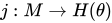
For cardinals , say that an elementary embedding a small embedding if is transitive and . A cardinal is uncountable and regular iff there is an such that for every , there is a small embedding .[3]Corollary 2.2

See also

[edit]

References

[edit]
Revisions and contributorsEdit on WikipediaRead on Wikipedia
from Grokipedia
In set theory, a regular cardinal is an infinite cardinal number κ that equals its own cofinality, meaning cf(κ) = κ.[1] Equivalently, κ is regular if no set of cardinality κ can be expressed as the union of fewer than κ many sets, each of cardinality strictly less than κ.[2] The smallest regular cardinal is ℵ₀, the cardinality of the natural numbers, which is regular because any countable union of finite sets is countable.[3] All successor cardinals are regular; for any infinite cardinal λ, the successor cardinal λ⁺ has cofinality λ⁺.[1] In contrast, some limit cardinals are singular, such as ℵ_ω, the least upper bound of the sequence ℵ_n for n < ω, which has cofinality ω.[4] Regular limit cardinals that are also strong limit cardinals—meaning that for every μ < κ, 2^μ < κ—are known as inaccessible cardinals, and their existence cannot be proved in ZFC set theory.[2] Regular cardinals are fundamental in advanced set-theoretic constructions, including the definition of inaccessible cardinals, measurable cardinals, and supercompact cardinals, as well as in forcing techniques where they ensure closure properties.[3] Beyond pure set theory, they underpin concepts in category theory, such as the accessibility of categories and the existence of filtered colimits in the category of sets bounded below a regular cardinal κ.[4]

Definition

Cofinality definition

In set theory, the cofinality of an ordinal κ\kappa, denoted cf(κ)\mathrm{cf}(\kappa), is the smallest ordinal α\alpha such that there exists an order-preserving map f:ακf: \alpha \to \kappa whose image is cofinal in κ\kappa, meaning that for every β<κ\beta < \kappa, there is some γ<α\gamma < \alpha with βf(γ)\beta \leq f(\gamma).[5] Equivalently, cf(κ)\mathrm{cf}(\kappa) is the order type of the smallest cofinal subset of κ\kappa, where a subset SκS \subseteq \kappa is cofinal if every initial segment of κ\kappa intersects SS.[5] For an infinite cardinal κ\kappa, this notion extends to a measure of how κ\kappa can be "approached" by smaller structures: cf(κ)\mathrm{cf}(\kappa) is the smallest ordinal α\alpha such that κ\kappa is the union of α\alpha many sets, each of cardinality strictly less than κ\kappa.[1] A cardinal κ\kappa is defined to be regular if cf(κ)=κ\mathrm{cf}(\kappa) = \kappa.[1] This condition captures the idea that κ\kappa is indivisible in the sense that it cannot be expressed as a union of fewer than κ\kappa many proper subcardinals; any decomposition into smaller pieces requires at least κ\kappa many components.[1] To illustrate, consider the smallest infinite ordinal ω\omega, which has cofinality ω\omega because every cofinal subset of ω\omega must be unbounded and thus order-isomorphic to ω\omega itself, confirming its regularity.[6] In contrast, the cardinal ωω=supn<ωωn\omega_\omega = \sup_{n < \omega} \omega_n has cofinality ω\omega, as it arises as the union of the countable sequence {ωnn<ω}\{\omega_n \mid n < \omega\} of strictly increasing smaller cardinals, making it singular.[6] The concept of cofinality was introduced by Felix Hausdorff in 1906, initially for linearly ordered sets in the context of ordinal arithmetic and order types.[7]

Set-theoretic definition

In set theory, an infinite cardinal κ\kappa is defined to be regular if it cannot be expressed as the union of fewer than κ\kappa many sets, each of cardinality less than κ\kappa. That is, for any family {Xαα<λ}\{X_\alpha \mid \alpha < \lambda\} where λ<κ\lambda < \kappa and Xα<κ|X_\alpha| < \kappa for each α<λ\alpha < \lambda, the cardinality of α<λXα\bigcup_{\alpha < \lambda} X_\alpha is less than κ\kappa.[8][9] Equivalently, κ\kappa cannot be written as a cardinal sum i<λμi\sum_{i < \lambda} \mu_i with λ<κ\lambda < \kappa and μi<κ\mu_i < \kappa for each i<λi < \lambda, where the sum denotes the cardinality of a disjoint union of sets of those sizes.[8][9] This characterization captures the operational sense in which κ\kappa is "indecomposable" under small unions, reflecting its role as a foundational measure of size in the cumulative hierarchy. This union-based definition is equivalent to the cofinality condition cf(κ)=κ\mathrm{cf}(\kappa) = \kappa, where cf(κ)\mathrm{cf}(\kappa) is the least ordinal λ\lambda such that there exists a cofinal function from λ\lambda into κ\kappa.[8][9] To see one direction, suppose cf(κ)=λ<κ\mathrm{cf}(\kappa) = \lambda < \kappa; let (αξξ<λ)(\alpha_\xi \mid \xi < \lambda) be a strictly increasing cofinal sequence of ordinals in κ\kappa with supξ<λαξ=κ\sup_{\xi < \lambda} \alpha_\xi = \kappa. Then κ=ξ<λαξ\kappa = \bigcup_{\xi < \lambda} \alpha_\xi, and each initial segment αξ=αξ<κ|\alpha_\xi| = \alpha_\xi < \kappa since αξ<κ\alpha_\xi < \kappa.[8][9] For the converse, assume κ=i<λAi\kappa = \bigcup_{i < \lambda} A_i with λ<κ\lambda < \kappa and Ai<κ|A_i| < \kappa for each ii; without loss of generality (by a bijection between κ\kappa and the union), take the AiκA_i \subseteq \kappa. For each ii, if supAi=κ\sup A_i = \kappa, then AiA_i is unbounded in κ\kappa, so cf(κ)Ai<κ\mathrm{cf}(\kappa) \leq |A_i| < \kappa because any unbounded subset of κ\kappa of cardinality μ<κ\mu < \kappa admits an increasing enumeration of length at most μ\mu whose supremum is κ\kappa. If instead supAi<κ\sup A_i < \kappa for all ii, then the set {supAii<λ}\{\sup A_i \mid i < \lambda\} is cofinal in κ\kappa (since every α<κ\alpha < \kappa belongs to some AiA_i, hence supAiα\sup A_i \geq \alpha), and has cardinality at most λ<κ\lambda < \kappa, so cf(κ)λ<κ\mathrm{cf}(\kappa) \leq \lambda < \kappa.[8][9] The Hartogs number of a set XX, defined as the least ordinal not injectively embeddable into XX, plays a role in formalizing such enumerations and ensuring that well-orderings of subsets of cardinality less than κ\kappa have order types below κ\kappa, thereby bounding the cofinal sequences in the proof.[8][9] Regularity, via cf(κ)=κ\mathrm{cf}(\kappa) = \kappa, represents the weakest nontrivial cofinality property among infinite cardinals, distinguishing it from stronger large cardinal notions like weak compactness, which require additional closure or embedding properties beyond mere regularity.[8][9]

Equivalent characterizations

In terms of ordinal functions

A cardinal κ\kappa is regular if and only if every function f:λκf: \lambda \to \kappa for λ<κ\lambda < \kappa has bounded range, meaning supran(f)<κ\sup \mathrm{ran}(f) < \kappa. This condition captures the ordinal-theoretic notion of regularity combinatorially, as it precludes the existence of any cofinal map from a smaller ordinal into κ\kappa, ensuring that κ\kappa cannot be approached cofinally by fewer than κ\kappa many steps. Equivalently, every subset of κ\kappa with cardinality less than κ\kappa is bounded below κ\kappa.[10][11] The aleph function, defined by f(α)=αf(\alpha) = \aleph_\alpha, provides a canonical example of an ordinal enumeration function in set theory. This function is normal, meaning it is strictly increasing (f(α)<f(β)f(\alpha) < f(\beta) for α<β\alpha < \beta) and continuous at limit ordinals (f(δ)=supα<δf(α)f(\delta) = \sup_{\alpha < \delta} f(\alpha) for limit δ\delta). For limit ordinals α\alpha, the cofinality satisfies cf(α)=cf(α)\mathrm{cf}(\aleph_\alpha) = \mathrm{cf}(\alpha), reflecting the continuity of the enumeration. Thus, α\aleph_\alpha is regular if and only if cf(α)=α\mathrm{cf}(\alpha) = \aleph_\alpha, which occurs precisely when α\alpha is a successor ordinal or a limit ordinal that is itself a fixed point of the aleph function with cofinality equal to its own value. The fixed-point property of normal functions like the aleph function ensures the existence of such points, but regularity imposes the additional condition that the index α\alpha aligns the cofinality with the cardinal itself.[11][10] Sierpiński's theorem provides another functional characterization: a cardinal κ\kappa is regular if and only if there does not exist a regressive function f:κκf: \kappa \to \kappa (i.e., f(α)<αf(\alpha) < \alpha for all limit α<κ\alpha < \kappa) that is constant on a stationary subset of κ\kappa. This equivalence highlights the combinatorial interplay between ordinal functions and stationary sets, where regressivity forces "pressing down" behavior incompatible with singularity. For singular κ\kappa, such a constant-on-stationary regressive function can exist, reflecting the lower cofinality.[11]

In terms of cardinal arithmetic

For an infinite regular cardinal κ, the cardinal addition satisfies κ + λ = max(κ, λ) for any cardinal λ < κ.[1] More generally, the sum of fewer than κ many cardinals, each of cardinality less than κ, has cardinality less than κ. This property serves as an equivalent characterization of regularity for infinite cardinals.[1][2] Similarly, cardinal multiplication for an infinite regular cardinal κ satisfies κ · λ = max(κ, λ) for any cardinal λ < κ.[1] The product of fewer than κ many cardinals, each less than κ, also has cardinality less than κ, paralleling the addition case.[12] For exponentiation, König's theorem states that for any infinite cardinal κ, κ^{cf(κ)} > κ.[1] For regular κ, where cf(κ) = κ, this specializes to κ^κ > κ, aligning with Cantor's theorem that the power set cardinality exceeds κ. The condition that κ^{cf(κ)} = κ cannot hold by König's theorem, as the exponentiation always exceeds κ; thus, regularity (cf(κ) = κ) is reinforced as the case where the cofinality matches the cardinal in this arithmetic context.[1] Singular cardinals violate these arithmetic properties. For example, the singular cardinal ℵ_ω has cf(ℵ_ω) = ω < ℵ_ω, and ℵ_ω = ∑_{n < ω} ℵ_n, where each ℵ_n < ℵ_ω and there are ω < ℵ_ω terms in the sum.[2]

Examples

Aleph fixed points

An aleph fixed point is a cardinal κ\kappa satisfying κ=κ\kappa = \aleph_\kappa, meaning κ\kappa is the κ\kappa-th infinite cardinal.[13] The aleph function αα\alpha \mapsto \aleph_\alpha is normal and continuous, so by standard results on normal functions, it has fixed points, which are necessarily cardinals.[14] ZFC proves the existence of such fixed points via the axiom of replacement: starting from κ0=0\kappa_0 = 0 and iterating κn+1=κn\kappa_{n+1} = \aleph_{\kappa_n} for n<ωn < \omega, the supremum κ=supn<ωκn\kappa = \sup_{n < \omega} \kappa_n satisfies κ=κ\kappa = \aleph_\kappa and has cofinality ω\omega, hence is singular.[13] This construction yields arbitrarily large singular aleph fixed points.[14] Most aleph fixed points are singular, typically with cofinality ω\omega.[13] For instance, the least aleph fixed point greater than the continuum 202^{\aleph_0} is obtained by iterating the aleph function ω\omega many times starting above the continuum and thus has cofinality ω\omega, making it singular.[13] Regular aleph fixed points are the uncountable regular limit cardinals. Those that are also strong limit cardinals are known as weakly inaccessible cardinals.[15] Such cardinals are fixed points because their regularity and limit nature imply they equal κ\aleph_\kappa.[16] However, the existence of regular aleph fixed points cannot be proved in ZFC and is equiconsistent with the existence of inaccessible cardinals, which are the first nontrivial large cardinals beyond those provable in ZFC.[17]

Inaccessible cardinals

A strongly inaccessible cardinal, or simply inaccessible cardinal, is defined as an uncountable regular cardinal κ\kappa that is also a strong limit cardinal. This means that for every cardinal μ<κ\mu < \kappa, the power set cardinality 2μ<κ2^\mu < \kappa.[18] The regularity condition ensures that κ\kappa cannot be expressed as the supremum of fewer than κ\kappa many smaller cardinals, while the strong limit property prevents κ\kappa from being reached via exponentiation from below. This combination makes inaccessible cardinals the primary examples of large regular cardinals beyond the smaller infinite cardinals like 0\aleph_0 or 1\aleph_1. The least inaccessible cardinal κ\kappa, if it exists, exhibits significant model-theoretic properties. In particular, the cumulative hierarchy up to κ\kappa, denoted VκV_\kappa, is isomorphic to the class HκH_\kappa of all sets with transitive closure of cardinality less than κ\kappa. This equivalence holds because the strong limit condition bounds the sizes of power sets within VκV_\kappa, and regularity ensures the overall cardinality of VκV_\kappa is exactly κ\kappa. Moreover, VκV_\kappa forms a Grothendieck universe, a model closed under standard set operations sufficient for developing much of classical mathematics internally, including category theory and algebraic geometry.[19] The existence of inaccessible cardinals has notable consistency strength relative to ZFC set theory. Their presence is independent of ZFC: ZFC neither proves nor refutes the existence of such cardinals, as models without inaccessibles can be constructed via forcing, while inner models under stronger assumptions yield them. Dana Scott first established in 1961 that the consistency of ZFC plus the existence of an inaccessible cardinal follows from the consistency of ZFC plus a measurable cardinal, marking a key step in understanding large cardinal hierarchies. In the broader hierarchy of large cardinals, inaccessible cardinals serve as a foundational level, with higher notions like Mahlo cardinals building upon them as inaccessible limits of sequences of inaccessibles. A Mahlo cardinal is an inaccessible κ\kappa such that the set of inaccessible cardinals below κ\kappa is stationary in κ\kappa, introduced by Paul Mahlo in his early work on transfinite numbers. However, the core significance of inaccessibility lies in its blend of regularity and limit properties, enabling robust models like VκV_\kappa \models ZFC.

Properties

Closure properties

Regular cardinals exhibit notable closure properties under various set-theoretic operations, which distinguish them from singular cardinals and underpin their role in infinitary combinatorics. A fundamental such property is closure under unions: if κ\kappa is a regular cardinal and {Aαα<λ}\{A_\alpha \mid \alpha < \lambda\} is a family of sets with λ<κ\lambda < \kappa and Aα<κ|A_\alpha| < \kappa for each α<λ\alpha < \lambda, then α<λAα<κ\left| \bigcup_{\alpha < \lambda} A_\alpha \right| < \kappa.[1] This follows directly from the definition of regularity, as the cofinality of κ\kappa prevents any such union from reaching size κ\kappa.[1] Successor cardinals provide a concrete class of regular cardinals with inherent closure characteristics. Every successor cardinal κ+\kappa^+, such as α+1\aleph_{\alpha+1} for any ordinal α\alpha, is regular, meaning cf(κ+)=κ+\mathrm{cf}(\kappa^+) = \kappa^+.[20] This regularity ensures that operations like forming power sets or taking successors preserve the structure below κ+\kappa^+ without introducing singularities at that level.[20] Diagonal intersections further illustrate closure for structures on regular cardinals. For a regular cardinal κ>ω\kappa > \omega, if {Cξξ<λ}\{C_\xi \mid \xi < \lambda\} is a family of club subsets of κ\kappa with λ<κ\lambda < \kappa, the diagonal intersection Δξ<λCξ={β<κξ<β(βCξ)}\Delta_{\xi < \lambda} C_\xi = \{\beta < \kappa \mid \forall \xi < \beta \, (\beta \in C_\xi)\} is club in κ\kappa.[21][22] The collection of stationary subsets of κ\kappa is similarly closed under such <κ\kappa-sized diagonal intersections, preserving stationarity.[21][22] Reflection properties also arise naturally on regular cardinals, enabling the propagation of combinatorial structures to smaller ordinals. For a stationary set SκS \subseteq \kappa where κ>ω\kappa > \omega is regular, Fodor's lemma (the pressing-down lemma) asserts that any regressive function f:Sκf: S \to \kappa (with f(α)<αf(\alpha) < \alpha for αS\alpha \in S) is constant on some stationary subset of SS.[22] This facilitates reflection: stationary sets on κ\kappa can reflect to initial segments α<κ\alpha < \kappa with cf(α)>ω\mathrm{cf}(\alpha) > \omega, where SαS \cap \alpha is stationary in α\alpha, under appropriate conditions tied to the regularity of κ\kappa.[22]

Relation to singular cardinals

A singular cardinal κ\kappa is an infinite cardinal such that its cofinality \cf(κ)<κ\cf(\kappa) < \kappa, meaning κ\kappa can be expressed as the supremum of a sequence of length \cf(κ)\cf(\kappa) consisting of fewer than κ\kappa many ordinals each strictly smaller than κ\kappa.[23] This contrasts with regular cardinals, where \cf(κ)=κ\cf(\kappa) = \kappa, preventing such a decomposition into fewer than κ\kappa parts. For example, ω\aleph_\omega is the least singular cardinal, with \cf(ω)=ω\cf(\aleph_\omega) = \omega, as it is the union of the countable sequence {n:n<ω}\{\aleph_n : n < \omega\}.[23] Every infinite cardinal is either regular or singular, as \cf(κ)κ\cf(\kappa) \leq \kappa holds universally for infinite cardinals κ\kappa, with equality defining regularity and strict inequality defining singularity.[23] Under the axiom of constructibility V=LV=L, the least singular cardinal remains ω\aleph_\omega, consistent with the generalized continuum hypothesis implied by V=LV=L.[23] Singular cardinals permit decompositions into fewer than κ\kappa many smaller sets, which has implications for their role in set-theoretic embeddings and hierarchies, rendering their cardinalities relatively weaker in constraining certain ultrapower constructions compared to regular cardinals. A key arithmetic distinction arises from König's theorem, which states that for any infinite cardinal κ\kappa, κ\cf(κ)>κ\kappa^{\cf(\kappa)} > \kappa; for singular κ\kappa, this yields κ\cf(κ)>κ\kappa^{\cf(\kappa)} > \kappa without the full exponentiation scale of regular κ\kappa, where \cf(κ)=κ\cf(\kappa) = \kappa and the inequality follows from Cantor's theorem on power sets.[23] Further implications for singular cardinals appear in exponentiation bounds, where regularity assumptions are absent. Shelah's PCF theory provides such a bound: if ω\aleph_\omega is a strong limit cardinal (i.e., 2n<ω2^{\aleph_n} < \aleph_\omega for all n<ωn < \omega), then 2ω<ω42^{\aleph_\omega} < \aleph_{\omega^4}.[23]

Applications

In forcing

In forcing, the regularity of uncountable cardinals is often preserved by certain posets, particularly those satisfying chain condition or closure properties that prevent the addition of short cofinal sequences. For instance, Cohen forcing, which adds real numbers via the poset of finite partial functions from ω\omega to 22, is countable chain complete (ccc) and thus preserves all uncountable cofinalities, including the regularity of any uncountable regular cardinal κ\kappa.[24] Similarly, the Lévy collapse Col(μ,<κ)\mathrm{Col}(\mu, <\kappa), where μ<κ\mu < \kappa is regular and κ\kappa is inaccessible, collapses all cardinals below κ\kappa to have cardinality μ\mu while preserving κ\kappa as a cardinal; due to its μ\mu-strategic closure and κ\kappa-chain condition, it maintains the regularity of κ\kappa.[25] Regularity can also be destroyed in forcing extensions, typically by adding a cofinal sequence to κ\kappa of length less than κ\kappa. Easton forcing, a class-sized product of Cohen forcings Add(κ,F(κ))\mathrm{Add}(\kappa, F(\kappa)) over regular cardinals κ\kappa with Easton support (limited to fewer than κ\kappa coordinates below κ\kappa), generally preserves cofinalities but can be adapted to include components that add such sequences, singularizing a targeted regular κ\kappa without collapsing cardinals, subject to the Easton function FF satisfying monotonicity and cofinality constraints.[26] For measurable cardinals, which are regular, Prikry forcing provides a canonical example: starting from a measurable κ\kappa with normal measure UU, the poset consists of finite stems and closed unbounded sets in the ultrapower, preserving all cardinals while forcing cf(κ)=ω\mathrm{cf}(\kappa) = \omega and thus making κ\kappa singular.[27] These preservation and destruction techniques find applications in consistency proofs within set theory. For example, iterated Cohen forcing with 1\aleph_1 many steps forces the continuum hypothesis (20=12^{\aleph_0} = \aleph_1) while preserving the regularity of 1\aleph_1, as the ccc ensures no uncountable cofinalities are altered. Prikry forcing, in turn, is used to explore the behavior of large cardinals in extensions where regularity fails at specific points, aiding in models that test hypotheses like the singular cardinals problem.[27] In generic extensions obtained by forcing, the regularity of successor cardinals such as 1V\aleph_1^V typically remains intact under the axiom of choice, as standard forcing notions preserve the successor structure and uncountable cofinalities when no collapse occurs below them.[28]

In inner model theory

In inner model theory, regular cardinals serve as foundational building blocks for analyzing the fine structure of canonical models like the constructible universe LL and core models KK. Fine structure theory, pioneered by Ronald Jensen, dissects these models through hierarchies such as JαJ_\alpha and Jα[A]J_\alpha[A], where regular cardinals appear as projecta—the least ordinals admitting non-absolute definable subsets—and ensure the acceptability and solidity of premice. For an acceptable structure MM, the Σ1\Sigma_1-projectum ρ=ρωM\rho = \rho_\omega^M is the least ordinal such that there exists a Σ1\Sigma_1-definable subset of ρ\rho over MM that is not absolute; this ρ\rho is a cardinal in MM, and embeddings π:MN\pi: M \to N preserve such cardinals above the critical point, as π(ρ)\pi(\rho) remains a cardinal if \crit(π)<ρ\crit(\pi) < \rho. Iterations of inner models, bounded by regular cardinals like Θ\Theta (the least ordinal not surjectively onto from the reals in L(R)L(\mathbb{R})), terminate below these bounds due to their cofinality properties, enabling comparisons via the comparison lemma.[29] In core model constructions, regular cardinals delineate the extent to which large cardinals are captured. For a measurable cardinal κ\kappa with normal measure μ\mu, the inner model L[μ]L[\mu] has κ\kappa as its least measurable cardinal, with the same uncountable regular cardinals above ω\omega and below κ\kappa as in LL, and GCH holding below it; more generally, the core model [K](/page/K)[K](/page/K)—the union of all iterable premice—incorporates sequences of measures or extenders up to the least "bad" regular cardinal where iterability fails. The Dodd-Jensen lemma guarantees that iterations along the main branch of length less than a regular θ>ω\theta > \omega yield unique normal iteration maps, preserving solidity and soundness. If no inner model with a Woodin cardinal exists, the covering lemma implies that every uncountable set XOrdX \subseteq \mathrm{Ord} in VV is covered by a set YKY \in K with YK=X|Y|^K = |X| for regular cardinals bounding the strength. These properties underscore how regularity facilitates the minimality of core models relative to large cardinal assumptions.[29] A pivotal application arises in models of determinacy, where the interplay between regularity and large cardinals reveals deep structural insights. In L(R)L(\mathbb{R}) under the axiom of determinacy (AD), John Steel established that every uncountable regular cardinal κ<Θ\kappa < \Theta—the supremum of ordinals constructible from reals—is measurable in HODL(R)\mathrm{HOD}^{L(\mathbb{R})}, the inner model of hereditarily ordinal-definable sets. This result, part of the HOD analysis, shows that HODL(R)\mathrm{HOD}^{L(\mathbb{R})} is a fine-structural core model satisfying GCH, with all such κ\kappa admitting a normal measure in its extender algebra; moreover, singular cardinals below Θ\Theta are limits of measurables. The theorem links choiceless axioms like AD to large cardinal strength, as its consistency follows from the existence of a measurable cardinal above infinitely many Woodins in VV, and it implies that projective determinacy holds without choice.[30]

References

User Avatar
No comments yet.