Hubbry Logo
ReiningReiningMain
Open search
Reining
Community hub
Reining
logo
8 pages, 0 posts
0 subscribers
Be the first to start a discussion here.
Reining
Reining
from Wikipedia

Reining is a western riding competition for horses in which the riders guide the horses through a precise pattern of circles, spins, and stops. All work is done at the lope (a version of the horse gait more commonly known worldwide as the canter), or the gallop (the fastest of the horse gaits). Originating from working cattle, reining requires the horse to be responsive and in tune with its rider, whose aids should not be easily seen, and judges the horse on its ability to perform a set pattern of movements. The horse should be willingly guided or controlled with little or no apparent resistance and dictated to completely. A horse that pins his ears, conveys a threat to his rider, refuses to go forward, runs sideways, bounces his rear, wrings his tail in irritation, or displays an overall poor attitude is not being guided willingly, and is judged accordingly. If a horse jogs or breaks gait it is a 0.[1]The Change needs to be in the middle of the arena.

Key Information

Origins

[edit]

Throughout the history of the Americas, dating back to the earliest Spanish settlers in what today is Mexico and the Southwestern United States, including Texas and California, ranchers needed to manage cattle from horseback. Cattle were moved, branded, doctored, sorted, and herded, often on open range without the benefit of fences, barns or other means of holding the animals. A good cowboy needed a quick and nimble horse, one that could change directions quickly, stop "on a dime," and sprint after an errant cow. The horse needed to be controlled mostly by legs and weight, ridden with only one hand and a light touch on the reins, so that the cowboy's attention could also be on tasks that could include handling a lariat (to rope cattle), opening a gate, or simply waving a hand, hat or rope to move along a reluctant herd animal. Informal demonstrations of these ideal characteristics amongst ranch cowboys and vaqueros evolved into the sport of reining, as well as the related events of cutting and working cow horse as well as several other horse show classes.

Other nations with traditions of herding livestock on vast areas, such as Australia and Argentina, developed similar traditions that have blended into the sport as it has expanded worldwide.

Movements

[edit]

The reining pattern includes an average of eight to twelve movements which must be executed by the horse. Patterns require the following movements:

Circles are performed at speed
  • Circles: the horse must perform large, fast circles at a near-gallop and smaller, slow circles at a lope. They should be perfectly round, with the rider dictating the pace of the horse. There should be an easily seen change of speed as the rider transitions from the large, fast to the small, slow circles. Most circles incorporate changes of direction that require a flying change of lead.
  • Flying lead change: the horse changes its leading front and hind legs at the lope mid-stride, during the suspension phase of the gait. The horse should not break gait nor change speed. It can be used for as turning and direction. While completing a change at speed can improve one's score, precision is the most important factor in judging: A horse taking more than one stride to complete the change, or a horse that changes early, late, or that changes only the front feet and not the hind feet will be penalized.
  • Rundown: the horse gallops or "runs" along the long side of the arena, at least 20 feet (6 m) from the fence or rail. A rundown is a required movement prior to a sliding stop and a rollback to the designated direction (either towards the judge or towards the nearest wall depending on the pattern).

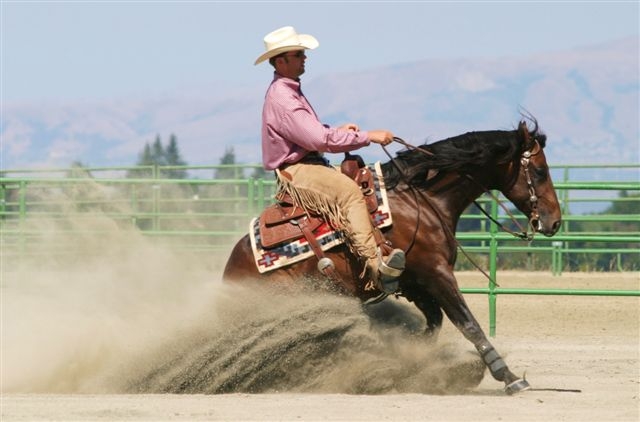
  • Sliding Stop: the horse accelerates to a gallop and then suddenly comes to a complete halt, planting its hind feet in the footing and allowing its hind feet to slide several feet, while continuing to let its front feet "walk" forward. The back should be raised upward and hindquarters come well underneath. A particularly powerful stop may, depending on arena conditions, produce flying dirt and a cloud of dust. The movement should finish in a straight line, and the horse's position should not change. This movement is a crowd favorite, along with spins (see below).
  • Back or Backup: the horse backs up quickly for at least 10 feet (3 m). The horse must back in a perfectly straight line, stop when asked and hesitate a moment before the next movement. It is judged on how quick, smooth and straight the line is.
  • Rollback: the horse immediately, without hesitation, performs a 180-degree turn after halting from a sliding stop, and immediately goes forward again into a lope. The horse must turn on its hindquarters, bringing its hocks well under, and the motion should be continuous with no hesitation.
The spin is one of the most difficult and crowd-pleasing maneuvers
  • Spins or Turnarounds: beginning from a standstill, the horse spins 360 degrees or more (up to four and one-quarter full turns) in place around its stationary inside hind leg. The hind pivot foot remains in essentially the same location throughout the spin, though the horse will pick it up and put it down as it turns. Spins are judged on correctness, smoothness, and cadence. Speed adds to the difficulty and will improve the score of a correctly done spin. A pattern requires at least one set of spins in each direction. Horses must stop the spin in the designated place or be penalized for over or under spinning. The term Pivot is sometimes used to describe a turn on the hindquarters of up to 360 degrees where the horse has to keep a rear pivot foot stationary. In 4-H competition, pivots of 90, 180, or 360 degrees are sometimes used in pattern classes to introduce youth riders to reining concepts.
  • Pause or Hesitate: the horse is asked to stand still for a few seconds to "settle" between certain movements in the reining pattern, particularly after spins. Pauses are not judged as a movement per se, but a horse that is ill-mannered or behaves with impatience when asked to wait will be penalized.

Scoring

[edit]
A proper sliding stop requires a horse to keep its head down, back rounded, hindquarters well underneath the body, and to "walk" with the front legs as the hind legs slide.

Scoring is on the basis of 70 and it is an average score for a horse that made no errors but also did not perform maneuvers with a higher level of difficulty.[2] Points for each maneuver are added or subtracted by 12-, 1-, and 1+12-point increments for each of the 7 to 8 maneuvers in the designated pattern as follows:

  • 1+12 for an extremely poor execution
  • −1 for very poor
  • 12 for poor
  • 0 for correct with no degree of difficulty
  • +12 for good execution
  • +1 for very good
  • +1+12 for excellent

Each part of the pattern is judged on precision, smoothness, and finesse. The "degree of difficulty" for each maneuver, typically related to speed and agility, is also assessed. Increased speed increases the difficulty of most movements and the potential for a high score. For example, a perfectly executed fast spin will score higher than an equally perfectly executed slow one.[2] A score below 70 reflects deductions for poorly performed movements or penalties, a score above 70 reflects that some or all movements were above average.

In addition to the scores for each maneuver, a large variety of penalties may be assessed for specific infractions. Penalties may range from a half-point to five points for each infraction, and in some cases a significant error may result in a zero score for the run. Certain misbehaviors may incur penalty points beyond a poor score for a given maneuver. Significant errors, such as going off pattern or using illegal equipment, will result in a "zero score". Under NRHA rules, horses with a zero score cannot earn a placing or advance in a multi-go event, though they may be eligible for a payout if there is a small number of horses in the entire competition.[2] Some sanctioning organizations other than NRHA may allow a horse in a small class to earn an award for last place. Major mistakes, such as failure to present the horse for an equipment check, a rider with illegal equipment or one who abuses the animal in specified ways, result in a "no score," which prevents the horse from earning any award or payout,[2] even if it is the only horse in the class.

The horse

[edit]

Reining may be performed by any horse, but the Stock horse breeds, particularly the American Quarter Horse, dominate the field. The reining horse must be agile, quick, and very responsive to the rider's commands. Powerful hindquarters are required to hold position in a sliding stop or a rollback, excellent coordination is required for proper spins and flying lead changes. Correct leg conformation is essential, as the limbs and joints are often under considerable stress in competition. The horse must also have an excellent temperament to perform with both speed and precision.

Equipment and attire

[edit]

Riders must use a western saddle. Spurs are allowed, but whips are not. Bridles are western-styled, without a noseband or cavesson. The bosal style hackamore is also allowed on "junior" horses. There are very strict rules about what types of bits and bosals are legal.

For protection, horses usually wear brushing boots on their lower front legs as well as skid boots on their hind fetlocks. Bell boots, which wrap around the pastern and protect the hoof and coronary band, are also usually seen, sometimes only on the front feet, other times on all four feet. Exercise bandages are also another form of protection that is used, this helps give support to the tendons and ligaments, and prevents bruising and irritation. These can be used on all four legs but if wrapped improperly can cause damage.

Reining horses are usually fitted with special horseshoes on the hind feet called slide plates. Slide plates have wider bar steel and are smoother than regular horseshoes, with even the nail heads filed to be flush with the shoe. When the horse plants its hind feet for a sliding stop, the shoes allow the hind legs to slide along the ground with less resistance. Slide plates often have long trailers to help the horse's hind legs slide in a straight path as well as a rolled toe so that the front of the hoof does not accidentally catch the ground.

Riders must wear a long-sleeved shirt, jeans, and cowboy boots. In most competitions, they also wear chaps. Gloves are optional. There has historically been less difference between men's and women's attire in reining than in most western events, though women's clothing is more influenced by fashion trends from Western pleasure competition, and thus women sometimes wear brighter colors, and are more apt to add a decorated jacket or vest, though usually not as flashy as in other horse show events. Wearing a certified equestrian helmet is permitted by some organizations,[3][4][5] though not commonly used.[6]

Bit and Hackamore rules

[edit]

Horses in most types of reining competition are required to perform in a curb bit. In most cases, riders with a horse in a curb must give all rein commands with only one hand.[7][8][9]

Riders may use both hands when a horse is ridden with a snaffle bit or a bosal hackamore. However, snaffles and hackamores ridden with both hands are usually limited only to special classes for horses between the ages of three and five years old. Most of the time, with the exception of "freestyle" classes, snaffle bit and hackamore horses do not compete directly against curb bit horses, though specific details vary depending on the particular sanctioning organization.[7][10][11] In the last thirty years, the snaffle bit is the more common headgear used on younger horses, but in the past, the hackamore was more common. Some local or regional competitions offer a non-sanctioned "novice horse" division where horses of any age who have limited experience as reining horses can be ridden two-handed in a snaffle.

Sometimes reining classes at breed shows are split into "junior horse" and "senior horse" divisions. Depending on the breed, Junior horses are either 3, 4 or 5 years old, and allowed to show in a snaffle or bosal. Senior horses who age out of the junior horse divisions at age six must be shown in a curb.[7][9] The rules have changed over the years to reduce the stress on young horses. Junior horse divisions at one time were limited to horses that were only 3 and, sometimes, 4 years old. Expansion to age five parallels the standards set by the FEI and in endurance competitions, recognizing that the physical and mental development of most young horses is not considered complete until that time. Further, though many western stock horse breeds are started under saddle at the age of two, they generally are not physically or mentally ready to be entered into any type of reining competition at that age and in some cases are prohibited from entering any performance class until at least 2+12 years old.[12] Both the NRHA and many breed associations offer snaffle bit futurities, usually for three-year-old horses, which pay very large purses.

Reining competition

[edit]

Reining as a sport was first recognized by the American Quarter Horse Association (AQHA) in 1949, and later by the United States Equestrian Federation (USEF) in its western division and within a number of its breed divisions. The National Reining Horse Association (NRHA) was formed in 1966 in the United States, and developed a worldwide membership as well as standardized rules and patterns that significantly influenced other organizations, including the AQHA and USEF. The sport of reining became an FEI-recognized discipline in 2000, and FEI-sanctioned reining competitions are held across the world, including at the World Equestrian Games. In 2011, USA Reining was established to serve as the reining sport affiliate for the USEF and FEI competition structure in the United States.

Individual divisions at a reining competition vary with the sanctioning organization. However, standard classes include those limited to junior or senior horses, to horses of a specific age (such as three-year-olds), classes for professional, "non-pro," or amateur riders (those who do not work with horses for pay), youth riders of various ages, adult riders over age 40 or 50, as well as open events for all competitors. Classes may also be limited by the experience level of the horse or the rider.

National

[edit]

In individual nations where reining competitions are held, national organizations usually oversee the sport. Reining classes can be held at a stand-alone competition just for reiners, or as one category within many different classes offered at a horse show. For example, in the United States, the National Reining Horse Association (NRHA) creates patterns and develops judging standards, sanctioning events open to all breeds. However, the United States Equestrian Federation (USEF) and its reining discipline affiliate, USA Reining, are the national organizations overseeing FEI and high performance competition in the USA, but also work with the NRHA in non-FEI open reining competition sanctioned by the USEF,[13] and in individual horse breed show reining competition governed by the USEF, such as Morgans or Arabians.[14][15] Breed organizations that sanction their own shows, including those for Quarter Horses (AQHA), Appaloosas (ApHC),[16] and American Paint Horses (APHA) also cooperate with the NRHA.

International

[edit]

International competitions are regulated by the International Federation for Equestrian Sports (FEI). Reining is growing in popularity around the world, including Europe and Australia. It was added as a part of the World Equestrian Games, beginning in 2002.

Freestyle

[edit]
A competitor in Freestyle reining, dressed as Miss Piggy

Freestyle reining allows a horse and rider team to incorporate reining movements into a three and one-half minute musical routine, akin to the KUR Freestyle competition in Dressage, but with elements that resemble the freestyle events in human competitions such as figure skating. Under NRHA rules, costumes are allowed, though not required; riders may ride with one, two or even no hands on any type of NRHA approved bit; props, within certain limits, are allowed; and the show management may allow special arena lighting. Freestyle reining competitions have no specific rules as to saddle, though humane equipment is required. Allowing "no hands" means that some competitors may perform without a bridle, which increases the difficulty of the movements. The rider must include a specified number of spins, stops and flying lead changes in a performance. Rollbacks, rein backs and dressage type maneuvers such as the half-pass may be added and scored. Competitors are judged on technical merit and artistic impression. At some competitions, an applause meter is added and may contribute to the artistic impression portion of the score.[17]

College Level

Equestrian is a Division 1 and Division 3 sport recognized by the NCAA. single discipline teams are in Division 3, only competing in English, and Division I teams consist of English and western, including reining, horsemanship, flat, and jumping.

See also

[edit]

References

[edit]
[edit]
Revisions and contributorsEdit on WikipediaRead on Wikipedia
from Grokipedia
Reining is a judged western equestrian discipline in which riders guide ranch-type horses through a precise of maneuvers, including circles, , sliding stops, and rollbacks, to demonstrate the horse's athletic , training, and responsiveness within the confines of a show . The emphasizes the rider's to control the horse with minimal resistance, showcasing smoothness, , quickness, and authority while performing at controlled speeds. Originating from the practical skills of Old West cowboys herding cattle on working ranches, reining has evolved into a competitive event that highlights these foundational horsemanship techniques. The National Reining Horse Association (NRHA), founded in 1966 as a non-profit organization, serves as the primary for the , establishing standardized rules, judging criteria, and competition formats to promote reining horses worldwide. Reining gained international recognition when it was incorporated into the Fédération Equestre Internationale (FEI) World Equestrian Games in 2002, fostering growth in countries such as , , , and the . Today, the NRHA boasts over 15,000 members and sanctions numerous events, including high-stakes competitions like the NRHA Futurity, which offers more than $2.3 million in prizes for three-year-old horses. Competitors perform one of 18 approved patterns, each consisting of key maneuvers such as large and small circles (performed at fast and slow speeds with flying lead changes), 360-degree spins on the hindquarters, sliding stops of up to 10 meters or more, and pauses. Judges evaluate performances on a scale where an average run scores 70 points, with individual maneuvers awarded from -1½ (extremely poor) to +1½ (excellent) points based on execution, , and correctness; penalties ranging from ½ to 5 points—or even zero scores—are deducted for errors like breaks, over- or under-spinning, or blatant disobedience. Equipment is strictly regulated to ensure fairness and horse welfare, including one-handed reining with bits, snaffle bits, or hackamores, while prohibiting mechanical aids or wire on bits. Reining competitions are divided into levels and classes for professionals, non-professionals, and , with earnings caps and eligibility requirements to accommodate varying skill levels, and the prioritizes through enforced medication policies and conduct standards. Notable achievements include riders like Shawn Flarida, who has earned over $8 million in lifetime winnings as of 2025, underscoring the 's professional caliber and economic impact. Through its blend of tradition and precision, reining continues to celebrate the partnership between horse and rider while adapting to global standards.

History

Origins

Reining traces its roots to the 16th-century Spanish equestrian traditions introduced to the during the colonial period, where vaqueros—skilled horsemen of Spanish, Indigenous, and descent—developed precise reining techniques essential for cattle herding on vast open ranges. These early practices, centered in regions like and the , involved maneuvers such as sharp turns, quick stops, and controlled spins to manage without dismounting, emphasizing a light contact and the horse's responsiveness to subtle cues. By the 19th and early 20th centuries, these vaquero methods evolved within American cowboy culture on working ranches in the western United States, where Quarter Horses became prized for their speed, agility, and ability to perform demanding tasks like cutting cattle from herds or navigating rough terrain. Cowboys, inspired by vaquero expertise, refined these skills into informal competitions at rodeos and ranch gatherings, showcasing horses' precision and athleticism as a point of pride among ranch hands. This period solidified reining as a core element of ranching life, transitioning from practical necessity to a celebrated aspect of Western horsemanship. The formal recognition of reining as a competitive occurred in 1949, when the (AQHA) established it as a judged event, standardizing patterns and criteria to preserve the discipline's ranching heritage while promoting it in organized shows. This milestone marked the shift from ranch contests to a structured equestrian class, highlighting the Quarter Horse's role in maintaining these traditional skills. Reining's foundational maneuvers also drew influence from global herding practices, such as the gaucho traditions in , where criollo horses performed similar agile work on the , and Australian stock disciplines, which adapted comparable techniques for mustering livestock in rugged conditions. These international parallels underscore how reining's core elements—precision control and partnership between and rider—emerged from diverse yet convergent stock handling cultures worldwide.

Modern Development

The National Reining Horse Association (NRHA) was incorporated on November 30, 1966, as a dedicated to promoting the reining horse through standardized competition formats and events. The NRHA played a pivotal role in formalizing the sport by developing official reining patterns—such as the 18 approved variations used exclusively in its approved shows—and organizing the inaugural NRHA Futurity that same year, which set benchmarks for judging maneuvers like spins, slides, and circles to ensure consistency and fairness across competitions. Reining achieved international prominence in 2000 when it was recognized as a discipline by the Fédération Equestre Internationale (FEI), facilitating global standardization and opening pathways for Olympic-level consideration through integration into major equestrian championships. This inclusion enabled the U.S. Reining Team to excel in , securing team gold medals in all five appearances from 2002 to 2018, along with nine individual medals comprising three golds, four silvers, and two bronzes. However, following the termination of FEI cooperation agreements with NRHA and AQHA in 2018, reining was removed as an FEI discipline effective 2022, with the NRHA continuing to lead international growth. The sport's growth accelerated under NRHA oversight, though 2020 saw reduced activity due to the , with membership at approximately 14,000, 722 affiliated shows worldwide, and lower purse distributions; by 2024, membership exceeded 15,000, with more than 1,493 shows annually distributing over $16 million in purses and fostering participation across all levels. Recent advancements since 2020 include -focused expansions at the National Reining Breeders Classic (NRBC), such as the addition of a $10,000-added Division in the Non Pro Classic for 2026, aimed at nurturing emerging talent with enhanced prizes and opportunities. The Run for a Million has emerged as the premier high-stakes event, drawing top professionals to compete for a $1,000,000 purse in a single-round format that highlights elite athleticism. Amid this expansion, 2025 has seen heightened discussions on training ethics within reining, particularly in response to updates in the USDA Horse Protection Act (HPA), which mandate stricter prevention measures, USDA-trained inspectors at all equine events, and enhanced reporting for show managers to safeguard horse welfare. These revisions, further delayed after April 2, 2025, with the current effective date of February 1, 2026, have prompted debates in the equine community about implementation burdens on non- disciplines like reining, while reinforcing commitments to ethical practices and animal protection across competitions.

Fundamentals of Reining

Key Movements

Reining patterns consist of eight required maneuvers executed in sequence within an enclosed arena, designed to demonstrate the horse's agility and responsiveness under one-handed control.[ NRHA Patterns, https://nrha.com/wp-content/uploads/2025/08/patterns.pdf ] These maneuvers must be performed along straight lines where applicable, with brief hesitation pauses between major elements to allow for transitions and to emphasize control.[ NRHA Reining Maneuvers, https://nrha.com/wp-content/uploads/2025/07/reining-maneuvers.pdf ] The core movements include large and small circles, where the horse lopes in perfectly round 360-degree paths: large circles are performed at a fast lope to showcase speed and extension, while small circles are executed at a slower lope for precision and collection.[ NRHA Reining Maneuvers, https://nrha.com/wp-content/uploads/2025/07/reining-maneuvers.pdf ] Typically, three circles are completed in each direction, with flying lead changes at the center to switch from left to right or vice versa, maintaining forward momentum without breaking .[ NRHA Patterns, https://nrha.com/wp-content/uploads/2025/08/patterns.pdf ] These changes require the horse to seamlessly alter its leading leg while loping, highlighting balance and suppleness.[ NRHA Handbook, https://nrha.com/wp-content/uploads/2025/07/2024-handbook.pdf ] Sliding stops follow run-ins, where the horse accelerates to a lope and then halts abruptly by sliding its hindquarters forward on the arena surface, often achieving depths exceeding (3 meters) while the front legs remain upright and pulling.[ Western Life Today, https://www.westernlifetoday.com/overview-of-reining/ ] Immediately after, a rollback is performed: the horse plants its inside front leg, executes a 180-degree pivot over its hindquarters without hesitation, and departs in the opposite direction at a lope, retracing its path to simulate quick directional changes.[ NRHA Reining Maneuvers, https://nrha.com/wp-content/uploads/2025/07/reining-maneuvers.pdf ] Spins conclude many patterns, involving four full 360-degree turns (sometimes with a quarter extra) on the haunches in each direction from a standstill, with the horse pivoting around its inside hind leg while maintaining cadence and vertical motion.[ NRHA Patterns, https://nrha.com/wp-content/uploads/2025/08/patterns.pdf ] Additional elements include run-ins, straight-line accelerations to build speed for stops or rollbacks, and backups, where the horse moves straight backward at least 10 feet (3 meters) post-stop to demonstrate straightness and power.[ NRHA Patterns, https://nrha.com/wp-content/uploads/2025/08/patterns.pdf ] The National Reining Horse Association (NRHA) approves 18 standard patterns (numbered 1 through 18), each varying the sequence—such as starting with spins in Pattern 6 or incorporating figure-eight lead changes in Pattern 2—but all adhering to the same maneuvers for consistency across competitions.[ NRHA Patterns, https://nrha.com/wp-content/uploads/2025/08/patterns.pdf ] These movements originated from the duties of working cow horses on ranches, replicating tasks like separating cattle, rapid turns, and controlled halts to emphasize the horse's precision, speed, and athleticism in confined spaces.[ NRHA Handbook, https://nrha.com/wp-content/uploads/2025/07/2024-handbook.pdf ]

Scoring System

The scoring system in reining evaluates the horse's performance on a predetermined pattern, starting with a base score of 70, which denotes an average execution. This score is then adjusted for each maneuver in increments of 0.5 points, ranging from +1.5 for excellent form to -1.5 for extremely poor execution, with 0 indicating a correct maneuver performed without notable difficulty. Judges assess maneuvers based on key factors including cadence (smooth, rhythmic movement), balance (proper body alignment and weight distribution), responsiveness (willing reaction to rider cues with minimal resistance), and manners (absence of disobedience or resistance). Penalties are deducted separately from the maneuver scores to account for faults, categorized by severity to reflect their impact on the performance. Minor penalties deduct 0.5 points, such as for over- or under-spinning up to one-eighth of a turn. Major penalties range from 1 to 2 points, including a 1-point deduction for being out of lead for one-quarter of a circle or a 2-point deduction for a break of at any time. Severe penalties deduct 5 points for actions like spurring in front of the cinch or using two hands on the when using a bit (resulting in a zero score for the run in applicable classes). Additional disqualifying faults, such as illegal equipment or failure to complete the pattern, result in no score. The overall judging process involves three to five judges, depending on the class's added , who independently score each exhibitor without conferring. Final scores are calculated by averaging the judges' totals after dropping the high and low scores in five-judge panels, with penalties applied uniformly. Ties are resolved through run-off patterns if agreed upon by the exhibitors, typically within 10 minutes of the class conclusion, or by declaring co-champions if no run-off occurs. Recent NRHA handbook provisions, as updated in the 2024 edition, allow judges to review video footage for major 2-point penalties like breaks of or to verify application, enhancing fairness in assessing rider-related errors.

Participants and Preparation

The Reining Horse

The is the dominant breed in reining competitions, prized for its muscular build, low center of gravity, and explosive speed that enable precise maneuvers like spins and slides. This breed's ability to sprint at speeds up to 55 miles per hour in short bursts provides the power needed for the rapid accelerations and decelerations central to the sport. Originating from work, Quarter Horses exhibit key temperamental traits such as agility for quick directional changes, high intelligence, strong willingness to perform, and innate "cow sense"—an instinctive ability to anticipate and respond to movements. These qualities stem from for versatile tasks, making the breed exceptionally suited to reining's demands for focus and responsiveness. Ideal conformation in a reining Quarter Horse emphasizes a short, strong back to efficiently transmit power from the hindquarters, paired with powerful, well-muscled hind end—including a long, sloping hip and robust gaskin muscles—for propulsion during slides and stops. The should be long and flexible, tying gracefully into the chest to allow low head and a responsive , facilitating subtle cues without resistance. Overall, the presents a compact, balanced frame with short cannon bones and well-sloped pasterns in the legs, promoting soundness and agility while minimizing injury risk during high-impact movements. While American Quarter Horses predominate in top reining competitions due to their specialized traits, other breeds such as American Horses and Appaloosas occasionally participate, often sharing similar stock horse lineage for comparable . considerations for reining s focus on joint care to mitigate stress from sliding stops, which heavily load the hocks, stifles, and soft tissues; proper , rest, and veterinary monitoring help sustain competitive careers. Equipment, such as protective sliding plates on hind hooves, is often fitted to complement the horse's conformation and reduce wear during these maneuvers.

Equipment and Rider Attire

In reining competitions, the horse's is designed to facilitate precise control, safety, and performance during high-speed maneuvers like and slides. The standard is a lightweight Western reining model featuring a deep seat for rider stability, a low horn and pommel to avoid interference with rein cues, and shorter skirts for close contact and . are typically braided rawhide or mecate-style romal reins, which allow one-handed operation as required in most classes, with the romal end passed through the hand and held at least 16 inches from the reins to prevent penalties. Protective gear includes bell boots (also called skid or overreach boots) on the hind legs to the fetlocks and heels from impact and interference during slides and turns, while sliding plates—specialized aluminum hind shoes that are wide, flat, and slick—enable longer, smoother stops by reducing on the arena surface. Bits used in reining provide the necessary leverage for cueing , with an overview including curb bits featuring shanks up to 8.5 inches and specific mouthpiece designs, or snaffle bits for younger horses in designated classes; detailed regulations on these are outlined separately to ensure humane and effective use. All equipment must comply with National Reining Association (NRHA) standards, prohibiting items like tie-downs or tack collars that could alter natural movement, with violations resulting in a score of zero. Rider attire emphasizes Western tradition, , and non-interference with the horse's performance. Competitors must wear a long-sleeved shirt, or , with heels, and a wide-brim Western or ASTM/SEI-certified helmet; loose or non-Western clothing is prohibited to avoid penalties for or risks. Optional protective gear includes gloves to improve grip on the reins during intense maneuvers, underscoring the need for secure handling amid high-speed slides. An entry-level setup for reining, including a basic , , protective boots, and rider attire, typically costs between $2,000 and $5,000, depending on material quality and brand, allowing beginners to compete without excessive investment while meeting regulatory requirements.

Rules and Equipment Regulations

Bit and Hackamore Rules

In reining competitions sanctioned by the National Reining Horse Association (NRHA), curb bits must feature a mouthpiece with a minimum of 5/16 inch (8.5 mm) measured one inch from the , ensuring smoothness without sharp edges to prioritize horse welfare. The mouthpiece may be solid or broken, including inlaid or latex-wrapped designs in round, oval, or egg-shaped forms, with no protrusions exceeding 1/8 inch below the surface. Ports are limited to a maximum height of 3.5 inches, including any roller, and must exhibit smooth curvature without sharp angles. Shanks cannot exceed 8.5 inches in length from to ring when measured with the bit upright, and they may be fixed or loose to facilitate leverage action. Prohibited elements include twisted wire, chain, or metal in the mouthpiece, as well as mechanical devices, slip or gag bits, donuts, and flat mouthpieces, all designed to eliminate harsh control methods. Hackamores, specifically traditional bosals, are permitted exclusively for horses aged 3, 4, or 5 years, with eligibility ending by December 31 of the horse's five-year-old year to encourage progressive training. The must have a maximum of 3/4 inch at the cheek and be made of flexible, braided rawhide, , or rope, excluding any wire, iron, metal, or materials that could cause . Mechanical hackamores and other devices are strictly banned to maintain humane, non-coercive guidance. At age 6, horses must transition to a or , reflecting a historical evolution in reining where bosals were once predominant for young horses but have been supplemented by snaffles for smoother direct-rein cues during foundational training. Both NRHA and Fédération Equestre Internationale (FEI) require pre- and post-competition inspections of bits and hackamores by stewards, judges, or management using for mouthpiece and shank measurements, with diameters checked at the cheek. Non-compliant equipment must be removed immediately, and use of non-compliant equipment results in a zero score; severe infractions like illegal mechanical aids lead to disqualification. These regulations underscore reining's emphasis on one-handed riding for precise, subtle communication, while safeguarding against abuse through rigorous standards that align with western horsemanship traditions.

General Competition Rules

In reining competitions sanctioned by the National Reining Horse Association (NRHA), riders must execute one of several approved patterns selected at random from a set of standardized designs, such as Patterns 1 through 18 for standard classes or simplified versions for entry-level divisions. The run order for competitors is determined by a random draw conducted prior to the event, with the sequence posted at least one hour before the first horse enters the ; horses must perform in this assigned order without deviation. Coaching or assistance from the ground during pattern execution is strictly prohibited, as it constitutes and may result in penalties, disqualification, or refusal by judges to score the run. Reining events are divided into categories based on rider experience and earnings to ensure fair competition, including the Open division for professional riders without restrictions, Non-Pro for riders who do not accept compensation for riding, Limited Non-Pro with a lifetime earnings cap of $10,000 for the horse, and for riders under 18 years old. Additional sub-divisions exist, such as Intermediate Non-Pro or levels with lower caps like $500 lifetime earnings or 200 youth points, allowing progression based on achievement while maintaining accessibility. These divisions promote participation across skill levels, with eligibility verified through the NRHA's online tools prior to entry. To compete in NRHA-approved events, horses must hold an NRHA competition license; for registered horses, breed association papers are required, while unregistered (grade) horses require four color photos for identification, ensuring pedigree verification where applicable and compliance with association standards. Both horses and riders are subject to drug testing under the NRHA Animal Welfare & Medications Policy, which permits certain substances like phenylbutazone or flunixin meglumine if administered more than six hours prior to competition and prohibits others such as anabolic steroids or excess non-steroidal anti-inflammatory drugs; this policy aligns with guidelines from the Fédération Equestre Internationale (FEI) and United States Equestrian Federation (USEF) for controlled medications. Violations trigger escalating penalties, including fines starting at $500 for overages of permitted substances and up to lifetime suspensions for repeated prohibited use. The typical flow of an NRHA reining event begins with a warm-up period allowing riders to prepare their horses, followed by one or more go-rounds where all entrants perform their patterns. Top-scoring combinations from go-rounds advance to finals via callbacks, with even horses receiving a zero score in preliminary rounds remaining eligible for payouts if they qualify; multi-day events may include multiple go-rounds to determine overall champions. This structure ensures comprehensive evaluation while managing large fields efficiently. Penalties for procedural violations are enforced rigorously to uphold competition integrity, such as a break of pattern—defined as significant deviation from the required maneuvers—which may allow a single restart at the judge's discretion or result in an immediate zero score. More severe infractions, including animal abuse through cruel or inhumane treatment, can lead to disqualification, fines, suspensions, or lifetime bans from NRHA events, as outlined in the disciplinary procedures. These measures, distinct from minor judging deductions for execution errors, emphasize ethical conduct and welfare.

Competitions

National Reining

National reining in the United States is primarily governed by the National Reining Horse Association (NRHA), founded in 1966 as a dedicated to promoting the sport through standardized rules, competitions, and education. The NRHA sanctions over 1,140 approved shows annually across various levels, providing opportunities for professional, amateur, and youth riders while emphasizing regional affiliates that host qualifiers leading to major events. Complementing the NRHA, the (AQHA) integrates reining as a core discipline in its extensive show circuit, including classes at prestigious gatherings like the All American Quarter Horse Congress, which features reining competitions with substantial added-money purses. These organizations collectively drive the sport's growth, with the NRHA distributing more than $30 million in total prizes yearly to support participation and horse development. Premier events under the NRHA banner include the NRHA Futurity, held annually in late fall in for three-year-old horses, offering a purse exceeding $3 million as of 2025 and attracting around 125,000 spectators as the world's richest reining competition. The event features divisions from Novice to Open, culminating in the Level 4 Open class with a $350,000 champion payout. Similarly, the 6666 NRHA Derby, conducted in early summer at the Oklahoma State Fairgrounds for horses aged four to seven, sets records with a total purse of $1.7 million as of 2025, including $795,000 for Open Levels 1-4, and highlights mature equine talent through progressive go-rounds and finals. Both events underscore the sport's emphasis on precision and athleticism, with regional qualifiers ensuring broad accessibility for U.S. competitors. Participation in national reining exceeds 600 shows yearly in the U.S., bolstered by NRHA affiliates that organize local and circuit events to funnel riders into national championships. This supports diverse skill levels, from entry-level to elite, and promotes involvement through point systems and year-end awards. Major events alone contribute millions to local economies, such as the NRHA Derby's $8.8 million infusion into . To foster youth engagement, the NRHA introduced dedicated youth classes in 1986, evolving into the NRHA Youth Championships that provide age-specific divisions (e.g., 13 and under, 14-18) with scholarships and leadership programs through the National Reining Horse Youth Association (NRHyA). These initiatives have grown to include over 1,400 youth members, emphasizing skill-building and alongside amateur and non-pro categories for adult participants.

International Reining

Reining's international expansion gained formal structure in 2000 when the Fédération Equestre Internationale (FEI) recognized it as its inaugural western discipline, enabling standardized global competitions. The FEI organized the World Reining Championships biennially from 2002 onward, with the inaugural event held in Jerez de la Frontera, Spain, to promote the sport beyond North America. This governance continued until 2021, when reining was removed as an FEI discipline due to unresolved conflicts over regulatory and operational differences with national organizations. Throughout its FEI era, the United States maintained dominance, amassing nine individual medals—three gold, four silver, and two bronze—at the World Equestrian Games, where reining featured from 2010 to 2018. Key international affiliates have driven reining's growth, with the United States-based National Reining Horse Association (NRHA) serving as a central hub through its extensive network of over 100 global affiliates. In , the European Federation of Reining Horse Affiliates (EFRHA) coordinates efforts among nations, fostering development in strongholds like and , where dedicated training facilities and youth programs have boosted participation. Similarly, NRHA Oceania supports expansion in , hosting regional shows and championships that emphasize skill-building and . These affiliates facilitate cross-border collaboration, adapting reining to local contexts while upholding core standards. Major events underscore reining's worldwide appeal, including the FEI European Reining Championships, contested biennially with teams from countries such as , , , and competing in team and individual divisions. Integration into the World Equestrian Games from 2010 to 2018 elevated the sport's profile, drawing elite athletes to multi-discipline spectacles. By 2025, participation has broadened significantly, with over 25 countries represented in flagship competitions like the NRHA World Youth Reining Cup and the independent World Reining Championships in Givrins, , which featured teams from , the , and . Cultural adaptations highlight reining's adaptability, notably in where Argentine influences—rooted in gaucho traditions and the widespread use of Quarter Horses for ranch work—have integrated the sport into local equestrian culture, promoting it through informal clinics and regional shows. Post-2020, global NRHA membership has surpassed 15,000, including substantial youth involvement, signaling robust growth amid the sport's transition to non-FEI formats. However, challenges persist in harmonizing rules across borders, as illustrated by the FEI-NRHA rift over horse age minimums, medication allowances, and event structures, which complicated unified standards and led to the discipline's FEI exit.

Freestyle Reining

Freestyle reining represents a choreographed and musical extension of traditional reining, where riders create custom patterns that integrate required maneuvers with artistic elements performed to music. This format emphasizes the horse's athleticism while allowing for creative expression through synchronization with the soundtrack, often featuring country and western themes to align with the discipline's roots. Riders must submit their pattern and music selection at least 24 hours prior to the class, ensuring a performance that highlights both precision and flair within a structured framework. The core of a freestyle routine requires the execution of specific maneuvers, including a minimum of four consecutive spins to the right, four to the left, three stops, and one lead change from right to left and one from left to right at the lope. These must be incorporated into a rider-designed sequence lasting no more than four minutes, commencing with the music's start; exceeding this limit or omitting any required element results in a zero score. Equipment follows NRHA standards, such as approved bits or hackamores, with no tie-downs permitted, and while costumes and limited props are allowed to enhance presentation, they must not obstruct the judges' view or compromise , with penalties applied for violations. Unsafe routines, including any acts of or excessive risk, lead to disqualification and a no-score outcome. Scoring builds on the standard reining system but adds an artistic dimension, with maneuver execution evaluated from -1½ to +1½ in half-point increments atop a base score of 70, while artistic impression—encompassing , , music synchronization, and showmanship—is scored from -2 to +2 and capped at no more than 20% of the total score. At least two NRHA-approved judges oversee classes with $2,000 or more in added money, focusing on technical merit alongside to determine winners. Introduced by the National Reining Horse Association (NRHA) in 1986 as the first freestyle event at the NRHA Derby in St. Paul, Minnesota, this variant has evolved into a staple of major competitions, including dedicated championships with purses exceeding $100,000, such as the $275,000 offered for open and non-pro divisions at the All American Quarter Horse Congress. Its blend of technical skill and entertainment has boosted popularity, drawing diverse audiences to events often described as "fan-favorites" and sold-out spectacles. Youth freestyle divisions, introduced in the late 2000s—such as the NRHA-sanctioned competition at the Colorado State Fair starting in —have further expanded its reach, engaging riders aged 9 to 18 in creative, music-driven performances.

References

Add your contribution
Related Hubs
User Avatar
No comments yet.