Hubbry Logo
SidesaddleSidesaddleMain
Open search
Sidesaddle
Community hub
Sidesaddle
logo
8 pages, 0 posts
0 subscribers
Be the first to start a discussion here.
Sidesaddle
Sidesaddle
from Wikipedia

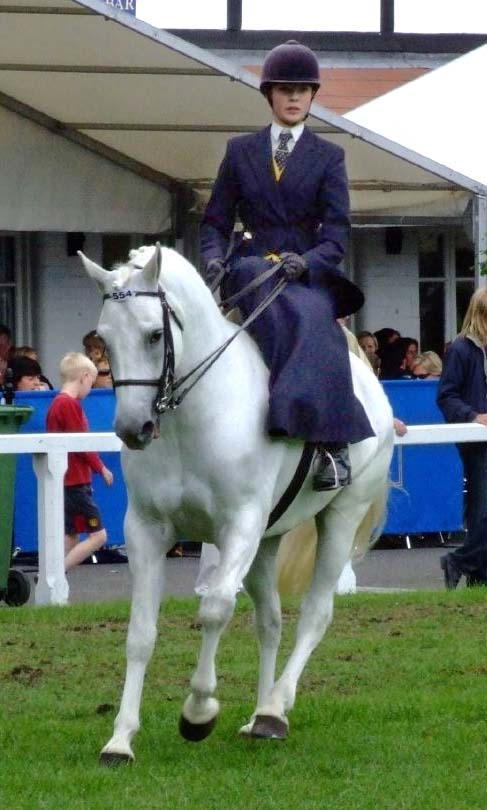
Woman riding in a modern English sidesaddle class.

Sidesaddle riding is a form of equestrianism that uses a type of saddle that allows riders, generally female, to sit aside rather than astride an equine. Sitting aside dates back to antiquity and developed in European countries in the Middle Ages as a way for women in skirts to ride a horse.

History

[edit]
Equestrian portrait of Catherine the Great, as a young woman, riding sidesaddle. She also rode astride.

The earliest depictions of women riding with both legs on the same side of the horse can be seen in Greek vases, sculptures, and Celtic stones. Medieval depictions show women seated aside with the horse being led by a man, or seated on a small padded seat (a pillion) behind a male rider. Ninth century depictions show a small footrest, or planchette added to the pillion. [1] These designs did not allow a woman to control a horse; she could only be a passenger.

In Europe, the sidesaddle developed in part because of cultural norms which considered it unbecoming for a woman to straddle a horse while riding. This was initially conceived as a way to protect the hymen of aristocratic girls, and thus the appearance of their being virgins.[2][3] Further, long skirts were the usual fashion and riding astride in such attire was often impractical, awkward, and could be viewed as immodest. However, women did ride horses and needed to be able to control their own horses, so there was a need for a saddle designed to allow control of the horse and modesty for the rider.

Anne of Bohemia is known to have made the sidesaddle more popular with ladies of the Middle Ages.[4] The type of sidesaddle she used was a chair-like affair where the woman sat sideways on the horse with her feet on a small footrest. The design made it difficult for a woman both to stay on and to use the reins to control the horse, so the animal was usually led by another rider, sitting astride. The insecure design of the early sidesaddle also contributed to the popularity of the Palfrey, a smaller horse with smooth ambling gaits, as a suitable mount for women.

A more practical design, developed in the 16th century, has been attributed to Catherine de' Medici. In her design, the rider sat facing forward, hooking her right leg around the pommel of the saddle with a horn added to the near side of the saddle to secure the rider's right knee. The footrest was replaced with a "slipper stirrup", a leather-covered stirrup iron into which the rider's left foot was placed.[1] This saddle allowed the rider both to stay on and to control her own horse, at least at slower speeds.

However not all women adopted the sidesaddle at all times. Women such as Diane de Poitiers (mistress to Henry II of France) and Marie Antoinette were known to ride astride. Catherine the Great of Russia went so far as to commission a portrait showing her riding astride wearing a male officer's uniform.[5]

Two-pommel design

[edit]
Left (near) side, two pommel sidesaddle design.
Right (off) side of a two pommel sidesaddle.
Mrs. Esther Stace riding sidesaddle and clearing 1.98 m (6 ft 6 in) at the Sydney Royal Easter Show, 1915, a feat made possible because of the leaping horn

In the 1830s, Jules Pellier invented a sidesaddle design with a second, lower pommel. In this design, still in use today, one pommel is nearly vertical, mounted approximately 10 degrees left of top dead center and curved gently to the right and up. The rider’s right leg goes around the upright, or fixed pommel, which supports the right thigh of the rider when it is lying across the top center of the saddle. The lower right leg rests along the shoulder of the left (near) side of the horse and up against the second pommel (called the leaping head or leaping horn), which lies below the first on the left of the saddle. It is mounted about 20 degrees off the top of the saddle. This pommel is curved gently downward in order to curve over the top of the rider's left thigh and is attached in such a way that it can pivot slightly, to adjust to the individual rider. The rider places her left leg beneath this pommel, with the top of the thigh close or lightly touching it, and places her left foot in a single stirrup on that side.

The impact of the second pommel was revolutionary: the additional horn gave women both increased security and additional freedom of movement, which allowed them to stay on at a gallop and even to jump fences while fox hunting and show jumping. With this design, nearly all recreational equestrian pursuits were opened to women yet they could also conform to expectations of modesty. For example a world record in sidesaddle show jumping was set at 6 ft 6 in (1.98 m) at a horse show in Sydney, Australia, in 1915.[6] The leaping horn was the last major technological innovation for the sidesaddle and remains the core of basic design even for saddles of modern manufacture made with modern materials.

Attire

[edit]
Modern English sidesaddle riding habit

The riding habit worn by women riding sidesaddle originally was similar to clothing worn in everyday life. Skirts could be protected with a "safeguard", and elites owned lavish versions of these overskirts.[7] It was not until the second half of the 16th century that a riding habit specifically designed for sidesaddle riding was introduced, though sidesaddle habit design still tended to follow fashion of the day. In 1875, the first safety skirt was introduced and later evolved into the open-sided apron.

Sidesaddle habits, also known as riding habits, developed as women became more active in the hunting field following the development of the leaping horn.. Skirts were gradually replaced by the apron commonly worn by sidesaddle riders today—which is actually a half skirt worn over breeches, designed so the rider does not sit on any apron fabric. The sidesaddle apron can be attached to the right foot by a piece of elastic to hold it in place when riding. When dismounted the apron is wrapped behind the legs and attached to a button on the left hip to give the impression of a skirt.

In the early 20th century, as it became socially acceptable for women to ride astride while wearing split skirts, and eventually breeches, the sidesaddle fell out of general use. The rise of women's suffrage also played a role as women rejected traditional restrictions in their physical activities as well as seeking greater social, political and economic freedoms.[8] However, there remained a place for sidesaddle riding in certain traditional and ceremonial circumstances, and aficionados kept the tradition alive until the sport enjoyed a revival in the 1970s.

Equipment

[edit]
Refurbished antique "catalogue" saddle, manufactured circa 1900. These were developed in America and sold to middle class women. Many still exist today.[9]

Although sidesaddles are still manufactured today, it is a small niche market, and a new model is quite expensive. Thus, many riders who wish to ride sidesaddle are often found hunting for older saddles at antique shops, estate sales, attics or barn lofts. It is difficult to find an antique sidesaddle that not only fits the rider and horse but also is in good condition. Old sidesaddles usually need reconditioning, sometimes even requiring complete removal of the leather and examination of the tree. Antique sidesaddles are frequently a problem to fit, as many are too narrow for modern horses.

Modern sidesaddles are usually based on the Jules Pellier two pommel design. The underlying tree, girthing system, flap or fender design, styling features and type of leather used may differ, however, the structure of the fixed pommel and leaping horn is a consistent design feature across all riding styles. Sidesaddles built on a tree designed for sidesaddle use are properly balanced, but many modern sidesaddles are built on a modified astride tree, which may result in an unbalanced, unridable saddle.[10]

Historical reenactment participants, notably those in American Civil War reenactments, also tend to use the two pommel sidesaddle, since the single pommel sidesaddle that was used into mid-19th century is now regarded as creating an insufficiently secure seat for safe riding. Most sidesaddles have a regular girth or cinch, an overgirth that holds the flaps down, and most have either a back cinch or a balancing strap to hold the saddle down in the back and provide additional stability.

A breastcollar can be added to stabilize the saddle, and, though seen less often, a crupper. There are few differences in the bridles used for sidesaddle and astride riding. Because riders' hands are farther from the horse's mouth as the riders are seated further back than when astride, bridles may require reins that are a longer than standard astride reins. This is most often a problem for western-style riding with romal reins, which are sized for astride riders and sometimes require extensions for use by sidesaddle riders.

Fitting

[edit]
Underside of an antique English sidesaddle. Tree must fit the horse.
A sidesaddle is measured by length and two width measurements, "neck" and "seat"

The saddle must fit horse and rider. The sidesaddle tree differs from an astride tree, most notably by the structure of the pommels but also due to a much longer saddle point on the left side of the saddle.[11] Horses are fitted in a manner similar to that of a regular saddle; the gullet must clear the withers, and the bars of the saddle should be the proper width to be comfortable on the horse.[12] The seat is measured for the rider in three places: Length, from the front of the fixed pommel to the end of the cantle; width across the widest part of the seat; and the distance across the narrowest part of the seat, called the "neck". To determine the correct seat length, which is based on the length of the rider's femur, a person sits on a stool or chair with their back and hips against a wall or flat surface, and the length of a saddle is ideally one inch longer than the distance from the wall to the back of the person's knee. Riders can more easily manage a saddle that is a bit too large than one that is too small, though a too-large saddle may leave the rider with an insecure seat.[13]

Riding techniques

[edit]
Ideal position in the saddle, the rider's spine aligns with that of the horse.
Correct leg position. Toe of right foot is up, heel down. Left leg is snug against leaping horn
Lateral movement. Left hand holds the reins while the right hand gently uses the whip in place of the missing right leg.
Sidesaddle rider without a skirt shows leg position with a leaping horn

Riding correctly is critical to protect the horse from injury as well as for the safety of the rider. Because both legs of the rider are on the same side of the horse, there is considerable concern that too much weight will be placed on only one side of the horse, which can cause physical harm to the animal. In addition, if a rider is not balanced, a sidesaddle may need to be cinched up far tighter than would a regular saddle, leading to discomfort in the animal.[8]

Correct posture is essential for balance and security in a sidesaddle and is specifically judged in sidesaddle classes. The rider sits squarely on the horse with the spine of the rider centered over the spine of the horse. The shoulders and hips are square to the horse, not twisted or turned off-center. The hands must be carried square to the horse, keeping both reins at the same length and tension.

Only one stirrup is used and it places the rider's heel higher on the horse's body than when riding astride. The left ankle is flexed and the heel of the left leg is kept down for proper balance, accurate contact with the horse, and correct placement in the stirrup. For modern riders, there are competing schools of thought as to the position of the right leg. Some argue that the right heel is also to be flexed down and the toe up, the same as when riding astride, while others argue that the toe of the right leg should be pointed down. Advocates for each toe position both argue that the position is required to maintain correct balance and make effective use of the leg muscles. In either case, when needed, the rider can squeeze her right (top) leg downwards and against the upper pommel, and her left (bottom) leg upwards into the leaping head to create an extremely strong grip. It is tiring for both the rider and the horse to maintain this emergency hold, however, and most riders rely upon good position, balance, and coordination to maintain their seat.

The spur and the whip are employed as supportive riding aids, in addition to weight and seat, used for cueing, not punishment. The English rider's whip is carried on the off (right) side, and is used in place of the rider's right leg to cue the horse on that side. The sidesaddle whip is between two and four feet long, depending on style of equipment and competition rules, when applicable. Western riders generally use the romal (a type of long quirt attached to the end of a set of closed reins) to support cues in place of the right leg. If the rider wears a spur to assist the use of her leg, she will wear only one, on the left boot.

Riders hold the reins evenly, not allowing one rein to be longer than the other. Most sidesaddle designs also force the rider to carry her hands a bit higher and farther from the horse's mouth than in a regular saddle. Because high hands on a direct pressure bit such as the snaffle bit may encourage the horse to carry its head too high, use of bits with curb bit pressure, such as a pelham bit or a double bridle, which help the horse lower its head to a proper position, are often seen in sidesaddle competition.

The horse used in sidesaddle riding will have additional training to accustom it to the placement of the rider and the use of the whip to replace off side leg commands. The horse also may need to adapt to a different and higher hand position. However, most well-trained horses adapt to the basics fairly quickly and generally can be used for riding both sidesaddle and astride.

In the early 1900s, some experts recommended riders periodically change from one side to another, to prevent irregular development of thigh muscles, .[14] However, would be impractical unless the rider had available two sidesaddles, one left-sided and one right-sided.

Sidesaddle today

[edit]
Queen Elizabeth II, riding sidesaddle, Trooping the Colour, 1986

While sidesaddles came to be regarded as a quaint anachronism, some modern riders found new applications in the horse show ring, in historical reenactments, and in parades or other exhibitions. Specialty sidesaddle classes with either traditional equipment or period costume are popular in many equestrian disciplines, including dressage, eventing, show jumping, western pleasure, and saddle seat-style English pleasure. Many horse shows include sidesaddle classes, usually judged on manners and performance of the horse and rider, suitability of specific style, and appointments.

Sidesaddle riding has also been revived in the fox hunting field, where the tradition is preserved by sidesaddle devotees. A small number of sidesaddle riders have also taken up steeplechasing with the creation of several side saddle steeplechases in Britain[15] and the US.[16] There have also been some flat racing competitions for sidesaddle riders.[17]

Riders with certain types of physical disabilities also find sidesaddles more comfortable than riding astride, and they are found useful by some people who have lost part of a leg. In addition, the sidesaddle has become a part of some therapeutic riding programs, because the design of the saddle provides extra security to certain types of riders.

English classes

[edit]

English sidesaddle classes are based on style and norms found in the hunting field before the Second World War. Dress, appointments, riding style, and even the type of horse used are all judged against a formalized standard for an "ideal" appearance. The riding habit in such classes is the formal attire found in the hunting field, starting with a coat and apron. The apron used is based on the open-sided safety apron developed in the late 19th century. The rider wears ordinary breeches or jodhpurs, over which she will wear the apron, which can partially open in the back. The jacket is usually cut a bit longer than a standard riding jacket. A vest, shirt, choker or stock tie, gloves, boots, and riding breeches are similar to those used when riding astride. For classes on the flat, a derby or top hat is traditional. When jumping, however, tradition gives way to safety, and most riders use a modern equestrian helmet, which is often mandatory equipment in competition rules.

The saddle seat variation of English sidesaddle, now seen almost exclusively in the United States in certain breed shows, allows riders to emulate the "Park" riders who rode flashy, high-stepping horses on the flat, often in public parks. The sidesaddle is essentially the same, and the rider may wear almost the same attire as the "hunt" version, an apron with breeches underneath, but with a coat having a noticeably longer cut, sometimes in bright colors, sometimes with a contrasting lining, and either a top hat or a derby. The shirt and vest will be of the style used in astride saddle seat classes, in that the vest will match either the coat or the coat lining, the shirt is a standard menswear dress shirt, and a "four-in-hand" tie is worn. When show rules permit, some saddle seat style riders adopt a period costume, often based on an antique riding habit from the Victorian era.

Western classes

[edit]
Western sidesaddle class

The western sidesaddle class is similar to the English class but with a sidesaddle having western design features, and riders wearing western style clothing. Riders generally wear a western-styled apron with belt, worn over some type of breeches or pants, but a modified two-leg chaps design in leather or ultrasuede is sometimes seen, though not legal in some types of competition. Period costumes are also seen in the western show ring. Western riders usually wear a short bolero-style jacket that matches the apron or skirt, often with elaborate decoration, gloves, cowboy boots and a cowboy hat.

A variation to western-style sidesaddle riding is use of Spanish or Mexican style regalia, often based on historic designs.

Sideways riding

[edit]
Riding sideways (1885)

Riding sideways while bareback or on a pack saddle is not uncommon, but this method is distinct from sidesaddle riding. Examples include sitting sideways on very wide-backed draft horses, and sitting sideways on a pack saddle, usually after the load has been removed or reduced.

See also

[edit]

References

[edit]
[edit]
Revisions and contributorsEdit on WikipediaRead on Wikipedia
from Grokipedia
Sidesaddle is a specialized equestrian saddle and riding technique in which the rider sits with both legs positioned on the left side of the , facing forward, secured by two pommels: a front fixed pommel around which the right hooks and a rear leaping horn over which the right drapes for stability during motion. This design originated in medieval around the to accommodate women's long skirts and cultural norms of modesty, with early adoption credited to , who introduced it to in 1382 while traveling sideways on a seat before refined saddles emerged. By the 1830s, innovations like the leaping horn enabled greater security, allowing skilled riders to hunt, jump fences, and compete effectively despite the asymmetrical posture. Though declining post-World War II with changing fashions and the rise of astride riding, sidesaddle persists in traditional shows, hunts, and ceremonial events, preserved by organizations such as the Side Saddle Association founded in 1974.

Origins and Historical Development

Early Adoption and Cultural Drivers

Side-saddle riding emerged in during the as a response to cultural norms deeming astride riding unseemly for women, particularly aristocrats clad in voluminous skirts that rendered straddling impractical and immodest. Early precedents appear in antiquity, with Greek vases and Celtic stones depicting women seated aside, typically as passive riders behind men, prioritizing containment over control to align with expectations of feminine restraint and chastity. By the , these practices solidified amid beliefs that astride postures exposed legs in a manner suggestive of vulgarity or compromised virginity, thus necessitating designs that maintained a sideways orientation while mitigating risks like skirt entanglement in falls. A landmark in early adoption occurred in 1381, when 15-year-old traversed roughly 1,100 kilometers from to on a equipped with a rudimentary chair-like side-saddle featuring a footrest, during her journey to wed King the following year. This voyage, conducted under male escort, exemplified the era's fusion of necessity and propriety, as the side-saddle allowed traversal of long distances without violating decorum. Upon arrival in in 1382, Anne's method gained traction at , transitioning side-saddle from marginal utility to emblem of refined female and influencing broader continental norms. Contemporary accounts further attest to this uptake, including Geoffrey Chaucer's late-14th-century Canterbury Tales, which references ladies employing side-saddles with cushioned seats, wooden planks for footing, and handholds for balance. These literary nods reflect how cultural drivers—encompassing class-based displays of elegance, hawkings, and hunts—propelled adoption among , evolving the apparatus from insecure passenger contraptions toward rudimentary security features by the . Such developments were less about inherent equine utility and more about enforcing gendered boundaries, with women's riding framed as an extension of sedentary grace rather than active prowess.

Key Design Evolutions

Early sidesaddles in , documented from the 12th to 14th centuries, featured rudimentary padded benches or chair-like frames that positioned riders sideways, typically facing the horse's rear, with both feet resting on a single or footboard for and stability. These designs prioritized passenger-like seating over active control, limiting the rider's ability to guide the horse independently. A transformative development emerged in the , credited to , who advocated for a forward-facing saddle incorporating a single pommel around which the rider hooked the right leg, paired with a for the left foot, thereby enhancing directional control while maintaining . This innovation, popularized by Queen Elizabeth I from 1558 onward, marked the shift from passive to semi-active riding postures. By the , refinements included taller, slender horns replacing footboards and the addition of side rails with dip seats; some variants featured a third off-side horn for supplementary support, though these were later deemed less secure. The brought the most critical advancement with Pellier's of the leaping head—a secondary, downward-angled pommel positioned over the left to secure the left —complementing the existing fixed pommel for the right and enabling secure galloping and jumping. This dual-pommel system, often augmented by a balance strap, vastly improved rider retention during dynamic maneuvers. Subsequent 19th-century modifications emphasized ergonomic balance, including the early adoption of flat seats with two primary horns for even and upright positioning, alongside the removal of protruding knee rests to mitigate injury risks. In the early , the flat-seat, two-horn configuration solidified as the standard, optimizing control and security for competitive and recreational use.

Decline Post-Industrial Era

The decline of sidesaddle riding accelerated in the early , driven primarily by shifting social norms that permitted women to ride astride. As movements gained momentum, particularly following , riding astride symbolized emancipation from restrictive traditions, with suffragettes viewing sidesaddle as emblematic of patriarchal control. By 1930, astride riding had become socially acceptable for women, coinciding with the adoption of split skirts and that facilitated it without compromising modesty concerns of prior eras. Practical advantages of astride riding further hastened the shift, offering superior balance, control, and compared to sidesaddle, especially for active equestrian pursuits amid rising participation in sports like and . Post-war economic pressures, including the of the 1930s, reduced the number of affluent households able to maintain horses and specialized equipment, diminishing demand for costly sidesaddles. Manufacturers increasingly prioritized versatile astride saddles, rendering sidesaddle production uneconomical outside niche markets. By the mid-20th century, sidesaddle had largely faded from everyday and competitive use, supplanted by astride methods in most Western equestrian disciplines, though it persisted in ceremonial contexts and select traditional shows. This transition reflected broader post-industrial changes, including urbanization and mechanized transport, which curtailed recreational horse use overall.

Equipment and Technical Specifications

Core Components and Pommel Systems

The foundational element of a sidesaddle is the , a rigid frame typically constructed from wood or steel-reinforced wood that provides structural integrity and distributes the rider's weight across the horse's back. This tree must conform precisely to the horse's conformation, with measurements taken for length, "" width at the , and seat width to ensure stability and prevent pressure points. Unlike conventional saddles, the sidesaddle tree incorporates asymmetrical points for attaching the dual pommels and a single leather on the near side, adapting to the rider's sideways posture. Central to the sidesaddle's design are the pommel systems, consisting of two distinct pommels mounted on the off-side (right side from the rider's perspective). The fixed pommel, an upright structure also termed the "queen" or "head" pommel, serves as the primary support for the rider's right , which hooks around it to secure the leg across the saddle's front. This pommel anchors the rider's balance during basic gaits and turns, forming the base of the asymmetrical seating position. The leaping pommel, a curved lower extension introduced in the , wraps over the rider's left thigh to provide leverage and during dynamic movements such as jumps or rapid accelerations. Positioned beneath the fixed pommel, it allows the left to rest against it while the foot engages a specialized, elongated on the near side, enabling the rider to "leap" forward without losing position. Early designs featured a single pommel, but the addition of the leaping pommel marked a pivotal , enhancing safety and performance for field sports like . Additional core components include the , which evolved from a concave "dip" shape in 19th-century models to a flatter, level profile in 20th-century iterations for improved rider comfort and fit, and the raised cantle at the rear, which offers support and prevents backward slippage. Flanking the are stuffed panels beneath skirting, which conform to the 's contours for even , while a girth system secures the without a off-side , relying on precise angling to maintain position. Modern reproductions often incorporate adjustable features in the pommel attachments to accommodate varying rider anatomies, reflecting ongoing refinements since the design's around 1850.

Fitting Challenges and Modern Modifications

Sidesaddles present unique fitting challenges due to the asymmetrical positioning of the rider, with both legs on the near side, which shifts the center of compared to astride saddles. This requires a specialized design to distribute weight evenly across the horse's back and prevent tipping or uneven pressure, often necessitating adjustments for the horse's conformation, such as prominent to maintain stability. Fitting begins without the rider to assess base contact, followed by mounted checks, as the rider's weight can alter the saddle's position and reveal issues like bridging or pinching. Horses with rounded backs or minimal exacerbate difficulties, as the saddle may rock or slip, demanding custom trees or shimming for secure placement. For the rider, proper pommel configuration is critical: the leaping head must align with the left for grip during motion, while the fixed head supports the right leg without restricting circulation or causing discomfort, tailored to individual length and flexibility. Inadequate core strength or prior astride habits can lead to postural strain, particularly increased lower back stress from absorbing trots without posting, heightening risk for less fit or older riders. Overall, achieving a balanced fit demands higher precision than standard saddles, often making professional saddlers essential due to the specialized nature. Modern modifications address these issues through evolved designs, including level seats replacing concave ones for improved rider balance and reduced back strain, a shift prominent in 20th-century iterations. Contemporary sidesaddles incorporate safety stirrups, such as the Mayhew type with quick-release mechanisms to prevent foot entrapment, enhancing security during falls. Shorter off-side flaps, like the Whippy No. 5 model, allow better visibility and control, while or synthetic trees—exemplified by Steele designs—offer lighter weight, durability, and adjustability for varied shapes without compromising the traditional pommel system. These adaptations enable safer, more versatile use in disciplines like or showing, provided fitting remains customized to mitigate inherent asymmetries.

Attire Requirements

Historical Dress Standards

The for women emerged in the mid-17th century as specialized attire for , designed to ensure by fully concealing the rider's legs positioned to one side while providing durability for equestrian activity. Initially influenced by men's uniforms, it consisted of a tailored , a long trained , a habit shirt or , and a , crafted from sturdy fabrics like woolen or camlet to withstand outdoor conditions. In the 17th and early 18th centuries, habits were produced by male tailors, featuring fitted jackets buttoned left-over-right with braided embellishments, paired with voluminous petticoats and underneath for support over stays; an apron-like safeguard could be buttoned across the front for additional during mounting or dismounting. Skirts extended to cover the horse's flank, often with internal loops or ties to manage the on foot, preventing entanglement in or undercarriage. Headwear included masculine cocked hats or periwigs, while comprised heeled boots suited for the left placement. By the (circa 1799–1817), habits retained masculine tailoring with spencer-style jackets featuring pleated peplums, full gathered skirts in colors like blue or green wool, and high-collared shirts often secured with cravats; underlayers included bodices and pockets, with the skirt's train ensuring leg coverage during sidesaddle posture. Accessories such as a riding crop for control and top hats or jockey bonnets completed the ensemble, emphasizing functionality over ornamentation until female dressmakers like Mrs. Bell began adapting designs in the . Victorian standards (mid-to-late 19th century) amplified skirt length by 1–2 feet for enhanced modesty, incorporating hooks or buttons to secure excess fabric post-ride and, by the 1870s–1880s, safety skirts with full-length buttons or detachable apron styles over trousers to mitigate risks of skirts catching on the saddle's pommels or leaping head. Tailored in tweed or navy wool with minimal decoration, these habits mirrored men's from the waist up, including military-inspired coats, to promote equality in equestrian pursuits while prioritizing safety and coverage; breeches or jodhpurs beneath prevented exposure, aligning with etiquette guides from 1856 onward that prescribed such attire for propriety.

Contemporary Adaptations

In contemporary sidesaddle riding, attire emphasizes functionality alongside traditional aesthetics, with the habit comprising a tailored jacket, collared shirt, stock tie secured by a gold pin, breeches or jodhpurs (often black or color-matched to the apron), tall boots, and an asymmetrical apron fastened after mounting to cover the rider's right leg and extend to the ankle. The apron, a key adaptation from historical full skirts, opens along the right seam to facilitate safe mounting and dismounting while concealing the rider's form. Modern modifications prioritize safety and mobility, supplanting cumbersome long gowns that increased fall hazards with streamlined aprons—such as "safety aprons" in hunt seat classes or fuller versions in —that minimize drag and entanglement risks. Protective meeting standards like British Safety Standards or equivalent is required in and many competitive classes, with hard hats permitted at all times and often concealed beneath a , , or for stylistic consistency; a face may accompany the hat for added protection against elements or insects. In period costume classes, skirt seams incorporate for rapid release during emergencies. Discipline-specific variations reflect astride counterparts with added sidesaddle elements: hunt seat requires a top hat, , canteen, and optional hunt ; saddle seat uses longer aprons over with derbies or protective ; Western or stock seat employs chap-style aprons, , and hats, sometimes with decorative adapted for aside use. Sewing patterns for custom habits enable personalization, accommodating modern body types and fabrics for better fit and durability. These adaptations support the revival of sidesaddle in shows and leisure, balancing historical fidelity with empirical safety improvements derived from equestrian risk assessments.

Riding Techniques and Skills

Fundamental Posture and Balance Mechanics

In sidesaddle riding, the rider adopts a posture facing forward with both legs positioned on the horse's near (left) side, sitting squarely over the horse's spine with hips, back, and shoulders aligned as in astride riding. The right thigh presses laterally against the fixed upper pommel for primary grip and security, with the knee bent at approximately 90 degrees, while the left leg extends relaxed over the leaping lower pommel, using the ankle joint for supplementary hold without excessive tension. This configuration distributes the rider's weight evenly across the saddle's midline, easing pressure on the near-side seat bone to prevent imbalance or horse discomfort. Balance mechanics emphasize core engagement and independent seat control, where the rider's center of gravity remains centered through the right thigh rather than relying heavily on the stirrup, which is set to allow a hand's width between the left leg and leaping pommel for optimal leverage. At rest or in steady gaits like walk and canter, the seat is fixed deeply into the saddle, with hip joints providing subtle play to follow the horse's motion without rising, except during trot where a slight forward lean aids posting on the near foreleg's beat. The upper body maintains an upright, erect alignment with shoulders level or the right shoulder drawn slightly back to counter any tendency toward off-side lean, eyes forward, and hands low for steady contact, minimizing rein dependence for stability. Effective balance requires dissociating grip from weight shifts, achieved through firm but intermittent muscle action on the pommels—right for lateral , left ankle for forward restraint—while avoiding common errors like prolonged weight or twisting, which disrupt equilibrium. Initial training on a quiet focuses on these fundamentals without or to build intrinsic stability, progressing to dynamic adjustments: leaning back on landings or inclines, forward on ascents or at speed, and using the pommels to recover from perturbations like without upper-body collapse. Core strengthening off-, via exercises targeting legs and , supports this posture, as sidesaddle demands acute and symmetry akin to astride but with amplified reliance on unilateral control.

Maneuvers and Performance Capabilities

Sidesaddle riders perform basic gaits including the walk, , canter, and gallop, with the typically absorbed in a sitting position rather than posting to maintain balance. The rider's posture involves keeping the right back and using the right against the fixed pommel for stability, while the left functions similarly to astride riding with a on the ball of the foot. Maneuvers such as mounting require straddling the initially before swinging the right leg over the pommels, and dismounting involves reversing this process on the left side. Advanced capabilities include , , hunt seat , , and even elements of three-day . In emergencies, riders employ an "emergency grip" by pressing the right calf against the and left thigh into the leaping head pommel to secure the seat during bucks or unexpected movements. Historical performance feats demonstrate proficiency, such as Australian rider Esther Stace clearing 6 feet 6 inches in 1915 and British rider Susan Oakes jumping a 6 feet 8 inch puissance . Long-distance was also achievable, exemplified by covering approximately 1,100 kilometers across Europe in 1381. Performance limitations arise from the asymmetrical position, which demands greater core engagement and can impose additional on the lower back compared to astride riding, as riders rely more on bones for cues rather than bilateral leg aids. While the pommel system provides security, particularly for and , the setup is less ergonomically balanced for both rider and than astride, potentially restricting high-intensity or prolonged efforts without . Nonetheless, proficient sidesaddle riders achieve comparable control through refined and cane usage, substituting for the absent right leg.

Social and Cultural Context

Ties to Gender Norms and Modesty

The sidesaddle riding style originated in 14th-century as a practical adaptation for women constrained by long, flowing skirts, enabling them to ride horses without straddling the animal and thereby preserving modesty by concealing the legs from view. This arrangement aligned with prevailing gender norms that deemed astride riding unseemly for women, associating it with potential indecency or compromise to through friction or exposure, while men rode conventionally to embody strength and directness. By the 16th century, advanced the design with a forward-facing seat and pommel for the right leg, enhancing balance and control without departing from modesty requirements, as the rider's posture kept both legs together on one side. This reflected causal pressures from evolving fashions—heavier skirts demanded non-straddling positions—while reinforcing cultural ideals of female restraint, where sidesaddle symbolized ladylike composure over athletic exertion. In the (1837–1901), sidesaddle attained peak association with gender propriety, mandating bespoke habits with train aprons and undergarments to fully obscure the figure, as societal protocols under patriarchal influence prioritized women's decorum and limited their equestrian roles to displays of grace rather than utility or speed. Such attire and posture not only averted from leg visibility but also perpetuated norms viewing female physicality as secondary to presentation, with rare astride exceptions confined to private or non-elite contexts.

Notable Riders and Historical Achievements

One of the earliest documented uses of sidesaddle riding in occurred in 1382, when Princess traveled to to marry King Richard II, employing a sidesaddle resembling a with a footrest to accommodate her skirts. This introduction marked the beginning of sidesaddle as a standard for noblewomen in , emphasizing modesty and posture over agility. During the , undertook a notable midnight ride on April 26, 1777, covering approximately 40 miles on horseback sidesaddle to alert colonial of a British advance, mirroring Paul Revere's earlier feat but in adverse weather conditions. In the early , Australian equestrienne Esther Stace achieved a for the highest sidesaddle jump, clearing 6 feet 6 inches (1.98 meters) on the horse Emu Plains at the Royal Sydney Show on March 27, 1915; this mark stood unbroken for women's sidesaddle high jumping until 2013. Stace, known for her skill despite a reportedly frail physique, competed in multiple events, demonstrating the feasibility of advanced maneuvers despite the saddle's constraints. Queen Elizabeth II exemplified ceremonial sidesaddle riding by mounting Burmese for the procession annually from 1952 to 1986, covering the route from to in full regalia, upholding a tradition rooted in royal equestrian heritage. Her consistent participation highlighted the saddle's role in preserving historical pageantry, with training provided by instructor Doreen Archer Houblon. Empress Elisabeth of Austria, or Sisi, was renowned in the for her exceptional sidesaddle horsemanship, often riding for hours daily and competing informally, which contributed to her reputation as one of Europe's most skilled female equestrians of the era. These figures underscore sidesaddle's evolution from necessity to a display of proficiency in , , and ceremonial contexts.

Criticisms and Debates

Safety Assessments Versus Astride

Proponents of sidesaddle riding maintain that a properly fitted modern sidesaddle offers security comparable to or exceeding that of astride riding, attributing this to the leaping head or fixed head, which hooks the rider's right and , creating a firm grip that resists unintended falls during gait transitions or minor spooks. This design, refined since the mid-19th century, positions the rider's weight more centrally over the horse's spine than earlier iterations, potentially minimizing shifts that could unseat the rider. Critics, however, highlight inherent vulnerabilities, such as the elevated height—often 2-4 inches higher than astride saddles—which increases fall distance and impact force if unseated, alongside challenges in rapid dismounts during emergencies like bolting or collisions, where the hooked leg may delay release. If a falls and rolls, the asymmetrical posture and pommel engagement can trap the rider beneath the animal, exacerbating crush injuries compared to the quicker extrication possible astride. Biomechanically, astride riding facilitates symmetrical distribution of the rider's weight via both thighs and calves, enabling reactive adjustments to maintain equilibrium against lateral forces or sudden stops, whereas sidesaddle concentrates control on the left leg and upper body, demanding greater core strength and potentially amplifying on the spine during unbalanced maneuvers. This can impose additional stress, as riders absorb trots without posting, relying instead on seated balance. No large-scale empirical studies or databases differentiate fall or trauma rates between sidesaddle and astride riding; general equestrian data indicate head, extremity, and spinal injuries comprise 50-80% of riding accidents across disciplines, but sidesaddle's rarity precludes stratified analysis. Anecdotal reports from enthusiasts predominate, often from skilled riders who emphasize training's role in mitigating risks, yet these overlook novice error amplification in asymmetrical seating. Historical prevalence of sidesaddle among nobility suggests survivability with expert horsemanship and calm mounts, but does not equate to inherent safety equivalence.

Perspectives on Restriction Versus Skill

Proponents of sidesaddle riding argue that the asymmetrical position fosters exceptional balance and core engagement, demanding greater and muscular control than astride riding, as the rider relies heavily on seat bones, a single extended leg, and precise weight distribution without bilateral thigh grip. Susan Oakes, a certified sidesaddle instructor, notes that it utilizes "a fairly unique set of muscles," enhancing overall riding proficiency transferable to astride disciplines. Empirical evidence includes competitive achievements, such as riders clearing 6-foot-8-inch puissance walls and completing 3,000-mile rides, demonstrating that skilled practitioners can execute advanced maneuvers like and with efficacy comparable to or exceeding astride limits in stability under fatigue. Critics contend that the design inherently restricts effective communication and security for novices or in dynamic scenarios, as the absence of right-leg contact impairs subtle aids and increases reliance on reins or compensatory tools like a riding cane tapped against the horse's flank. The deeper, elevated seat—approximately 20 cm higher than astride equivalents—forces a posterior positioning over the horse's center of gravity, potentially compromising quick directional cues and elevating fall risks during unbalanced gaits or evasions, particularly on rough terrain. Historical accounts reinforce this, with early iterations requiring male escorts for control due to insecure pommels and limited independent mobility. Modern regulatory pushback, such as Australian equestrian bodies granting exemptions only for physical disabilities rather than stylistic preference, underscores perceptions of reduced versatility for able-bodied riders in high-stakes events. Reconciling these views, first-principles analysis reveals that while the setup imposes initial biomechanical constraints—favoring horses with smooth, ambling gaits over those requiring aggressive impulsion—mastery yields a more independent seat, as the fixed leaping head pommel secures the rider without dependency, cultivating skills like hip adjustment and abdominal bracing that mitigate asymmetry. , another instructor, emphasizes the "very strong right leg" development essential for retention, arguing it hones precision unattainable astride. Competitive data from associations like the American Sidesaddle Association, where participants routinely perform , , and , counters restriction claims by evidencing adaptive techniques, such as leveraging the cane for flank cues, that equalize performance outcomes with dedicated training. Thus, restriction appears more pronounced for untrained riders, whereas skill perspectives dominate among experts, prioritizing empirical proficiency over ergonomic symmetry.

Current Practice and Revival

Competitive Classes and Events

Competitive sidesaddle riding occurs in specialized classes within broader equestrian shows, primarily organized by national associations such as the American Sidesaddle Association (ASA) in the United States and The Side Saddle Association (SSA) in the United Kingdom. These classes emphasize rider , horse performance, and adherence to traditional sidesaddle posture, with judging criteria mirroring astride disciplines but adapted for the aside seat, including the rider's balance over the fixed horn and evenness of the pommels. In the United States, the ASA promotes entries in events like the Equine Affaire in (April 10-13, 2025), and the Midwest Horse Fair in (April 11-13, 2025), where sidesaddle competitors participate in hunter, , and classes. Additional prominent venues include the Scottsdale Arabian Show, featuring Ladies Side Saddle Championships for riders under 18, and the Washington International Show's Ladies' Side Saddle Hunter class, which requires navigation of eight fences at 3 feet in height, evaluated on manners, jumping form, consistency, and pace. Western-style sidesaddle classes, such as those in Arabian or cowboy competitions, incorporate pleasure riding and patterns, often seen at events like the Germantown Charity . The hosts the SSA's annual National Side Saddle Show, which drew competitors from across and the for its 2025 edition at Addington Equestrian Centre on July 25, offering qualifiers in , classical, and contemporary categories to suit novice through advanced riders and ponies. Affiliated shows, including the International Side Saddle Show and Royal Windsor Horse Show, feature over 20 dedicated classes per event, covering , , and working hunter trials, open to both SSA members and non-members. Internationally, sidesaddle classes appear sporadically in breed-specific or heritage events, such as Arabian shows with dedicated championships, but lack a centralized world championship structure; instead, national qualifiers feed into premier domestic finals. Participation has grown since 2020, with associations reporting increased entries amid revival efforts, though events remain niche compared to astride competitions.

English Versus Western Variants

The English sidesaddle features a lightweight design built on an English tree, incorporating two pommels—a fixed leaping head for the rider's right knee and a movable balance pommel for the left thigh—to secure the rider in a forward-facing position with legs on the near side. This configuration, refined in England before the 1940s, includes a balance strap to prevent forward slipping and supports disciplines such as hunt seat and sidesaddle dressage, emphasizing close contact and precise aids. Modern English sidesaddles, like those from Whippy & Stegall or Malvern Saddle Co., often use hybrid panels for improved fit on contemporary horse breeds. In contrast, the Western sidesaddle adapts ranch-style elements to the aside posture, typically constructed on a heavier Western tree with broader bars for weight distribution over long distances. Originating in the United States around 1870, when cattleman commissioned saddlemaker S.C. Gallop to create a functional design for his Mary Ann Dyer Goodnight to manage duties, the Goodnight-style Western sidesaddle includes a rear cinch for lateral stability akin to the English balance strap. These saddles often feature double skirts, decorative tooling, and a higher cantle for during or work, though they may provide less "locked-in" compared to English models due to the absence of a second pommel. Key differences lie in tree construction, with English variants prioritizing rider-horse communication and in formal settings, while Western designs emphasize durability and comfort for utilitarian tasks on rugged terrain. Western sidesaddles are rarer in authentic form, often requiring restoration of antiques or custom builds from makers like Crest Ridge Saddlery, and are suited to Western apparel such as and boots rather than tailored habits. In competitive contexts, English classes demand adherence to traditional standards, whereas Western variants incorporate horse patterns, reflecting the broader divergence in riding philosophies between the styles. Since 2020, sidesaddle riding has persisted as a niche equestrian discipline amid the disruptions of the , with governing organizations resuming and planning events to sustain interest. The American Sidesaddle Association, for example, organized demonstrations at events such as the Equine Affaire on April 10-13, 2025, and the Midwest Horse Fair on April 11-13, 2025, reflecting continued promotional efforts despite limited mainstream adoption. In the , the Side Saddle Association maintained its calendar of affiliated shows for 2025, including the National Side Saddle Show, and reported growing engagement through platforms with approximately 2,000 followers on , indicating steady online visibility. Community observations in the United States highlight a potential decline in competition participation, with class entries dropping from 20-30 riders in prior years to around five in larger recent shows, attributed to evolving equestrian preferences favoring astride riding. Recent media coverage, including documentaries on enthusiasts in March 2025 and articles affirming its specialized role in disciplines like foxhunting and therapeutic programs, underscores ongoing but specialized appeal rather than widespread revival.

References

Add your contribution
Related Hubs
User Avatar
No comments yet.