Hubbry Logo
Ricky JohnsonRicky JohnsonMain
Open search
Ricky Johnson
Community hub
Ricky Johnson
logo
8 pages, 0 posts
0 subscribers
Be the first to start a discussion here.
Ricky Johnson
Ricky Johnson
from Wikipedia

Richard Bernard "Ricky" Johnson Jr. (born July 6, 1964) is an American former professional motocross, off-road truck and stock car racer. He competed in AMA motocross and Supercross during the 1980s and, won seven AMA national championships.[2] He later switched to off-road racing. He won the Pro 2WD Trophy Truck championship in the 1998 Championship Off-Road Racing and 2010 TORC Series.[3] He also won the Pro 4WD class at the 2011 and 2012 TORC Series. In September 2012, Johnson won the 4x4 world championship race at Crandon International Off-Road Raceway and later that day won the AMSOIL Cup pitting the two and four wheel drive trucks. Johnson won the 2014 Frozen Rush, the first short-course off-road race on snow.

Key Information

Racing career

[edit]

Motocross career

[edit]

Johnson was born in El Cajon, California where his father was an avid motorcyclist who bought his son a mini-bike when he was 3 years old.[2] When he turned 16 in 1980, he earned his pro license.[2] He won his first 250cc class national championship in 1984 for the Yamaha factory motocross team.[4] For the 1986 season, he was offered a job with the Honda team by team manager and five time former world champion Roger De Coster.[2] He battled his Honda teammate David Bailey throughout the 1986 season, coming away with the 250 title and the Supercross crown.[5] De Coster picked Johnson, Bailey and another Honda teammate Johnny O'mara to represent the US in the Motocross des Nations in Maggiora, Italy. Team U.S.A. won with a clean sweep. Back home,[citation needed] he finished second to Bailey in the 500 class. The rivalry was short-lived as just prior to the start of the 1987 season Bailey was paralyzed in a practice crash.[2]

Johnson dominated the 1987 season, winning both the 250 and 500 crowns.[2] In 1987, Johnson also won what is considered one of Supercross history's greatest races in the Super Bowl of Motocross at the L.A. Coliseum.[citation needed] After crashing in the first corner Johnson came back from near dead last to pass Jeff Ward and eventually privateer Guy Cooper on the penultimate lap to squeeze the win. Johnson followed this performance by adding the 1988 Supercross and 500 titles to his name.

Johnson started the 1989 season strongly but suffered a serious injury when he broke his wrist in a practice session.[2] He would never fully recover from the injury. He soldiered on for a few more seasons but the injury proved too debilitating. He announced his retirement at the beginning of the 1991 season.[2]

At the time of his retirement from motocross racing at age 26, he was the all-time leader in Supercross victories. Johnson was inducted into the AMA Motorcycle Hall of Fame in 1999 and the Motorsports Hall of Fame of America[1] in 2012.

Career after motocross

[edit]

Johnson went on to have success in off-road racing and stock car racing. He took wins in the famous Baja 1000 twice and was American Speed Association stock car series Rookie of the Year in 1999, driving for Herzog Motorsports as a teammate to unrelated El Cajon, CA off-road racer Jimmie Johnson.[2] Johnson ran twelve races in the NASCAR Craftsman Truck Series from 1995 to 1997.

Off-road racing

[edit]
Johnson's 2010 truck

Johnson founded the Traxxas TORC Series for the 2009 season. He sold the series after the season to the United States Auto Club (USAC) and he concentrated on being a driver. Johnson won the TORC Series Pro2wd Championship in 2010 after a season long battle with Rob MacCachren, the defending champ. This championship came down to the last race of the season at Crandon International Off-Road Raceway with Johnson securing a second-place finish to win the championship.[3]

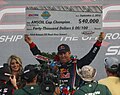
In 2012, Johnson won the Pro 4x4 World Championship race on Sunday at Crandon's second race weekend. Later that day, he won the AMSOIL Cup pitting the Pro 4x4 and Pro 2 drivers against each other.

In 2013, Johnson joined some Stadium Super Trucks races, with sponsorship from Jegs High Performance.[6] He did not return to the series until 2021 at the Music City Grand Prix.[7]

Johnson started 2014 early by competing in the Red Bull-sponsored Frozen Rush race. This inaugural event featured Pro 4 trucks racing with studded tires on snowy mountain slopes at Sunday River in Maine. Eight drivers from the two national series (TORC and LOORRS) were selected to compete head to head with the victory advancing to the next round. Johnson beat Johnny Greaves in the final round for the win.[8]

In addition to short course truck racing, Johnson has competed in desert off-road races. In 2009 and 2010 he was 3rd in the Unlimited Truck class of the SNORE Mint 400.

Personal life

[edit]

Johnson now lives in Southern California with his wife, Stephanie, and their children.

Images

[edit]

Motorsports career results

[edit]

NASCAR

[edit]

(key) (Bold – Pole position awarded by qualifying time. Italics – Pole position earned by points standings or practice time. * – Most laps led.)

Craftsman Truck Series

[edit]
NASCAR Craftsman Truck Series results
Year Team No. Make 1 2 3 4 5 6 7 8 9 10 11 12 13 14 15 16 17 18 19 20 21 22 23 24 25 26 27 NCTC Pts Ref
1995 Vestar Motorsports 01 Chevy PHO TUS SGS MMR POR EVG I70 LVL BRI MLW CNS HPT IRP FLM RCH MAR NWS SON MMR
25
PHO 93rd 88 [9]
1996 Penske Racing 22 Ford HOM PHO POR
25
EVG
15
TUS CNS
DNQ
HPT BRI NZH MLW LVL I70 IRP FLM GLN
30
NSV RCH NHA MAR 31st 786 [10]
Billy Ballew Motorsports 15 Ford NWS
27
SON
23
MMR
21
PHO
15
LVS
38
1997 Prime Performance Motorsports 63 Chevy WDW TUS HOM PHO POR EVG I70 NHA TEX BRI NZH MLW LVL CNS HPT IRP FLM NSV GLN
8
RCH MAR SON
4
MMR CAL
DNQ
PHO LVS
17
48th 414 [11]
1998 WDW
DNQ
HOM PHO POR EVG I70 GLN TEX BRI MLW NZH CAL PPR IRP NHA FLM NSV HPT LVL RCH MEM GTY MAR SON MMR PHO LVS NA - [12]

Stadium Super Trucks

[edit]

(key) (Bold – Pole position. Italics – Fastest qualifier. * – Most laps led.)

Stadium Super Trucks results
Year 1 2 3 4 5 6 7 8 9 10 11 12 13 14 SSTC Pts Ref
2013 PHO LBH
4
LAN
13
SDG
2*
SDG
5
STL TOR TOR CRA CRA OCF OCF OCF CPL 8th 123 [13]
2021 STP STP MOH MOH MOH MOH NSH
13
NSH
13
LBH LBH 21st 16 [14]

References

[edit]
[edit]
Revisions and contributorsEdit on WikipediaRead on Wikipedia
from Grokipedia
Richard "Ricky" Johnson Jr. (born July 6, 1964) is an American former professional racer in , supercross, off-road trucks, and stock cars, widely regarded as one of the most accomplished competitors in American motorsports history. Born in , Johnson began racing motorcycles at the age of three and quickly rose as a prodigy in the scene, becoming a local hero by age 16. He turned professional in 1981, earning AMA 125cc of the Year honors that season while riding for Yamaha. Johnson's aggressive style and charisma earned him the nickname "The Bad Boy of Supercross," setting him apart in a highly competitive era. During the 1980s, Johnson dominated AMA racing, securing seven national championships: three in the 250cc class (1984, 1986, 1987), two in the 500cc class (1987, 1988), and two in the 250cc Supercross class (1986, 1988). He amassed 61 AMA national wins, including 28 Supercross victories, which held the all-time record until surpassed by in the 1990s. Johnson also contributed to four victorious U.S. teams at the Motocross des Nations (1984, 1986, 1987, 1988), further cementing his legacy. His 1987 season was particularly remarkable, as he won both the 250cc and 500cc titles in the same year. Johnson retired from in 1991 at age 26 due to a chronic but transitioned successfully to other racing disciplines. He won the off-road race twice and later competed in the ASA stock car series, where he was named Rookie of the Year in 1999. In 2009, he founded the Traxxas Series for short-course off-road and claimed the Pro 2WD championship in 2010. Inducted into the AMA Motorcycle Hall of Fame in 1999 and the Motorsports Hall of Fame of America in 2012, Johnson's influence extends to training military drivers and riders as well as stunt work.

Early life

Childhood and family background

Richard Bernard "Ricky" Johnson Jr. was born on July 6, 1964, in , a suburb of in . He grew up in a modest, working-class household in the region's motocross-rich environment, where access to local tracks and dealerships was commonplace. Johnson's father, a former Navy painter who was semi-retired by the mid-1980s and an avid motorcyclist owning an old Harley nicknamed "Sinbad," played a pivotal role in his early years by fostering an interest in riding. The family included a sister, Laurie, who owned her own minibike, which Johnson coveted as a young child. His parents provided unwavering support for his pursuits, with his mother frequently driving him to after-school practice sessions. At age three, Johnson's father bought him his first mini-bike, a 1.5-horsepower model from , marking the beginning of his hands-on engagement with motorcycles in a nurturing family setting. This early familial encouragement, amid Southern California's outdoor-oriented lifestyle, profoundly influenced his childhood development.

Introduction to racing

Growing up in during the burgeoning era of in the 1970s, Johnson quickly developed a passion for dirt bikes, starting with informal rides that evolved into structured racing pursuits. By age seven, he was competing in local TT (time trial) races, and at nine, he entered his first official event, finishing last but gaining invaluable experience on the tracks that dotted the region's landscape. Johnson's amateur racing career began in earnest around age 10, focusing on local and regional events in , where he honed his skills on and progressed to larger machines. By age 12, he had established himself as one of the top riders in the state, participating in competitive scrambles and flat-track style races that built his competitive edge. As a teenager, around ages 13 to 15, he transitioned to full-sized bikes, training alongside established professionals like Broc Glover and competing in classes at tracks such as Carlsbad and Saddleback. These early races secured initial sponsorships from local dealers, providing equipment support that allowed him to intensify his training and compete more frequently. In the late and early , Johnson's amateur achievements included regional dominance in youth classes, earning him recognition as a local prodigy by age 16. That year, he obtained his AMA professional license and received his first factory support ride from Yamaha, marking a pivotal step toward professionalism. After earning AMA 125cc Rookie of the Year honors in 1981, at age 18 in 1982 Johnson signed his inaugural professional contract with Yamaha for $18,000, enabling him to race a 250cc bike on weekends while having dropped out of high school. This deal capped his amateur progression, transitioning him from regional standout to national contender.

Motocross and Supercross career

Professional debut and early achievements

Ricky Johnson transitioned to the professional ranks in 1981 after a successful amateur career, where he had won multiple regional and national titles on Yamaha machinery, providing a strong foundation for his pro success. That year, riding for Yamaha, he earned the AMA 125cc Rookie of the Year award by finishing seventh in the national standings with consistent top-10 results across the season. In 1982, Johnson moved up to the competitive 250cc class, focusing primarily on the outdoor AMA National series and securing second place overall in the championship standings despite limited Supercross appearances. The following year, 1983, marked his full entry into professional Supercross as Yamaha provided a factory contract, though injuries limited his potential: a broken collarbone at the Anaheim season opener sidelined him early, and a dislocated hip during the outdoor season further hampered progress. Despite these setbacks, Johnson notched a significant victory at the Washougal National in the 250cc class and ended the year sixth overall in the AMA 250 National Championship, demonstrating resilience and speed against established riders like Jeff Ward and . Johnson's 1984 season represented a major breakthrough, as he captured the AMA 250 National Motocross Championship aboard a production , achieving four overall wins in the 12-round series and outpacing rivals through consistent moto performances. In Supercross, he claimed his first career main event victory at the round in February—part of a triple-header weekend—and added another win later in the season, finishing runner-up overall in the 250cc standings to Honda's O'Mara with multiple podiums. These results, totaling two Supercross victories in his breakout year, solidified Johnson's reputation as an aggressive, charismatic talent in the 250cc division, setting the stage for his dominance in the sport.

Championship dominance (1984–1988)

Johnson's championship era began in 1984 when he captured the AMA 250cc National Championship riding for the Yamaha factory team, marking his first outdoor title after a strong foundation in the professional ranks. This victory included four national wins, solidifying his transition from promising rookie to elite contender. In 1986, Johnson elevated his performance by winning both the AMA 250cc National Championship—dominating all but one outdoor round—and the AMA 250cc Supercross Championship with , securing six of twelve Supercross mains that year. He repeated as 250cc Champion in 1987 while also claiming the 500cc National title, losing only once across both classes in a display of versatility rarely seen in the sport. These back-to-back doubles highlighted his adaptability between displacement classes and track types. The pinnacle came in 1988, as Johnson defended his 500cc National Motocross Championship and added the AMA 250cc Supercross title, capping a decade of unparalleled success with seven AMA national championships overall. By retirement, he had amassed 28 Supercross main event victories, retiring as the all-time leader in that category, alongside 61 AMA national wins across classes. His dominance was forged through intense rivalries with peers like Jeff Ward and , whose consistent challenges pushed Johnson to refine his aggressive style and strategic racing.

Injuries and retirement

In 1989, during a practice session at the Gatorback National in , Ricky Johnson suffered a severe right after colliding with rider Danny Storbeck, whose bike landed on Johnson's arm, breaking and dislocating the wrist. This , which involved torn tendons and limited recovery despite multiple surgeries, marked the beginning of the end for Johnson's dominant career, as it severely hampered his control and overall performance. Although he had started the 1989 Supercross season with five consecutive wins, Johnson did not secure another Supercross victory after the incident, and it contributed to tensions within his team, ultimately leading to contract disputes and his departure from the factory squad at the end of the year. Johnson attempted a comeback in 1990, signing with and showing flashes of his former prowess by winning the National at Gainesville early in the season. However, additional injuries compounded the wrist issues, including a broken hand at the Daytona Supercross, which further weakened his and reduced his wrist functionality to about 50% according to medical specialists. These setbacks limited him to just two National wins that year (one in the class and one in the 500 class) and a fourth-place finish in the 500 National Championship, far below his pre-injury standards. By early 1991, persistent pain and declining results—finishing no higher than 10th in five Supercross races—prompted Johnson to retire officially at age 26 after the event in February. At the time, he held the all-time record for Supercross wins with 28, along with two Supercross championships and five AMA National outdoor titles, achievements that underscored the tragedy of his early exit. The retirement was emotionally devastating for Johnson, who described the frustration of racing for mid-pack positions as "tearing me up inside," and it shifted his focus toward off-road and auto racing disciplines where the physical demands on his wrist were less severe.

Off-road racing career

Transition from motocross

Following his retirement from professional motocross in 1991, Ricky Johnson sought a less physically demanding form of racing that would minimize the risk of further injuries while providing fresh competitive challenges. The cumulative toll of injuries, particularly a severe wrist fracture sustained in a 1989 practice crash, had left him in chronic physical and mental pain, rendering him unable to perform at his previous elite level on motorcycles. Johnson described the end of his motocross career as "an ugly divorce," reflecting the resentment and frustration that prompted him to pivot entirely to four-wheeled competition. Johnson's initial foray into began in 1992 with stadium truck events under the Entertainment Group (MTEG) series, where he adapted his skills to high-speed, short-course racing in enclosed venues using purpose-built trucks. These vehicles, often based on modified pickup chassis with reinforced suspensions and roll cages, allowed him to leverage his throttle control and cornering expertise from while transitioning to a seated, four-wheeled format that reduced direct impact on his body. By 1993, he expanded into , piloting trophy trucks in open-terrain events, marking a deliberate shift toward endurance-based challenges that emphasized navigation and vehicle reliability over the high-risk jumps of supercross. Early sponsorships, including ties to performance brands from his days, supported his setup, though he primarily operated through personal teams focused on truck preparation. In 1995, Johnson deepened his commitment to off-road series by continuing in stadium trucks while preparing for broader desert competition, bridging his two-wheeled background with full-time four-wheel endeavors. This period saw him racing in select MTEG events and initial desert runs, including participations in marquee races like the , where he honed his adaptation to long-distance, rugged courses on trucks equipped for high-speed dune and rock navigation. His entry into these series represented a strategic evolution, capitalizing on off-road's appeal for sustained careers amid motocross's injury demands.

Major championships and victories

Johnson's transition from motocross to off-road racing in the mid-1990s positioned him for sustained success in desert endurance events and short-course competitions. One of his earliest major triumphs came in the grueling SCORE , where he secured class victories in the Pro Truck division in 1997 and 2003, demonstrating his prowess in the demanding desert rally format that spans hundreds of miles across . These wins highlighted his adaptability to long-distance navigation and high-speed off-road conditions, contributing to his reputation as a versatile racer. In short-course off-road racing, Johnson achieved significant dominance, amassing four championships across Pro 2WD and Pro 4WD classes. He captured the 2010 TORC Pro 2WD Championship, edging out competitors in a season marked by consistent podium finishes. Building on that momentum, he transitioned to the unlimited Pro 4WD class, winning back-to-back TORC titles in 2011 and 2012, including a dominant performance with four consecutive victories to start the 2012 season. These championships solidified his status as a four-time short-course champion, with additional accolades in the 1998 Championship Off-Road Racing Pro 2WD class. Johnson's influence extended beyond driving; in 2009, he founded the Series, establishing a premier platform for short-course that elevated the sport's visibility and professional standards before selling it to focus on . Notable individual victories included the 2012 Cup, the short-course world championship event at Crandon International Off-Road Raceway, where he clinched the Pro 4WD win in a high-stakes finale. He further innovated by winning the inaugural 2014 Frozen Rush, the first short-course race held on snow at Sunday River Resort in , adapting his unlimited truck to frozen terrain for a groundbreaking victory. Overall, these achievements underscore his record-setting endurance in , with multiple class wins and short-course titles that span over two decades. Johnson has continued competing into the 2020s, including multiple victories in the Trophy Truck Legends class at the , such as his 15th consecutive class win in November 2025.

Other racing activities

Stock car racing

Following his retirement from professional motocross due to chronic injuries, Ricky Johnson sought to diversify his racing portfolio by entering in the mid-1990s, aiming to apply his extensive dirt racing experience to paved ovals while adapting to the demands of heavier vehicles and structured series formats. This transition highlighted the challenges of shifting from the loose, high-grip surfaces of and off-road events to the smoother, more predictable dynamics of asphalt stock cars, where precise and mechanical setup played larger roles. Johnson made his stock car debut in the , competing in a total of 12 races across the –1997 seasons with various small teams, including drives in Ford and Chevrolet trucks. His most competitive year came in 1996, when he started 8 races and finished 31st in the driver points standings with 722 points, marking his best overall performance in the series. During his Truck Series tenure, Johnson recorded two top-10 finishes, including a ninth-place result at the Spears Manufacturing 200 at Mesa Marin Raceway and a 10th at the 1997 Carquest 420K at , demonstrating flashes of potential despite limited resources. In 1999, Johnson advanced to the ASA National Tour, racing late-model stock cars as a teammate to emerging talent with Herzog Motorsports. He earned the series' Rookie of the Year honors after completing 20 of 20 events and finishing third in the final points standings with 2,864 points, behind champion Tim Sauter and runner-up Gary St. Amant. Key highlights included consistent top-10 runs, such as a fourth-place finish at the season-opening event at Gresham Motorsports Park, underscoring his quick adaptation and strong debut season in the competitive short-track touring series.

Stadium Super Trucks and special events

In 2013, Ricky Johnson made his debut in the inaugural season of the series, competing in select events with sponsorship from . Driving the No. 5 truck, he participated in races at the Grand Prix of Long Beach and the , ultimately finishing 8th overall in the points standings with 123 points across five starts. Johnson returned to the series in after an eight-year absence, racing at the Music City Grand Prix in Nashville across two events. He completed both races but encountered challenges, including an accident in the first, leading to a 21st-place finish in the overall season standings with 16 points. Beyond , Johnson has appeared in various special events emphasizing entertainment and stunt elements. In the 1980s, he competed in ABC's Superbikers series, a high-profile exhibition on Wide World of Sports that pitted top riders from , flat track, and against each other on modified dirt bikes at venues like Carlsbad Raceway. More recently, in November 2024, he set the fastest qualifying time in the SCORE Legend class (for drivers over 50) during the pre-race qualifier for the 57th SCORE , piloting the No. 1L Mason AWD and finishing within the top 10 overall qualifiers. Johnson has also made occasional guest appearances in dirt and stunt racing formats, such as short-course off-road exhibitions, leveraging his prior off-road expertise to handle high-speed jumps and dynamic track conditions. In the 58th SCORE in November 2025, Johnson competed in the Legends class, finishing 12th overall. These events highlight Johnson's adaptation to the Stadium Super Trucks' entertainment-focused format, which features 900-horsepower trucks capable of 40-foot jumps in stadium arenas, blending competitive racing with spectacle to engage diverse audiences.

Personal life

Family and relationships

Ricky Johnson married his longtime girlfriend, Stephanie Hodgetts, in 1990. The couple has maintained a strong partnership and remains married as of 2025. Johnson and have three children: sons Luke (born 1992) and Jake (born 1993), and daughter (born 1995). Their son Luke has followed in his father's footsteps, becoming a professional off-road racer and achieving multiple championships in short-course events, including alongside Johnson in desert competitions. The family dynamics emphasize close-knit support, with Johnson describing himself primarily as a dedicated father and husband in his post-racing life. During Johnson's career transition from to in 1991, following injuries that prompted his retirement at age 26, Stephanie played a key role by encouraging him to compete one more season to avoid future regrets, which allowed him to secure additional championships before shifting focus. The family provided ongoing stability during his subsequent moves into and eventual full retirement from professional competition, enabling Johnson to balance racing pursuits with family responsibilities. Johnson and his family have long resided in .

Residence and personal interests

Ricky Johnson resides in Murrieta, , where he has made his home since at least the mid-2010s. This location in the region allows him convenient access to off-road trails and motorsports facilities, aligning with his ongoing connection to the sport. Post-retirement, Johnson leads a balanced centered on , physical fitness, and sustained passion for motorsports. He shares his home with his wife, , and their three children, integrating family life into his daily routine. Johnson maintains fitness through regular physical activity, mindful of past injuries, and continues to engage in motorsports as a recreational pursuit rather than a professional endeavor. His personal interests include recreational riding, where he focuses on honing foundational skills like braking, cornering, and jumping to promote safe and enjoyable experiences for himself and others. Johnson also pursues stunt driving and riding, drawing from his racing background to perform high-skill maneuvers, and contributes to military driver and rider training programs as a way to share expertise with service members. Additionally, he enjoys adventure tours that combine exploration with riding challenges. In terms of philanthropy, Johnson supports initiatives like the Road 2 Recovery Foundation by participating as a guest speaker on topics for injured action sports athletes.

Later career and legacy

Business ventures and training

After retiring from full-time competition, Ricky Johnson founded the Series in 2009, establishing a professional short-course championship to revitalize the discipline. The series, sponsored by , featured high-profile events and attracted top drivers, promoting the sport through televised races and increased participation. Johnson sold the series to the (USAC) following the inaugural season, allowing USAC to expand its sanctioning and operational role while ensuring the championship's continuity and growth within the off-road community. In 2021, Johnson launched the Ricky Johnson Adventure Academy (RJAA), offering skill-building courses for adventure and dual-sport riders of all levels, including multi-day tours through Southern California's deserts, mountains, and routes like Highway 395 from Mammoth to Tahoe. These programs emphasize practical instruction on asphalt and dirt riding, with participants required to provide their own safety gear or rent bikes through partners. The academy also provides VIP Supercross and Motocross experiences, granting access to exclusive amenities at major events, alongside 5-Star Race Day packages that combine guided tours with premium race viewing, such as the Baja 400 alongside instructor Chuck Miller. For 2025, the academy scheduled outdoor nationals tours as part of its ongoing event lineup, enhancing rider engagement with professional-level insights. Johnson has pursued additional ventures, including stunt riding and driving for film and television, with credits in productions like Supercross (2005) and Dust to Glory (2005). Through his company American Offroad, co-founded with Jeff Benrud, he delivers specialized training programs for military personnel, focusing on offensive and defensive off-road driving and riding techniques for tactical scenarios, with sessions continuing into 2024 and 2025 for U.S. and allied forces. These efforts have extended Johnson's influence in the off-road community by fostering safety, skill development, and professional standards beyond competitive racing.

Awards, honors, and influence

Ricky Johnson was inducted into the AMA Motorcycle Hall of Fame in 1999, recognizing his dominance in and Supercross during the 1980s, where he secured seven AMA national championships and contributed to four victorious U.S. Motocross des Nations teams. In 2012, he was honored with induction into the Motorsports Hall of Fame of America, celebrating his broader achievements across multiple racing disciplines, including 61 professional victories and his pioneering transition from two-wheeled to four-wheeled competition. More recently, in 2024, Johnson received the "Legend of the Sport" accolade at the Quail Gathering, an event that highlights enduring icons of for their contributions to the 's evolution and excitement. Johnson's influence extends beyond his competitive record, as he pioneered multi-discipline racing by excelling in AMA motocross, Supercross, off-road desert events like the Baja 1000 (which he won twice), and short-course truck racing, setting a template for versatility that continues to shape modern motorsports careers. His legacy as the all-time Supercross wins leader upon retiring in 1991 at age 26—amassing 28 victories—remains a benchmark, while his ongoing success in off-road racing, including Legends category wins at the 2025 SCORE Baja 500 and 2025 SCORE Baja 1000 that extended a streak of 15 consecutive victories since 2022, demonstrates sustained excellence into the 2020s. Johnson also played a key role in popularizing short-course off-road racing through founding the Traxxas TORC series in 2009 and capturing Pro 2WD championships in 1998 and 2010, elevating the discipline's visibility and fan appeal. In 2025 discussions, Johnson has been vocal about inspiring the next generation, praising riders like Haiden Deegan for his aggressive style and Jett Lawrence for his precision, reflecting how his "bad boy" persona and boundary-pushing approach continue to motivate current stars in Supercross and motocross. Overall, Johnson's seven AMA championships, persistent off-road triumphs, and foundational impact on short-course racing have cemented his status as a transformative figure whose adaptability and charisma broadened motorsports' reach and diversity.

References

Add your contribution
Related Hubs
User Avatar
No comments yet.