Hubbry Logo
Robert A. M. SternRobert A. M. SternMain
Open search
Robert A. M. Stern
Community hub
Robert A. M. Stern
logo
8 pages, 0 posts
0 subscribers
Be the first to start a discussion here.
Robert A. M. Stern
Robert A. M. Stern
from Wikipedia

Robert Arthur Morton Stern (May 23, 1939 – November 27, 2025) was an American architect, educator and author. He was the founding partner of the architecture firm, Robert A.M. Stern Architects, also known as RAMSA. From 1998 to 2016, he was the Dean of the Yale School of Architecture.

Key Information

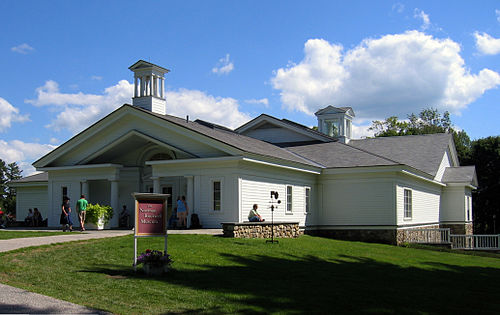
His firm's major works include the classically styled New York apartment building, 15 Central Park West; two residential colleges at Yale University; Philadelphia's Museum of the American Revolution; and the modernist Comcast Center skyscraper in Philadelphia.[1] In 2011, Stern was honored with the Driehaus Architecture Prize for his achievements in contemporary classical architecture.

Early life and education

[edit]

Born in the Brooklyn borough of New York City on May 23, 1939,[2] to a Jewish family,[3][4] Stern spent his earliest years with his parents in the nearby Manhattan borough.[5][better source needed] After 1940, they moved back to Brooklyn, where Stern grew up. Stern received a bachelor's degree from Columbia University in 1960 and a master's degree in architecture from Yale University in 1965. Stern cited the historian Vincent Scully and the architect Philip Johnson as early mentors and influences.[6]

Career

[edit]

After graduating from Yale, Stern worked as a curator for the Architectural League of New York, a job he gained through his connection to Philip Johnson.[citation needed] While at the League, he organized the second 40 Under 40 show, which featured his own work alongside work of then-little-known[citation needed] architects Charles Moore, Robert Venturi, and Romaldo Giurgola,[7] all of whom were featured as authors in the influential[citation needed] issue of Perspecta that Stern edited a year before at Yale.[8][9] Upon leaving the Architectural League in 1966, Stern worked briefly as a designer in the office of the architect Richard Meier, then worked for two and a half years at New York City's Housing and Development Administration, after which he established Stern & Hagmann with John S. Hagmann, a fellow student from his days at Yale.[10] In 1977, he founded its successor firm, Robert A.M. Stern Architects, now known as RAMSA.[11]

Educator

[edit]

Stern was the dean of the Yale School of Architecture from 1998 to 2016, and taught there after the end of his tenure until 2022.[12] From 1970 to 1998, he taught at Columbia University, in the Columbia Graduate School of Architecture, Planning and Preservation. From 1984 to 1988, was the inaugural director of Columbia GSAPP's Temple Hoyne Buell Center for the Study of American Architecture,[12] and from 1992 to 1998, Stern served as Director of the Graduate Program in Historic Preservation at GSAPP.[13]

Other activities

[edit]

A prolific writer, Stern authored, co-authored, and edited numerous books about architecture, including six volumes about New York City's architectural history, each focusing on a different period.[14] In 1986, he hosted Pride of Place: Building the American Dream, an eight-part documentary series that aired on PBS. The series featured Peter Eisenman, Léon Krier, Philip Johnson, Frank Gehry, and other notable architects.[15]

Work

[edit]
Comcast Center, in Philadelphia

Many of Stern's early works were private houses in the New York metropolitan area, including in the Hamptons and in Westchester County.[10] His early commercial commissions included projects for Walt Disney World such as Disney's Yacht Club Resort, Disney's Beach Club Resort and the master plan for Celebration, Florida, and from 1992−2003, Stern served on the board of the Walt Disney Company.[16][17]

Stern was later better known for his large-scale condominium and apartment building projects in New York City, which include 20 East End Avenue, The Chatham, The Brompton, and 15 Central Park West. The latter was, at the time of its completion, one of the most financially successful apartment buildings ever constructed, with sales totaling $2 billion,[18] later succeeded by 220 Central Park South.[19]

Stern designed some of the tallest structures in the United States, including the glass-clad Comcast Center, the second tallest building in both Philadelphia and Pennsylvania.[20] The Driehaus Prize committee (commenting on a preliminary, stone-clad, pyramidal-topped scheme) characterized the design as "[carrying] forward the proportions of the classical obelisk".[21] The scheme, along with Stern's 15 Central Park West, and his master plan for Celebration, were cited as contributing factors in his having won the award. More recently, Stern designed three skyscrapers in New York City, 220 Central Park South, 520 Park Avenue, and 30 Park Place, which became some of the tallest buildings in the city and the United States once completed.[22][23][24] In 2017, RAMSA completed a major addition to the campus of Yale University, with two new residential colleges, Pauli Murray College and Benjamin Franklin College, both designed in a Collegiate Gothic style.[25]

He also designed Schwarzman College in China; its 200,000-square-foot (19,000 m2) campus houses advanced higher-education facilities[26] and was LEED Gold-certified.[27]

Style

[edit]

In the 1970s, and early 1980s, Stern developed a reputation as a postmodern architect for integrating classical elements into his designs for contemporary buildings.[28] Stern contributed a postmodern architectural facade to the Strada Novissima in The Presence of the Past exhibit at the 1980 Venice Architecture Biennale. In the mid-1980s, his work became more traditional, more in keeping with the then emerging New Classical architectural movement.[29] Stern, however, rejected such characterizations, arguing that his projects draw on vernacular context and local traditions.[30]

Notable projects

[edit]

Personal life

[edit]

Stern owned an apartment in The Chatham, a building he designed in New York City.[31] In 1966, he married photographer Lynn Gimbel Solinger, the daughter of David Solinger and the granddaughter of Bernard Gimbel.[32][33] They had one son, Nicholas S. G. Stern, who manages the boutique construction and planning firm Stern Projects.[34][35] The couple divorced in 1977.[32]

Stern died from a pulmonary illness in Manhattan, on November 27, 2025, at the age of 86.[2]

Professional associations and honors

[edit]

Stern was president of the Architectural League of New York from 1973 to 1977;[36] held various roles at the non-profit Institute for Architecture and Urban Studies until its closure in 1985, including visiting fellow and eventually institute trustee;[37] and was a board member of the SOM Foundation beginning in 1985.[38] He was a member of the Council of Advisors for the Institute of Classical Architecture and Art[39] and served on the board of trustees for the National Building Museum.[40] He was elected a member of the American Academy of Arts and Sciences in 2007,[41] and a member of the American Academy of Arts and Letters in 2011.[42]

Other select awards include:

Bibliography

[edit]

References

[edit]
[edit]
Revisions and contributorsEdit on WikipediaRead on Wikipedia
from Grokipedia
Robert A. M. Stern (born May 23, 1939) is an American architect, educator, and author renowned for his modern traditionalist designs that integrate historical architectural references with contemporary sensibilities. He earned a B.A. from in 1960 and an M.Arch. from in 1965, after which he began his career in architecture, initially partnering with John Hagmann to form Stern & Hagmann in 1969 before founding his own firm, Robert A.M. Stern Architects (RAMSA), in 1977. Based in , RAMSA has grown into a 300-person multidisciplinary firm specializing in architecture, , and , with a research-driven approach emphasizing cultural continuity, place, and history across residential, institutional, commercial, and urban projects worldwide. Stern's notable works include luxury residential towers like and in Manhattan, university buildings such as the at , and restorations often characterized by their revival of classical and vernacular styles. As an educator, he taught at Columbia University, where he directed the Historic Preservation Program and the Temple Hoyne Buell Center for the Study of American Architecture, before serving as Dean of the Yale School of Architecture from 1998 to 2016, during which he also held the J.M. Hoppin Professorship. Stern has authored or co-authored over 20 books on American architectural history and his firm's projects, including the influential New York 1900: Metropolitan Architecture and Urbanism, 1890-1915 (1973), New York 1930 (1987), Paradise Planned: The Garden Suburb and the Modern City (2013), and New York 2020: Architecture and Urbanism at the Beginning of a New Century (2025), contributing significantly to the discourse on preservation and urbanism. His achievements have been recognized with prestigious awards, such as the Richard H. Driehaus Prize for from the , the 2017 AIA Topaz Medallion for architectural education, and election to the American Academy of and Letters in 2011, affirming his influence in promoting classical principles in modern practice.

Early Life and Education

Early Life

Robert A. M. Stern was born on May 23, 1939, in , New York, to Jewish parents Sonya Cohen Stern and Sidney Stanley Stern. His family came from a modest lower-middle-class background, with his mother working as a housewife before becoming a tableware salesperson at B. Altman's department store, and his father holding various jobs including insurance broker, factory worker, housewares store owner, and eventually cabdriver. He is a second cousin to , as their paternal grandmothers were sisters. The Sterns were part of New York's vibrant Jewish community. Stern spent his formative years in Brooklyn, where the bustling urban landscape of profoundly influenced his early worldview. From his home in Brooklyn, he was captivated by the evolving skyline, viewing it as a "metropolitan Oz" that sparked his lifelong passion for during the 1940s and 1950s. Neighborhood explorations and family outings across the city's diverse boroughs exposed him to a rich tapestry of architectural styles, from historic brownstones to emerging modern structures, fostering a deep appreciation for the amid post-war urban transformation. Stern attended public schools in Brooklyn, including Manual Training High School—where he had hoped to attend Erasmus Hall but was assigned there due to redrawn district lines—where his initial artistic inclinations emerged through hobbies like drawing and sketching. As a youth, he often redrew house plans from real estate advertisements, honing his creative skills and solidifying his interest in design. By adolescence, Stern knew he wanted to pursue architecture, a calling shaped by these everyday encounters with New York's dynamic cityscape. This early immersion laid the groundwork for his later academic pursuits at Columbia University.

Education

Stern earned a degree from Columbia College at in 1960. He pursued graduate studies at the , entering the program in 1960 and receiving his degree in 1965. During this period, Stern benefited from the transformative leadership of Paul Rudolph, who served as department chair and emphasized innovative design pedagogy. He also engaged deeply with architectural history through the lectures of , for whom Stern later served as a teaching assistant, and gained early professional exposure through interactions with , a prominent architect and critic who influenced Stern's understanding of and . To deepen his historical perspective, Stern took a year off from Yale to focus on art history research, examining the work of architect George Howe, which informed his evolving approach to blending tradition with contemporary design. His master's thesis project at Yale explored urban and institutional themes, including a proposal related to the Whitney Museum of American Art, reflecting his interest in contextual architecture within American cities.

Career

Architectural Practice

Following his graduation from Yale University's School of Architecture in 1965, Robert A. M. Stern entered professional practice with a brief position at Richard Meier's New York office, where he contributed to early modernist projects. He then served as the first J. Clawson Mills Fellow and curator at the Architectural League of New York in the late 1960s, developing programs that explored contemporary architectural discourse. Subsequently, Stern spent two and a half years at New York City's Housing and Development Administration under Mayor , focusing on and initiatives. In 1969, Stern co-founded the firm Stern & Hagmann with fellow Yale alumnus John S. Hagmann, initially emphasizing residential renovations and small-scale commissions in New York. The partnership concentrated on adapting historic structures and designing modest homes, laying the groundwork for Stern's independent practice. By 1977, following the dissolution of the partnership, Stern established Robert A. M. Stern Architects (RAMSA) as its successor, shifting toward a broader portfolio while maintaining a New York base. Under Stern's leadership, RAMSA expanded significantly, evolving into a 300-person firm by 2025, comprising architects, landscape architects, interior designers, and support staff headquartered in . The firm has pursued international projects across continents, including residential, institutional, and urban developments, reflecting steady business growth through strategic hires and partnerships. In 2023, RAMSA formalized its Houses Studio division to specialize in residential architecture, integrating dedicated teams for custom and multi-family housing. A notable business milestone occurred in 2024, when RAMSA launched a collaboration with the for Historic Preservation's Where Women Made History initiative, providing , planning, and technical services to preservation organizations over a 12-month pilot period. This partnership underscored the firm's commitment to within its practice.

Academic Roles

Stern began his academic career shortly after earning his from in 1965, opening his own practice in 1969 before returning to his alma mater, , as a in the Graduate School of Architecture, and Preservation (GSAPP) in 1970. He advanced to full at Columbia in 1982 and served as the first director of the Temple Hoyne Buell Center for the Study of American Architecture from 1984 to 1988, where he emphasized the integration of historical context in contemporary design education. Stern remained at Columbia until 1998, contributing to curricula that bridged architectural and practice during a period of postmodern exploration in the field. In 1998, Stern returned to Yale University as Dean of the Yale School of Architecture, a role he held for 18 years until 2016, during which he revitalized the program's focus on architectural history, theory, and contextual design. Appointed the J.M. Hoppin Professor of Architecture in 2000, he also taught as the William Clyde DeVane Professor in 2001, guiding students through studios that emphasized classical traditions and urban responsiveness. Following his deanship, Stern continued as professor emeritus at Yale, mentoring graduate students on the application of historical precedents to modern architectural challenges and remaining active in architectural education as of 2025. To support emerging scholars in neoclassical and traditional studies, Stern's firm, Robert A.M. Stern Architects (RAMSA), established the RAMSA Fellowship—initially known as the RAMSA Prize—in 2013, providing an annual $15,000 award to penultimate-year graduate students at NAAB-accredited schools for travel and research into architecture's inventive traditions. The program, now in its thirteenth year, includes an optional two-week residency in New York with an additional stipend, culminating in presentations to RAMSA staff. In 2024, recipients Regine Swanson and Joyce Zhou used the fellowship to study French colonial influences on in and Dalat, , examining adaptations of traditional Vietnamese elements. The 2025 call for proposals was announced in December 2024, inviting applications due March 26, 2025, to further this focus on historical innovation; recipients for 2025 were selected in May 2025.

Other Contributions

In the 1970s, Stern served as curator for the Architectural League of New York, where he organized exhibitions that explored emerging postmodern architectural themes, contributing to the broader discourse on historical references and contextual design in opposition to strict . His curatorial work emphasized the revival of traditional elements in , helping to shape early postmodern exhibitions that highlighted ironic and eclectic approaches. During the and , Stern held advisory positions in and preservation efforts, notably as director of the Historic Preservation Program at Columbia University's Graduate School of Architecture, Planning, and Preservation, where he influenced policies related to New York City's landmarks and historic districts. This role involved guiding research and advocacy on protecting architectural heritage amid urban development pressures, including expansions of districts like SoHo and . In the 1990s, Stern contributed to Disney's Celebration in as a master planner, collaborating with Cooper, Robertson & Partners to develop a comprehensive plan that integrated New Urbanist principles with nostalgic, small-town aesthetics inspired by early 20th-century American architecture. The project, broken ground in 1994, aimed to create a pedestrian-friendly with diverse types and civic spaces, emphasizing and historical vernacular styles. More recently, in 2024–2025, Stern, through Robert A.M. Stern Architects (RAMSA), has provided advisory consultations for projects under the for Historic Preservation's Where Women Made History initiative, including master planning for sites like the Palmer Memorial Institute in Sedalia, , to highlight women's contributions to American history. This partnership, valued at $100,000 in services, focuses on sustainable restoration and public access to underrepresented historic places associated with women leaders.

Architectural Philosophy and Style

Evolution of Style

Robert A. M. Stern's architectural style evolved significantly over his career, beginning with postmodern experimentation and progressing toward a refined synthesis of tradition and modernity, influenced briefly by mentors like who emphasized historical continuity. In the 1970s and 1980s, Stern's early postmodern phase featured ironic historical references that critiqued modernist austerity through playful allusions to vernacular and classical motifs, evident in residential works like the 1967 Wiseman House in . This approach, developed during his partnership in Stern & Hagmann from 1969 to 1976, sought to foster dialogue between historical precedents and contemporary needs, using elements like exaggerated gables and porches to evoke a romantic yet self-aware nostalgia. By the mid-1980s, this irony softened into more straightforward traditionalism, aligning with emerging trends that prioritized contextual respect over pure abstraction. By the 1990s, Stern transitioned to contextual under his firm Robert A.M. Stern Architects, blending modern construction techniques with traditional forms to create harmonious urban developments. This shift emphasized "modern traditionalism," where historical silhouettes and materials were adapted to address and site-specific demands, such as village-scale neighborhoods in revitalizing city areas. The result was architecture that reconciled functional innovation with cultural continuity, moving away from postmodern irony toward a more integrative narrative. Entering the , Stern's mature New Classical style fully emerged, characterized by symmetrical compositions, detailed ornamentation, and the use of vernacular materials like and brick in high-rise structures. This phase prioritized timeless proportions and historical resonance to enhance civic presence, applying classical principles to large-scale contemporary buildings while maintaining a commitment to client-driven . In recent projects through 2025, Stern has further adapted his New Classical idiom to contemporary sustainability standards, incorporating energy-efficient systems such as net-zero energy designs and certifications behind classical facades. This evolution ensures that traditional aesthetics coexist with modern environmental imperatives, as seen in projects like the South Fifth Housing at the , targeting Platinum status through passive strategies and renewable integration. Stern's traditionalist approach has been praised for promoting cultural continuity and urban harmony but criticized by some modernists as anachronistic and insufficiently innovative.

Key Influences

Robert A. M. Stern's architectural philosophy was profoundly shaped by his mentor during his time at , where Scully's lectures emphasized the continuity of American and urbanism as a narrative rooted in historical context and . Scully taught Stern to interpret buildings not in isolation but as expressions of societal values, fostering a deep appreciation for how evolves through adaptation of past forms to contemporary needs. This pedagogical influence encouraged Stern to view critically, prioritizing contextual harmony over abstract innovation. Stern's exposure to Philip Johnson's hybrid approach, blending modernist rigor with traditional elements, came through mentorship and close professional interactions, including extensive interviews that revealed Johnson's eclectic embrace of historical references within modern frameworks. Johnson, as a pivotal figure in American architecture, demonstrated to Stern the viability of synthesizing techniques with classical proportions, influencing Stern's early explorations of ironic and contextual designs that bridged eras. Stern's designs draw heavily from 19th-century Beaux-Arts and Georgian styles, which he studied through extensive research into European precedents and their adaptations in American contexts, recognizing their emphasis on , ornament, and civic grandeur as timeless tools for creating enduring public spaces. These historical inspirations, encountered via travels and scholarly analysis, informed Stern's commitment to "Modern Classicism," where Beaux-Arts monumentality and Georgian restraint provide a foundation for responsive, site-specific . In his early career, Stern was influenced by postmodern theorists such as , whose seminal work Complexity and Contradiction in Architecture (1966) introduced ironic appropriations of historical motifs, encouraging Stern to incorporate subtle quotations and ambiguities that critique pure . Later, Stern gravitated toward classicists like , whose rigorous revival of traditional orders and proportions reinforced Stern's belief in as a living discipline capable of addressing modern programmatic demands without stylistic compromise. This evolution reflects Stern's selective engagement with postmodern irony transitioning to a more authentic , as articulated in his own writings on the genre.

Notable Works

Residential and Urban Projects

Robert A. M. Stern's early residential work in the 1970s included a series of custom houses in Point O' Woods on , New York, where he explored modernist influences adapted to the site's natural constraints, such as shingled exteriors and integration with dune landscapes. These projects marked his initial foray into residential , emphasizing contextual sensitivity in vacation homes that blended with the coastal environment. In the 1990s, Stern contributed to the master planning of , a 4,900-acre developed by outside Orlando, which housed approximately 20,000 residents and promoted New Urbanist principles through mixed-use neighborhoods and pedestrian-friendly design. Working in partnership with Cooper, Robertson & Partners, Stern's involvement focused on establishing a with varied architectural styles inspired by traditional American towns, including residential clusters that prioritized community interaction over suburban sprawl. Stern's iconic New York residential towers exemplify his approach to luxury high-rises that evoke pre-war elegance while meeting contemporary urban demands. Completed in 2008, comprises a 19-story "House" section facing the park and a taller 35-story "Tower," with facades designed to harmonize with neighboring apartment buildings like and . The project, developed by a including Maurice and Charles Bendib, set records for sales in , with units ranging from one- to four-bedroom apartments and expansive penthouses exceeding 6,000 square feet. At , completed in 2019, Stern designed a 953-foot tower divided into an 18-story limestone-clad "" along South and a 70-story glass "Tower" to the south, creating a composition that respects the scale of surrounding landmarks while providing panoramic views. Developed by , the building offers 99 condominium residences above a base of amenities, including a private 100-foot pool and fitness center, and achieved full sales of over $2 billion, underscoring its status as a pinnacle of contextual luxury . The tower, with construction beginning in 2015 and substantial completion by 2018, rises 54 stories on the , featuring 34 luxury condominiums—primarily floor-through simplexes, duplexes, and a triplex penthouse—clad in to echo the avenue's historic mansions. Developed by Related Companies and Daniel Romualdez in partnership with the Zeckendorf family, it sold out for approximately $1.2 billion, with residences offering vistas and bespoke interiors that blend classical proportions with modern conveniences. Similarly, 30 Park Place in , completed in 2016, integrates 157 residences above a 189-room Four Seasons in an 82-story limestone tower adjacent to the , achieving a of 1:10.5 while maintaining urban harmony through setbacks and articulated facades. Developed by , the project provides residents with hotel-level amenities like a spa and , and its residences, ranging from one- to five-bedroom units, contributed to the revitalization of Lower Manhattan's residential . Among Stern's recent urban projects, 255 East 77th Street on Manhattan's began construction in 2022, with the 36-story, 500-foot tower topping out in 2025 and model residences available for tours that year, offering 62 units in a design that reinterprets pre-war apartment house typology with brick and limestone detailing. Developed by Naftali Group, the 170,481-square-foot building emphasizes urbane sophistication through two-bedroom to four-bedroom layouts with private terraces and shared amenities like a rooftop lounge. In Miami Beach, The Shore Club project reimagines a 1940s oceanfront site with a new 17-story tower under , comprising three staggered tiers that step back from the and will house 49 private residences, including beachfront homes up to 6,000 square feet. Developed by Witkoff Group and Monroe Capital, and managed by Auberge Resorts Collection, it is anticipated to debut in 2027 and will restore the historic while adding modern luxury features like direct beach access and a 100,000-square-foot amenities program. Stern's emphasis on contextual luxury housing is evident in projects like in , a 361,200-square-foot completed in 2015 for , providing 861 beds in two- and four-bedroom suites across two towers connected by a public plaza, designed to activate Chestnut Street's urban corridor with ground-level retail and classical massing that complements the neighborhood's historic fabric. Developed by , it received the Urban Land Institute's Willard G. Rouse III Award for Excellence in 2015 for transforming a underutilized block into a vibrant student residential hub.

Institutional and Educational Buildings

Robert A. M. Stern's institutional and educational buildings demonstrate his firm's capacity for large-scale civic projects, blending contextual sensitivity with functional innovation through the growth of Robert A. M. Stern Architects (RAMSA). One prominent example is the in , completed in 2008 as the headquarters for Corporation. This 58-story , rising 975 feet, spans 1.25 million square feet and was designed as the tallest LEED-certified green office building in the United States at the time, incorporating energy-efficient features like a HVAC system and extensive daylighting. The facade combines modern glass curtain walls with subtle nods to 's architectural heritage, creating a sleek yet approachable presence in the skyline. Stern's contributions to higher education are particularly notable at his alma mater, Yale University. The Pauli Murray College and Benjamin Franklin College, opened in 2017, expand Yale's residential college system with two collegiate Gothic-style structures housing over 800 undergraduates each. These buildings feature limestone facades, cloistered courtyards, and communal dining halls that echo the historic campus while providing modern amenities like flexible study spaces and sustainable mechanical systems. Complementing these, the Schwarzman Center, completed in 2022, renovates Carrère & Hastings' 1901 Commons and Memorial Hall into a 70,000-square-foot social hub for Yale students, preserving Beaux-Arts details while adding contemporary elements such as a great hall for events and collaborative lounges. The project emphasizes accessibility and community, with ground-level arcades fostering interaction across Yale's campus. In recent years, Stern has extended his educational designs to other institutions. The at , completed in 2024, provides a 150,000-square-foot flagship facility on the Capitol Campus in , featuring 20 classrooms, a 400-seat , and collaborative spaces oriented toward discourse. The building's limestone and brick exterior integrates with Georgetown's Federal-style surroundings, while interiors include broadcast-ready studios and a student commons to support interdisciplinary learning. Similarly, Hartman Hall at , opened in 2023 as an extension of the existing Showker Hall, creates a 216,000-square-foot home for the of Business with lakefront views, classrooms, and a simulating financial markets. The design employs a red-brick vocabulary to harmonize with the campus's Georgian Revival aesthetic, promoting community through open plazas and integrated outdoor spaces. Stern's institutional work also includes cultural expansions, such as the New-York Historical Society's Tang Wing, a 70,000-square-foot addition topping out in April 2025 at 170 West. Designed to open in 2026, this project adds gallery spaces, classrooms, a , and an outdoor while restoring the society's 1908 Beaux-Arts landmark, with a focus on American democracy exhibits. The limestone-clad wing extends the historic envelope, enhancing public access to collections through light-filled exhibition areas. Additionally, the South Fifth Housing at the , under construction since 2023, comprises five residence halls for 2,300 first- and second-year students, organized around courtyards with communal dining and academic support facilities to foster a supportive . These projects underscore Stern's approach to institutional as a means of reinforcing community and contextual continuity.

Personal Life and Recognition

Personal Life

Robert A. M. Stern married Lynn Gimbel Solinger, a photographer and graduate, in 1966 at the Gimbel family estate in . The couple met during John V. Lindsay's mayoral campaign in and separated in 1977, with their divorce finalized the following year. They had one son, Nicholas Solinger Gimbel Stern, born in 1968. Nicholas Stern, who studied architecture at and , founded and manages Stern Projects, a construction management firm specializing in high-end residential work. Stern renovated a historic 1847 Greek Revival townhouse in Manhattan's for Nicholas and his family in the early 2000s, transforming it into a single-family home with modern amenities while preserving its period details. Stern maintains a private , with limited public details beyond his family. He resides in a luxury apartment in the Chatham, a tower he designed on Manhattan's , which he moved into following his divorce. Stern has also owned a house in East Hampton, , which he later gifted to his son. A notable interest outside architecture is his collection of , acquired since the and including works by artists such as , , , , John Chamberlain, Roy , , , and Dan Flavin. These pieces are displayed throughout his home, integrated with mid-20th-century furniture he has collected or designed. Stern's reflections on his personal experiences appear in his 2021 memoir Between Memory and Invention: My Journey in Architecture, which blends with insights into his career.

Professional Honors

Robert A. M. Stern has received numerous accolades recognizing his contributions to classical architecture, architectural education, and preservation efforts. These honors highlight his influence as both a practitioner and educator, particularly during his tenure as dean of the Yale School of Architecture from 1998 to 2016. In 2011, Stern was awarded the Richard H. Driehaus Prize by the School of Architecture, which honors individuals for advancing and traditional . The prize recognized Stern's body of work that revives historical architectural forms while addressing contemporary needs. Stern's impact on architectural education was acknowledged in 2017 with the (AIA) Topaz Medallion, the highest honor for excellence in architectural education, celebrating his mentorship and leadership in shaping future architects. His scholarly and professional stature led to election as a Fellow of the American Academy of Arts and Sciences in 2007, joining distinguished figures in , sciences, and humanities. Four years later, in 2011, he was elected to the American Academy of Arts and Letters, an elite body honoring exceptional achievement in . More recently, Stern's firm, Robert A. M. Stern Architects (RAMSA), participated in Open House New York Weekend 2025 (October 18-19), offering public tours of projects including Claremont Hall and the New York Historical Society, underscoring his ongoing commitment to accessible architectural discourse. In 2024, RAMSA collaborated with the on the Where Women Made History initiative, contributing to preservation planning at sites like the Museum, though no specific awards were conferred in 2024-2025 for these efforts.

Publications

Major Books

Robert A. M. Stern has authored or co-authored several influential books that document the evolution of and urbanism, particularly in , blending historical analysis with visual archives to illuminate the city's . His publications emphasize contextual understanding, drawing on primary sources, photographs, and critical narratives to trace architectural transformations over time. These works, often produced in collaboration with and researchers, have become essential references for scholars and practitioners, reflecting Stern's as and architectural historian. The cornerstone of Stern's bibliographic output is the "New York" series, a comprehensive documentary exploration of the city's architectural and urban history spanning from the to the late 20th century. Initiated with New York 1900: Metropolitan Architecture and Urbanism, 1890–1915 (1983), co-authored with Gregory Gilmartin and John Montague Massengale, the book serves as the middle volume in an initial trilogy covering the Metropolitan Era from the post-Civil War period to the . It examines the rapid and stylistic innovations of the late 19th and early 20th centuries, including the rise of , Beaux-Arts influences, and infrastructure like subways, using over 500 illustrations to highlight how New York emerged as a modern metropolis. The series continued with New York 1930: Architecture and Urbanism Between the Two World Wars (1987), co-authored with Gilmartin and Thomas Mellins, which chronicles the interwar period's exuberant boom in the followed by the economic challenges of . This volume details landmark structures such as the and , alongside neighborhood developments, through archival photographs and contemporary accounts, establishing it as a definitive resource on New York's transformation into a vertical amid prosperity and crisis. New York 1960: Architecture and Urbanism Between the Second World War and the Bicentennial (1995), co-authored with Mellins and David Fishman, extends the series chronologically as its third volume (fourth in sequence), surveying postwar developments from the 1940s to the 1970s. Organized by borough and neighborhood, it covers shifts from modernism to early , including corporate towers like the and projects, while addressing the city's fiscal decline by the bicentennial era; the 1,376-page tome relies on period images and primary documents to capture New York's artistic and economic zenith and subsequent challenges. New York 2000: Architecture and Urbanism Between the Bicentennial and the Millennium (2006), co-authored with Fishman and Jacob Tilove, continues the series by surveying New York City's architecture and urbanism from 1970 to 2000. Organized geographically from through the outer boroughs, it examines the effects of zoning reforms, historic preservation initiatives, and major real estate developments, including , the revitalization of and , and waterfront parks along the Hudson and East Rivers; featuring over 2,000 illustrations, the 1,520-page volume highlights works by architects such as Norman Foster, Cesar Pelli, and amid the city's economic resurgence and cultural shifts. Preceding these in historical scope, New York 1880: Architecture and Urbanism in the (1999), co-authored with Mellins and Fishman, acts as a , focusing on the late 19th century's technological and social upheavals that laid the foundation for modern New York. It explores innovations in transportation (e.g., the ), utilities (e.g., and elevators), and housing types like apartment buildings, illustrated with more than 1,200 archival images, underscoring how these elements fostered the metropolis's distinctive urban fabric. Beyond the New York series, Stern's Pride of Place: Building the (1986) shifts focus to broader American domestic architecture, examining iconic residences from Mark Twain's home to Hearst's San Simeon through the lens of architects and clients who embodied cultural aspirations. The book narrates the interplay of historical context, stylistic evolution, and personal ambition in shaping U.S. houses and estates, using photographs and essays to reveal timeless architectural ideals rendered in diverse materials. In Paradise Planned: The Garden Suburb and the Modern City (2013), co-authored with David Fishman and Jacob Tilove, Stern broadens his scope to global , tracing the garden suburb movement from its 18th-century English origins to its adoption in the U.S., , and beyond. Spanning over 1,000 pages with extensive visuals, it documents planned communities accessible by rail or road, emphasizing their role in balancing with natural settings, and advocates for reviving these principles in contemporary suburban redesigns to address modern city challenges.

Recent and Collaborative Works

In 2022, Robert A. M. Stern published Between Memory and Invention: My Journey in Architecture, a co-authored with Leopoldo Villardi that chronicles his six-decade career, blending personal anecdotes, institutional histories, and reflections on architectural evolution from the onward. The book offers an unpretentious retrospective, emphasizing Stern's role in revitalizing traditionalism amid modernism's dominance, with vivid accounts of collaborations and influences shaping his firm's trajectory. Stern's most recent major work, New York 2020: Architecture and Urbanism at the Beginning of a New Century, released in October 2025 by Phaidon Press, serves as the culminating volume in his long-running series on the city's built environment, co-authored with David Fishman and Jacob Tilove. Spanning 1,488 pages, it analyzes post-2000 developments across all five boroughs, from supertall skyscrapers like Billionaires' Row to revitalized waterfront parks and civic structures, framing these changes against events such as 9/11 and the COVID-19 pandemic. A November 2025 New York Times profile highlighted the book's comprehensive survey, noting Stern's praise for neoclassical-inspired projects that integrate historical motifs with contemporary needs, such as his own Bronx Community College library, while critiquing overly vertiginous modern towers that disrupt street-level harmony. These 2020s publications extend Stern's ongoing contributions to , with New York 2020 updating his earlier volumes to address evolving architectural dialogues on and , informed by his firm's recent residential and institutional designs.

References

Add your contribution
Related Hubs
User Avatar
No comments yet.