Hubbry Logo
Sagres PointSagres PointMain
Open search
Sagres Point
Community hub
Sagres Point
logo
8 pages, 0 posts
0 subscribers
Be the first to start a discussion here.
Sagres Point
Sagres Point
from Wikipedia
Sagres Point's location in Continental Portugal
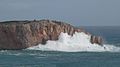
The windswept point with the castle.

Sagres Point (Ponta de Sagres, Portuguese pronunciation: [ˈsaɣɾɨʃ], from the Latin Promontorium Sacrum ‘Holy Promontory’) is a windswept shelf-like promontory located in the southwest Algarve region of southern Portugal. Only 4 km to the west and 3 km to the north lies Cape St. Vincent (Cabo de São Vicente), which is usually taken as the southwesternmost tip of Europe. The vicinity of Sagres Point and Cape St. Vincent has been used for religious purposes since Neolithic times, to which standing menhirs near Vila do Bispo, a few miles from both points, attest.

History

[edit]

The promontory of Sagres has always been important for sailors because it offers a shelter for ships before attempting the dangerous voyage around Cape St. Vincent (could be Belixe Bay, between Sagres Point and the Cape, or Sagres Bay, to the east). Given the dangers of being blown onto the coastal rocks, captains preferred to wait in the lee of the point until favourable winds allowed them to continue.

Strabo

[edit]
Martinhal Islets, at the Sagres Harbor entrance.
Tonel Beach in Sagres

There is some question whether Sagres Point, whose name derives from Sacrum Promontorium, or neighboring Cape St. Vincent, was the ancient sacred promontory. Strabo[1] believed the promontory was the most westerly point of the "whole inhabited world." In fact Cape St. Vincent is more westerly, but because it is further north, and Strabo's map of the Iberian Peninsula is rotated clockwise, bringing the Pyrenees into a north–south line, it could have been taken as further east. The most westerly point of the Iberian Peninsula and of the European continent is Cabo da Roca, near Sintra; the southernmost, Punta de Tarifa, in Andalusia. The rocks at the base of the Cape St. Vincent lighthouse are called "fim do mundo", or "end of the world".

Strabo reports (Book 3.1.4) as follows:

The region adjacent to this cape they call in the Latin tongue Cuneum, which signifies a wedge. The promontory which projects into the sea, Artemidorus (who states that he has himself been at the place) compares to a ship; three little islands, each having a small harbour, contribute to give it this form; the former island resembling the beak of the ship, and the two latter the beams on each side of the ship's bows ... there is no temple of Hercules shown there, as Ephorus falsely states, nor yet any altar nor to any other divinity; but in many parts there are three or four stones placed together, which are turned by all travellers who arrive there, in accordance with a certain local custom, and are changed in position by such as turn them incorrectly. It is not lawful to offer sacrifice there, nor yet to approach the place during the night, for it is said that then the gods take up their abode at the place. Those who go thither to view it stay at a neighbouring village overnight, and proceed to the place on the morrow, carrying water with them, as there is none to be procured there.

No part of Cape St. Vincent fits this description, but on the eastern side of Sagres Point is a harbor, Baleeira, port of the modern town of Sagres, protected by four small islands in a line (the tiny Martinhal Islets) visible in satellite imagery. At the far eastern end of the beach of Martinhal, erosion of the cliffs has exposed a series of Roman pottery kilns for fabricating transport amphoras and roof tiles.

Henry the Navigator

[edit]
Cannon inside the fortress

When Henry the Navigator commenced his explorations, which would initiate the Portuguese Age of Discoveries, at his Vila do Infante, Sagres peninsula lacked the necessary requirements for such large undertakings. Fresh water was scarce, agriculture was minimal, there was a shortage of wood for shipbuilding, no deep-water landing site, and the population was small. Henry re-populated a village called Terçanabal, which had been deserted due to continuous pirate attacks on the coast. The village was situated in a strategic position for his maritime enterprises and was later called Vila do Infante.

Henry the Navigator employed cartographers, such as Jehuda Cresques, to help him chart the coast of Mauretania in the wake of voyages he had caused to be made to there. He also engaged an expert map and instrument-maker, Jayme of Majorca, so that his captains might have the best nautical information. This probably led to the legend of the Nautical School of Sagres (although a "school" also means a group of followers). There was no centre of navigational science or any supposed observatory, if compared to the modern definition of "observatory" or "navigational centre". The centre of his expeditions was actually at Lagos, further to the east along the Algarve coast. Later Portuguese voyages left from Belém, just west of Lisbon.

Plaque honoring Henry the Navigator, erected by the United States Power Squadrons.
Sagres, Portugal

This was a time of many important discoveries: cartography was being refined with the use of newly devised instruments, such as an improved astrolabe and improved sundial, maps were regularly being updated and extended, and a revolutionary type of vessel known as the caravel was designed.

Prince Henry built a chapel next to his house in 1459, as he began to spend more time in the Sagres area in his later years. He died at Sagres on 13 November 1460.

The exact location of Henry's School of Navigation is not known (it is popularly believed to have been destroyed by the 1755 Lisbon earthquake).

Fortress history

[edit]
The compass rose.

The 16th century bulwark-like fortress was severely damaged during the Great Earthquake of 1755. It was restored in the mid 20th century, but there is still a 16th-century turret present. After passing through the thick tunnel entrance, one sees a giant pebble compass rose (rosa dos ventos) of 43 m diameter. Normally compass roses are divided into 32 segments, but strangely this one has 40 segments (probably an error of the 20th-century restorers). It is unlikely to date back to the time of Henry the Navigator.

The much-restored church Nossa Senhora da Graça dates from 1579. It replaced the original church of Henry the Navigator of 1459. It was also damaged by the earthquake of 1755. Some alterations to the church were made, such as the building of a new bell tower over the old charnel house of the cemetery. There are still a set of tombstones present. Inside this unpretentious church, the 17th century Baroque retable above the altar originates from the Capela de Santa Catarina do Forte de Belixe (St. Catherine's Chapel in Belixe Fortress), while the polychrome statues of St. Vincent and St. Francis were once part of the Franciscan convent on the Cape St. Vincent.

Next to the church stands a replica stone standard (padrão), used by the explorers to claim a newly discovered territory.

[edit]

Notes

[edit]

References

[edit]

See also

[edit]

37°00′23″N 8°56′21″W / 37.00639°N 8.93917°W / 37.00639; -8.93917

Revisions and contributorsEdit on WikipediaRead on Wikipedia
from Grokipedia
Sagres Point is a windswept, shelf-like extending into the Atlantic Ocean on the southwestern coast of Portugal's region, forming the southern boundary of the Sagres Bay and characterized by rugged coastal escarpments, capes, and sparse vegetation shaped by constant winds and sea exposure. Located approximately 37°00′N 8°56′W, it has been a significant maritime since antiquity, known in Roman times as Promontorium Sacrum and serving as the last sheltered port before venturing into the open Atlantic. Historically, Sagres Point gained prominence in the 15th century as the base for (Infante D. Henrique), who established the Vila do Infante settlement there around 1419—traditionally associated with Portuguese advancements in exploration during the Age of Discoveries—and oversaw developments in , , and techniques. The site features the remnants of the Sagres Fortress, a 15th-century defensive structure including saw-tooth walls, a tower, and a large stone windrose compass discovered in 1921, which underscore its role in enabling voyages like Gil Eanes's rounding of in 1434. Prince Henry died at the promontory on November 13, 1460, cementing its legacy in global maritime expansion. The point's strategic location also marked pivotal events, including Christopher Columbus's shipwreck off nearby in 1476, Sir Francis Drake's raid on the Vila do Infante in 1587, and the Battle of in 1797, where British forces under Horatio Nelson secured a victory. of earlier human activity includes menhirs and religious sites dating back to the 8th century B.C., highlighting its enduring cultural and spiritual importance as a perceived edge of the known world. Today, Sagres Point is part of the Southwest and Vicentine Coast Natural Park, valued for its , dramatic landscapes, and as a hub for and eco-tourism while preserving its historical fortifications.

Geography

Location and Topography

Sagres Point is situated at approximately 37°00′N 8°57′W in the municipality of Vila do Bispo, within the Faro District of southern Portugal's region. This windswept promontory extends into the Atlantic Ocean, forming a key feature near , which marks the southwesternmost point of mainland . The site lies within the expansive Southwest Alentejo and Vicentine Coast Natural Park, a spanning over 110 km of coastline dedicated to preserving its unique landscapes and . The topography of Sagres Point features dramatic, rugged cliffs that rise up to around 100 meters above , creating a stark, exposed battered by the open Atlantic. These cliffs are primarily composed of layered sedimentary rocks, including limestones and , with overlying Miocene bioclastic limestones that unconformably rest upon older strata such as redbeds and clays. The underlying geology includes folded greywackes and shales from the , visible in nearby outcrops, contributing to the area's monoclinal structure dipping southward. This rock succession reflects a of tectonic extension, marine transgressions, and subsequent uplift during the in the Tertiary period. The immediate vicinity integrates seamlessly with the Vicentine Coast Natural Park, encompassing diverse coastal habitats from steep sea cliffs to small beaches and dunes. Sagres Point is located about 3 km south of the town of Sagres and roughly 32 km west of the city of , providing accessible yet isolated access to this remote southwestern extremity. Ongoing geological processes, including relentless by prevailing winds and powerful Atlantic waves, continue to shape the headland's contours, carving notches, platforms, and arches while accentuating its wild, untamed character.

Climate and Natural Environment

Sagres Point experiences a with oceanic influences, classified under the Köppen system as Csb, characterized by mild, wet winters and cool, dry summers. Average winter temperatures range from 12°C to 15°C, while summers see highs of 18°C to 25°C, with annual precipitation around 420 mm, mostly concentrated between and . The region is renowned for its persistent high winds, averaging 20-25 km/h year-round with gusts frequently exceeding 50 km/h, particularly from the northwest, which shapes the local landscape and marine conditions. The natural environment supports notable , particularly in its coastal and cliff habitats. Terrestrial includes endemic species adapted to saline, windswept conditions, such as Bellevalia hackelii, Biscutella vicentina, and Linaria algarviana, thriving in rocky outcrops and stabilized sand dunes. Fauna features rare insects like Machilis sacra and diverse seabirds, including peregrine falcons (Falco peregrinus), red-billed choughs (Pyrrhocorax pyrrhocorax), and migratory species such as (Calonectris diomedea). The marine ecosystem hosts migratory cetaceans, including dolphins and occasional whales, alongside seabirds and fish like sunfish (Mola mola), though forests are less prominent here compared to northern Portuguese waters. Sagres Point falls within the Southwest Alentejo and Vicentine Coast Natural Park, established in 1995 and encompassing 89,569 hectares of land and marine areas to preserve coastal ecosystems. Additionally, the 134-hectare Biogenetic Reserve of Ponta de Sagres, designated by the in 1988, specifically safeguards endemic , , and habitats in the promontory's cliffs and caves. Regulations enforce restrictions on activities contributing to and , including prohibitions on off-path travel, littering, and fires, to mitigate habitat degradation. Natural hazards in the area include frequent winter storms and coastal , which exacerbate and loss along the cliffs and beaches. These events, driven by Atlantic swells, can remove up to several meters of beach material per storm, impacting dune stability and associated flora like dune-binding grasses, while reduces visibility and affects migratory patterns. Ecologically, such hazards threaten nesting sites for seabirds and the overall integrity of the limestone formations that harbor unique microhabitats.

History

Ancient References and Early Settlement

Evidence of prehistoric human activity in the region includes numerous menhirs, isolated or in alignments, dating to around 3500 BCE and suggesting early ritual or religious significance of the landscape. The Greek geographer , in his composed around the 1st century BCE, described the Promontorium Sacrum—or Sacred Promontory—as the westernmost point of the inhabited world, situated at the edge of Iberia and marking the boundary before the vast . This promontory, identified with adjacent to Sagres Point, served as a critical navigational for ancient Mediterranean sailors from as early as the 8th century BCE, who ascended its heights to consult deities and make vows before venturing into unknown waters. The site's sacred designation likely stemmed from its remote, awe-inspiring position, evoking a sense of divine frontier in classical texts. During the Roman era, from the 1st to 4th centuries CE, evidence of minor human activity emerges around Sagres Point, including fragments of Roman ceramics discovered in the area and a small settlement in nearby Raposeira supporting a modest focused on . These finds suggest sporadic use as trading outposts or waystations linked to the larger Roman port of Lacóbriga (modern ), approximately 30 kilometers east, where extensive , coins, and attest to regional and settlement. The promontory's strategic coastal location facilitated limited maritime interactions, though no major urban centers developed there. From the 8th to 13th centuries, during the Islamic period, Sagres Point fell under Moorish control as part of al-Garb al-Andalus, with the region serving defensive roles against pirate incursions along the Algarve coast. Historical records indicate the persistence of the Vincentine cult at the site, drawing Christian, Muslim, and Mozarabic pilgrims until its destruction by Almoravids in the mid-12th century, after which relics were relocated to Lisbon. Sparse documentation points to basic fortifications, such as watchtowers, for coastal vigilance, reflecting the area's vulnerability in broader Moorish defensive networks. The reconquest of the by King Afonso III in 1249 marked the transition to Christian dominion, with Portuguese forces capturing key southwestern strongholds like Aljezur, near Sagres Point, as part of a swift campaign that overwhelmed remaining Muslim positions. This event finalized Portugal's territorial expansion southward, integrating the promontory into the kingdom. Throughout the medieval period, Sagres retained its aura as the "end of the world" in European cartography and lore, symbolizing the perilous western brink and fueling later motivations for oceanic exploration.

Prince Henry the Navigator and the Age of Discoveries

Tradition holds that around 1418–1420, Prince Henry the Navigator, the third son of King John I of Portugal, established a navigational institute, often referred to as a "school," at Sagres Point on the southwestern tip of Portugal, but modern historians regard the existence of a formal school there as a 19th-century myth, with his primary base likely in nearby Lagos. Nonetheless, Sagres served as a strategic outpost where Henry gathered experts including astronomers, cartographers, mathematicians, and shipbuilders from across Europe and the Islamic world, fostering advancements in maritime science and technology essential for long-distance voyages. Henry's choice of the isolated promontory allowed secure operations and observation of Atlantic winds and currents. At sites associated with Henry's patronage, key innovations emerged that revolutionized . Shipbuilders refined the , a small, maneuverable vessel with sails that enabled sailing against the wind, making it ideal for coastal probing along . Improvements to the allowed more accurate measurement of at sea by adapting the Arabic quadrant for nautical use, while portolan charts—detailed coastal maps with rhumb lines—were enhanced to guide pilots through . From elevated vantages near Sagres, teams conducted experiments on wind patterns, ocean currents, and tidal influences, compiling knowledge that informed safer routes southward. Sagres served as the primary base for launching exploratory expeditions along the West African coast, systematically pushing beyond known limits. In 1434, under Henry's direct sponsorship, navigator successfully rounded , dispelling the longstanding myth of the "Green Sea of Darkness"—a perilous region believed to boil and turn sailors to dust—and opening the door to further advances down the African shoreline. This breakthrough voyage, departing from Sagres, marked a pivotal psychological and practical victory, encouraging subsequent probes that reached the by 1445. Prince Henry resided intermittently at Sagres throughout his later years, overseeing operations from his villa until his death there on November 13, 1460. His efforts at the site laid the foundational momentum for the Age of Discoveries, catalyzing Portugal's global maritime empire and inspiring later triumphs such as the sea route to in 1498 and the discovery of in 1500.

Post-Discovery Developments

Following the era of , Sagres Point retained strategic importance in the 16th century as a sheltered harbor and provisioning stop for fleets en route to and beyond, facilitating the resupply of ships before their Atlantic crossings. This role built on the foundational navigational advancements from Henry's patronage at Sagres, which continued to influence maritime operations during the height of Portugal's overseas expansion. Historical records indicate that vessels often underwent necessary repairs here after enduring the rigors of open-ocean voyages, underscoring Sagres' position as a critical in the empire's supply chains. In 1476, survived a shipwreck off nearby , an event that prompted him to settle in and further his navigational pursuits. The site's vulnerability to maritime threats became evident through frequent pirate raids in the 16th and 17th centuries, primarily by French privateers and Barbary corsairs from , who targeted coastal settlements like Sagres for plunder and captives. These attacks prompted the erection of temporary fortifications to protect against incursions, as the region, including Sagres, faced ongoing depredations that disrupted local trade and fishing. A notable escalation occurred in 1587 during the Anglo-Spanish War, when English privateer launched a raid on Sagres, occupying the fortress and inflicting significant damage on its early structures before withdrawing. By the , Sagres' prominence waned as major exploration and trade hubs shifted to and other northern ports, reducing the site's role in global navigation to primarily military oversight. The exacerbated this decline through indirect effects on regional infrastructure, as seismic shocks and subsequent tsunamis devastated coastal areas, including damage to buildings and harbors near Sagres that hindered recovery efforts. In 1797, the Battle of took place nearby, where British forces under Admiral John Jervis defeated a Spanish fleet, with Horatio Nelson distinguishing himself in the engagement. In the 19th century, the (1808–1814) saw broader British naval support along Portugal's coasts to counter French invasions, though Sagres itself was not a primary base. As maritime exploration diminished, Sagres' local economy transitioned toward fishing and small-scale agriculture, reflecting broader shifts in the where abundant sustained communities amid declining imperial activities.

Sagres Fortress

Construction and Historical Role

The Sagres Fortress was initiated in the under the direction of as a defensive structure to secure Portugal's southwestern Atlantic frontier amid expanding maritime explorations. Construction advanced through the , incorporating defensive walls and barracks to strengthen its military capacity. The structure endured until 1587, when it suffered severe damage during a raid by English . It was subsequently reinforced in the 16th and 18th centuries, with further repairs following the and tsunami, after which it lost much of its military significance. The fortress's primary purpose was to defend against maritime threats from the Atlantic, capitalizing on the promontory's steep cliffs for elevated and natural barriers against invaders. It operated as a critical signal station, employing bonfires and shots to warn of approaching fleets and coordinate responses across the . Throughout its operational , the site housed military personnel and adapted to evolving roles, including vigilance over regional naval activities during the . By the early 19th century, the fortress had shifted from active military use to other applications.

Architecture and Defensive Features

The Sagres Fortress exhibits an irregular layout adapted to the rugged promontory, with early 15th-century walls from the era of Prince Henry the Navigator forming the core enclosure, later reinforced by 16th-century ramparts and an 18th-century bastioned structure designed by José de Sande Lemos that includes two bulwarks connected by a curtain wall. Constructed primarily from local stone to blend with the natural terrain, the fortress spans a strategic area that integrates the sheer cliffs as an extension of its perimeter, enclosing key internal features such as the 15th-century Church of Nossa Senhora da Graça—founded in 1459 by Prince Henry and remodeled in 1570—and cisterns including a prominent tower-tank for water storage within the Vila do Infante complex. A notable feature is the large windrose compass, a pebble circle approximately 43 meters in circumference discovered in 1921, associated with navigational history. Defensive elements emphasize artillery and natural barriers, with corner bastions such as those of and Saint Anthony positioned for batteries, while the seaward side relies on the moat-like cliffs rising dramatically from the Atlantic to deter naval assaults. The main entrance incorporates a neoclassical gate from the late , preceded by a and leading to a guardhouse via an access corridor, enhancing controlled entry and vigilance. Engineering adaptations reflect the site's exposure to extreme coastal conditions, with the overall design leveraging the promontory's for stability against and storms, though specific features like sloped roofs and anchored foundations are evident in surviving 16th- and 18th-century remnants. Archaeological evidence from sondages reveals 15th-century integrations, such as the ground-level , underscoring the site's evolution from a maritime hub. Today, the visible remnants consist of partially ruined walls and structures exposed through restorations by Portugal's Directorate-General for Buildings and National Monuments, which cleared and preserved elements like the curtain walls, bastions, and internal ruins, illustrating the fortress's from a 15th-century navigation and scholarly center under Prince Henry to a robust stronghold. These features highlight its role in broader historical defenses against pirate incursions during the .

Modern Significance

Preservation Efforts and Restoration

The Fortress of Sagres was classified as a by Decree on June 16, 1910, marking an early 20th-century recognition of its cultural and historical value as a key site linked to Portugal's maritime explorations. This designation prompted initial protective measures, though the site suffered from natural degradation over the decades due to its exposed coastal location. Post-World War II efforts focused on structural rehabilitation, with major renovations occurring in the to address wear from environmental exposure and time, including the restoration of the ammunition storage building. Further works in the 1990s and 2010 strengthened the fortress's walls and overall integrity, preserving its 15th- to 18th-century architectural features amid ongoing erosion challenges. These interventions were driven by the site's enduring association with , ensuring its role as a tangible link to the Age of Discoveries remained intact. In the , preservation has integrated European-level support, culminating in the Sagres Promontory's award of the European Heritage Label in 2015, which highlights its significance in the shared history of European maritime expansion and fosters collaborative conservation strategies. A key project under this framework is the €2.8 million Discoveries Exhibition Centre, opened in 2022 and financed partly through funds, which enhances visitor interpretation while incorporating sustainable site management to mitigate deterioration. These initiatives address projected regional sea-level rises of around 0.5 meters by 2100, prioritizing the site's resilience without compromising its historical authenticity. In April 2025, a public tender was launched for €1.5 million in conservation and restoration works on the fortress walls, tunnel, tower, and bastions to combat ongoing .

Tourism and Cultural Impact

Sagres Point attracted 427,817 visitors in 2023, drawn primarily to its marked coastal trails, the Sagres Fortress with its interpretation center featuring exhibits on maritime navigation, and the scenic viewpoint at the nearby Cabo de São Vicente lighthouse. The site's appeal peaks during the high season from May to , when favorable weather enhances opportunities for and ocean viewing along the dramatic cliffs. In November 2024, the entry ticket price for the Sagres Fortress increased from €3 to €10. The promontory holds significant cultural resonance, referenced in ' epic poem (1572) as a symbolic launch point for Portugal's Age of Discoveries, evoking themes of exploration and destiny. It has also appeared in various documentaries and films highlighting Portugal's maritime heritage, such as those produced by the on the site's role in global history. Since 2012, the annual Sagres Surf Culture Festival has promoted the area's oceanic legacy through events blending competitions, workshops on maritime traditions, and environmental awareness activities. Tourism at Sagres Point bolsters the local , with the sector supporting a substantial portion of employment and revenue in the region, where over 60% of residents derive income from visitor-related activities like guided tours and accommodations. Educational initiatives, including programs on exploration history offered through the fortress's exhibits, further engage visitors in the site's historical context. Accessibility has improved with paved roads connecting Sagres town to the promontory and the addition of wheelchair-friendly paths in 2018, enabling easier navigation to key areas like the fortress entrance and central plaza via principles. Seasonal events, such as reenactments of 15th-century voyages during festivals, add interactive elements to the visitor experience. Environmental protections, including those under the European Heritage Label, support by preserving the natural landscape for future generations.

References

Add your contribution
Related Hubs
User Avatar
No comments yet.